
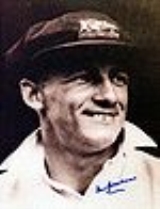
Sir Donald George Bradman,
ACThe Order of Australia is an order of chivalry established on 14 February 1975 by Elizabeth II, Queen of Australia, "for the purpose of according recognition to Australian citizens and other persons for achievement or for meritorious service"...
(27 August 1908 – 25 February 2001), often referred to as "The Don", was an Australian
cricketCricket is a bat-and-ball game played between two teams of 11 players on an oval-shaped field, at the centre of which is a rectangular 22-yard long pitch. One team bats, trying to score as many runs as possible while the other team bowls and fields, trying to dismiss the batsmen and thus limit the...
er, widely acknowledged as the greatest batsman of all time. Bradman's career
TestTest cricket is the longest form of the sport of cricket. Test matches are played between national representative teams with "Test status", as determined by the International Cricket Council , with four innings played between two teams of 11 players over a period of up to a maximum five days...
batting averageBatting average is a statistic in both cricket and baseball that measures the performance of cricket batsmen and baseball hitters. The two statistics are related in that baseball averages are directly descended from the concept of cricket averages.- Cricket :...
of 99.94 has been claimed to be statistically the greatest achievement in any major sport.
The story that the young Bradman practised alone with a cricket stump and a golf ball is part of
Australian folklore-Australian Aboriginal mythology:*Bunyip - According to legend, they are said to lurk in swamps, billabongs, creeks, riverbeds, and waterholes.*Rainbow serpent - It is the sometimes unpredictable Rainbow Serpent, who vies with the ever-reliable Sun, that replenishes the stores of water, forming...
. Bradman's meteoric rise from
bush"The bush" is a term used for rural, undeveloped land or country areas in certain countries.-Australia:The term is iconic in Australia. In reference to the landscape, "bush" describes a wooded area, intermediate between a shrubland and a forest, generally of dry and nitrogen-poor soil, mostly...
cricket to the Australian Test team took just over two years. Before his 22nd birthday, he had set many records for high scoring, some of which still stand, and became Australia's sporting idol at the height of the
Great DepressionAustralia suffered badly during the period of the Great Depression of the 1930s. The Depression began with the Wall Street Crash of October, 1929 and rapidly spread worldwide. As in other nations, Australia suffered years of high unemployment, poverty, low profits, deflation, plunging incomes, and...
.
During a 20-year playing career, Bradman consistently scored at a level that made him, in the words of former Australia
captainThe captain of a cricket team often referred to as the skipper is the appointed leader, having several additional roles and responsibilities over and above those of a regular player...
Bill WoodfullWilliam Maldon "Bill" Woodfull OBE was an Australian cricketer of the 1920s and 1930s. He captained both Victoria and Australia, and was best known for his dignified and moral conduct during the tumultuous bodyline series in 1932–33 that almost saw the end of Anglo-Australian cricketing ties...
, "worth three batsmen to Australia". A controversial set of tactics, known as
BodylineBodyline, also known as fast leg theory bowling, was a cricketing tactic devised by the English cricket team for their 1932–33 Ashes tour of Australia, specifically to combat the extraordinary batting skill of Australia's Don Bradman...
, was specifically devised by the England team to curb his scoring. As a captain and administrator Bradman was committed to attacking, entertaining cricket; he drew spectators in record numbers. He hated the constant adulation, however, and it affected how he dealt with others. The focus of attention on his individual performances strained relationships with some team-mates, administrators and journalists, who thought him aloof and wary. Following an enforced hiatus, due to the Second World War, he made a dramatic comeback, captaining an Australian team known as "The Invincibles" on a record-breaking unbeaten tour of England.
A complex, highly driven man, not given to close personal relationships, Bradman retained a pre-eminent position in the game by acting as an administrator, selector and writer for three decades following his retirement. Even after he became reclusive in his declining years his opinion was highly sought, and his status as a national icon was still recognised—more than 50 years after his retirement as a Test player, in 2001, the Australian Prime Minister
John HowardJohn Winston Howard AC, SSI, was the 25th Prime Minister of Australia, from 11 March 1996 to 3 December 2007. He was the second-longest serving Australian Prime Minister after Sir Robert Menzies....
called him the "greatest living Australian". Bradman's image has appeared on postage stamps and coins, and he was the first living Australian to have a museum dedicated to his life. On the centenary of his birth, 27 August 2008, the
Royal Australian MintThe Royal Australian Mint is situated in the Australian federal capital city of Canberra, in the suburb of Deakin.Before the opening of the mint, Australian coins were struck at branches of the Royal Mint - the Sydney Mint, Melbourne Mint and Perth Mint. The Royal Australian Mint holds a place in...
issued a $5 commemorative gold coin with his image.
On 19 November 2009, Sir Donald Bradman was inducted into the
ICC Cricket Hall of FameThe ICC Cricket Hall of Fame "recognises the achievements of the legends of the game from cricket's long and illustrious history". A hall of fame, it was launched by the International Cricket Council on 2 January 2009, in association with the Federation of International Cricketers'...
.
Early years
Donald Bradman was the youngest son of George and Emily (née Whatman) Bradman, and was born on 27 August 1908 at
CootamundraCootamundra is a town and Local Government Area in the South West Slopes region of New South Wales, Australia and within the Riverina. At the 2006 census, Cootamundra had a population of 5,566. It is located on the Olympic Highway at the point where it crosses the Muttama Creek, between Junee and...
, New South Wales (NSW). He had a brother, Victor, and three sisters—Islet, Lilian and Elizabeth May. When Bradman was about two-and-a-half years old, his parents moved to
Bowral-Attractions:Bowral is perhaps the best known of the towns and villages of the Southern Highlands, and in recent years has become the commercial centre of the Wingecarribee Shire. Bowral is known for its boutiques, antique stores, gourmet restaurants, and rich coffee culture.Bowral is home to the...
in the
NSW Southern HighlandsThe Southern Highlands, also locally referred to as the Highlands, is a geographical region and district in New South Wales, Australia and is 110 km south-west of Sydney. The entire region is under the local government area of the Wingecarribee Shire...
.
Bradman practised batting incessantly during his youth. He invented his own solo cricket game, using a
cricket stumpStump is a term used in the sport of cricket where it has three different meanings:# part of the wicket# a manner of dismissing a batsman# the end of the day's play .-Part of the wicket:...
for a
batA cricket bat is a specialised piece of equipment used by batsmen in the sport of cricket to hit the ball. It is usually made of willow wood. Its use is first mentioned in 1624....
, and a
golf ballA golf ball is a ball designed to be used in the game of golf.Under the Rules of Golf, a golf ball weighs no more than 1.620 oz , has a diameter not less than 1.680 in , and performs within specified velocity, distance, and symmetry limits...
. A water tank, mounted on a curved brick stand, stood on a paved area behind the family home. When hit into the curved brick facing of the stand, the ball rebounded at high speed and varying angles—and Bradman would attempt to hit it again. This form of practice developed his timing and reactions to a high degree. In more formal cricket, he hit his first
centuryIn the sport of cricket, a batsman reaches his century when he scores 100 or more runs in a single innings. The term is also included in "century partnership" which occurs when two batsmen add 100 runs to the team total when they are batting together. A century is regarded as a landmark score for...
at the age of 12, playing for Bowral Public School against
MittagongMittagong is a town located in the Southern Highlands of New South Wales, Australia, in Wingecarribee Shire. At the 2006 census, Mittagong had a population of 7,460 people. The town can be seen as the gateway to the Southern Highlands when coming from Sydney. The town is close to Bowral, Berrima,...
High School.
Bush cricketer
In 1920–21, Bradman acted as
scorerScoring in cricket matches involves citing two facts, the number of runs scored by each team and the number of wickets each has lost. These are the basic figures likely to be quoted in a media report on a match completed or still in progress....
for the local Bowral team, captained by his uncle George Whatman. In October 1920, he filled in when the team was one man short, scoring 37
not outIn cricket, a batsman will be not out if he comes out to bat in an innings and has not been dismissed by the end of the innings. One may similarly describe a batsman as not out while the innings is still in progress...
and 29 not out on debut. During the season, Bradman's father took him to the
Sydney Cricket GroundThe Sydney Cricket Ground is a sports stadium in Sydney in Australia. It is used for Australian football, Test cricket, One Day International cricket, some rugby league and rugby union matches and is the home ground for the New South Wales Blues cricket team and the Sydney Swans of the Australian...
(SCG) to watch the fifth
AshesThe Ashes is a Test cricket series played between England and Australia. It is one of the most celebrated rivalries in international cricket and dates back to 1882. It is currently played biennially, alternately in the United Kingdom and Australia. Cricket being a summer sport, and the venues...
Test matchTest cricket is the longest form of the sport of cricket. Test matches are played between national representative teams with "Test status", as determined by the International Cricket Council , with four innings played between two teams of 11 players over a period of up to a maximum five days...
. On that day, Bradman formed an ambition. "I shall never be satisfied", he told his father, "until I play on this ground". Bradman left school in 1922 and went to work for a local real estate agent who encouraged his sporting pursuits by giving him time off when necessary. He gave up cricket in favour of tennis for two years, but resumed playing cricket in 1925–26.
Bradman became a regular selection for the Bowral team; several outstanding performances earned him the attention of the Sydney daily press. Competing on
matting-over-concrete pitchesIn the game of cricket, the cricket pitch consists of the central strip of the cricket field between the wickets - 1 chain or 22 yards long and 10 feet wide. The surface is very flat and normally covered with extremely short grass though this grass is soon removed by wear at the ends of the...
, Bowral played other rural towns in the
Berrima DistrictBerrima is an historic village in the Southern Highlands of New South Wales, Australia, in Wingecarribee Shire. The village, once a major town, is located on the Old Hume Highway between Canberra and Sydney. It was previously known officially as the Town of Berrima...
competition. Against
WingelloWingello is a village in the Southern Highlands of New South Wales, Australia. It is about equidistant between Sydney, the capital of NSW, and Canberra, the nation’s capital. It has a station on CityRail's Southern Highlands line...
, a team that included the future
TestTest cricket is the longest form of the sport of cricket. Test matches are played between national representative teams with "Test status", as determined by the International Cricket Council , with four innings played between two teams of 11 players over a period of up to a maximum five days...
bowler
Bill O'ReillyWilliam Joseph "Bill" O'Reilly , often known as Tiger O'Reilly, was an Australian cricketer, rated as one of the greatest bowlers in the history of the game. Following his retirement from playing, he became a well-respected cricket writer and broadcaster.O'Reilly was one of the best spin bowlers to...
, Bradman made 234. In the competition final against
Moss ValeMoss Vale is a town in the Southern Highlands of New South Wales, Australia, in Wingecarribee Shire. It has a population of 7,339 and is sited on the Illawarra Highway, which connects to Wollongong and the Illawarra coast via Macquarie Pass...
, which extended over five consecutive Saturdays, Bradman scored 320 not out. During the following Australian winter (1926), an ageing
Australian teamEngland won the 1926 Ashes series against Australia. England won the last Test of the series after the first four matches were drawn:*1st Test — drawn - *2nd Test — drawn - *3rd Test — drawn -...
lost The Ashes in England, and a number of Test players retired. The
New South Wales Cricket AssociationThe New South Wales Cricket Association is a sporting club who administer cricket in New South Wales, based at the Sydney Cricket Ground. Their trading name is Cricket NSW....
began a hunt for new talent. Mindful of Bradman's big scores for Bowral, the association wrote to him, requesting his attendance at a practice session in Sydney. He was subsequently chosen for the "Country Week" tournaments at both cricket and tennis, to be played during separate weeks. His boss presented him with an ultimatum: he could have only one week away from work, and therefore had to choose between the two sports. He chose cricket.
Bradman's performances during Country Week resulted in an invitation to play
grade cricketSydney Grade Cricket is a cricket competition played in Sydney, Australia. The competition began in 1893 when a number of clubs, which had been playing for many years on an ad hoc basis, voted to create a formal competition structure....
in Sydney for
St GeorgeSt George Cricket Club is a cricket club based in the St. George area that competes in Sydney Grade Cricket. Many famous Australian Test cricketers have represented the club.- Test players :...
in the 1926–27 season. He scored 110 on his debut, making his first century on a
turf wicketIn the game of cricket, the cricket pitch consists of the central strip of the cricket field between the wickets - 1 chain or 22 yards long and 10 feet wide. The surface is very flat and normally covered with extremely short grass though this grass is soon removed by wear at the ends of the...
. On 1 January 1927, he turned out for the NSW second team. For the remainder of the season, Bradman travelled the 130 kilometres (80.8 mi) from Bowral to Sydney every Saturday to play for St George.
First-class debut
The next season continued the rapid rise of the "Boy from Bowral". Selected to replace the unfit
Archie JacksonArchibald "Archie" Jackson , occasionally known as Archibald Alexander Jackson, was an Australian cricketer who played eight Test matches as a specialist batsman between 1929 and 1931. A teenage prodigy, he played first grade cricket at only 15 years of age and was selected for New South Wales at 17...
in the
NSW teamThe New South Wales cricket team are an Australian first class cricket team based in Sydney, New South Wales...
, Bradman made his
first-classFirst-class cricket is a class of cricket that consists of matches of three or more days' scheduled duration, that are between two sides of eleven players and are officially adjudged first-class by virtue of the standard of the competing teams...
debut at the
Adelaide OvalThe Adelaide Oval is a sports ground in Adelaide, South Australia, located in the parklands between the Central Business District and North Adelaide...
, aged 19. He secured the achievement of a hundred on debut, with an innings of 118 featuring what soon became his trademarks—fast footwork, calm confidence and rapid scoring. In the final match of the season, he made his first century at the SCG, against the Sheffield Shield champions
VictoriaThe Victorian cricket team, nicknamed the Bushrangers, is an Australian cricket team based in Melbourne, that represents the state of Victoria. It is administered by Cricket Victoria and draws its players from Melbourne's Premier Cricket competition...
. Despite his potential, Bradman was not chosen for the Australian second team to tour
New ZealandNew Zealand is an island country in the south-western Pacific Ocean comprising two main landmasses and numerous smaller islands. The country is situated some east of Australia across the Tasman Sea, and roughly south of the Pacific island nations of New Caledonia, Fiji, and Tonga...
.
Bradman decided that his chances for Test selection would be improved by moving to Sydney for the 1928–29 season, when England were to tour in defence of the Ashes. Initially, he continued working in real estate, but later took a promotions job with the sporting goods retailer Mick Simmons Ltd. In the first match of the Sheffield Shield season, he scored a century in each innings against
QueenslandThe Queensland cricket team, nicknamed the Bulls, are the Brisbane-based Queensland representative cricket team in Australia's domestic cricket tournaments:*Sheffield Shield, 4-day matches with first-class status, since the 1926/27 season...
. He followed this with scores of 87 and 132 not out against the England touring team, and was rewarded with selection for the first Test, to be played at
BrisbaneThe Brisbane Cricket Ground, commonly known as The Gabba, is a major sports stadium in Brisbane, the capital of Queensland. It is named after the suburb of Woolloongabba, in which it is located....
.
Test career
Playing in only his tenth first-class match, Bradman, nicknamed "Braddles" by his teammates, found his initial Test a harsh learning experience. Caught on a
sticky wicketSticky wicket is a metaphor used to describe a difficult circumstance; it originates from difficult circumstances in the sport of cricket.-Origins:...
, Australia were all out for 66 in the second innings and lost by 675 runs (still a Test record). Following scores of 18 and 1, the selectors dropped Bradman to twelfth man for the Second Test. An injury to
Bill PonsfordWilliam Harold "Bill" Ponsford MBE was an Australian cricketer. Usually playing as an opening batsman, he formed a successful and long-lived partnership opening the batting for Victoria and Australia with Bill Woodfull, his friend and state and national captain...
early in the match required Bradman to field as substitute while England amassed 636, following their 863 runs in the First Test. RS Whitington wrote, "... he had scored only nineteen himself and these experiences appear to have provided him with food for thought". Recalled for the Third Test at the
Melbourne Cricket GroundThe Melbourne Cricket Ground is an Australian sports stadium located in Yarra Park, Melbourne and is home to the Melbourne Cricket Club. It is the tenth largest stadium in the world, the largest in Australia, the largest stadium for playing cricket, and holds the world record for the highest light...
, Bradman scored 79 and 112 to become the youngest player to make a Test century, although the match was still lost. Another loss followed in the Fourth Test. Bradman reached 58 in the second innings and appeared set to guide the team to victory when he was
run outRun out is a method of dismissal in the sport of cricket. It is governed by Law 38 of the Laws of cricket.-The rules:A batsman is out Run out if at any time while the ball is in play no part of his bat or person is grounded behind the popping crease and his wicket is fairly put down by the opposing...
. It was to be the only run out of his Test career. The losing margin was just 12 runs.
The improving Australians did manage to win the Fifth and final Test. Bradman top-scored with 123 in the first innings, and was at the wicket in the second innings when his captain Jack Ryder hit the winning runs. Bradman completed the season with 1,690 first-class runs,
averagingBatting average is a statistic in both cricket and baseball that measures the performance of cricket batsmen and baseball hitters. The two statistics are related in that baseball averages are directly descended from the concept of cricket averages.- Cricket :...
93.88, and his first multiple century in a Sheffield Shield match, 340 not out against Victoria, set a new ground record for the SCG. Bradman averaged 113.28 in 1929–30. In a trial match to select the team that would tour England, he was last man out in the first innings for 124. As his team
followed onFollow-on is a term used in the sport of cricket to describe a situation where the team that bats second is forced to take its second batting innings immediately after its first, because the team was not able to get close enough to the score achieved by the first team batting in the first innings...
, the skipper
Bill WoodfullWilliam Maldon "Bill" Woodfull OBE was an Australian cricketer of the 1920s and 1930s. He captained both Victoria and Australia, and was best known for his dignified and moral conduct during the tumultuous bodyline series in 1932–33 that almost saw the end of Anglo-Australian cricketing ties...
asked Bradman to keep the
padsCricket is traced back to 1550. It was first played in Guildford, Surrey. Later in 1598, cricket was cited in an Italian English dictionary written by Florio. In the year 1676, British residents in Aleppo played cricket abroad for the first time....
on and open the second innings. By the end of play, he was 205 not out, on his way to 225. Against Queensland at the SCG, Bradman set a world record for first-class cricket by scoring 452 not out; he made his runs in only 415 minutes. Not long after the feat, he recalled:
On 434 ..., I had a curious intuition ... I seemed to sense that the ball would be a short-pitched one on the leg-stump, and I could almost feel myself getting ready to make my shot before the ball was delivered. Sure enough, it pitched exactly where I had anticipated, and, hooking it to the square-leg boundary, I established the only record upon which I had set my heart.
Although he was an obvious selection to tour England, Bradman's unorthodox style raised doubts that he could succeed on the slower English pitches.
Percy FenderPercy George Herbert Fender was an English all-round cricketer who played 13 Tests for England. He was a middle order batsman and bowled mainly leg spin.-Biography:...
wrote:
The encomiums were not confined to his batting gifts; nor did the criticism extend to his character. "Australia has unearthed a champion," raved former Australian Test great
Clem HillClement "Clem" Hill was an Australian cricketer who played 49 Test matches as a specialist batsman between 1896 and 1912. He captained the Australian team in ten Tests, winning five and losing five...
, "self-taught, with natural ability. But most important of all, with his heart in the right place." Selector Dick Jones weighed in with the observation that it was "good to watch him talking to an old player, listening attentively to everything that is said and then replying with a modest 'thank you'."
1930 tour of England
England were favourites to win the 1930 Ashes series, and if the Australians were to exceed expectations, their young batsmen, Bradman and Jackson, needed to prosper. With his elegant batting technique, Jackson appeared the brighter prospect of the pair. However, Bradman began the tour with 236 at
WorcesterNew Road, Worcester, England, has been the home cricket ground of Worcestershire County Cricket Club since 1896. Immediately to the northwest is a road called New Road, part of the A44, hence the name.- Overview :...
and went on to score 1,000 first-class runs by the end of May, the fifth player (and first Australian) to achieve this rare feat. In his first Test appearance in England, Bradman hit 131 in the second innings but England won the match. His batting reached a new level in the Second Test at
Lord'sLord's Cricket Ground is a cricket venue in St John's Wood, London. Named after its founder, Thomas Lord, it is owned by Marylebone Cricket Club and is the home of Middlesex County Cricket Club, the England and Wales Cricket Board , the European Cricket Council and, until August 2005, the...
where he scored 254 as Australia won and levelled the series. Later in life, Bradman rated this the best innings of his career as, "practically without exception every ball went where it was intended to go".
WisdenWisden Cricketers' Almanack is a cricket reference book published annually in the United Kingdom...
noted his fast footwork and how he hit the ball "all round the wicket with power and accuracy", as well as faultless concentration in keeping the ball on the ground.
In terms of runs scored, this performance was soon surpassed. In the Third Test, at
LeedsHeadingley Stadium is a sporting complex in the Leeds suburb of Headingley in West Yorkshire, England. It is the home of Yorkshire County Cricket Club, rugby league team Leeds Rhinos and rugby union team Leeds Carnegie ....
, Bradman scored a century before lunch on 11 July, the first day of the Test match to equal the performances of
Victor TrumperVictor Thomas Trumper was an Australian cricketer known as the most stylish and versatile batsman of the Golden Age of cricket, capable of playing match-winning innings on wet wickets his contemporaries found unplayable. Archie MacLaren said of him, "Compared to Victor I was a cab-horse to a Derby...
and Charlie Macartney. In the afternoon, Bradman added another century between lunch and tea, before finishing the day on 309 not out. He remains the only Test player to pass 300 in one day's play. His eventual score of 334 was a world-record, exceeding the previous mark of 325 by
Andy SandhamAndrew Sandham was an English cricketer, a right-handed batsman who played 14 Test matches between 1921 and 1930. He scored over 40,000 first-class runs, but bowled only very rarely; he took just 18 wickets in his career.Sandham made his Surrey debut in 1911, and was capped in 1913...
. Bradman dominated the Australian innings; the second-highest tally was 77 by
Alan KippaxAlan Falconer Kippax was a cricketer for New South Wales and Australia. Regarded as one of the great stylists of Australian cricket during the era between the two World Wars, Kippax overcame a late start to Test cricket to become a regular in the Australian team between the 1928–29 and...
. Businessman Arthur Whitelaw later presented Bradman with a cheque for £1,000 in appreciation of his achievement. The match ended in anti-climax as poor weather prevented a result, as it also did in the Fourth Test.
In the deciding Test at
The OvalThe Kia Oval, still commonly referred to by its original name of The Oval, is an international cricket ground in Kennington, in the London Borough of Lambeth. In the past it was also sometimes called the Kennington Oval...
, England made 405. During an innings stretching over three days due to intermittent rain, Bradman made yet another multiple century, this time 232, which helped give Australia a big lead of 290 runs. In a crucial partnership with Archie Jackson, Bradman battled through a difficult session when England
fast bowlerFast bowling, sometimes known as pace bowling, is one of the two main approaches to bowling in the sport of cricket. The other is spin bowling...
Harold LarwoodHarold Larwood was an English cricket player, an extremely accurate fast bowler best known for his key role as the implementer of fast leg theory in the infamous "bodyline" Ashes Test series of 1932–33....
bowled short on a pitch enlivened by the rain.
Wisden gave this period of play only a passing mention:
A number of English players and commentators noted Bradman's discomfort in playing the
short, rising deliveryIn the sport of cricket, a bouncer is a type of delivery, usually bowled by a fast bowler. It is pitched short so that it bounces on the pitch well short of the batsman and rears up to chest or head height as it reaches the batsman.Bouncers are used tactically to drive the batsman back on to his...
. The revelation came too late for this particular match, but was to have immense significance in the next Ashes series. Australia won the match by an innings and regained the Ashes. The victory made an impact in Australia. With the economy sliding toward
depressionAustralia suffered badly during the period of the Great Depression of the 1930s. The Depression began with the Wall Street Crash of October, 1929 and rapidly spread worldwide. As in other nations, Australia suffered years of high unemployment, poverty, low profits, deflation, plunging incomes, and...
and
unemploymentUnemployment , as defined by the International Labour Organization, occurs when people are without jobs and they have actively sought work within the past four weeks...
rapidly rising, the country found solace in sporting triumph. The story of a self-taught 22-year-old from the bush who set a series of records against the old rival made Bradman a national hero. The statistics Bradman achieved on the tour, and in the Test matches in particular, broke records for the day and some have stood the test of time. In all, Bradman scored 974 runs at an average of 139.14 during the Test series, with four centuries, including two double hundreds and a triple. As of 2008, no-one has matched or exceeded 974 runs or three double centuries in one Test series; the record of 974 runs exceeds the second-best performance by 69 runs and was achieved in two fewer innings. Bradman's first-class tally, 2,960 runs (at an average of 98.66 with 10 centuries), was another enduring record: the most by any overseas batsman on a tour of England.
On the tour, the dynamic nature of Bradman's batting contrasted sharply with his quiet, solitary off-field demeanour. He was described as aloof from his teammates and he did not offer to buy them a round of drinks, let alone share the money given to him by Whitelaw. Bradman spent a lot of his free time alone, writing, as he had sold the rights to a book. On his return to Australia, Bradman was surprised by the intensity of his reception; he became a "reluctant hero". Mick Simmons wanted to cash in on their employee's newly won fame. They asked Bradman to leave his teammates and attend official receptions they organised in Adelaide, Melbourne,
GoulburnGoulburn is a provincial city in the Southern Tablelands of New South Wales, Australia in Goulburn Mulwaree Council Local Government Area. It is located south-west of Sydney on the Hume Highway and above sea-level. On Census night 2006, Goulburn had a population of 20,127 people...
, his hometown Bowral and Sydney, where he received a brand new custom-built
ChevroletChevrolet , also known as Chevy , is a brand of vehicle produced by General Motors Company . Founded by Louis Chevrolet and ousted GM founder William C. Durant on November 3, 1911, General Motors acquired Chevrolet in 1918...
. At each stop, Bradman received a level of adulation that "embarrassed" him. This focus on individual accomplishment, in a team game, "... permanently damaged relationships with his contemporaries". Commenting on Australia's victory, the team's vice-captain
Vic RichardsonVictor York Richardson OBE was a leading Australian sportsman of the 1920s and 1930s, captaining the Australian cricket team and the South Australian Australian rules football team, representing Australia in baseball and South Australia in golf, winning the South Australian state tennis title and...
said, "... we could have played any team without Bradman, but we could not have played the blind school without
Clarrie GrimmettClarence Victor "Clarrie" Grimmett was a cricketer; although born in New Zealand, he played most of his cricket in Australia. He is thought by many to be one of the finest early spin bowlers, and usually credited as the developer of the flipper.Grimmett was born in Caversham a suburb of Dunedin,...
". A modest Bradman can be heard in a 1930 recording saying "I have always endeavoured to do my best for the side, and the few centuries that have come my way have been achieved in the hope of winning matches. My one idea when going into bat was to make runs for Australia."
Reluctant hero
In 1930–31, against the first West Indian side to visit Australia, Bradman's scoring was more sedate than in England—although he did make 223 in 297 minutes in the Third Test at Brisbane and 152 in 154 minutes in the following Test at Melbourne. However, he scored quickly in a very successful sequence of innings against the South Africans in the Australian summer of 1931–32. For NSW against the tourists, he made 30, 135 and 219. In the Test matches, he scored , , 2 and ; his 299 not out in the Fourth Test, at Adelaide, set a new record for the highest score in a Test in Australia. Australia won nine of the ten Tests played over the two series.
At this point, Bradman had played 15 Test matches since the beginning of 1930, scoring 2,227 runs at an average of 131. He had played 18 innings, scoring 10 centuries, six of which had extended beyond 200. His overall scoring rate was 42 runs per hour, with 856 (or 38.5% of his tally) scored in boundaries. Significantly, he had not hit a six, which typified Bradman's attitude: if he hit the ball along the ground, then it could not be caught. During this phase of his career, his youth and natural fitness allowed him to adopt a "machine-like" approach to batting. The South African fast bowler
Sandy BellAlexander John Bell , also known as Sandy Bell, was a South African cricketer who played in 16 Tests from 1929 to 1935. He was born in East London, Cape Province in 1906 and died there in 1985....
described bowling to him as, "heart-breaking ... with his sort of cynical grin, which rather reminds one of the Sphinx ... he never seems to perspire".
Between these two seasons, Bradman seriously contemplated playing professional cricket in England with the Lancashire League club
AccringtonAccrington Cricket Club are a cricket club in the Lancashire League, which play their home games at Thorneyholme Road in Accrington. For the 2011 season their captain is Jimmy Hayhurst and their professional is Ashar Zaidi....
, a move that according to the rules of the day, would have ended his Test career. A consortium of three Sydney businesses offered an alternative. They devised a two-year contract whereby Bradman wrote for Associated Newspapers, broadcast on Radio
2UE2UE is a commercial radio station in Sydney, Australia owned by Fairfax Media. It is Sydney's and Australia's oldest commercial radio station, first broadcasting on 26 January 1925 on 1025 kHz AM before moving to 950 kHz in 1935 when virtually all Australian radio stations were assigned new...
and promoted the menswear retailing chain FJ Palmer and Son. However, the contract increased Bradman's dependence on his public profile, making it more difficult to maintain the privacy that he ardently desired.
Bradman's chaotic wedding to Jessie Menzies in April 1932 epitomised these new and unwelcome intrusions into his private life. The church "was under siege all throughout the day ... uninvited guests stood on chairs and pews to get a better view"; police erected barriers that were broken down and many of those invited could not get a seat. Just weeks later, Bradman joined a private team organised by
Arthur MaileyArthur Alfred Mailey was an Australian cricketer who played in 21 Test matches between 1920 and 1926....
to tour the
United StatesThe United States of America is a federal constitutional republic comprising fifty states and a federal district...
and
CanadaCanada is a North American country consisting of ten provinces and three territories. Located in the northern part of the continent, it extends from the Atlantic Ocean in the east to the Pacific Ocean in the west, and northward into the Arctic Ocean...
. He travelled with his wife, and the couple treated the trip as a honeymoon. Playing 51 games in 75 days, Bradman scored 3,779 runs at 102.1, with 18 centuries. Although the standard of play was not high, the effects of the amount of cricket Bradman had played in the three years previous, together with the strains of his celebrity status, began to show on his return home.
Bodyline
Within the
Marylebone Cricket ClubMarylebone Cricket Club is a cricket club in London founded in 1787. Its influence and longevity now witness it as a private members' club dedicated to the development of cricket. It owns, and is based at, Lord's Cricket Ground in St John's Wood, London NW8. MCC was formerly the governing body of...
(MCC), which administered English cricket at the time, few voices were more influential than
"Plum" WarnerSir Pelham Francis Warner MBE , affectionately and better known as Plum Warner, or even "the Grand Old Man" of English cricket was a Test cricketer....
's, who, when considering England's response to Bradman, wrote that it "must evolve a new type of bowler and develop fresh ideas and strange tactics to curb his almost uncanny skill". To that end, Warner orchestrated the appointment of
Douglas JardineDouglas Robert Jardine was an English cricketer and captain of the England cricket team from 1931 to 1933–34.When describing cricket seasons, the convention used is that a single year represents an English cricket season, while two years represent a southern hemisphere cricket season because it...
as England captain in 1931, as a prelude to Jardine leading the 1932–33 tour to Australia, with Warner as team manager. Remembering that Bradman had struggled against
bouncersIn the sport of cricket, a bouncer is a type of delivery, usually bowled by a fast bowler. It is pitched short so that it bounces on the pitch well short of the batsman and rears up to chest or head height as it reaches the batsman.Bouncers are used tactically to drive the batsman back on to his...
during his 232 at
The OvalThe Kia Oval, still commonly referred to by its original name of The Oval, is an international cricket ground in Kennington, in the London Borough of Lambeth. In the past it was also sometimes called the Kennington Oval...
in 1930, Jardine decided to combine traditional
leg theoryLeg theory is a bowling tactic in the sport of cricket. The term leg theory is somewhat archaic and seldom used any more, but the basic tactic still plays a part in modern cricket....
with short-pitched bowling to combat Bradman. He settled on the
NottinghamshireNottinghamshire County Cricket Club is one of the 18 major county clubs which make up the English and Welsh domestic cricket structure, representing the historic county of Nottinghamshire, and the current county champions. Its limited overs team is called the Nottinghamshire Outlaws...
fast bowlersFast bowling, sometimes known as pace bowling, is one of the two main approaches to bowling in the sport of cricket. The other is spin bowling...
Harold LarwoodHarold Larwood was an English cricket player, an extremely accurate fast bowler best known for his key role as the implementer of fast leg theory in the infamous "bodyline" Ashes Test series of 1932–33....
and
Bill VoceBill Voce was an English cricketer. He played for the Nottinghamshire and England, and was an instrumental part of England's infamous Bodyline tour of Australia in 1932–1933.-Life and career:...
as the spearheads for his tactics. In support, the England selectors chose another three
pacemenFast bowling, sometimes known as pace bowling, is one of the two main approaches to bowling in the sport of cricket. The other is spin bowling...
for the squad. The unusually high number of fast bowlers caused a lot of comment in both countries and roused Bradman's own suspicions.
Bradman had other problems to deal with at this time; among these were bouts of illness from an undiagnosed malaise which had begun during the tour of
North AmericaNorth America is a continent wholly within the Northern Hemisphere and almost wholly within the Western Hemisphere. It is also considered a northern subcontinent of the Americas...
, and that the
Australian Board of ControlCricket Australia, formerly known as the Australian Cricket Board, is the governing body for professional and amateur cricket in Australia. It was originally formed in 1905 as the Australian Board of Control for International Cricket...
had initially refused permission for him to write a column for the
Sydney Sun. Bradman, who had signed a two-year contract with the newspaper, threatened to withdraw from cricket to honour his contract when the board denied him permission to write; eventually, the paper released Bradman from the contract, in a victory for the Board. In three first-class games against England before the Tests, Bradman averaged just 17.16 in 6 innings. Jardine decided to give the new tactics a trial in only one game, a fixture against an Australian XI at
MelbourneThe Melbourne Cricket Ground is an Australian sports stadium located in Yarra Park, Melbourne and is home to the Melbourne Cricket Club. It is the tenth largest stadium in the world, the largest in Australia, the largest stadium for playing cricket, and holds the world record for the highest light...
. In this match, Bradman faced the leg theory and later warned local administrators that trouble was brewing if it continued. He withdrew from the First Test at the
Sydney Cricket GroundThe Sydney Cricket Ground is a sports stadium in Sydney in Australia. It is used for Australian football, Test cricket, One Day International cricket, some rugby league and rugby union matches and is the home ground for the New South Wales Blues cricket team and the Sydney Swans of the Australian...
amid rumours that he had suffered a nervous breakdown. Despite his absence, England employed what were already becoming known as the
BodylineBodyline, also known as fast leg theory bowling, was a cricketing tactic devised by the English cricket team for their 1932–33 Ashes tour of Australia, specifically to combat the extraordinary batting skill of Australia's Don Bradman...
tactics against the Australian batsmen and won an ill-tempered match.
The public clamoured for the return of Bradman to defeat Bodyline: "he was the batsman who could conquer this cankerous bowling ... 'Bradmania', amounting almost to religious fervour, demanded his return". Recovered from his indisposition, Bradman returned to the side in
Alan KippaxAlan Falconer Kippax was a cricketer for New South Wales and Australia. Regarded as one of the great stylists of Australian cricket during the era between the two World Wars, Kippax overcame a late start to Test cricket to become a regular in the Australian team between the 1928–29 and...
's position. A world record crowd of 63,993 at the
MCGThe Melbourne Cricket Ground is an Australian sports stadium located in Yarra Park, Melbourne and is home to the Melbourne Cricket Club. It is the tenth largest stadium in the world, the largest in Australia, the largest stadium for playing cricket, and holds the world record for the highest light...
saw Bradman come to the
creaseIn the sport of cricket, the crease is a certain area demarcated by white lines painted or chalked on the field of play.The term crease also refers to any of the lines themselves, particularly the popping crease. Law 9 of the Laws of Cricket governs the size and position of the crease markings...
on the first day of the Second Test with the score at 2/67. A standing ovation ensued that delayed play for several minutes. Bradman anticipated receiving a bouncer as his first ball and, as the bowler delivered, he moved across his stumps to play the
hook shotIn the sport of cricket, batting is the act or skill of hitting the cricket ball with a cricket bat to score runs or prevent the loss of one's wicket. A player who is currently batting is denoted as a batsman, while the act of hitting the ball is called a shot or stroke...
. The ball failed to rise and Bradman dragged it onto his stumps; the first-ball
duckIn the sport of cricket, a duck refers to a batsman's dismissal for a score of zero.-Origin of the term:The term is a shortening of the term "duck's egg", the latter being used long before Test cricket began...
was his first in a Test. The crowd fell into stunned silence as he walked off. However, Australia took a first innings lead in the match, and another record crowd on 2 January 1933 watched Bradman hit a counter-attacking second innings century. His
unbeatenIn cricket, a batsman will be not out if he comes out to bat in an innings and has not been dismissed by the end of the innings. One may similarly describe a batsman as not out while the innings is still in progress...
103 (from 146 balls) in a team total of 191 helped set England a target of 251 to win.
Bill O'ReillyWilliam Joseph "Bill" O'Reilly , often known as Tiger O'Reilly, was an Australian cricketer, rated as one of the greatest bowlers in the history of the game. Following his retirement from playing, he became a well-respected cricket writer and broadcaster.O'Reilly was one of the best spin bowlers to...
and
Bert IronmongerHerbert Ironmonger was a Victorian and Australian cricketer....
bowled Australia to a series-levelling victory amid hopes that Bodyline was beaten.
The Third Test at the
Adelaide OvalThe Adelaide Oval is a sports ground in Adelaide, South Australia, located in the parklands between the Central Business District and North Adelaide...
proved pivotal. There were angry crowd scenes after the Australian captain
Bill WoodfullWilliam Maldon "Bill" Woodfull OBE was an Australian cricketer of the 1920s and 1930s. He captained both Victoria and Australia, and was best known for his dignified and moral conduct during the tumultuous bodyline series in 1932–33 that almost saw the end of Anglo-Australian cricketing ties...
and
wicket-keeperThe wicket-keeper in the sport of cricket is the player on the fielding side who stands behind the wicket or stumps being guarded by the batsman currently on strike...
Bert OldfieldWilliam Albert Stanley "Bert" Oldfield was an Australian cricket player. He played for New South Wales and the Australian cricket team as wicket-keeper....
were hit by bouncers. An apologetic Plum Warner entered the Australian dressing room and was rebuked by Woodfull. Woodfull's remarks (that "...there are two teams out there and only one of them is playing cricket") were
leakedThe Adelaide leak was the revelation of a dressing-room incident which occurred during the third Test match of the 1932–33 Ashes series between Australia and England, more commonly known as the Bodyline series. During the course of play on 14 January 1933, the Australian Test captain Bill Woodfull...
to the press, and Warner and others attributed this to Fingleton, however for many years (even after Fingleton's death) a bitter war of accusation passed between Fingleton and Bradman as to who was the real source of the leak. In a cable to the MCC, the Australian Board of Control repeated the allegation of poor sportsmanship directed at Warner by Woodfull. With the support of the MCC, England continued with Bodyline despite Australian protests. The tourists won the last three Tests convincingly and regained the Ashes. Bradman caused controversy with his own tactics. Always seeking to score, and with the
leg sideThe leg side, or on side, is defined to be a particular half of the field used to play the sport of cricket.From the point of view of a right-handed batsman facing the bowler, it is the left hand side of the cricket field...
packed with fielders, he often backed away and hit the ball into the vacant half of the outfield with unorthodox shots reminiscent of tennis or golf. This brought him 396 runs (
atBatting average is a statistic in both cricket and baseball that measures the performance of cricket batsmen and baseball hitters. The two statistics are related in that baseball averages are directly descended from the concept of cricket averages.- Cricket :...
56.57) for the series and plaudits for attempting to find a solution to Bodyline, although his series average was just 57% of his career mean.
Jack FingletonJohn "Jack" Henry Webb Fingleton OBE was an Australian cricketer who was trained as a journalist and became a political and cricket commentator after the end of his playing career...
was in no doubt that Bradman's game altered irrevocably as a consequence of Bodyline, writing:
The constant glare of celebrity and the tribulations of the season forced Bradman to reappraise his life outside the game and to seek a career away from his cricketing fame. Harry Hodgetts, a South Australian delegate to the Board of Control, offered Bradman work as a stockbroker if he would relocate to Adelaide and captain
South AustraliaThe South Australia cricket team, nicknamed the Southern Redbacks and known as the West End Redbacks due to their sponsorship agreement with local brewers West End, are an Australian first class cricket team based in Adelaide, South Australia, and represent the state of South Australia...
(SA). Unknown to the public, the SA Cricket Association (SACA) instigated Hodgetts' approach and subsidised Bradman's wage. Although his wife was hesitant about moving, Bradman eventually agreed to the deal in February 1934.
Declining health and a brush with death
In his farewell season for NSW, Bradman averaged 132.44, his best yet. He was appointed vice-captain for the
1934 tour of EnglandAustralia won the 1934 Ashes series against England, winning two of the matches and losing one, with the other two tests drawn. The Australian tourists were captained by Bill Woodfull, while the home side were led by Bob Wyatt, with Cyril Walters deputising for Wyatt in the first Test.In the second...
. However, "he was unwell for much of the [English] summer, and reports in newspapers hinted that he was suffering from heart trouble". Although he again started with a double century at
WorcesterThe City of Worcester, commonly known as Worcester, , is a city and county town of Worcestershire in the West Midlands of England. Worcester is situated some southwest of Birmingham and north of Gloucester, and has an approximate population of 94,000 people. The River Severn runs through the...
, his famed concentration soon deserted him.
Wisden wrote:
At one stage, Bradman went 13 first-class innings without a century, the longest such spell of his career, prompting suggestions that Bodyline had eroded his confidence and altered his technique. After three Tests, the series was one–one and Bradman had scored 133 runs in five innings. The Australians travelled to
Sheffield-Cricket at the Lane:Bramall Lane opened as a cricket ground in 1855, having been leased by Michael Ellison from the Duke of Norfolk at an annual rent of £70. The site was then away from the town's industrial area, and relatively free from smoke. It was built to host the matches of local cricket...
and played a warm up game before the Fourth Test. Bradman started slowly and then, "... the old Bradman [was] back with us, in the twinkling of an eye, almost". He went on to make 140, with the last 90 runs coming in just 45 minutes. On the opening day of the Fourth Test at
HeadingleyHeadingley Stadium is a sporting complex in the Leeds suburb of Headingley in West Yorkshire, England. It is the home of Yorkshire County Cricket Club, rugby league team Leeds Rhinos and rugby union team Leeds Carnegie ....
(Leeds), England were out for 200, but Australia slumped to 3/39, losing the third wicket from the last ball of the day. Listed to bat at number five, Bradman would start his innings the next day.
That evening, Bradman declined an invitation to dinner from
Neville CardusSir John Frederick Neville Cardus CBE was an English writer and critic, best known for his writing on music and cricket. For many years, he wrote for The Manchester Guardian. He was untrained in music, and his style of criticism was subjective, romantic and personal, in contrast with his critical...
, telling the journalist that he wanted an early night because the team needed him to make a double century the next day. Cardus pointed out that his previous innings on the ground was 334, and the law of averages was against another such score. Bradman told Cardus, "I don't believe in the law of averages". In the event, Bradman batted all of the second day and into the third, putting on a world record partnership of 388 with Bill Ponsford. When he was finally out for 304 (473 balls, 43 fours and 2 sixes), Australia had a lead of 350 runs, but rain prevented them from forcing a victory. The effort of the lengthy innings stretched Bradman's reserves of energy, and he did not play again until the Fifth Test at The Oval, the match that would decide the Ashes.
In the first innings at The Oval, Bradman and Ponsford recorded an even more massive partnership, this time 451 runs. It had taken them less than a month to break the record they had set at Headingley; this new world record was to last 57 years. Bradman's share of the stand was 244 from 271 balls, and the Australian total of 701 set up victory by 562 runs. For the fourth time in five series, the Ashes changed hands. England would not recover them again until after Bradman's retirement.
Seemingly restored to full health, Bradman blazed two centuries in the last two games of the tour. However, when he returned to London to prepare for the trip home, he experienced severe abdominal pain. It took a doctor more than 24 hours to diagnose acute
appendicitisAppendicitis is a condition characterized by inflammation of the appendix. It is classified as a medical emergency and many cases require removal of the inflamed appendix, either by laparotomy or laparoscopy. Untreated, mortality is high, mainly because of the risk of rupture leading to...
and a surgeon operated immediately. Bradman lost a lot of blood during the four-hour procedure and
peritonitisPeritonitis is an inflammation of the peritoneum, the serous membrane that lines part of the abdominal cavity and viscera. Peritonitis may be localised or generalised, and may result from infection or from a non-infectious process.-Abdominal pain and tenderness:The main manifestations of...
set in. Penicillin and
sulphonamidesSulfonamide or sulphonamide is the basis of several groups of drugs. The original antibacterial sulfonamides are synthetic antimicrobial agents that contain the sulfonamide group. Some sulfonamides are also devoid of antibacterial activity, e.g., the anticonvulsant sultiame...
were still experimental treatments at this time; peritonitis was usually a fatal condition. On 25 September, the hospital issued a statement that Bradman was struggling for his life and that blood donors were needed urgently.
"The effect of the announcement was little short of spectacular". The hospital could not deal with the number of donors, and closed its switchboard in the face of the avalanche of telephone calls generated by the news. Journalists were asked by their editors to prepare obituaries. Teammate Bill O'Reilly took a call from
King George'sGeorge V was King of the United Kingdom and the British Dominions, and Emperor of India, from 6 May 1910 through the First World War until his death in 1936....
secretary asking that the King be kept informed of the situation. Jessie Bradman started the month-long journey to London as soon as she received the news. En route, she heard a rumour that her husband had died. A telephone call clarified the situation and by the time she reached London, Bradman had begun a slow recovery. He followed medical advice to convalesce, taking several months to return to Australia and missing the 1934–35 Australian season.
Internal politics and the Test captaincy
There was off-field intrigue in Australian cricket during the antipodean winter of 1935. Australia, scheduled to make a tour of South Africa at the end of the year, needed to replace the retired Bill Woodfull as captain. The Board of Control wanted Bradman to lead the team, yet, on 8 August, the Board announced Bradman's withdrawal from the team due to a lack of fitness. Surprisingly, in the light of this announcement, Bradman led the
South Australian teamThe South Australia cricket team, nicknamed the Southern Redbacks and known as the West End Redbacks due to their sponsorship agreement with local brewers West End, are an Australian first class cricket team based in Adelaide, South Australia, and represent the state of South Australia...
in a full programme of matches that season.
The captaincy was given to
Vic RichardsonVictor York Richardson OBE was a leading Australian sportsman of the 1920s and 1930s, captaining the Australian cricket team and the South Australian Australian rules football team, representing Australia in baseball and South Australia in golf, winning the South Australian state tennis title and...
, Bradman's predecessor as South Australian captain. Cricket author Chris Harte's analysis of the situation is that a prior (unspecified) commercial agreement forced Bradman to remain in Australia. Harte attributed an ulterior motive to his relocation: the off-field behaviour of Richardson and other South Australian players had displeased the South Australia Cricket Association (SACA), which was looking for new leadership. To help improve discipline, Bradman became a committeeman of the SACA, and a selector of the South Australian and Australian teams. He took his adopted state to its first Sheffield Shield title for 10 years, Bradman weighing in with personal contributions of 233 against Queensland and 357 against Victoria. He finished the season with 369 (in 233 minutes), a South Australian record, made against
TasmaniaThe Tasmanian cricket team, nicknamed the Tigers, represents the Australian state of Tasmania in cricket tournaments. They compete annually in the Australian domestic senior men's cricket season, which currently consists of the first-class Sheffield Shield, the limited overs Ford Ranger Cup, and...
. The bowler who dismissed him, Reginald Townley, would later become leader of the Tasmanian Liberal Party.
Australia defeated South Africa 4–0 and senior players such as
Bill O'ReillyWilliam Joseph "Bill" O'Reilly , often known as Tiger O'Reilly, was an Australian cricketer, rated as one of the greatest bowlers in the history of the game. Following his retirement from playing, he became a well-respected cricket writer and broadcaster.O'Reilly was one of the best spin bowlers to...
were pointed in their comments about the enjoyment of playing under Richardson's captaincy. A group of players who were openly hostile toward Bradman formed during the tour. For some, the prospect of playing under Bradman was daunting, as was the knowledge that he would additionally be sitting in judgement of their abilities in his role as a selector.
To start the new season, the Test side played a "Rest of Australia" team, captained by Bradman, at
SydneyThe Sydney Cricket Ground is a sports stadium in Sydney in Australia. It is used for Australian football, Test cricket, One Day International cricket, some rugby league and rugby union matches and is the home ground for the New South Wales Blues cricket team and the Sydney Swans of the Australian...
in early October 1936. The Test XI suffered a big defeat, due to Bradman's 212 and a haul of 12 wickets taken by
leg-spinnerSpin bowling is a technique used for bowling in the sport of cricket. Practitioners are known as spinners or spin bowlers.-Purpose:The main aim of spin bowling is to bowl the cricket ball with rapid rotation so that when it bounces on the pitch it will deviate, thus making it difficult for the...
Frank Ward. Bradman let the members of the Test team know that despite their recent success, the team still required improvement. Shortly afterwards, Bradman's first child was born on 28 October, but died the next day. He took time out of cricket for two weeks and on his return made 192 in three hours against Victoria in the last match before the beginning of the Ashes series.
The Test selectors made five changes to the team who had played in the previous Test match. Significantly, Australia's most successful bowler
Clarrie GrimmettClarence Victor "Clarrie" Grimmett was a cricketer; although born in New Zealand, he played most of his cricket in Australia. He is thought by many to be one of the finest early spin bowlers, and usually credited as the developer of the flipper.Grimmett was born in Caversham a suburb of Dunedin,...
was replaced by Ward, one of four players making their debut. Bradman's role in Grimmett's omission from the team was controversial and it became a theme that dogged Bradman as Grimmett continued to be prolific in domestic cricket while his successors were ineffective—he was regarded as having finished the veteran bowler's Test career in a political purge.
Australia fell to successive defeats in the opening two Tests, Bradman making two
ducksIn the sport of cricket, a duck refers to a batsman's dismissal for a score of zero.-Origin of the term:The term is a shortening of the term "duck's egg", the latter being used long before Test cricket began...
in his four innings, and it seemed that the captaincy was affecting his form. The selectors made another four changes to the team for the Third Test at
MelbourneThe Melbourne Cricket Ground is an Australian sports stadium located in Yarra Park, Melbourne and is home to the Melbourne Cricket Club. It is the tenth largest stadium in the world, the largest in Australia, the largest stadium for playing cricket, and holds the world record for the highest light...
.
Bradman won the toss on New Year's Day 1937, but again failed with the bat, scoring just 13. The Australians could not take advantage of a
pitchIn the game of cricket, the cricket pitch consists of the central strip of the cricket field between the wickets - 1 chain or 22 yards long and 10 feet wide. The surface is very flat and normally covered with extremely short grass though this grass is soon removed by wear at the ends of the...
that favoured batting, and finished the day at 6/181. On the second day, rain dramatically altered the course of the game. With the sun drying the pitch (in those days, covers could not be used during matches) Bradman
declaredIn the sport of cricket a declaration occurs when a captain declares his team's innings closed and a forfeiture is when a captain chooses to forfeit an innings. Declaration and forfeiture are covered in Law 14 of the Laws of cricket...
to get England in to bat while the pitch was "
stickySticky wicket is a metaphor used to describe a difficult circumstance; it originates from difficult circumstances in the sport of cricket.-Origins:...
"; England also declared to get Australia back in, conceding a lead of 124. Bradman countered by reversing his
batting orderIn cricket, the batting order is the sequence in which batsmen play through their team's innings, there always being two batsmen taking part at any one time...
to protect his run-makers while conditions improved. The ploy worked and Bradman went in at number seven. In an innings spread over three days, he battled influenza while scoring 270 off 375 balls, sharing a record partnership of 346 with
Jack FingletonJohn "Jack" Henry Webb Fingleton OBE was an Australian cricketer who was trained as a journalist and became a political and cricket commentator after the end of his playing career...
, and Australia went on to victory. In 2001,
Wisden rated this performance as the best Test match innings of all time.
The next Test, at the
Adelaide OvalThe Adelaide Oval is a sports ground in Adelaide, South Australia, located in the parklands between the Central Business District and North Adelaide...
, was fairly even until Bradman played another patient second innings, making 212 from 395 balls. Australia levelled the series when the erratic
left-arm spinnerSpin bowling is a technique used for bowling in the sport of cricket. Practitioners are known as spinners or spin bowlers.-Purpose:The main aim of spin bowling is to bowl the cricket ball with rapid rotation so that when it bounces on the pitch it will deviate, thus making it difficult for the...
"Chuck" Fleetwood-Smith bowled Australia to victory. In the series-deciding Fifth Test, Bradman returned to a more aggressive style in top-scoring with 169 (off 191 balls) in Australia's 604 and Australia won by an innings. Australia's achievement of winning a series after losing the first two Tests has, of 1997, not been equalled in Test cricket.
End of an era
During the 1938 tour of England, Bradman played the most consistent cricket of his career.
He needed to score heavily as England had a strengthened batting line-up, while the Australian
bowlingIn the sport of cricket, bowling is the action of propelling the ball toward the wicket defended by a batsman. A player skilled at bowling is called a bowler; a bowler who is also a competent batsman is known as an all-rounder...
was over-reliant on O'Reilly. Grimmett was overlooked, but
Jack FingletonJohn "Jack" Henry Webb Fingleton OBE was an Australian cricketer who was trained as a journalist and became a political and cricket commentator after the end of his playing career...
made the team, so the clique of anti-Bradman players remained. Playing 26
inningsAn inning, or innings, is a fixed-length segment of a game in any of a variety of sports – most notably cricket and baseball during which one team attempts to score while the other team attempts to prevent the first from scoring. In cricket, the term innings is both singular and plural and is...
on tour, Bradman recorded 13 centuries (a new Australian record) and again made 1,000
first-classFirst-class cricket is a class of cricket that consists of matches of three or more days' scheduled duration, that are between two sides of eleven players and are officially adjudged first-class by virtue of the standard of the competing teams...
runs before the end of May, becoming the only player to do so twice. In scoring 2,429 runs, Bradman achieved the highest average ever recorded in an English season: 115.66.
In the First Test, England amassed a big first innings score and looked likely to win, but
Stan McCabeStanley Joseph McCabe was an Australian cricketer who played 39 Test matches for Australia from 1930 to 1938. A short, stocky right-hander,...
made 232 for Australia, a performance Bradman rated as the best he had ever seen. With Australia forced to
follow-onFollow-on is a term used in the sport of cricket to describe a situation where the team that bats second is forced to take its second batting innings immediately after its first, because the team was not able to get close enough to the score achieved by the first team batting in the first innings...
, Bradman fought hard to ensure McCabe's effort was not in vain, and he secured the draw with 144 not out. It was the slowest Test hundred of his career and he played a similar innings of 102 not out in the next Test as Australia struggled to another draw. Rain completely washed out the Third Test at Manchester.
Australia's opportunity came at
HeadingleyHeadingley Stadium is a sporting complex in the Leeds suburb of Headingley in West Yorkshire, England. It is the home of Yorkshire County Cricket Club, rugby league team Leeds Rhinos and rugby union team Leeds Carnegie ....
, a Test described by Bradman as the best he ever played in. England batted first and made 223. During the Australian innings, Bradman backed himself by opting to bat on in poor light conditions, reasoning that Australia could score more runs in bad light on a good wicket than on a rain affected wicket in good light, when he had the option to go off. He scored 103 out of a total of 242 and the gamble paid off, as it meant there was sufficient time to push for victory when an England collapse left them a target of only 107 to win. Australia slumped to 4/61, with Bradman out for 16. An approaching storm threatened to wash the game out, but the poor weather held off and Australia managed to secure the win, a victory that retained the Ashes. For the only time in his life, the tension of the occasion got to Bradman and he could not watch the closing stages of play, a reflection of the pressure that he felt all tour: he described the captaincy as "exhausting" and said he "found it difficult to keep going".
The euphoria of securing the Ashes preceded Australia's heaviest defeat. At
The OvalThe Kia Oval, still commonly referred to by its original name of The Oval, is an international cricket ground in Kennington, in the London Borough of Lambeth. In the past it was also sometimes called the Kennington Oval...
, England amassed a world record of 7/903 and their opening batsman
Len HuttonSir Leonard "Len" Hutton was an English Test cricketer, who played for Yorkshire County Cricket Club and England in the years around the Second World War as an opening batsman. He was described by Wisden Cricketer's Almanack as one of the greatest batsmen in the history of cricket...
scored an individual world record, by making 364. In an attempt to relieve the burden on his bowlers, Bradman took a rare turn at bowling. During his third
overIn the sport of cricket, an over is a set of six consecutive balls bowled in succession. An over is normally bowled by a single bowler. However, in the event of injury preventing a bowler from completing an over, it is completed by a teammate....
, he
fracturedA bone fracture is a medical condition in which there is a break in the continuity of the bone...
his ankle and teammates carried him from the ground. With Bradman injured and Fingleton unable to bat because of a leg muscle strain, Australia were thrashed by an innings and 579 runs, which remains the largest margin in Test cricket history. Unfit to complete the tour, Bradman left the team in the hands of vice-captain Stan McCabe. At this point, Bradman felt that the burden of captaincy would prevent him from touring England again, although he did not make his doubts public.
Despite the pressure of captaincy, Bradman's batting form remained supreme. An experienced, mature player now commonly called "The Don" had replaced the blitzing style of his early days as the "Boy from Bowral". In 1938–39, he led
SAThe South Australia cricket team, nicknamed the Southern Redbacks and known as the West End Redbacks due to their sponsorship agreement with local brewers West End, are an Australian first class cricket team based in Adelaide, South Australia, and represent the state of South Australia...
to the Sheffield Shield and made a century in six consecutive innings to equal the world record of CB Fry. Bradman totalled 21 first-class centuries in 34 innings, from the beginning of the 1938 tour of England (including preliminary games in Australia) until early 1939.
The next season, Bradman made an abortive bid to join the Victoria State side. The
Melbourne Cricket ClubThe Melbourne Cricket Club is a sporting club based in Melbourne, Australia. It was founded in 1838 and is regarded as the oldest sporting club in Australia....
advertised the position of club secretary and he was led to believe that if he applied, he would get the job. The position, which had been held by
Hugh TrumbleHugh Trumble was an Australian cricketer who played 32 Test matches as a bowling all-rounder between 1890 and 1904. He captained the Australian team in two Tests, winning both. Trumble took 141 wickets in Test cricket—a world record at the time of his retirement—at an average of...
until his death in August 1938, was one of the most prestigious jobs in Australian cricket. The annual salary of £1,000 would make Bradman financially secure while allowing him to retain a connection with the game. On 18 January 1939, the club's committee, on the casting vote of the chairman, chose ex-Test batsman
Vernon RansfordVernon Seymour Ransford was an Australian cricketer who played in 20 Tests between 1907 and 1912. His best series was the 1909 tour of England when he topped the Australian batting averages, helped by a career best score of 143 not out. The following year he was a Wisden Cricketer of the Year...
over Bradman.
The 1939–40 season was Bradman's most productive ever for SA: 1,448 runs at an average of 144.8. He made three double centuries, including 251 not out against NSW, the innings that he rated the best he ever played in the Sheffield Shield, as he tamed Bill O'Reilly at the height of his form. However, it was the end of an era. The outbreak of World War Two led to the indefinite postponement of all cricket tours, and the suspension of the Sheffield Shield competition.
Troubled war years
Bradman joined the
Royal Australian Air ForceThe Royal Australian Air Force is the air force branch of the Australian Defence Force. The RAAF was formed in March 1921. It continues the traditions of the Australian Flying Corps , which was formed on 22 October 1912. The RAAF has taken part in many of the 20th century's major conflicts...
(RAAF) on 28 June 1940 and was passed fit for air crew duty. The RAAF had more recruits than it could equip and train and Bradman spent four months in
AdelaideAdelaide is the capital city of South Australia and the fifth-largest city in Australia. Adelaide has an estimated population of more than 1.2 million...
before the Governor-General of Australia,
Lord GowrieBrigadier General Alexander Gore Arkwright Hore-Ruthven, 1st Earl of Gowrie VC, GCMG, CB, DSO & Bar, PC was a British soldier and colonial governor and the tenth Governor-General of Australia. Serving for 9 years and 7 days, he is the longest serving Governor-General in Australia's history...
, persuaded Bradman to transfer to the army, a move that was criticised as a safer option for him. Given the rank of
LieutenantThis article lists the ranks of officers and enlisted personnel in the Australian Defence Force 's three service branches. The ADF comprises the:*Royal Australian Navy *Australian Army*Royal Australian Air Force...
, he was posted to the Army School of Physical Training at
FrankstonFrankston is a suburb within the Greater Melbourne metropolitan area in Victoria, Australia. It is located 40 km southeast of the state capital Melbourne at the southernmost edge of Greater Melbourne, near the beginnings of the Mornington Peninsula...
, Victoria, to act as a divisional supervisor of physical training. The exertion of the job aggravated his chronic muscular problems, diagnosed as
fibrositisFibromyalgia is a medical disorder characterized by chronic widespread pain and allodynia, a heightened and painful response to pressure. It is an example of a diagnosis of exclusion...
. Surprisingly, in light of his batting prowess, a routine army test revealed that Bradman had poor eyesight.
Invalided out of service in June 1941, Bradman spent months recuperating, unable even to shave himself or comb his hair due to the extent of the muscular pain he suffered. He resumed stockbroking during 1942. In his biography of Bradman, Charles Williams expounded the theory that the physical problems were psychosomatic, induced by stress and possibly depression; Bradman read the book's manuscript and did not disagree. Had any cricket been played at this time, he would not have been available. Although he found some relief in 1945 when referred to the Melbourne masseur Ern Saunders, Bradman permanently lost the feeling in the thumb and index finger of his (dominant) right hand.
In June 1945, Bradman faced a financial crisis when the firm of Harry Hodgetts collapsed due to fraud and embezzlement. Bradman moved quickly to set up his own business, utilizing Hodgetts' client list and his old office in Grenfell Street, Adelaide. The fallout led to a prison term for Hodgetts, and left a stigma attached to Bradman's name in the city's business community for many years.
However, the SA Cricket Association had no hesitation in appointing Bradman as their delegate to the
Board of ControlCricket Australia, formerly known as the Australian Cricket Board, is the governing body for professional and amateur cricket in Australia. It was originally formed in 1905 as the Australian Board of Control for International Cricket...
in place of Hodgetts. Now working alongside some of the men he had battled in the 1930s, Bradman quickly became a leading light in the administration of the game. With the resumption of international cricket, he was once more appointed a Test selector, and played a major role in planning for post-war cricket.
"The ghost of a once great cricketer"
In 1945–46, Bradman suffered regular bouts of fibrositis while coming to terms with increased administrative duties and the establishment of his business. He played for
SAThe South Australia cricket team, nicknamed the Southern Redbacks and known as the West End Redbacks due to their sponsorship agreement with local brewers West End, are an Australian first class cricket team based in Adelaide, South Australia, and represent the state of South Australia...
in two matches to help with the re-establishment of first-class cricket and later described his batting as "painstaking". Batting against the
Australian Services cricket teamThe Australian Services XI was a cricket team comprising solely military service personnel during World War II. They became active in May 1945 after the defeat of Nazi Germany. The team played matches against English cricket sides of both military and civilian origins to celebrate the end of the war...
, Bradman scored 112 in less than two hours, yet Dick Whitington (playing for the Services) wrote, "I have seen today the ghost of a once great cricketer". Bradman declined a tour of New Zealand and spent the winter of 1946 wondering whether he had played his last match. "With the English team due to arrive for the
1946–47 Ashes seriesThe 1946–47 Ashes series consisted of five cricket Test matches, each of six days with five hours play each day and eight ball overs. Unlike pre-war Tests in Australia, matches were not timeless and played to a finish. It formed part of the MCC tour of Australia in 1946–47 and England played its...
, the media and the public were anxious to know if Bradman would lead Australia." His doctor recommended against a return to the game.
Encouraged by his wife, Bradman agreed to play in lead-up fixtures to the Test series. After hitting two centuries, Bradman made himself available for the First Test at
The GabbaThe Brisbane Cricket Ground, commonly known as The Gabba, is a major sports stadium in Brisbane, the capital of Queensland. It is named after the suburb of Woolloongabba, in which it is located....
.
Controversy emerged on the first day of the First Test at Brisbane. After compiling an uneasy 28 runs, Bradman hit a ball to the gully fieldsman,
Jack IkinJohn Thomas Ikin, known as Jack Ikin was an English cricketer, who played in eighteen Tests from 1946 to 1955...
. "An appeal for a catch was denied in the umpire's contentious ruling that it was a bump ball". At the end of the
overIn the sport of cricket, an over is a set of six consecutive balls bowled in succession. An over is normally bowled by a single bowler. However, in the event of injury preventing a bowler from completing an over, it is completed by a teammate....
, England captain
Wally HammondWalter Reginald "Wally" Hammond was an English Test cricketer who played for Gloucestershire in a career that lasted from 1920 to 1951. Beginning his career as a professional, he later became an amateur and was appointed captain of England...
spoke with Bradman and criticised him for not "walking"; "from then on the series was a cricketing war just when most people desired peace", Whitington wrote. Bradman regained his finest pre-war form in making 187, followed by 234 during the Second Test at
SydneyThe Sydney Cricket Ground is a sports stadium in Sydney in Australia. It is used for Australian football, Test cricket, One Day International cricket, some rugby league and rugby union matches and is the home ground for the New South Wales Blues cricket team and the Sydney Swans of the Australian...
. Australia won both matches by an innings. Jack Fingleton speculated that had the decision at Brisbane gone against him, Bradman would have retired, such were his fitness problems. In the remainder of the series, Bradman made three half-centuries in six innings, but was unable to make another century; nevertheless, his team won handsomely, 3–0. He was the leading batsman on either side, with an average of 97.14. Nearly 850,000 spectators watched the Tests, which helped lift public spirits after the war.
Century of centuries and "The Invincibles"
India made its first tour of Australia in the 1947–48 season. On 15 November, Bradman made 172 against them for an Australian XI at
SydneyThe Sydney Cricket Ground is a sports stadium in Sydney in Australia. It is used for Australian football, Test cricket, One Day International cricket, some rugby league and rugby union matches and is the home ground for the New South Wales Blues cricket team and the Sydney Swans of the Australian...
, his 100th
first-classFirst-class cricket is a class of cricket that consists of matches of three or more days' scheduled duration, that are between two sides of eleven players and are officially adjudged first-class by virtue of the standard of the competing teams...
century. The first non-Englishman to achieve the milestone, Bradman remains the only Australian to have done so. In five Tests, he scored 715 runs (at 178.75 average). His last double century (201) came at
AdelaideThe Adelaide Oval is a sports ground in Adelaide, South Australia, located in the parklands between the Central Business District and North Adelaide...
, and he scored a century in each innings of the Melbourne Test. On the eve of the Fifth Test, he announced that the match would be his last in Australia, although he would tour England as a farewell.
Australia had assembled one of the great teams of cricket history. Bradman made it known that he wanted to go through the tour unbeaten, a feat never accomplished, before or since. English spectators were drawn to the matches knowing that it would be their last opportunity to see Bradman in action.
RC Robertson-GlasgowRaymond Charles 'Crusoe' Robertson-Glasgow was a British cricketer and cricket writer....
observed of Bradman that:
Despite his waning powers, Bradman compiled 11 centuries on the tour, amassing 2,428 runs (average 89.92). His highest score of the tour (187) came against
EssexEssex County Cricket Club is one of the 18 major county clubs which make up the English and Welsh national cricket structure, representing the historic county of Essex. Its limited overs team is called the Essex Eagles, their team colours this season are blue.The club plays most of its home games...
, when Australia compiled a world record of 721 runs in a day. In the Tests, he scored a century at
NottinghamTrent Bridge is a Test, One-day international and County cricket ground located in West Bridgford, Nottinghamshire, England and is also the headquarters of Nottinghamshire County Cricket Club. As well as International cricket and Nottinghamshire's home games, the ground has hosted the Finals Day of...
, but the performance most like his pre-war exploits came in the Fourth Test at
LeedsHeadingley Stadium is a sporting complex in the Leeds suburb of Headingley in West Yorkshire, England. It is the home of Yorkshire County Cricket Club, rugby league team Leeds Rhinos and rugby union team Leeds Carnegie ....
. England
declaredIn the sport of cricket a declaration occurs when a captain declares his team's innings closed and a forfeiture is when a captain chooses to forfeit an innings. Declaration and forfeiture are covered in Law 14 of the Laws of cricket...
on the last morning of the game, setting Australia a world record 404 runs to win in only 345 minutes on a
heavily worn wicketIn the game of cricket, the cricket pitch consists of the central strip of the cricket field between the wickets - 1 chain or 22 yards long and 10 feet wide. The surface is very flat and normally covered with extremely short grass though this grass is soon removed by wear at the ends of the...
. In
partnershipAn inning, or innings, is a fixed-length segment of a game in any of a variety of sports – most notably cricket and baseball during which one team attempts to score while the other team attempts to prevent the first from scoring. In cricket, the term innings is both singular and plural and is...
with
Arthur MorrisArthur Robert Morris MBE is a former Australian cricketer who played 46 Test matches between 1946 and 1955. An opener, Morris is regarded as one of Australia's greatest left-handed batsmen. He is best known for his key role in Don Bradman's Invincibles side, which made an undefeated tour of...
(182), Bradman reeled off 173 not out and the match was won with 15 minutes to spare. The journalist
Ray RobinsonRaymond John Robinson was an Australian journalist and author, best known for his writings on the sport of cricket. Born in Melbourne, Robinson attended Brighton State school and joined the Melbourne's The Herald as a copyboy. Given a cadetship with the paper, he reported on Australian football...
called the victory "the 'finest ever' in its conquest of seemingly insuperable odds".
In the final Test at
The OvalThe Kia Oval, still commonly referred to by its original name of The Oval, is an international cricket ground in Kennington, in the London Borough of Lambeth. In the past it was also sometimes called the Kennington Oval...
, Bradman walked out to bat in Australia's first innings. He received a standing ovation from the crowd and three cheers from the opposition. His Test batting average stood at 101.39. Facing the
wrist-spinSpin bowling is a technique used for bowling in the sport of cricket. Practitioners are known as spinners or spin bowlers.-Purpose:The main aim of spin bowling is to bowl the cricket ball with rapid rotation so that when it bounces on the pitch it will deviate, thus making it difficult for the...
of
Eric HolliesWilliam Eric Hollies was an English cricketer, who is mainly remembered for taking the wicket of Donald Bradman for a duck in Bradman's final Test match innings, in which only four was needed for a Test average of 100...
, Bradman pushed forward to the second ball that he faced, was deceived by a
googlyIn cricket, a googly is a type of delivery bowled by a right-arm leg spin bowler. It is occasionally referred to as a Bosie , an eponym in honour of its inventor Bernard Bosanquet.- Explanation :...
, and
bowledBowled is a method of dismissing a batsman in the sport of cricket. This method of dismissal is covered by Law 30 of the Laws of cricket.A batsman is out bowled if his wicket is put down by a ball delivered by the bowler...
between bat and pad for a
duckIn the sport of cricket, a duck refers to a batsman's dismissal for a score of zero.-Origin of the term:The term is a shortening of the term "duck's egg", the latter being used long before Test cricket began...
. An England batting collapse resulted in an innings defeat, denying Bradman the opportunity to bat again and so his career average finished at 99.94; if he had scored just four runs in his last innings, it would have been 100. A story developed over the years that claimed Bradman missed the ball because of tears in his eyes, a claim Bradman denied for the rest of his life.
The Australian team won the Ashes 4–0, completed the tour unbeaten, and have entered history as "The Invincibles". Just as Bradman's legend grew, rather than diminished, over the years, so too has the reputation of the 1948 team. For Bradman, it was the most personally fulfilling period of his playing days, as the divisiveness of the 1930s had passed. He wrote:
With Bradman now retired from professional cricket,
RC Robertson-GlasgowRaymond Charles 'Crusoe' Robertson-Glasgow was a British cricketer and cricket writer....
wrote of the English reaction "... a miracle has been removed from among us. So must ancient Italy have felt when she heard of the death of Hannibal".
After cricket
After his return to Australia, Bradman played in his own
Testimonial matchA testimonial match or testimonial game, often referred to simply as a testimonial, is a practice in some sports, notably football and especially in the United Kingdom, where a club puts on a match in honour of a player for service to the club....
at Melbourne, scoring his 117th and last century, and receiving £9,342 in proceeds. In the 1949 New Year's Honours List, he was made a
Knight BachelorThe rank of Knight Bachelor is a part of the British honours system. It is the most basic rank of a man who has been knighted by the monarch but not as a member of one of the organised Orders of Chivalry...
for his services to the game, being the only Australian cricketer ever to be knighted. The following year he published a memoir,
Farewell to Cricket. Bradman accepted offers from the
Daily MailThe Daily Mail is a British daily middle-market tabloid newspaper owned by the Daily Mail and General Trust. First published in 1896 by Lord Northcliffe, it is the United Kingdom's second biggest-selling daily newspaper after The Sun. Its sister paper The Mail on Sunday was launched in 1982...
to travel with, and write about, the 1953 and 1956 Australian teams in England.
The Art of CricketThe Art of Cricket is an instructional book on the game of cricket written by Sir Don Bradman in 1958. Despite its age, the book is still widely regarded as one of the best coaching manuals available for technique and tactics and is a clear demonstration of Bradman's skill as a student of the...
, his final book published in 1958, is an instructional manual.
Bradman retired from his stockbroking business in June 1954, depending on the "comfortable" income earned as a board member of 16 publicly listed companies. His highest profile affiliation was with
Argo Investments LimitedArgo Investments Limited is an Australian listed investment company , which trades its shares on the Australian Stock Exchange . Their diversified portfolio of shares are selected for profitability and long-term growth prospects at cost-effective prices...
, where he was chairman for a number of years. Charles Williams commented that, "[b]usiness was excluded on medical grounds, [so] the only sensible alternative was a career in the administration of the game which he loved and to which he had given most of his active life".
Bradman was honoured at a number of cricket grounds, notably when his portrait was hung in the
Long RoomThe Long Room is a notable, historic room at Lord's cricket ground, in St John's Wood, London."The most evocative four walls in world cricket", the Long Room is situated in the Pavilion.-Function:...
at
Lord'sLord's Cricket Ground is a cricket venue in St John's Wood, London. Named after its founder, Thomas Lord, it is owned by Marylebone Cricket Club and is the home of Middlesex County Cricket Club, the England and Wales Cricket Board , the European Cricket Council and, until August 2005, the...
; until
Shane WarneShane Keith Warne is a former Australian international cricketer widely regarded as one of the greatest bowlers in the history of the game. In 2000, he was selected by a panel of cricket experts as one of the five Wisden Cricketers of the Century, the only specialist bowler selected in the quintet...
's portrait was added in 2005, Bradman was one of just three Australians to be honoured in this way. Bradman inaugurated a "Bradman Stand" at the
Sydney Cricket GroundThe Sydney Cricket Ground is a sports stadium in Sydney in Australia. It is used for Australian football, Test cricket, One Day International cricket, some rugby league and rugby union matches and is the home ground for the New South Wales Blues cricket team and the Sydney Swans of the Australian...
in January 1974; the
Adelaide OvalThe Adelaide Oval is a sports ground in Adelaide, South Australia, located in the parklands between the Central Business District and North Adelaide...
also opened a Bradman Stand in 1990. Later in 1974, he attended a Lord's Taverners function in London where he experienced heart problems, which forced him to limit his public appearances to select occasions only. With his wife, Bradman returned to
Bowral-Attractions:Bowral is perhaps the best known of the towns and villages of the Southern Highlands, and in recent years has become the commercial centre of the Wingecarribee Shire. Bowral is known for its boutiques, antique stores, gourmet restaurants, and rich coffee culture.Bowral is home to the...
in 1976, where the new cricket ground was named in his honour. He gave the keynote speech at the historic
Centenary TestCentenary Test refers to two matches of Test cricket played between the English cricket team and the Australian cricket team, the first in 1977 and the second in 1980. These matches were played to mark the 100th anniversaries of the first Test cricket matches played in Australia and in England ...
at Melbourne in 1977.
On 16 June 1979, the Australian government awarded Bradman the nation's second-highest civilian honour at that time, Companion of the
Order of AustraliaThe Order of Australia is an order of chivalry established on 14 February 1975 by Elizabeth II, Queen of Australia, "for the purpose of according recognition to Australian citizens and other persons for achievement or for meritorious service"...
(AC), "in recognition of service to the sport of cricket and cricket administration". In 1980, he resigned from the ACB, to lead a more secluded life.
Administrative career
In addition to acting as one of South Australia's delegates to the
Board of ControlCricket Australia, formerly known as the Australian Cricket Board, is the governing body for professional and amateur cricket in Australia. It was originally formed in 1905 as the Australian Board of Control for International Cricket...
from 1945 to 1980, Bradman was a committee member of the SACA between 1935 and 1986. It is estimated that he attended 1,713 SACA meetings during this half century of service. Aside from two years in the early 1950s, he filled a selector's berth for the Test team between 1936 and 1971.
Cricket saw an increase in defensive play during the 1950s. As a selector, Bradman favoured attacking, positive cricketers who entertained the paying public. He formed an alliance with Australian captain
Richie BenaudRichard "Richie" Benaud OBE is a former Australian cricketer who, since his retirement from international cricket in 1964, has become a highly regarded commentator on the game....
, seeking more attractive play, with some success. He served two high-profile periods as Chairman of the Board of Control, in 1960–63 and 1969–72. During the first, he dealt with the growing prevalence of illegal bowling actions in the game, a problem that he adjudged "the most complex I have known in cricket, because it is not a matter of fact but of opinion". The major controversy of his second stint was a proposed tour of Australia by South Africa in 1971–72. On Bradman's recommendation, the series was cancelled.
In the late 1970s, Bradman played an important role during the
World Series CricketWorld Series Cricket was a break away professional cricket competition staged between 1977 and 1979 and organised by Kerry Packer for his Australian television network, Nine Network. The matches ran in opposition to established international cricket...
schism as a member of a special
Australian Cricket BoardCricket Australia, formerly known as the Australian Cricket Board, is the governing body for professional and amateur cricket in Australia. It was originally formed in 1905 as the Australian Board of Control for International Cricket...
committee formed to handle the crisis. He was criticised for not airing an opinion, but he dealt with World Series Cricket far more pragmatically than other administrators. Richie Benaud described Bradman as "a brilliant administrator and businessman", warning that he was not to be underestimated. As Australian captain,
Ian ChappellIan Michael Chappell is a former cricketer who played for South Australia and Australia. He captained Australia between 1971 and 1975 before taking a central role in the breakaway World Series Cricket organisation...
fought with Bradman over the issue of player remuneration in the early 1970s and has suggested that Bradman was parsimonious:
I ... thought to myself, 'Ian, did you just ask Bradman to fill your wallet with money?' Bradman's harangue confirmed my suspicions that the players were going to have a hard time extracting more money from the ACB.
Later years and legacy
Cricket writer
David FrithDavid Edward John Frith is a leading cricket writer and historian. Cricinfo describes him as "an author, historian, and founding editor of Wisden Cricket Monthly".-Life and career:...
summed up the paradox of the continuing fascination with Bradman:
In the 1963 edition of
Wisden Cricketers' AlmanackWisden Cricketers' Almanack is a cricket reference book published annually in the United Kingdom...
, Bradman was selected by
Neville CardusSir John Frederick Neville Cardus CBE was an English writer and critic, best known for his writing on music and cricket. For many years, he wrote for The Manchester Guardian. He was untrained in music, and his style of criticism was subjective, romantic and personal, in contrast with his critical...
as one the
Six Giants of the Wisden CenturyThe "Six Giants of the Wisden Century" are six cricketers who were judged by Sir Neville Cardus in 1963 to have been the most notable players of the previous 100 years...
. This was a special commemorative selection requested by Wisden for its 100th edition. The other five players chosen were:
- Sydney Barnes
Sydney Francis Barnes was an English professional cricketer who is generally regarded as one of the greatest bowlers in the sport's history...
- WG Grace
- Jack Hobbs
Sir John Berry "Jack" Hobbs was an English professional cricketer who played for Surrey from 1905 to 1934 and for England in 61 Test matches from 1908 to 1930....
- Tom Richardson
Tom Richardson was an English cricketer. A fast bowler, Richardson relied to a great extent on the break-back , a relatively long run-up and high arm which allowed him to gain sharp lift on fast pitches even from the full, straight length he always bowled...
- Victor Trumper
Victor Thomas Trumper was an Australian cricketer known as the most stylish and versatile batsman of the Golden Age of cricket, capable of playing match-winning innings on wet wickets his contemporaries found unplayable. Archie MacLaren said of him, "Compared to Victor I was a cab-horse to a Derby...
On 10 December 1985, Bradman was the first of 120 inaugural inductees into the Sport Australia Hall of Fame. He spoke of his philosophy for considering the stature of athletes:
Although modest about his own abilities and generous in his praise of other cricketers, Bradman was fully aware of the talents he possessed as a player; there is some evidence that he sought to influence his legacy. During the 1980s and 1990s, Bradman carefully selected the people to whom he gave interviews, assisting Michael Page,
Roland PerryRoland Perry is a Melbourne-based author best known for his books on history, especially Australia in the two world wars. His Monash: The Outsider Who Won The War, won the Fellowship of Australian Writers' 'Melbourne University Publishing Award' in 2004...
and Charles Williams, who all produced biographical works about him. Bradman also agreed to an extensive interview for
ABC radioABC Radio and Regional Content is the division of the Australian Broadcasting Corporation responsible for radio output and regional content.-Origins:...
, broadcast as
Bradman: The Don Declares in eight 55-minute episodes during 1988.
The most significant of these legacy projects was a museum, opened in 1987 at the Bradman Oval in Bowral. This organisation was reformed in 1993 as a non-profit charitable Trust, called the Bradman Foundation. When the
Australian Cricket Hall of FameThe Australian Cricket Hall of Fame is a part of the Australian Gallery of Sport and Olympic Museum in the National Sports Museum at the Melbourne Cricket Ground. This Hall of Fame commemorates the greatest Australian cricketers of all time....
was created in 1996, Bradman was made one of its 10 inaugural members. In 2000, Bradman was selected by cricket experts as one of five
Wisden Cricketers of the CenturyThe Wisden Cricketers of the Century are five cricketers who were judged to be the most prominent players of the 20th century, as selected by a 100-member panel of cricket experts appointed by Wisden Cricketers' Almanack in 2000...
. Each of the 100 members of the panel were able to select five cricketers: all 100 voted for Bradman.
After his wife's death in 1997, Bradman suffered "a discernible and not unexpected wilting of spirit". The next year, on his 90th birthday, he hosted a meeting with his two favourite modern players,
Shane WarneShane Keith Warne is a former Australian international cricketer widely regarded as one of the greatest bowlers in the history of the game. In 2000, he was selected by a panel of cricket experts as one of the five Wisden Cricketers of the Century, the only specialist bowler selected in the quintet...
and
Sachin TendulkarSachin Ramesh Tendulkar is an Indian cricketer widely regarded as one of the greatest batsmen in the history of cricket. He is the leading run-scorer and century maker in Test and one-day international cricket. He is the only male player to score a double century in the history of ODI cricket...
, but he was not seen in his familiar place at the Adelaide Oval again.
Hospitalised with pneumonia in December 2000, he returned home in the New Year and died there on 25 February 2001, aged 92.
A memorial service to mark Bradman's life was held on 25 March 2001 at
St Peter's Anglican Cathedral, AdelaideSt Peter's Cathedral is an Anglican Cathedral in the South Australian capital of Adelaide. It is the seat of the Bishop of the Anglican Diocese of Adelaide...
. The service was attended by a host of former and current Test cricketers, as well as Australia's then prime minister,
John HowardJohn Winston Howard AC, SSI, was the 25th Prime Minister of Australia, from 11 March 1996 to 3 December 2007. He was the second-longest serving Australian Prime Minister after Sir Robert Menzies....
, leader of the opposition
Kim BeazleyIn the October 1998 election, Labor polled a majority of the two-party vote and received the largest swing to a first-term opposition since 1934. However, due to the uneven nature of the swing, Labor came up eight seats short of making Beazley Prime Minister....
and former prime minister
Bob HawkeRobert James Lee "Bob" Hawke AC GCL was the 23rd Prime Minister of Australia from March 1983 to December 1991 and therefore longest serving Australian Labor Party Prime Minister....
. Eulogies were given by
Richie BenaudRichard "Richie" Benaud OBE is a former Australian cricketer who, since his retirement from international cricket in 1964, has become a highly regarded commentator on the game....
and Governor-General Sir William Deane. The service was broadcast live on
ABC TelevisionABC Television is a service of the Australian Broadcasting Corporation launched in 1956. As a public broadcasting broadcaster, the ABC provides four non-commercial channels within Australia, and a partially advertising-funded satellite channel overseas....
to a viewing audience of 1.45 million.
Bradman's life and achievements were recognised in Australia with two notable issues. Three years before he died, he became the first living Australian to be featured on an Australian postage stamp. After his death, the Australian Government produced a 20 cent coin to commemorate his life.
Family life
Bradman first met Jessie Martha Menzies in 1920 when she boarded with the Bradman family, to be closer to school in Bowral. The couple married at St Paul's Anglican Church at
BurwoodBurwood is a suburb in the inner-west of Sydney, in the state of New South Wales, Australia. Burwood is located 12 kilometres west of the Sydney central business district and is the administrative centre for the local government area of Burwood Council....
, Sydney on 30 April 1932. During their 65-year marriage, Jessie was "shrewd, reliable, selfless, and above all, uncomplicated ... she was the perfect foil to his concentrated, and occasionally mercurial character". Bradman paid tribute to his wife numerous times, once saying succinctly, "I would never have achieved what I achieved without Jessie".
The Bradmans lived in the same modest, suburban house in Holden Street,
Kensington ParkKensington Park is a suburb of Adelaide in the City of Burnside in South Australia....
in Adelaide for all but the first three years of their married life. They experienced much personal tragedy in raising their children. Their first-born son died as an infant in 1936, their second son, John (born in 1939) contracted polio, and their daughter, Shirley, born in 1941, had
cerebral palsyCerebral palsy is an umbrella term encompassing a group of non-progressive, non-contagious motor conditions that cause physical disability in human development, chiefly in the various areas of body movement....
since her birth. His family name proved a burden for John Bradman; he changed his last name to Bradsen by deed poll in 1972. Although claims were made that he became estranged from his father, it was more a matter of "the pair inhabit[ing] different worlds". After the cricketer's death, a collection of personal letters written by Bradman to his close friend Rohan Rivett between 1953 and 1977 was released and gave researchers new insights into Bradman's family life, including the strain between father and son.
Bradman's reclusiveness in later life is partly attributable to the on-going health problems of his wife, particularly following the open-heart surgery Jessie underwent in her 60s. Lady Bradman died in 1997, aged 88, from cancer. This had a dispiriting effect on Bradman, but the relationship with his son improved, to the extent that John resolved to change his name back to Bradman. Since his father's death, John Bradman has become the spokesperson for the family and has been involved in defending the Bradman legacy in a number of disputes. The relationship between Bradman and his wider family is less clear, although nine months after Bradman's death, his nephew Paul Bradman criticised him as a "snob" and a "loner" who forgot his connections in Bowral and who failed to attend the funerals of Paul's mother and father.
Style
Bradman's early development was shaped by the high bounce of the ball on
matting-over-concrete pitchesIn the game of cricket, the cricket pitch consists of the central strip of the cricket field between the wickets - 1 chain or 22 yards long and 10 feet wide. The surface is very flat and normally covered with extremely short grass though this grass is soon removed by wear at the ends of the...
. He favoured "horizontal-bat" shots (such as the hook, pull and cut) to deal with the bounce and devised a unique grip on the bat handle that would accommodate these strokes without compromising his ability to defend. Employing a side-on stance at the wicket, Bradman kept perfectly still as the bowler ran in. His backswing had a "crooked" look that troubled his early critics, but he resisted entreaties to change. His backswing kept his hands in close to the body, leaving him perfectly balanced and able to change his stroke mid-swing, if need be. Another telling factor was the decisiveness of Bradman's footwork. He "used the crease" by either coming metres down the wicket to drive, or playing so far back that his feet ended up level with the stumps when playing the cut, hook or pull.
Bradman's game evolved with experience. He temporarily adapted his technique during the Bodyline series, deliberately moving around the crease in an attempt to score from the short-pitched deliveries. At his peak, in the mid-1930s, he had the ability to switch between a defensive and attacking approach as the occasion demanded. After the Second World War, he adjusted to bat within the limitations set by his age, becoming a steady "accumulator" of runs. However, Bradman never truly mastered batting on
sticky wicketSticky wicket is a metaphor used to describe a difficult circumstance; it originates from difficult circumstances in the sport of cricket.-Origins:...
s.
Wisden commented, "[i]f there really is a blemish on his amazing record it is ... the absence of a significant innings on one of those 'sticky dogs' of old".
In popular culture
Bradman's name has become an archetypal name for outstanding excellence, both within cricket and in the wider world. The term
Bradmanesque has been coined and is used both within and without cricketing circles.
Steve WaughStephen Rodger "Steve" Waugh, AO is a former Australian cricketer and fraternal twin of cricketer Mark Waugh. A right-handed batsman, he was also a successful medium-pace bowler...
described Sri Lankan
Muttiah MuralitharanMuttiah Muralitharan , often referred to as Murali, is a former Sri Lankan cricketer who was rated the greatest Test match bowler ever by Wisden Cricketers' Almanack in 2002...
as "the Don Bradman of bowling", while former Australian
Prime MinisterThe Prime Minister of the Commonwealth of Australia is the highest minister of the Crown, leader of the Cabinet and Head of Her Majesty's Australian Government, holding office on commission from the Governor-General of Australia. The office of Prime Minister is, in practice, the most powerful...
John HowardJohn Winston Howard AC, SSI, was the 25th Prime Minister of Australia, from 11 March 1996 to 3 December 2007. He was the second-longest serving Australian Prime Minister after Sir Robert Menzies....
was called "the Don Bradman of politics" by his Liberal Party colleague
Joe HockeyJoseph Benedict "Joe" Hockey , is an Australian politician and member of the Australian House of Representatives, representing the Division of North Sydney for the Liberal Party of Australia since 1996....
.
Bradman has been the subject of more biographies than any other Australian, apart from the outlaw
Ned KellyEdward "Ned" Kelly was an Irish Australian bushranger. He is considered by some to be merely a cold-blooded cop killer — others, however, consider him to be a folk hero and symbol of Irish Australian resistance against the Anglo-Australian ruling class.Kelly was born in Victoria to an Irish...
. Bradman himself wrote four books:
Don Bradman's Book–The Story of My Cricketing Life with Hints on Batting, Bowling and Fielding (1930),
My Cricketing Life (1938),
Farewell to Cricket (1950) and
The Art of CricketThe Art of Cricket is an instructional book on the game of cricket written by Sir Don Bradman in 1958. Despite its age, the book is still widely regarded as one of the best coaching manuals available for technique and tactics and is a clear demonstration of Bradman's skill as a student of the...
(1958). The story of the
BodylineBodyline, also known as fast leg theory bowling, was a cricketing tactic devised by the English cricket team for their 1932–33 Ashes tour of Australia, specifically to combat the extraordinary batting skill of Australia's Don Bradman...
series was retold in a 1984 television mini-series.
Bradman is immortalised in three popular songs from different eras, "Our Don Bradman" (1930s, by
Jack O'HaganJohn Francis O'Hagan was an Australian musician.O'Hagan was born in Fitzroy, Victoria, a suburb of Melbourne. He was the son of Pat O'Hagan, a hotelkeeper and Alice née Quinlan. He went to school at St Patrick's College and then later at Xavier College in Melbourne...
), "Bradman" (1980s, by
Paul KellyPaul Maurice Kelly is an Australian rock music singer-songwriter, guitarist, and harmonica player. He has performed solo, and has led numerous groups, including the Dots, the Coloured Girls, and the Messengers. He has worked with other artists and groups, including associated projects Professor...
), and "Sir Don", (a tribute by
John WilliamsonJohn Robert Williamson AM is an Australian country music singer-songwriter. Williamson has released over thirty-two albums, ten videos, five DVDs, and two lyric books...
performed at Bradman's memorial service). Bradman recorded several songs accompanying himself and others on piano in the early 1930s, including "Every Day Is A Rainbow Day For Me". In 2000, the Australian Government made it illegal for the names of corporations to suggest a link to "Sir Donald Bradman", if such a link does not in fact exist. Other entities with similar protection are the Australian and foreign governments, the British Royal Family and the
Returned and Services League of AustraliaThe Returned and Services League of Australia is a support organisation for men and women who have served or are serving in the Australian Defence Force ....
.
Test match performance
| |
Batting |
Bowling |
| Opposition |
Matches |
Runs |
Average |
High Score |
100 / 50 |
Runs |
Wickets |
Average |
Best (Inns) |
| England |
37 |
5028 |
89.78 |
334 |
19/12 |
51 |
1 |
51.00 |
1/23 |
| India |
5 |
715 |
178.75 |
201 |
4/1 |
4 |
0 |
– |
– |
| South Africa |
5 |
806 |
201.50 |
299* |
4/0 |
2 |
0 |
– |
– |
| West Indies |
5 |
447 |
74.50 |
223 |
2/0 |
15 |
1 |
15.00 |
1/8 |
| Overall |
52 |
6996 |
99.94 |
334 |
29/13 |
72 |
2 |
36.00 |
1/8 |
First-class performance
|
Innings |
Not Out |
Highest |
Aggregate |
Average |
100s |
100s/inns |
| Ashes Tests |
63 |
7 |
334 |
5,028 |
89.78 |
19 |
30.2% |
| All Tests |
80 |
10 |
334 |
6,996 |
99.94 |
29 |
36.3% |
| Sheffield Shield |
96 |
15 |
452* |
8,926 |
110.19 |
36 |
37.5% |
| All First Class |
338 |
43 |
452* |
28,067 |
95.10 |
117 |
34.6% |
| Grade |
93 |
17 |
303 |
6,598 |
86.80 |
28 |
30.1% |
| All Second Class |
331 |
64 |
320* |
22,664 |
84.80 |
94 |
28.4% |
| Grand Total |
669 |
107 |
452* |
50,731 |
90.27 |
211 |
31.5% |
| Statistics from Bradman Museum. |
Test records
Bradman still holds the following significant records for Test match cricket:
- Highest career batting average (minimum 20 innings): 99.94
- Highest series batting average (5 Test series): 201.50 (1931–32)
- Highest ratio of centuries per innings played: 36.25% (29 centuries from 80 innings)
- Highest 5th wicket partnership: 405 (with Sid Barnes, 1946–47)
- Highest 6th wicket partnership: 346 (with Jack Fingleton, 1936–37)
- Highest score by a number 5 batsman: 304 (1934)
- Highest score by a number 7 batsman: 270 (1936–37)
- Most runs against one opponent: 5,028 (v England)
- Most runs in one series: 974 (1930)
- Most centuries scored in a single session of play: 6 (1 pre lunch, 2 lunch-tea, 3 tea-stumps)
- Most runs in one day's play: 309 (1930)
- Most double centuries: 12
- Most double centuries in a series: 3 (1930)
- Most triple centuries: 2 (equal with Chris Gayle
Christopher Henry "Chris" Gayle is a Jamaican cricketer who currently plays international cricket for the West Indies. He captained the West Indies' side from 2007 to 2010. He plays domestic cricket for Jamaica, and has also represented Worcestershire, the Western Warriors and the Kolkata Knight...
, Brian LaraBrian Charles Lara, TC, OCC, AM is a former West Indian international cricket player. Lara is generally regarded as one of the greatest batsmen of all time...
and Virender SehwagVirender Sehwag , affectionately known as Viru, the Nawab of Najafgarh, or the Zen master of modern cricket, is one of the leading batsmen in the Indian cricket team. Sehwag is an aggressive right-handed opening batsman and a part-time right-arm off-spin bowler...
)
- Most consecutive matches in which he made a century: 6 (the last three Tests in 1936–37, and the first three Tests in 1938)
- Bradman has averaged over 100 in seven different calendar years (*qualification 400 runs). No other player has achieved this in more than two calendar years.
- Fastest player to reach 2000 (in 22 innings), 3000 (33 innings), 4000 (48 innings), 5000 (56 innings) and 6000 (68 innings) Test runs.
Cricket context
Bradman's Test batting average of 99.94 has become one of cricket's most famous, iconic statistics. No other player who has played more than 20 Test match innings has finished with a Test average of more than 61. Bradman scored
centuriesIn the sport of cricket, a batsman reaches his century when he scores 100 or more runs in a single innings. The term is also included in "century partnership" which occurs when two batsmen add 100 runs to the team total when they are batting together. A century is regarded as a landmark score for...
at a rate better than one every three innings—in 80 Test innings, Bradman scored 29 centuries. Only seven players have surpassed his total, all at a much slower rate:
Sachin TendulkarSachin Ramesh Tendulkar is an Indian cricketer widely regarded as one of the greatest batsmen in the history of cricket. He is the leading run-scorer and century maker in Test and one-day international cricket. He is the only male player to score a double century in the history of ODI cricket...
(who required 159 innings to do so),
Matthew HaydenMatthew Lawrence Hayden AM is a former Australian cricketer, and was signed to the Chennai Super Kings in the IPL until the 2010 season. Hayden is a powerful and aggressive left-handed opening batsman, known for his ability to score quickly at both Test and one day levels.Hayden holds the record...
(167 innings),
Ricky PontingRicky Thomas Ponting , nicknamed Punter, is an Australian cricketer, a former captain of the Australian cricket team between 2004 and 2011 in Test cricket and 2002 and 2011 in One Day International cricket. He is a specialist right-handed batsman, slips and close catching fielder, as well as a very...
(170 innings),
Sunil GavaskarSunil Manohar "Sunny" Gavaskar is a former cricketer who played during the 1970s and 1980s for Bombay and India. Widely regarded as one of the greatest opening batsmen in cricket history, Gavaskar set world records during his career for the most Test runs and most Test centuries scored by any...
(174 innings),
Jacques KallisJacques Henry Kallis is a South African cricketer. As an all-rounder he is a formidable right-handed batsman and fast-medium swingbowler. He is one of the greatest all-rounders of all time, being the only cricketer in the history of the game to hold more than 12,000 runs and 250 wickets in both...
(200 innings),
Brian LaraBrian Charles Lara, TC, OCC, AM is a former West Indian international cricket player. Lara is generally regarded as one of the greatest batsmen of all time...
(205 innings) and
Steve WaughStephen Rodger "Steve" Waugh, AO is a former Australian cricketer and fraternal twin of cricketer Mark Waugh. A right-handed batsman, he was also a successful medium-pace bowler...
(247 innings). He converted 41.4% of his centuries into double centuries.
His total of 12 Test double hundreds (in 15% of his innings) is the most achieved by any batsman.
The next best is
Brian LaraBrian Charles Lara, TC, OCC, AM is a former West Indian international cricket player. Lara is generally regarded as one of the greatest batsmen of all time...
with 9 in 232 innings (4%), Walter Hammond with 7 in 140 innings (5%) and
Kumar SangakkaraKumar Sangakkara is a Sri Lankan, Sinhalese cricketer and the former captain of the Sri Lanka national cricket team. He is a left-handed top-order batsman...
6 in 110 innings (5%).
World sport context
Wisden hailed Bradman as, "the greatest phenomenon in the history of cricket, indeed in the history of all ball games".
StatisticianA statistician is someone who works with theoretical or applied statistics. The profession exists in both the private and public sectors. The core of that work is to measure, interpret, and describe the world and human activity patterns within it...
Charles Davis analysed the statistics for several prominent sportsmen by comparing the number of
standard deviationStandard deviation is a widely used measure of variability or diversity used in statistics and probability theory. It shows how much variation or "dispersion" there is from the average...
s that they stand above the
meanIn mathematics and statistics, the arithmetic mean, often referred to as simply the mean or average when the context is clear, is a method to derive the central tendency of a sample space...
for their sport. The top performers in his selected sports are:
| Athlete |
Sport |
Statistic |
Standard deviations |
| Bradman |
CricketCricket is a bat-and-ball game played between two teams of 11 players on an oval-shaped field, at the centre of which is a rectangular 22-yard long pitch. One team bats, trying to score as many runs as possible while the other team bowls and fields, trying to dismiss the batsmen and thus limit the...
|
Batting average |
4.4 |
PeléHowever, Pelé has always maintained that those are mistakes, that he was actually named Edson and that he was born on 23 October 1940.), best known by his nickname Pelé , is a retired Brazilian footballer. He is widely regarded as one of the greatest football players of all time...
|
Association football |
Goals per game |
3.7 |
Ty CobbTyrus Raymond "Ty" Cobb , nicknamed "The Georgia Peach," was an American Major League Baseball outfielder. He was born in Narrows, Georgia...
|
BaseballBaseball is a bat-and-ball sport played between two teams of nine players each. The aim is to score runs by hitting a thrown ball with a bat and touching a series of four bases arranged at the corners of a ninety-foot diamond...
|
Batting average |
3.6 |
Jack NicklausJack William Nicklaus , nicknamed "The Golden Bear", is an American professional golfer. He won 18 career major championships on the PGA Tour over a span of 25 years and is widely regarded as one of the greatest professional golfers of all time. In addition to his 18 Majors, he was runner-up a...
|
GolfGolf is a precision club and ball sport, in which competing players use many types of clubs to hit balls into a series of holes on a golf course using the fewest number of strokes....
|
Major titles |
3.5 |
Michael JordanMichael Jeffrey Jordan is a former American professional basketball player, active entrepreneur, and majority owner of the Charlotte Bobcats...
|
BasketballBasketball is a team sport in which two teams of five players try to score points by throwing or "shooting" a ball through the top of a basketball hoop while following a set of rules...
|
Points per game |
3.4 |
The statistics show that "no other athlete dominates an international sport to the extent that Bradman does cricket". In order to post a similarly dominant career statistic as Bradman, a
baseballBaseball is a bat-and-ball sport played between two teams of nine players each. The aim is to score runs by hitting a thrown ball with a bat and touching a series of four bases arranged at the corners of a ninety-foot diamond...
batter would need a career batting average of .392, while a
basketballBasketball is a team sport in which two teams of five players try to score points by throwing or "shooting" a ball through the top of a basketball hoop while following a set of rules...
player would need to score an average of 43.0 points per game. The respective records are .366 and 30.1.
When Bradman died,
TimeTime is an American news magazine. A European edition is published from London. Time Europe covers the Middle East, Africa and, since 2003, Latin America. An Asian edition is based in Hong Kong...
magazine allocated a space in its "Milestones" column for an
obituaryAn obituary is a news article that reports the recent death of a person, typically along with an account of the person's life and information about the upcoming funeral. In large cities and larger newspapers, obituaries are written only for people considered significant...
:
... Australian icon considered by many to be the pre-eminent sportsman of all time ... One of Australia's most beloved heroes, he was revered abroad as well. When Nelson MandelaNelson Rolihlahla Mandela served as President of South Africa from 1994 to 1999, and was the first South African president to be elected in a fully representative democratic election. Before his presidency, Mandela was an anti-apartheid activist, and the leader of Umkhonto we Sizwe, the armed wing...
was released after 27 years in prison, his first question to an Australian visitor was, "Is Sir Donald Bradman still alive?"
External links