


Vexillology

Encyclopedia
Flag
A flag is a piece of fabric with a distinctive design that is usually rectangular and used as a symbol, as a signaling device, or decoration. The term flag is also used to refer to the graphic design employed by a flag, or to its depiction in another medium.The first flags were used to assist...
s. The word is a synthesis of the Latin word vexillum
Vexillum
The vexillum was a flag-like object used in the Classical Era of the Roman Empire. The word is itself a diminutive for the Latin word, velum, sail, which confirms the historical evidence that vexilla were literally "little sails" i.e. flag-like standards...
, meaning 'flag', and the Greek suffix -logy
-logy
-logy is a suffix in the English language, used with words originally adapted from Ancient Greek language ending in -λογία...
, meaning 'study'. The vexillum was a particular type of flag used by Roman legion
Roman legion
A Roman legion normally indicates the basic ancient Roman army unit recruited specifically from Roman citizens. The organization of legions varied greatly over time but they were typically composed of perhaps 5,000 soldiers, divided into maniples and later into "cohorts"...
s during the classical era
Classical antiquity
Classical antiquity is a broad term for a long period of cultural history centered on the Mediterranean Sea, comprising the interlocking civilizations of ancient Greece and ancient Rome, collectively known as the Greco-Roman world...
; its name is a diminutive form of the word velum meaning 'sail', and thus literally means 'little sail'. Unlike most modern flags, which are suspended from a pole or mast
Mast (sailing)
The mast of a sailing vessel is a tall, vertical, or near vertical, spar, or arrangement of spars, which supports the sails. Large ships have several masts, with the size and configuration depending on the style of ship...
along a vertical side, the square vexillum was suspended from a horizontal crossbar along its top side, which was attached to a spear
Spear
A spear is a pole weapon consisting of a shaft, usually of wood, with a pointed head.The head may be simply the sharpened end of the shaft itself, as is the case with bamboo spears, or it may be made of a more durable material fastened to the shaft, such as flint, obsidian, iron, steel or...
.
The term was coined in 1957 by the American scholar Whitney Smith
Whitney Smith
Whitney Smith is a professional vexillologist, i.e., scholar of flags. The term vexillology, which he coined in his 1958 article Flags of the Arab World, refers to the scholarly analysis of all aspects of flags. In 1961, Smith and colleague Gerhard Grahl cofounded The Flag Bulletin, the world's...
, the author of many books and articles on the subject. It was originally considered a sub-discipline of heraldry
Heraldry
Heraldry is the profession, study, or art of creating, granting, and blazoning arms and ruling on questions of rank or protocol, as exercised by an officer of arms. Heraldry comes from Anglo-Norman herald, from the Germanic compound harja-waldaz, "army commander"...
, and is still occasionally seen as such. It is sometimes considered a branch of semiotics
Semiotics
Semiotics, also called semiotic studies or semiology, is the study of signs and sign processes , indication, designation, likeness, analogy, metaphor, symbolism, signification, and communication...
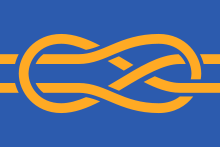
. It is formally defined in the FIAV (Fédération internationale des associations vexillologiques
Fédération internationale des associations vexillologiques
The Fédération internationale des associations vexillologiques is an international federation of 55 regional, national, and multinational associations and institutions across the globe that study vexillology, which FIAV defines in its constitution as "the creation and development of a body of...
) constitution as "the creation and development of a body of knowledge about flags of all types, their forms and functions, and of scientific theories and principles based on that knowledge." A person who studies flags is a vexillologist; a person who designs flags is a vexillographer; and any person who simply likes, admires, or enjoys flags is a vexillophile.
Since 1965, an International Congress of Vexillology (ICV) has been organized every two years under the auspices of FIAV
Fédération internationale des associations vexillologiques
The Fédération internationale des associations vexillologiques is an international federation of 55 regional, national, and multinational associations and institutions across the globe that study vexillology, which FIAV defines in its constitution as "the creation and development of a body of...
. The 2007 ICV was in Berlin
Berlin
Berlin is the capital city of Germany and is one of the 16 states of Germany. With a population of 3.45 million people, Berlin is Germany's largest city. It is the second most populous city proper and the seventh most populous urban area in the European Union...
, Germany; the 2009 ICV was in Yokohama
Yokohama
is the capital city of Kanagawa Prefecture and the second largest city in Japan by population after Tokyo and most populous municipality of Japan. It lies on Tokyo Bay, south of Tokyo, in the Kantō region of the main island of Honshu...
, Japan; the 2011 ICV was in Alexandria, Virginia
Alexandria, Virginia
Alexandria is an independent city in the Commonwealth of Virginia. As of 2009, the city had a total population of 139,966. Located along the Western bank of the Potomac River, Alexandria is approximately six miles south of downtown Washington, D.C.Like the rest of northern Virginia, as well as...
, USA, and the the 2013 will be in Rotterdam
Rotterdam
Rotterdam is the second-largest city in the Netherlands and one of the largest ports in the world. Starting as a dam on the Rotte river, Rotterdam has grown into a major international commercial centre...
, The Netherlands (www.nfc2013.com). Internet
Internet
The Internet is a global system of interconnected computer networks that use the standard Internet protocol suite to serve billions of users worldwide...
activity of vexillologists is centered on the Flags of the World
Flags of the World
Flags of the World is an Internet-based vexillological association and resource. Its principal project is the Internet's largest website devoted to vexillology, containing comprehensive information about all kinds of flags, and an associated mailing list...
website and mailing list.
Flag identification symbols (FIS)
The Flag Identification System was created by Whitney SmithWhitney Smith
Whitney Smith is a professional vexillologist, i.e., scholar of flags. The term vexillology, which he coined in his 1958 article Flags of the Arab World, refers to the scholarly analysis of all aspects of flags. In 1961, Smith and colleague Gerhard Grahl cofounded The Flag Bulletin, the world's...
and adopted by FIAV
Fédération internationale des associations vexillologiques
The Fédération internationale des associations vexillologiques is an international federation of 55 regional, national, and multinational associations and institutions across the globe that study vexillology, which FIAV defines in its constitution as "the creation and development of a body of...
.
The first row represents use on land and the second use on water, each divided into private (civil), government (state), and military (war) use.
| Usage | Private use | Government use | Military use |
|---|---|---|---|
| Land use | Civil flag Civil flag A civil flag is a version of the national flag that is flown by civilians on non-government installations or craft. The use of civil flags was more common in the past, in order to denote buildings or ships that were not manned by the military.... |
State flag State flag There are two separate meanings for the term state flag in vexillology – the flag of the government of a sovereign state, and the flag of an individual subnational state.-Government flag:... |
War flag War flag A war flag is a variant of a national flag for use by the nation's military forces on land. The nautical equivalent is a naval ensign — the battle ensign... |
| Sea use | Civil ensign Civil ensign The civil ensign is the national flag flown by civil ships to denote nationality... |
State ensign Ensign An ensign is a national flag when used at sea, in vexillology, or a distinguishing token, emblem, or badge, such as a symbol of office in heraldry... |
War ensign |
There are 63 representing symbols that can describe the flag, including:
| FIS | Text mode | Description | Usage |
|---|---|---|---|
 |
C**/*** | Civil flag | by private persons on land |
 |
*S*/*** | State flag | by state institutions on land |
 |
**W/*** | War flag | by military on land (army) |
 |
***/C** | Civil ensign | on private vessels (merchant ensign) |
 |
***/*S* | State ensign | on state owned vessels |
 |
***/**W | War ensign | by navy |
 |
CS*/*** | Civil and state flag | by private persons and state on land |
 |
*SW/*** | State and war flag | by state services and military on land |
 |
CSW/*** | National flag | for all purposes on land |
 |
***/CSW | National ensign | for all purposes on vessels |
 |
CSW/CSW | National flag and ensign | for all purposes on land and sea |
Other symbols are used to describe other aspects of the usage of the flag, such as official status and which side of the flag is being shown. The ones in general use are:
| FIS | Description |
|---|---|
| Normal or de jure version of flag, or obverse side | |
| Design proposed but not officially adopted | |
| Design is a reconstruction based on observations | |
| Reverse side of flag | |
| Design is an acceptable variant | |
| Alternative version of flag | |
| De facto version of flag | |
| Flag has different designs on its obverse side and its reverse side | |
| Obverse side meant to be hoisted with pole to the observer's right | |
| Design officially authorized to represent nation by government of that nation | |
| Design used in the past, but now abandoned (not part of Smith's original set) | |
| Reverse side is mirror image of obverse side | |
| Reverse side is congruent with obverse side | |
| Information on reverse side is not available | |
| Flag can be hung vertically by hoisting on a normal pole, then turning the pole 90° | |
| Flag can be hung vertically by rotating the design first | |
| Vertical hoist method of flag is unknown | |
| Design has no element that can be rotated | |
| Flag can be hoisted vertically only |
Principles of flag design
Flag designs exhibit a number of regularities, arising from a variety of practical concerns, historical circumstances, and cultural prescriptions that have shaped and continue to shape their evolution.First among the practical issues confronting a vexillographer is the necessity for the design to be manufactured (and often mass produced
Mass production
Mass production is the production of large amounts of standardized products, including and especially on assembly lines...
) into or onto a piece of cloth, which will subsequently be hoisted aloft in the outdoors to represent an organization, individual or idea. In this respect, flag design departs considerably from logo
Logo
A logo is a graphic mark or emblem commonly used by commercial enterprises, organizations and even individuals to aid and promote instant public recognition...
design: logos are predominantly still images to be read off a page, screen, or billboard, while flags are alternately draped and fluttering images to be seen from a variety of distances and angles. The prevalence of simple bold colors and shapes in flag design attests to these practical issues.
Flag design is also a historical process in which current designs often refer back to previous designs, effectively quoting, elaborating, or commenting upon them. Families of current flags may derive from a few common ancestors as in the cases of the Pan-African colours
Pan-African colours
Two different sets of three colours are referred to as the Pan-African colours: the red, green and gold first used in the flag of Ethiopia and Eritrea before the countries broke apart; and the red, green and black adopted by the American-based Universal Negro Improvement Association and African...
, the Pan-Arab colors
Pan-Arab colors
The Pan-Arab colors are black, white, green, and red. They were first combined in the flag of the Arab Revolt in 1916. They are used currently in the flags of Jordan, Kuwait, Palestinian Authority, Sahrawi Republic, Sudan, Libya and the United Arab Emirates. A sub-set of the Pan-Arab colors are...
, the Pan-Slavic colors, the Nordic Cross flag
Nordic Cross Flag
The Nordic Cross Flag, Nordic Cross, or Scandinavian Cross is a pattern of flags usually associated with the flags of the Scandinavian countries of which it originated. All of the Nordic countries except Greenland have adopted such flags...
and the Ottoman flag
Ottoman Flag
The term Ottoman flag refers to any of the flags used by the ruling Sultans of the Ottoman Dynasty. Various flags were used within the Ottoman Empire during its existence, and the sultan also used different personal flags on different occasions of state...
.
Certain cultures prescribe the proper design of flags, through heraldic
Heraldry
Heraldry is the profession, study, or art of creating, granting, and blazoning arms and ruling on questions of rank or protocol, as exercised by an officer of arms. Heraldry comes from Anglo-Norman herald, from the Germanic compound harja-waldaz, "army commander"...
or other authoritative systems. Prescription may be based on religious principles: see, for example, Islamic flags
Islamic Flags
An Islamic flag is a flag that complies with Islamic rules. Traditionally Islamic flags were of solid colour. The most favoured colours were black, white, red and green. However, other plain colours can be adopted. A bi-colour or tricolour flag can also be adopted as an Islamic flag...
. As a discipline, vexillology is beginning to promote design principles based on a body of research on flag history and design. Prominent examples are Ted Kaye's five Good Flag, Bad Flag principles published and endorsed by the North American Vexillological Association
North American Vexillological Association
The North American Vexillological Association is a membership organization devoted to "vexillology as the scientific study of flags." Flag researchers, designers, collectors, activists, merchants, and other enthusiasts from the United States and Canada meet annually at NAVA meetings in order to...
:
- Keep It Simple: the flag should be so simple that a child can draw it from memory.
- Use Meaningful Symbolism: the flag’s images, colors, or patterns should relate to what it symbolizes.
- Use 2–3 Basic Colors: that is limit of the number of colors on the flag to three, which contrast well and come from the standard color set.
- No Lettering or Seals: never use writing of any kind or an organization’s seal.
- Be Distinctive or Be Related: avoid duplicating other flags, but use similarities to show connections.
Prominent vexillologists
- E.M.C. Barraclough, Laureate of FIAVFédération internationale des associations vexillologiquesThe Fédération internationale des associations vexillologiques is an international federation of 55 regional, national, and multinational associations and institutions across the globe that study vexillology, which FIAV defines in its constitution as "the creation and development of a body of...
and author of Flags of the World - Ralph Bartlett, leader in the Flag Society of Australia; Secretary-General for Congresses (1989-1997) and Fellow of FIAVFédération internationale des associations vexillologiquesThe Fédération internationale des associations vexillologiques is an international federation of 55 regional, national, and multinational associations and institutions across the globe that study vexillology, which FIAV defines in its constitution as "the creation and development of a body of...
; and expert on flags of aspirant peoplesStateless nationA stateless nation is a group, usually a minority ethnic group, considered as a nation entitled to its own state for that nation. Since there are few objective criteria for whether a particular group is a nation, or which particular group "has" any given multinational state, usage of the term is... - Graham BartramGraham BartramGraham Bartram is a British vexillologist who is currently Secretary-General for Congresses of the Fédération internationale des associations vexillologiques, the Chief Vexillologist of the Flag Institute and a consultant to the British government on flag design and usage.Graham Bartram was born...
, Chief Vexillologist and Fellow of the Flag InstituteFlag InstituteThe Flag Institute is a research and documentation centre for flags and flag information, founded on St George's Day, 23 April 1971 by William Crampton and Captain EMC Barraclough CBE RN. Although not an official body, it is the principal advisor and designer of flags to the government of the...
; Secretary-General for Congresses (1999-present) of FIAVFédération internationale des associations vexillologiquesThe Fédération internationale des associations vexillologiques is an international federation of 55 regional, national, and multinational associations and institutions across the globe that study vexillology, which FIAV defines in its constitution as "the creation and development of a body of...
; and author of British Flags and Emblems, Flags of All Nations (BR20), and Flying Flags in the United Kingdom - Bruce B. Berry, founder member of the Southern African Vexillological Association (SAVA); editor of the SAVA Journal and SAVA Newsletter; Secretary-General for Congresses (1997-1999) and Fellow of FIAVFédération internationale des associations vexillologiquesThe Fédération internationale des associations vexillologiques is an international federation of 55 regional, national, and multinational associations and institutions across the globe that study vexillology, which FIAV defines in its constitution as "the creation and development of a body of...
; and collector of Rhodesian and South African flags - Hugh Boudin, Belgian vexillologist and President (1981-1993) and Fellow of FIAVFédération internationale des associations vexillologiquesThe Fédération internationale des associations vexillologiques is an international federation of 55 regional, national, and multinational associations and institutions across the globe that study vexillology, which FIAV defines in its constitution as "the creation and development of a body of...
- Aleš Brožek, Czech vexillologist, recipient of FIAVFédération internationale des associations vexillologiquesThe Fédération internationale des associations vexillologiques is an international federation of 55 regional, national, and multinational associations and institutions across the globe that study vexillology, which FIAV defines in its constitution as "the creation and development of a body of...
’s 1997 Vexillon, and Fellow of FIAVFédération internationale des associations vexillologiquesThe Fédération internationale des associations vexillologiques is an international federation of 55 regional, national, and multinational associations and institutions across the globe that study vexillology, which FIAV defines in its constitution as "the creation and development of a body of... - Andries Burgers, recipient of FIAVFédération internationale des associations vexillologiquesThe Fédération internationale des associations vexillologiques is an international federation of 55 regional, national, and multinational associations and institutions across the globe that study vexillology, which FIAV defines in its constitution as "the creation and development of a body of...
’s 2009 Vexillon and author of The South African Flag Book: The History of South African Flags from Dias to Mandela - Devereaux D. Cannon, Jr., founder of the Confederate States Vexillological Associationand author of The Flags of the Confederacy and The Flags of the Union
- William CramptonWilliam CramptonWilliam George Crampton, PhD, MEd was a British vexillologist. His chief legacy the Flag Institute has hundreds of members in the UK and overseas. He was recognised as Britain's foremost authority on flags by government agencies, the flag trade, the media, publishers, librarians and...
, founder of the Flag InstituteFlag InstituteThe Flag Institute is a research and documentation centre for flags and flag information, founded on St George's Day, 23 April 1971 by William Crampton and Captain EMC Barraclough CBE RN. Although not an official body, it is the principal advisor and designer of flags to the government of the...
; recipient of FIAVFédération internationale des associations vexillologiquesThe Fédération internationale des associations vexillologiques is an international federation of 55 regional, national, and multinational associations and institutions across the globe that study vexillology, which FIAV defines in its constitution as "the creation and development of a body of...
’s 1991 Vexillon; Secretary-General for Congresses (1983-1989), President (1993-1997), Fellow, and Laureate of FIAVFédération internationale des associations vexillologiquesThe Fédération internationale des associations vexillologiques is an international federation of 55 regional, national, and multinational associations and institutions across the globe that study vexillology, which FIAV defines in its constitution as "the creation and development of a body of...
; and author of many editions of Flags of the World - Emil Dreyer, president of Société Suisse de Vexillologie and Secretary-General (1991-1997) and Fellow of FIAVFédération internationale des associations vexillologiquesThe Fédération internationale des associations vexillologiques is an international federation of 55 regional, national, and multinational associations and institutions across the globe that study vexillology, which FIAV defines in its constitution as "the creation and development of a body of...
- Petr Exner, recipient of FIAVFédération internationale des associations vexillologiquesThe Fédération internationale des associations vexillologiques is an international federation of 55 regional, national, and multinational associations and institutions across the globe that study vexillology, which FIAV defines in its constitution as "the creation and development of a body of...
’s 2005 Vexillon and author of Vexilologický lexikon - vlajky obcí České republiky - Prof. Scot Guenter, academic vexillologist; past president (1991-1994) and honorary member of NAVANorth American Vexillological AssociationThe North American Vexillological Association is a membership organization devoted to "vexillology as the scientific study of flags." Flag researchers, designers, collectors, activists, merchants, and other enthusiasts from the United States and Canada meet annually at NAVA meetings in order to...
; Fellow and Laureate of FIAVFédération internationale des associations vexillologiquesThe Fédération internationale des associations vexillologiques is an international federation of 55 regional, national, and multinational associations and institutions across the globe that study vexillology, which FIAV defines in its constitution as "the creation and development of a body of...
; and author of The American Flag, 1777-1924: Cultural Shifts from Creation to Codification - Kevin Harrington, president of the Canadian Flag Association; Fellow of FIAVFédération internationale des associations vexillologiquesThe Fédération internationale des associations vexillologiques is an international federation of 55 regional, national, and multinational associations and institutions across the globe that study vexillology, which FIAV defines in its constitution as "the creation and development of a body of...
; and editor of Flagscan - Don Healy, past president (1989-1991) of NAVANorth American Vexillological AssociationThe North American Vexillological Association is a membership organization devoted to "vexillology as the scientific study of flags." Flag researchers, designers, collectors, activists, merchants, and other enthusiasts from the United States and Canada meet annually at NAVA meetings in order to...
; researcher of U.S. tribal flags; recipient of FIAVFédération internationale des associations vexillologiquesThe Fédération internationale des associations vexillologiques is an international federation of 55 regional, national, and multinational associations and institutions across the globe that study vexillology, which FIAV defines in its constitution as "the creation and development of a body of...
’s 1999 Vexillon; and author of Flags of the Native Peoples of the United States and Native American Flags (with Peter Orenski) - Ted Kaye, editor of NAVANorth American Vexillological AssociationThe North American Vexillological Association is a membership organization devoted to "vexillology as the scientific study of flags." Flag researchers, designers, collectors, activists, merchants, and other enthusiasts from the United States and Canada meet annually at NAVA meetings in order to...
's Raven: A Journal of Vexillology (1996–present) and compiler of Good Flag, Bad Flag - Roman Klimes, Czech founder of the World Vexillological Research Institute; Fellow of FIAVFédération internationale des associations vexillologiquesThe Fédération internationale des associations vexillologiques is an international federation of 55 regional, national, and multinational associations and institutions across the globe that study vexillology, which FIAV defines in its constitution as "the creation and development of a body of...
; and author of Freie Stadt Danzig - Flaggen, Wappen und Siegel (1920–1939) - Marc LeepsonMarc LeepsonMarc Leepson is an American journalist, historian, and author. His books include Lafayette: Lessons in Leadership from the Idealist General ; Desperate Engagement: How a Little Known Civil War Battle Saved Washington, D.C. and Changed American History Marc Leepson (born June 20, 1945 in Newark,...
, author of Flag: An American Biography - Michel Lupant, Belgian vexillologist; founder of the Centre Belgo-Européen d'Études des Drapeaux; full member of the Conseil d'héraldique et de vexillologie de la Communauté française de Belgique; President (1997-present) of FIAVFédération internationale des associations vexillologiquesThe Fédération internationale des associations vexillologiques is an international federation of 55 regional, national, and multinational associations and institutions across the globe that study vexillology, which FIAV defines in its constitution as "the creation and development of a body of...
; and author of many publications including reference works on flags of police and fire services - Howard M. Madaus, recipient of FIAVFédération internationale des associations vexillologiquesThe Fédération internationale des associations vexillologiques is an international federation of 55 regional, national, and multinational associations and institutions across the globe that study vexillology, which FIAV defines in its constitution as "the creation and development of a body of...
’s 2007 Vexillon and author of The American Flag: Two Centuries of Concord & Conflict - David B. Martucci, past president (1998–2004) of NAVANorth American Vexillological AssociationThe North American Vexillological Association is a membership organization devoted to "vexillology as the scientific study of flags." Flag researchers, designers, collectors, activists, merchants, and other enthusiasts from the United States and Canada meet annually at NAVA meetings in order to...
and expert in U.S. historical flags - Louis Mühlemann, Swiss vexillologist and cofounder, Fellow, and President (1969-1973) of FIAVFédération internationale des associations vexillologiquesThe Fédération internationale des associations vexillologiques is an international federation of 55 regional, national, and multinational associations and institutions across the globe that study vexillology, which FIAV defines in its constitution as "the creation and development of a body of...
- Ottfried NeubeckerOttfried NeubeckerOttfried Neubecker was a German vexillologist and heraldist.-Early life and education:He was born 22 March 1908 in Berlin-Charlottenburg in Germany, into the family of a university teacher...
, German vexillologist; President (1973-1981), Secretary-General (1981-1983), Fellow, and Laureate of FIAVFédération internationale des associations vexillologiquesThe Fédération internationale des associations vexillologiques is an international federation of 55 regional, national, and multinational associations and institutions across the globe that study vexillology, which FIAV defines in its constitution as "the creation and development of a body of...
; and author in 1939 of the German navy Flaggenbuch - Bruce Nicolls, recipient of FIAVFédération internationale des associations vexillologiquesThe Fédération internationale des associations vexillologiques is an international federation of 55 regional, national, and multinational associations and institutions across the globe that study vexillology, which FIAV defines in its constitution as "the creation and development of a body of...
’s 1989 Vexillon, Fellow of FIAVFédération internationale des associations vexillologiquesThe Fédération internationale des associations vexillologiques is an international federation of 55 regional, national, and multinational associations and institutions across the globe that study vexillology, which FIAV defines in its constitution as "the creation and development of a body of...
, and author of Practical Aspects of Designing, Making and Flying Flags - Armand Nöel du Payrat, French vexillologist; recipient of FIAVFédération internationale des associations vexillologiquesThe Fédération internationale des associations vexillologiques is an international federation of 55 regional, national, and multinational associations and institutions across the globe that study vexillology, which FIAV defines in its constitution as "the creation and development of a body of...
’s 2001 Vexillon; and editor of Album des Pavillons - Anne M. Platoff, recipient of FIAVFédération internationale des associations vexillologiquesThe Fédération internationale des associations vexillologiques is an international federation of 55 regional, national, and multinational associations and institutions across the globe that study vexillology, which FIAV defines in its constitution as "the creation and development of a body of...
’s 2011 Vexillon and author of Russian Regional Flags: The Flags of the Subjects of the Russian Federation and Where No Flag Has Gone Before: Political and Technical Aspects of Placing a Flag on the Moon - George H. PrebleGeorge H. PrebleGeorge Henry Preble was an American naval officer and writer, notable for his history of the flag of the United States and for taking the first photograph of the Fort McHenry flag that inspired The Star-Spangled Banner.-Biography:He was born in Portland, Maine into a seafaring family; his father...
, American naval admiral and author in 1872 of History of the American Flag - John M. Purcell, past president (1981–1983) and honorary member of NAVANorth American Vexillological AssociationThe North American Vexillological Association is a membership organization devoted to "vexillology as the scientific study of flags." Flag researchers, designers, collectors, activists, merchants, and other enthusiasts from the United States and Canada meet annually at NAVA meetings in order to...
; recipient of FIAVFédération internationale des associations vexillologiquesThe Fédération internationale des associations vexillologiques is an international federation of 55 regional, national, and multinational associations and institutions across the globe that study vexillology, which FIAV defines in its constitution as "the creation and development of a body of...
’s 2005 Vexillon; Fellow of FIAVFédération internationale des associations vexillologiquesThe Fédération internationale des associations vexillologiques is an international federation of 55 regional, national, and multinational associations and institutions across the globe that study vexillology, which FIAV defines in its constitution as "the creation and development of a body of...
; and principal author of American City Flags: 150 Flags from Akron to Yonkers - Sanjeeva Rao Kambhampati, Indian-born founder of the Indian Vexillological Association
- María José Sastre y Arribas, recipient of FIAVFédération internationale des associations vexillologiquesThe Fédération internationale des associations vexillologiques is an international federation of 55 regional, national, and multinational associations and institutions across the globe that study vexillology, which FIAV defines in its constitution as "the creation and development of a body of...
’s 1993 Vexillon and author of Diccionario de Vexilología and Normas de Descripción y Codificación Vexilologíca - Rudolf Siegel, author in 1912 of Die Flagge
- Klaes Sierksma, founder of the Stichting voor Banistiek en Heraldiek; cofounder, Fellow, and Secretary-General for Congresses (1969-1981) of FIAVFédération internationale des associations vexillologiquesThe Fédération internationale des associations vexillologiques is an international federation of 55 regional, national, and multinational associations and institutions across the globe that study vexillology, which FIAV defines in its constitution as "the creation and development of a body of...
; and author of numerous books on flags, including a annotated English edition of the world's first flag manuscript Flags of the World 1699-1670 - Whitney SmithWhitney SmithWhitney Smith is a professional vexillologist, i.e., scholar of flags. The term vexillology, which he coined in his 1958 article Flags of the Arab World, refers to the scholarly analysis of all aspects of flags. In 1961, Smith and colleague Gerhard Grahl cofounded The Flag Bulletin, the world's...
, founder of the Flag Research Center; editor of the Flag Bulletin; founder, past president (1967-1977), and honorary member of NAVANorth American Vexillological AssociationThe North American Vexillological Association is a membership organization devoted to "vexillology as the scientific study of flags." Flag researchers, designers, collectors, activists, merchants, and other enthusiasts from the United States and Canada meet annually at NAVA meetings in order to...
; recipient of FIAVFédération internationale des associations vexillologiquesThe Fédération internationale des associations vexillologiques is an international federation of 55 regional, national, and multinational associations and institutions across the globe that study vexillology, which FIAV defines in its constitution as "the creation and development of a body of...
’s 2007 Vexillon; cofounder, Secretary-General (1969-1981, 1983-1991), Secretary-General for Congresses (1981-1983), Fellow, and Laureate of FIAVFédération internationale des associations vexillologiquesThe Fédération internationale des associations vexillologiques is an international federation of 55 regional, national, and multinational associations and institutions across the globe that study vexillology, which FIAV defines in its constitution as "the creation and development of a body of...
; author of Flags Through the Ages and Across the World, The Flag Book of the United States, and The American Flag: Two Centuries of Concord & Conflict; and coiner in 1957 of the word vexillology - Charles A. Spain, Jr., Texas vexillologist, past president (1996-1998) of NAVANorth American Vexillological AssociationThe North American Vexillological Association is a membership organization devoted to "vexillology as the scientific study of flags." Flag researchers, designers, collectors, activists, merchants, and other enthusiasts from the United States and Canada meet annually at NAVA meetings in order to...
; founder member of the Vexillological Association of the State of Texas; Secretary-General (1997-present) of FIAVFédération internationale des associations vexillologiquesThe Fédération internationale des associations vexillologiques is an international federation of 55 regional, national, and multinational associations and institutions across the globe that study vexillology, which FIAV defines in its constitution as "the creation and development of a body of...
; and author of The Flags and Seals of Texas - Alfred ZnamierowskiAlfred ZnamierowskiAlfred Znamierowski, born June, 1940, is a Polish vexillologist, heraldist and journalist. During his career he has published several books and designed hundreds of coats of arms, flags, banners and seals for over 200 different municipalities and institutions....
, Polish-born founder of the Flag Design Center; recipient of FIAVFédération internationale des associations vexillologiquesThe Fédération internationale des associations vexillologiques is an international federation of 55 regional, national, and multinational associations and institutions across the globe that study vexillology, which FIAV defines in its constitution as "the creation and development of a body of...
’s 2003 Vexillon; Fellow of FIAVFédération internationale des associations vexillologiquesThe Fédération internationale des associations vexillologiques is an international federation of 55 regional, national, and multinational associations and institutions across the globe that study vexillology, which FIAV defines in its constitution as "the creation and development of a body of...
; and author of The World Encyclopedia of Flags
Prominent vexillographers
- LuisLuis AranaLuis Arana Goiri , self-styled as Arana ta Goiri'taŕ Koldobika was a Basque nationalist politician and founder of the Basque Nationalist Party along with his brother Sabino Arana. He served as president of the PNV 1911?–1916, 1922–1930 , and 1932–1933....
and Sabino AranaSabino AranaSabino Arana Goiri, self-styled as Arana ta Goiri'taŕ Sabin, , was a Spanish and Basque writer. He was the founder of the Basque Nationalist Party and father of Basque nationalism....
, designers of the IkurriñaIkurriñaThe ikurrina flag or ikurriña is a Basque symbol and the official flag of the Basque Country Autonomous Community of Spain.-Design:...
(the flag of the Basque CountryBasque Country (autonomous community)The Basque Country is an autonomous community of northern Spain. It includes the Basque provinces of Álava, Biscay and Gipuzkoa, also called Historical Territories....
) - Graham BartramGraham BartramGraham Bartram is a British vexillologist who is currently Secretary-General for Congresses of the Fédération internationale des associations vexillologiques, the Chief Vexillologist of the Flag Institute and a consultant to the British government on flag design and usage.Graham Bartram was born...
, designer of the flag of Tristan da CunhaFlag of Tristan da CunhaThe flag of Tristan da Cunha was adopted on October 20, 2002, in a proclamation made by the Governor of Saint Helena under a Royal Warrant granted by Queen Elizabeth II...
and others - Manuel BelgranoManuel BelgranoManuel José Joaquín del Corazón de Jesús Belgrano , usually referred to as Manuel Belgrano, was an Argentine economist, lawyer, politician, and military leader. He took part in the Argentine Wars of Independence and created the Flag of Argentina...
, designer of the flag of ArgentinaFlag of ArgentinaThe national flag of Argentina is a triband, composed of three equally wide horizontal bands coloured light blue, white and light blue. There are multiple interpretations on the reasons for those colors... - Frederick 'Fred' BrownellFrederick BrownellFrederick Gordon Brownell OMSS SM MMM JCD is a South African herald, vexillologist, and genealogist.He joined the Bureau of Heraldry as Assistant State Herald in 1977, and was promoted to State Herald in 1982. He retired in 2002....
, designer of the flags of South AfricaSouth AfricaThe Republic of South Africa is a country in southern Africa. Located at the southern tip of Africa, it is divided into nine provinces, with of coastline on the Atlantic and Indian oceans...
and NamibiaNamibiaNamibia, officially the Republic of Namibia , is a country in southern Africa whose western border is the Atlantic Ocean. It shares land borders with Angola and Zambia to the north, Botswana to the east and South Africa to the south and east. It gained independence from South Africa on 21 March...
; recipient of FIAVFédération internationale des associations vexillologiquesThe Fédération internationale des associations vexillologiques is an international federation of 55 regional, national, and multinational associations and institutions across the globe that study vexillology, which FIAV defines in its constitution as "the creation and development of a body of...
’s 1995 Vexillon; and Fellow of FIAVFédération internationale des associations vexillologiquesThe Fédération internationale des associations vexillologiques is an international federation of 55 regional, national, and multinational associations and institutions across the globe that study vexillology, which FIAV defines in its constitution as "the creation and development of a body of... - Ron CobbRon CobbRon Cobb is an American cartoonist, artist, writer, film designer, and film director.By the age of 18, with no formal training in graphic illustration, Cobb was working as an animation "inbetweener" artist for Disney Studios in Burbank, California. He progressed to becoming a breakdown artist on...
, designer of the American Ecology FlagEcology Flag (American)The Ecology Flag was a cultural symbol used in the 1970s by American environmentalists.- Description :Ron Cobb created an ecology symbol which he published on November 7, 1969, in the Los Angeles Free Press and then placed it in the public domain... - John EisemannJohn EisemannJohn Eisemann was an architect from Cleveland, Ohio who created the Ohio flag in 1902. The shape of the flag of Ohio is a burgee.-External links:...
, designer of the flag of the U.S. state of OhioFlag of OhioThe flag of the state of Ohio was adopted in 1902 and designed by John Eisemann, for the 1901 Pan-American Exposition.-Design:The large blue triangle represents Ohio's hills and valleys, and the stripes represent roads and waterways... - Quamrul HassanQuamrul HassanQuamrul Hassan was a Bangladeshi artist. Hassan was born in Kolkata, India. In Bangladesh, Hassan's fame as an artist is perhaps only second to that of Zainul Abedin. Hassan is often referred to in Bangladesh as Potua, a word usually associated with folk artists, due to his down to earth style...
, designer of the flag of BangladeshFlag of BangladeshThe national flag of Bangladesh was adopted officially on 17 January 1972. It is based on a similar flag used during the Bangladesh Liberation War of 1971. The map was later deleted from the flag by the order of General Abul Manzur, most likely to simplify the design... - Robert G. HeftRobert G. HeftRobert G. "Bob" Heft , born in Saginaw, Michigan, was a designer of the 50-star flag, and one of the proposed designs for a 51-star flag for the United States of America. He spent his childhood in Lancaster, Ohio, where he created the flag as a school project.He designed the current U.S. flag in...
, alleged designer of the 50-star cantonFlag terminologyFlag terminology is a jargon used in vexillology, the study of flags, to describe precisely the parts, patterns, and other attributes of flags and their display.-Description of standard flag parts and terms:...
for the American flagFlag of the United StatesThe national flag of the United States of America consists of thirteen equal horizontal stripes of red alternating with white, with a blue rectangle in the canton bearing fifty small, white, five-pointed stars arranged in nine offset horizontal rows of six stars alternating with rows... - Cederic Herbert, designer of the flag of the short-lived Zimbabwe RhodesiaZimbabwe RhodesiaZimbabwe Rhodesia , officially the Republic of Zimbabwe Rhodesia, was an unrecognized state that existed from 1 June 1979 to 12 December 1979...
- Adolf HitlerAdolf HitlerAdolf Hitler was an Austrian-born German politician and the leader of the National Socialist German Workers Party , commonly referred to as the Nazi Party). He was Chancellor of Germany from 1933 to 1945, and head of state from 1934 to 1945...
, designer of the flag of Nazi Germany, the ReichskriegsflaggeReichskriegsflaggeReichskriegsflagge was the official name of the war flag used by the German armed forces from 1867 to 1945. A total of seven different designs were used during this period.-Imperial Germany:...
and his personal standard. - Francis HopkinsonFrancis HopkinsonFrancis Hopkinson , an American author, was one of the signers of the Declaration of Independence as a delegate from New Jersey. He later served as a federal judge in Pennsylvania...
, designer (according to some historians) of the American flagFlag of the United StatesThe national flag of the United States of America consists of thirteen equal horizontal stripes of red alternating with white, with a blue rectangle in the canton bearing fifty small, white, five-pointed stars arranged in nine offset horizontal rows of six stars alternating with rows... - Friedensreich HundertwasserFriedensreich HundertwasserFriedensreich Regentag Dunkelbunt Hundertwasser was an Austrian painter and architect. Born Friedrich Stowasser in Vienna, he became one of the best-known contemporary Austrian artists, although controversial, by the end of the 20th century.-Life:Hundertwasser's father Ernst Stowasser died three...
, designer of the Koru FlagKoru FlagThe Koru Flag has been proposed as a secondary flag for New Zealand. It was designed by Friedensreich Hundertwasser in 1983. It is claimed by some New Zealanders that the current flag of New Zealand is a reminder of British colonialism and does not truly represent their culture; however, those who...
among others - Susan K. Huhume, designer of the flag of Papua New GuineaPapua New GuineaPapua New Guinea , officially the Independent State of Papua New Guinea, is a country in Oceania, occupying the eastern half of the island of New Guinea and numerous offshore islands...
- Sharif HusseinHussein bin Ali, Sharif of MeccaSayyid Hussein bin Ali, GCB was the Sharif of Mecca, and Emir of Mecca from 1908 until 1917, when he proclaimed himself King of Hejaz, which received international recognition. He initiated the Arab Revolt in 1916 against the increasingly nationalistic Ottoman Empire during the course of the...
, designer of the flag of the Arab RevoltArab RevoltThe Arab Revolt was initiated by the Sherif Hussein bin Ali with the aim of securing independence from the ruling Ottoman Turks and creating a single unified Arab state spanning from Aleppo in Syria to Aden in Yemen.- Background :... - James I of EnglandJames I of EnglandJames VI and I was King of Scots as James VI from 24 July 1567 and King of England and Ireland as James I from the union of the English and Scottish crowns on 24 March 1603...
, designer of the first flag of Great BritainUnion FlagThe Union Flag, also known as the Union Jack, is the flag of the United Kingdom. It retains an official or semi-official status in some Commonwealth Realms; for example, it is known as the Royal Union Flag in Canada. It is also used as an official flag in some of the smaller British overseas...
. - Syed Amir-uddin KedwaiiSyed Amir-uddin KedwaiiSyed Ameer ud din Kedwaii was an active worker of Pakistan Movement and possess the distinction of proposing and designing the flag of Pakistan in 1946 which was accepted and appreciated by the founder of Pakistan, Quaid-e-Azam Muhammad Ali Jinnah.Mr...
, designer of the flag of PakistanFlag of PakistanThe national flag of Pakistan was adopted in its present form during a meeting of the Constituent Assembly on August 11, 1947, just three days before the country's independence, when it became the official flag of the Dominion of Pakistan. It was afterwards retained by the current-day Islamic... - Lu Hao-tungLu Hao-tungLu Hao-tung , born Lu Chung-gui , courtesy name Hsien-hsiang , was the first "revolutionary martyr" of the Republic of China...
, designer of the Blue Sky with a White SunBlue Sky with a White SunThe Blue Sky with a White Sun serves as the design for the party flag and emblem of the Kuomintang , the canton of the flag of the Republic of China, the national emblem of the Republic of China , and as the naval jack of the ROC Navy....
flag of the Republic of ChinaRepublic of ChinaThe Republic of China , commonly known as Taiwan , is a unitary sovereign state located in East Asia. Originally based in mainland China, the Republic of China currently governs the island of Taiwan , which forms over 99% of its current territory, as well as Penghu, Kinmen, Matsu and other minor... - John McConnellJohn McConnell (peace activist)John McConnell , the founder and creator of Earth Day, has demonstrated a major passion for peace, religion, and science throughout his life. He has made efforts to relieve human suffering and promote the common good...
, designer of a Flag of the Earth - Fredrik MeltzerFredrik MeltzerFredrik Meltzer was a Norwegian businessman and politician perhaps best known for designing the flag of Norway. A member of the constituent assembly, Meltzer was one of the signatories of the Norwegian Constitution of 1814...
, designer of the flag of NorwayFlag of NorwayThe flag of Norway is red with an indigo blue Scandinavian cross outlined in white that extends to the edges of the flag; the vertical part of the cross is shifted to the hoist side in the style of the Dannebrog, the flag of Denmark.- History :... - Raimundo Teixeira MendesRaimundo Teixeira MendesRaimundo Teixeira Mendes was a Brazilian philosopher and mathematician. He is credited with creating the national motto, "Order and Progress", as well as the national flag on which it appears....
, designer of the flag of BrazilFlag of BrazilThe national flag of Brazil is a blue disc depicting a starry sky spanned by a curved band inscribed with the national motto, within a yellow rhombus, on a green field. Brazil officially adopted this design for its national flag on November 19, 1889, replacing the flag of the second Empire of Brazil... - William Porcher MilesWilliam Porcher MilesWilliam Porcher Miles was among the ardent States' Rights advocates, supporters of slavery, and Southern secessionists who came to be known as the "Fire-Eaters." Born in South Carolina, he showed little early interest in politics and his early career included the study of law and a tenure as a...
, designer of the battle flag of the Confederate States of AmericaFlags of the Confederate States of AmericaThere were only three flag designs adopted, with later, minor variants made to those designs, that served as the official national flags of the Confederate States of America and used during its existence from 1861 to 1865... - Francisco de MirandaFrancisco de MirandaSebastián Francisco de Miranda Ravelo y Rodríguez de Espinoza , commonly known as Francisco de Miranda , was a Venezuelan revolutionary...
, designer of the flag of VenezuelaFlag of VenezuelaThe current flag of Venezuela was introduced in 2006.The basic design includes a horizontal tricolor of yellow, blue, and red, dating to the original flag introduced in 1811, in the Venezuelan War of Independence....
, upon which the present flags of ColombiaFlag of ColombiaAfter Miranda later designed his flag based on this conversation, he happily recalled seeing a fresco by Lazzaro Tavarone in the Palazzo Belimbau in Genoa that depicted Christopher Columbus unfurling a similar-coloured flag in Veragua during his fourth voyage....
and EcuadorFlag of EcuadorThe flag of Ecuador, which consists of horizontal bands of yellow , blue and red, was first adopted on September 26, 1860. The design of the current flag was finalized in 1900 with the addition of the coat of arms in the center of the flag. Before using the yellow, blue and red tricolor, Ecuador...
are based. - Theodosia Okoh, designer of the flag of GhanaFlag of GhanaThe flag of Ghana was designed to replace the flag of the United Kingdom upon attainment of independence in 1957. It was flown until 1959, and then reinstated in 1966. It consists of the Pan-African colours of red, yellow, and green, in horizontal stripes, with a black five-pointed star in the...
- Christopher PrattChristopher PrattFor other uses, see Christopher Pratt .John Christopher Pratt CC is a Canadian painter.Pratt moved to New Brunswick in 1953 to attend Mount Allison University, where he met his future wife, the artist Mary West. They married in 1957. They have 4 children, John, Barbara, Anne and Edwin...
, designer of the flag of the Canadian province of Newfoundland and LabradorFlag of Newfoundland and LabradorThe flag of Newfoundland and Labrador was introduced in 1980, and was designed by Newfoundland artist Christopher Pratt. The flag design, with the proportions 2:1, was approved by the House of Assembly of the province of Newfoundland and Labrador, Canada, on May 28, 1980. It was flown for the first... - Betsy RossBetsy RossBetsy Ross is widely credited with making the first American flag. There is, however, no credible historical evidence that the story is true.-Early life:...
, alleged designer (according to legend) of the American flagFlag of the United StatesThe national flag of the United States of America consists of thirteen equal horizontal stripes of red alternating with white, with a blue rectangle in the canton bearing fifty small, white, five-pointed stars arranged in nine offset horizontal rows of six stars alternating with rows...
during the American RevolutionAmerican RevolutionThe American Revolution was the political upheaval during the last half of the 18th century in which thirteen colonies in North America joined together to break free from the British Empire, combining to become the United States of America... - Gerard SlevinGerard SlevinGerard Slevin was born in Cork, Ireland. Slevin was assistant to Edward McLysaght, the Chief Herald of Ireland, from 1944 to 1954, at which time he succeeded McLysaght...
, former Chief Herald of Ireland reputed to have helped design the flag of the European Union - Whitney SmithWhitney SmithWhitney Smith is a professional vexillologist, i.e., scholar of flags. The term vexillology, which he coined in his 1958 article Flags of the Arab World, refers to the scholarly analysis of all aspects of flags. In 1961, Smith and colleague Gerhard Grahl cofounded The Flag Bulletin, the world's...
, designer of the flag of GuyanaFlag of GuyanaThe flag of Guyana, known as The Golden Arrowhead, has been the national flag of Guyana since May 1966 when the country became independent from the United Kingdom...
and other flags - George StanleyGeorge StanleyColonel George Francis Gillman Stanley, OC, CD, KStJ, DPhil, FRSC, FRHistS, FRHSC was a historian, author, soldier, teacher, public servant, and designer of the current Canadian flag.-Career:...
, designer of the flag of CanadaFlag of CanadaThe national flag of Canada, also known as the Maple Leaf, and , is a red flag with a white square in its centre, featuring a stylized 11-pointed red maple leaf. Its adoption in 1965 marked the first time a national flag had been officially adopted in Canada to replace the Union Flag... - Joaquín SuárezJoaquín SuárezJoaquín Luis Miguel Suárez de Rondelo was a Uruguayan political figure. He gave his name to Joaquín Suárez .-Head of State of Uruguay:...
, designer of the flag of UruguayFlag of UruguayThe national flag of Uruguay has a field of nine equal horizontal stripes alternating white and blue. The canton is white, charged with the Sun of May, from which 16 rays extend, alternating between triangular and wavy... - Robert WattRobert WattRobert Douglas Watt, LVO, FRHSC was the first Chief Herald of Canada. He was appointed at the foundation of the Canadian Heraldic Authority, and was succeeded by Claire Boudreau in 2007....
, designer of the flag of VancouverFlag of VancouverThe flag of the city of Vancouver, British Columbia, Canada, was adopted by City Council on May 17, 1983. It was designed by Robert Watt, then the Director of the Vancouver Museum, and later the Chief Herald of Canada....
, British Columbia, Canada - Oliver Wolcott, Jr.Oliver Wolcott, Jr.Oliver Wolcott, Jr. was United States Secretary of the Treasury from 1795 to 1800 and the 24th Governor of Connecticut from 1817 to 1827.-Youth and education:...
, designer of the flag of the United States Customs ServiceUnited States Customs ServiceUntil March 2003, the United States Customs Service was an agency of the U.S. federal government that collected import tariffs and performed other selected border security duties.Before it was rolled into form part of the U.S... - Zeng LiansongZeng LiansongZeng Liansong was the designer of the Flag of the People's Republic of China. He was from Ruian, Zhejiang province.He entered the economics department at the National Central University in 1936 . During the Second Sino-Japanese War, he participated in confrontation against Japanese forces...
, designer of the flag of the People's Republic of ChinaFlag of the People's Republic of ChinaThe flag of the People's Republic of China is a red field charged in the canton with five golden stars. The design features one large star, with four smaller stars in a semicircle set off towards the fly...
See also
- Fédération internationale des associations vexillologiquesFédération internationale des associations vexillologiquesThe Fédération internationale des associations vexillologiques is an international federation of 55 regional, national, and multinational associations and institutions across the globe that study vexillology, which FIAV defines in its constitution as "the creation and development of a body of...
- FlagFlagA flag is a piece of fabric with a distinctive design that is usually rectangular and used as a symbol, as a signaling device, or decoration. The term flag is also used to refer to the graphic design employed by a flag, or to its depiction in another medium.The first flags were used to assist...
- Flag InstituteFlag InstituteThe Flag Institute is a research and documentation centre for flags and flag information, founded on St George's Day, 23 April 1971 by William Crampton and Captain EMC Barraclough CBE RN. Although not an official body, it is the principal advisor and designer of flags to the government of the...
- FlagmasterFlagmasterFlagmaster is a vexillology magazine published by the Flag Institute and edited by Michael Faul. Since November 2005, the magazine has been printed entirely in colour; it is the second periodical principally about flags to have been so printed .Flagmaster was mentioned prominently in a 30 September...
- Flag terminologyFlag terminologyFlag terminology is a jargon used in vexillology, the study of flags, to describe precisely the parts, patterns, and other attributes of flags and their display.-Description of standard flag parts and terms:...
- Flags of the WorldFlags of the WorldFlags of the World is an Internet-based vexillological association and resource. Its principal project is the Internet's largest website devoted to vexillology, containing comprehensive information about all kinds of flags, and an associated mailing list...
- Great Waters Association of VexillologyGreat Waters Association of VexillologyThe Great Waters Association of Vexillology is an organization devoted to vexillology, the scientific study of flags. GWAV has a particular focus on flags found in the Midwest....
- HeraldryHeraldryHeraldry is the profession, study, or art of creating, granting, and blazoning arms and ruling on questions of rank or protocol, as exercised by an officer of arms. Heraldry comes from Anglo-Norman herald, from the Germanic compound harja-waldaz, "army commander"...
- Nordic Flag SocietyNordic Flag SocietyThe Nordic Flag Society is an association of Nordic vexillologists. It has an official name in the languages of all the five countries in which its activities are principally based: Nordiska Flaggsällskapet , Nordisk Flagselskab , Nordisk Flaggselskap , Pohjoismaiden Lippuseura , and Norræna...
- North American Vexillological AssociationNorth American Vexillological AssociationThe North American Vexillological Association is a membership organization devoted to "vexillology as the scientific study of flags." Flag researchers, designers, collectors, activists, merchants, and other enthusiasts from the United States and Canada meet annually at NAVA meetings in order to...
- Sociedad Española de VexilologíaSociedad Española de VexilologíaThe Sociedad Española de Vexilología , is an association devoted to the study of flags. Based in Spain, most of its members are Spanish speaking vexillologists. Founded on 31. October 1977, the Spanish Society of Vexillology is a member of the Fédération internationale des associations...
- Tincture (heraldry)Tincture (heraldry)In heraldry, tinctures are the colours used to emblazon a coat of arms. These can be divided into several categories including light tinctures called metals, dark tinctures called colours, nonstandard colours called stains, furs, and "proper". A charge tinctured proper is coloured as it would be...
- William Crampton LibraryWilliam Crampton LibraryThe William Crampton Library, so named in honour of Dr William Crampton, founder of the Flag Institute, is the United Kingdom's largest single library devoted to the subject of vexillology....