


United States Marine Corps Boot Camp

Encyclopedia
Recruit training
Recruit training, more commonly known as Basic Training and colloquially called Boot Camp, is the initial indoctrination and instruction given to new military personnel, enlisted and officer...
", is a program of initial training
Recruit training
Recruit training, more commonly known as Basic Training and colloquially called Boot Camp, is the initial indoctrination and instruction given to new military personnel, enlisted and officer...
that each recruit must successfully complete in order to join the United States Marine Corps
United States Marine Corps
The United States Marine Corps is a branch of the United States Armed Forces responsible for providing power projection from the sea, using the mobility of the United States Navy to deliver combined-arms task forces rapidly. It is one of seven uniformed services of the United States...
. All enlisted individuals entering the Marine Corps, regardless of eventual active or reserve duty status, will undergo recruit training at one of the two Marine Corps Recruit Depots (MCRD): Parris Island
Marine Corps Recruit Depot Parris Island
Marine Corps Recruit Depot Parris Island is an military installation located within Port Royal, South Carolina, approximately south of Beaufort, the community that is typically associated with the installation. MCRD Parris Island is used for the training of enlisted Marines...
, South Carolina
South Carolina
South Carolina is a state in the Deep South of the United States that borders Georgia to the south, North Carolina to the north, and the Atlantic Ocean to the east. Originally part of the Province of Carolina, the Province of South Carolina was one of the 13 colonies that declared independence...
, or San Diego
Marine Corps Recruit Depot San Diego
Marine Corps Recruit Depot San Diego is a United States Marine Corps military installation in San Diego, California. It lies between San Diego Bay and Interstate 5, adjacent to San Diego International Airport and the former Naval Training Center San Diego...
, California
California
California is a state located on the West Coast of the United States. It is by far the most populous U.S. state, and the third-largest by land area...
. Male recruits from the 8th, 9th and 12th recruiting districts (predominantly areas west of the Mississippi River
Mississippi River
The Mississippi River is the largest river system in North America. Flowing entirely in the United States, this river rises in western Minnesota and meanders slowly southwards for to the Mississippi River Delta at the Gulf of Mexico. With its many tributaries, the Mississippi's watershed drains...
) are sent to MCRD San Diego. Male recruits from 1st, 4th and 6th recruiting districts, as well as all female recruits, are sent to Parris Island.
Those desiring to become officers attend training at Officer Candidates School
Officer Candidates School (United States Marine Corps)
The United States Marine Corps Officer Candidates School is the entry-level training for Marine officers, equivalent to recruit training for enlisted Marines. Located at Marine Corps Base Quantico, the school trains, screens, and evaluates potential Marine Corps officers...
.
Marines generally hold that their recruit training is the most physically and mentally difficult amongst the Uniformed Services, often by citing that it is longer than the other branches, requires a more demanding Physical Fitness Test
United States Marine Corps Physical Fitness Test
The United States Marine Corps requires that all Marines perform a Physical Fitness Test and a Combat Fitness Test once per fiscal year. Each test must have an interval of 6 months . The PFT ensures that Marines are keeping physically fit and in a state of physical readiness. It consists of...
(PFT), and has the strictest height and weight standards. Furthermore, only the Marines require 500 yard marksmanship qualification, while others require significantly less.
Daily schedule
An average day typically begins before sunrise. ReveilleReveille
"Reveille" is a bugle call, trumpet call or pipes call most often associated with the military or summer camp; it is chiefly used to wake military personnel at sunrise...
is sounded and all recruits present themselves for accountability. After personal hygiene and morning clean-up, recruits will perform physical training (only on Monday through Saturday). After the morning meal, the recruits begin the day's scheduled training, which may include classes, drill, or martial arts. On Sundays, recruits are offered the morning to attend various religious services and personal time (often called "Square-Away Time"). After the noon meal, the day's training continues until the evening meal, typically around 1700 to 1800 (5:00 to 6:00 PM). After this time, recruits will have hygiene time to shower, clean their weapons, and clean their barracks. Recruits also get roughly 1 hour of square away time after this, personal time for recruits to engage in personal activities such as preparing uniforms or equipment, writing letters, working out, or doing laundry. Recruits are not free from their Drill Instructors (DIs) or allowed to leave the squad bay during this time. In preparation to sleep, recruits may hydrate, pray together for 5 minutes, ensure footlockers and rifles are locked, and often recite the Rifleman's Creed
Rifleman's Creed
The Rifleman's Creed is a part of basic United States Marine Corps doctrine. Major General William H. Rupertus wrote it during World War II, probably in late 1941 or early 1942. All Marines learn the creed at recruit training and they are expected to live by it...
or Marines' Hymn
Marines' Hymn
The "Marines' Hymn" is the official hymn of the United States Marine Corps. It is the oldest official song in the United States military. The "Marines' Hymn" is typically sung at the position of attention as a gesture of respect...
before hitting the rack. Lights-out can range from 2000 to 2200 (8:00 to 10:00 PM), depending on the next day's activities.
Organizational structure
Recruits are organized by regimentRegiment
A regiment is a major tactical military unit, composed of variable numbers of batteries, squadrons or battalions, commanded by a colonel or lieutenant colonel...
, battalion
Battalion
A battalion is a military unit of around 300–1,200 soldiers usually consisting of between two and seven companies and typically commanded by either a Lieutenant Colonel or a Colonel...
, company
Company (military unit)
A company is a military unit, typically consisting of 80–225 soldiers and usually commanded by a Captain, Major or Commandant. Most companies are formed of three to five platoons although the exact number may vary by country, unit type, and structure...
, platoon
Platoon
A platoon is a military unit typically composed of two to four sections or squads and containing 16 to 50 soldiers. Platoons are organized into a company, which typically consists of three, four or five platoons. A platoon is typically the smallest military unit led by a commissioned officer—the...
, squad
Squad
In military terminology, a squad is a small military unit led by a non-commissioned officer that is subordinate to an infantry platoon. In countries following the British Army tradition this organization is referred to as a section...
, and often fireteam
Fireteam
A fireteam is a small military unit of infantry. It is the smallest unit in the militaries that use it and is the primary unit upon which infantry organization is based in the British Army, Royal Air Force Regiment, Royal Marines, United States Army, United States Marine Corps, United States Air...
. A Recruit Training Regiment is composed of three recruit training battalions (at Parris Island, there is an additional battalion to train female recruits). All three of the male battalions are made up of four companies, while the female battalion comprises three. Each company is broken down into two series, designated as Lead and Follow, which may have between one and four platoons, depending on the number of recruits in the company at the time the training cycle begins.
Each company is much like a class
Class (education)
A class in education has a variety of related meanings.It can be the group of students which attends a specific course or lesson at a university, school or other educational institution, see Form ....
at a civilian education institution; each company begins and finishes recruit training together (with the exception of those who are dropped for medical or personal reasons to a different company). Thus, each of the thirteen companies will be at a different stage in the thirteen week training cycle.
Each series is broken down into a number of platoons, usually from two to four in each. These platoons will be the basic unit for recruit training, assigned a four digit number as identification. Drill instructors are assigned to each platoon, and will usually stay from the beginning to the end of training. The Senior Drill Instructor of each platoon will select recruits to billets of responsibility, to mimic command and staff positions of a Marine unit. The selections often change on the whims of the drill instructors, and can include:
- the platoon guide, the senior-most recruit responsible for carrying the platoon's guidon
- four squad leaderSquad leaderSquad leader in military terminology means a non-commissioned officer who is the leader of a squad . In the United States Army and the United States Marine Corps, a squad leader is usually a sergeant , though a staff sergeant may also act as a squad leader.-Other meanings:* Squad Leader * Squadron...
s, each in charge of one-fourth of the platoon; they may choose to further subdivide their squads into four-man fire teams - a scribe, responsible for maintaining administrative records such as the interior guard schedule
- a whiskey locker recruit, responsible for maintaining the platoon's supplies
- house mouse, who cleans the normally off-limits drill instructors' offices
Drill Instructors
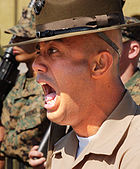
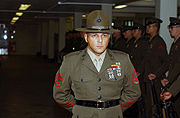
Central to the experience, training and development of Marine recruits is the Drill Instructor. Each platoon is assigned three or more Drill Instructors, sometimes informally referred to as "hats" due to their distinctive campaign coverCampaign hat
A campaign cover is a broad-brimmed felt or straw hat, with a high crown, pinched symmetrically at the four corners .It is associated with the New Zealand Army, the Royal Canadian...
.
The head drill instructor is called the "Senior Drill Instructor", and must be addressed as such by recruits and drill instructors alike. Often referred to simply as "Seniors", the SDIs often bond with the recruits and ensure that the DIs do not push recruits beyond necessary barriers or violate regulations. Senior Drill Instructors are usually a Staff Sergeant
Staff Sergeant
Staff sergeant is a rank of non-commissioned officer used in several countries.The origin of the name is that they were part of the staff of a British army regiment and paid at that level rather than as a member of a battalion or company.-Australia:...
or higher, and are distinguished by wearing a black leather duty belt (whereas other drill instructors wear wide green webbed duty belts
Webbed Belt
A webbed belt, military belt or skater belt is a type of belt distinguished by its belt buckle design and lack of holes in the cord, which is usually found in other belts where a pin is used as the fastening mechanism in the belt buckle....
).
The second in command is officially the "Experienced Drill Instructor" but is unofficially referred to as the "heavy hat", "j-hat", "strong-j" (notionally for "junior"), or "drill hat" (as they normally provide the majority of instruction in close order drill). The remaining drill instructor(s) are called the "Assistant Drill Instructor", but commonly referred to as the "green belt", "kill hat", "knowledge hat", "bulldog", or "3rd hat", normally charged with teaching the recruits much of their academic knowledge and responsible for the overall discipline of recruits. Additional drill instructors may be assigned in the winter season, when there are fewer recruits, or as a temporary assignment for students at the drill instructor school.
The drill instructors of a platoon are responsible to the Series Commander
Series Commander
The Series Commander is a United States Marine Corps officer assigned to a Recruit Training Company who is responsible for the conduct and instruction of Marine recruits and Marine Corps Drill Instructors within one of the two series, lead or follow...
, a level of command added below that of the company commander
Company Commander
A company commander is the commanding officer of a company, a military unit which typically consists of 100 to 350 soldiers, often organized into three or four smaller units called platoons....
, as a safety measure put into place following the Ribbon Creek incident
Ribbon Creek Incident
The Ribbon Creek incident is the most common term for events which occurred on the night of April 8, 1956, when Staff Sergeant Matthew McKeon, a junior drill instructor at the Marine Corps Recruit Depot Parris Island, South Carolina, marched his assigned platoon into Ribbon Creek, a swampy tidal...
. Drill instructors are trained at the drill instructor schools at each MCRD. Those drill instructors who successfully complete three years of duty are eligible to receive the Drill Instructor Ribbon
Drill Instructor Ribbon
A Drill Instructor Ribbon is a military award of the United States Armed Forces which is issued by the Navy, Air Force and United States Marine Corps...
.
Diet, fitness, and medical care
Prior to arriving at recruit training, all prospective recruits undergo a physical examinationPhysical examination
Physical examination or clinical examination is the process by which a doctor investigates the body of a patient for signs of disease. It generally follows the taking of the medical history — an account of the symptoms as experienced by the patient...
by a doctor at a Military Entrance Processing Station
United States Military Entrance Processing Command
The United States Military Entrance Processing Command is a Major Command of the Department of Defense, which screens and processes applicants into the United States Armed Forces...
. Recruits receive their initial weigh-in during the forming phase. If the recruit is under or over the height and weight standards, the recruit is placed on double rations if underweight, or in a "diet" status if overweight. Recruits on double rations, or "double rat recruits", are given twice the usual amount of food. Conversely, diet recruits are put on a strict diet composed of fewer calories and lower-fat foods such as baked fish and rice.
All recruits receive three meals a day (also known as "chow time"), with the exception of the Crucible. These are either served at the mess facility while in garrison
Garrison
Garrison is the collective term for a body of troops stationed in a particular location, originally to guard it, but now often simply using it as a home base....
, a boxed A-ration
A-ration
A-ration is a term used in the United States armed forces for a meal provided to troops which is prepared using fresh, refrigerated, or frozen foods. The use of fresh, refrigerated or frozen foods distinguish 'A' rations from 'B' rations, which use canned or preserved ingredients to enable them to...
when traveling to a mess facility is not practical, or a Meal, Ready-to-Eat during field training. Meal time can last 30 minutes or less, depending on how quickly the platoon gets in line at the chow hall. Recruits are mandated a minimum of 20 minutes to consume each meal.
Those male recruits who fail the initial fitness test, as well as those that fail to perform adequately later in training, are dropped to the Physical Conditioning Platoon (PCP), informally known as the "Pork Chop Platoon" or "Donut Brigade", and females to the Female Rehabilitation Platoon. Here, recruits are made physically fit by intense exercise, as well as the rehabilitation of recruits who have recovered from an injury or illness. The company that oversees the platoon is known as STC, or Special Training Company.
Medical care is provided by the Naval
United States Navy
The United States Navy is the naval warfare service branch of the United States Armed Forces and one of the seven uniformed services of the United States. The U.S. Navy is the largest in the world; its battle fleet tonnage is greater than that of the next 13 largest navies combined. The U.S...
medical personnel: doctors and corpsmen
United States Navy Hospital Corpsman
A Hospital Corpsman is an enlisted medical specialist for the United States Navy who serves with Navy and United States Marine Corps units. The Hospital Corpsman works in a wide variety of capacities and locations, including shore establishments such as naval hospitals and clinics, aboard ships,...
. Those recruits who sustain recoverable injuries or illnesses that will disrupt training are sent to the Medical Rehabilitation Platoon, and once found medically fit, can join a platoon that is at an equivalent place in the training cycle that the recruit left. Severe or unrecoverable injuries can result in separation from service. Sometimes, a recovered recruit will need to be rehabilitated with the PCP to re-attain the required physical fitness.
Rivalry
The intense nature of recruit training lends itself to competition and rivalry between recruits at every level, from squads and platoons up to the rivalry between the two recruit depots. Each platoon in a given company competes to win trophies for having the highest collective scores in marksmanship, close order drill, academic testing, and the final physical fitness test. Platoons that do poorly are sometimes nicknamed the "booger" platoon. While each company will be at a different point in the training cycle at a given time and thus not able to compete directly, graduates and drill instructors foster an atmosphere of friendly rivalry.However, the rivalry between MCRDs Parris Island and San Diego is much more pronounced. Marines trained at San Diego are often referred to as "Hollywood Marines", because of the base's location in Southern California
Southern California
Southern California is a megaregion, or megapolitan area, in the southern area of the U.S. state of California. Large urban areas include Greater Los Angeles and Greater San Diego. The urban area stretches along the coast from Ventura through the Southland and Inland Empire to San Diego...
. Marines trained at Parris Island are sometimes referred to as "Swamp Dogs" because of the large amount of marsh
Marsh
In geography, a marsh, or morass, is a type of wetland that is subject to frequent or continuous flood. Typically the water is shallow and features grasses, rushes, reeds, typhas, sedges, other herbaceous plants, and moss....
land surrounding the base, and more derisively known as "Hump Waivers" because the terrain there is significantly less hilly than that of the West Coast.
Training schedule
Boot camp is a thirteen week cycle of training, beginning with a receiving phase of in-processing or "forming", followed by three numbered phases. Each phase includes intensive education and training on various topics essential for military life. Each phase consists of a predetermined number of training days, these are counted in the training matrix as "T1", "T2", up to "T70" which is Graduation Day.Receiving Phase

Uniform Code of Military Justice
The Uniform Code of Military Justice , is the foundation of military law in the United States. It is was established by the United States Congress in accordance with the authority given by the United States Constitution in Article I, Section 8, which provides that "The Congress shall have Power . ....
, to which they are now subject. Disembarking from the bus, they line up on the famous "yellow footprints", which is their first formation and learn how to stand at attention
At attention
The position of At attention, or Standing at attention is a military posture which involves the following general postures:* Standing upright with an assertive and correct posture: famously "chin up, chest out, shoulders back, stomach in"....
.
The recruits are given the opportunity to phone their next of kin and inform them of the recruit's safe arrival, then are searched for contraband. They are issued utility and physical training uniforms
Uniforms of the United States Marine Corps
The Uniforms of the United States Marine Corps serve to distinguish Marines from members of other services. Among current uniforms in the United States Armed Forces, the Marines' uniforms have been in service the longest...
and toiletries
Personal care
Personal care or toiletries is the industry which manufactures consumer products used for beautification and in personal hygiene.-Subsectors:Subsectors of personal care include cosmetics and feminine hygiene....
. From here, the males receive their first military haircut, where they are left essentially bald. Females are instructed in the authorized hairstyling, which allows hair to be short enough to not touch the collar or in a bun
Bun (hairstyle)
A bun is a type of hairstyle, typically worn by women, where the hair is pulled back from the face, twisted or plaited, and wrapped in a circular coil around itself, typically on the back of the head or neck. They can either be secured with a hairpiece, a hairnet and bobby pins. They may be...
.
The remainder of receiving involves completing paperwork, issuing an M16A4 service rifle
Service rifle
The service rifle of a given army or armed force is that which it issues as standard to its soldiers. In modern forces, this is typically a highly versatile and rugged assault rifle suitable for use in nearly all theatres and environments...
, receiving vaccine
Vaccine
A vaccine is a biological preparation that improves immunity to a particular disease. A vaccine typically contains an agent that resembles a disease-causing microorganism, and is often made from weakened or killed forms of the microbe or its toxins...
s and medical tests, and storing civilian belongings under the eye of drill instructors set aside specifically for receiving. This takes approximately three days, usually without the opportunity to sleep, and ends with the Initial Strength Test (IST). The IST is a shortened form of the PFT to assess if a recruit is physically fit enough to begin training. To pass, a male recruit must complete at least 2 pull-ups
Pull-up (exercise)
A pull-up is an upper body compound pulling exercise where the body is suspended by the arms, gripping something, and pulled up with muscular effort...
, 44 crunches
Crunch (exercise)
The crunch is one of the most common abdominal exercises. It primarily works the rectus abdominis muscle.-Form:A crunch begins with lying face up on the floor with knees bent. The movement begins by curling the shoulders towards the pelvis. The hands can be behind or beside the neck or crossed over...
in two minutes, and run 1.5 miles in 13:30 minutes or less. The female recruits must hold a “flexed arm hang” (hanging on a bar with their arms bent) for at least 12 seconds, complete 44 crunches in two minutes, and run 1.5 miles in 14 minutes and 30 seconds or less.
From this point, recruits experience "Black Friday", where they meet their permanent Drill Instructors. They also meet their Company Commander, usually a captain, who orders their Drill Instructors to train them to become Marines and has them recite the Drill Instructor's Creed. At this point recruit training truly begins. Recruits are familiarized with incentive training as one of the consequences of disobedience or failure to perform to a Drill Instructor's expectations. The Drill Instructors physically, psychologically, and mentally challenge the recruits, including yelling at maximum volume and intimidation, to simulate stress of the battlefield and elicit immediate compliance to instructions. The remainder of receiving is made as confusing and disorienting for the recruits as possible, to help distance the recruits from civilian habits and to prepare them for Marine Corps discipline.
It is at this point that a recruit must come to terms with the decision he or she has made and develop the true determination needed to make it through the process of becoming a United States Marine. The final "moment of truth" is offered to those who have been dishonest about their eligibility, such as drug use, judicial convictions, or other disqualifying conditions.
Phase One
Glossary of nautical terms
This is a glossary of nautical terms; some remain current, many date from the 17th-19th century. See also Wiktionary's nautical terms, :Category:Nautical terms, and Nautical metaphors in English.- A :...
.
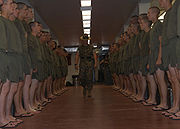
The purpose of the first phase is not only to physically challenge, but also to psychologically break down the recruit. At this point, civilian thoughts and habits are considered detrimental to training, so they are squashed during this period by intense physical training, unchanging routines, strict discipline, and heavy instruction. The process is designed to enable recruits to learn to survive in combat situations and generally to adapt and overcome any unexpected situation. One of the principal ideals learned during this period is that recruits are not to think of themselves as individuals; they are not permitted to use first person or second person
Grammatical person
Grammatical person, in linguistics, is deictic reference to a participant in an event; such as the speaker, the addressee, or others. Grammatical person typically defines a language's set of personal pronouns...
pronouns. Instead, recruits are required to use third-person referrals, such as referring to themselves as "This recruit" and accomplish all tasks with teamwork. Any actions that put the benefit of an individual over the benefit of the other recruits are not permitted, and recruits are expected to conform to a standard that does not tolerate personal deviance or eccentricities. Speed, intensity and volume when speaking are valued as well.
The bulk of first-phase education consists of classes about the Marine Corps and its history
History of the United States Marine Corps
The history of the United States Marine Corps began with the founding of the Continental Marines on November 10, 1775 to conduct ship-to-ship fighting, provide shipboard security and discipline enforcement, and assist in landing forces. Its mission evolved with changing military doctrine and...
and culture
Culture of the United States Marine Corps
The Culture of the United States Marine Corps is widely varied, but unique amongst the branches of the United States armed forces. Because its members are drawn from across the United States , it is as varied as each individual Marine, but tied together with core values and traditions passed from...
, first aid
First aid
First aid is the provision of initial care for an illness or injury. It is usually performed by non-expert, but trained personnel to a sick or injured person until definitive medical treatment can be accessed. Certain self-limiting illnesses or minor injuries may not require further medical care...
, rank structure and insignia
United States Marine Corps rank insignia
Marine ranks in descending order, with tables indicating abbreviations in the style used by the United States Marine Corps, pay grades, and rank insignia:-Commissioned Officers:...
, protocol, customs and courtesies, the 11 General Orders
General Orders for Sentries
Orders to Sentry is the official title of a set of rules governing sentry duty in the United States armed forces. While any guard posting has rules that may go without saying , these orders are carefully detailed and particularly stressed in the United States Navy, United States Marine Corps, and...
, aspects of the five paragraph order
Five paragraph order
The five paragraph order is an element of United States Army, United States Marine Corps and United States Navy Seabees of small unit tactics that specifies instruction to a unit, based on an METT-TC Analysis...
, prepare equipment for use (such as how to properly make a rack), regulations regarding uniforms, and other topics. Recruits learn through the use of rote memorization
Rote learning
Rote learning is a learning technique which focuses on memorization. The major practice involved in rote learning is learning by repetition by which students commit information to memory in a highly structured way. The idea is that one will be able to quickly recall the meaning of the material the...
and mnemonic
Mnemonic
A mnemonic , or mnemonic device, is any learning technique that aids memory. To improve long term memory, mnemonic systems are used to make memorization easier. Commonly encountered mnemonics are often verbal, such as a very short poem or a special word used to help a person remember something,...
s; recruits are expected to be able to recite a passage or quote in unison, without error, and on demand.
Close order drill is an important factor in recruit training, and begins from their first formation on the yellow footprints. In the first phase, they learn all of the basic commands and movements, memorizing the timing through the use of "ditties", or mnemonic
Mnemonic
A mnemonic , or mnemonic device, is any learning technique that aids memory. To improve long term memory, mnemonic systems are used to make memorization easier. Commonly encountered mnemonics are often verbal, such as a very short poem or a special word used to help a person remember something,...
s, that help synchronize a recruit's movements with the rest of his or her platoon. Constant repetition and practice are used to facilitate muscle memory
Muscle memory
Muscle memory has been used synonymously with motor learning, which is a form of procedural memory that involves consolidating a specific motor task into memory through repetition. When a movement is repeated over time, a long-term muscle memory is created for that task, eventually allowing it to...
, so that any given movement can be rendered immediately and accurately upon order without hesitation. To aid in this development, drill movements are worked into other parts of daily life, to help increase the platoon's synchronization and muscle memory; this same technique is used with other non-drill activities as well. For example, a recruit is instructed to hold his/her food tray in a similar fashion to holding the butt of a rifle during "shoulder arms."
During this phase, recruits are familiarized with their rifle. This weapon, never referred to as a "gun", stays with the recruit through the entirety of recruit training, being locked to his or her rack at night, while platoons will stack weapons together under guard for activities where retaining it is impractical, such as swimming. Recruits must memorize the rifle's serial number, the four weapons safety rules, the four weapons conditions, and go through preparatory lessons in marksmanship. In addition, recruits use the rifles in close order drill, and will spend considerable time cleaning their weapons.
Recruits begin work toward earning their tan belt in the Marine Corps Martial Arts Program
Marine Corps Martial Arts Program
The Marine Corps Martial Arts Program is a combat system developed by the United States Marine Corps to combine existing and new hand-to-hand and close quarters combat techniques with morale and team-building functions and instruction in what the Marine Corps calls the "Warrior Ethos". The...
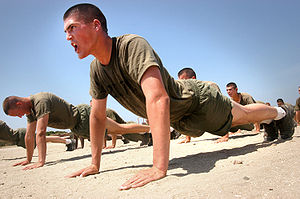
. Physical fitness gradually becomes more and more intense as recruits begin to get stronger and their bodies accustomed to the strain. Recruits undergo the first of their conditioning marches, which will grow in length. Periodic fitness tests assess which recruits need more attention, and those who consistently fail to meet the minimum are in danger of being sent to the PCP. Recruits will conduct two pugil stick
Pugil stick
A pugil stick is a heavily padded pole-like training weapon used by military personnel for training in rifle and bayonet combat since the early 1940s. The pugil stick is similar to a quarterstaff or Japanese bo, and may be marked at one end to indicate which portion represents the bayonet proper...
bouts and are introduced to the obstacle course
Obstacle course
An obstacle course is a series of challenging physical obstacles an individual or team must navigate usually while being timed. Obstacle courses can include running, climbing, jumping, crawling, swimming, and balancing elements with the aim of testing speed and endurance. Sometimes a course...
.
In the last week of the first phase, recruits are taught swimming and water survival. This is the first event where failure to pass will result in a recruit being dropped to a different company to restart training and attempt to qualify again. If a recruit fails twice, he or she will be evaluated to see if a third chance is warranted, or if the recruit will be deemed unable to qualify and administratively separated from service.
By the end of the first phase, recruits can march, respond to orders, pass the first written test, and keep up in physical fitness.
Phase Two
In the first week of the second phase the first inter-platoon contest is held. Termed "initial drill", the platoon and junior-most drill instructor are graded as a whole on their performance in close order drill.
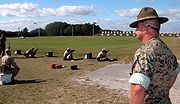
The second week is known as "Grass Week". This week is partly spent in a class setting to learn about marksmanship principles of the M16 and how to shoot efficiently. When not in class, recruits are snapping in, or practicing their firing positions. Recruits are taught how to shoot by a Primary Marksmanship Instructor, a Marine of the MOS 0931. While range personnel wear campaign covers similar to drill instructors, PMIs are not drill instructors and generally not as strict in enforcing discipline upon recruits, focusing on marksmanship and expecting recruits to uphold their own discipline. Marine leaders have not allowed recruits to use the AN/PVQ-31 Rifle Combat Optic
Advanced Combat Optical Gunsight
Advanced Combat Optical Gunsights are a series of telescopic sights manufactured by Trijicon. The ACOG is designed to be used on the M16 rifle and M4 carbine, but Trijicon has developed ACOG accessories for certain other firearms...
,however the first company to use the RCO was Bravo Company who graduated on Sept 9th 2011 preferring to focus on fundamentals and teach the use of optics later, at the School of Infantry
United States Marine Corps School of Infantry
The School of Infantry is the second stage of initial military training for enlisted United States Marines after Recruit Training. Since the initial training pipeline is divided between coasts, Marines from areas east of the Mississippi River usually graduate from MCRD Parris Island and move on to...
.
The third week is called "Firing Week", which ends with Qualification Day. This week recruits are awakened early in the morning to prepare the rifle range
Shooting range
A shooting range or firing range is a specialized facility designed for firearms practice. Each facility is typically overseen by one or more supervisory personnel, called variously a range master or "RSO – Range Safety Officer" in the United States or a range conducting officer or "RCO" in the UK...
for firing. They spend all day running through the Known Distance Course of fire (also known as table 1), in order to practice their marksmanship skills with live rounds. Half of the platoons will fire at the 200 ,, in the standing, sitting, kneeling and prone positions; the other half will mark targets in the pits. Friday of that week is qualification day, where recruits must qualify with a minimum score in order to earn a marksmanship badge and continue training. Those who fail to qualify are given a second opportunity during Team Week; if they fail again, they are dropped and will repeat Grass Week. The Marines are the only branch of the United States Armed Forces
United States armed forces
The United States Armed Forces are the military forces of the United States. They consist of the Army, Navy, Marine Corps, Air Force, and Coast Guard.The United States has a strong tradition of civilian control of the military...
that require the 500 yard line qualification. A trophy is awarded to the platoon with the highest cumulative scores.
After the rifle range, recruits begin Team Week. During this week, recruits are placed in various service jobs around the depot, such as yard work, cleaning, maintenance, etc. During this week, recruits will be able to revisit previous instruction and retake tests. Recruits that need to have medical or dental needs addressed, such as the extraction of wisdom teeth
Wisdom tooth
A wisdom tooth, in humans, is any of the usually four third molars. Wisdom teeth usually appear between the ages of 17 and 25. Most adults have four wisdom teeth, but it is possible to have fewer , or more, in which case they are called supernumerary teeth...
, have those procedures done here so that recovery time impacts training as little as possible. Recruits are also fitted for their service and dress uniforms
Uniforms of the United States Marine Corps
The Uniforms of the United States Marine Corps serve to distinguish Marines from members of other services. Among current uniforms in the United States Armed Forces, the Marines' uniforms have been in service the longest...
.
Many companies choose to end team week with a weekend "field meet", where platoons will compete in several military-related sports events, such as a rifle assembly race, sprints, a short marathon
Marathon
The marathon is a long-distance running event with an official distance of 42.195 kilometres , that is usually run as a road race...
, an obstacle course race, and a tug of war
Tug of war
Tug of war, also known as tug o' war, tug war, rope war or rope pulling, is a sport that directly pits two teams against each other in a test of strength. The term may also be used as a metaphor to describe a demonstration of brute strength by two opposing groups, such as a rivalry between two...
.
Because MCRD San Diego is located in the center of a dense urban area, it is impractical to conduct rifle qualification and field training there. Instead, recruits are sent to the Edson Range
Edson Range
Edson Range is a firing range at Marine Corps Base Camp Pendleton, California. It is named for Marine "Red" Mike Edson.While located on Camp Pendleton, the range is actually an annex of the Marine Corps Recruit Depot San Diego, which is home to four of the largest firing ranges on the base. It...
at Marine Corps Base Camp Pendleton
Marine Corps Base Camp Pendleton
Marine Corps Base Camp Pendleton is the major West Coast base of the United States Marine Corps and serves as its prime amphibious training base...
for three weeks during the second phase. At the conclusion, they are returned to MCRD San Diego to continue training.
Phase Three
Third phase begins with A-line, where recruits learn to fire their rifle under more realistic combat conditions, such as unknown distances, at night, and wearing a gas mask
Gas mask
A gas mask is a mask put on over the face to protect the wearer from inhaling airborne pollutants and toxic gases. The mask forms a sealed cover over the nose and mouth, but may also cover the eyes and other vulnerable soft tissues of the face. Some gas masks are also respirators, though the word...
.
The next week sees recruits at Basic Warrior Training (BWT), where they learn the fundamentals of combat and will sleep in the field and eat MREs. Skills taught include camouflage
Military camouflage
Military camouflage is one of many means of deceiving an enemy. In practice, it is the application of colour and materials to battledress and military equipment to conceal them from visual observation. The French slang word camouflage came into common English usage during World War I when the...
, low crawling, land navigation
Orienteering
Orienteering is a family of sports that requires navigational skills using a map and compass to navigate from point to point in diverse and usually unfamiliar terrain, and normally moving at speed. Participants are given a topographical map, usually a specially prepared orienteering map, which they...
, basic squad tactics, rapelling
Abseiling
Abseiling , rappelling in American English, is the controlled descent down a rock face using a rope; climbers use this technique when a cliff or slope is too steep and/or dangerous to descend without protection.- Slang terms :...
, and other foundations of military skills. BWT ends with the gas chamber
Gas chamber (disambiguation)
Gas chamber may refer to:* Gas chamber, a means of execution where a poisonous gas is introduced into a hermetically sealed chamber, to kill animals.* Various uses for a compartment containing gas, e.g.:...
, where recruits must don and clear their gas mask while exposed to CS gas
CS gas
2-chlorobenzalmalononitrile is the defining component of a "tear gas" commonly referred to as CS gas, which is used as a riot control agent...
, in order to be confident in its use in case of exposure to a lethal agent. Recruits who attempt to flee from the chamber before finishing or refuse to enter are dropped.
After this week, recruits return to garrison for the final drill competition, take the final PFT, and take the final written test (which culminates all of their academic and classroom topics); each event has a trophy for the highest-scoring platoon. At this point, recruits will take their MCMAP test and earn their tan belt; those who fail are dropped. Recruits then prepare for the Crucible.
The Crucible
The Crucible is the final testFinal examination
A final examination is a test given to students at the end of a course of study or training. Although the term can be used in the context of physical training, it most often occurs in the academic world...
in recruit training, and represents the culmination of all of the skills and knowledge a Marine should possess. Designed in 1996 to emphasize the importance of teamwork
Teamwork
Teamwork is action performed by a team towards a common goal. A team consists of more than one person, each of whom typically has different responsibilities....
in overcoming adversity, the Crucible is a rigorous 54-hour field training exercise
Military exercise
A military exercise is the employment of military resources in training for military operations, either exploring the effects of warfare or testing strategies without actual combat...
demanding the application of everything a recruit has learned until that point in recruit training
Recruit training
Recruit training, more commonly known as Basic Training and colloquially called Boot Camp, is the initial indoctrination and instruction given to new military personnel, enlisted and officer...
, and includes a total of 48 miles of marching. It simulates typical combat situations with strenuous testing, hardship, and the deprivation of food and sleep. A recruit is given three MREs (= Meal Ready-to-Eat, a self-contained, individual field ration, previously two and half) and four to eight hours of sleep through the entire 54-hour event. For this event, recruits are broken into squad-sized teams (possibly smaller) and placed under the charge of one drill instructor. West Coast recruits are returned to Edson Range for the Crucible. Parris Island recruits will conduct the Crucible in the derelict Page Airfield on the south end of the depot.
Throughout the Crucible, recruits are faced with physical and mental
Mind
The concept of mind is understood in many different ways by many different traditions, ranging from panpsychism and animism to traditional and organized religious views, as well as secular and materialist philosophies. Most agree that minds are constituted by conscious experience and intelligent...
challenges that must be accomplished before advancing further. Teamwork is stressed, as the majority of tasks are completely impossible without it; each group must succeed or fail as a whole. The others will result in failure unless every recruit passes through together, requiring the team to aid their fellow recruit(s) who struggle in the accomplishment of the given mission. Also stressed are the Corps' core values of Honor, Courage, and Commitment; events sometimes present a moral challenge. Many challenge events are named after Marine Medal of Honor
Medal of Honor
The Medal of Honor is the highest military decoration awarded by the United States government. It is bestowed by the President, in the name of Congress, upon members of the United States Armed Forces who distinguish themselves through "conspicuous gallantry and intrepidity at the risk of his or her...
recipients or otherwise notable Marines, and drill instructors will often take the time to read the citation of the award and hold a guided discussion with the recruits to evaluate their moral development. Drill instructors are also vigilant for those recruits who succeed and fail in leadership positions.
Some of the challenges encountered during the Crucible are various team and individual obstacle courses, day and night assault courses, land navigation courses, individual rushes up steep hills, large-scale martial arts challenges, and countless patrols to and from each of these. Often, these challenges are made even more difficult by the additions of limitations or handicaps, such as the requirement to carry several ammunition drums
Ammunition box
An ammunition box is a container designed for safe transport and storage of ammunition. It is typically made of metal and labelled with caliber, quantity, and manufacturing date or lot number...
, not touching portions of an obstacle painted red to indicate simulated booby traps, and evacuating team members with simulated wounds.
On the final day of the Crucible, recruits are awoken and begin their final march (known as the "Reaper" march on the west coast). Immediately following this, recruits are offered the "Warrior's Breakfast", where they are permitted to eat as much as they like, even of previously forbidden foods, such as ice cream. Following this is the Eagle, Globe, and Anchor
Eagle, Globe, and Anchor
The Eagle, Globe, and Anchor is the official emblem and insignia of the United States Marine Corps. The current emblem traces its roots in the designs and ornaments of the early Continental Marines as well as the British Royal Marines. The present emblem, adopted in 1966, differs from the emblem of...
ceremony, where the recruits receive the eponymous emblem, and thereby cease to be recruits, finally becoming Marines. In recent years, this ceremony has been moved to the day before graduation, and signals the start of Family Day.
Graduation
United States Marine Corps School of Infantry
The School of Infantry is the second stage of initial military training for enlisted United States Marines after Recruit Training. Since the initial training pipeline is divided between coasts, Marines from areas east of the Mississippi River usually graduate from MCRD Parris Island and move on to...
will conduct a brief, and travel arrangements are made for a ten day leave
Leave (military)
In military, leave is a permission to be away from one's unit, either for a specified or unspecified period of time.The term AWOL, standing for absent without leave, is a term for desertion used in armed forces of many English speaking countries....
.
The last full day before graduation is called Family Day. The public day begins early with a "Motivational Run", when the new Marines run (by company, then by platoon) yelling Marine Corps Cadences, past their families; circling the base and ending at the parade deck. The newest Marines are dismissed to on-base liberty with their families from late morning until early evening. During the last night, some platoons allow the recruits to host a gong show
The Gong Show
The Gong Show is an amateur talent contest franchised by Sony Pictures Television to many countries. It was broadcast on NBC's daytime schedule from June 14, 1976 through July 21, 1978, and in first-run syndication from 1976–1980 and 1988–1989. The show was produced by Chuck Barris, who also served...
, where they perform skits regarding humorous moments during training, especially of their drill instructors. Some drill instructors will use this as an excuse to perform incentive training on their platoon one last time.
The next morning, the new Marines form for their graduation ceremony, march across the parade deck, and are dismissed from recruit training by their senior drill instructors.
Continuing education
After ten days of leave, Marines will attend the School of InfantryUnited States Marine Corps School of Infantry
The School of Infantry is the second stage of initial military training for enlisted United States Marines after Recruit Training. Since the initial training pipeline is divided between coasts, Marines from areas east of the Mississippi River usually graduate from MCRD Parris Island and move on to...
(SOI); east coast graduates will attend SOI East at Camp Geiger
Camp Geiger
Camp Geiger is a United States Marine Corps Base. Although not geographically connected, Camp Geiger is part of the Marine Corps Base Camp Lejeune complex, and is home to the United States Marine Corps School of Infantry East for all Marines recruited through the Eastern Recruiting Region. Located...
, while west coast graduates will return to Camp Pendleton for SOI West. Non-infantry
Infantry
Infantrymen are soldiers who are specifically trained for the role of fighting on foot to engage the enemy face to face and have historically borne the brunt of the casualties of combat in wars. As the oldest branch of combat arms, they are the backbone of armies...
Marines will attend a course called Marine Combat Training for 29 days, then proceed to the appropriate school for their Military Occupational Specialty (which vary in length). Infantry Marines attend the Infantry Training Battalion for 59 days. Then these newly-trained Marines are assigned to their first unit.
History
In the earliest years of the Corps, training was performed by the individial Marine Barracks where the individual was recruited before being assigned to a permanent post. Marine non-commissioned officerNon-commissioned officer
A non-commissioned officer , called a sub-officer in some countries, is a military officer who has not been given a commission...
s were responsible for instructing privates in discipline, drill, weapons handling, and other skills. Commandant Franklin Wharton
Franklin Wharton
Franklin Wharton was the third Commandant of the United States Marine Corps.-Biography:Wharton was born into a prominent Philadelphia, Pennsylvania family, the son of Joseph Wharton...
established a formal school for recruits at Marine Barracks, Washington, D.C.
Marine Barracks, Washington, D.C.
Marine Barracks, Washington, D.C. is located at 8th and I Streets, Southeast in Washington, D.C. Established in 1801, it is a National Historic Landmark, the oldest post in the United States Marine Corps, the official residence of the Commandant of the Marine Corps since 1806, and main ceremonial...
in approximately 1808, but no records indicate that this served as a centralized recruit depot, and the training regimen remained inconsistent and primitive due to manpower shortages and lack of funding. For example, recruits at Washington were hastily formed into a battalion in July 1861, and drilled as they marched on their way to the First Battle of Bull Run
First Battle of Bull Run
First Battle of Bull Run, also known as First Manassas , was fought on July 21, 1861, in Prince William County, Virginia, near the City of Manassas...
.
In 1911, Commandant William P. Biddle
William P. Biddle
Major General William Phillips Biddle was the 11th Commandant of the United States Marine Corps.-Biography:...
standardized a mandatory two-month recruit training schedule (including drill, physical exercise, personal combat, and intensive marksmanship qualification with the recently-adopted M1903 Springfield rifle) and set up four depots at Philadelphia, Norfolk
Norfolk, Virginia
Norfolk is an independent city in the Commonwealth of Virginia in the United States. With a population of 242,803 as of the 2010 Census, it is Virginia's second-largest city behind neighboring Virginia Beach....
, Puget Sound
Puget Sound
Puget Sound is a sound in the U.S. state of Washington. It is a complex estuarine system of interconnected marine waterways and basins, with one major and one minor connection to the Strait of Juan de Fuca and the Pacific Ocean — Admiralty Inlet being the major connection and...
, and Mare Island
Mare Island
Mare Island is a peninsula in the United States alongside the city of Vallejo, California, about northeast of San Francisco. The Napa River forms its eastern side as it enters the Carquinez Strait juncture with the east side of San Pablo Bay. Mare Island is considered a peninsula because no full...
. In 1915, the Norfolk depot was shifted to its current location at Parris Island, while the Philadelphia and Puget Sound depots were closed and merged with the two remaining depots. As the United States entered World War I
World War I
World War I , which was predominantly called the World War or the Great War from its occurrence until 1939, and the First World War or World War I thereafter, was a major war centred in Europe that began on 28 July 1914 and lasted until 11 November 1918...
, the number of recruits being trained surged from 835 at any given time to a peak of 13,286, while follow-on training was provided at Quantico
Quantico
Quantico may refer to:* Quantico , a 2005 science fiction/thriller novel by Greg Bear* Quantico, Maryland, an unincorporated community in Wicomico County, Maryland, United States...
and in France. During the summer of 1923, the west coast recruit depot was moved from Mare Island to its current location in San Diego, and the training program was modified to include three weeks of basic indoctrination, three weeks on the rifle range, and the final two weeks was occupied in bayonet drill, guard duty, drill, and ceremonies.
After Congress authorized an increase in manpower in preparation for World War II
World War II
World War II, or the Second World War , was a global conflict lasting from 1939 to 1945, involving most of the world's nations—including all of the great powers—eventually forming two opposing military alliances: the Allies and the Axis...
in September 1939, the syllabus was halved to four weeks to accommodate the influx of recruits. After standards and marksmanship plummeted as a result, the seven-week schedule was returned, and additional training was given at Camps Lejeune or Pendleton for Marines, based on specialties, before being assigned to a unit. An additional segregated depot was established at Montford Point
Camp Gilbert H. Johnson
Camp Gilbert H. Johnson is a satellite camp of Marine Corps Base Camp Lejeune and home to the Marine Corps Combat Service Support Schools . This is where various support Military Occupational Specialties such as administration, supply, logistics, finance, and motor transport maintenance are trained...
for roughly 20,000 African-American recruits, who wouldn't be integrated until 1949. Overall, half a million recruits were trained by the end of the war at the three depots.
During the Korean War
Korean War
The Korean War was a conventional war between South Korea, supported by the United Nations, and North Korea, supported by the People's Republic of China , with military material aid from the Soviet Union...
, training was shortened from ten weeks to eight, but returned afterward to ten. The Ribbon Creek incident
Ribbon Creek Incident
The Ribbon Creek incident is the most common term for events which occurred on the night of April 8, 1956, when Staff Sergeant Matthew McKeon, a junior drill instructor at the Marine Corps Recruit Depot Parris Island, South Carolina, marched his assigned platoon into Ribbon Creek, a swampy tidal...
in 1956 led to considerable scrutiny and reform in recruit training, such as an additional layer of command oversight
Series Commander
The Series Commander is a United States Marine Corps officer assigned to a Recruit Training Company who is responsible for the conduct and instruction of Marine recruits and Marine Corps Drill Instructors within one of the two series, lead or follow...
and the distinctive campaign cover
Campaign hat
A campaign cover is a broad-brimmed felt or straw hat, with a high crown, pinched symmetrically at the four corners .It is associated with the New Zealand Army, the Royal Canadian...
. The Vietnam War
Vietnam War
The Vietnam War was a Cold War-era military conflict that occurred in Vietnam, Laos, and Cambodia from 1 November 1955 to the fall of Saigon on 30 April 1975. This war followed the First Indochina War and was fought between North Vietnam, supported by its communist allies, and the government of...
-era syllabus was shortened to nine weeks, and again saw infantry recruits attend follow-on training at Lejeune and Pendleton.
See also
- Ribbon Creek incidentRibbon Creek IncidentThe Ribbon Creek incident is the most common term for events which occurred on the night of April 8, 1956, when Staff Sergeant Matthew McKeon, a junior drill instructor at the Marine Corps Recruit Depot Parris Island, South Carolina, marched his assigned platoon into Ribbon Creek, a swampy tidal...
- Officer Candidates School (United States Marine Corps)Officer Candidates School (United States Marine Corps)The United States Marine Corps Officer Candidates School is the entry-level training for Marine officers, equivalent to recruit training for enlisted Marines. Located at Marine Corps Base Quantico, the school trains, screens, and evaluates potential Marine Corps officers...
External links
- Marine Recruit Training on the Marine Corps recruiting website
- Official websites for MCRD Parris Island and MCRD San Diego