
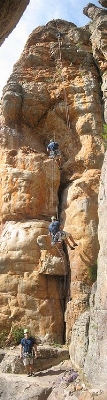
Abseiling rappelling in American English, is the controlled descent down a rock face using a rope;
climbersClimbing is the activity of using one's hands and feet to ascend a steep object. It is done both for recreation and professionally, as part of activities such as maintenance of a structure, or military operations.Climbing activities include:* Bouldering: Ascending boulders or small...
use this technique when a cliff or slope is too steep and/or dangerous to descend without protection.
Slang terms
Slang terms for the technique include:
rapping or
rap jumping (American slang),
deepelling (Canadian slang),
abbing (
British slangBritish slang is English language slang used in the UK. Slang is informal language sometimes peculiar to a particular social class or group and its use in Britain dates back to before the 16th century...
for "abseiling"),
rappling (
HindiStandard Hindi, or more precisely Modern Standard Hindi, also known as Manak Hindi , High Hindi, Nagari Hindi, and Literary Hindi, is a standardized and sanskritized register of the Hindustani language derived from the Khariboli dialect of Delhi...
slang).
The term rappel / rappelling is derived from the French language: French, recall, return, rappel, from Old French, recall, from rappeler, to recall: re-, re- + appeler, to summon.
History
The origin of the abseil is attributed to Jean Estéril Charlet, a
ChamonixChamonix-Mont-Blanc or, more commonly, Chamonix is a commune in the Haute-Savoie département in the Rhône-Alpes region in south-eastern France. It was the site of the 1924 Winter Olympics, the first Winter Olympics...
guide who lived from 1840–1925. Charlet originally devised the technique of the abseil method of roping down during a failed solo attempt of Petit Dru in 1876. After many attempts, some of them solo, he managed to reach the summit of the Petit Dru in 1879 in the company of two other Chamonix guides, Prosper Payot and Frédéric Folliguet, whom he hired. During that ascent, Charlet perfected the abseil.
Equipment
- Rope
A rope is a length of fibres, twisted or braided together to improve strength for pulling and connecting. It has tensile strength but is too flexible to provide compressive strength...
s: Climbers often simply use their climbing ropesKernmantle rope is rope constructed with its interior core protected with a woven exterior sheath that is designed to optimize strength, durability, and flexibility. The core fibers provide the tensile strength of the rope, while the sheath protects the core from abrasion during use...
for rappelling. For many other applications, low-stretch rope (typically ~2% stretch when under the load of a typical bodyweight) called static rope is used to reduce bouncing and to allow easier ascending of the rope.
- Anchors for rappelling are sometimes made with trees or boulders, using webbing and cordellete, or also with rock climbing equipment, such as nuts
In rock climbing, a nut is a metal wedge threaded on a wire, used for protection by wedging it into a crack in the rock. Quickdraws are clipped to the nut wire by the ascending climber and the rope threads through the quickdraw. Nuts come in a variety of sizes and styles, and several different...
, hexes and spring-loaded camming devices. Some climbing areas have fixed anchors for rappelling.
- A descender or rappel device is a friction device or friction hitch that allows rope to be paid out in a controlled fashion, under load, with a minimal effort by the person controlling it. The speed at which the rappeller descends is controlled by applying greater or lesser force on the rope below the device or altering the angle at which the rope exits the device. Descenders can be task-designed or improvised from other equipment. Mechanical descenders include braking bars, the figure eight, the abseil rack, the "bobbin" (and its self-locking variant the "stop"), the gold tail, and the "sky genie" used by some window-washers and wildfire firefighter
Firefighters are rescuers extensively trained primarily to put out hazardous fires that threaten civilian populations and property, to rescue people from car incidents, collapsed and burning buildings and other such situations...
s. Some improvised descenders include the Munter hitchThe Munter hitch, also known as the Italian hitch, is a simple knot, commonly used by climbers and cavers as part of a life-lining or belay system. To climbers, this knot is also known as HMS, the abbreviation for the German term Halbmastwurfsicherung, meaning half clove hitch belay...
, a carabiner wrap, the basic crossed-carabiner brake and the piton bar brake (sometimes called the carabiner and piton). There is an older, more uncomfortable, method of wrapping the rope around one's body for friction instead of using a descender, as in the Dulfersitz or Geneva methods used by climbers in the 1960s.
- A climbing harness
A climbing harness is a piece of equipment used in certain types of rock-climbing, abseiling or other activities requiring the use of ropes to provide access or safety...
is often used around the waist to secure the descender. A comfortable climbing harness is important for descents that may take many hours.
- A prusik, Klemheist knot
The Klemheist knot is a type of friction hitch, used as part of a system to ascend or descend a climbing rope. As with other friction knots, it grips the rope when weight is applied and is free to move when the weight is released...
, or Bachmann knotThe Bachmann is a friction hitch. It is useful when the friction hitch needs to be reset quickly/often or made to be self-tending as in crevasse and self-rescue....
may be used as safety back-up, also called a "third hand," and is used as a back-up in the case of the rappeller losing control of the rappel.
- Helmet
A helmet is a form of protective gear worn on the head to protect it from injuries.Ceremonial or symbolic helmets without protective function are sometimes used. The oldest known use of helmets was by Assyrian soldiers in 900BC, who wore thick leather or bronze helmets to protect the head from...
s are worn to protect the head from bumps and falling rocks. A light source may be mounted on the helmet in order to keep the hands free in unlit areas.
- Glove
A glove is a garment covering the hand. Gloves have separate sheaths or openings for each finger and the thumb; if there is an opening but no covering sheath for each finger they are called "fingerless gloves". Fingerless gloves with one large opening rather than individual openings for each...
s protect hands from the rope and from hits with the wall. They are mainly used by recreational abseilers, industrial access practitioners, adventure racers and military as opposed to climbers or mountaineers. In fact, they can increase the risk of accident by becoming caught in the descender in certain situations.
- Boots or other sturdy footwear with good grips.
- Knee
The knee joint joins the thigh with the leg and consists of two articulations: one between the fibula and tibia, and one between the femur and patella. It is the largest joint in the human body and is very complicated. The knee is a mobile trocho-ginglymus , which permits flexion and extension as...
-pads (and sometimes elbow-pads) are popular in some applications for the protection of joints during crawls or hits.
Application
Abseiling is used in a number of applications, including:
- Climbing
Climbing is the activity of using one's hands and feet to ascend a steep object. It is done both for recreation and professionally, as part of activities such as maintenance of a structure, or military operations.Climbing activities include:* Bouldering: Ascending boulders or small...
, for returning to the base of a climb or to a point where one can try a new route.
- Recreational abseiling.
- Canyoning
Canyoning is traveling in canyons using a variety of techniques that may include other outdoor activities such as walking, scrambling, climbing, jumping, abseiling, and/or swimming....
, where jumping waterfalls or cliffs may be too dangerous.
- Caving
Caving—also occasionally known as spelunking in the United States and potholing in the United Kingdom—is the recreational pastime of exploring wild cave systems...
and speleologySpeleology is the scientific study of caves and other karst features, their make-up, structure, physical properties, history, life forms, and the processes by which they form and change over time...
, where underground pitches-Climbing:In rock climbing and ice climbing, a pitch is a steep section of a route that requires a rope between two belays, as part of a climbing system...
are accessed using this method (Single Rope TechniqueSingle Rope Technique is a set of methods used to descend and ascend on the same single rope. SRT is used in caving, potholing, rock climbing, canyoning, roped access for building maintenance and by arborists for tree climbing.-Historical Developments:...
).
- Adventure racing
Adventure racing is a combination of two or more endurance disciplines, including orienteering and/or navigation , cross-country running, mountain biking, paddling and climbing and related rope skills...
, where events often include abseiling and other rope work.
- Industrial/commercial applications, where abseiling techniques are used to access parts of structures or buildings so as to perform maintenance, cleaning or construction, e.g. steeplejack
A steeplejack is a craftsman who scales buildings, chimneys and church steeples to carry out repairs or maintenance.Britain's most famous steeplejack was Fred Dibnah, who became a television presenter and minor celebrity as a result of his craft....
ing, window cleaning, etc.)
- Access to wildfire
A wildfire is any uncontrolled fire in combustible vegetation that occurs in the countryside or a wilderness area. Other names such as brush fire, bushfire, forest fire, desert fire, grass fire, hill fire, squirrel fire, vegetation fire, veldfire, and wilkjjofire may be used to describe the same...
s.
- Confined spaces access, such as investigating ballast tanks and other areas of ships.
- Rescue
Rescue refers to responsive operations that usually involve the saving of life, or prevention of injury during an incident or dangerous situation....
applications, such as accessing injured people or accident sites (vehicle or aircraft) and extracting the casualty using abseiling techniques.
- (Military) Tactical heliborne insertion of troops and special forces
Special forces, or special operations forces are terms used to describe elite military tactical teams trained to perform high-risk dangerous missions that conventional units cannot perform...
into the battlefield close to the objective when proper landing zones are not available. More commonly used in urban warfareUrban warfare is combat conducted in urban areas such as towns and cities. Urban combat is very different from combat in the open at both the operational and tactical level...
scenarios and is increasingly replaced by fast-ropingFast-roping, sometimes known as Fast Rope Insertion Extraction System , is a technique for descending a thick rope. It is useful for deploying troops from a helicopter in places where the helicopter itself cannot touch down. First developed by the British with UK rope manufacturer Marlow Ropes,...
. Typical examples include: insertion into urban environments, boarding (attack)Boarding, in its simplest sense, refers to the insertion on to a ship's deck of individuals. However, when it is classified as an attack, in most contexts, it refers to the forcible insertion of personnel that are not members of the crew by another party without the consent of the captain or crew...
of sea-going vessels and insertion of forces to seize and secure a landing zone in enemy territory (airheadAn airhead is a designated area in a hostile or threatened territory which, when seized and held, allows the air landing of further troops and material via an airbridge, and provides the maneuver and preparation space necessary for projected operations. Normally it is the area seized in the assault...
assault).
Styles/techniques

- Australian rappel
Australian abseiling is the process of descending a fixed rope in a standing position while facing the ground....
— Involves descending facing down.
- Tandem or spider rappelling — Involves two climbers descending on the same belay device. This is done in some rescue situations when one of the climbers is incapacitated, or the descent needs to be done quickly. The set up is similar to a regular rappelling set up with the first climber is girth hitched off a sling into the descender on the carabiner, and has an auto block from belay loop of the harness to the rope as a backup. The second rappeller is also girth hitched into the belay device on the carabiner and also anchored into the main rappeller's harness as a back-up.
- Simul rappelling — Two separate rappellers on the two strands of the rope running through the anchors. Rappellers need to descend at the same speed as each other and should be anchored into each other to avoid the other getting ahead and causing problems.
- Counterbalance rappelling — Used typically by a leader to reach an injured second. Idea is to rappel off on one strand of rope, using the incapacitated second's weight on the other strand of the rope to counterbalance.
- Releasable abseil - used by some guides for inexperienced abseilers is by setting up a rope by anchoring it with a munter hitch and locking off the non-rappelling strand of the rope. The client descends on the non-locked strand of the rope. If the client gets into trouble, the guide unlocks the other strand and lowers the client or the rappeller. Useful, when it is an inexperienced rappeller or when the rappeller gets into trouble, by getting a piece of clothing or hair entangled in the descender.
- Classical (non-mechanical methods) — are generally more dangerous and used only in emergencies, when no other option is available. They involve descending without aid of mechanical devices, by wrapping the rope around the body, and were used before harnesses and hardware were in common usage.
- South African classical abseil (double-roped)- This method is less dangerous as it provides better body support than the classical abseil.
Safety and ecological issues
Abseiling can be dangerous, and presents risks, especially to unsupervised or inexperienced abseilers. According to German mountaineer Pit Schubert, about 25% of climbing deaths occur during abseiling, most commonly due to failing anchors. Another frequent cause of accidents is abseiling beyond the end of the rope. Backing-up the rope set-up with a friction knot (autoblock, Kleimheist, or prusik) such that the slipping of the rope is stopped even if the climber lets go of the control rope provides a measure of safety with regard to the control of the rate of descent.
Abseiling is prohibited or discouraged in some areas, due to the potential for environmental damage and/or conflict with climbers heading upwards, or the danger to people on the ground.
External links