


Turbodiesel

Encyclopedia
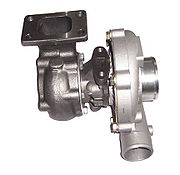
Diesel engine
A diesel engine is an internal combustion engine that uses the heat of compression to initiate ignition to burn the fuel, which is injected into the combustion chamber...
with a turbocharger
Turbocharger
A turbocharger, or turbo , from the Greek "τύρβη" is a centrifugal compressor powered by a turbine that is driven by an engine's exhaust gases. Its benefit lies with the compressor increasing the mass of air entering the engine , thereby resulting in greater performance...
. Turbocharging is the norm rather than the exception in modern car and truck diesel engines. As with any turbocharged engine, turbodiesels can offer higher specific power outputs, lower emissions levels, improved efficiency and higher refinement levels than their naturally aspirated counterparts.
History
The turbochargerTurbocharger
A turbocharger, or turbo , from the Greek "τύρβη" is a centrifugal compressor powered by a turbine that is driven by an engine's exhaust gases. Its benefit lies with the compressor increasing the mass of air entering the engine , thereby resulting in greater performance...
was invented in the early 20th century by Alfred Büchi, a Swiss
Switzerland
Switzerland name of one of the Swiss cantons. ; ; ; or ), in its full name the Swiss Confederation , is a federal republic consisting of 26 cantons, with Bern as the seat of the federal authorities. The country is situated in Western Europe,Or Central Europe depending on the definition....
engineer
Engineer
An engineer is a professional practitioner of engineering, concerned with applying scientific knowledge, mathematics and ingenuity to develop solutions for technical problems. Engineers design materials, structures, machines and systems while considering the limitations imposed by practicality,...
. Büchi specifically intended his device to be used on diesel engine
Diesel engine
A diesel engine is an internal combustion engine that uses the heat of compression to initiate ignition to burn the fuel, which is injected into the combustion chamber...
s- his patent
Patent
A patent is a form of intellectual property. It consists of a set of exclusive rights granted by a sovereign state to an inventor or their assignee for a limited period of time in exchange for the public disclosure of an invention....
of 1905 noted the efficiency improvements that a turbocharger could bring to diesel engines. At the time metal and bearing
Bearing (mechanical)
A bearing is a device to allow constrained relative motion between two or more parts, typically rotation or linear movement. Bearings may be classified broadly according to the motions they allow and according to their principle of operation as well as by the directions of applied loads they can...
technology was not sufficiently advanced to allow a practical turbocharger to be built. The first practical turbodiesels were marine engines fitted to two German
Germany
Germany , officially the Federal Republic of Germany , is a federal parliamentary republic in Europe. The country consists of 16 states while the capital and largest city is Berlin. Germany covers an area of 357,021 km2 and has a largely temperate seasonal climate...
passenger liner
Ocean liner
An ocean liner is a ship designed to transport people from one seaport to another along regular long-distance maritime routes according to a schedule. Liners may also carry cargo or mail, and may sometimes be used for other purposes .Cargo vessels running to a schedule are sometimes referred to as...
s- the Danzig and the Preussen in 1923, each having two 10-cylinder engines of 2,500 horsepower
Horsepower
Horsepower is the name of several units of measurement of power. The most common definitions equal between 735.5 and 750 watts.Horsepower was originally defined to compare the output of steam engines with the power of draft horses in continuous operation. The unit was widely adopted to measure the...
(the naturally aspirated versions of the same engine produced 1,750 HP). By the late 1920s several diesel engine builders were making large turbodiesels for marine and stationary use such as Sulzer Bros.
Sulzer (manufacturer)
Sulzer Ltd. is a Swiss industrial engineering and manufacturing firm, founded by Salomon Sulzer-Bernet in 1775 and established as Sulzer Brothers Ltd. in 1834 in Winterthur, Switzerland. Today it is a publicly owned company with international subsidiaries...
, MAN and Paxman
Paxman (engines)
Paxman is a major British brand of diesel engines. Ownership has changed on a number of occasions since the company's formation in 1865, and now the brand is owned by MAN SE, as part of MAN Diesel & Turbo. At its peak, the Paxman works covered 23 acres and employed over 2,000 people. Engine...
.
Turbocharger technology was improved greatly by developments during World War II
World War II
World War II, or the Second World War , was a global conflict lasting from 1939 to 1945, involving most of the world's nations—including all of the great powers—eventually forming two opposing military alliances: the Allies and the Axis...
and subsequent development of the gas turbine
Gas turbine
A gas turbine, also called a combustion turbine, is a type of internal combustion engine. It has an upstream rotating compressor coupled to a downstream turbine, and a combustion chamber in-between....
. It was now possible to use smaller turbochargers on smaller, higher-speed engines. Diesel locomotive
Diesel locomotive
A diesel locomotive is a type of railroad locomotive in which the prime mover is a diesel engine, a reciprocating engine operating on the Diesel cycle as invented by Dr. Rudolf Diesel...
s with turbodiesels began appearing in the late 1940s and 1950s (such as the ALCO PA
ALCO PA
ALCO PA refers to a family of A1A-A1A diesel locomotives built to haul passenger trains that were built in Schenectady, New York in the United States by a partnership of the American Locomotive Company and General Electric between June, 1946 and December, 1953...
in the United States).
In 1951 Scania-Vabis
Scania-Vabis
Scania-Vabis was a Swedish truck and car manufacturer. The company was formed from a merger of Scania with the firm of Vabis in 1911. The car production ended in 1929...
produced their first turbo engine. It was initially used only for trains and it wasn't until 1954 it was used in trucks. In 1958 Scania-Vabis produced a 10 litre turbodiesel engine giving 205 bhp. Experiments with turbodiesels of a suitable size and speed to be used in an automobile
Automobile
An automobile, autocar, motor car or car is a wheeled motor vehicle used for transporting passengers, which also carries its own engine or motor...
were carried out in the 1960s. The Rover Company (already a builder of industrial gas turbines) built experimental 2.5 liter 4-cylinder turbodiesels (including versions with an intercooler
Intercooler
An intercooler , or charge air cooler, is an air-to-air or air-to-liquid heat exchange device used on turbocharged and supercharged internal combustion engines to improve their volumetric efficiency by increasing intake air charge density through nearly isobaric cooling, which removes...
) in 1963, but did not put the design into production. The first turbodiesel production car was the Mercedes-Benz 300SD
Mercedes-Benz 300
Mercedes-Benz has sold a number of automobiles with the "300" model name:* 1951–1957 W186** 1951–1957 300* 1951–1958 W188** 1951–1958 300S* 1954–1963 W198** 1954–1963 300SL* 1958–1962 W189** 1958–1962 300d...
(series W116
Mercedes-Benz W116
The Mercedes-Benz W116 was a series of flagship vehicles produced from September 1972 through 1979. The W116 automobiles were the first Mercedes-Benz models to be officially called S-Class, although earlier sedan models had already unofficially been designated with the letter 'S' - for...
, engine OM617.950
Mercedes-Benz OM617 engine
The OM617 engine family was a straight-5 Diesel automobile engine from Mercedes-Benz used in the 1970s and 1980s. With some Mercedes-Benz 300D/300SD diesels already exceeding 500,000 miles, it's considered to be one of the most reliable engines ever produced .-OM617.912:The OM617.912 was a...
), introduced in May 1978. It used a Garrett AiResearch
Garrett AiResearch
Garrett AiResearch was a manufacturer of turboprop engines and turbochargers, and a pioneer in numerous aerospace technologies. It was previously known as Aircraft Tool and Supply Company, Garrett Supply Company, AiResearch Manufacturing Company, or simply AiResearch...
turbocharger, and was produced only for the United States
United States
The United States of America is a federal constitutional republic comprising fifty states and a federal district...
. In Europe
Europe
Europe is, by convention, one of the world's seven continents. Comprising the westernmost peninsula of Eurasia, Europe is generally 'divided' from Asia to its east by the watershed divides of the Ural and Caucasus Mountains, the Ural River, the Caspian and Black Seas, and the waterways connecting...
, the first turbodiesel was the Peugeot 604
Peugeot 604
The Peugeot 604 is an executive car produced by the French manufacturer Peugeot from 1975 to 1985. 153,252 examples of the 604 were sold during its 10-year production life. It was made in France and also by Kia in Korea....
in early 1979 (model year 1978). Turbodiesel cars began to be widely built and sold in Europe during the late 1980s and early 1990s, a trend that has continued to the present day.
Characteristics
Improvements in power, fuel economy and Noise, Vibration, and HarshnessNoise, Vibration, and Harshness
Noise, vibration, and harshness , also known as noise and vibration , is the study and modification of the noise and vibration characteristics of vehicles, particularly cars and trucks...
in both small- and large-capacity turbodiesels over the last decade have spurred their widespread adoption in certain markets, notably in Europe where they (as of 2006) make up over 50% of new car registrations. Turbodiesels are generally considered more flexible for automotive uses than naturally aspirated diesels, which have strong low-speed torque
Torque
Torque, moment or moment of force , is the tendency of a force to rotate an object about an axis, fulcrum, or pivot. Just as a force is a push or a pull, a torque can be thought of as a twist....
outputs but lack power at higher speeds. Turbodiesels can be designed to have a more acceptable spread of both power and torque over their speed range or, if being built for commercial use, can be designed to improve either torque or power at a given speed depending on the exact use. Naturally aspirated diesels, almost without exception, have a lower power output than a petrol engine of the same capacity whilst the same time requiring stronger (and thus heavier) internal components such as the piston
Piston
A piston is a component of reciprocating engines, reciprocating pumps, gas compressors and pneumatic cylinders, among other similar mechanisms. It is the moving component that is contained by a cylinder and is made gas-tight by piston rings. In an engine, its purpose is to transfer force from...
s and crankshaft
Crankshaft
The crankshaft, sometimes casually abbreviated to crank, is the part of an engine which translates reciprocating linear piston motion into rotation...
to withstand the greater stresses of the diesel engine's operating cycle. These factors give naturally aspirated diesels a poor power-to-weight ratio. Turbocharger units weigh very little but can offer significant power, torque and efficiency improvements- fitting a turbocharger can bring a diesel engine's power-to-weight ratio up to the same level as an equivalent petrol unit, making turbodiesels desirable for automotive use, where manufacturers aim for comparable power outputs and handling qualities across their range regardless of the type of power unit chosen.
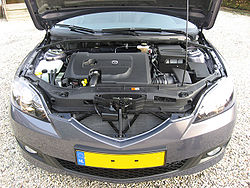
Commercial vehicle
A commercial vehicle is a type of motor vehicle that may be used for transporting goods or passengers. The European Union defines "commercial motor vehicle" as any motorised road vehicle, which by its type of construction and equipment is designed for, and capable of transporting, whether for...
) mean that the turbocharger has to change speed less, reducing turbo lag and improving efficiency. Diesel engine
Diesel engine
A diesel engine is an internal combustion engine that uses the heat of compression to initiate ignition to burn the fuel, which is injected into the combustion chamber...
s do not require dump valves (see the turbocharger
Turbocharger
A turbocharger, or turbo , from the Greek "τύρβη" is a centrifugal compressor powered by a turbine that is driven by an engine's exhaust gases. Its benefit lies with the compressor increasing the mass of air entering the engine , thereby resulting in greater performance...
article for more information). Perhaps most significantly, the diesel engine is immune from detonation because the fuel is not injected until the moment of combustion, so the compression ratio does not have to be reduced, or other anti-detonation measures taken, as would be necessary for a turbocharged spark-ignition engine.The turbodiesel engine can also help with the amount of torque it can give out. Commonly used in trucks, it helps improve the towing capacity of a truck, as well as fuel economy
Fuel economy in automobiles
Fuel usage in automobiles refers to the fuel efficiency relationship between distance traveled by an automobile and the amount of fuel consumed....
.
Turbochargers vs superchargers
A turbocharger is generally more desirable than a superchargerSupercharger
A supercharger is an air compressor used for forced induction of an internal combustion engine.The greater mass flow-rate provides more oxygen to support combustion than would be available in a naturally aspirated engine, which allows more fuel to be burned and more work to be done per cycle,...
unless outright power is required. Turbochargers offer increased power without the same decrease in fuel economy. In both a turbo- and a supercharged engine, power is increased by providing air under pressure to the engine's cylinders
Cylinder (engine)
A cylinder is the central working part of a reciprocating engine or pump, the space in which a piston travels. Multiple cylinders are commonly arranged side by side in a bank, or engine block, which is typically cast from aluminum or cast iron before receiving precision machine work...
. This allows an increased amount of fuel to be burnt, producing more power. However, this inevitably increases fuel consumption. A supercharger is driven directly from the engine and thus its boost output is directly related to engine speed. A turbocharger is more directly controlled by the pressure of the exhaust gas
Exhaust gas
Exhaust gas or flue gas is emitted as a result of the combustion of fuels such as natural gas, gasoline/petrol, diesel fuel, fuel oil or coal. According to the type of engine, it is discharged into the atmosphere through an exhaust pipe, flue gas stack or propelling nozzle.It often disperses...
es which, as well as increasing with engine speed, also vary significantly with engine load
Structural load
Structural loads or actions are forces, deformations or accelerations applied to a structure or its components.Loads cause stresses, deformations and displacements in structures. Assessment of their effects is carried out by the methods of structural analysis...
.
When a diesel engine is put under a load there is greater resistance to the expansion of combustion gases in the cylinder. This increases combustion pressure and temperature which, in turn, increases the pressure and temperature of the exhaust gases. A turbodiesel engine under a heavy load will thus drive its turbocharger at a greater speed than if the same engine is run at the same RPM under little or no load.
This has the effect that a turbocharger delivers boost, thus increasing power (and fuel consumption) only when such a power increase is demanded by putting the engine under a heavy load. A turbodiesel-powered vehicle accelerating from rest, for example, will put its engine under a heavy load, thus causing high boost pressures to be delivered by the turbocharger. This is detected by the fuel injection
Fuel injection
Fuel injection is a system for admitting fuel into an internal combustion engine. It has become the primary fuel delivery system used in automotive petrol engines, having almost completely replaced carburetors in the late 1980s....
system which delivers more fuel to provide more power. Once the vehicle reaches a constant speed and constant engine RPM load decreases significantly, the pressure of the exhaust gases through the turbo drop, boost and fuel delivery decrease, thus lowering fuel consumption to near the same levels as a naturally aspirated diesel engine. If, say, the vehicle starts climbing a gradient, the engine load increases and the turbocharger and fuel system provide more power. Extra fuel is delivered only when needed.
A supercharger delivers near-constant boost pressures, and so fuel consumption suffers. Superchargers have the advantage of having no boost threshold (an RPM level below which a turbocharger does not operate effectively) and almost no lag. Superchargers only need to be connected to the engine's intake system, thus making installation easier and reducing to some extent the increase in internal temperatures that occurs with turbocharging.
Even in engines operating under a constant load (such as electrical generators), turbochargers have advantages over superchargers. The main advantage is that a turbocharger does not "rob" power from the engine to the same extent that a supercharger does. A supercharger takes power directly from the engine's crankshaft
Crankshaft
The crankshaft, sometimes casually abbreviated to crank, is the part of an engine which translates reciprocating linear piston motion into rotation...
to drive it- large units can draw up to 10% of the engine's total power when at full boost, although of course, they provide a power increase much greater than this. Turbochargers are driven by the engine's exhaust gases. A smaller power loss is caused by the turbocharger's turbine
Turbine
A turbine is a rotary engine that extracts energy from a fluid flow and converts it into useful work.The simplest turbines have one moving part, a rotor assembly, which is a shaft or drum with blades attached. Moving fluid acts on the blades, or the blades react to the flow, so that they move and...
restricting the flow of exhaust gases and increasing back-pressure. In a gasoline engine this power-loss is much more pronounced. It is commonly referred to as turbo-lag and is experienced at lower engine speeds. However, since these speeds are where a diesel is most efficient, the turbo spools (spins) very quickly and lag is almost non-existent. The diesel's torque output is increased and a broader range of engine speeds can be used.
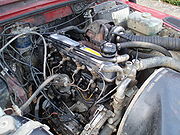
Turbodiesels in the United States
During the 1990s, turbodiesel engines were mainly used in the United StatesUnited States
The United States of America is a federal constitutional republic comprising fifty states and a federal district...
for light truck
Light truck
Light truck or light duty truck is a U.S. classification for trucks or truck-based vehicles with a payload capacity of less than 4,000 pounds...
s. An example is the Ford Power Stroke engine
Ford Power Stroke engine
Power Stroke is the name given to the diesel engines found in Ford Super Duty trucks, Ford Excursion SUVs, Ford Econoline vans, and Ford LCF commercial vehicles. Production by Navistar International Corporation for Ford Motor Company began in mid 1994, in Indianapolis, Indiana, Huntsville,...
series, mounted on Ford F-Series
Ford F-Series
The F-Series is a series of full-size pickup trucks from Ford Motor Company which has been sold continuously for over six decades. The most popular variant of the F-Series is the F-150...
Super Duty pickup truck
Pickup truck
A pickup truck is a light motor vehicle with an open-top rear cargo area .-Definition:...
s, the E-series
Ford E-Series
The Ford E-Series, formerly known as the Econoline or Club Wagon, is a line of full-size vans and truck chassis from the Ford Motor Company. The E-Series is related to the Ford F-Series line of pickup trucks. The line was introduced in 1961 as a compact van and its descendants are still produced...
van
Van
A van is a kind of vehicle used for transporting goods or groups of people.In British English usage, it can be either specially designed or based on a saloon or sedan car, the latter type often including derivatives with open backs...
s and the Excursion
Ford Excursion
The Ford Excursion is a full-size sport utility vehicle that was produced by the Ford Motor Company between model years 2000 and 2005 . Based on the Super Duty pickup truck platform, it served as Ford's largest SUV in its lineup during the tenure of its production and mainly competed against the...
sport utility vehicle
Sport utility vehicle
A sport utility vehicle is a generic marketing term for a vehicle similar to a station wagon, but built on a light-truck chassis. It is usually equipped with four-wheel drive for on- or off-road ability, and with some pretension or ability to be used as an off-road vehicle. Not all four-wheel...
s.
As demand for diesel engines in standard sedan and station wagon
Station wagon
A station wagon is a body style variant of a sedan/saloon with its roof extended rearward over a shared passenger/cargo volume with access at the back via a third or fifth door , instead of a trunk lid...
cars in the United States has been much lower than in Europe
Europe
Europe is, by convention, one of the world's seven continents. Comprising the westernmost peninsula of Eurasia, Europe is generally 'divided' from Asia to its east by the watershed divides of the Ural and Caucasus Mountains, the Ural River, the Caspian and Black Seas, and the waterways connecting...
, the development of smaller automotive turbodiesels has (in general) been led by European manufacturers in recent years. Diesel fuel in the USA (prior to 2006) had a significantly higher level of sulphur than the fuel used in Europe, which meant that diesel-engined cars from European makers had to either be fitted with specially developed fuel and emissions control system for the (prohibitively small) North American market, or simply could not be sold in that market.
After ultra low sulphur diesel
Ultra-low sulfur diesel
Ultra-low-sulfur diesel is a term used to describe diesel fuel with substantially lowered sulfur content...
was introduced in the United States in October 2006, automakers began to offer turbodiesel models which could take advantage of it to reduce emissions. Manufacturers such as Volkswagen
Volkswagen
Volkswagen is a German automobile manufacturer and is the original and biggest-selling marque of the Volkswagen Group, which now also owns the Audi, Bentley, Bugatti, Lamborghini, SEAT, and Škoda marques and the truck manufacturer Scania.Volkswagen means "people's car" in German, where it is...
, BMW
BMW
Bayerische Motoren Werke AG is a German automobile, motorcycle and engine manufacturing company founded in 1916. It also owns and produces the Mini marque, and is the parent company of Rolls-Royce Motor Cars. BMW produces motorcycles under BMW Motorrad and Husqvarna brands...
, Audi
Audi
Audi AG is a German automobile manufacturer, from supermini to crossover SUVs in various body styles and price ranges that are marketed under the Audi brand , positioned as the premium brand within the Volkswagen Group....
, Mercedes-Benz
Mercedes-Benz
Mercedes-Benz is a German manufacturer of automobiles, buses, coaches, and trucks. Mercedes-Benz is a division of its parent company, Daimler AG...
have been releasing cars with four and six-cylinder turbodiesels.
See also
- Common railCommon railCommon rail direct fuel injection is a modern variant of direct fuel injection system for petrol and diesel engines.On diesel engines, it features a high-pressure fuel rail feeding individual solenoid valves, as opposed to low-pressure fuel pump feeding unit injectors...
- Diesel engineDiesel engineA diesel engine is an internal combustion engine that uses the heat of compression to initiate ignition to burn the fuel, which is injected into the combustion chamber...
- Injection pumpInjection pumpAn Injection Pump is the device that pumps fuel into the cylinders of a diesel engine or less typically, a gasoline engine. Traditionally, the pump is driven indirectly from the crankshaft by gears, chains or a toothed belt that also drives the camshaft on overhead-cam engines . It rotates at half...
- IntercoolerIntercoolerAn intercooler , or charge air cooler, is an air-to-air or air-to-liquid heat exchange device used on turbocharged and supercharged internal combustion engines to improve their volumetric efficiency by increasing intake air charge density through nearly isobaric cooling, which removes...
- TurbochargerTurbochargerA turbocharger, or turbo , from the Greek "τύρβη" is a centrifugal compressor powered by a turbine that is driven by an engine's exhaust gases. Its benefit lies with the compressor increasing the mass of air entering the engine , thereby resulting in greater performance...
- Variable geometry turbochargerVariable geometry turbochargerVariable-geometry turbochargers are a family of turbochargers, usually designed to allow the effective aspect ratio of the turbo to be altered as conditions change. This is done because optimum aspect ratio at low engine speeds is very different from that at high engine speeds...