
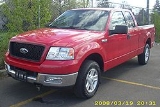
The F-Series is a series of full-size pickup trucks from
Ford Motor CompanyFord Motor Company is an American multinational automaker based in Dearborn, Michigan, a suburb of Detroit. The automaker was founded by Henry Ford and incorporated on June 16, 1903. In addition to the Ford and Lincoln brands, Ford also owns a small stake in Mazda in Japan and Aston Martin in the UK...
which has been sold continuously for over six decades. The most popular variant of the F-Series is the F-150. It was the best-selling vehicle in the United States for 24 years, currently the best-selling truck for 34 years, and the best selling vehicle in Canada, though this does not include combined sales of GM pickup trucks. In the tenth generation of the F-series, the F-250 and F-350 changed body style in 1998 and joined the
Super DutyFor the 1999 model year, Ford shifted the F-250 and F-350 truck lines to a design mechanically and cosmetically distinct from that of the F-150. The F-350 was not available for 1998, while the F-250 was available that year with the F-150's body...
series.
During the post-WWII era, smaller Canadian rural communities had access to either a Ford dealer or a Lincoln-Mercury-Meteor dealer, but not both;
a Mercury-badged versionThe Mercury M-Series pickup truck was produced between 1946 and 1968 by Ford Motor Company of Canada, primarily for the Canadian market. Early versions often came with a higher output Mercury/Ford flathead V8 engine over and above the Unique Mercury Specific Grille, Badging and Trim that adorned...
was sold at Lincoln-Mercury-Meteor dealers there from 1946-1968. Other than the grilles, trim, and badging, these trucks were identical to their Ford counterparts.
First generation (1948–1952)
The first F-Series truck (known as the Ford Bonus-Built) was introduced in 1948 as a replacement for the previous car-based pickup line introduced in 1941. It had a flat, one-piece windshield and integrated
headlampA headlamp is a lamp, usually attached to the front of a vehicle such as a car or a motorcycle, with the purpose of illuminating the road ahead during periods of low visibility, such as darkness or precipitation. Headlamp performance has steadily improved throughout the automobile age, spurred by...
s. It had a wider cab. Options included the "See-Clear" windshield washer (operated by foot plunger), passenger-side windshield wiper & sun visor, and passenger-side taillight. The F-1 truck was also available with additional chrome trim and two horns as an option. All F-series were available with optional "
Marmon-HerringtonThe Marmon-Herrington Company, Inc. is an American-based manufacturer of axles and transfer cases for trucks and other vehicles. Earlier, the company built military vehicles and some tanks during World War II, and until the late 1950s or early 1960s was a manufacturer of trucks and trolley buses...
All Wheel Drive" until 1959.
Design of the F-Series truck changed tremendously from 1960 to 1964. From 1948 to 1950, the grill was a series of horizontal bars and the headlights were set into the fenders. For 1951 and 1952, the headlights were connected by a wide aerodynamic cross piece with three similarly aerodynamic supports. The rear window was wider in the later trucks and the dashboard was redesigned.
F-Series trucks were assembled at sixteen different Ford factories. Serial numbers indicate the truck model, engine, year, assembly plant, and unit number. The most common model was the F-1 with a 6 ½-foot bed followed by the F-2 and F-3 Express models with an 8 feet (2.4 m) bed.
The models are:
- F-1: 1/2 ton
The ton is a unit of measure. It has a long history and has acquired a number of meanings and uses over the years. It is used principally as a unit of weight, and as a unit of volume. It can also be used as a measure of energy, for truck classification, or as a colloquial term.It is derived from...
(4,700 GVWR max)
- F-2: 3/4 ton (5,700 GVWR max)
- F-3: Heavy Duty 3/4 ton (6,800 GVWR max)
- F-3: Parcel Delivery (7,000 GVWR max) & optional rear spring pkg (7,800 GVWR max)
- F-4: 1 ton (7,500 GVWR max) & optional 1¼ ton pkg (10,000 GVWR max)
- F-5: 1½ ton: Conventional, school bus, and cab over engine (C.O.E.) (10,000–14,500 GVWR)
- F-6: 2 ton: Conventional, school bus, and C.O.E. (14,000–16,000 GVWR)
- F-7: Conventional (17,000–19,000 GVWR)
- F-8: Conventional (20,000–22,000 GVWR)
Engines:
| Engine |
Years |
Power |
Usage |
| 226 CID Flathead 6 |
1948–51 |
95 hp at 3,300 rpm |
F-1 through F-6 |
| 239 CID Flathead V8 |
1948–52 |
100 hp at 3,800 rpm |
F-1 through F-6 |
| 254 CID Flathead 6 |
1948–51 |
110 hp at 3,400 rpm |
F-6 only |
337 CID Flathead V-8The Ford flathead V8 was a V8 engine of the flathead type, designed by the Ford Motor Company and built by Ford and various licensees... |
1948–51 |
145 hp at 3,600 rpm |
F-7 and F-8 |
| 215 CID OHV Straight-6 |
1952–53 |
101 hp |
|
| 279 Y-block (EAL) |
1952–55 |
145 hp at 3,800 rpm |
F-7 only |
| 317 Y-block (EAM) |
1952–55 |
155 hp at 3,900 rpm |
F-8 only |
Transmissions:
- 3-speed light-duty, F-1 only
- 3-speed heavy-duty, F-1 through F-5
- 4-speed (spur gear), F-1 through F-6
- 4-speed Synchro-Silent, F-4 through F-6
- 5-speed overdrive, F-7 and F-8
- 5-speed direct drive, F-7 and F-8
Second generation (1953–1956)
The F-Series was redesigned for 1953 with a more integrated look. The pickups also acquired their now familiar names: The F-1 now became the F-100, the F-2 now became the F-250, and the F-3 now became the 1-ton F-350. Optional interior amenities were new, including a dome light, lighter, arm rests, sun visors and a radio. On March 13, 1953, the "Ford-O-Matic" automatic transmission became an option.
The 1953 F-100 was the last year for the flathead in the US. Canadian models, however, (
Mercury M-SeriesThe Mercury M-Series pickup truck was produced between 1946 and 1968 by Ford Motor Company of Canada, primarily for the Canadian market. Early versions often came with a higher output Mercury/Ford flathead V8 engine over and above the Unique Mercury Specific Grille, Badging and Trim that adorned...
), retained the flathead. 1954 saw the introduction of the new 239 CID
overhead valveAn overhead valve engine, also informally called pushrod engine or I-head engine, is a type of piston engine that places the camshaft within the cylinder block , and uses pushrods or rods to actuate rocker arms above the cylinder...
Y-block 8-cylinder, dubbed "Power King." The six-cylinder engine's displacement was also increased from 215 to 223 CID and power steering was introduced as an option. In 1955 the 239 Y-block was replaced with the 272 and 292.
The 1956 F-100 is a one-year only body style. The 1956 F-100 is easily identified as it has vertical windshield pillars and a wrap around windshield as opposed to the sloped pillars and angled windshield of the 1953-55. The 1956 model also offered a larger wrap-around back window as an option. Starting in 1956, Ford offered the very rare "Low GVWR" versions of each model. Also in 1956, seat belts became an option.
Second generation trucks were built in
BrazilBrazil , officially the Federative Republic of Brazil , is the largest country in South America. It is the world's fifth largest country, both by geographical area and by population with over 192 million people...
from 1957 to 1962 as the F-100, F-350 and F-600.
Models:
- F-100: 1/2 ton
The ton is a unit of measure. It has a long history and has acquired a number of meanings and uses over the years. It is used principally as a unit of weight, and as a unit of volume. It can also be used as a measure of energy, for truck classification, or as a colloquial term.It is derived from...
(5,000 GVWR max)
- F-110: 1/2 ton (4,000 GVWR max)
- F-250: 3/4 ton (7,400 GVWR max)
- F-260: 3/4 ton (4,900 GVWR max)
- F-350: 1 ton (9,800 GVWR max)
- F-360: 1 ton (7,700 GVWR max)
Engines:
| Engine |
Years |
Power |
| 215 CID Straight-6 |
1953 |
101 hp |
| 239 CID Flathead V8 |
1953 |
100 hp |
| 223 CID Mileage Maker I6 |
1954–55 |
115 hp |
| 239 CID Y-block V8 |
1954–55 |
130 hp |
| 223 CID Mileage Maker I6 |
1956 |
137 hp |
| 272 CID Y-block V8 |
1956 |
173 hp |
Third generation (1957–1960)
The truck was restyled again in 1957 with a hood that now sat flush with the fenders and a new chrome grille. In the back, Ford started its tradition of distinguishing the two types of pickup boxes; the traditional separate-fender body was called FlareSide, while a new smooth-sided look was known as StyleSide.
Four-wheel driveFour-wheel drive, 4WD, or 4×4 is a four-wheeled vehicle with a drivetrain that allows all four wheels to receive torque from the engine simultaneously...
drive-train, previously outsourced to
Marmon-HerringtonThe Marmon-Herrington Company, Inc. is an American-based manufacturer of axles and transfer cases for trucks and other vehicles. Earlier, the company built military vehicles and some tanks during World War II, and until the late 1950s or early 1960s was a manufacturer of trucks and trolley buses...
, was now produced in-house by Ford beginning in 1959. Ford still offered a "Low GVWR" version of each model.
In May 1957 Ford discontinued building trucks at the
Highland Park Ford PlantThe Highland Park Ford Plant is a former factory located in Highland Park, Michigan at 91 Manchester Avenue . The second production facility for the Model T automobile, it became a National Historic Landmark in 1978.-Description:...
in
Highland Park, Michigan- Geography :According to the United States Census Bureau, the city has a total area of , all land.- Demographics :As of the census of 2000, there were 16,746 people, 6,199 households, and 3,521 families residing in the city. The population density was 5,622.9 per square mile . There were 7,249...
. All light and medium trucks were transferred to 10 other plants in the USA. Heavy-duty trucks (above F-350) were transferred to
Kentucky Truck AssemblyKentucky Truck Plant is an automobile manufacturing plant owned by Ford Motor Company in Louisville, Kentucky. The plant on opened in 1969 and currently employs 5,154 people total. It is located at 3001 Chamberlain Lane in the Northeast corner of the city...
in
Louisville, KentuckyLouisville is the largest city in the U.S. state of Kentucky, and the county seat of Jefferson County. Since 2003, the city's borders have been coterminous with those of the county because of a city-county merger. The city's population at the 2010 census was 741,096...
.
Third generation trucks were built in
BrazilBrazil , officially the Federative Republic of Brazil , is the largest country in South America. It is the world's fifth largest country, both by geographical area and by population with over 192 million people...
as the F-100, F-350 & F-600 from 1962 to 1971.
Models:
- F-100 (F10, F11, F14): 1/2 ton
The ton is a unit of measure. It has a long history and has acquired a number of meanings and uses over the years. It is used principally as a unit of weight, and as a unit of volume. It can also be used as a measure of energy, for truck classification, or as a colloquial term.It is derived from...
(4,000–5,000 GVWR max)
- F-100 (F18, F19)(4×4): 1/2 ton (4,000–5,600 GVWR max)
- F-250 (F25, F26): 3/4 ton (4,900–7,400 GVWR max)
- F-250 (F28, F29)(4×4): 3/4 ton (4,900–7,400 GVWR max)
- F-350 (F35, F36): 1 ton (7,700–9,800 GVWR max)
Engines:
| Engine |
Years |
Power |
| 223 CID Mileage Maker I6 |
1958–60 |
137 hp |
| 272 CID Y-block V8 |
1958 |
173 hp |
| 292 CID Y-block V8 |
1959–60 |
186 hp |
Fourth generation (1961–1966)
The truck was completely redesigned for 1961 with a wider look; Ford also introduced a new style of truck. Unibody trucks, integrating the cab and the box, were produced from 1961 to 1963. From 1964 on, only the traditional separate cab and bed arrangement were available. Power was over 200 hp with the 1965 update of the powertrain. In 1965, the Twin I-Beam front suspension was introduced with
coil springA Coil spring, also known as a helical spring, is a mechanical device, which is typically used to store energy and subsequently release it, to absorb shock, or to maintain a force between contacting surfaces...
s. 1965 also marked the beginning of a completely different chassis; many parts from 1965-1979 interchange such as brakes and motor mounts. The 1965 and 1966 trucks have a "TWIN I-BEAM" emblem on the front fender.
A 4-door crew cab version was also introduced in 1965, which would become a popular option. The Camper Special was built heavier for the slide in campers that were becoming increasingly popular during this time. Ford still offered a "Low GVWR" version of each model. In 1965, the Ranger name first appeared as a styling package for the F-Series pickup trucks. The interior featured bucket seats (from the Mustang) and a curtain over the gas tank.
In 1965, the 300-cubic inch (4.9 L) straight six was introduced (a larger version of the 240-cubic inch Six). It had 7 main bearings and timing gears (no chain or belt). The 300 six would remain in the F-Series lineup until the end of the 1996 model year.
Models:
- F-100 (F10, F11, F14): 1/2 ton
The ton is a unit of measure. It has a long history and has acquired a number of meanings and uses over the years. It is used principally as a unit of weight, and as a unit of volume. It can also be used as a measure of energy, for truck classification, or as a colloquial term.It is derived from...
(4,000–5,000 GVWR max)
- F-100 (F18, F19)(4×4): 1/2 ton (4,000–5,600 GVWR max)
- F-250 (F25): 3/4 ton (7,400 GVWR max)
- F-250 (F26)(4×4): 3/4 ton (4,900 GVWR max)
- F-350 (F35): 1 ton (9,800 GVWR max)
Engines:
Note: HP in Net HP
| Engine |
Years |
Power |
| 223 CID Mileage Maker I6 |
1961–64 |
114 hp |
| 262 CID Mileage Maker I6 |
1961–64 |
132 hp |
| 292 CID Y-block V8 |
1961–64 |
135 hp |
| 240 CID Straight-6 |
1965–66 |
150 hp |
| 300 CID Straight-6 |
1965–66 |
170 hp |
| 352 CID FE V8 |
1965–66 |
172 hp |
Fifth generation (1967–1972)
Another refresh came in 1967 along with a familiar name: the upscale Ranger trim line in addition to the base and Custom Cab trim levels. In 1968, federal regulations required all automotive manufacturers to add side marker reflectors or lights, so Ford redesigned the hood emblems to incorporate reflectors. The same year the trucks received larger versions of Ford's FE engine family with the introduction of the 360 and 390 cubic inch engines. Also changed for 1968 were the heater controls, arm rests, interior door handles and window cranks, and the upper trim moulding on models so equipped. Rear side marker reflectors were also added to the lower bed side panels in 1968, per government regulations. The 302 V8 became an option in late '69. The top trim for 1970 was now named Ranger XLT with Ranger, Sport Custom and Custom rounding off the rest of the line. The fifth generation bodies were noted for durability and simplicity of design making them a favorite for restoration.
Some trucks came with an outer flush mounted bed side compartment/tool box on the passenger side only. Trucks from the Fifth Generation can be identified as to year model by their year specific grille arrangements.
After the 1968 models, Ford discontinued the "Low GVWR" versions. Still available was the Camper Special option, along with the new Explorer Special (a limited edition trim and option package), Contractor's Special(including a behind the seat toolbox and 3/4 ton (F-250) suspension), Farm and Ranch Special, and Heavy-Duty Special. Most of these "specials" from 1967 to 1972 were made in relatively low numbers and are now becoming increasingly difficult to locate.
The fifth-generation F-series was introduced in
BrazilBrazil , officially the Federative Republic of Brazil , is the largest country in South America. It is the world's fifth largest country, both by geographical area and by population with over 192 million people...
in 1971, which remained in production until circa 1992 with a slight redesign and changes in its motorizations. It was the last Ford truck manufactured in the Ipiranga plant, that was soon closed. At the end of the 1972 F100 production a low number of trucks made had the 1973 body.
Models:
- F-100: 1/2 ton
The ton is a unit of measure. It has a long history and has acquired a number of meanings and uses over the years. It is used principally as a unit of weight, and as a unit of volume. It can also be used as a measure of energy, for truck classification, or as a colloquial term.It is derived from...
(5,600 GVWR max)
- F-110: 1/2 ton (4×4)(5,600 GVWR max)
- F-250: 3/4 ton (7,500 GVWR max)
- F-260: 3/4 ton (4×4)(4,800 GVWR max)
- F-350: 1 ton (10,000 GVWR max)
- F-360: 1 ton (4×4)(6,000 GVWR max)
Engines:
| Engine |
Years |
Power |
| 240 CID Straight-6 |
1967–72 |
150 hp |
| 300 CID Straight-6 |
1967–72 |
170 hp |
| 352 CID FE V8 |
1967 |
208 hp |
| 360 CID FE V8 |
1968–72 |
215 hp |
| 390 CID FE V8 |
1967–72 |
255 hp |
| 302 CID Windsor V8 |
1969–72 |
205 hp |
Sixth generation (1973–1979)
The F-Series was redesigned in 1973; the grille featured two silver-metallic plastic inserts divided by an aluminum bar that was part of the main grille frame, with the letters "F O R D" spaced out in a thin rail in the upper part of the grille. Large round headlights were on either side of the grille with the park/turn signal lamps placed above in the same rail where the "FORD" lettering was. Medium-duty models, however, weren't redesigned as drastically as the light-duty trucks. In fact they were incredibly similar to the fifth-generation medium-duty F-Series trucks. In 1976, this familiar "split-grille" design was facelifted slightly to feature black accents around the headlights and a refined appearance overall. In 1978, the round headlight design was retained for the regular Ranger and Custom trim levels. The XLT and "Lariat" trim level incorporated rectangular headlights with optional chrome headlight doors and chrome grille insert. The split grille design was overhauled in favor of a single-piece grille insert design. The headlights were also placed in a more stylized "insert" themselves, and the park/turn signal lamps were now placed below the headlights. Additionally, a new chrome-plated "F O R D" letter set could now be seen on the hood immediately above the grille. A luxury Lariat trim was also introduced for 1978. In 1979, the round headlights were replaced by rectangular headlamps across all the trim levels and the surrounding grille insert that framed the headlamps was now available in either black, or chrome to match that of the aluminum grille frame.
In 1973, a new model was offered, the F350 SRW (single rear wheel) pickup. These were a new heavy-duty pickup with contractors and camping enthusiasts in mind. The trucks rode on a longer-wheelbase chassis but were the same overall length as an F250 pickup. If you ordered the Camper Special package on an F350 SRW it became a Super Camper Special which was designed for the much heavier slide-in campers coming on the market at that time. Other changes included the 1974 introduction of the extended cab version, dubbed SuperCab. The F-150 was introduced in 1975 to help circumvent coming emissions requirements. These came with a maximum payload of 2275 lb (1,031.9 kg) when properly equipped. With the 1/2 ton F-100 still in production, the new F-150 was referred to as the "heavy half" ton by some people.
In 1976, the F-series became the best-selling truck in America, a position it has continued to hold ever since. This generation is noted for the durability of the body panels as Ford used extensive amounts of galvanized sheet metal to fight corrosion. 1977 was the first year for smaller cowl insignias moved near the windshield and the last year for the medium-duty F-500.
The GVWR ratings for these trucks was tied to a combination of wheel, spring, axle and brake combinations. The series code on the ID tag denotes which model and from that it can be determined what weight rating each vehicle has. 4×4 trucks can also be identified by the VIN number and on the ID plate as a serial number. For example, F10 is an F-100 2-wheel drive, but F11 is an F-100 4×4, and so on. Serial numbers beginning with an "X" are SuperCab models.
Starting in 1978, Ford redesigned their
Ford BroncoThe Ford Bronco is a sport utility vehicle that was produced from 1966 to 1996, with five distinct generations. Broncos can be divided into two categories: early Broncos and full-size Broncos ....
and based it upon the F-150. The Bronco was now virtually identical to the F-150, except for its unibody design structure. The new Bronco incorporated design characteristics which eliminated leaky roofs and body flex associated with other full size removable top utility vehicles of the era. This allowed Ford to compete better with the
Chevrolet BlazerSee also Chevrolet Blazer The K5 Blazer was the smallest full size SUV version of the General Motors C/K Trucks family. Introduced to the Chevrolet line in 1969, the full-size Blazer was replaced in 1995 by the Chevrolet Tahoe. In 1970, GMC introduced its own model of the truck, called the Jimmy,...
by offering a larger and more luxurious SUV while minimalizing production costs since many (especially the most complex and expensive) parts were shared with the F-series trucks. The Bronco was only offered with the 351M and 400 V8 engines.
Models:
- F100 F101 F102 F103 F104 F105 F106 F107 F108 F109 F10N: 1/2 ton
The ton is a unit of measure. It has a long history and has acquired a number of meanings and uses over the years. It is used principally as a unit of weight, and as a unit of volume. It can also be used as a measure of energy, for truck classification, or as a colloquial term.It is derived from...
(4,550–5,700 GVWR max)
- F110 F111 F112 F113 : 1/2 ton (4×4)(5,250–6,500 GVWR max)
- F150 F151 : "heavy" 1/2 ton (6,050–6,200 GVWR max)
- F140 F141 F142 F143: "heavy" 1/2 ton (4x4)(6,050–6,500 GVWR max)
- F250 F251 F252 F253 F254 F255 F256 F257 F258 F259: 3/4 ton (6,200–8,100 GVWR max)
- F260 F261 F262 F263 F264 F265 F266: 3/4 ton (4×4) (6,500–8,400 GVWR max)
- F350 F350 F351 F352 F353 F354 F355 F356 F357 F358 F359 F35P: 1 ton (6,000–10,000 GVWR max)
- F-360: 1 ton (4×4) (8,550 GVWR max)
Engines:
| Engine |
Years |
Power (SAE net) |
| 240 CID Straight-6 |
1973–77 |
|
| 300 CID I6 |
1973–79 |
|
| 302 CID Windsor V8 |
1969–72 |
130 hp |
| 360 CID FE V8 |
1973–76 |
145 hp |
| 390 CID FE V8 |
1973–77 |
195 hp |
460 CID 385The Ford 385 engine family was the Ford Motor Company's final big block V8 engine design, replacing the Ford MEL engine and gradually superseding the Ford FE engine family... V8 |
1973–79 |
200–220 hp (150–162 kW) |
| 351 CID 351M V8 |
1977–79 |
150 hp |
| 400 CID 400M V8 |
1977–79 |
169 hp |
Seventh generation (1980–1996/97)
1980-1986
The next major redesign for the F-Series came for the 1980 model year. The new truck had a squarer look, with sharp lines and flat panels; the trucks were designed with improved fuel efficiency in mind, and to this end, Ford added its new
AODThe AOD is a four-speed automatic transmission with overdrive. Introduced in 1980, it was Ford's first four-speed automatic overdrive transmission. The design is based on the same gearset as the 1960s and 1970s...
automatic overdrive (four-speed) transmission as an option on light-duty models. The upscale Ranger trim line was dropped from the F-Series in 1982;
RangerThe Ford Ranger is a pickup truck produced by the Ford Motor Company. The "Ranger" name had previously been used for a premium styling package on the F-Series full-sized pickup trucks since 1965. The name was moved to this line of North American compact trucks for the 1983 model year.In North...
was subsequently applied to the replacement for the
Ford Courier- North America :This was a commercial model based on Ford's full-size stationwagon line. Its model code was designated 78A.From 1952 to 1956 access to the rear storage area was through a unique door hinged on the side. For 1957 and 1958, the rear access door was a combination of the lift gate and...
compact-pickup line. Trim options became XL, XLS, and XLT Lariat. In 1982, a slightly re-designed grille appeared, featuring fewer vertical bars than the previous 1980–1981 grille; for the first time, the corporate Blue Oval logo made its appearance on the grille. This generation of Ford trucks are the latest to become popular restoration projects as most of these trucks are becoming emissions exempt in most states and now old enough to be registered as classics or antiques.
The F-100 was dropped as the base model at the end of 1983 and the now-familiar F-150 took its place as the base model F-Series truck for 1984. This generation also saw extensive use of galvanized body panels to fight corrosion which is now gaining them popularity among restorers. In Mexico, there is an "F-200" which was introduced in 1976. This variant remained until 1991.
The various changes that occurred between the 1981 and 1982 model years were accompanied by a slight cosmetic change- 1980–81 trucks have a plain grille with "FORD" spelled across the front of the hood in chrome letters, similar to the previous generation. 1982–86 models had the letters removed, and a Ford oval placed in the center of the grille. This made the 1982 the first model year to feature a blue oval on the front, something that has been on every model that followed it, with the exception of the 2010 and 2011 F-150 SVT Raptor.
This generation saw two different sets of trim levels:
In 1980 and 1981, there was:
- Custom- Mainly Base model with manual locks/windows, vinyl seat, and black rubber floor mat,but could be had with other options.
- Ranger- Intermediate trim that added a color-keyed floor mat, chrome trim on the door panels,and woodtone dash trim.
- Ranger XLT- A step up from the Ranger that added better seat trim, a color-keyed headliner, color-keyed carpeting, aluminum tailgate trim and optional power windows/locks.
- Ranger Lariat- a step above the XLT that added a plusher interior,and Woodgrain Trim on the door panels.It also featured special "Lariat" emblems on the cab,as well as Ranger Lariat script above the radio.
- Explorer- a limited edition options and trim group with year specific stripes unique to the Explorer. Was combined with one of the other trim levels.
For 1982–1986:
- Base – basically the same as the Custom of the previous years.
- XL – replaced the intermediate Ranger trim for 1982 as the Ranger name would be used for Ford's new compact truck.
- XLS- a new trim level that featured a blacked-out grille, bumpers, headlight bezels, and windshield trim. It also featured a stripe graphics package and black and silver dash trim. Available exterior colors were red, silver, and black.
- XLT Lariat- featured floor carpeting, color-keyed headliner, a standard chrome grille, and optional power windows/door locks. 1984 saw the last year for woodgrain trim on the door panels as 1985–1986 models had a carpeted section applied to the door panels. In 1985 the tailgate trim was changed to a "flat" full width aluminum with a red "reflector" towards the bottom with chrome FORD letters.
- Explorer a limited edition options and trim group with optional year specific stripes unique to the Explorer– The Explorer trim line (1968–1986) was dropped for the 1987 models to introduce the Ford Explorer SUV in 1991. Explorer packages changed every year,and were only offered for a limited time each model year.
- Eddie Bauer-introduced for 1985, an outdoors-themed interior trim package with two-tone exterior paint. Originally also offered with the Bronco, the Eddie Bauer trim would spread to a number of other Ford light trucks.
Powertrain
The big-block 460 CID V8 was dropped for 1980, but returned in 1983 along with the 6.9 L V8
International Harvester IDIThe International Harvester IDI engine is a 4-stroke 8-cylinder Diesel engine used in International Harvester trucks and Ford F-Series pickups from 1982 to 1994...
option. In 1982, the 335-series "Cleveland" V8s were discontinued. The 351C was replaced by the 351 Windsor (an older design that now made its debut in light trucks), while the 400 vanished altogether (Ford's competitors had ceased selling engines in that size range a few years before). The 5.0 L V8 switched over to fuel injection, first as an option in 1985 and then as standard in 1986.
The new
EssexThe Ford Essex V6 engine was a 90° V6 engine family built by Ford Motor Company at the Essex Engine Plant in Windsor, Ontario, Canada. Unlike the British Essex V6, the Canadian Essex used a 90° V configuration, in addition to having different displacements and valvetrains...
V6 was added in 1982, but didn't sell particularly well. It was dropped after 1983, and the long-lived 300 inline six continued as the standard engine through the series. Trucks equipped with the 3-speed manual transmission were the last American vehicles to have a column-shifted manual transmission.
Engines:
| Engine |
Years |
Power |
Torque |
Notes |
| 232 CID Essex V6 |
1982–83 |
110 hp |
183 lbft |
|
| 255 CID Windsor V8 |
1980–81 |
115 hp |
206 lbft |
2bbl |
| 300 CID Straight-6 |
1980 |
117 hp |
227 lbft |
1bbl |
| 300 CID† Straight-6 |
1980 |
120 hp |
229 lbft |
1bbl |
| 300 CID Straight-6 |
1981–86 |
122 hp |
255 lbft |
1bbl |
| 302 CID Windsor V8 |
1980–85 |
133 hp |
233 lbft |
2bbl |
| 302 CID Windsor V8 |
1985–86 |
185 hp |
270 lbft |
EFI |
| 351 CID 351M V8 |
1980–82 |
136 hp |
262 lbft |
2bbl |
| 351 CID Windsor V8 |
1980–82 |
136 hp |
262 lbft |
2bbl |
| 351 CID Windsor V8 |
1983–85 |
150 hp |
280 lbft |
2bbl |
| 351 CID HO Windsor V8 |
1984–86 |
210 hp |
305 lbft |
4bbl |
| 400 CID† 400 V8 |
1980–82 |
136 hp |
310 lbft |
2bbl |
| 420 CID International Harvester IDI The International Harvester IDI engine is a 4-stroke 8-cylinder Diesel engine used in International Harvester trucks and Ford F-Series pickups from 1982 to 1994... diesel V8† |
1983–87 |
170 hp |
315 lbft |
IDI |
460 CID† 385The Ford 385 engine family was the Ford Motor Company's final big block V8 engine design, replacing the Ford MEL engine and gradually superseding the Ford FE engine family... V8 |
1983–84 |
225 hp |
380 lbft |
4bbl |
460 CID†† 385The Ford 385 engine family was the Ford Motor Company's final big block V8 engine design, replacing the Ford MEL engine and gradually superseding the Ford FE engine family... V8 |
1985–86 |
245 hp |
385 lbft |
4bbl |
† Only available F-250 HD and F-350
†† 1984–85 only available on HD F-250 and F-350 models, 1986 available all models
Axles/Differentials
This generation was the first time Ford used
Independent suspensionIndependent suspension is a broad term for any automobile suspension system that allows each wheel on the same axle to move vertically independently of each other. This is contrasted with a beam axle, live axle or deDion axle system in which the wheels are linked – movement on one side affects...
on their full size 4x4 trucks. As well as being the first time any of the Big Three (automobile manufacturers) made a 4x4 full size truck without a solid front axle. Ford & Dana Corporation called this the
Twin Traction BeamThe Twin Traction Beam is an independent suspension system for front drive axles in four-wheel drive Ford F-Series trucks and sport utility vehicles....
or TTB. The F-150 used a
Dana 44The Dana/Spicer Model 44 is an automotive axle manufactured by Dana Corp. and is used extensively among automobile manufacturers and in the automotive aftermarket area as well. The Dana 44 was first manufactured in the 1940s and is still being manufactured today, both front and rear axle variants...
TTB. The rear was a
Ford 9-inch axleThe Ford 9 inch is known as one of the most popular axles in automotive history. Ford ended its production in 1986 however aftermarket companies still produce this axle. The Ford 9 inch is a semi-floating, drop-out axle. It had a GAWR up to 3600 lbs...
with the
Ford 8.8 axleThe Ford 8.8 is an automotive axle manufactured by Visteon at the Sterling Axle Plant in Sterling Heights, MI. It was first used in model year 1983 Ford trucks. The axle was developed to replace the Ford 9-inch axle...
being phased in, in 1983. The F-250 used a 8 lug version of the
Dana 44The Dana/Spicer Model 44 is an automotive axle manufactured by Dana Corp. and is used extensively among automobile manufacturers and in the automotive aftermarket area as well. The Dana 44 was first manufactured in the 1940s and is still being manufactured today, both front and rear axle variants...
TTB called the Dana 44 TTBHD with the
Dana 50The Dana/Spicer Model 50 was an automotive axle manufactured by the Dana Corp. for 25 years and was used solely in OEM Ford applications. Dana 50's were made as front axles only. The Dana 50 has a "50" cast in to the housing and is regarded to have more strength than a Dana 44, but not as much...
TTB being a option. The rear was a
Dana 60The Dana/Spicer Model 60 is an automotive axle manufactured by Dana Corp. and used in OEM "heavy duty" pickup applications by Chevrolet, Dodge, Chrysler, Jeep and Ford. There are rear axle and four wheel drive front steering versions of the Dana 60. It can be readily identified by its straight axle...
until 1985 when Ford phased out the axle for their own
Sterling 10.25The Sterling 10.5 axle is an automotive axle manufactured by Visteon at the Sterling Axle Plant in Sterling Heights, MI. It was first used in model year 1985 Ford trucks. The axle was developed to replace the Dana 60 and Dana 70...
. The F-350 used the Dana 50 TTB in front until a mid-year change in 1985, when the F-350 was fitted with the Dana 60 solid front axle. For the rear axle the F-350 trucks used a Dana 60 for the single rear wheel trucks and a
Dana 70The Dana/Spicer Model 70 is an automotive axle manufactured by Dana Corp. and has been used in OEM heavy duty applications by Chevrolet, Dodge, and Ford. It can be identified by its straight axle tubes, 10 bolt asymmetrical cover, and a "70" cast in to the housing and is visually similar to the...
for the dual rear wheel trucks until 1985 when Ford once again phased in their own Sterling axle.
1987-1991
The 1987 design was more streamlined, and maintenance items were made simpler. Rear antilock brakes were now standard, the first truck to boast this. The five speed
Mazda M5OD transmissionThe M5OD is a line of manual transmissions produced by Mazda and used in Mazda and Ford cars and trucks. Two variants, light-duty R1 and medium duty R2, are made. R1 transmissions have been used in the Ford Ranger, Explorer, Aerostar, and Bronco II...
was added to the lineup in 1988, while still retaining the heavier built Borg-Warner T18 four speed manual transmission. Also for 1988, the flareside box was dropped. For 1987 the 4.9 L (300 CID) had standard
fuel injectionFuel injection is a system for admitting fuel into an internal combustion engine. It has become the primary fuel delivery system used in automotive petrol engines, having almost completely replaced carburetors in the late 1980s....
; for 1988, the 351 CID (5.8 L) and 7.5 L (460 CID) also gained
fuel injectionFuel injection is a system for admitting fuel into an internal combustion engine. It has become the primary fuel delivery system used in automotive petrol engines, having almost completely replaced carburetors in the late 1980s....
, with 1988 being the first year no carbureted engines were offered. 1988 also saw the replacement of the 6.9 L (420 CID)
dieselA diesel engine is an internal combustion engine that uses the heat of compression to initiate ignition to burn the fuel, which is injected into the combustion chamber...
V8 with a 7.3 L (444 CID) International Harvester IDI
dieselA diesel engine is an internal combustion engine that uses the heat of compression to initiate ignition to burn the fuel, which is injected into the combustion chamber...
V8 (now making 180 hp. and 365 ft.lbf. of torque).
Four-wheel-drive improvements included the addition of automatic locking hubs for the F-150 in 1989, and for the rest in 1991. Starting in 1980 (to 1996), Ford offered a four-wheel-drive swing arm independent front suspension called
Twin Traction BeamThe Twin Traction Beam is an independent suspension system for front drive axles in four-wheel drive Ford F-Series trucks and sport utility vehicles....
, or TTB. Based on its I-beam suspension from the mid '60s, Ford mounted a
Dana 44The Dana/Spicer Model 44 is an automotive axle manufactured by Dana Corp. and is used extensively among automobile manufacturers and in the automotive aftermarket area as well. The Dana 44 was first manufactured in the 1940s and is still being manufactured today, both front and rear axle variants...
differential in the driver-side (front) axle beam and transmitted torque to the passenger-side wheel with a double U-jointed axleshaft. Radius arms and coil springs were still used on the F-150's, while the four-wheel-drive F-250s and F-350s got leaf springs. The F-250s received TTB
Dana 50The Dana/Spicer Model 50 was an automotive axle manufactured by the Dana Corp. for 25 years and was used solely in OEM Ford applications. Dana 50's were made as front axles only. The Dana 50 has a "50" cast in to the housing and is regarded to have more strength than a Dana 44, but not as much...
axles and the F-350s got a solid axle
Dana 60The Dana/Spicer Model 60 is an automotive axle manufactured by Dana Corp. and used in OEM "heavy duty" pickup applications by Chevrolet, Dodge, Chrysler, Jeep and Ford. There are rear axle and four wheel drive front steering versions of the Dana 60. It can be readily identified by its straight axle...
. The 5.0 L (302 CID) truck also had an optional "Touch Drive" electronic transfer case. Custom(Dropped after 1988), XL, XLT, and XLT Lariat were the trim options available.
For 1991, a new "Nite" trim package was introduced. It included all blacked-out exterior trim and either a pink or blue/purple stripe and "Nite" decal on the sides of the cargo box. Some sources report that a sport suspension was included, although this is not certain.
F-Super Duty
The F-Super Duty (as the fender emblems stated) models appeared from 1987 to 1997. They were basically F-450s built as an "incomplete vehicle" (chassis cab) due to the fact that there was no bed installed and an aftermarket bed (specific to its future use) was added after the truck's initial build date. It came with dual fuel tanks with a dash-mounted toggle switch to switch between each tank while using only the one fuel gauge. It came with a PTO (Power Take-Off) used to power attachments (like winches or a dump bed) from the transmission. They were rated at about 15000 lb (6,803.9 kg) GVWR (Gross Vehicle Weight Rating). They came with either the standard 7.5 L (460 CID) gas V8 or the optional 7.3 L (444 CID) diesel V8. All wheels were 10-lug with DRW (Dual Rear Wheels). This model should not be confused with the "
Super DutyFor the 1999 model year, Ford shifted the F-250 and F-350 truck lines to a design mechanically and cosmetically distinct from that of the F-150. The F-350 was not available for 1998, while the F-250 was available that year with the F-150's body...
" commercial line of trucks starting with the 1999 model year.
The models are:
- F-150: 1/2 ton
The ton is a unit of measure. It has a long history and has acquired a number of meanings and uses over the years. It is used principally as a unit of weight, and as a unit of volume. It can also be used as a measure of energy, for truck classification, or as a colloquial term.It is derived from...
(6,250 lb GVWR max)
- F-250: 3/4 ton (8,800 lb GVWR max)
- F-350: 1 ton (11,000 lb GVWR max)
- F-Super Duty: 1 ton plus (15,000 lb GVWR max)
Engines:
| Engine |
Years |
Power |
Torque |
Notes |
| 4.9 L I6 |
1987–91 |
165 hp |
275 lbft |
EFI |
| 5.0 L V8 |
1987–91 |
185 hp |
270 lbft |
EFI |
| 5.8 L V8 |
1987 |
210 hp |
305 lbft |
4-bbl. |
| 5.8 L V8 |
1988–91 |
210 hp |
315 lbft |
EFI |
| 7.5 L V8 |
1987 |
225 hp |
362 lbft |
4-bbl. |
| 7.5 L V8 |
1988–91 |
230 hp |
390 lbft |
EFI |
| 6.9 L Diesel V8 |
1982- 1987 |
170 hp |
315 lbft |
IDI |
| 7.3 L Diesel V8 |
1987–91 |
180 hp |
345 lbft |
IDI |
1992–1996/1997
The 1992 truck received a new aerodynamic-looking front end, a new dashboard, and the Flareside bed returned. The "Nite" package introduced in 1991 continued, but was dropped at the end of the 1992 model year.
The 1994 models brought several changes, including a driver's-side
airbagAn Airbag is a vehicle safety device. It is an occupant restraint consisting of a flexible envelope designed to inflate rapidly during an automobile collision, to prevent occupants from striking interior objects such as the steering wheel or a window...
, "CHMSL" third brake light, brake-shift interlock and CFC-free air conditioning. New options in 1994 included remote keyless entry with alarm, a
compact disc playerCar audio/video , auto radio, mobile audio, 12-volt and other terms are used to describe the sound or video system fitted in an automobile. While 12-volt audio and video systems are also used, marketed, or manufactured for marine, aviation, and buses, this article focuses on cars as the most common...
fitted into the regular stereo system, and a
power driver's seatA power seat in an automobile is a front seat which can be adjusted by using a switch or joystick and a set of small electric motors. Most cars with this feature have controls for the driver's seat only, though almost all luxury cars also have power controls for the front passenger seat.In addition...
; an electrochromic inside rear view mirror was also offered in 1994 and 1995 as part of a luxury light package. Following the lead of the
ExplorerThe Ford Explorer is a sport-utility vehicle sold in North America and built by the Ford Motor Company since 1990, as a replacement for the smaller but related Ford Bronco II. It is manufactured in Chicago, Illinois...
, an Eddie Bauer trim line — featuring plusher trim and increased standard features — was added for 1995.
Ford trailed rival General Motors in combined truck sales for much of the ninth generation, though sales steadily rose each year. 500,000 F-Series trucks were sold in 1992, but this rose to nearly 800,000 by 1996, and the Ford had overtaken the combined
ChevroletChevrolet , also known as Chevy , is a brand of vehicle produced by General Motors Company . Founded by Louis Chevrolet and ousted GM founder William C. Durant on November 3, 1911, General Motors acquired Chevrolet in 1918...
and GMC pickup sales for the first time in a decade.
Models:
- F-150: 1/2 ton
The ton is a unit of measure. It has a long history and has acquired a number of meanings and uses over the years. It is used principally as a unit of weight, and as a unit of volume. It can also be used as a measure of energy, for truck classification, or as a colloquial term.It is derived from...
(6,100 lb GVWR max)
- F-250: 3/4 ton (8,300 lb GVWR max)
- F-250 HD: 1992–1997 Heavy Duty 3/4 ton (8,800 GVWR max)
- F-350: 1 ton (10,000 lb GVWR max)
- F-Super Duty: 1 ton plus (15,000 lb GVWR max)
Engines:
| Engine |
Years |
Power |
Torque |
Notes |
| 4.9 L I6 |
1992–93 |
145 hp |
265 lbft |
|
| 4.9 L I6 |
1994–96 |
150 hp |
260 lbft |
|
| 5.0 L V8 |
1992–93 |
185 hp |
270 lbft |
|
| 5.0 L V8 |
1994–96 |
205 hp |
275 lbft |
195 hp for automatic |
| 5.8 L V8 |
1992 |
210 hp |
315 lbft |
|
| 5.8 L V8 |
1993 |
200 hp |
310 lbft |
|
| 5.8 L V8 |
1993–95 |
240 hp |
340 lbft |
Lightning only |
| 5.8 L V8 |
1994–96 |
210 hp |
325 lbft |
|
| 7.5 L V8 |
1992–93 |
230 hp |
390 lbft |
|
| 7.5 L V8 |
1994–97 |
245 hp |
395 lbft |
|
| 7.3 L Diesel V8 |
1992–94 |
185 hp |
360 lbft |
IDI |
| 7.3 L Diesel V8 |
1992.5–94 |
190 hp |
390 lbft |
IDI Turbo |
| 7.3 L Diesel V8 |
1994–97 |
|
|
Direct injection Turbo, Powerstroke Power Stroke is the name given to the diesel engines found in Ford Super Duty trucks, Ford Excursion SUVs, Ford Econoline vans, and Ford LCF commercial vehicles. Production by Navistar International Corporation for Ford Motor Company began in mid 1994, in Indianapolis, Indiana, Huntsville,...
|
The 7.5L and diesel engines were not available on the F-150, and the 4.9L and 5.0L were not available on the F-350 or F-450.
Eighth generation (1997–2004)
Ford took the aero styling further for 1997 with a rounded nose on the new F-series. Since it was the F-150's first major redesign since 1980, the redesigned truck went on a nation-wide 87-stop tour to Ford plants and the external part suppliers in October, 1995 prior to its release. To build anticipation for the redesigned truck, the 1997 model was released in January 1996 with the first ad campaigns airing during
Super Bowl XXXSuper Bowl XXX was an American football game played on January 28, 1996 at Sun Devil Stadium in Tempe, Arizona to decide the National Football League champion following the 1995 regular season...
. Because of the radical styling, Ford predicted that traditional truck buyers wouldn't receive the radical and car-like 1997 too well, so it continued to produce and sell the previous 1996 model alongside the redesigned 1997 model for a few months.
The regular F-250 (light-duty) was basically an F-150 with the same body panels but with a heavy-duty
Sterling 10.5 axleThe Sterling 10.5 axle is an automotive axle manufactured by Visteon at the Sterling Axle Plant in Sterling Heights, MI. It was first used in model year 1985 Ford trucks. The axle was developed to replace the Dana 60 and Dana 70...
and suspension, along with 7 lug wheels. Additionally, the F-250 Light Duty also offered a load leveling rear suspension system. The F-250 HD (Heavy Duty) was in the same series as the F-350. With the arrival of the all new 1999 "
Super DutyFor the 1999 model year, Ford shifted the F-250 and F-350 truck lines to a design mechanically and cosmetically distinct from that of the F-150. The F-350 was not available for 1998, while the F-250 was available that year with the F-150's body...
" series in early 1998, the standard F-250 ('light-duty'), F-250HD (Heavy Duty), & F-350 line was totally dropped and the F-250 (light-duty), which was a temporary model from the start, became the "7700" package for the F-150 (noted on the tailgate emblem).
Completely new, more efficient engines were offered beginning in 1997. A 4.2 L OHV V6, based on Ford's
3.8 L Essex V6The Ford Essex V6 engine was a 90° V6 engine family built by Ford Motor Company at the Essex Engine Plant in Windsor, Ontario, Canada. Unlike the British Essex V6, the Canadian Essex used a 90° V configuration, in addition to having different displacements and valvetrains...
, replaced the 4.9 L OHV I6, while 4.6 and 5.4 liter SOHC V8s replaced the 5.0 and 5.8 liter OHV V8s, also the 7.5 liter big block V8 was replaced by the 6.8 liter V10 for the super duty models respectively. The 4.6 and 5.4 liter V8s were marketed under the name "Triton" and mark the first use of Ford's Modular Single Overhead Cam (SOHC) engines in the F-Series pickups. Ford's own 8.8 IFS replaced the
Dana 44The Dana/Spicer Model 44 is an automotive axle manufactured by Dana Corp. and is used extensively among automobile manufacturers and in the automotive aftermarket area as well. The Dana 44 was first manufactured in the 1940s and is still being manufactured today, both front and rear axle variants...
front end, while the Ford 8.8 rear remained. The Ford Sterling 9.75 axle was also optioned in heavy-duty versions. In 2000 the
Sterling 10.25 axleThe Sterling 10.5 axle is an automotive axle manufactured by Visteon at the Sterling Axle Plant in Sterling Heights, MI. It was first used in model year 1985 Ford trucks. The axle was developed to replace the Dana 60 and Dana 70...
became an option.
A wide variety of body options were available: regular cab and SuperCab, standard or flareside boxes, and short and long beds. A new Lightning was introduced in 1999, and
Harley-DavidsonHarley-Davidson , often abbreviated H-D or Harley, is an American motorcycle manufacturer. Founded in Milwaukee, Wisconsin, during the first decade of the 20th century, it was one of two major American motorcycle manufacturers to survive the Great Depression...
and
King RanchKing Ranch, located in south Texas between Corpus Christi and Brownsville, is one of the world's largest ranches. The ranch, founded in 1853 by Captain Richard King and Gideon K. Lewis, includes portions of six Texas counties, including most of Kleberg County and much of Kenedy County, with...
versions were also created. In 2001 the SuperCrew cab was introduced with four full-size doors. In 2002, an FX4 model was introduced which came with skid plates,a carbon steel frame,
RanchoRancho may refer to:*Alta California land grants in the 19th century; see Ranchos of California*Rancho High School, a North Las Vegas high school*Rancho Los Amigos National Rehabilitation Center**Rancho Los Amigos Scale...
shock absorbers, and specific 17" aluminum wheels along with more standard features that were optional on XLT. In 2003, a sporty STX trim package was introduced, aimed at younger truck buyers. The STX package featured color keyed front/rear bumpers along with clear lens headlights and integrated round fog lamps. The package also featured chrome step rails, 17" chrome wheels, and a Kenwood Z828 stereo was installed in place of the standard Ford radio.
This generation F-150 received an overall "Poor" rating by the
Insurance Institute for Highway SafetyThe Insurance Institute for Highway Safety is a U.S. non-profit organization funded by auto insurers, established in 1959 and headquartered in Arlington, Virginia. It works to reduce the number of motor vehicle crashes, and the rate of injuries and amount of property damage in the crashes that...
(IIHS) in the frontal offset test, and was ranked the 2nd Worst Performimg Vehicle behind the 1997–2005 GM U-platform minivans.
Sales of the F-150 surged in the tenth generation from 750,000 to over 900,000 in 2001 as the
General MotorsGeneral Motors Company , commonly known as GM, formerly incorporated as General Motors Corporation, is an American multinational automotive corporation headquartered in Detroit, Michigan and the world's second-largest automaker in 2010...
and
DodgeDodge is a United States-based brand of automobiles, minivans, and sport utility vehicles, manufactured and marketed by Chrysler Group LLC in more than 60 different countries and territories worldwide....
products lagged. Ford's sales dropped, however, for the final years of this generation as the redesigned Dodge trucks were released.
The new F-150 was
Motor TrendMotor Trend is an American automobile magazine. It first appeared in September 1949, issued by Petersen Publishing Company in Los Angeles, and bearing the tag line "The Magazine for a Motoring World". Petersen Publishing was sold to British publisher EMAP in 1998, who sold the former Petersen...
magazine's
Truck of the YearCar of the Year is a phrase usually considered to have been invented by Motor Trend magazine in the 1950s for their annual award for best American automobile...
for 1997. The grille was updated in 1999 with minor interior updates as well. The SuperCrew was added to the lineup in 2001. Ford manufactured a limited run of "Heritage" F-150s of this body style in 2004 (as 2004 model years) to finish out production.
Ford has found that the cruise control system in many of their trucks could catch fire, because the switch system could corrode over time, overheat and ignite. Ignition was later blamed on spillage from the adjacent master cylinder. On March 5, 2007 Ford recalled 155,000 2003 full-size pickups and full-size SUVs for the defective part. During the previous two years Ford had recalled 5.8 million vehicles in because of the defective cruise control systems in trucks, SUVs and
vanA van is a kind of vehicle used for transporting goods or groups of people.In British English usage, it can be either specially designed or based on a saloon or sedan car, the latter type often including derivatives with open backs...
s. That recall, one of the largest in history, covered vehicles from the 1994–2002 model years.
This generation of F-150 was sold in Mexico until the twelfth generation 2010 model was released there.
Engines:
| Engine |
Years |
Power |
Torque |
Notes |
| 4.2 L Essex V6 |
1997–2003 |
202 hp |
252 lbft |
|
| 4.6 L Triton V8 |
1997–98 |
220 hp |
280 lbft |
|
| 4.6 L Triton V8 |
1999–2003 |
231 hp |
293 lbft |
|
| 5.4 L Triton V8 |
1997–98 |
235 hp |
330 lbft |
|
| 5.4 L Triton V8 |
1999–2003 |
260 hp |
350 lbft |
|
| 5.4 L Supercharged Triton V8 |
1999–2000 |
360 hp |
450 ft.lbf |
Lightning |
| 5.4 L Supercharged Triton V8 |
2001–2003 |
380 hp |
450 ft·lbf |
Lightning |
| 5.4 L Supercharged Triton V8 |
1999–2003 |
340 hp |
425 ft·lbf |
Harley-Davidson |
| 6.8 L Triton V10 |
1999–2003 |
310 hp |
425
ft·lbf |
Super Duty Only |
| 7.3 L Power Stroke Turbo Diesel V8 |
1999–2003 |
250 hp |
500 ft·lbf |
Super Duty Only |
Ninth generation (2004–2008)
In 2004, Ford redesigned the F-150 using the new P2 platform. The side windows also changed to a
KenworthKenworth is an American manufacturer of medium and heavy-duty Class 8 trucks based in Kirkland, Washington, United States, a suburb of Seattle. It is a subsidiary of PACCAR, and is also a former manufacturer of transit buses and school buses.-History:...
"Daylight Door" and
Ford Super DutyFor the 1999 model year, Ford shifted the F-250 and F-350 truck lines to a design mechanically and cosmetically distinct from that of the F-150. The F-350 was not available for 1998, while the F-250 was available that year with the F-150's body...
-like appearance; dipping towards the front of the door. Initially, only Ford's 4.6 L Triton or new 3-valve 5.4 L 3V Triton
V8 engineA V8 engine is a V engine with eight cylinders mounted on the crankcase in two banks of four cylinders, in most cases set at a right angle to each other but sometimes at a narrower angle, with all eight pistons driving a common crankshaft....
s and four-speed
automatic transmissionAn automatic transmission is one type of motor vehicle transmission that can automatically change gear ratios as the vehicle moves, freeing the driver from having to shift gears manually...
s were offered to the retail public on the new trucks. In 2005, Ford's 4.2 L
EssexThe Ford Essex V6 engine was a 90° V6 engine family built by Ford Motor Company at the Essex Engine Plant in Windsor, Ontario, Canada. Unlike the British Essex V6, the Canadian Essex used a 90° V configuration, in addition to having different displacements and valvetrains...
V6 and
manual transmissionA manual transmission, also known as a manual gearbox or standard transmission is a type of transmission used in motor vehicle applications...
became available and standard on base models after they were available only for fleet orders for 2004.
The F-250 and F-350
Ford Super DutiesFor the 1999 model year, Ford shifted the F-250 and F-350 truck lines to a design mechanically and cosmetically distinct from that of the F-150. The F-350 was not available for 1998, while the F-250 was available that year with the F-150's body...
(on the P3 platform) are a different class (over 8500 lb (3,855.5 kg) GVWR) than the regular F-series lineup, although they are still F-series trucks.
Most F-Series have two large "closed loop" front tow hook design (no hooks on some 2wd models) as opposed to conventional open hooks. The F-Series can pull up to 30000 lb (13,607.8 kg) with just one hook.
For the 2006 model year beginning in December, 2005, a flex-fuel version of the 3-valve 5.4 L Triton V8 became available. Also for the 2006 model year, an updated front bumper with circular fog lamps and a smaller bumper vent distinguished the 2006-2008 models from the 2004-2005 F-150. Other updates included improved front seats with more supportive side bolstering, and new 20" wheels were available on FX4, Lariat and King Ranch. A navigation system became an option for the first time, being offered on the Lariat and King Ranch, as well as the all-new Harley Davidson trim. Not leaving the XLT unnoticed, Ford offered an XLT Chrome Package, also known as XTR in Canada, as well as a Lariat Chrome package. SIRIUS satellite radio became available on all trims except the XL. The FX4 became more upscale with a Luxury package, making it almost an alternative trim to the Lariat. A Harley-Davidson special edition was offered for 2006, being available in AWD or 2WD, and only in SuperCab. for 2007, a SuperCrew Harley Davidson was offered. Other mid-cycle refresh improvements included Five inch Running boards, traction assist on 2WD V8 models, and an all new "Smokestone Clearcoat Metallic" paint on Lariat only.
For 2007, Ford introduced a complement to the existing FX4 model, the new FX2 Sport package (a 2-wheel-drive truck with an appearance package).
Ford states a properly equipped 2007 F-150 (Long Wheel Base, 2WD model only) can tow up to 11000 lb (4,989.5 kg) maximum and 1800–3050 lb maximum payload.
This generation F-150 got top safety ratings (5 stars) from the NHSTA in frontal collisions, and not only got a "Good" rating from the Insurance Institute for Highway Safety's frontal offset test, but also a Best Pick. The dummy sensors recorded no injuries to any body region.
Saleen offers their own OEM version of the F-150, badged as the S331. Additionally, Roush offers an aftermarket version with similar power. Beginning with the second half of the 2007 model year, Ford offered the Saleen forced-induction package on the Harley edition as an OEM option.
The F-150 Foose Edition debuted in fall 2007 as a 2008 model. Based on an F-150 FX2 Sport, it uses a Roush-developed powertrain. The supercharged 5.4 L V8 puts out 450 hp and 500 lbft of torque.
Awards, sales accomplishments
The new F-150 earned the
North American Truck of the YearThe North American Car of the Year is an automobile award voted annually in January at the North American International Auto Show in Detroit. The jury consists of no more than 50 automotive journalists.-Example:-Pre-1994:-1994-1999:-2000-2009:...
award for 2004 and was
Motor TrendMotor Trend is an American automobile magazine. It first appeared in September 1949, issued by Petersen Publishing Company in Los Angeles, and bearing the tag line "The Magazine for a Motoring World". Petersen Publishing was sold to British publisher EMAP in 1998, who sold the former Petersen...
magazine's
Truck of the YearCar of the Year is a phrase usually considered to have been invented by Motor Trend magazine in the 1950s for their annual award for best American automobile...
for 2004. It also beat the three-time winning
Chevrolet SilveradoThe Chevrolet Silverado , is the latest line of full-size pickup trucks from General Motors.-History:...
for
Car and DriverCar and Driver is an American automotive enthusiast magazine. Its total circulation is 1.31 million. It is owned by Hearst Magazines, who purchased prior owner Hachette Filipacchi Media U.S. in 2011...
magazine's
Best Pickup TruckCar and Driver magazine annually nominates a list of what it considers the Ten Best cars and Five Best trucks.All production vehicles for sale in that calendar year are considered with these restrictions:# The vehicle must be on sale by January...
for 2004 and 2005. Additionally, over 939,000 F-Series trucks were sold in 2005, a
single-year sales record for trucks.
As a popular fleet vehicle, this generation of the F-Series has garnered a number of awards from fleet management professionals. The 2006 F-150 was named Fleet Truck of the Year by Automotive Fleet and Business Fleet magazines, and the 2007 models of the F-150, F-250 and F-350 were chosen Best Fleet Value vehicles in their respective categories by automotive data-analysis firm Vincentric. Winner of the 2006–2007 Golden Icon Award (presented by Travolta Family Entertainment) for "Best Truck".
| Engine |
Years |
Power |
Torque |
| 4.0 L V6 |
2004–2008 |
202 hp |
260 lbft |
| 4.6 L V8 |
2004–2007 |
231 hp |
293 lbft |
| 4.6 L V8 |
2008 |
248 hp |
293 lbft |
| 5.4 L V8 |
2004–2008 |
300 hp |
365 lbft |
Tenth generation (2009–present)
Ford revealed the next generation 2009 F-150 design at the
North American International Auto ShowThe North American International Auto Show is an annual auto show held in Detroit, Michigan at Cobo Center, usually in January. It is among the largest auto shows in North America.-History:...
in January, 2008. Production of the series began in October 2008 at Ford's Kansas City Assembly Plant. The truck features a larger and more flexible interior, an updated three-bar grille, and additional choices of cab styles and trim levels. The chassis includes lighter-weight, high-strength steel for better fuel economy and safety and improved payload and towing capacity. Three engines were initially offered with the 2009 redesign: a revised 5.4 L 3-valve Triton V8 that is
E85E85 is an abbreviation for an ethanol fuel blend of up to 85% denatured ethanol fuel and gasoline or other hydrocarbon by volume. E85 is commonly used by flex-fuel vehicles in the US, Canada, and Europe. Some of the benefits of E85 over conventional gasoline powered vehicles include the potential...
capable with an output rating of 320 hp and 395 lbft of torque, a 292 hp 4.6 L 3-valve V8, and a 248 hp 4.6 L 2-valve V8. The 3-valve 5.4 and 4.6 liter V8s are mated to Ford's new 6R80E 6-speed automatic transmission while the 4R75E 4-speed automatic transmission used previously is carried over for the 2-valve 4.6 L V8. The 4.2 L OHV V6 engine, which was previously available, has been dropped due to the closure of the Essex engine plant where it was produced.
A top-of-the-line Platinum edition F-150 replaced the
Lincoln Mark LTThe Mark LT is a luxury pickup truck that was manufactured by the Lincoln division of American automaker Ford Motor Company. It first went on sale in January 2005 for the 2006 model year. The Mark LT is a successor to the failed 2002-only Lincoln Blackwood , Lincoln's only other pickup truck, which...
truck. However, this trim line is still sold as the Lincoln Mark LT in Mexico.
The 2009 Ford F150 features front-seat side impact airbags and Ford's Safety Canopy System for the first and second rows as Head protection in the event of a side impact. It will also feature Ford's exclusive ADVANCETRAC RSC (Roll Stability Control)--an Electronic Stability control and anti-rollover safety feature also available in other Ford vehicles, from the Fusion to the Expedition.
The
manual transmissionA manual transmission, also known as a manual gearbox or standard transmission is a type of transmission used in motor vehicle applications...
option was dropped in 2009. 2009 was the last year when Flareside Box was available, and the last year when the 17" wheels for the FX4 Off-Road were available. In 2010 the only box will be Styleside, and the base wheels for FX4 will be 18".
For the 2011 model year, an all-new engine lineup is offered. Two of the engines, a 3.7 L V6 and a 5.0 L V8, are based on the 2011 Ford Mustang engines, and both offer E85 flex-fuel capability. The 6.2 L V8 used in the 2011
Ford Super DutyFor the 1999 model year, Ford shifted the F-250 and F-350 truck lines to a design mechanically and cosmetically distinct from that of the F-150. The F-350 was not available for 1998, while the F-250 was available that year with the F-150's body...
is available with the F-150 Platinum, Lariat, SVT Raptor, and Harley Davidson editions. Finally, the 3.5 L
direct-injectedIn internal combustion engines, gasoline direct injection , also known as petrol direct injection or direct petrol injection, is a variant of fuel injection employed in modern two-stroke and four-stroke gasoline engines...
twin-turboTwin-turbo refers to a turbocharged engine, in which two turbochargers compress the intake charge. There are two commonly used twin turbo configurations: parallel twin-turbo and sequential twin-turbo...
EcoBoost V6 was offered in the F-150 starting in early 2011. All engines are paired with a new six-speed automatic transmission (6R80). Electric power-assisted steering is available on all engines besides the 6.2. Since 2008, the Ford F-150 has towing and hauling capacity of 11,300 lbs and 3,060 lbs, respectively.
| Engine |
Years |
Power |
Torque |
| 4.6 L (281 CID) 2V V8 |
2009–2010 |
248 hp @ 4750 rpm |
294 lbft @ 4000 rpm |
| 4.6 L (281 CID) 3V V8 |
2009–2010 |
292 hp @ 5700 rpm |
320 lbft @ 4000 rpm |
| 5.4 L (330 CID) 3V V8 |
2009–2010 |
310 hp @ 5000 rpm |
365 lbft @ 3500 rpm |
| 5.4 L (330 CID) 3V V8 (E85) |
2009–2010 |
320 hp @ 5000 rpm |
390 lbft @ 3500 rpm |
| 3.7 L Ti-VCT V6 4V |
2011 |
302 hp @ 6500 rpm |
278 lbft @ 4000 rpm |
| 3.5 L 4V Ecoboost V6 |
2011 |
365 hp @ 5000 rpm |
420 lbft @ 2500 rpm |
| 5.0 L (302 CID) 4V V8 |
2011 |
360 hp @ 5500 rpm |
380 lbft @ 4250 rpm |
| 6.2 L (379 CID) 2V V8 |
2011 |
411 hp @ 5500 rpm |
434 lbft @ 4500 rpm |
| 6.2 L (379 CID) 2V V8 (SVT Raptor) |
2010–2011 |
411 hp @ 5500 rpm |
434 lbft @ 4500 rpm |
Ford originally planned to reintroduce the F-100, known internally as P525, as global replacement for
Ford RangerThe Ford Ranger is a pickup truck produced by the Ford Motor Company. The "Ranger" name had previously been used for a premium styling package on the F-Series full-sized pickup trucks since 1965. The name was moved to this line of North American compact trucks for the 1983 model year.In North...
in 2010 or 2011, but the plan was cancelled, instead offering EcoBoost engines for the F-150.
Safety
The F-150 comes standard with AdvanceTrac
Electronic Stability ControlElectronic stability control is a computerized technology that may potentially improve the safety of a vehicle's stability by detecting and minimizing skids. When ESC detects loss of steering control, it automatically applies the brakes to help "steer" the vehicle where the driver intends to go...
, front and rear row side curtain airbags, and front row torso side airbags. In the
Insurance Institute for Highway SafetyThe Insurance Institute for Highway Safety is a U.S. non-profit organization funded by auto insurers, established in 1959 and headquartered in Arlington, Virginia. It works to reduce the number of motor vehicle crashes, and the rate of injuries and amount of property damage in the crashes that...
(IIHS) crash tests the F150 received the Good overall score in both front and side impact tests and was given the Top Safety Pick award.
The U.S.
National Highway Traffic Safety AdministrationThe National Highway Traffic Safety Administration is an agency of the Executive Branch of the U.S. government, part of the Department of Transportation...
(NHTSA) F150 crash test results:
- Frontal Driver:
- Frontal Passenger:
- Side Driver:
- Side Rear Passenger:
- 2wd Rollover:
- 4wd Rollover:
Concepts
At the 2008
SEMASpecialty Equipment Market Association of the automobile aftermarket was formed in 1963 by Roy Richter, Ed Iskenderian, Willie Garner, Bob Hedman, John Bartlett, Phil Weiand, Jr., Al Segal, Dean Moon, and Vic Edelbrock, Jr...
show, four 2009 Ford F-150s were unveiled: the F-150 Heavy Duty DEWALT Contractor, the FX-4 by X-Treme Toyz, the F-150 by Street Scene Equipment, and the Hi-Pa Drive F-150. The Heavy Duty DEWALT Contractor was built in a
DeWaltDeWalt is a worldwide brand of power tools for the construction, manufacturing and woodworking industries. It is a subsidiary of Stanley Black & Decker.- History :...
theme. The FX-4, also called Fahrenheit F-150, was built for outdoor lifestyle enthusiasts. The Street Scene Equipment version is a lowered truck built with performance and style. The Hi-Pa Drive F-150 was powered by 4 electric in-wheel motors rated over 480 hp and over 375 ft.lbf torque combined.
European version
Following the merger of the Ford Focus, the European subsidiary will not bring the
next generation Ford RangerThe Ford Ranger, code named T6, was unveiled at the Australian International Motor Show in Sydney. The T6 replaces two regional Ranger platforms: the Mazda BT-50-derived model sold in the Latin America, Europe, and Asia-Pacific regions and the North American model sold in select Latin American...
into their market. Instead, they will develop a European version of the F-Series, which will be based on the North American version, but with some major changes to meet the latest emissions requirements.
SVT Lightning
The SVT Lightning is a sports/performance version of the F-150, released by Ford's SVT (Special Vehicle Team) division.
1993-1995
Ford introduced the Lightning in 1993 to compete with primarily the Chevrolet 454 SS, in an effort to enhance the sporty, personal-use image of the Ford F-Series pickup. This initial Lightning featured performance handling developed by world-champion driver
Jackie StewartSir John Young Stewart, OBE , better known as Jackie Stewart, and nicknamed The Flying Scotsman, is a Scottish former racing driver and team owner. He competed in Formula One between 1965 and 1973, winning three World Drivers' Championships. He also competed in Can-Am...
. The Lightning was powered by a special 240 hp version of the 351 cu in (5.8 l) V8 engine. The Lightning shared its basic platform structure with the regular F-150, but modifications were made to many vehicle systems, including enhancing the Lightning chassis to increase rigidity. The stock Lightning was capable of achieving 0.88 g lateral acceleration, yet it retained almost all the hauling and trailering capabilities of the parent F-Series. A 351 cu in (5.8 l) Windsor V8 producing 240 hp (179 kW) and 340 ft·lbf (461 N·m) of torque replaced the standard F-150 engine. The engine was based on an existing block, but Ford engineers fitted it with high flow rate "GT40" heads and used hypereutectic pistons to increase response, output and durability.
An upgraded Ford E40D
automatic transmissionAn automatic transmission is one type of motor vehicle transmission that can automatically change gear ratios as the vehicle moves, freeing the driver from having to shift gears manually...
was the only available transmission. An aluminum
driveshaftA drive shaft, driveshaft, driving shaft, propeller shaft, or Cardan shaft is a mechanical component for transmitting torque and rotation, usually used to connect other components of a drive train that cannot be connected directly because of distance or the need to allow for relative movement...
connected it to 4.10:1 rear gears. Special 17" aluminum wheels with
FirestoneThe Firestone Tire and Rubber Company is an American tire company founded by Harvey Firestone in 1900 to supply pneumatic tires for wagons, buggies, and other forms of wheeled transportation common in the era. Firestone soon saw the huge potential for marketing tires for automobiles. The company...
Firehawk tires, Lightning badging, a front air dam with fog lamps, a 120 mi/h speedometer and a special intake manifold all differentiated the Lightning from normal F-150s. Bucket seats with electrically-adjustable side bolsters and
lumbarIn tetrapod anatomy, lumbar is an adjective that means of or pertaining to the abdominal segment of the torso, between the diaphragm and the sacrum ...
supports were part of the package. Suspension modifications provided a 1 in front and 2.5 in rear drop in ride height.
The 1993 Lightning, launched on 15 December 1992 by Ford President Ed Hagenlocker, received more than 150 favorable articles in America's newspapers, magazines, and television outlets, and helped Ford regain leadership in the personal-use truck market. Three-time World Champion driver Jackie Stewart was highly involved in fine-tuning of the Lightning's handling. Key Ford engineers, managers, and executives involved in developing the original Lightning Performance Truck were Jim Mason, Robert Burnham, Jim Englehart, Terry DeJonckheere, Rory Carpenter, Bob Hommel, Terrell Edgar, Dick Liljestrand, Deb Neill, Adolfo Mejia, and Fred Gregg.
| Year | Engine | Power | Torque | Black Trucks | Red Trucks | White Trucks | Total Production |
| 1993 |
5.8 L Windsor FIFuel injection is a system for admitting fuel into an internal combustion engine. It has become the primary fuel delivery system used in automotive petrol engines, having almost completely replaced carburetors in the late 1980s.... V8A V8 engine is a V engine with eight cylinders mounted on the crankcase in two banks of four cylinders, in most cases set at a right angle to each other but sometimes at a narrower angle, with all eight pistons driving a common crankshaft....
|
240 hp (179 kW) |
340 ft·lbf (461 N·m) |
2,691 |
2,585 |
N/A |
5,276 |
| 1994 |
1,382 |
1,165 |
1,460 |
4,007 |
| 1995 |
824 |
695 |
761 |
2,280 |
| Total |
11,563 |
1999-2004
In 1999, after a three-year hiatus, Ford SVT unveiled a new Ford Lightning powered by a modular SOHC 16-valve 5.4 L Triton engine producing 360 hp and 440 ft.lbf, with a factory-installed Eaton
superchargerA supercharger is an air compressor used for forced induction of an internal combustion engine.The greater mass flow-rate provides more oxygen to support combustion than would be available in a naturally aspirated engine, which allows more fuel to be burned and more work to be done per cycle,...
. The 4R100 automatic transmission was used, and the rear gear ratio was 3.55:1. The Lightning featured 18" wheels and
GoodyearThe Goodyear Tire & Rubber Company was founded in 1898 by Frank Seiberling. Goodyear manufactures tires for automobiles, commercial trucks, light trucks, SUVs, race cars, airplanes, farm equipment and heavy earth-mover machinery....
Eagle F1 295/45ZR-18 tires. The suspension system, which lowers the truck one inch in front and two inches in the rear, was also modified from the standard F-150. It retained the front short-and long-arm system with coil springs and a 31 mm solid stabilizer bar along with the rear solid axle with five-leaf springs and a 23 mm solid stabilizer bar. Monroe shocks were used from 1999-2001 then replaced with Bilstein shocks from 2002-2004.
For the 2001 model year, the engine design was slightly altered to produce 380 hp @ 4,750 rpm and 450 ft.lbf @ 3,250 rpm. Also, the previously leaky intercooler was redesigned. This problem was addressed as a recall in earlier models. A cast iron block was used instead of aluminum. These upgrades were critical in order to support the 8 psi (0.55 bar) of boost delivered from the stock Eaton M112 roots supercharger. Another engine revision came in the 2003 Model Year when a weakness in the heads, the lack of sufficient threads for spark plugs, was addressed and fixed, although "piston slap", a mild knocking noise while the engine is cold, was still present. At the other end of the drivetrain, the final drive ratio was shortened to 3.73:1 with an 9.5 inch rear end in 2001. Also, in 2001 the drive shaft was increased in size to a 4.5 inches (114.3 mm) aluminum unit, from the previous 3.5 inches (88.9 mm) steel unit. The specially developed 295/45ZR-18 Goodyear Eagle F1-GS unidirectional tires were upgraded utilizing a new generation F1 GS rubber compound. With these engine and drivetrain revisions,
Car and DriverCar and Driver is an American automotive enthusiast magazine. Its total circulation is 1.31 million. It is owned by Hearst Magazines, who purchased prior owner Hachette Filipacchi Media U.S. in 2011...
magazine drove a Lightning from zero to 60 mi/h in 5.2 seconds. For 2003, the Lightning's cargo capacity was raised from 800 lb (362.9 kg). to 1350 lb (612.3 kg).
The second generation Lightning was initially offered in just Bright Red, Black, and White paint colors. The 2000 Model Year brought the addition of the Silver color to the lineup. In 2002, True Blue, a very dark blue, was offered, but replaced with a lighter Sonic Blue in 2003. The 2003 Model Year also saw the introduction of the Dark Shadow Gray color.
These trucks were manufactured at Ford's Canada Truck Facility in Oakville, Ontario until its closure. Special features specific to the Lightning included:
- 5.4L 2V Triton Supercharged Intercooled V8 engine
- Modified 4R100 4-speed automatic transmission with OD lockout
- Limited-slip differential
- Auxiliary transmission fluid cooler
- Eaton supercharger
- Engine super cooling system
- Heavy duty battery
- Unique front fascia with integrated, round fog lamps
- Unique upper and lower grilles
- Unique front lower air deflectors
- Unique cab rocker and lower box moldings
- Unique wheels and tires
- 4-wheel ABS / 4-wheel disc brakes
- Heavy duty front and rear shock absorbers
| Year | Engine | Power | Torque | Production |
| 1999 |
5.4 L supercharged Triton V8A V8 engine is a V engine with eight cylinders mounted on the crankcase in two banks of four cylinders, in most cases set at a right angle to each other but sometimes at a narrower angle, with all eight pistons driving a common crankshaft....
|
360 hp (268 kW) |
440 ft·lbf (597 N·m) |
4,000 |
| 2000 |
4,966 |
| 2001 |
380 hp (283 kW) |
450 ft·lbf (610 N·m) |
6,381 |
| 2002 |
4,726 |
| 2003 |
4,270 |
| 2004 |
3,781 |
| Total |
28,124 |
SVT Raptor
Raptor began hitting showrooms in late 2009 as a dedicated off-roader. It debuted in 2010 and sales were much better than expected. It was powered by a 5.4L (330 CID) engine, with a 6.2L option. The 6.2L (379 CID) engine has 411 hp and 434 ft.lbf of torque. The suggested retail price was $3000 over the 5.4L model. A six-speed automatic is standard. It has Fox Racing Shox internal bypass shocks with external reservoirs which allows for 11" of suspension travel in front, and 12" in the rear. It will come standard with 35" BFGoodrich All Terrain tires, and a rear
Locking differentialA locking differential, diff-lock or locker is a variation on the standard automotive differential. A locking differential may provide increased traction compared to a standard, or "open" differential by restricting each of the two wheels on an axle to the same rotational speed without regard to...
with a 4.10:1 gear ratio. Also, it will be available in solid black, white, blue, and orange with a "digital mud" decal scheme as an option. In April 2011, Ford sold 1,186 Raptors, outselling Honda's Ridgeline. The first production Raptor, orange with the digital mud graphic, sold at an auction for $130,000. Ford donated all proceeds above the MSRP to charity. The race version, F-150 SVT Raptor R, was built for the
Baja 1000SCORE Baja 1000 is an off-road race that takes place on Mexico's Baja California Peninsula in November. The Baja 1000 is part of the SCORE Championship Desert Racing Series that include the Baja 500, San Felipe 250 and the new San Felipe Challenge of Champions in place of the Primm 300 which had...
races. It uses a 6.2 L engine rated at 500 hp.
2011
In August 2010, Ford announced the 2011 SVT Raptor would be powered exclusively with the 6.2L V8 as the only engine choice. Other notable changes to the 2011 SVT Raptor include availability in a 4-door Super Crew cab and a new color option Ingot Silver Metallic making the Raptor available in a total of five colors.
2012
The 2012 Raptors eliminated the open differential in the front end in favor of a Torsen helical gear limited slip differential.
Body, Frame, and Features
From the A-pillar forward, the Raptor has a composite hood and fenders different from other F-150s and is bereft of the blue oval badge in the grille. SVT widened the track by 7 inches, and so its 5.5-foot box is unique to the Raptor as well. The Raptor's height is 2 inches over a standard Supercrew. It also features new, internal bypass shocks, designed by
Fox Racing ShoxFox Racing Shox is a brand used by Fox Factory to sell off road racing suspension components.- History :Fox Racing, Inc. was founded in 1980 by Bob Fox in Watsonville, California. It started as a small business distributing suspension components for motocross bikes...
.
The Raptor has new leaf springs and shocks, new front upper- and lower-A-arms, and a wider, thicker-walled rear axle. It's the first Ford with hill-descent control and comes with an electronic differential locker that lets the driver keep it locked at high speeds when the Raptor's Off Road Mode is engaged. Off Road Mode is a feature unique to the Raptor which allows more controlled, aggressive driving while in situations where increased traction and braking are necessary. The Raptor's Off Road Mode allows ABS, roll stability control and traction control to be completely turned off giving the driver total control over the driving experience. Off Road Mode also changes the Raptor's throttle sensitivity and transmission shift points causing a more linear power curve for low traction situations.
Towing capacity is up to 8,000 pounds with a 1,770-pound payload (Super Crew only). Interior changes include high-bolster seats, a special steering wheel, a redesigned center console and auxiliary switches connected to pre-wired pass though leads allowing ease of aftermarket product installation. Ford originally promised a value price and a multi-year run—final pricing came in at $42,000.00 for 2010.
2011 frame issues
In June 2011, a group of 14 Ford F-150 SVT Raptor owners took an off-roading trip, during which 10 of these 14 trucks suffered bent frames. The lack of other damage to the trucks led to speculation about potentially inadequate frame design. A Ford engineer from
SVTSpecial Vehicle Team, also known as SVT, is an arm of Ford Motor Company responsible for the development of the company's highest-performance vehicles, much like Mercedes-AMG, BMW M, Chrysler's SRT division and GM's Performance Division. SVT is the successor to the SVO division.The current SVT...
stated the trucks were driven too fast and may have even had the
Speed limiterA speed limiter is a governor used to limit the top speed of a vehicle. For some classes of vehicle and in some jurisdictions they are a statutory requirement, for some other vehicles the manufacturer provides a non-statutary system which may be fixed or programmable by the driver.-Mopeds:Mopeds in...
removed.
Gas Mileage
The Ford Raptor's fuel economy is rated at 11 miles per US gallon (4.6 km/L) city and 14 miles per US gallon (5.9 km/L) highway.
2010 Harley-Davidson F-150
On February 10, 2009 at the
Chicago Auto ShowThe Chicago Auto Show is held annually in February at Chicago's McCormick Placeconvention complex. It is among the largest auto shows in North America....
, the latest edition of the F-150 was introduced. Adopting many luxury features of the Platinum Edition, this Harley went one step further by providing leather seating surfaces derived from authentic Harley biker-jacket materials, as well as the requisite exhaust tones and power to reach a top speed of 115 miles per hour (185.1 km/h).
F-150 Platinum
Ford ceased sales of the
Lincoln Mark LTThe Mark LT is a luxury pickup truck that was manufactured by the Lincoln division of American automaker Ford Motor Company. It first went on sale in January 2005 for the 2006 model year. The Mark LT is a successor to the failed 2002-only Lincoln Blackwood , Lincoln's only other pickup truck, which...
in the United States and Canada after the 2008 model year. In its place beginning in the 2009 model year, Ford created an upper-end trim of the 2009 F-150 called F-150 Platinum. Sales continued in Mexico, because the Ford F-150 was sold as the Ford Lobo until the 2010 model was released there.
Motorsports
In 2008, Ford announced its intention to enter Baja 1000 race class 8 race. The race team consisted driver of record Steve Oligos and co-drivers Randy Merritt, Greg Foutz and Bud Brutsman, competing in class eight for moderately modified, full-size pickup trucks. The vehicle was built in collaboration between the Ford Special Vehicle Team (SVT), Ford Racing, and Foutz Motorsports Inc. Ford F-150 SVT Raptor R completed the 2008 41st Tecate SCORE Baja 1000 race in 25:28:10, or 3rd rank within the class.
In Best In The Desert race series, an F150 SVT Raptor R completed the "Terrible's 250" race placing 2nd overall in Class 8000.
In January 2010 a single Raptor SVT (#439), driven by Chilean driver
Javier Campillay, competed in the Argentina-Chile Dakar Rally. However, the truck was unable to finish due a catch-up crash with another car, which had stopped in the middle of a dusty road in the middle of stage 7. In January 2011 two Raptors started in
Buenos AiresBuenos Aires is the capital and largest city of Argentina, and the second-largest metropolitan area in South America, after São Paulo. It is located on the western shore of the estuary of the Río de la Plata, on the southeastern coast of the South American continent...
, Campillay returned with a more reliable Raptor (#375), and American female driver
Sue Mead entered with a T2 Raptor(#374). Mead crossed the finish line in Buenos Aires, winning the "Super Production" class; the team has pulled off the first North American class win in Dakar history, and brought the Raptor to the finish after more than 9500 km in some of
South AmericaSouth America is a continent situated in the Western Hemisphere, mostly in the Southern Hemisphere, with a relatively small portion in the Northern Hemisphere. The continent is also considered a subcontinent of the Americas. It is bordered on the west by the Pacific Ocean and on the north and east...
’s harshest environments. Campillay was unable to finish the 12th stage after losing time due to mechanical failure in the 11th stage, leading to his disqualification for not reaching the race camp on time.
Awards and recognition
The Ford F-150 has won numerous awards; In 2009 alone, it received:
- Motor Trend 2009 Truck of the Year Award
- 2009 Best Redesigned Vehicle from Kelley Blue Book’s kbb.com
- Top honors as "Truck of Texas" as well as "Best Luxury Pickup" for the 2009 F-150 King Ranch from Texas Auto Writers Association
- "Best Overall Half-Ton Pickup" from PickupTrucks.com
- "Automotive Excellence" award in the Workhorse Category from Popular Mechanics
- "Top Safety Pick" from the Insurance Institute for Highway Safety for its standard safety technology: Safety Canopy side curtain air bags and AdvanceTrac with Roll Stability Control
- "Residual Value" award from Automotive Leasing Guide (ALG) for retaining the highest percentage of its original price among 2009 full-size light-duty pickups at the end of a conventional three-year lease, based on ALG projections
- Motor Trend's Truck Trend Top 5 Trucks from Specialty Equipment Market Association (SEMA) for 2009 Ford F-150 Heavy Duty DeWalt Contractor Concept
- "Accessory-Friendly Truck" Design Award from SEMA
Sales
| Calendar Year |
United States | Canada | Total |
| 1999 |
869,001 |
|
|
| 2000 |
876,716 |
|
|
| 2001 |
911,597 |
|
|
| 2002 |
813,701 |
|
|
| 2003 |
845,586 |
|
|
| 2004 |
939,511 |
|
|
| 2005 |
901,463 |
|
|
| 2006 |
796,039 |
|
|
| 2007 |
690,589 |
|
|
| 2008 |
515,513 |
|
|
| 2009 |
413,625 |
|
|
| 2010 |
528,349 |
97,913 |
626,262 |
Footnotes
45. ^ White, Joseph. "Ford's New Pickup Line: Like My Tough V-6?" Wall Street Journal 8 August 2010: D1.
46. ^ Lavrinc, Damon. "Spy Shots: 2011 Ford F-150 EcoBoost V6." Auto Blog. 21 May 2010. Web. 08 Sept. 2010.
.
External links