

Intercooler

Encyclopedia
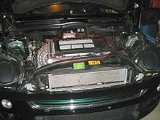
An intercooler or charge air cooler
, is an air-to-air or air-to-liquid heat exchange device
used on turbocharged
and supercharged
(forced induction
) internal combustion engine
s to improve their volumetric efficiency
by increasing intake air charge density through nearly isobaric
(constant pressure) cooling, which removes the heat of compression (i.e., the temperature rise) that occurs in any gas when its pressure is raised or its unit mass per unit volume (density) is increased. A decrease in intake air charge temperature sustains use of a more dense intake charge into the engine, as a result of supercharging. The lowering of the intake charge air temperature also eliminates the danger of pre-detonation (knock) of the fuel air charge prior to timed spark ignition. Thus preserving the benefits of more fuel/air burn per engine cycle, increasing the output of the engine. Intercoolers increase the efficiency of the induction system by reducing induction air heat created by the turbocharger and promoting more thorough combustion. They also eliminate the need for using the wasteful method of lowering intake charge temperature by the injection of excess fuel into the cylinders' air induction chambers, to cool the intake air charge, prior to its flowing into the cylinders. This wasteful practice (when intercoolers are not used) nearly eliminated the gain in engine efficiency from supercharging, but was necessitated by the greater need to prevent at all costs the engine damage that pre-detonation engine knocking causes.
The inter prefix in the device name originates from historic compressor
designs. In the past, aircraft engines were built with charge air coolers that were installed between multiple stages of supercharging, thus the designation of inter. Modern automobile
designs are technically designated aftercoolers because of their placement at the end of supercharging chain. This term is now considered archaic in modern automobile terminology since most forced induction vehicles have single-stage superchargers or turbochargers although "aftercooler" is still in common use in the piston engined aircraft industry. In a vehicle fitted with two-stage turbocharging, it is possible to have both an intercooler (between the two turbocharger units) and an aftercooler (between the second-stage turbo and the engine). The JCB Dieselmax
land speed record-holding car is an example of such a system. In general, an intercooler or aftercooler is said to be a charge air cooler.
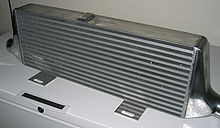
Intercoolers can vary dramatically in size, shape and design, depending on the performance and space requirements of the entire supercharger system. Common spatial designs are front mounted intercoolers (FMIC), top mounted intercoolers (TMIC) and hybrid mount intercoolers (HMIC). Each type can be cooled with an air-to-air system, air-to-liquid system, or a combination of both.

 Turbocharger
s and supercharger
s are engineered to force more air mass into an engine's intake manifold and combustion chamber. Intercooling is a method used to compensate for heating caused by supercharging, a natural byproduct of the semi-adiabatic compression process. Increased air pressure can result in an excessively hot intake charge, significantly reducing the performance gains of supercharging due to decreased density
. Increased intake charge temperature can also increase the cylinder combustion temperature, causing detonation
, excessive wear, or heat damage to an engine block.
Passing a compressed and heated intake charge through an intercooler reduces its temperature (due to heat rejection) and pressure (due to flow restriction of fins). If properly engineered, the relative decrease in temperature is greater than the relative loss in pressure, resulting a net increase in density. This increases system performance by recovering some losses of the inefficient compression process by rejecting heat to the atmosphere. Additional cooling can be provided by externally spraying a fine mist onto the intercooler surface, or even into the intake air itself
, to further reduce intake charge temperature through evaporative cooling.
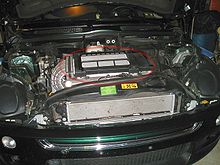
Intercoolers that exchange their heat directly with the atmosphere are designed to be mounted in areas of an automobile with maximum air flow. These types are mainly mounted in front mounted systems (FMIC). Cars such as the Nissan Skyline
, Saab
, Volvo 200 Series
Turbo, Volvo 700 Series
(and 900 series) turbo, Dodge SRT-4
, 1st gen Mazda MX-6
, Mitsubishi Lancer Evolution
and Chevrolet Cobalt SS
all use front mounted intercooler(s) mounted near the front bumper, in line with the car's radiator.
Many other turbo-charged cars, particularly where the aesthetics of the car are not to be compromised by unattractive top mount scoops, such as the Toyota Supra
(JZA80 only), Nissan 300ZX Twin Turbo, Nissan 200SX
(S13/14/14a/15), Mitsubishi 3000gt, Saab 900
, Volkswagen
, Audi TT
, and Turbo Mitsubishi Eclipse
use side-mounted air-to-air intercoolers (SMIC), which are mounted in the front corner of the bumper or in front of one of the wheels. Side-mounted intercoolers are generally smaller, mainly due to space constraints, and sometimes two are used to gain the performance of a larger, single intercooler. Cars such as the Subaru Impreza WRX
, MINI Cooper S, Toyota Celica GT-Four
, Nissan Pulsar GTI-R
, Mazdaspeed3
, Mazdaspeed6, and the PSA Peugeot Citroën
turbo diesels, use air-to-air top mounted intercoolers (TMIC) located on top of the engine. Air is directed through the intercooler through the use of a hood scoop
. In the case of the PSA cars the air flows through the grille above the front bumper, then through under-hood ducting. Top mounted intercoolers sometimes suffer from heat diffusion due to proximity with the engine, warming them and reducing their overall efficiency. Some World Rally Championship
cars use a reverse-induction system design whereby air is forced through ducts in the front bumper to a horizontally-mounted intercooler.
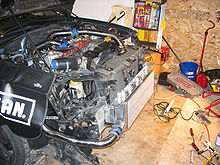 Because FMIC systems require open bumper design for optimal performance, the entire system is vulnerable to debris. Some engineers choose other mount locations due to this reliability concern. FMICs can be located in front of or behind the radiator, depending on the heat dissipation needs of the engine.
As well as allowing a greater mass of air to be admitted to an engine, intercoolers have a key role in controlling the internal temperatures in a turbocharged engine. When fitted with a turbo (as with any form of supercharging), the engine's specific power
is increased, leading to higher combustion and exhaust temperatures. The exhaust gases passing through the turbine section of the turbocharger are usually around 450 °C (840 °F), but can be as high as 1000 °C (1830 °F) under extreme conditions. This heat passes through the turbocharger unit and contributes to the heating of the air being compressed in the compressor section of the turbo. If left uncooled this hot air enters the engine, further increasing internal temperatures. This leads to a build up of heat that will eventually stabilise, but this may be at temperatures in excess of the engine's design limits- 'hot spots' at the piston
crown or exhaust valve can cause warping or cracking of these components. This effect is especially found in modified or tuned engines running at very high specific power outputs. An efficient intercooler removes heat from the air in the induction system, preventing the cyclic heat build-up via the turbocharger, allowing higher power outputs to be achieved without damage.
Compression by the turbocharger causes the intake air to heat up; rather than the air being heated by contact with the hot turbocharger itself, the vast majority is through the act of compression (ideal gas law
) plus added heat due to compressor inefficiencies (adiabatic efficiency). The extra power obtained from forced induction is due to the extra air available to burn more fuel in each cylinder. This sometimes requires a lower compression ratio
be used, to allow a wider mapping of ignition timing advance before detonation occurs (for a given fuel's octane rating). On the other hand, a lower compression ratio generally lowers combustion efficiency and costs power.
s that transfer intake charge heat to an intermediate fluid, usually water, which finally rejects heat to the air. These systems use radiators in other locations, usually due to space constraints, to reject unwanted heat, similar to an automotive radiator cooling system. Air-to-liquid intercoolers are usually heavier than their air-to-air counterparts due to additional components making up the system (water circulation pump, radiator, fluid, and plumbing). The Toyota Celica GT-Four
had this system from 1988 to 1989, 1994 to 1999, also in the Carlos Sainz
Rally Championship Version from 1990 to 1993. The 1989-1993 Subaru Legacy with the 2.0 L DOHC flat-4 engine also used a top installed air-to-water intercooler on the GT and RS models sold in Japan, Europe, and Australia.
A big advantage of the air-to-liquid setup is the lower overall pipe and intercooler length, which offers faster response (lowers turbo lag) , giving peak boost faster than most front-mount intercooler setups. Some setups can use reservoirs that can have ice put into it for intake temperatures lower than ambient air, giving a big advantage (but of course, ice would need constant replacement).
Ford had adopted the technology when they decided to use forced induction (via Supercharger) on their Mustang Cobra and Ford Lightning truck platforms. It uses a water/glycol mixture intercooler inside the intake manifold, just under the supercharger, and has a long heat exchanger front mounted, all powered by a Bosch pump made for Ford. Ford still uses this technology today with their Shelby GT500. The 2005-2007 Chevrolet Cobalt SS Supercharged also utilizes a similar setup.
Air-to-liquid intercoolers are by far the most common form of intercooler found on marine engines, given that a limitless supply of cooling water is available and most engines are located in closed compartments where obtaining a good flow of cooling air for an air-to-air unit would be difficult. Marine intercoolers take the form of a tubular heat exchanger
with the air passing through a series of tubes and cooling water circulating around the tubes within the unit's casing. The source of water for the intercooler depends on the exact cooling system fitted to the engine. Most marine engines have fresh water
circulating within them which is passed through a heat exchanger cooled by sea water. In such a system the intercooler will be attached to the sea water circuit and placed before the engine's own heat exchanger to ensure a supply of cool water.
Charge air cooler
A charge air cooler is used to cool engine air after it has passed through a turbocharger, but before it enters the engine. The idea is to return the air to a lower temperature, for the optimum power for the combustion process within the engine.Charge air coolers range in size depending on the...
, is an air-to-air or air-to-liquid heat exchange device
Heat exchanger
A heat exchanger is a piece of equipment built for efficient heat transfer from one medium to another. The media may be separated by a solid wall, so that they never mix, or they may be in direct contact...
used on turbocharged
Turbocharger
A turbocharger, or turbo , from the Greek "τύρβη" is a centrifugal compressor powered by a turbine that is driven by an engine's exhaust gases. Its benefit lies with the compressor increasing the mass of air entering the engine , thereby resulting in greater performance...
and supercharged
Supercharger
A supercharger is an air compressor used for forced induction of an internal combustion engine.The greater mass flow-rate provides more oxygen to support combustion than would be available in a naturally aspirated engine, which allows more fuel to be burned and more work to be done per cycle,...
(forced induction
Forced induction
Forced induction is the process of compressing air on the intake of an internal combustion engine . A forced induction engine uses a gas compressor to increase the pressure, temperature and density of the air...
) internal combustion engine
Internal combustion engine
The internal combustion engine is an engine in which the combustion of a fuel occurs with an oxidizer in a combustion chamber. In an internal combustion engine, the expansion of the high-temperature and high -pressure gases produced by combustion apply direct force to some component of the engine...
s to improve their volumetric efficiency
Volumetric efficiency
Volumetric efficiency in internal combustion engine design refers to the efficiency with which the engine can move the charge into and out of the cylinders. More specifically, volumetric efficiency is a ratio of what quantity of fuel and air actually enters the cylinder during induction to the...
by increasing intake air charge density through nearly isobaric
Isobaric process
An isobaric process is a thermodynamic process in which the pressure stays constant. The term derives from the Greek isos, , and barus,...
(constant pressure) cooling, which removes the heat of compression (i.e., the temperature rise) that occurs in any gas when its pressure is raised or its unit mass per unit volume (density) is increased. A decrease in intake air charge temperature sustains use of a more dense intake charge into the engine, as a result of supercharging. The lowering of the intake charge air temperature also eliminates the danger of pre-detonation (knock) of the fuel air charge prior to timed spark ignition. Thus preserving the benefits of more fuel/air burn per engine cycle, increasing the output of the engine. Intercoolers increase the efficiency of the induction system by reducing induction air heat created by the turbocharger and promoting more thorough combustion. They also eliminate the need for using the wasteful method of lowering intake charge temperature by the injection of excess fuel into the cylinders' air induction chambers, to cool the intake air charge, prior to its flowing into the cylinders. This wasteful practice (when intercoolers are not used) nearly eliminated the gain in engine efficiency from supercharging, but was necessitated by the greater need to prevent at all costs the engine damage that pre-detonation engine knocking causes.
The inter prefix in the device name originates from historic compressor
Gas compressor
A gas compressor is a mechanical device that increases the pressure of a gas by reducing its volume.Compressors are similar to pumps: both increase the pressure on a fluid and both can transport the fluid through a pipe. As gases are compressible, the compressor also reduces the volume of a gas...
designs. In the past, aircraft engines were built with charge air coolers that were installed between multiple stages of supercharging, thus the designation of inter. Modern automobile
Automobile
An automobile, autocar, motor car or car is a wheeled motor vehicle used for transporting passengers, which also carries its own engine or motor...
designs are technically designated aftercoolers because of their placement at the end of supercharging chain. This term is now considered archaic in modern automobile terminology since most forced induction vehicles have single-stage superchargers or turbochargers although "aftercooler" is still in common use in the piston engined aircraft industry. In a vehicle fitted with two-stage turbocharging, it is possible to have both an intercooler (between the two turbocharger units) and an aftercooler (between the second-stage turbo and the engine). The JCB Dieselmax
JCB Dieselmax
The JCB Dieselmax is a diesel-engined 'Streamliner' car designed for the purpose of breaking the land speed record for a diesel-engined vehicle.The car was built for JCB...
land speed record-holding car is an example of such a system. In general, an intercooler or aftercooler is said to be a charge air cooler.
Intercoolers can vary dramatically in size, shape and design, depending on the performance and space requirements of the entire supercharger system. Common spatial designs are front mounted intercoolers (FMIC), top mounted intercoolers (TMIC) and hybrid mount intercoolers (HMIC). Each type can be cooled with an air-to-air system, air-to-liquid system, or a combination of both.
Applications to forced induction
Turbocharger
A turbocharger, or turbo , from the Greek "τύρβη" is a centrifugal compressor powered by a turbine that is driven by an engine's exhaust gases. Its benefit lies with the compressor increasing the mass of air entering the engine , thereby resulting in greater performance...
s and supercharger
Supercharger
A supercharger is an air compressor used for forced induction of an internal combustion engine.The greater mass flow-rate provides more oxygen to support combustion than would be available in a naturally aspirated engine, which allows more fuel to be burned and more work to be done per cycle,...
s are engineered to force more air mass into an engine's intake manifold and combustion chamber. Intercooling is a method used to compensate for heating caused by supercharging, a natural byproduct of the semi-adiabatic compression process. Increased air pressure can result in an excessively hot intake charge, significantly reducing the performance gains of supercharging due to decreased density
Density
The mass density or density of a material is defined as its mass per unit volume. The symbol most often used for density is ρ . In some cases , density is also defined as its weight per unit volume; although, this quantity is more properly called specific weight...
. Increased intake charge temperature can also increase the cylinder combustion temperature, causing detonation
Engine knocking
Knocking in spark-ignition internal combustion engines occurs when combustion of the air/fuel mixture in the cylinder starts off correctly in response to ignition by the spark plug, but one or more pockets of air/fuel mixture explode outside the envelope of the normal combustion front.The...
, excessive wear, or heat damage to an engine block.
Passing a compressed and heated intake charge through an intercooler reduces its temperature (due to heat rejection) and pressure (due to flow restriction of fins). If properly engineered, the relative decrease in temperature is greater than the relative loss in pressure, resulting a net increase in density. This increases system performance by recovering some losses of the inefficient compression process by rejecting heat to the atmosphere. Additional cooling can be provided by externally spraying a fine mist onto the intercooler surface, or even into the intake air itself
Water injection (engines)
In internal combustion engines, water injection, also known as anti-detonant injection, is spraying water into the cylinder or incoming fuel-air mixture to cool the combustion chambers of the engine, allowing for greater compression ratios and largely eliminating the problem of engine knocking...
, to further reduce intake charge temperature through evaporative cooling.
Intercoolers that exchange their heat directly with the atmosphere are designed to be mounted in areas of an automobile with maximum air flow. These types are mainly mounted in front mounted systems (FMIC). Cars such as the Nissan Skyline
Nissan Skyline
The first Skyline was introduced in April 1957, by the Prince Motor Company, and was marketed as a luxury car. It featured a 1.5 L GA-30 engine producing 44 kW @ 4400 rpm. It used a de Dion tube rear suspension and was capable of 140 km/h . The car weighed around 1300 kg...
, Saab
Saab Automobile
Saab Automobile AB, better known as Saab , is a Swedish car manufacturer owned by Dutch automobile manufacturer Swedish Automobile NV, formerly Spyker Cars NV. It is the exclusive automobile Royal Warrant holder as appointed by the King of Sweden...
, Volvo 200 Series
Volvo 200 series
The Volvo 200 series is a range of large family cars , produced by Volvo from 1974 to 1993, with more than 2.8 million units sold worldwide. The 200 series was essentially an updated version of the 140; both were designed by Jan Wilsgaard. It shared the same body, but included a number of...
Turbo, Volvo 700 Series
Volvo 700 series
The 760 was Volvo's attempt to cement a place in the prestige market, after building a reputation for being solid and safe rather than out-and-out luxurious cars. Jan Wilsgaard, head of Volvo's Design and Styling team, proposed over 50 new designs for the new car. It was introduced to the US in...
(and 900 series) turbo, Dodge SRT-4
Dodge SRT-4
The Dodge SRT-4 is a sport compact car manufactured by Dodge from 2003-2005. A turbocharged variant of the Neon, the car was developed by DaimlerChrysler's in house PVO tuner group. PVO was officially renamed SRT in 2004. The "4" in the SRT-4's name denotes the number of cylinders of the engine...
, 1st gen Mazda MX-6
Mazda MX-6
The first generation MX-6 appeared in 1988 and lasted until 1992 in the United States. In some markets the model years were from 1987 to 1991. It was based on a series of futuristic sports compact concept cars of the early 1980s...
, Mitsubishi Lancer Evolution
Mitsubishi Lancer Evolution
The Mitsubishi Lancer Evolution, colloquially known as the Lancer Evo or Evo, is a high-performance sedan manufactured by Mitsubishi Motors. There have been ten official versions to date, and the designation of each model is most commonly a roman numeral...
and Chevrolet Cobalt SS
Chevrolet Cobalt SS
The Cobalt SS is a line of three sport compact versions of the Chevrolet Cobalt built on the General Motors Delta platform at Lordstown Assembly in Ohio, United States...
all use front mounted intercooler(s) mounted near the front bumper, in line with the car's radiator.
Many other turbo-charged cars, particularly where the aesthetics of the car are not to be compromised by unattractive top mount scoops, such as the Toyota Supra
Toyota Supra
The Toyota Supra is a sports car/grand tourer that was produced by Toyota Motor Company from 1979 to 2002. The styling of the Toyota Supra was derived from the Toyota Celica, but it was both longer and wider. Starting in mid-1986, the Supra became its own model and was no longer based on the Celica...
(JZA80 only), Nissan 300ZX Twin Turbo, Nissan 200SX
Nissan 200SX
From 1995 to 1998 Nissan applied the name "200SX" to two different lines of automobiles in different markets these years.In 1995, Nissan reintroduced the 200SX nameplate in United States and Canada to designate a two-door version of the Nissan Sentra , known in Japan and Mexico as Lucino, replacing...
(S13/14/14a/15), Mitsubishi 3000gt, Saab 900
Saab 900
The Saab 900 was a car produced by Saab Automobile from 1978 until 1998 in two generations. The first generation from 1978 to 1993 is known as the "classic"; the generation from 1994 to 1998 is known as the "new generation" ....
, Volkswagen
Volkswagen
Volkswagen is a German automobile manufacturer and is the original and biggest-selling marque of the Volkswagen Group, which now also owns the Audi, Bentley, Bugatti, Lamborghini, SEAT, and Škoda marques and the truck manufacturer Scania.Volkswagen means "people's car" in German, where it is...
, Audi TT
Audi TT
The Audi TT is a two-door sports car manufactured by the German automaker and Volkswagen Group subsidiary Audi since 1998.The Audi TT has been produced in two generations. Both generations have been available in two car body styles; as a 2+2 Coupé, or two-seater Roadster...
, and Turbo Mitsubishi Eclipse
Mitsubishi Eclipse
The Mitsubishi Eclipse was a coupe that was in production since 1989 for left hand drive traffic markets. According to Mitsubishi, the car was named after an 18th century English racehorse which won 26 races, and has also been sold as the Eagle Talon and the Plymouth Laser captive imports through...
use side-mounted air-to-air intercoolers (SMIC), which are mounted in the front corner of the bumper or in front of one of the wheels. Side-mounted intercoolers are generally smaller, mainly due to space constraints, and sometimes two are used to gain the performance of a larger, single intercooler. Cars such as the Subaru Impreza WRX
Subaru Impreza WRX
The Subaru Impreza WRX is a turbocharged version of the Subaru Impreza, an all-wheel drive, four-door passenger vehicle. It is available as a sedan or wagon....
, MINI Cooper S, Toyota Celica GT-Four
Toyota Celica GT-Four
The Toyota Celica GT-Four is a high performance model of the Celica liftback, with a turbocharged 3S-GTE engine, and full-time AWD. It was created to compete in the World Rally Championship, whose regulations dictate that a manufacturer must build road-going versions of the vehicle in sufficient...
, Nissan Pulsar GTI-R
Nissan Pulsar GTI-R
The Nissan Pulsar GTI-R is a homologated 2 litre turbo-charged AWD vehicle manufactured by Nissan in Japan between 1990 and 1994 in order to enter the WRC under Group A rules. The body is based on the Nissan Pulsar N14 3-door hatchback model, but distinguished by the large rear wing and bonnet...
, Mazdaspeed3
Mazdaspeed3
The 2010 Mazdaspeed3 retains the MZR 2.3 DISI Turbo engine. Pictures and comprehensive details were revealed to the public at the 2009 Geneva Auto Show and its North American Debut was at the New York Auto Show in April 2009. The MZR 2.3 liter engine remains, however new ECU tweaks will provide...
, Mazdaspeed6, and the PSA Peugeot Citroën
PSA Peugeot Citroën
PSA Peugeot Citroën is a French manufacturer of automobiles and motorcycles sold under the Peugeot and Citroën marques. Headquartered in the 16th arrondissement of Paris, PSA is the second largest automaker based in Europe and the number eight in the world.-History:In December 1974 Peugeot S.A....
turbo diesels, use air-to-air top mounted intercoolers (TMIC) located on top of the engine. Air is directed through the intercooler through the use of a hood scoop
Hood scoop
A bonnet/hood scoop is an upraised component on the hood of an automobile that either allows a flow of air to directly enter the engine compartment, or appears to do so. It has only one opening and is closed on all other sides...
. In the case of the PSA cars the air flows through the grille above the front bumper, then through under-hood ducting. Top mounted intercoolers sometimes suffer from heat diffusion due to proximity with the engine, warming them and reducing their overall efficiency. Some World Rally Championship
World Rally Championship
The World Rally Championship is a rallying series organised by the FIA, culminating with a champion driver and manufacturer. The driver's world championship and manufacturer's world championship are separate championships, but based on the same point system. The series currently consists of 13...
cars use a reverse-induction system design whereby air is forced through ducts in the front bumper to a horizontally-mounted intercooler.
As well as allowing a greater mass of air to be admitted to an engine, intercoolers have a key role in controlling the internal temperatures in a turbocharged engine. When fitted with a turbo (as with any form of supercharging), the engine's specific power
Specific power
In physics and engineering, surface power density or sometimes simply specific power is power per unit area.-Applications:* The intensity of electromagnetic radiation can be expressed in W/m2...
is increased, leading to higher combustion and exhaust temperatures. The exhaust gases passing through the turbine section of the turbocharger are usually around 450 °C (840 °F), but can be as high as 1000 °C (1830 °F) under extreme conditions. This heat passes through the turbocharger unit and contributes to the heating of the air being compressed in the compressor section of the turbo. If left uncooled this hot air enters the engine, further increasing internal temperatures. This leads to a build up of heat that will eventually stabilise, but this may be at temperatures in excess of the engine's design limits- 'hot spots' at the piston
Piston
A piston is a component of reciprocating engines, reciprocating pumps, gas compressors and pneumatic cylinders, among other similar mechanisms. It is the moving component that is contained by a cylinder and is made gas-tight by piston rings. In an engine, its purpose is to transfer force from...
crown or exhaust valve can cause warping or cracking of these components. This effect is especially found in modified or tuned engines running at very high specific power outputs. An efficient intercooler removes heat from the air in the induction system, preventing the cyclic heat build-up via the turbocharger, allowing higher power outputs to be achieved without damage.
Compression by the turbocharger causes the intake air to heat up; rather than the air being heated by contact with the hot turbocharger itself, the vast majority is through the act of compression (ideal gas law
Ideal gas law
The ideal gas law is the equation of state of a hypothetical ideal gas. It is a good approximation to the behavior of many gases under many conditions, although it has several limitations. It was first stated by Émile Clapeyron in 1834 as a combination of Boyle's law and Charles's law...
) plus added heat due to compressor inefficiencies (adiabatic efficiency). The extra power obtained from forced induction is due to the extra air available to burn more fuel in each cylinder. This sometimes requires a lower compression ratio
Compression ratio
The 'compression ratio' of an internal-combustion engine or external combustion engine is a value that represents the ratio of the volume of its combustion chamber from its largest capacity to its smallest capacity...
be used, to allow a wider mapping of ignition timing advance before detonation occurs (for a given fuel's octane rating). On the other hand, a lower compression ratio generally lowers combustion efficiency and costs power.
Air-to-liquid intercoolers
Air-to-liquid intercoolers (aka Charge-Air-Coolers) are heat exchangerHeat exchanger
A heat exchanger is a piece of equipment built for efficient heat transfer from one medium to another. The media may be separated by a solid wall, so that they never mix, or they may be in direct contact...
s that transfer intake charge heat to an intermediate fluid, usually water, which finally rejects heat to the air. These systems use radiators in other locations, usually due to space constraints, to reject unwanted heat, similar to an automotive radiator cooling system. Air-to-liquid intercoolers are usually heavier than their air-to-air counterparts due to additional components making up the system (water circulation pump, radiator, fluid, and plumbing). The Toyota Celica GT-Four
Toyota Celica GT-Four
The Toyota Celica GT-Four is a high performance model of the Celica liftback, with a turbocharged 3S-GTE engine, and full-time AWD. It was created to compete in the World Rally Championship, whose regulations dictate that a manufacturer must build road-going versions of the vehicle in sufficient...
had this system from 1988 to 1989, 1994 to 1999, also in the Carlos Sainz
Carlos Sainz
Carlos Sainz Cenamor is a Spanish rally driver. He won the World Rally Championship drivers' title with Toyota in 1990 and 1992, and finished runner-up four times...
Rally Championship Version from 1990 to 1993. The 1989-1993 Subaru Legacy with the 2.0 L DOHC flat-4 engine also used a top installed air-to-water intercooler on the GT and RS models sold in Japan, Europe, and Australia.
A big advantage of the air-to-liquid setup is the lower overall pipe and intercooler length, which offers faster response (lowers turbo lag) , giving peak boost faster than most front-mount intercooler setups. Some setups can use reservoirs that can have ice put into it for intake temperatures lower than ambient air, giving a big advantage (but of course, ice would need constant replacement).
Ford had adopted the technology when they decided to use forced induction (via Supercharger) on their Mustang Cobra and Ford Lightning truck platforms. It uses a water/glycol mixture intercooler inside the intake manifold, just under the supercharger, and has a long heat exchanger front mounted, all powered by a Bosch pump made for Ford. Ford still uses this technology today with their Shelby GT500. The 2005-2007 Chevrolet Cobalt SS Supercharged also utilizes a similar setup.
Air-to-liquid intercoolers are by far the most common form of intercooler found on marine engines, given that a limitless supply of cooling water is available and most engines are located in closed compartments where obtaining a good flow of cooling air for an air-to-air unit would be difficult. Marine intercoolers take the form of a tubular heat exchanger
Heat exchanger
A heat exchanger is a piece of equipment built for efficient heat transfer from one medium to another. The media may be separated by a solid wall, so that they never mix, or they may be in direct contact...
with the air passing through a series of tubes and cooling water circulating around the tubes within the unit's casing. The source of water for the intercooler depends on the exact cooling system fitted to the engine. Most marine engines have fresh water
Fresh Water
Fresh Water is the debut album by Australian rock and blues singer Alison McCallum, released in 1972. Rare for an Australian artist at the time, it came in a gatefold sleeve...
circulating within them which is passed through a heat exchanger cooled by sea water. In such a system the intercooler will be attached to the sea water circuit and placed before the engine's own heat exchanger to ensure a supply of cool water.