

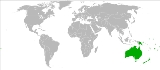
Treaty of Rarotonga

Encyclopedia
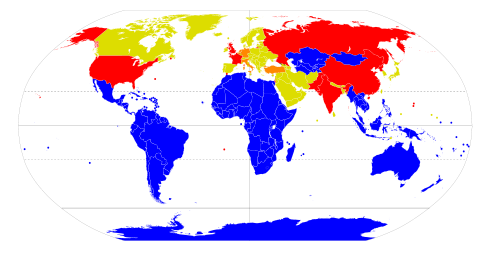
Nuclear-Weapon-Free Zone
A nuclear-weapons-free zone, or NWFZ is defined by the United Nations as an agreement which a group of states has freely established by treaty or convention, that bans the use, development, or deployment of nuclear weapons in a given area, that has mechanisms of verification and control to enforce...
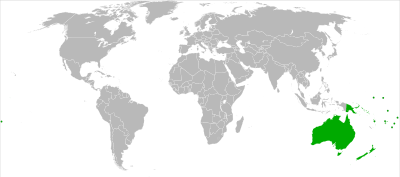
in the South Pacific
Pacific Ocean
The Pacific Ocean is the largest of the Earth's oceanic divisions. It extends from the Arctic in the north to the Southern Ocean in the south, bounded by Asia and Australia in the west, and the Americas in the east.At 165.2 million square kilometres in area, this largest division of the World...
. The treaty bans the use, testing, and possession of nuclear weapons within the borders of the zone.
It was signed by the South Pacific nations of Australia
Australia
Australia , officially the Commonwealth of Australia, is a country in the Southern Hemisphere comprising the mainland of the Australian continent, the island of Tasmania, and numerous smaller islands in the Indian and Pacific Oceans. It is the world's sixth-largest country by total area...
, the Cook Islands
Cook Islands
The Cook Islands is a self-governing parliamentary democracy in the South Pacific Ocean in free association with New Zealand...
, Fiji
Fiji
Fiji , officially the Republic of Fiji , is an island nation in Melanesia in the South Pacific Ocean about northeast of New Zealand's North Island...
, Kiribati
Kiribati
Kiribati , officially the Republic of Kiribati, is an island nation located in the central tropical Pacific Ocean. The permanent population exceeds just over 100,000 , and is composed of 32 atolls and one raised coral island, dispersed over 3.5 million square kilometres, straddling the...
, Nauru
Nauru
Nauru , officially the Republic of Nauru and formerly known as Pleasant Island, is an island country in Micronesia in the South Pacific. Its nearest neighbour is Banaba Island in Kiribati, to the east. Nauru is the world's smallest republic, covering just...
, New Zealand
New Zealand
New Zealand is an island country in the south-western Pacific Ocean comprising two main landmasses and numerous smaller islands. The country is situated some east of Australia across the Tasman Sea, and roughly south of the Pacific island nations of New Caledonia, Fiji, and Tonga...
, Niue
Niue
Niue , is an island country in the South Pacific Ocean. It is commonly known as the "Rock of Polynesia", and inhabitants of the island call it "the Rock" for short. Niue is northeast of New Zealand in a triangle between Tonga to the southwest, the Samoas to the northwest, and the Cook Islands to...
, Papua New Guinea
Papua New Guinea
Papua New Guinea , officially the Independent State of Papua New Guinea, is a country in Oceania, occupying the eastern half of the island of New Guinea and numerous offshore islands...
, the Solomon Islands, Tonga
Tonga
Tonga, officially the Kingdom of Tonga , is a state and an archipelago in the South Pacific Ocean, comprising 176 islands scattered over of ocean in the South Pacific...
, Tuvalu
Tuvalu
Tuvalu , formerly known as the Ellice Islands, is a Polynesian island nation located in the Pacific Ocean, midway between Hawaii and Australia. Its nearest neighbours are Kiribati, Nauru, Samoa and Fiji. It comprises four reef islands and five true atolls...
, Vanuatu
Vanuatu
Vanuatu , officially the Republic of Vanuatu , is an island nation located in the South Pacific Ocean. The archipelago, which is of volcanic origin, is some east of northern Australia, northeast of New Caledonia, west of Fiji, and southeast of the Solomon Islands, near New Guinea.Vanuatu was...
and Western Samoa on the island of Rarotonga
Rarotonga
Rarotonga is the most populous island of the Cook Islands, with a population of 14,153 , out of the country's total population of 19,569.The Cook Islands' Parliament buildings and international airport are on Rarotonga...
(where the capital of the Cook Islands is located) on August 6, 1985, and has since been ratified by all of those states.
The Federated States of Micronesia
Federated States of Micronesia
The Federated States of Micronesia or FSM is an independent, sovereign island nation, made up of four states from west to east: Yap, Chuuk, Pohnpei and Kosrae. It comprises approximately 607 islands with c...
, Marshall Islands
Marshall Islands
The Republic of the Marshall Islands , , is a Micronesian nation of atolls and islands in the middle of the Pacific Ocean, just west of the International Date Line and just north of the Equator. As of July 2011 the population was 67,182...
, and Palau
Palau
Palau , officially the Republic of Palau , is an island nation in the Pacific Ocean, east of the Philippines and south of Tokyo. In 1978, after three decades as being part of the United Nations trusteeship, Palau chose independence instead of becoming part of the Federated States of Micronesia, a...
are not eligible, since they are part of the so-called Compact of Free Association
Compact of Free Association
The Compact of Free Association defines the relationship that three sovereign states—the Federated States of Micronesia , the Republic of the Marshall Islands and the Republic of Palau—have entered into as associated states with the United States.Now sovereign nations, the three freely associated...
which provides access to nuclear submarines of the United States of America.
Protocols binding other states
There are three protocols to the treaty, which have been signed by the five declared nuclear states, with the exception of Protocol 1 for China and Russia who have no territory in the Zone.- no manufacture, stationing or testing in their territories within the Zone
- no use against the Parties to the Treaty, or against territories where Protocol 1 is in force
- no testing within the Zone
In 1996 France
France
The French Republic , The French Republic , The French Republic , (commonly known as France , is a unitary semi-presidential republic in Western Europe with several overseas territories and islands located on other continents and in the Indian, Pacific, and Atlantic oceans. Metropolitan France...
and the United Kingdom
United Kingdom
The United Kingdom of Great Britain and Northern IrelandIn the United Kingdom and Dependencies, other languages have been officially recognised as legitimate autochthonous languages under the European Charter for Regional or Minority Languages...
signed and ratified the three protocols. The USA signed them the same year but never ratified them. China signed and ratified protocols 2 and 3 in 1987.
Scope of applicability
The treaty's different provisions apply variously to the Zone, to the territories within the Zone, or globally."South Pacific Nuclear Free Zone" means the area :
- south of the EquatorEquatorAn equator is the intersection of a sphere's surface with the plane perpendicular to the sphere's axis of rotation and containing the sphere's center of mass....
- north of the 60th parallel south60th parallel southThe 60th parallel south is a circle of latitude that is 60 degrees south of the Earth's equatorial plane. No land lies on the parallel—it crosses nothing but ocean...
(the northern limit of the Antarctic Treaty zone) - east of the 115th meridian east115th meridian eastThe meridian 115° east of Greenwich is a line of longitude that extends from the North Pole across the Arctic Ocean, Asia, the Indian Ocean, Australasia, the Southern Ocean, and Antarctica to the South Pole....
- west of the 115th meridian west115th meridian westThe meridian 115° west of Greenwich is a line of longitude that extends from the North Pole across the Arctic Ocean, North America, the Pacific Ocean, the Southern Ocean, and Antarctica to the South Pole....
(the western limit of the Treaty of TlatelolcoTreaty of TlatelolcoThe Treaty of Tlatelolco is the conventional name given to the Treaty for the Prohibition of Nuclear Weapons in Latin America and the Caribbean...
Latin American Nuclear-Weapon-Free Zone)
plus three projections north of the Equator to include the territory and territorial waters of Papua New Guinea
Papua New Guinea
Papua New Guinea , officially the Independent State of Papua New Guinea, is a country in Oceania, occupying the eastern half of the island of New Guinea and numerous offshore islands...
, Nauru
Nauru
Nauru , officially the Republic of Nauru and formerly known as Pleasant Island, is an island country in Micronesia in the South Pacific. Its nearest neighbour is Banaba Island in Kiribati, to the east. Nauru is the world's smallest republic, covering just...
, and Kiribati
Kiribati
Kiribati , officially the Republic of Kiribati, is an island nation located in the central tropical Pacific Ocean. The permanent population exceeds just over 100,000 , and is composed of 32 atolls and one raised coral island, dispersed over 3.5 million square kilometres, straddling the...
,
but minus the northwest corner beyond Australia
Australia
Australia , officially the Commonwealth of Australia, is a country in the Southern Hemisphere comprising the mainland of the Australian continent, the island of Tasmania, and numerous smaller islands in the Indian and Pacific Oceans. It is the world's sixth-largest country by total area...
n territorial waters and near Indonesia
Indonesia
Indonesia , officially the Republic of Indonesia , is a country in Southeast Asia and Oceania. Indonesia is an archipelago comprising approximately 13,000 islands. It has 33 provinces with over 238 million people, and is the world's fourth most populous country. Indonesia is a republic, with an...
(and the Southeast Asian Nuclear-Weapon-Free Zone).
Several islands in the Indian Ocean
Indian Ocean
The Indian Ocean is the third largest of the world's oceanic divisions, covering approximately 20% of the water on the Earth's surface. It is bounded on the north by the Indian Subcontinent and Arabian Peninsula ; on the west by eastern Africa; on the east by Indochina, the Sunda Islands, and...
also belong to Australia and are therefore part of the zone.
"Territory" means internal waters
Internal waters
A nation's internal waters covers all water and waterways on the landward side of the baseline from which a nation's territorial waters is defined. It includes waterways such as rivers and canals, and sometimes the water within small bays. According to the United Nations Convention on the Law of...
, territorial sea and archipelagic waters, the seabed
Seabed
The seabed is the bottom of the ocean.- Ocean structure :Most of the oceans have a common structure, created by common physical phenomena, mainly from tectonic movement, and sediment from various sources...
and subsoil
Subsoil
Subsoil, or substrata, is the layer of soil under the topsoil on the surface of the ground. The subsoil may include substances such as clay and/or sand that has only been partially broken down by air, sunlight, water, wind etc., to produce true soil...
beneath, the land territory and the airspace
Airspace
Airspace means the portion of the atmosphere controlled by a country above its territory, including its territorial waters or, more generally, any specific three-dimensional portion of the atmosphere....
above them.
It does not include international waters
International waters
The terms international waters or trans-boundary waters apply where any of the following types of bodies of water transcend international boundaries: oceans, large marine ecosystems, enclosed or semi-enclosed regional seas and estuaries, rivers, lakes, groundwater systems , and wetlands.Oceans,...
.
Article 2 says "Nothing in this Treaty shall prejudice or in any way affect the rights, or the exercise of the rights, of any State under international law
International law
Public international law concerns the structure and conduct of sovereign states; analogous entities, such as the Holy See; and intergovernmental organizations. To a lesser degree, international law also may affect multinational corporations and individuals, an impact increasingly evolving beyond...
with regard to freedom of the seas
Freedom of the seas
Freedom of the seas is a principle in the international law and law of the sea. It stresses freedom to navigate the oceans. It also disapproves of war fought in water. The freedom is to be breached only in a necessary international agreement....
."
The Treaty is an agreement between nation-state
Nation-state
The nation state is a state that self-identifies as deriving its political legitimacy from serving as a sovereign entity for a nation as a sovereign territorial unit. The state is a political and geopolitical entity; the nation is a cultural and/or ethnic entity...
s and as such of course cannot apply to those who have not signed the treaty or protocols, for example the four countries not signatories to the Non-Proliferation Treaty, who are all nuclear powers.
List of states and territories
- The only territory north of the EquatorEquatorAn equator is the intersection of a sphere's surface with the plane perpendicular to the sphere's axis of rotation and containing the sphere's center of mass....
that is part of the Zone is in KiribatiKiribatiKiribati , officially the Republic of Kiribati, is an island nation located in the central tropical Pacific Ocean. The permanent population exceeds just over 100,000 , and is composed of 32 atolls and one raised coral island, dispersed over 3.5 million square kilometres, straddling the...
, the only state straddling the Equator. - MicronesiaMicronesiaMicronesia is a subregion of Oceania, comprising thousands of small islands in the western Pacific Ocean. It is distinct from Melanesia to the south, and Polynesia to the east. The Philippines lie to the west, and Indonesia to the southwest....
is outside the Zone except for KiribatiKiribatiKiribati , officially the Republic of Kiribati, is an island nation located in the central tropical Pacific Ocean. The permanent population exceeds just over 100,000 , and is composed of 32 atolls and one raised coral island, dispersed over 3.5 million square kilometres, straddling the...
. - MelanesiaMelanesiaMelanesia is a subregion of Oceania extending from the western end of the Pacific Ocean to the Arafura Sea, and eastward to Fiji. The region comprises most of the islands immediately north and northeast of Australia...
is inside the Zone except for IndonesiaIndonesiaIndonesia , officially the Republic of Indonesia , is a country in Southeast Asia and Oceania. Indonesia is an archipelago comprising approximately 13,000 islands. It has 33 provinces with over 238 million people, and is the world's fourth most populous country. Indonesia is a republic, with an...
which is in the Southeast Asian Nuclear-Weapon-Free Zone. - PolynesiaPolynesiaPolynesia is a subregion of Oceania, made up of over 1,000 islands scattered over the central and southern Pacific Ocean. The indigenous people who inhabit the islands of Polynesia are termed Polynesians and they share many similar traits including language, culture and beliefs...
is inside the Zone except for Easter IslandEaster IslandEaster Island is a Polynesian island in the southeastern Pacific Ocean, at the southeasternmost point of the Polynesian triangle. A special territory of Chile that was annexed in 1888, Easter Island is famous for its 887 extant monumental statues, called moai, created by the early Rapanui people...
which is in the Latin American Nuclear-Weapon-Free Zone, the Polynesian outliers of KapingamarangiKapingamarangiKapingamarangi is an atoll and a municipality in the state of Pohnpei of the Federated States of Micronesia. It is by far the most southerly atoll or island of the country and of the Caroline Islands, 300 km south of the next southerly atoll, Nukuoro, and 740 km southwest of the main island of...
and NukuoroNukuoroNukuoro is an atoll in the Federated States of Micronesia.It is a municipality of the state of Pohnpei, Federated States of Micronesia. Except for Kapingamarangi, it is the southermost atoll of the country. Nukuoro has a population of 372 , though several hundred Nukuorans live on Pohnpei...
in Micronesia, HawaiiHawaiiHawaii is the newest of the 50 U.S. states , and is the only U.S. state made up entirely of islands. It is the northernmost island group in Polynesia, occupying most of an archipelago in the central Pacific Ocean, southwest of the continental United States, southeast of Japan, and northeast of...
, and several uninhabited US Minor Outlying Islands.
| State | Signed | Deposited |
 Australia Australia |
1985-08-06 | 1986-12-11 |
 Cook Islands Cook Islands |
1985-08-06 | 1985-10-28 |
 Fiji Fiji |
1985-08-06 | 1985-10-04 |
 Kiribati Kiribati |
1985-08-06 | 1986-10-28 |
 Nauru Nauru |
1986-07-17 | 1987-05-13 |
 New Zealand New Zealand |
1985-08-06 | 1986-11-13 |
 Niue Niue |
1985-08-06 | 1986-05-12 |
 Papua New Guinea Papua New Guinea |
1985-09-16 | 1989-09-15 |
 Samoa Samoa |
1985-08-06 | 1986-10-20 |
 Solomon Islands Solomon Islands |
1987-05-29 | 1989-01-27 |
 Tonga Tonga |
1996-07-02 | 2000-12-18 |
 Tuvalu Tuvalu |
1985-08-06 | 1986-01-16 |
 Vanuatu Vanuatu |
1995-09-16 | 1996-02-09 |


