


Treaty of Belgrade

Encyclopedia
Peace treaty
A peace treaty is an agreement between two or more hostile parties, usually countries or governments, that formally ends a state of war between the parties...
signed on September 18, 1739 in Belgrade
Belgrade
Belgrade is the capital and largest city of Serbia. It is located at the confluence of the Sava and Danube rivers, where the Pannonian Plain meets the Balkans. According to official results of Census 2011, the city has a population of 1,639,121. It is one of the 15 largest cities in Europe...
, Habsburg Kingdom of Serbia (today Republic of Serbia), by the Ottoman Empire
Ottoman Empire
The Ottoman EmpireIt was usually referred to as the "Ottoman Empire", the "Turkish Empire", the "Ottoman Caliphate" or more commonly "Turkey" by its contemporaries...
on one side and the Habsburg Monarchy
Habsburg Monarchy
The Habsburg Monarchy covered the territories ruled by the junior Austrian branch of the House of Habsburg , and then by the successor House of Habsburg-Lorraine , between 1526 and 1867/1918. The Imperial capital was Vienna, except from 1583 to 1611, when it was moved to Prague...
on the other.
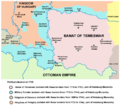
This treaty ended the hostilities of the two-year Austro-Turkish War, 1737-1739, in which the Habsburgs joined Imperial Russia in its fight against the Ottomans. With the Treaty of Belgrade, the Habsburgs ceded Kingdom of Serbia with Belgrade, southern part of the Banat of Temeswar
Banat of Temeswar
The Banat of Temeswar was a Habsburg province that existed between 1718 and 1778. It was located in the present day region of Banat, which was named after this province...
and northern Bosnia to the Ottomans, and Oltenia
Oltenia
Oltenia is a historical province and geographical region of Romania, in western Wallachia. It is situated between the Danube, the Southern Carpathians and the Olt river ....
, gained by the Treaty of Passarowitz
Treaty of Passarowitz
The Treaty of Passarowitz or Treaty of Požarevac was the peace treaty signed in Požarevac , a town in Ottoman Empire , on 21 July 1718 between the Ottoman Empire on one side and the Habsburg Monarchy of Austria and the Republic of Venice on the other.During the years 1714-1718, the Ottomans had...
in 1718, to Wallachia
Wallachia
Wallachia or Walachia is a historical and geographical region of Romania. It is situated north of the Danube and south of the Southern Carpathians...
(an Ottoman subject), and set the demarcation line to the rivers Sava and Danube
Danube
The Danube is a river in the Central Europe and the Europe's second longest river after the Volga. It is classified as an international waterway....
. The Habsburg withdrawal forced Russia to accept peace at the Russo-Turkish War, 1735-1739
Russo-Turkish War, 1735-1739
Russo–Turkish War of 1735–1739, a war between Russia and the Ottoman Empire, caused by intensified contradictions over the results of the War of the Polish Succession of 1733–1735 and endless raids by the Crimean Tatars...
with the Treaty of Niš, whereby it was allowed to build a port at Azov
Azov
-External links:** *...
, gaining a foothold on the Black Sea
Black Sea
The Black Sea is bounded by Europe, Anatolia and the Caucasus and is ultimately connected to the Atlantic Ocean via the Mediterranean and the Aegean seas and various straits. The Bosphorus strait connects it to the Sea of Marmara, and the strait of the Dardanelles connects that sea to the Aegean...
.
The Treaty of Belgrade has effectively ended the Kingdom of Serbia which had existed since 1718. The Kingdom of Serbia would await the next Habsburg-Ottoman war to be temporarily reestablished in 1788 with the help of Koča Anđelković.
See also
- Ottoman wars in EuropeOttoman wars in EuropeThe wars of the Ottoman Empire in Europe are also sometimes referred to as the Ottoman Wars or as Turkish Wars, particularly in older, European texts.- Rise :...
- List of treaties
- List of treaties of the Ottoman Empire