


Tramway de Nantes

Encyclopedia
The Nantes tramway is a tram
way system located around the city of Nantes
, France
. The first tramway in Nantes opened in 1879 and closed in 1958 due to bombing damage during World War II
, while the present tramway was re-introduced to the city in 1985.
The first tramway in Nantes was notable for its use of compressed air
propulsion, pioneering this technology. The present tramway is notable as the first 'new generation' tramway to be built in Europe
, reversing the trend of tramway closures that had been going on since the middle of the 20th century and becoming the first in a wave of tramways built from scratch in France and the rest of Europe.
The current tramway system is over 40 kilometres of track, and 90 stations. It is operated by Semitan
, the operator of Nantes public transport network.
tramcars propelled by compressed air, using the Mekarski system
. The cars stored the compressed air in steel cylinders, and were periodically topped up with air and steam (used to heat the compressed air) at a pair of recharging stations. The later Nantes cars operated at 840 psi (5,791,596.1 Pa).
The first line constructed was just over 6 km (3.7 mi) long and was a mostly level route operating east-west along the quays of the River Loire
. The initial fleet comprised 22 trams, 2 locomotives and four open top trailers. A second route, running north-south and crossing both the original route and the River Loire was opened in 1888.
Further extensions, together with a third route along the banks of the River Erdre
, brought the length of the system to 39 km (24.2 mi) by 1910. By then the fleet had grown to 94 trams, 3 locomotives and 10 open top trailers, and was carrying 12 million passengers per year. By this stage compressed air trams were seen as old-fashioned, and it was decided to electrify the system. Replacement began in 1913, and the last compressed air tram ran in 1917.
Nantes compressed air tramcar 22, later renumbered 18 and dating from 1879, still exists and is the only surviving compressed air tram in the world. It is part of the collection at the AMTUIR museum in Paris
, but was in Nantes in 1992.
. By 1915, 8 lines were in service, and work was not completed until the end of 1919. The company standardized its fleet of 100 tramcars, all on Brill trucks with vestibuled platforms. Further extensions were opened, and by 1932 there were 20 lines serving 14 routes. The network was centred on the Place du Commerce, which is today still the centre of Nantes's tramway network.
During World War II
, the network was heavily damaged by continued bombing, and several lines were immediately converted to bus operation due to the prohibitive cost of repairs. After the war, tram was seen as being obsolete, noisy and uncomfortable. The decision to replace all tram services by buses was made in 1949, with the last tram running in 1958.
. In an attempt to relieve congestion, the construction of a motorway along the quays of the River Edre
was proposed. The destruction of the urban fabric this would have caused resulted in an outcry and the proposal was rejected. Various public transport solutions were investigated, including improved bus
or trolleybus
services (rejected as having too limited a capacity), and a metro
(rejected as too expensive). Finally a tramway was proposed.
At this point in time, the idea of constructing a new tramway was revolutionary. The trend throughout the world had been to close existing tramways rather than open new ones, and only three relatively small tram systems remained in France (the Lille
, Marseille
and Saint-Étienne
systems). In North America
the very beginning of a light rail renaissance was just starting to be seen, with the Edmonton Light Rail Transit
system opening in 1978, followed by the Calgary C-Train
and San Diego Trolley
systems in 1981. No significant new tramway system had been built in Europe
in many years.
Against this background, Nantes's municipal council gathered a team of engineers to discuss the possibility of building a new tramway system. The project was set up on 10 February 1981 and financial details sorted. The government accepted financing 30% of the construction. Alstom
was chosen for the construction of twenty tramcars.
The tramway was finally re-opened in January 1985, with a single line connecting Place du Commerce with Haluchère in the north-east of the city. A month later the section from Place du Commerce to Bellevue in the west opened, resulting in a 10.4 km (6.5 mi) line with 22 tram stops. This line, the core of the current line 1, was an immediate success and carried 42,000 passengers daily by the end of the first year. Line 1 was extended by 2.2 km (1.4 mi) and two stops from Haluchère to Beaujoire in April 1989.
The success of line 1 lead to the decision to construct the north-south line 2, which crosses line 1 at Place du Commerce. The line opened from a southern terminus at Trocadière to 50 Otages, just north of the city centre, in September 1992. Subsequent nortward extensions reached Orvault Grand Val two years later.The first section of line 3 opened in August 2000. This shared tracks with line 2 from its southern terminus at Hotel Dieu, south of Place du Commerce, to a point just north of the Place du Commerce stop, from where it ran on its own tracks to Longchamp in the north-west of the city.
An extension at the western end of line 1 took it to François Mitterrand in August 2000, leaving Bellevue at the end of a short branch. In April 2004, line 3 was extended from Longchamp to Sillon de Bretagne. In August 2005, line 2 was extended 2.2 km (1.4 mi) and three stops from Trocadière to Neustrie. In September 2007, a short stub and terminus was constructed off line 2 at Pont Rousseau, and line 2 cut back from Neustrie to there. In compensation, line 3 was extended from Hotel Dieu to Neustrie.
and Haluchère and entirely built on reserved track
, following the trackbed of a line of the former tramway network. It serves the Stade de la Beaujoire
along with the city's biggest exhibition centre, the railway station of Nantes
, and the city's main and largest library. Along with line two, line one is one of the busiest lines on the network as it serves the very heart of the city.
at Petit Port, as well as Hôtel-Dieu, Nantes' main hospital. In September 2007, the line was reduced in length, so that the southern terminus is now located at Pont-Rousseau in Rezé
, adjacent to Rezé-Pont-Rousseau railway station.
. A shuttle bus links the short distance between the airport and Neustrie, giving easier access to the tramway and the city centre.
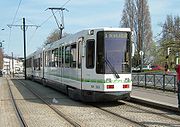
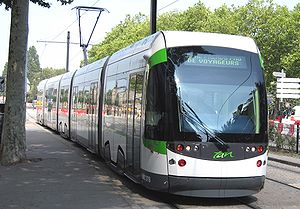 The fleet is composed of 79 tramcars of two types, the TFS-1 and the Incentro. Both types serve all three routes. In 2011, Nantes ordered eight Urbos
trams, with four options, from Spanish manufacturers Construcciones y Auxiliar de Ferrocarriles
.
TFS
design. TFS stands for Tramway Français Standard, and the intention was that this design would become the standard for subsequent French tram systems. However in the end the design was significantly revised for the Grenoble tram system
, the second system to open, introducing the low-floor TFS-2 variant. Consequently, only Nantes has ever operated the TFS-1 variant.
As built, the TFS-1 were double-ended, single-articulated 6-axle tramcars with a high floor and steep stepped access from low level boarding platforms. All the tramcars built in this form have since been rebuilt with an added low-floor centre section, thus becoming 8-axle double-articulated cars with a length of 38 m (124.7 ft). Nantes subsequently bought further TFS-1 trams in this 8-axle configuration. Nantes now has 46 of these trams, built in 4 tranches from 1985 to 1994.
. Instead, in 1997, Nantes became the first city to order a fleet of trams to the Adtranz
(now Bombardier Transportation
) Incentro
design. This modular design is made up of cab, powered and suspended sections, and is 100% low floor. The trams built for Nantes are double-ended and consist of five sections, with a length of 36.4 m (119.4 ft). Nantes now has 33 of these trams.
, known as Tan for short. Semitan is responsible for the whole public transport network throughout the Nantes Metropole, and the Metropole has a majority shareholding in the company.
The transport group Transdev
, which is also involved in the operation of several other tram systems, including the Grenoble
, Montpellier, Nottingham
and Strasbourg
systems, has a minority share holding in Semitan. This allows for exchange of information and assistance between these systems. As an example, the tram drivers for Montpellier were trained at Nantes.
, local bus
es, Navibus
, and suburban trains. The Navette Tan Air airport express bus has its own (more expensive) tickets, but these are also accepted on trams and other modes.
Tickets are not sold on trams, but ticket machines can be found at every tram stop, and tickets must be purchased before boarding the tram. There are also a few staffed ticket offices in the centre of Nantes, opening for limited periods only.
In providing this service, the cumulative distance travelled by the tram fleet in 2007 was approximately 4.5 million kilometers.
Tram
A tram is a passenger rail vehicle which runs on tracks along public urban streets and also sometimes on separate rights of way. It may also run between cities and/or towns , and/or partially grade separated even in the cities...
way system located around the city of Nantes
Nantes
Nantes is a city in western France, located on the Loire River, from the Atlantic coast. The city is the 6th largest in France, while its metropolitan area ranks 8th with over 800,000 inhabitants....
, France
France
The French Republic , The French Republic , The French Republic , (commonly known as France , is a unitary semi-presidential republic in Western Europe with several overseas territories and islands located on other continents and in the Indian, Pacific, and Atlantic oceans. Metropolitan France...
. The first tramway in Nantes opened in 1879 and closed in 1958 due to bombing damage during World War II
World War II
World War II, or the Second World War , was a global conflict lasting from 1939 to 1945, involving most of the world's nations—including all of the great powers—eventually forming two opposing military alliances: the Allies and the Axis...
, while the present tramway was re-introduced to the city in 1985.
The first tramway in Nantes was notable for its use of compressed air
Compressed air
Compressed air is air which is kept under a certain pressure, usually greater than that of the atmosphere. In Europe, 10 percent of all electricity used by industry is used to produce compressed air, amounting to 80 terawatt hours consumption per year....
propulsion, pioneering this technology. The present tramway is notable as the first 'new generation' tramway to be built in Europe
Europe
Europe is, by convention, one of the world's seven continents. Comprising the westernmost peninsula of Eurasia, Europe is generally 'divided' from Asia to its east by the watershed divides of the Ural and Caucasus Mountains, the Ural River, the Caspian and Black Seas, and the waterways connecting...
, reversing the trend of tramway closures that had been going on since the middle of the 20th century and becoming the first in a wave of tramways built from scratch in France and the rest of Europe.
The current tramway system is over 40 kilometres of track, and 90 stations. It is operated by Semitan
Semitan
Semitan is the company responsible for the comprehensive public transport network of the Nantes Métropole, the urban community of the French city of Nantes. The network operated by Semitan is marketed under the name and logo of tan, and this abbreviated form is also sometimes used to refer to the...
, the operator of Nantes public transport network.
Compressed air trams (1879-1917)
The history of the tramway in Nantes began on 13 December 1879 with the opening of the first line. Service was provided using standard gaugeStandard gauge
The standard gauge is a widely-used track gauge . Approximately 60% of the world's existing railway lines are built to this gauge...
tramcars propelled by compressed air, using the Mekarski system
Mekarski system
The Mekarski system was a compressed-air propulsion system for trams invented by Louis Mékarski or Louis Mékarsky in the 1870s. He worked in France, was born in 1843 in Clermont-Ferrand of Polish origin...
. The cars stored the compressed air in steel cylinders, and were periodically topped up with air and steam (used to heat the compressed air) at a pair of recharging stations. The later Nantes cars operated at 840 psi (5,791,596.1 Pa).
The first line constructed was just over 6 km (3.7 mi) long and was a mostly level route operating east-west along the quays of the River Loire
Loire
Loire is an administrative department in the east-central part of France occupying the River Loire's upper reaches.-History:Loire was created in 1793 when after just 3½ years the young Rhône-et-Loire department was split into two. This was a response to counter-Revolutionary activities in Lyon...
. The initial fleet comprised 22 trams, 2 locomotives and four open top trailers. A second route, running north-south and crossing both the original route and the River Loire was opened in 1888.
Further extensions, together with a third route along the banks of the River Erdre
Erdre
The Erdre is a river in western France, right tributary to the river Loire. Its source is in the Maine-et-Loire département, near La Pouëze. It flows through the départements Maine-et-Loire and Loire-Atlantique. It flows into the river Loire in the city Nantes...
, brought the length of the system to 39 km (24.2 mi) by 1910. By then the fleet had grown to 94 trams, 3 locomotives and 10 open top trailers, and was carrying 12 million passengers per year. By this stage compressed air trams were seen as old-fashioned, and it was decided to electrify the system. Replacement began in 1913, and the last compressed air tram ran in 1917.
Nantes compressed air tramcar 22, later renumbered 18 and dating from 1879, still exists and is the only surviving compressed air tram in the world. It is part of the collection at the AMTUIR museum in Paris
Paris
Paris is the capital and largest city in France, situated on the river Seine, in northern France, at the heart of the Île-de-France region...
, but was in Nantes in 1992.
Electric trams (1911-1958)
In 1911 the intention to electrify the network was announced by the mayor, Paul Bellamy, but work did not start until just before the outbreak of World War IWorld War I
World War I , which was predominantly called the World War or the Great War from its occurrence until 1939, and the First World War or World War I thereafter, was a major war centred in Europe that began on 28 July 1914 and lasted until 11 November 1918...
. By 1915, 8 lines were in service, and work was not completed until the end of 1919. The company standardized its fleet of 100 tramcars, all on Brill trucks with vestibuled platforms. Further extensions were opened, and by 1932 there were 20 lines serving 14 routes. The network was centred on the Place du Commerce, which is today still the centre of Nantes's tramway network.
During World War II
World War II
World War II, or the Second World War , was a global conflict lasting from 1939 to 1945, involving most of the world's nations—including all of the great powers—eventually forming two opposing military alliances: the Allies and the Axis...
, the network was heavily damaged by continued bombing, and several lines were immediately converted to bus operation due to the prohibitive cost of repairs. After the war, tram was seen as being obsolete, noisy and uncomfortable. The decision to replace all tram services by buses was made in 1949, with the last tram running in 1958.
Modern network (1985-present)
By the end of the 1970s, transport in Nantes was heavily biased to the motor carAutomobile
An automobile, autocar, motor car or car is a wheeled motor vehicle used for transporting passengers, which also carries its own engine or motor...
. In an attempt to relieve congestion, the construction of a motorway along the quays of the River Edre
Erdre
The Erdre is a river in western France, right tributary to the river Loire. Its source is in the Maine-et-Loire département, near La Pouëze. It flows through the départements Maine-et-Loire and Loire-Atlantique. It flows into the river Loire in the city Nantes...
was proposed. The destruction of the urban fabric this would have caused resulted in an outcry and the proposal was rejected. Various public transport solutions were investigated, including improved bus
Bus
A bus is a road vehicle designed to carry passengers. Buses can have a capacity as high as 300 passengers. The most common type of bus is the single-decker bus, with larger loads carried by double-decker buses and articulated buses, and smaller loads carried by midibuses and minibuses; coaches are...
or trolleybus
Trolleybus
A trolleybus is an electric bus that draws its electricity from overhead wires using spring-loaded trolley poles. Two wires and poles are required to complete the electrical circuit...
services (rejected as having too limited a capacity), and a metro
Rapid transit
A rapid transit, underground, subway, elevated railway, metro or metropolitan railway system is an electric passenger railway in an urban area with a high capacity and frequency, and grade separation from other traffic. Rapid transit systems are typically located either in underground tunnels or on...
(rejected as too expensive). Finally a tramway was proposed.
At this point in time, the idea of constructing a new tramway was revolutionary. The trend throughout the world had been to close existing tramways rather than open new ones, and only three relatively small tram systems remained in France (the Lille
Tramway de Lille
Lille tramway is a tramway system located around the city of Lille, France. It is often called the Mongy, after Alfred Mongy, the engineer who created the interurban lines that make up the current system....
, Marseille
Tramway de Marseille
Marseille tram is a tramway system in the French city of Marseille. The tramway opened on 21 January 1876 and, unlike most other French cities, has never closed and continues to this day to operate.- History :...
and Saint-Étienne
Tramway de Saint-Étienne
The Saint-Étienne tramway is a tram system in the French city of Saint-Étienne, Rhône-Alpes , its particularity is that is has functionned non stop since its opening in 1881...
systems). In North America
North America
North America is a continent wholly within the Northern Hemisphere and almost wholly within the Western Hemisphere. It is also considered a northern subcontinent of the Americas...
the very beginning of a light rail renaissance was just starting to be seen, with the Edmonton Light Rail Transit
Edmonton Light Rail Transit
Edmonton Light Rail Transit, more commonly referred to as the LRT, is a light rail system in Edmonton, Alberta. Part of the Edmonton Transit System , the 20.5-kilometre route starts in Edmonton's northeast suburbs and ends at Century Park in Edmonton's south end.The ETS designates the LRT as Route...
system opening in 1978, followed by the Calgary C-Train
C-Train
C-Train is the light rail transit system in Calgary, Alberta, Canada. It has been in operation since May 25, 1981. The system is operated by Calgary Transit, a department of the Calgary municipal government.-Operations:...
and San Diego Trolley
San Diego Trolley
The San Diego Trolley is a light rail system operating in the metropolitan area of San Diego. The operator, San Diego Trolley, Inc. , is a subsidiary of the San Diego Metropolitan Transit System ...
systems in 1981. No significant new tramway system had been built in Europe
Europe
Europe is, by convention, one of the world's seven continents. Comprising the westernmost peninsula of Eurasia, Europe is generally 'divided' from Asia to its east by the watershed divides of the Ural and Caucasus Mountains, the Ural River, the Caspian and Black Seas, and the waterways connecting...
in many years.
Against this background, Nantes's municipal council gathered a team of engineers to discuss the possibility of building a new tramway system. The project was set up on 10 February 1981 and financial details sorted. The government accepted financing 30% of the construction. Alstom
Alstom
Alstom is a large multinational conglomerate which holds interests in the power generation and transport markets. According to the company website, in the years 2010-2011 Alstom had annual sales of over €20.9 billion, and employed more than 85,000 people in 70 countries. Alstom's headquarters are...
was chosen for the construction of twenty tramcars.
The tramway was finally re-opened in January 1985, with a single line connecting Place du Commerce with Haluchère in the north-east of the city. A month later the section from Place du Commerce to Bellevue in the west opened, resulting in a 10.4 km (6.5 mi) line with 22 tram stops. This line, the core of the current line 1, was an immediate success and carried 42,000 passengers daily by the end of the first year. Line 1 was extended by 2.2 km (1.4 mi) and two stops from Haluchère to Beaujoire in April 1989.
The success of line 1 lead to the decision to construct the north-south line 2, which crosses line 1 at Place du Commerce. The line opened from a southern terminus at Trocadière to 50 Otages, just north of the city centre, in September 1992. Subsequent nortward extensions reached Orvault Grand Val two years later.The first section of line 3 opened in August 2000. This shared tracks with line 2 from its southern terminus at Hotel Dieu, south of Place du Commerce, to a point just north of the Place du Commerce stop, from where it ran on its own tracks to Longchamp in the north-west of the city.
An extension at the western end of line 1 took it to François Mitterrand in August 2000, leaving Bellevue at the end of a short branch. In April 2004, line 3 was extended from Longchamp to Sillon de Bretagne. In August 2005, line 2 was extended 2.2 km (1.4 mi) and three stops from Trocadière to Neustrie. In September 2007, a short stub and terminus was constructed off line 2 at Pont Rousseau, and line 2 cut back from Neustrie to there. In compensation, line 3 was extended from Hotel Dieu to Neustrie.
Line one (François Mitterrand-Beaujoire)
This was the first line to open in 1985; originally running between BellevueBellevue
Bellevue can refer to:-Australia:* Bellevue, Western Australia* Bellevue Hill, New South Wales* Bellevue, Glebe, an historic house in Sydney, New South Wales-Canada:* Bellevue, Alberta...
and Haluchère and entirely built on reserved track
Reserved track
In tram transport terminology reserved track is track on ground exclusively for trams. Unlike track on streets and roads, reserved track does not need to take into account the transit of other wheeled vehicles, pedestrians, bicyclists or horses...
, following the trackbed of a line of the former tramway network. It serves the Stade de la Beaujoire
Stade de la Beaujoire
The Stade de la Beaujoire - Louis Fonteneau, or "Stade de la Beaujoire", is a stadium in Nantes, France. It is the home of the FC Nantes football club....
along with the city's biggest exhibition centre, the railway station of Nantes
Gare de Nantes
The Gare de Nantes is the principal passenger railway station serving the French city of Nantes. It is a through station aligned east-west, with entrances and station facilities on both north and south sides...
, and the city's main and largest library. Along with line two, line one is one of the busiest lines on the network as it serves the very heart of the city.
Line two (Gare de Pont Rousseau-Orvault Grand Val)
Extended on 29 August 2005, towards the south, line two transports the most passengers a day in France. At rush hours, the line is always close to capacity, as it serves the campus of the University of NantesUniversity of Nantes
The University of Nantes is a well-known French university, located in the city of Nantes. Currently, it is attended by approximately 34,000 students. 10% of them are international students coming from 110 countries.-History:...
at Petit Port, as well as Hôtel-Dieu, Nantes' main hospital. In September 2007, the line was reduced in length, so that the southern terminus is now located at Pont-Rousseau in Rezé
Rezé
Rezé is a commune in the Loire-Atlantique department in western France.It was also called Ratiate in the Middle Ages and Rezay in the High Middle Ages.Inhabitants of Rezé are called Rezéens.-Panorama:...
, adjacent to Rezé-Pont-Rousseau railway station.
Line three (Neustrie-Marcel Paul)
Extended in 2007, line three now runs on the former track of southern line 2, towards its last station, Neustrie, near Nantes Atlantique AirportNantes Atlantique Airport
Nantes Atlantique Airport is an international airport serving Nantes, France. It is located southwest of the city, in Bouguenais.The airport is operated by the Chambre de commerce et d'industrie de Nantes...
. A shuttle bus links the short distance between the airport and Neustrie, giving easier access to the tramway and the city centre.
Network extensions
A connection between lines one and two is due to open around 2010 on the northern part of the network. The link will run between the station of Haluchère on line one and Recteur Shmitt on line two.Rolling stock
Urbos
Urbos is a family of light rail vehicles built by CAF.There are three generations of Urbos:-Urbos 1:This series was only sold to Euskotren to operate tram services in Bilbao.- Urbos 2 :* Tranvía de Vélez-Málaga* Tranvía de Vitoria* Metro de Sevilla...
trams, with four options, from Spanish manufacturers Construcciones y Auxiliar de Ferrocarriles
Construcciones y Auxiliar de Ferrocarriles
Construcciones y Auxiliar de Ferrocarriles is a rail equipment manufacturer based in Beasain in the Basque Country, Spain. Equipment manufactured by CAF includes light rail vehicles, rapid transit trains, railroad cars and locomotives, as well as variable gauge axles that can be fitted on any...
.
TFS-1
Line 1 opened with 20 cars of type TFS-1, this being the original variant of the AlstomAlstom
Alstom is a large multinational conglomerate which holds interests in the power generation and transport markets. According to the company website, in the years 2010-2011 Alstom had annual sales of over €20.9 billion, and employed more than 85,000 people in 70 countries. Alstom's headquarters are...
TFS
Tramway Français Standard
The Tramway Français Standard, or TFS, is a type of tramcar used on tramway systems in France. It was manufactured by Alstom, the France-based multinational company whose businesses are power generation and transport...
design. TFS stands for Tramway Français Standard, and the intention was that this design would become the standard for subsequent French tram systems. However in the end the design was significantly revised for the Grenoble tram system
Tramway de Grenoble
The Grenoble tramway network is 35 km long, and comprises four lines: lines A, B, C and D. Line A was opened in 1987, line B in 1990, line C on 20 May 2006 and line D on October 2007. There previously existed a network of tramways in Grenoble, between 1894 and 1952...
, the second system to open, introducing the low-floor TFS-2 variant. Consequently, only Nantes has ever operated the TFS-1 variant.
As built, the TFS-1 were double-ended, single-articulated 6-axle tramcars with a high floor and steep stepped access from low level boarding platforms. All the tramcars built in this form have since been rebuilt with an added low-floor centre section, thus becoming 8-axle double-articulated cars with a length of 38 m (124.7 ft). Nantes subsequently bought further TFS-1 trams in this 8-axle configuration. Nantes now has 46 of these trams, built in 4 tranches from 1985 to 1994.
Incentro
Unlike most other French tramways, Nantes decided not to use Alstom's successor to the TFS tramcar, the CitadisCitadis
The Citadis is a low-floor tram built by Alstom in La Rochelle, France, and Barcelona, Spain. 1,140 Citadis are currently in use in 28 cities, among others: Bordeaux, Grenoble, Lyon, Montpellier, Orléans, the Paris area, and Barcelona, Dublin, Gdańsk, Katowice, Adelaide, Melbourne, Jerusalem and...
. Instead, in 1997, Nantes became the first city to order a fleet of trams to the Adtranz
Adtranz
ABB Daimler-Benz Transportation , commonly known under its brand Adtranz, was a multi-national rail transport equipment manufacturer with facilities concentrated in Europe and the USA....
(now Bombardier Transportation
Bombardier Transportation
Bombardier Transportation is the rail equipment division of the Canadian firm, Bombardier Inc. Bombardier Transportation is one of the world's largest companies in the rail-equipment manufacturing and servicing industry. Its headquarters are in Berlin, Germany....
) Incentro
Incentro
The Incentro is a model of tram manufactured by Bombardier Transportation. It is a five-section 100% low-floor articulated tram, built for bi-directional operation and capable of speeds up to 80 km/h...
design. This modular design is made up of cab, powered and suspended sections, and is 100% low floor. The trams built for Nantes are double-ended and consist of five sections, with a length of 36.4 m (119.4 ft). Nantes now has 33 of these trams.
Operator
The line is operated by SemitanSemitan
Semitan is the company responsible for the comprehensive public transport network of the Nantes Métropole, the urban community of the French city of Nantes. The network operated by Semitan is marketed under the name and logo of tan, and this abbreviated form is also sometimes used to refer to the...
, known as Tan for short. Semitan is responsible for the whole public transport network throughout the Nantes Metropole, and the Metropole has a majority shareholding in the company.
The transport group Transdev
Transdev
Transdev was a major international public transport group based in Issy-les-Moulineaux near Paris, France and operating in several countries. Originally created as Société centrale pour l'équipement du territoire in 1955 and developing transportation activities since 1973, Transdev was a subsidiary...
, which is also involved in the operation of several other tram systems, including the Grenoble
Tramway de Grenoble
The Grenoble tramway network is 35 km long, and comprises four lines: lines A, B, C and D. Line A was opened in 1987, line B in 1990, line C on 20 May 2006 and line D on October 2007. There previously existed a network of tramways in Grenoble, between 1894 and 1952...
, Montpellier, Nottingham
Nottingham Express Transit
Nottingham Express Transit is a light-rail tramway in the Nottingham area in England. The first line opened to the public on 9 March 2004, having cost £200 million to construct. The scheme took sixteen years from conception to implementation...
and Strasbourg
Tramways in Strasbourg
The Strasbourg tram system, run by the CTS, consists of six lines, A, B, C, D, E and F. Lines A and D were opened in 1994, lines B and C were opened in 2000, line E was opened in 2007 and line F was opened in 2010.- History :...
systems, has a minority share holding in Semitan. This allows for exchange of information and assistance between these systems. As an example, the tram drivers for Montpellier were trained at Nantes.
Ticketing
The transport network in Nantes uses paper tickets and passes. There are no "travel zones", as a ticket or pass gives access everywhere on the network in greater Nantes. The basic tickets and passes can be used on most forms of public transport in the city, including trams, the BusWayBusWay
The BusWay is a bus rapid transit line operating in the city of Nantes, France. The service was inaugurated on 6 November 2006. The line runs from Place Foch to Porte de Vertou, and interconnects with line one of the Tramway de Nantes....
, local bus
Bus
A bus is a road vehicle designed to carry passengers. Buses can have a capacity as high as 300 passengers. The most common type of bus is the single-decker bus, with larger loads carried by double-decker buses and articulated buses, and smaller loads carried by midibuses and minibuses; coaches are...
es, Navibus
Navibus
Navibus is a group of water bus routes in the French city of Nantes, operated as part of the Tan urban transit network that also includes buses and trams. Routes operate on both the River Loire and the River Erdre, and accept the full range of standard Tan tickets.The current services date back to...
, and suburban trains. The Navette Tan Air airport express bus has its own (more expensive) tickets, but these are also accepted on trams and other modes.
Tickets are not sold on trams, but ticket machines can be found at every tram stop, and tickets must be purchased before boarding the tram. There are also a few staffed ticket offices in the centre of Nantes, opening for limited periods only.
Traffic
In 2007, 63.5 million journeys were made on the tram system, where a journey is defined as a single boarding on a single vehicle. Of these 27.6 million were on line 1, 24.1 million on line 2 and 11.8 million on line 3. On a typical weekday during the school term in 2007, approximately 266,000 journeys were made on the tramway, with 41% on line 1, 32% on line 2 and 27% on line 3.In providing this service, the cumulative distance travelled by the tram fleet in 2007 was approximately 4.5 million kilometers.
Hours of operation
Trams on the network begin operating around 4 a.m., running until around 1 a.m. on weekdays and Sundays and until 3 a.m. on Saturdays.See also
- Transportation in Nantes
- Trams in FranceTrams in FranceTrams in France go back to 1837 when a 15 km steam tram line connected Montrond-les-Bains and Montbrison in the Loire. With the development of electric trams at the end of the 19th century, networks proliferated in French cities over the next 15 years...
- List of town tramway systems in France