

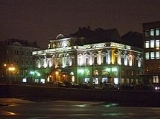
Tovstonogov Theater

Encyclopedia
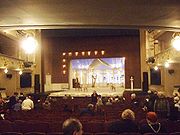
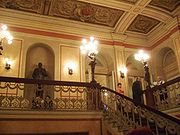
Tovstonogov Bolshoi Drama Theater , formerly known as Gorky Bolshoi Drama Theater (1931–1992), often referred to as the Bolshoi Drama Theater and by the acronym BDT , is a theater in Saint Petersburg
, that is considered one of the best Russia
n theaters. The theater is named after its long time director Georgy Tovstonogov
.
The theater is also encountered in literature as the Great Drama Theater or Great Dramatic Theater of Leningrad.
, Maria Andreeva
, Alexander Blok
and Anatoly Lunacharsky.
Already by 1914, before the October Revolution
, actress Maria Andreeva —common law wife
of Gorky from 1903 and Commissar for Theatres and Public Spectacles in Petrograd from 1918 to 1921— had participated in a theater initiative, including actor Yury Yuryev, with the aim of returning to the "classics". In 1918 Yuryev staged some works in Leningrad.
Gorky, Blok, Adreeva and Lunacharsky —who was People's Commissar of Enlightenment after the revolution— had similarly worked towards the aim of staging the classics for the masses. Eventually they merged with Andreeva's other endeavor.
In January 1919, the government sponsored the staging of Nikolai Gogol
's The Government Inspector.
During the first year of its operation the theater performed on the stage of the Great Hall of the Petrograd Conservatory
. The chief director of the theater was Andrey Lavrentyev and the Chairman was Alexander Blok. The first performance of the new theater was Friedrich Schiller
's Don Carlos
on 15 February 1919. In 1920 the theater moved to the building, at 65 Fontanka
Embankment, of the former Suvorin Theatre also known as Maly Imperial Drama Theater.
The main actors of that period were Yury Yuryev and Nikolay Monakhov. Many brilliant painters worked for the theater including Alexandre Benois
, Mstislav Dobuzhinsky
, Vladimir Shuko, Nikolay Akimov
; among the composers working with the theater were Boris Asafiev
and Yuri Shaporin. The theater produced mostly classical Romantic
Dramas like: Don Carlos
(1919), Othello
(1920), King Lear
(1920), Twelfth Night (1921), Ruy Blas
(1921), The Robbers (1919), Le Médecin malgré lui
, 1921, etc Since mid 1920s the theater adds to its repertoire plays of German expressionists including Gas by Georg Kaiser
, Virgin Forest by Ernst Toller
and influenced by expressionism Machine Mutiny (Bunt Mashin) by Alexey Tolstoy.
(Gorod Vetrov, 1928); Nikolai Pogodin
(Moy drug, 1932).
Very important were performances of Maxim Gorky
plays including Yegor Bulychev and the others, 1932; Dostigaeyev and others, 1933. In 1932 the theater was named in honor of Maxim Gorky. The theater was known as Gorky Bolshoi Drama Theater (Bolshoi Dramaticheskiy Teatr imeni Gor'kogo) until 1992, when it was renamed after Georgy Tovstonogov
.
The Artistic Directors (khudozhetvenniy rukovoditel) of that period were:
During World War II
the theater was evacuated to Kirov
, Kirov Oblast
. In 1943 in the last days of the Siege of Leningrad
the theater returned to serve the troops of Leningrad Front
and the military hospitals.
was the Artistic Director of the theater since 1956 until his death in 1989. During his prime Tovstonogov was considered one the best theatre directors of Europe and the theater was one of the best in the Soviet Union
Tovstonogov was the first who returned Fyodor Dostoyevsky into Soviet theater, by his productions of The Idiot
(1957).
Among other famous performances are:
and many others.
 The prominent members of his troupe included Alisa Freindlich
, Zinaida Sharko, Lyudmila Makarova, Tatiana Doronina
, Svetlana Kryuchkova, Kirill Lavrov
, Innokenty Smoktunovsky
, Pavel Luspekaev, Yefim Kopelyan
, Sergey Yursky, Vladislav Strzhelchik, Еvgeny Lebedev, and Oleg Basilashvili
.
was unanimously elected the Artistic Director. He managed to preserve the artistic tradition established by Tovstonogov, and to rename BDT after Tovstonogov in 1993.
Lavrov did not acted as a theatrical director. Many spectacles of the period were directed by Temur Chkheidze. Among them were: Intrigue and Love
by Friedrich Schiller
(1990), Macbeth
by William Shakespeare
(1995); Antigone
by Jean Anouilh
(1996), Boris Godunov
by Alexander Pushkin (1998)
On 27 April 2007 Kirill Lavrov died and Temur Chkheidze was elected as the Artistic Director of BDT.
Saint Petersburg
Saint Petersburg is a city and a federal subject of Russia located on the Neva River at the head of the Gulf of Finland on the Baltic Sea...
, that is considered one of the best Russia
Russia
Russia or , officially known as both Russia and the Russian Federation , is a country in northern Eurasia. It is a federal semi-presidential republic, comprising 83 federal subjects...
n theaters. The theater is named after its long time director Georgy Tovstonogov
Georgy Tovstonogov
Georgy Alexandrovich Tovstonogov was a Russian theatre director, the leader of Saint Petersburg Bolshoi Academic Theatre of Drama , which now bears his name.-Biography:...
.
The theater is also encountered in literature as the Great Drama Theater or Great Dramatic Theater of Leningrad.
Background
The main people behind the establishment of the theater were Maxim GorkyMaxim Gorky
Alexei Maximovich Peshkov , primarily known as Maxim Gorky , was a Russian and Soviet author, a founder of the Socialist Realism literary method and a political activist.-Early years:...
, Maria Andreeva
Maria Andreeva
Maria Fyodorovna Andreyeva was the stage name of Maria Fyodorovna Yurkovskaya , a Russian/Soviet actress and Bolshevik administrator....
, Alexander Blok
Alexander Blok
Alexander Alexandrovich Blok was a Russian lyrical poet.-Life and career:Blok was born in Saint Petersburg, into a sophisticated and intellectual family. Some of his relatives were literary men, his father being a law professor in Warsaw, and his maternal grandfather the rector of Saint Petersburg...
and Anatoly Lunacharsky.
Already by 1914, before the October Revolution
October Revolution
The October Revolution , also known as the Great October Socialist Revolution , Red October, the October Uprising or the Bolshevik Revolution, was a political revolution and a part of the Russian Revolution of 1917...
, actress Maria Andreeva —common law wife
Common-law marriage
Common-law marriage, sometimes called sui juris marriage, informal marriage or marriage by habit and repute, is a form of interpersonal status that is legally recognized in limited jurisdictions as a marriage even though no legally recognized marriage ceremony is performed or civil marriage...
of Gorky from 1903 and Commissar for Theatres and Public Spectacles in Petrograd from 1918 to 1921— had participated in a theater initiative, including actor Yury Yuryev, with the aim of returning to the "classics". In 1918 Yuryev staged some works in Leningrad.
Gorky, Blok, Adreeva and Lunacharsky —who was People's Commissar of Enlightenment after the revolution— had similarly worked towards the aim of staging the classics for the masses. Eventually they merged with Andreeva's other endeavor.
In January 1919, the government sponsored the staging of Nikolai Gogol
Nikolai Gogol
Nikolai Vasilievich Gogol was a Ukrainian-born Russian dramatist and novelist.Considered by his contemporaries one of the preeminent figures of the natural school of Russian literary realism, later critics have found in Gogol's work a fundamentally romantic sensibility, with strains of Surrealism...
's The Government Inspector.
Early years
The theater was organized in 1918 by the order of Maria Andreeva. The original name of the theater was Osobaya Drammaticheskaya Truppa (Special Drama Company). The theater was organized by merging the Theater of Tragedy led by Yury Yuryev and the Theater of Art Drama led by Andrey Lavrentyev.During the first year of its operation the theater performed on the stage of the Great Hall of the Petrograd Conservatory
Saint Petersburg Conservatory
The N. A. Rimsky-Korsakov Saint Petersburg State Conservatory is a music school in Saint Petersburg. In 2004, the conservatory had around 275 faculty members and 1,400 students.-History:...
. The chief director of the theater was Andrey Lavrentyev and the Chairman was Alexander Blok. The first performance of the new theater was Friedrich Schiller
Friedrich Schiller
Johann Christoph Friedrich von Schiller was a German poet, philosopher, historian, and playwright. During the last seventeen years of his life , Schiller struck up a productive, if complicated, friendship with already famous and influential Johann Wolfgang von Goethe...
's Don Carlos
Don Carlos (play)
Don Carlos is a historical tragedy in five acts by Friedrich Schiller; it was written between 1783 and 1787 and first produced in Hamburg in 1787...
on 15 February 1919. In 1920 the theater moved to the building, at 65 Fontanka
Fontanka
Fontanka is a left branch of the river Neva, which flows through the whole of Central Saint Petersburg, Russia. Its length is 6,700 meters, its width is up to 70 meters, and its depth is up to 3,5 meters. The Fontanka Embankment is lined with the former private residences of Russian nobility.This...
Embankment, of the former Suvorin Theatre also known as Maly Imperial Drama Theater.
The main actors of that period were Yury Yuryev and Nikolay Monakhov. Many brilliant painters worked for the theater including Alexandre Benois
Alexandre Benois
Alexandre Nikolayevich Benois , an influential artist, art critic, historian, preservationist, and founding member of Mir iskusstva , an art movement and magazine...
, Mstislav Dobuzhinsky
Mstislav Dobuzhinsky
Mstislav Valerianovich Dobuzhinsky or Dobujinsky was a Russian-Lithuanian artist noted for his cityscapes conveying the explosive growth and decay of the early twentieth-century city....
, Vladimir Shuko, Nikolay Akimov
Nikolay Akimov
Nikolay Pavlovich Akimov was an experimental theatre director and scenic designer noted for his work with the Leningrad Comedy Theatre. His most notorious production was the cynical version of Hamlet , with Ophelia as a drunken prostitute and the king's ghost as a clever mystification arranged by...
; among the composers working with the theater were Boris Asafiev
Boris Asafiev
Boris Vladimirovich Asafyev was a Russian and Soviet composer, writer, musicologist, musical critic and one of founders of Soviet musicology.Asafyev had a strong influence on Soviet music. His compositions include ballets, operas, symphonies, concertos and chamber music...
and Yuri Shaporin. The theater produced mostly classical Romantic
Romanticism
Romanticism was an artistic, literary and intellectual movement that originated in the second half of the 18th century in Europe, and gained strength in reaction to the Industrial Revolution...
Dramas like: Don Carlos
Don Carlos (play)
Don Carlos is a historical tragedy in five acts by Friedrich Schiller; it was written between 1783 and 1787 and first produced in Hamburg in 1787...
(1919), Othello
Othello
The Tragedy of Othello, the Moor of Venice is a tragedy by William Shakespeare, believed to have been written in approximately 1603, and based on the Italian short story "Un Capitano Moro" by Cinthio, a disciple of Boccaccio, first published in 1565...
(1920), King Lear
King Lear
King Lear is a tragedy by William Shakespeare. The title character descends into madness after foolishly disposing of his estate between two of his three daughters based on their flattery, bringing tragic consequences for all. The play is based on the legend of Leir of Britain, a mythological...
(1920), Twelfth Night (1921), Ruy Blas
Ruy Blas
Ruy Blas is a tragic drama by Victor Hugo. It was the first play presented at the Théâtre de la Renaissance and opened on November 8, 1838. Though considered by many to be Hugo’s best drama, the play initially met with only average success....
(1921), The Robbers (1919), Le Médecin malgré lui
Le Médecin malgré lui
Le Médecin malgré lui is a comedy by Molière.-Characters:*Sganarelle, a woodcutter*Martine, Sganarelle's wife*Géronte, a wealthy bourgeois*Lucinde, Géronte's daughter...
, 1921, etc Since mid 1920s the theater adds to its repertoire plays of German expressionists including Gas by Georg Kaiser
Georg Kaiser
Friedrich Carl Georg Kaiser, called Georg Kaiser, was a German dramatist.-Biography:Kaiser was born at Magdeburg....
, Virgin Forest by Ernst Toller
Ernst Toller
Ernst Toller was a left-wing German playwright, best known for his Expressionist plays and serving as President of the short-lived Bavarian Soviet Republic, for six days.- Biography :...
and influenced by expressionism Machine Mutiny (Bunt Mashin) by Alexey Tolstoy.
Konstantin Tverskoy (1925-1935)
The main director of that period was Konstantin Tverskoy (real name Konstantin Konstantinovich Kuzmin-Karavayev officially the Artistic Director in 1929-1935). The theater was producing spectacles of Soviet drmaturgists, including Boris Lavrenev (Myatezh, 1925; Razlom), Vladimir KirshonVladimir Kirshon
Vladimir Mikhailovich Kirshon was a Soviet playwright.Born in Nalchik in the Caucasus into the family of a lawyer, Kirshon served in the Red Army during the Russian Civil War and in 1920 joined the Communist Party, which sent him to the Sverdlov Communist University. As a young idealist, he was...
(Gorod Vetrov, 1928); Nikolai Pogodin
Nikolai Pogodin
Nikolai Fyodorovich Pogodin was a Soviet playwright.Born into a peasant family at Gundorovskaya Stantsiya in the Don Province, young Nikolai Stukalov "spent a wandering childhood with his mother, who travelled from one Cossack village to another taking in sewing"; he worked as a bookbinder and...
(Moy drug, 1932).
Very important were performances of Maxim Gorky
Maxim Gorky
Alexei Maximovich Peshkov , primarily known as Maxim Gorky , was a Russian and Soviet author, a founder of the Socialist Realism literary method and a political activist.-Early years:...
plays including Yegor Bulychev and the others, 1932; Dostigaeyev and others, 1933. In 1932 the theater was named in honor of Maxim Gorky. The theater was known as Gorky Bolshoi Drama Theater (Bolshoi Dramaticheskiy Teatr imeni Gor'kogo) until 1992, when it was renamed after Georgy Tovstonogov
Georgy Tovstonogov
Georgy Alexandrovich Tovstonogov was a Russian theatre director, the leader of Saint Petersburg Bolshoi Academic Theatre of Drama , which now bears his name.-Biography:...
.
Difficult years (1935-1956)
The years after Tverskoy are considered to be a crisis for the theater. The leaders of the theater frequently changed, the level of performances lowered and the numbers of theater-goes dramatically decreased.The Artistic Directors (khudozhetvenniy rukovoditel) of that period were:
- V.F. Fyodorov - 1934;
- Aleksei DikiyAleksei Dikiy-Ukraine:He was born Aleksei Denisovich Dikiy on February 24, 1889, inEkaterinoslav, Russian Empire, now Dnepropetrivsk, Ukraine. At youngage he moved to Kharkov, where his sister, named Maria Sukhodolska - Dikova, was a popular actress, and she helped...
- 1936-1937; - Boris BabochkinBoris BabochkinBoris Andreyevich Babochkin was a well-known Soviet film and theatre actor and director. Boris Babochkin was one of the first internationally recognized stars of the Soviet-Russian cinema...
- 1939-1940; - L.S. Rudnik - 1940-1944;
- N.S. Rashevskaya - 1946-1950;
- I.S. Yefremov - 1951-1952;
- O.G. Kaziko - 1952-1954;
- K.P. Khokhlov - 1954-1955;
During World War II
World War II
World War II, or the Second World War , was a global conflict lasting from 1939 to 1945, involving most of the world's nations—including all of the great powers—eventually forming two opposing military alliances: the Allies and the Axis...
the theater was evacuated to Kirov
Kirov, Kirov Oblast
Kirov , formerly known as Vyatka and Khlynov, is a city in northeastern European Russia, on the Vyatka River, and the administrative center of Kirov Oblast. Population: -History:...
, Kirov Oblast
Kirov Oblast
Kirov Oblast is a federal subject of Russia . Its administrative center is the city of Kirov. Population: -History:In the late 19th and early 20th centuries, Vyatka remained a place of exile for opponents of the tsarist regime, including many prominent revolutionary figures.In 1920, a number of...
. In 1943 in the last days of the Siege of Leningrad
Siege of Leningrad
The Siege of Leningrad, also known as the Leningrad Blockade was a prolonged military operation resulting from the failure of the German Army Group North to capture Leningrad, now known as Saint Petersburg, in the Eastern Front theatre of World War II. It started on 8 September 1941, when the last...
the theater returned to serve the troops of Leningrad Front
Leningrad Front
The Leningrad Front was first formed on August 27, 1941, by dividing the Northern Front into the Leningrad Front and Karelian Front, during the German approach on Leningrad .-History:...
and the military hospitals.
Georgy Tovstonogov (1956-1989)
Georgy TovstonogovGeorgy Tovstonogov
Georgy Alexandrovich Tovstonogov was a Russian theatre director, the leader of Saint Petersburg Bolshoi Academic Theatre of Drama , which now bears his name.-Biography:...
was the Artistic Director of the theater since 1956 until his death in 1989. During his prime Tovstonogov was considered one the best theatre directors of Europe and the theater was one of the best in the Soviet Union
Soviet Union
The Soviet Union , officially the Union of Soviet Socialist Republics , was a constitutionally socialist state that existed in Eurasia between 1922 and 1991....
Tovstonogov was the first who returned Fyodor Dostoyevsky into Soviet theater, by his productions of The Idiot
The Idiot (novel)
The Idiot is a novel written by 19th century Russian author Fyodor Dostoyevsky. It was first published serially in The Russian Messenger between 1868 and 1869. The Idiot is ranked beside some of Dostoyevsky's other works as one of the most brilliant literary achievements of the "Golden Age" of...
(1957).
Among other famous performances are:
- The Three Sisters 1965 and Uncle VanyaUncle VanyaUncle Vanya is a play by the Russian playwright Anton Chekhov. It was first published in 1897 and received its Moscow première in 1899 in a production by the Moscow Art Theatre, under the direction of Konstantin Stanislavski....
(1982) by Anton ChekhovAnton ChekhovAnton Pavlovich Chekhov was a Russian physician, dramatist and author who is considered to be among the greatest writers of short stories in history. His career as a dramatist produced four classics and his best short stories are held in high esteem by writers and critics... - Five evenings 1958 and My big sister 1961 by Alexander Volodin
- Irkusk Story by A. N. Arbuzov 1960
- Wit Works Woe 1962 by Alexander Griboedov
- Barbarians (1959) and Meschane (1966) by Maxim GorkyMaxim GorkyAlexei Maximovich Peshkov , primarily known as Maxim Gorky , was a Russian and Soviet author, a founder of the Socialist Realism literary method and a political activist.-Early years:...
- Once again about Love (1964) by Edvard RadzinskyEdvard RadzinskyEdvard Stanislavovich Radzinsky is a Russian playwright, writer, TV personality, and film screenwriter. He is also known as an author of several books on history which were characterized as "folk history" by journalists and academic historians.-Biography:Edvard Stanislavovich Radzinsky was born...
- Henry IVHenry IV, Part 1Henry IV, Part 1 is a history play by William Shakespeare, believed to have been written no later than 1597. It is the second play in Shakespeare's tetralogy dealing with the successive reigns of Richard II, Henry IV , and Henry V...
(1969) by William ShakespeareWilliam ShakespeareWilliam Shakespeare was an English poet and playwright, widely regarded as the greatest writer in the English language and the world's pre-eminent dramatist. He is often called England's national poet and the "Bard of Avon"... - Revisor by Nikolay Gogol (1972)
- Last summer in Chulimsk by Alexander VampilovAlexander VampilovAlexander Valentinovich Vampilov was a Russian playwright. His play Elder Son was first performed in 1969, and became a national success two years later. Many of his plays have been filmed or televised in Russia...
(1974) - Energetic people by Vasily ShukshinVasily ShukshinVasily Makarovich Shukshin was a notable Soviet/Russian actor, writer, screenwriter and movie director from the Altay region who specialized in rural themes. Upon his death, Shukshin was interred at Novodevichy Cemetery in Moscow.-Biography:...
(1974) - History of a Horse after Leo TolstoyLeo TolstoyLev Nikolayevich Tolstoy was a Russian writer who primarily wrote novels and short stories. Later in life, he also wrote plays and essays. His two most famous works, the novels War and Peace and Anna Karenina, are acknowledged as two of the greatest novels of all time and a pinnacle of realist...
's KholstomerKholstomer"Kholstomer", also translated as "Strider", is one of the most striking stories in Russian literature. It was started by Leo Tolstoy in 1863 and left unfinished until 1886, when it was reworked and published as "Kholstomer: The Story of a Horse". Georgi Tovstonogov staged it in his theatre in 1975....
(1975)
and many others.
Alisa Freindlich
Alisa Brunovna Freindlich is a Soviet and Russian actress, People's Artist of the USSR.-Biography:Alisa Freindlich was born into the family of Bruno Freindlich, a prominent actor and People's Artist of the USSR. She is of German and Russian ancestry. Her father and paternal relatives were ethnic...
, Zinaida Sharko, Lyudmila Makarova, Tatiana Doronina
Tatiana Doronina
Tatiana Vasilyevna Doronina is a popular Soviet/Russian actress who has performed in movies and the theater. She is generally regarded as one of the most talented actresses of her generation and was named a People's Artist of the USSR in 1981....
, Svetlana Kryuchkova, Kirill Lavrov
Kirill Lavrov
Kirill Yuryevich Lavrov was a well-known Soviet and Russian film and theatre actor and director.-Childhood:Kirill Yuryevich Lavrov was born on September 15, 1925, in Leningrad, USSR . He was baptized by the Russian Orthodox Church of St. John the Divine in Lavrushinskoe Podvorie Monastery in...
, Innokenty Smoktunovsky
Innokenty Smoktunovsky
Innokentiy Mikhailovich Smoktunovsky was a Soviet actor acclaimed as the "king of Soviet actors". He was named People's Artist of the USSR in 1974 and the Hero of Socialist Labour in 1990....
, Pavel Luspekaev, Yefim Kopelyan
Yefim Kopelyan
Yefim Zakharovich Kopelyan was a Soviet actor of theater and cinema, one of the legendary masters of the Bolshoi Theatre of Drama . He performed the bright characteristic roles in the films The Elusive Avengers, Intervention, Eternal call, Straw cap, read author's text in the television series...
, Sergey Yursky, Vladislav Strzhelchik, Еvgeny Lebedev, and Oleg Basilashvili
Oleg Basilashvili
Oleg Valerianovich Basilashvili is a well-known Soviet/Russian film and theatre actor of Georgian and Polish origin, as well as political figure in the former Soviet Union and in the new Russia.-Childhood:...
.
After Tovstonogov
In 1989, a prominent actor of the theater, Kirill LavrovKirill Lavrov
Kirill Yuryevich Lavrov was a well-known Soviet and Russian film and theatre actor and director.-Childhood:Kirill Yuryevich Lavrov was born on September 15, 1925, in Leningrad, USSR . He was baptized by the Russian Orthodox Church of St. John the Divine in Lavrushinskoe Podvorie Monastery in...
was unanimously elected the Artistic Director. He managed to preserve the artistic tradition established by Tovstonogov, and to rename BDT after Tovstonogov in 1993.
Lavrov did not acted as a theatrical director. Many spectacles of the period were directed by Temur Chkheidze. Among them were: Intrigue and Love
Intrigue and Love
Intrigue and Love , , is a five-act play, written by the German dramatist and writer Friedrich Schiller...
by Friedrich Schiller
Friedrich Schiller
Johann Christoph Friedrich von Schiller was a German poet, philosopher, historian, and playwright. During the last seventeen years of his life , Schiller struck up a productive, if complicated, friendship with already famous and influential Johann Wolfgang von Goethe...
(1990), Macbeth
Macbeth
The Tragedy of Macbeth is a play by William Shakespeare about a regicide and its aftermath. It is Shakespeare's shortest tragedy and is believed to have been written sometime between 1603 and 1607...
by William Shakespeare
William Shakespeare
William Shakespeare was an English poet and playwright, widely regarded as the greatest writer in the English language and the world's pre-eminent dramatist. He is often called England's national poet and the "Bard of Avon"...
(1995); Antigone
Antigone (Anouilh play)
Jean Anouilh's play Antigone is a tragedy inspired by Greek mythology and the play of the same name from the fifth century B.C...
by Jean Anouilh
Jean Anouilh
Jean Marie Lucien Pierre Anouilh was a French dramatist whose career spanned five decades. Though his work ranged from high drama to absurdist farce, Anouilh is best known for his 1943 play Antigone, an adaptation of Sophocles' Classical drama, that was seen as an attack on Marshal Pétain's...
(1996), Boris Godunov
Boris Godunov (drama)
Boris Godunov is a play by Alexander Pushkin. It was written in 1825, published in 1831, but not approved for performance by the censor until 1866. Its subject is the Russian ruler Boris Godunov, who reigned as Tsar from 1598 to 1605. It consists of 25 scenes and is written predominantly in blank...
by Alexander Pushkin (1998)
On 27 April 2007 Kirill Lavrov died and Temur Chkheidze was elected as the Artistic Director of BDT.