

Uncle Vanya

Encyclopedia
Uncle Vanya is a play by the Russian
playwright
Anton Chekhov
. It was first published in 1897 and received its Moscow première in 1899 in a production by the Moscow Art Theatre
, under the direction of Konstantin Stanislavski
.
The play portrays the visit of an elderly Professor and his glamorous, much younger second wife, Elena, to the rural estate that supports their urban lifestyle. Two friends, Vanya, brother of the Professor's late first wife, who has long managed the estate, and Astrov, the local Doctor, both fall under Elena's spell, while bemoaning the ennui of their provincial existence. Sonya, the Professor's daughter by his first wife, who has worked with Vanya to keep the estate going, meanwhile suffers from the awareness of her own lack of beauty and from her unrequited feelings for Dr. Astrov. Matters are brought to a crisis when the Professor announces his intention to sell the estate, Vanya and Sonya's home and raison d'être
, with a view to investing the proceeds to achieve a higher income for himself and his wife.
, Richard Gilman
, and Eric Bentley
have sought to chart the development of Chekhov's dramaturgical method through the 1890s.
Rayfield cites recent scholarship suggesting Chekhov revisited The Wood Demon during his trip to the island of Sakhalin
, a prison colony in Eastern Russia, in 1891.
, several days later. It is late at night. Before going to bed, Serebryakov complains of being in pain and of old age. Astrov arrives, having been sent for by Sonya, but the professor refuses to see him. After Serebryakov is asleep, Elena and Vanya talk. She speaks of the discord in the house, and Vanya speaks of dashed hopes. He feels he’s misspent his youth, and he associates his unrequited love for Elena with the devastation of his life. Elena refuses to listen. Alone, Vanya questions why he did not fall in love with Elena when he first met her ten years before, when it would have been possible for the two to have married and had a happy life together. At that time, Vanya believed in Prof. Serebryakov’s greatness and was happy to think that his own efforts supported Serebryakov's work; now he has become disillusioned with the professor and his life feels empty. As Vanya agonizes over his past, Astrov returns, the worse for drink, and the two talk together. Sonya chides Vanya for his drinking, and responds pragmatically to his reflections on the futility of a wasted life, pointing out that only work is truly fulfilling.
Outside, a storm is gathering and Astrov talks with Sonya about the suffocating atmosphere in the house; Astrov says Serebryakov is difficult, Vanya is a hypochondriac, and Elena is charming but idle. He laments that it’s a long time since he loved anyone. Sonya begs Astrov to stop drinking, telling him it is unworthy of him to destroy himself. The two discuss love, during which it becomes clear that Sonya is in love with the Doctor and that he is unaware of her feelings.
When the doctor leaves, Elena enters and makes peace with Sonya, after an apparently long period of mutual anger and antagonism. Trying to resolve their past difficulties, Elena reassures Sonya that she had strong feelings for her father when she married him, though the love proved false. The two women converse at cross purposes, with Elena confessing her unhappiness and Sonya gushing about the doctor’s virtues. In a happy mood, Sonya leaves to ask the professor if Elena may play the piano. Sonya returns with his negative answer, which quickly dampens the mood.
When Elena asks Astrov about his feelings for Sonya, he says he has none and concludes that Elena has brought up the subject of love to encourage him to confess his own emotions for her. Astrov kisses Elena, and Vanya witnesses the embrace. Upset, Elena begs Vanya to use his influence so that she and the professor can leave immediately. Before Serebryakov can make his announcement, Elena conveys to Sonya the message that Astrov doesn’t love her.
Serebryakov proposes that he solve the family’s financial problems by selling the estate, and using the proceeds to invest in interest-bearing paper which will bring in a significantly higher income (and, he hopes, leave enough over to buy a villa for himself and Elena in Finland). Angrily, Vanya asks where he, Sonya, and his mother would live. He protests that the estate rightly belongs to Sonya and that Vanya has never been appreciated for the self-sacrifice it took to rid the property of debt. As Vanya’s anger mounts, he begins to rage against the professor, blaming him for the failure of his life, wildly claiming that, without Serebryakov to hold him back, he could have been a second Schopenhauer or Dostoevsky. In despair, he cries out to his mother, but instead of comforting her son, Maria insists that Vanya listen to the professor. Serebryakov insults Vanya, who storms out of the room. Elena begs to be taken away from the country and Sonya pleads with her father on Vanya's behalf. Serebryakov exits to confront Vanya further. A shot is heard from offstage and Serebryakov returns, being chased by Vanya, who is wielding a loaded pistol. He fires the pistol again at the professor, but misses. He throws the gun down in disgust and sinks into a chair.
, presumably to commit suicide; Sonya and Astrov beg him to return the narcotic, which he eventually does.
Elena and Serebryakov bid everyone farewell. When Elena says goodbye to Astrov, she admits to having been carried away by him, embraces him, and takes one of his pencils as a souvenir. Serebryakov and Vanya make their peace, agreeing all will be as it was before. Once the outsiders have departed, Sonya and Vanya pay bills, Maria reads a pamphlet, and Marina knits. Vanya complains of the heaviness of his heart, and Sonya, in response, speaks of living, working, and the rewards of the afterlife: “We shall hear the angels, we shall see the whole sky all diamonds, we shall see how all earthly evil, all our sufferings, are drowned in the mercy that will fill the whole world. And our life will grow peaceful, tender, sweet as a caress. . . . In your life you haven’t known what joy was; but wait, Uncle Vanya, wait. . . . We shall rest.”
Arguably it remains somewhat difficult to organize these concepts into a coherent theme as they belong more to the play's "nastroenie," its melancholic mood or atmosphere, than to a distinct program of ideas.
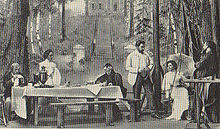 Although the play had previous small runs in provincial theatres in 1898, its metropolitan première took place on at the Moscow Art Theatre
. Konstantin Stanislavski
played the role of Astrov while Chekhov's future wife Olga Knipper
played Elena. The initial reviews were favourable yet pointed to defects in both the play and the acting. As the staging and the acting improved over successive performances, however, and as "the public understood better its inner meaning and nuances of feeling," the reviews improved. Uncle Vanya became a permanent fixture in the Moscow Art Theatre.
Other actors who have appeared in notable stage productions of Uncle Vanya include Franchot Tone
, Cate Blanchett
, Jacki Weaver
, Anthony Sher, Ian McKellen
, William Hurt
, George C. Scott
, Derek Jacobi
and Trevor Eve
. The cast of the celebrated 1963 Laurence Olivier
production is discussed below under Film and opera adaptations. The play was also adapted as the new stage-play Dear Uncle by the British playwright Alan Ayckbourn
, who reset it in the 1930s Lake District
- this adaptation premiered from July to September 2011 at the Stephen Joseph Theatre
.
The Reduced Shakespeare Company performed a shortened version of the play on their BBC radio show, which contained only three lines:
Are you Uncle Vanya?
I am.
[Gunshot sounds]
Ouch!
Sonya's Story
, an opera adapted by director Sally Burgess
, composer Neal Thornton and designer Charles Phu
, portraying events in the play Uncle Vanya from the character Sonya's perspective, premiered in 2010.
Awards
Nominations
Russian literature
Russian literature refers to the literature of Russia or its émigrés, and to the Russian-language literature of several independent nations once a part of what was historically Russia or the Soviet Union...
playwright
Playwright
A playwright, also called a dramatist, is a person who writes plays.The term is not a variant spelling of "playwrite", but something quite distinct: the word wright is an archaic English term for a craftsman or builder...
Anton Chekhov
Anton Chekhov
Anton Pavlovich Chekhov was a Russian physician, dramatist and author who is considered to be among the greatest writers of short stories in history. His career as a dramatist produced four classics and his best short stories are held in high esteem by writers and critics...
. It was first published in 1897 and received its Moscow première in 1899 in a production by the Moscow Art Theatre
Moscow Art Theatre
The Moscow Art Theatre is a theatre company in Moscow that the seminal Russian theatre practitioner Constantin Stanislavski, together with the playwright and director Vladimir Nemirovich-Danchenko, founded in 1898. It was conceived as a venue for naturalistic theatre, in contrast to the melodramas...
, under the direction of Konstantin Stanislavski
Konstantin Stanislavski
Constantin Sergeyevich Stanislavski , was a Russian actor and theatre director. Building on the directorially-unified aesthetic and ensemble playing of the Meiningen company and the naturalistic staging of Antoine and the independent theatre movement, Stanislavski organized his realistic...
.
The play portrays the visit of an elderly Professor and his glamorous, much younger second wife, Elena, to the rural estate that supports their urban lifestyle. Two friends, Vanya, brother of the Professor's late first wife, who has long managed the estate, and Astrov, the local Doctor, both fall under Elena's spell, while bemoaning the ennui of their provincial existence. Sonya, the Professor's daughter by his first wife, who has worked with Vanya to keep the estate going, meanwhile suffers from the awareness of her own lack of beauty and from her unrequited feelings for Dr. Astrov. Matters are brought to a crisis when the Professor announces his intention to sell the estate, Vanya and Sonya's home and raison d'être
Raison d'être
Raison d'être is a French phrase meaning "reason for existence." It may also refer to:* Raison d'être , a Swedish dark-ambient-industrial-drone music project* Raison D'être , an album by Australian jazz fusion guitarist Frank Gambale...
, with a view to investing the proceeds to achieve a higher income for himself and his wife.
Background
Uncle Vanya is unique among Chekhov's major plays because it is essentially an extensive reworking of his own play published a decade earlier, The Wood Demon. By elucidating the specific changes Chekhov made during the revision process - these include reducing the cast-list from almost two dozen down to a lean nine, changing the climactic suicide of the The Wood Demon into the famous failed homicide of Uncle Vanya, and altering the original happy ending into a more problematic, less final resolution - critics such as Donald RayfieldDonald Rayfield
Donald Rayfield is professor of Russian and Georgian at Queen Mary, University of London. He is an author of books about Russian and Georgian literature, and about Joseph Stalin and his secret police...
, Richard Gilman
Richard Gilman
Richard Gilman was one of the leading drama and literary critics of the second half of the 20th century. He was a professor at the Yale School of Drama for 31 years and the author of five books of criticism and a memoir.Gilman died of lung cancer at the age of 83.-External links:* *...
, and Eric Bentley
Eric Bentley
Eric Bentley is a critic, playwright, singer, editor and translator. He became an American citizen in 1948, and currently lives in New York City...
have sought to chart the development of Chekhov's dramaturgical method through the 1890s.
Rayfield cites recent scholarship suggesting Chekhov revisited The Wood Demon during his trip to the island of Sakhalin
Sakhalin
Sakhalin or Saghalien, is a large island in the North Pacific, lying between 45°50' and 54°24' N.It is part of Russia, and is Russia's largest island, and is administered as part of Sakhalin Oblast...
, a prison colony in Eastern Russia, in 1891.
Characters
- Aleksandr Vladimirovich Serebryakov (Александр Владимирович Серебряков) - a retired university professor, who has lived for years in the city on the earnings of his late first wife's rural estate, managed for him by Vanya and Sonya.
- Elena Andreyevna Serebryakova (Елена Андреевна Серебрякова) - Professor Serebryakov's young and beautiful second wife. She is 27 years old.
- Sofia Alexandrovna Serebryakova (Sonya) (Софья Александровна Серебрякова) - Professor Serebryakov's plain daughter from his first marriage.
- Maria Vasilyevna Voynitskaya (Мария Васильевна Войницкая) - the widow of a privy councilor and mother of Vanya (and of Vanya's late sister, the Professor's first wife).
- Ivan Petrovitch Voynitsky ("Uncle Vanya") (Иван Петрович Войницкий)- Maria's son and Sonya's uncle, the title character of the play. He is 47 years old.
- Mikhail Lvovich Astrov (Михаил Львович Астров) - a middle aged country doctor.
- Ilya Ilych Telegin (nicknamed "Waffles" for his pockmarked skin) (Илья Ильич Телегин) - an impoverished landowner, who now lives on the estate as a dependent of the family.
- Marina Timofeevna (Марина Тимофеевна) - an old nurse.
- A Workman
Act I
A garden in Serebryakov's country estate. Astrov and Marina discuss how old Astrov has grown, and how he feels bored with his life as a country doctor. Vanya enters, yawning from a nap, the three complain about how all order has been disrupted since the professor and his wife, Elena, arrived. As they’re talking, Serebryakov, Elena, Sonya, and Telegin return from a walk. Out of the professor's earshot, Vanya calls him “a learned old dried mackerel,” criticizing him for his pomposity and the smallness of his achievements. Vanya’s mother, Maria Vasilyevna, who idolizes Serebryakov, objects to her son’s derogatory comments. Vanya also praises the professor’s wife, Elena, for her beauty, arguing that faithfulness to an old man like Serebryakov means silencing youth and emotions — an immoral waste of vitality. Astrov is forced to depart to attend a patient, but not before delivering a speech on the preservation of the forests, a subject he is very passionate about. Act I closes with Elena becoming exasperated as Vanya declares his love for her.Act II
The dining roomDining room
A dining room is a room for consuming food. In modern times it is usually adjacent to the kitchen for convenience in serving, although in medieval times it was often on an entirely different floor level...
, several days later. It is late at night. Before going to bed, Serebryakov complains of being in pain and of old age. Astrov arrives, having been sent for by Sonya, but the professor refuses to see him. After Serebryakov is asleep, Elena and Vanya talk. She speaks of the discord in the house, and Vanya speaks of dashed hopes. He feels he’s misspent his youth, and he associates his unrequited love for Elena with the devastation of his life. Elena refuses to listen. Alone, Vanya questions why he did not fall in love with Elena when he first met her ten years before, when it would have been possible for the two to have married and had a happy life together. At that time, Vanya believed in Prof. Serebryakov’s greatness and was happy to think that his own efforts supported Serebryakov's work; now he has become disillusioned with the professor and his life feels empty. As Vanya agonizes over his past, Astrov returns, the worse for drink, and the two talk together. Sonya chides Vanya for his drinking, and responds pragmatically to his reflections on the futility of a wasted life, pointing out that only work is truly fulfilling.
Outside, a storm is gathering and Astrov talks with Sonya about the suffocating atmosphere in the house; Astrov says Serebryakov is difficult, Vanya is a hypochondriac, and Elena is charming but idle. He laments that it’s a long time since he loved anyone. Sonya begs Astrov to stop drinking, telling him it is unworthy of him to destroy himself. The two discuss love, during which it becomes clear that Sonya is in love with the Doctor and that he is unaware of her feelings.
When the doctor leaves, Elena enters and makes peace with Sonya, after an apparently long period of mutual anger and antagonism. Trying to resolve their past difficulties, Elena reassures Sonya that she had strong feelings for her father when she married him, though the love proved false. The two women converse at cross purposes, with Elena confessing her unhappiness and Sonya gushing about the doctor’s virtues. In a happy mood, Sonya leaves to ask the professor if Elena may play the piano. Sonya returns with his negative answer, which quickly dampens the mood.
Act III
Vanya, Sonya, and Elena are in the living room, having been called there by Serebryakov. Vanya calls Elena a water nymph and urges her, once again, to break free. Sonya complains to Elena that she has loved Astrov for six years but that, because she is not beautiful, he doesn’t notice her. Elena volunteers to question Astrov and find out if he’s in love with Sonya. Sonya is pleased, but before agreeing she wonders whether uncertainty is better than knowledge, because then, at least, there is hope.When Elena asks Astrov about his feelings for Sonya, he says he has none and concludes that Elena has brought up the subject of love to encourage him to confess his own emotions for her. Astrov kisses Elena, and Vanya witnesses the embrace. Upset, Elena begs Vanya to use his influence so that she and the professor can leave immediately. Before Serebryakov can make his announcement, Elena conveys to Sonya the message that Astrov doesn’t love her.
Serebryakov proposes that he solve the family’s financial problems by selling the estate, and using the proceeds to invest in interest-bearing paper which will bring in a significantly higher income (and, he hopes, leave enough over to buy a villa for himself and Elena in Finland). Angrily, Vanya asks where he, Sonya, and his mother would live. He protests that the estate rightly belongs to Sonya and that Vanya has never been appreciated for the self-sacrifice it took to rid the property of debt. As Vanya’s anger mounts, he begins to rage against the professor, blaming him for the failure of his life, wildly claiming that, without Serebryakov to hold him back, he could have been a second Schopenhauer or Dostoevsky. In despair, he cries out to his mother, but instead of comforting her son, Maria insists that Vanya listen to the professor. Serebryakov insults Vanya, who storms out of the room. Elena begs to be taken away from the country and Sonya pleads with her father on Vanya's behalf. Serebryakov exits to confront Vanya further. A shot is heard from offstage and Serebryakov returns, being chased by Vanya, who is wielding a loaded pistol. He fires the pistol again at the professor, but misses. He throws the gun down in disgust and sinks into a chair.
Act IV
As the final act opens, a few hours later, Marina and Telegin wind wool and discuss the planned departure of Serebryakov and Elena. When Vanya and Astrov enter, Astrov says that in this district only he and Vanya were “decent, cultured men” and that ten years of “narrow-minded life” have made them vulgar. Vanya has stolen a vial of Astrov’s morphineMorphine
Morphine is a potent opiate analgesic medication and is considered to be the prototypical opioid. It was first isolated in 1804 by Friedrich Sertürner, first distributed by same in 1817, and first commercially sold by Merck in 1827, which at the time was a single small chemists' shop. It was more...
, presumably to commit suicide; Sonya and Astrov beg him to return the narcotic, which he eventually does.
Elena and Serebryakov bid everyone farewell. When Elena says goodbye to Astrov, she admits to having been carried away by him, embraces him, and takes one of his pencils as a souvenir. Serebryakov and Vanya make their peace, agreeing all will be as it was before. Once the outsiders have departed, Sonya and Vanya pay bills, Maria reads a pamphlet, and Marina knits. Vanya complains of the heaviness of his heart, and Sonya, in response, speaks of living, working, and the rewards of the afterlife: “We shall hear the angels, we shall see the whole sky all diamonds, we shall see how all earthly evil, all our sufferings, are drowned in the mercy that will fill the whole world. And our life will grow peaceful, tender, sweet as a caress. . . . In your life you haven’t known what joy was; but wait, Uncle Vanya, wait. . . . We shall rest.”
Themes
Uncle Vanya is thematically preoccupied with frustrated hopes and what might be called the "wasted life"; Chekhov's characters are each unhappy, and (like Tolstoy's unhappy families) they are each unhappy in their own way. In this sense, there are many parallels with other Chekhov plays.Arguably it remains somewhat difficult to organize these concepts into a coherent theme as they belong more to the play's "nastroenie," its melancholic mood or atmosphere, than to a distinct program of ideas.
Productions
Moscow Art Theatre
The Moscow Art Theatre is a theatre company in Moscow that the seminal Russian theatre practitioner Constantin Stanislavski, together with the playwright and director Vladimir Nemirovich-Danchenko, founded in 1898. It was conceived as a venue for naturalistic theatre, in contrast to the melodramas...
. Konstantin Stanislavski
Konstantin Stanislavski
Constantin Sergeyevich Stanislavski , was a Russian actor and theatre director. Building on the directorially-unified aesthetic and ensemble playing of the Meiningen company and the naturalistic staging of Antoine and the independent theatre movement, Stanislavski organized his realistic...
played the role of Astrov while Chekhov's future wife Olga Knipper
Olga Knipper
Olga Leonardovna Knipper-Chekhova was a Russian stage actress. She was married to Anton Chekhov.Knipper was among the 39 original members of the Moscow Art Theatre when it was formed by Constantin Stanislavski in 1898...
played Elena. The initial reviews were favourable yet pointed to defects in both the play and the acting. As the staging and the acting improved over successive performances, however, and as "the public understood better its inner meaning and nuances of feeling," the reviews improved. Uncle Vanya became a permanent fixture in the Moscow Art Theatre.
Other actors who have appeared in notable stage productions of Uncle Vanya include Franchot Tone
Franchot Tone
Franchot Tone was an American stage, film, and television actor, star of Mutiny on the Bounty and many other films through the 1960s...
, Cate Blanchett
Cate Blanchett
Catherine Élise "Cate" Blanchett is an Australian actress. She came to international attention for her role as Elizabeth I of England in the 1998 biopic film Elizabeth, for which she won British Academy of Film and Television Arts and Golden Globe Awards, and earned her first Academy Award...
, Jacki Weaver
Jacki Weaver
Jacqueline Ruth "Jacki" Weaver is an Australian theatre, film and television actress. She is best known outside Australia for her performance in Animal Kingdom, for which she was nominated for the 2011 Academy Award for Best Supporting Actress.-Career:Jacki Weaver has been working in Australian...
, Anthony Sher, Ian McKellen
Ian McKellen
Sir Ian Murray McKellen, CH, CBE is an English actor. He has received a Tony Award, two Academy Award nominations, and five Emmy Award nominations. His work has spanned genres from Shakespearean and modern theatre to popular fantasy and science fiction...
, William Hurt
William Hurt
William McGill Hurt is an American stage and film actor. He received his acting training at the Juilliard School, and began acting on stage in the 1970s. Hurt made his film debut as a troubled scientist in the science-fiction feature Altered States , for which he received a Golden Globe nomination...
, George C. Scott
George C. Scott
George Campbell Scott was an American stage and film actor, director and producer. He was best known for his stage work, as well as his portrayal of General George S. Patton in the film Patton, and as General Buck Turgidson in Stanley Kubrick's Dr...
, Derek Jacobi
Derek Jacobi
Sir Derek George Jacobi, CBE is an English actor and film director.A "forceful, commanding stage presence", Jacobi has enjoyed a highly successful stage career, appearing in such stage productions as Hamlet, Uncle Vanya, and Oedipus the King. He received a Tony Award for his performance in...
and Trevor Eve
Trevor Eve
Trevor John Eve is a British film and television actor. In 1979 he gained fame as the eponymous lead in the detective series Shoestring and is also known for his role as Detective Superintendent Peter Boyd in BBC television drama Waking the Dead.-Early life:Eve was born in Sutton Coldfield,...
. The cast of the celebrated 1963 Laurence Olivier
Laurence Olivier
Laurence Kerr Olivier, Baron Olivier, OM was an English actor, director, and producer. He was one of the most famous and revered actors of the 20th century. He married three times, to fellow actors Jill Esmond, Vivien Leigh, and Joan Plowright...
production is discussed below under Film and opera adaptations. The play was also adapted as the new stage-play Dear Uncle by the British playwright Alan Ayckbourn
Alan Ayckbourn
Sir Alan Ayckbourn CBE is a prolific English playwright. He has written and produced seventy-three full-length plays in Scarborough and London and was, between 1972 and 2009, the artistic director of the Stephen Joseph Theatre in Scarborough, where all but four of his plays have received their...
, who reset it in the 1930s Lake District
Lake District
The Lake District, also commonly known as The Lakes or Lakeland, is a mountainous region in North West England. A popular holiday destination, it is famous not only for its lakes and its mountains but also for its associations with the early 19th century poetry and writings of William Wordsworth...
- this adaptation premiered from July to September 2011 at the Stephen Joseph Theatre
Stephen Joseph Theatre
The Stephen Joseph Theatre is a theatre in the round in Scarborough, North Yorkshire, England that was founded by Stephen Joseph and was the first theatre in the round in Britain....
.
The Reduced Shakespeare Company performed a shortened version of the play on their BBC radio show, which contained only three lines:
Are you Uncle Vanya?
I am.
[Gunshot sounds]
Ouch!
Film and opera adaptations
Over the years, Uncle Vanya has been adapted for film several times.- Uncle VanyaUncle Vanya (1957 film)Uncle Vanya is a 1957 American film adaptation of the play Uncle Vanya by Anton Chekhov. Filmed concurrently with an Off Broadway production, it was both co-produced and co-directed by actor Franchot Tone, who starred as Dr. Astroff...
, a 1957 adaptation of a concurrent Off Broadway production that starred Franchot ToneFranchot ToneFranchot Tone was an American stage, film, and television actor, star of Mutiny on the Bounty and many other films through the 1960s...
, who co-produced and co-directed the film
- Uncle Vanya (1963 film)Uncle Vanya (1963 film)Uncle Vanya is a 1963 British film adaptation of the work Uncle Vanya by Anton Chekhov. The film was directed by Stuart Burge. It was a filmed version of the Chichester Festival production, directed by Laurence Olivier as Astrov,...
, a version of the star-studded 1962-63 Chichester Festival stage production, directed for the stage by Laurence OlivierLaurence OlivierLaurence Kerr Olivier, Baron Olivier, OM was an English actor, director, and producer. He was one of the most famous and revered actors of the 20th century. He married three times, to fellow actors Jill Esmond, Vivien Leigh, and Joan Plowright...
, who played the Doctor, and also starring Michael RedgraveMichael RedgraveSir Michael Scudamore Redgrave, CBE was an English stage and film actor, director, manager and author.-Youth and education:...
as Vanya, Max AdrianMax AdrianMax Adrian was a Northern Irish stage, film and television actor and singer. He was a founding member of both the Royal Shakespeare Company and the National Theatre....
as the Professor, Rosemary HarrisRosemary HarrisRosemary Ann Harris is an English actress and a member of the American Theatre Hall of Fame. Throughout her career she has been nominated for an Academy Award, a BAFTA Award and has won a Golden Globe, an Emmy, a Tony Award, an Obie, and five Drama Desk Awards.-Early life:Harris was born in...
as Elena and Olivier's wife Joan PlowrightJoan PlowrightJoan Ann Plowright, Baroness Olivier, DBE , better known as Dame Joan Plowright, is an English actress, whose career has spanned over sixty years. Throughout her career she has won two Golden Globe Awards and a Tony Award and has been nominated for an Academy Award, an Emmy, and two BAFTA Awards...
as Sonya. Harold HobsonHarold HobsonSir Harold Hobson was an influential English drama critic and author.He was born in Thorpe Hesley near Rotherham in South Yorkshire, England and read History at Oxford University. He was an assistant literary editor for the Sunday Times from 1944 and later became its drama critic...
of the Sunday Times described the Chichester production as "the admitted master achievement in British twentieth-century theatre" while the New YorkerNew YorkerNew Yorker may refer to:* A resident of New York City * A resident of New York state * The New Yorker, a magazine* A predecessor newspaper to Horace Greeley's New York Tribune...
called it "probably the best 'Vanya' in English we shall ever see".
- Dyadya VanyaUncle Vanya (1970 film)Uncle Vanya is a 1970 film adaptation of the Anton Chekhov play of the same title and directed by Andrey Konchalovskiy.- Cast :*Irina Anisimova-Wulf as Mariya Vasilievna Voinitskaya*Sergei Bondarchuk as Dr...
, a 1970 Russian film version, adapted and directed by Andrei Mikhalkov-Konchalovsky.
- Vanya on 42nd StreetVanya on 42nd StreetVanya on 42nd Street is a 1994 film by Louis Malle and Andre Gregory. The film is an intimate, interpretive performance of the play Uncle Vanya by Anton Chekhov based on the English translation by David Mamet...
, a 1994 American film version, adapted by David MametDavid MametDavid Alan Mamet is an American playwright, essayist, screenwriter and film director.Best known as a playwright, Mamet won a Pulitzer Prize and received a Tony nomination for Glengarry Glen Ross . He also received a Tony nomination for Speed-the-Plow . As a screenwriter, he received Oscar...
and directed by Louis MalleLouis MalleLouis Malle was a French film director, screenwriter, and producer. He worked in both French cinema and Hollywood. His films include Ascenseur pour l'échafaud , Atlantic City , and Au revoir, les enfants .- Early years in France :Malle was born into a wealthy industrialist family in Thumeries,...
. It stars Wallace ShawnWallace ShawnWallace Michael Shawn , sometimes credited as Wally Shawn, is an American stand-up comedian, actor, writer, author, voice artist, and intellectual. His best-known film roles include Wally Shawn in My Dinner with Andre , Vizzini in The Princess Bride , and debate teacher Mr...
and Julianne MooreJulianne MooreJulianne Moore is an American actress and a children's book author. Throughout her career, she has been nominated for four Oscars, six Golden Globes, three BAFTAs and nine Screen Actors Guild Awards....
. Originally a little-known studio production, it was later adapted for the screen, where it garnered wider acclaim.
- Country LifeCountry Life (film)Country Life is an Australian film made in 1994, adapted from the play Uncle Vanya by Anton Chekhov.The film was directed by Michael Blakemore. Actors appearing included Sam Neill and Googie Withers....
, a 1994 Australian adaptation, set in the OutbackOutbackThe Outback is the vast, remote, arid area of Australia, term colloquially can refer to any lands outside the main urban areas. The term "the outback" is generally used to refer to locations that are comparatively more remote than those areas named "the bush".-Overview:The outback is home to a...
, starring Sam NeillSam NeillNigel John Dermot "Sam" Neill, DCNZM, OBE is a New Zealand actor. He is well known for his starring role as paleontologist Dr Alan Grant in Jurassic Park and Jurassic Park III....
as the equivalent of Astrov.
- AugustAugust (1996 film)August is a 1996 film starring Anthony Hopkins as Ieuan Davies, and featuring Rhys Ifans in a small role in one of his earliest films as Griffiths. It is an adaptation of Chekhov's Uncle Vanya, with Ieuan taking over the title role...
, a 1996 English film adaptation, set in Wales, directed by and starring Anthony HopkinsAnthony HopkinsSir Philip Anthony Hopkins, KBE , best known as Anthony Hopkins, is a Welsh actor of film, stage and television...
in the Vanya role.
- Additionally, the 2009 film Cold SoulsCold SoulsCold Souls is a 2009 comedy-drama film written and directed by Sophie Barthes. The film features Paul Giamatti, Dina Korzun, Emily Watson, and David Strathairn. Giamatti stars as a fictionalised version of himself, an anxious, overwhelmed actor who decides to enlist the service of a company to deep...
revolves around Paul GiamattiPaul GiamattiPaul Edward Valentine Giamatti is an American actor. Giamatti began his career as a supporting actor in several films produced during the 1990s including Private Parts, The Truman Show, Saving Private Ryan, The Negotiator, and Man on the Moon, before earning lead roles in several projects in the...
, portraying a loose version of himself, struggling with the title role in a stage production of Vanya.
Sonya's Story
Sonya's Story
Sonya's Story is an opera by the British composer Neal Thornton to a libretto based on the original Russian text of Anton Chekhov's play Uncle Vanya. The libretto reproduces passages from Uncle Vanya in English translation with additional spoken text by Neal Thornton...
, an opera adapted by director Sally Burgess
Sally Burgess
Sally Burgess FRCM is a South Africa-born British operatic lyric mezzo-soprano, opera director, and educator. She has been a Fellow and Professor of Vocal Studies at the Royal College of Music since 2004, as well as teaching stagecraft...
, composer Neal Thornton and designer Charles Phu
Charles Phu
Charles Phu , is a London-based architect, opera set designer, and painter. Born in Taiwan, he was educated and has practiced architectural design in the United States. Phu has made a number of studies on architecture and cultures including Uyghurs, Mongolians, Uzbeks along the ancient Silk Road...
, portraying events in the play Uncle Vanya from the character Sonya's perspective, premiered in 2010.
Awards and nominations
Awards
- 2003 Laurence Olivier Award for Best Revival
Nominations
- 1992 Laurence Olivier Award for Best Revival
- 2000 Drama Desk Award Outstanding Revival of a Play
External links
- Productions in Theatre Archive, University of Bristol
- Full text of Uncle Vanya
- Uncle Vanya program note from 1957 San Francisco International Film Festival
- Full English translation via the Gutenberg Project