


Alexander Blok

Encyclopedia
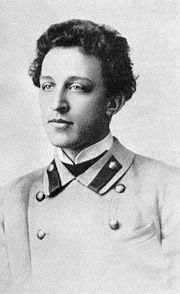
Life and career
Blok was born in Saint PetersburgSaint Petersburg
Saint Petersburg is a city and a federal subject of Russia located on the Neva River at the head of the Gulf of Finland on the Baltic Sea...
, into a sophisticated and intellectual family. Some of his relatives were literary men, his father being a law professor in Warsaw
Warsaw
Warsaw is the capital and largest city of Poland. It is located on the Vistula River, roughly from the Baltic Sea and from the Carpathian Mountains. Its population in 2010 was estimated at 1,716,855 residents with a greater metropolitan area of 2,631,902 residents, making Warsaw the 10th most...
, and his maternal grandfather the rector of Saint Petersburg State University
Saint Petersburg State University
Saint Petersburg State University is a Russian federal state-owned higher education institution based in Saint Petersburg and one of the oldest and largest universities in Russia....
. After his parents' separation, Blok lived with aristocratic relatives at the manor Shakhmatovo
Solnechnogorsk
Solnechnogorsk is a town in Moscow Oblast, Russia, the administrative center of Solnechnogorsky District. It is situated on the Moscow-Saint Petersburg Highway and the Moscow-Saint Petersburg Railway, on the coast of Senezh Lake, north-west from Moscow. Population: Originally, there was a village...
near Moscow
Moscow
Moscow is the capital, the most populous city, and the most populous federal subject of Russia. The city is a major political, economic, cultural, scientific, religious, financial, educational, and transportation centre of Russia and the continent...
, where he discovered the philosophy of Vladimir Solovyov
Vladimir Solovyov (philosopher)
Vladimir Sergeyevich Solovyov was a Russian philosopher, poet, pamphleteer, literary critic, who played a significant role in the development of Russian philosophy and poetry at the end of the 19th century...
, and the verse of then-obscure 19th-century poets, Fyodor Tyutchev
Fyodor Tyutchev
Fyodor Ivanovich Tyutchev is generally considered the last of three great Romantic poets of Russia, following Alexander Pushkin and Mikhail Lermontov.- Life :...
and Afanasy Fet
Afanasy Fet
Afanasy Afanasyevich Fet , was a Russian poet regarded as one of the finest lyricists in Russian literature.-Origins:...
. These influences would affect his early publications, later collected in the book Ante Lucem.
During 1903 he married Lyubov (Lyuba) Dmitrievna Mendeleeva, daughter of the renowned chemist Dmitri Mendeleev
Dmitri Mendeleev
Dmitri Ivanovich Mendeleev , was a Russian chemist and inventor. He is credited as being the creator of the first version of the periodic table of elements...
. Later, she would involve him in a complicated love-hate relationship with his fellow Symbolist Andrei Bely
Andrei Bely
Andrei Bely was the pseudonym of Boris Nikolaevich Bugaev , a Russian novelist, poet, theorist, and literary critic. His novel Petersburg was regarded by Vladimir Nabokov as one of the four greatest novels of the 20th century.-Biography:...
. To Lyuba he dedicated a cycle of poetry that made him famous, Stikhi o prekrasnoi Dame (Verses About the Beautiful Lady, 1904).
Blok's few relatives live currently in Moscow
Moscow
Moscow is the capital, the most populous city, and the most populous federal subject of Russia. The city is a major political, economic, cultural, scientific, religious, financial, educational, and transportation centre of Russia and the continent...
, Riga
Riga
Riga is the capital and largest city of Latvia. With 702,891 inhabitants Riga is the largest city of the Baltic states, one of the largest cities in Northern Europe and home to more than one third of Latvia's population. The city is an important seaport and a major industrial, commercial,...
, Rome
Rome
Rome is the capital of Italy and the country's largest and most populated city and comune, with over 2.7 million residents in . The city is located in the central-western portion of the Italian Peninsula, on the Tiber River within the Lazio region of Italy.Rome's history spans two and a half...
and England.
During the last period of his life, Blok emphasized political themes, pondering the messianic destiny of his country (Vozmezdie, 1910–21; Rodina, 1907–16; Skify, 1918). Influenced by Solovyov's doctrines, he had vague apocalyptic apprehensions and often vacillated between hope and despair. "I feel that a great event was coming, but what it was exactly was not revealed to me," he wrote in his diary during the summer of 1917. Quite unexpectedly for most of his admirers, he accepted the October Revolution
October Revolution
The October Revolution , also known as the Great October Socialist Revolution , Red October, the October Uprising or the Bolshevik Revolution, was a political revolution and a part of the Russian Revolution of 1917...
as the final resolution of these apocalyptic yearnings.
By 1921 Blok had become disillusioned with the Russian Revolution. He did not write any poetry for three years. Blok complained to Maksim Gorky that his "faith in the wisdom of humanity" had ended. He explained to his friend Korney Chukovsky
Korney Chukovsky
Korney Ivanovich Chukovsky was one of the most popular children's poets in the Russian language. His poems, Doctor Aybolit , The Giant Roach , The Crocodile , and Wash'em'clean have been favourites with many generations of Russophone children...
why he could not write poetry any more: "All sounds have stopped. Can't you hear that there are no longer any sounds?". Within a few days Blok became sick. His doctors requested him to be sent for medical treatment abroad, but he was not allowed to leave the country. Gorky pleaded for a visa. On 29 May 1921, he wrote to Anatoly Lunacharsky: "Blok is Russia's finest poet. If you forbid him to go abroad, and he dies, you and your comrades will be guilty of his death". Blok received permission only on 10 August, after his death.
Several months earlier, Blok had delivered a celebrated lecture on Alexander Pushkin, the memory of whom he believed to be capable of uniting White
White Guard
The term White Guard may refer to:* White Guard , part of the White Army of the 1918 Finnish Civil War* White Guard , part of the Axis colaborators in Slovenia during the Second World War* Military arm of the Russian White movement...
and Soviet
Russian Soviet Federative Socialist Republic
The Russian Soviet Federative Socialist Republic , commonly referred to as Soviet Russia, Bolshevik Russia, or simply Russia, was the largest, most populous and economically developed republic in the former Soviet Union....
Russian factions.
Work
The idealized mystical images presented in his first book helped establish Blok as a major poet of the Russian SymbolismRussian Symbolism
Russian symbolism was an intellectual and artistic movement predominant at the end of the 19th and beginning of the 20th century. It represented the Russian branch of the symbolist movement in European art, and was mostly known for its contributions to Russian poetry.-Russian symbolism in...
style. Blok's early verse is musical, but he later sought to introduce daring rhythmic patterns and uneven beats into his poetry. Poetical inspiration was natural for him, often producing unforgettable, otherworldly images out of the most banal surroundings and trivial events (Fabrika, 1903). Consequently, his mature poems are often based on the conflict between the Platonic theory
Platonism
Platonism is the philosophy of Plato or the name of other philosophical systems considered closely derived from it. In a narrower sense the term might indicate the doctrine of Platonic realism...
of ideal beauty and the disappointing reality of foul industrialism (Neznakomka, 1906).
The description of St Petersburg he crafted for his next collection of poems, The City (1904–08), was both impressionistic and eerie. Subsequent collections, Faina and the Mask of Snow, helped augment Blok's reputation. He was often compared with Alexander Pushkin, and is considered perhaps the most important poet of the Silver Age of Russian Poetry
Silver Age of Russian Poetry
Silver Age is a term traditionally applied by Russian philologists to the first two decades of the 20th century. It was an exceptionally creative period in the history of Russian poetry, on par with the Golden Age a century earlier...
. During the 1910s, Blok was admired greatly by literary colleagues, and his influence on younger poets was virtually unsurpassed. Anna Akhmatova
Anna Akhmatova
Anna Andreyevna Gorenko , better known by the pen name Anna Akhmatova , was a Russian and Soviet modernist poet, one of the most acclaimed writers in the Russian canon.Harrington p11...
, Marina Tsvetaeva
Marina Tsvetaeva
Marina Ivanovna Tsvetaeva was a Russian and Soviet poet. Her work is considered among some of the greatest in twentieth century Russian literature. She lived through and wrote of the Russian Revolution of 1917 and the Moscow famine that followed it. In an attempt to save her daughter Irina from...
, Boris Pasternak
Boris Pasternak
Boris Leonidovich Pasternak was a Russian language poet, novelist, and literary translator. In his native Russia, Pasternak's anthology My Sister Life, is one of the most influential collections ever published in the Russian language...
, and Vladimir Nabokov
Vladimir Nabokov
Vladimir Vladimirovich Nabokov was a multilingual Russian novelist and short story writer. Nabokov wrote his first nine novels in Russian, then rose to international prominence as a master English prose stylist...
wrote important verse tributes to Blok.
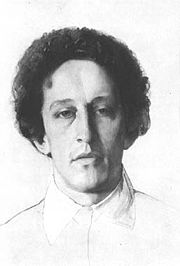
The Twelve
The Twelve is a controversial long poem by Aleksandr Blok. Written early in 1918, the poem was one of the first poetic responses to the October Revolution of 1917.-Background:...
" (1918). The long poem exhibits "mood-creating sounds, polyphonic rhythms, and harsh, slangy language" (as the Encyclopædia Britannica
Encyclopædia Britannica
The Encyclopædia Britannica , published by Encyclopædia Britannica, Inc., is a general knowledge English-language encyclopaedia that is available in print, as a DVD, and on the Internet. It is written and continuously updated by about 100 full-time editors and more than 4,000 expert...
termed it). It describes the march of twelve Bolshevik
Bolshevik
The Bolsheviks, originally also Bolshevists , derived from bol'shinstvo, "majority") were a faction of the Marxist Russian Social Democratic Labour Party which split apart from the Menshevik faction at the Second Party Congress in 1903....
soldiers (likened to the Twelve Apostles of Christ) through the streets of revolutionary Petrograd
Saint Petersburg
Saint Petersburg is a city and a federal subject of Russia located on the Neva River at the head of the Gulf of Finland on the Baltic Sea...
, with a fierce winter blizzard raging around them. "The Twelve" alienated Blok from many of his intellectual readers (who accused him of lack of artistry), while the Bolsheviks scorned his former mysticism and aesceticism. Blok considered this poem]to be his best work. Searching for modern language and new images, Blok used unusual sources for the poetry of Symbolism
Symbolism (arts)
Symbolism was a late nineteenth-century art movement of French, Russian and Belgian origin in poetry and other arts. In literature, the style had its beginnings with the publication Les Fleurs du mal by Charles Baudelaire...
: urban folklore, ballads (songs of a sentimental nature) and ditties ("chastushka"). He was inspired by the popular chansonnier
Chansonnier
A chansonnier is a manuscript or printed book which contains a collection of chansons, or polyphonic and monophonic settings of songs, hence literally "song-books," although some manuscripts are so called even though they preserve the text but not the music A chansonnier is a manuscript or...
Mikhail Savoyarov
Mikhail Savoyarov
Mikhail Savoyarov is a Russian chansonnier, composer, poet, comic actor and mime. In the first quarter of 20th century he was a famous satirical singer-songwriter. His popularity peak was in the years of war when he began to be called the King of eccentrics. It was also the time when he became...
, whose concerts during the years 1915–1920 were visited often by Blok. Academician Viktor Shklovsky
Viktor Shklovsky
Viktor Borisovich Shklovsky was a Russian and Soviet critic, writer, and pamphleteer.-Life:...
noted, that the poem is written in criminal language and in ironic style, similar to Savoyarov’s couplet
Couplet
A couplet is a pair of lines of meter in poetry. It usually consists of two lines that rhyme and have the same meter.While traditionally couplets rhyme, not all do. A poem may use white space to mark out couplets if they do not rhyme. Couplets with a meter of iambic pentameter are called heroic...
s, by which Blok imitated the slang of 1918 Petrograd.
Symbolism
Blok considered his poetical output as composed of three volumes. The first volume is composed of his early poems about the Fair Lady. The second volume comments upon the impossibility of attaining the ideal for which he craved. The third volume, featuring his poems from pre-revolutionary years, is more lively. For Blok's poetry, colours are essential. Blue or violet is the colour of frustration, when the poet understands that his hope to see the Lady is delusive. The yellow colour of street lanterns, windows and sunsets is the colour of treason and triviality. Black hints at something terrible, dangerous but potentially capable of esoteric revelation. Russian words for yellow and black are spelled by the poet with a long O instead of YO, in order to underline "a hole inside the word".Imitating Fyodor Tyutchev, Blok developed a complicated system of poetic symbols. In his early work, for instance, wind represents the Fair Lady's approach, whereas morning or spring is the time when their meeting is most likely to happen. Winter and night are the evil times when the poet and his lady are far away from each other. Bog and mire represent everyday life with no spiritual light from above.
Musical settings
Dmitri ShostakovichDmitri Shostakovich
Dmitri Dmitriyevich Shostakovich was a Soviet Russian composer and one of the most celebrated composers of the 20th century....
wrote a late song cycle
Song cycle
A song cycle is a group of songs designed to be performed in a sequence as a single entity. As a rule, all of the songs are by the same composer and often use words from the same poet or lyricist. Unification can be achieved by a narrative or a persona common to the songs, or even, as in Schumann's...
for soprano and piano trio, Seven Romances of Alexander Blok, and Arthur Lourié
Arthur Lourié
Arthur-Vincent Lourié, born Naum Izrailevich Luria , later changed his name to Artur Sergeyevich Luriye was a significant Russian composer. Lourié played an important role in the earliest stages of the organization of Soviet music after the 1917 Revolution but later went into exile...
a choral cantata, In the Sanctuary of Golden Dreams.
Alexander Blok was a favourite poet of Georgy Sviridov
Georgy Sviridov
Georgy Vasilyevich Sviridov was a Soviet Russian neoromantic composer....
; such works as "Petersburg" (a vocal poem), "Nightly Clouds" (cantata) and "Songs From Hard Times" (concerto) were written to Blok's poetry.
Works
- English translation of Blok's Poems. The New FormalistThe New FormalistThe New Formalist is a U.S.-based literary periodical published twice a year in electronic form and once a year in print form. Distributed by and edited by Leo Yankevich, it has published many of the leading formal poets writing in English today, among them Jared Carter, Alfred Dorn, T.S....
Press. Retrieved 2010-10-28 - English translations of 4 short poems. University of Albany. Retrieved 2010-10-28
- "Died and survived" review of new works published on Blok By Simon Karlinsky. 9 May 1982 New York Times. Retrieved 2010-10-28
- Essay on Blok's poem "the Twelve", Maria Carlson, University of Kansas. Retrieved 2010-10-28
- Essay on Blok by Leon TrotskyLeon TrotskyLeon Trotsky , born Lev Davidovich Bronshtein, was a Russian Marxist revolutionary and theorist, Soviet politician, and the founder and first leader of the Red Army....
. Retrieved 2010-10-28