


Joulupukki

Encyclopedia
Finnish language
Finnish is the language spoken by the majority of the population in Finland Primarily for use by restaurant menus and by ethnic Finns outside Finland. It is one of the two official languages of Finland and an official minority language in Sweden. In Sweden, both standard Finnish and Meänkieli, a...
Christmas figure. The name Joulupukki literally means Christmas Goat or Yule Goat
Yule Goat
The Yule Goat is one of the oldest Scandinavian and Northern European Yule and Christmas symbols and traditions. Originally denoting the goat that was slaughtered during the Germanic pagan festival of Yule, "Yule Goat" now typically refers to a goat-figure made of straw...
. The Finnish word "pukki" comes from the Swedish "bock" (equivalent of the English "buck" or "billy-goat") and is an old Scandinavian
Scandinavians
Scandinavians are a group of Germanic peoples, inhabiting Scandinavia and to a lesser extent countries associated with Scandinavia, and speaking Scandinavian languages. The group includes Danes, Norwegians and Swedes, and additionally the descendants of Scandinavian settlers such as the Icelandic...
tradition. Over time, the figure became more or less merged with Santa Claus
Santa Claus
Santa Claus is a folklore figure in various cultures who distributes gifts to children, normally on Christmas Eve. Each name is a variation of Saint Nicholas, but refers to Santa Claus...
.
There is a long Finnish tradition of persons dressing in goat costume to solicit or perform for leftover food after Christmas. Historically, such a person was an older man, and the tradition refers to him as a nuuttipukki. The term now also describes the practice, reportedly continuing in some parts of Finland.
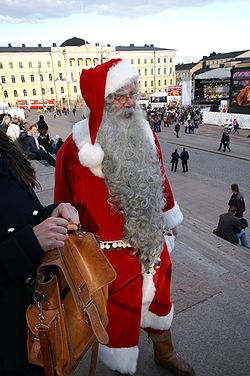
Today Joulupukki looks and behaves mostly like his American
United States
The United States of America is a federal constitutional republic comprising fifty states and a federal district...
version, but there are differences. Joulupukki's house and workshop are situated in the mountains of Korvatunturi
Korvatunturi
Korvatunturi is a fell in Lapland. It is located within Urho Kekkonen National Park in the municipality of Savukoski. The Finnish name translates to "Ear Fell"....
, whereas the American counterpart resides at the North Pole
North Pole
The North Pole, also known as the Geographic North Pole or Terrestrial North Pole, is, subject to the caveats explained below, defined as the point in the northern hemisphere where the Earth's axis of rotation meets its surface...
. Another difference is that instead of sneaking in through the chimney
Chimney
A chimney is a structure for venting hot flue gases or smoke from a boiler, stove, furnace or fireplace to the outside atmosphere. Chimneys are typically vertical, or as near as possible to vertical, to ensure that the gases flow smoothly, drawing air into the combustion in what is known as the...
during the late night hours, Joulupukki knocks on the front door during the Christmas Eve
Christmas Eve
Christmas Eve refers to the evening or entire day preceding Christmas Day, a widely celebrated festival commemorating the birth of Jesus of Nazareth that takes place on December 25...
celebrations. When he comes in, his first words are traditionally "Onkos täällä kilttejä lapsia?" (Are there (any) well-behaved children here?)
He usually wears warm red clothes, uses a walking stick, and travels in a sleigh pulled by a number of reindeer
Reindeer
The reindeer , also known as the caribou in North America, is a deer from the Arctic and Subarctic, including both resident and migratory populations. While overall widespread and numerous, some of its subspecies are rare and one has already gone extinct.Reindeer vary considerably in color and size...
. Unlike the American version, the reindeer do not fly. In Lapland, pulkka rather than a sleigh can be encountered. The popular song "Rudolph the Red-Nosed Reindeer
Rudolph the Red-Nosed Reindeer
Rudolph the Red-nosed Reindeer is a fictional reindeer with a glowing red nose. He is popularly known as "Santa's 9th Reindeer" and, when depicted, is the lead reindeer pulling Santa's sleigh on Christmas Eve. The luminosity of his nose is so great that it illuminates the team's path through...
" in its Finnish translation, Petteri Punakuono
Petteri Punakuono
Petteri Punakuono is the Finnish version of the English Rudolph the Red-Nosed Reindeer. The Finnish lyrics are as follows:-Petteri Punakuono:At evenings others disparged him mocking as a lighthouse,but from that Santa Claus got an idea....
, has led to Rudolph's general acceptance in the mythology as Joulupukki's lead reindeer. Joulupukki has a wife, Joulumuori ("Old Lady Christmas"), but tradition doesn't have much to say about her.
Home
Joulupukki lives in KorvatunturiKorvatunturi
Korvatunturi is a fell in Lapland. It is located within Urho Kekkonen National Park in the municipality of Savukoski. The Finnish name translates to "Ear Fell"....
in Finnish
Finland
Finland , officially the Republic of Finland, is a Nordic country situated in the Fennoscandian region of Northern Europe. It is bordered by Sweden in the west, Norway in the north and Russia in the east, while Estonia lies to its south across the Gulf of Finland.Around 5.4 million people reside...
Lapland.
Joulupukki's assistants are called tonttu, or more precisely joulutonttu (from Swedish tomte); they are not elves
Elf
An elf is a being of Germanic mythology. The elves were originally thought of as a race of divine beings endowed with magical powers, which they use both for the benefit and the injury of mankind...
, but essentially human, often dwarflike in character. They usually wear similar attire to Joulupukki's, and males also have a white beard; but joulutonttu are often smaller in size and may be of any age and either gender. While only a rather large, aged person can convincingly dress as Joulupukki, conveniently everyone can dress as a joulutonttu, with less special attire required.
Trivia
- The location of Joulupukki's workshop comes from a children's radio show called Markus-sedän lastentunti (Children's hour with Uncle Markus) hosted by Markus Rautio and broadcast by the Finnish Broadcasting CompanyYleisradioThe Finnish Broadcasting Company , abbreviated to YLE , is Finland's national broadcasting company, founded in 1926. YLE is a public-broadcasting organization which shares many of its characteristics with its British counterpart, the BBC, on which it was largely modelled...
between years 1927–1956.
- Finland's Joulupukki received over 700,000 letters from children all over the world in 2006, according to a news report by the Finnish Broadcasting Company, YLE.
- The US-based Coca-ColaCoca-ColaCoca-Cola is a carbonated soft drink sold in stores, restaurants, and vending machines in more than 200 countries. It is produced by The Coca-Cola Company of Atlanta, Georgia, and is often referred to simply as Coke...
Santa Claus was designed by the son of Finnish emigrants, Haddon SundblomHaddon SundblomHaddon Hubbard "Sunny" Sundblom was an artist best known for the images of Santa Claus he created for The Coca-Cola Company.-Background:Sundblom was born in Muskegon, Michigan to a Swedish-speaking family...
.
- Joulupukki is a prominent character in Rare Exports, a movie based on the award winning shorts by Jalmari Helander.
Joulupukki's dark side
Pagans used to have festivities to ward off evil spirits. In Finland these spirits of darkness wore goat skins and horns. In the beginning this creature didn't give presents but demanded them. The Yule GoatYule Goat
The Yule Goat is one of the oldest Scandinavian and Northern European Yule and Christmas symbols and traditions. Originally denoting the goat that was slaughtered during the Germanic pagan festival of Yule, "Yule Goat" now typically refers to a goat-figure made of straw...
was an ugly creature and frightened children.
It is unclear how this personality was transformed into the benevolent Father Christmas. Nowadays the only remaining feature is the name. The process was probably a continuous amalgamation of many old folk customs and beliefs from varied sources. One can speak of a Christmas pageant tradition consisting of many personages with roles partly Christian, partly pagan: A white-bearded saint, the Devil, demons, house gnomes. Nowadays the Joulupukki of Finland resembles the American Santa Claus.
Popular radio programs from the year 1927 onwards probably had great influence in reformatting the concept with the Santa-like costume, reindeer and Korvatunturi
Korvatunturi
Korvatunturi is a fell in Lapland. It is located within Urho Kekkonen National Park in the municipality of Savukoski. The Finnish name translates to "Ear Fell"....
as its dwelling place. Because there really are reindeer in Finland, and Finns live up North, the popular American cult took root in Finland very quickly.
See also
- Finland at Christmas around the world
- KorvatunturiKorvatunturiKorvatunturi is a fell in Lapland. It is located within Urho Kekkonen National Park in the municipality of Savukoski. The Finnish name translates to "Ear Fell"....
- Rare Exports
- Santa Claus VillageSanta Claus VillageSanta Claus Village is an amusement park near Rovaniemi in the Lapland region of Finland.-Location and transportation:Santa Claus Village is located about 8 km northeast of Rovaniemi and about 2 km from the Rovaniemi Airport....
- Yule GoatYule GoatThe Yule Goat is one of the oldest Scandinavian and Northern European Yule and Christmas symbols and traditions. Originally denoting the goat that was slaughtered during the Germanic pagan festival of Yule, "Yule Goat" now typically refers to a goat-figure made of straw...