

Tommy Atkins

Encyclopedia
British Army
The British Army is the land warfare branch of Her Majesty's Armed Forces in the United Kingdom. It came into being with the unification of the Kingdom of England and Scotland into the Kingdom of Great Britain in 1707. The new British Army incorporated Regiments that had already existed in England...
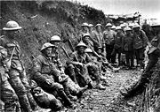
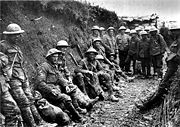
that was already well established in the 19th century, but is particularly associated with World War I
World War I
World War I , which was predominantly called the World War or the Great War from its occurrence until 1939, and the First World War or World War I thereafter, was a major war centred in Europe that began on 28 July 1914 and lasted until 11 November 1918...
. It can be used as a term of reference, or as a form of address. German
Germany
Germany , officially the Federal Republic of Germany , is a federal parliamentary republic in Europe. The country consists of 16 states while the capital and largest city is Berlin. Germany covers an area of 357,021 km2 and has a largely temperate seasonal climate...
soldiers would call out to "Tommy" across no man's land
No man's land
No man's land is a term for land that is unoccupied or is under dispute between parties that leave it unoccupied due to fear or uncertainty. The term was originally used to define a contested territory or a dumping ground for refuse between fiefdoms...
if they wished to speak to a British soldier. French
France
The French Republic , The French Republic , The French Republic , (commonly known as France , is a unitary semi-presidential republic in Western Europe with several overseas territories and islands located on other continents and in the Indian, Pacific, and Atlantic oceans. Metropolitan France...
and Commonwealth
Commonwealth of Nations
The Commonwealth of Nations, normally referred to as the Commonwealth and formerly known as the British Commonwealth, is an intergovernmental organisation of fifty-four independent member states...
troops would also call British soldiers "Tommies". In more recent times, the term Tommy Atkins has been used less frequently, although the name "Tom" is occasionally still heard, especially with regard to paratrooper
Paratrooper
Paratroopers are soldiers trained in parachuting and generally operate as part of an airborne force.Paratroopers are used for tactical advantage as they can be inserted into the battlefield from the air, thereby allowing them to be positioned in areas not accessible by land...
s.
History
Tommy Atkins or Thomas Atkins has been used as a generic name for a common British soldier for many years. The origin of the term is a subject of debate, but it is known to have been used as early as 1743. A letter sent from JamaicaJamaica
Jamaica is an island nation of the Greater Antilles, in length, up to in width and 10,990 square kilometres in area. It is situated in the Caribbean Sea, about south of Cuba, and west of Hispaniola, the island harbouring the nation-states Haiti and the Dominican Republic...
about a mutiny amongst the troops says "except for those from N. America ye Marines and Tommy Atkins behaved splendidly". The surname Atkins means "little son of red earth", a reference to the soldiers in their red tunics. Tommy, a diminutive of Thomas meaning twin, has been a very popular English male name since Saint
Saint
A saint is a holy person. In various religions, saints are people who are believed to have exceptional holiness.In Christian usage, "saint" refers to any believer who is "in Christ", and in whom Christ dwells, whether in heaven or in earth...
Thomas Becket
Thomas Becket
Thomas Becket was Archbishop of Canterbury from 1162 until his murder in 1170. He is venerated as a saint and martyr by both the Roman Catholic Church and the Anglican Communion...
was martyred in the 12th century.
Following the British defeat by the Boers at the Battle of Magersfontein
Battle of Magersfontein
The Battle of MagersfonteinSpelt incorrectly in various English texts as "Majersfontein", "Maaghersfontein" and "Maagersfontein". was fought on 11 December 1899, at Magersfontein near Kimberley on the borders of the Cape Colony and the independent republic of the Orange Free State...
in December 1899, Private Smith of the Black Watch
Black Watch
The Black Watch, 3rd Battalion, Royal Regiment of Scotland is an infantry battalion of the Royal Regiment of Scotland. The unit's traditional colours were retired in 2011 in a ceremony led by Queen Elizabeth II....
wrote the following poem:
Robert Graves
Robert Graves
Robert von Ranke Graves 24 July 1895 – 7 December 1985 was an English poet, translator and novelist. During his long life he produced more than 140 works...
, in his autobiography Goodbye to All That
Goodbye to All That
Good-Bye to All That, an autobiography by Robert Graves, first appeared in 1929, when the author was thirty-four. "It was my bitter leave-taking of England," he wrote in a prologue to the revised second edition of 1957, "where I had recently broken a good many conventions"...
(1929), states that: "The original 'Thomas Atkins' was a Royal Welch Fusilier
Royal Welch Fusiliers
The Royal Welch Fusiliers was an infantry regiment of the British Army, part of the Prince of Wales' Division. It was founded in 1689 to oppose James II and the imminent war with France...
in the American Revolutionary War
American Revolutionary War
The American Revolutionary War , the American War of Independence, or simply the Revolutionary War, began as a war between the Kingdom of Great Britain and thirteen British colonies in North America, and ended in a global war between several European great powers.The war was the result of the...
". Graves, an officer in the Royal Welch in 1915, mentions this among other regimental history but does not cite his reference.
According to Lieutenant General Sir William MacArthur in an article in the Army Medical Services Magazine (circa 1950), "Tommy Atkins" was chosen as a generic name by the War Office
War Office
The War Office was a department of the British Government, responsible for the administration of the British Army between the 17th century and 1964, when its functions were transferred to the Ministry of Defence...
in 1815.
Richard Holmes
Richard Holmes (military historian)
Brigadier Edward Richard Holmes, CBE, TD, JP , known as Richard Holmes, was a British soldier and noted military historian, particularly well-known through his many television appearances...
, in the prologue to Tommy (2005), states that in:
- "1815 a War Office publication showing how the Soldier's Pocket Book should be filled out gave as its example one Private Thomas Atkins, No. 6 Troop, 6th Dragoons. Atkins became a sergeant in the 1837 version, and was now able to sign his name rather than merely make his mark. ."
The Oxford English Dictionary
Oxford English Dictionary
The Oxford English Dictionary , published by the Oxford University Press, is the self-styled premier dictionary of the English language. Two fully bound print editions of the OED have been published under its current name, in 1928 and 1989. The first edition was published in twelve volumes , and...
states its origin as "arising out of the casual use of this name in the specimen forms given in the official regulations from 1815 onward"; the citation references Collection of Orders, Regulations, etc., pp. 75–87, published by the War Office,31 August 1815. The name is used for an exemplary cavalry and infantry soldier; other names used included William Jones and John Thomas.
A common belief is that the name was chosen by the Duke of Wellington
Arthur Wellesley, 1st Duke of Wellington
Field Marshal Arthur Wellesley, 1st Duke of Wellington, KG, GCB, GCH, PC, FRS , was an Irish-born British soldier and statesman, and one of the leading military and political figures of the 19th century...
after having been inspired by the bravery of a soldier at the Battle of Boxtel
Battle of Boxtel
The Battle of Boxtel was a battle fought during the First Coalition in the Dutch province North Brabant, on the 15 September 1794. It was part of the Flanders Campaign of 1793-94 in which British, Dutch and Austrian troops had attempted to launch an invasion of France through Flanders...
in 1794 during the Flanders Campaign
Flanders Campaign
This feature refers to the conflict that took place during the Wars of the French Revolution 1792–1801.For the Low Countries campaigns of the War of the Grand Alliance 1688–97 see Nine Years' War...
. After a fierce engagement, the Duke, in command of the 33rd Regiment of Foot, spotted the best man-at-arms in the regiment, Private Thomas Atkins, terribly wounded. The private said "It's all right, sir. It's all in a day's work" and died shortly after.
A further suggestion was given in 1900 by an army chaplain named Reverend E. J. Hardy. He wrote of an incident during the Sepoy Rebellion in 1857. When most of the Europeans in Lucknow
Lucknow
Lucknow is the capital city of Uttar Pradesh in India. Lucknow is the administrative headquarters of Lucknow District and Lucknow Division....
were fleeing to the British Residency for protection, a private of the 32nd Regiment of Foot
32nd Regiment of Foot
The 32nd Regiment of Foot of the British Army was first raised in 1702 as a regiment of marines to fight in the War of Spanish Succession.It won its first battle honour in 1705 for the siege and capture of Gibraltar....
remained on duty at an outpost. Despite the pleas of his comrades, he insisted that he must remain at his post. He was killed at his post, and the Reverend Hardy wrote that "His name happened to be Tommy Atkins and so, throughout the Mutiny Campaign, when a daring deed was done, the doer was said to be 'a regular Tommy Atkins'".
Rudyard Kipling
Rudyard Kipling
Joseph Rudyard Kipling was an English poet, short-story writer, and novelist chiefly remembered for his celebration of British imperialism, tales and poems of British soldiers in India, and his tales for children. Kipling received the 1907 Nobel Prize for Literature...
published the poem Tommy (part of the Barrack-Room Ballads
Barrack-Room Ballads
The Barrack-Room Ballads, and Other Verses are a set of martial songs and poems by Rudyard Kipling originally published in two parts: the first set in 1892, the second in 1896...
, which were dedicated "To T.A.") in 1892, and in 1893 the music hall
Music hall
Music Hall is a type of British theatrical entertainment which was popular between 1850 and 1960. The term can refer to:# A particular form of variety entertainment involving a mixture of popular song, comedy and speciality acts...
song Private Tommy Atkins was published with words by Henry Hamilton
Henry Hamilton (playwright)
Henry Hamilton was an English playwright, lyricist, and critic. He is best remembered for his musical theatre pieces....
and music by S. Potter. In 1898 William McGonagall wrote Lines in Praise of Tommy Atkins, which was an attack on what McGonagall saw as the disparaging portrayal of Tommy in Kipling's poem.
It is also said that the name "Tommy Atkins" was the example name on conscription sheets during the First World War, and that teenagers who were underage often signed up as "Tommy Atkins".
The paybook issued to all British soldiers in the First World War used the name "Tommy Atkins" to illustrate how it should be filled in.
Today's soldier is nicknamed (within the Army) "Tom", and the British Army Magazine Soldier features a cartoon strip character called Tom.
The last Tommy
On 25 July 2009, the death of the last "Tommy" from World War IWorld War I
World War I , which was predominantly called the World War or the Great War from its occurrence until 1939, and the First World War or World War I thereafter, was a major war centred in Europe that began on 28 July 1914 and lasted until 11 November 1918...
, Harry Patch
Harry Patch
Henry John "Harry" Patch , known in his latter years as "the Last Fighting Tommy", was a British supercentenarian, briefly the oldest man in Europe, and the last surviving soldier to have fought in the trenches of the First World War...
(at 111 the oldest man in the United Kingdom
United Kingdom
The United Kingdom of Great Britain and Northern IrelandIn the United Kingdom and Dependencies, other languages have been officially recognised as legitimate autochthonous languages under the European Charter for Regional or Minority Languages...
and also in Europe
Europe
Europe is, by convention, one of the world's seven continents. Comprising the westernmost peninsula of Eurasia, Europe is generally 'divided' from Asia to its east by the watershed divides of the Ural and Caucasus Mountains, the Ural River, the Caspian and Black Seas, and the waterways connecting...
), left Claude Choules
Claude Choules
Claude Stanley Choules was the last World War I combat veteran, and was the last military witness to the scuttling of the German fleet in Scapa Flow. He was also the last veteran to have served in both world wars, and the last seaman from the First World War...
as the last serviceman
Soldier
A soldier is a member of the land component of national armed forces; whereas a soldier hired for service in a foreign army would be termed a mercenary...
of the British forces in World War I
World War I
World War I , which was predominantly called the World War or the Great War from its occurrence until 1939, and the First World War or World War I thereafter, was a major war centred in Europe that began on 28 July 1914 and lasted until 11 November 1918...
.
There was a growing opinion that the passing of the last of them should be marked in an appropriate manner. This was the subject of a cross party campaign led by the politician Iain Duncan Smith
Iain Duncan Smith
George Iain Duncan Smith is a British Conservative politician. He is currently the Secretary of State for Work and Pensions and was previously leader of the Conservative Party from September 2001 to October 2003...
. It was originally proposed that the last veteran to die should be given a state funeral. However, this met with opposition from the veterans themselves, few of whom wanted to be singled out in this way. As of 28 June 2006, it was decided that a service at Westminster Abbey
Westminster Abbey
The Collegiate Church of St Peter at Westminster, popularly known as Westminster Abbey, is a large, mainly Gothic church, in the City of Westminster, London, United Kingdom, located just to the west of the Palace of Westminster. It is the traditional place of coronation and burial site for English,...
would be held upon the death of the last veteran.
See also
- Alternative names for the British
- LimeyLimeyLimey is an old slang nickname, often pejorative, for the British, originally referring to their sailors. The term is believed to derive from Lime , referring to the Royal Navy and Merchant Navy practice of supplying lime juice to British sailors to prevent scurvy...
- DiggerDigger (soldier)Digger is an Australian and New Zealand military slang term for soldiers from Australia and New Zealand. It originated during World War I.- Origin :...
, DoughboyDoughboyDoughboy is an informal term for an American soldier, especially members of the American Expeditionary Forces in World War I. The term dates back to the Mexican–American War of 1846–48....
and PoiluPoiluPoilu is a warmly informal term for a French World War I infantryman, meaning, literally, hairy one. The term came into popular usage in France during the era of Napoleon Bonaparte and his massive citizen armies, though the term grognard was also common. It is still widely used as a term of...
for the allied counterparts - Jack TarJack TarJack Tar was a common English term used to refer to seamen of the Merchant or Royal Navy, particularly during the period of the British Empire. Both members of the public, and seafarers themselves, made use of the name in identifying those who went to sea...
- KrautKrautKraut is a German word recorded in English from 1918 onwards as a derogatory term for a German, particularly a German soldier during World War I and World War II. Its earlier meaning in English was as a synonym for sauerkraut, a traditional German and central European food.- Etymological...
- Brodie helmetBrodie helmetThe Brodie helmet, called Helmet, steel, Mark I helmet in Britain and the M1917 Helmet in the U.S., was a steel combat helmet designed and patented in 1915 by the Briton John Leopold Brodie...
- Squaddie
- G.I.GI (term)G.I. is a noun used to describe members of the United States armed forces or items of their equipment. The term is now used as an initialism of "Government Issue" , but originally referred to galvanized iron....
- Joe Bloggins
- Jerry (WWII)
- HMS Birkenhead (1845)HMS Birkenhead (1845)HMS Birkenhead, also referred to as HM Troopship Birkenhead or steam frigate Birkenhead, was one of the first iron-hulled ships built for the Royal Navy...
External links
- Tommy Atkins Society British WW2 Reenactment Society in the UK, and winner of the Best Display Award at the Victory Show 2007 sponsored by the Armchair General Magazine.
- The last time I saw Tommy, illustrated poem by Joshua QuagmireJoshua QuagmireJoshua Quagmire is an American cartoonist for both underground and mainstream comic books, best known for his creation Cutey Bunny.-Biography:...
- The Last Tommy - a campaign to mark the passing of the last WWI Tommy with a state funeral.
- Why were English soldiers called "Tommy Atkins" or "Tommy"?