

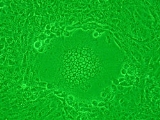
Syncytium

Encyclopedia
In biology
, a syncytium (also spelled syncitium, plural syncytia) is a large cell-like structure; filled with cytoplasm
and containing many nuclei
. Most cells in eukaryotic
organisms have a single nucleus; syncytia are specialized forms used by various organisms.
The term may also refer to cells that are connected by specialized membrane proteins (e.g. gap junctions), like the heart muscle cells.
An example of the first is the formation of the blastoderm
of Drosophila melanogaster
, and an example of the latter is the formation of skeletal muscle
.
and algae
. Most complex fungi exist as a dikaryon
in which threadlike cells are partially partitioned into segments each containing two differing nuclei. More primitive fungi may contain multiple nuclei in a true syncytium. A syncytium functions as a single coordinated unit composed of multiple cells linked structurally and functionally, i.e. through gap junctions.
, lay eggs that initially develop as syncytial blastoderms, i.e. early on the embryo
s exhibit incomplete cell division
. The nuclei undergo S-phase (DNA replication) and sister chromatids get pulled apart and re-assembled into nuclei containing full sets of homologous chromosomes, but cytokinesis
does not occur. Thus, the nuclei multiply in a common cytoplasmic space.
The early embryo syncytium of invertebrates such as Drosophila is important for syncytial specification of cell differentiation. The egg cell cytoplasm contains localized mRNA molecules such as those that encode the transcription factors Bicoid
and Nanos. Bicoid protein is expressed in a gradient that extends from the anterior end of the early embryo, whereas Nanos protein is concentrated at the posterior end. At first, the nuclei of the early embryo rapidly and synchronously divide in the syncytial blastoderm and then migrate through the cytoplasm and position themselves in a monolayer around the periphery, leaving only a small number of nuclei in the center of the egg, which will become yolk nuclei. The position of the nuclei along the embryonic axes determines the relative exposure of different amounts of Bicoid, Nanos, and other morphogens. Those nuclei with more Bicoid will activate genes that promote differentiation of cells into head and thorax structures. Nuclei exposed to more Nanos will activate genes responsible for differentiation of posterior regions, such as the abdomen and germ cells. The same principles hold true for the specification of the dorso-ventral axis – higher concentration of nuclear Dorsal protein on the ventral side of the egg specify the ventral fate, whereas absence thereof allows dorsal fates.
After the nuclei are positioned in a monolayer underneath the egg membrane, the membrane begins to slowly invaginate, thus separating the nuclei into cellular compartments; during this period, the egg is called a cellular blastoderm. The pole cells – the germline anlage – are the first cells to separate fully.
fibers form by the fusion of thousands of individual muscle cells. The multinucleated (symplastic
) arrangement of skeletal muscle is important in pathologic states such as myopathy
, where focal necrosis (death) of a portion of a skeletal muscle fibers does not result in necrosis death of the adjacent sections of that same skeletal muscle fiber, because those adjacent sections have their own nuclear material. Thus, myopathy
is usually associated with such "segmental necrosis", but with some of the surviving segments being functionally cut off from their nerve supply via loss of continuity with the neuromuscular junction
.
is important because it allows rapid coordinated contraction of muscles along their entire length. Action potential
s propagate along the surface of the muscle fiber from the point of synaptic
contact.
of placental mammals. Embryo-derived cells that form the interface with the maternal blood stream fuse together to form a multi-nucleated barrier. This is probably important in order to limit the exchange of migratory cells between the developing embryo and the body of the mother, as some blood cells
are specialized to be able to insert themselves between adjacent epithelial
cells. The syncytial epithelium of the placenta does not provide such an access path from the maternal circulation into the embryo.
 Syncytia can also form when cells are infected with certain types of virus
es, notably HIV
and paramyxovirus
es, e.g. Respiratory syncytial virus (RSV). During infection, viral fusion proteins used by the virus to enter
the cell are transported to the cell surface where they can cause the host cell membrane
to fuse
with neighbouring cells.
HIV infects CD4+ T cell
s and makes the cell produce viral proteins, including fusion proteins. Then, the cell begins to display surface HIV glycoprotein
s, which are antigen
ic. Normally, a Cytotoxic T cell
will immediately come to "inject" lymphotoxin
s, such as perforin
or granzyme
, that will kill the infected T helper cell. However, if there are nearby T helper cells, the gp41
HIV receptors displayed on the surface of the T helper cell will bind to other similar lymphocytes. This makes dozens of T helper cells fuse cell membrane
s into a giant, nonfunctional syncytium, which allows the HIV virion to kill many T helper cells by infecting only one.
Biology
Biology is a natural science concerned with the study of life and living organisms, including their structure, function, growth, origin, evolution, distribution, and taxonomy. Biology is a vast subject containing many subdivisions, topics, and disciplines...
, a syncytium (also spelled syncitium, plural syncytia) is a large cell-like structure; filled with cytoplasm
Cytoplasm
The cytoplasm is a small gel-like substance residing between the cell membrane holding all the cell's internal sub-structures , except for the nucleus. All the contents of the cells of prokaryote organisms are contained within the cytoplasm...
and containing many nuclei
Cell nucleus
In cell biology, the nucleus is a membrane-enclosed organelle found in eukaryotic cells. It contains most of the cell's genetic material, organized as multiple long linear DNA molecules in complex with a large variety of proteins, such as histones, to form chromosomes. The genes within these...
. Most cells in eukaryotic
Eukaryote
A eukaryote is an organism whose cells contain complex structures enclosed within membranes. Eukaryotes may more formally be referred to as the taxon Eukarya or Eukaryota. The defining membrane-bound structure that sets eukaryotic cells apart from prokaryotic cells is the nucleus, or nuclear...
organisms have a single nucleus; syncytia are specialized forms used by various organisms.
The term may also refer to cells that are connected by specialized membrane proteins (e.g. gap junctions), like the heart muscle cells.
Formation
A syncytium can form in two ways:- By incomplete cell division, i.e. without cytokinesis or
- By cell fusion.
An example of the first is the formation of the blastoderm
Blastoderm
-In amniotes:A blastoderm is the layer of cells formed at one pole of macrolecithal eggs such as the yolky egg of birds. The yolk prevents the division from taking place through the egg, resulting in meroblastic cleavage during the many cleavage divisions...
of Drosophila melanogaster
Drosophila melanogaster
Drosophila melanogaster is a species of Diptera, or the order of flies, in the family Drosophilidae. The species is known generally as the common fruit fly or vinegar fly. Starting from Charles W...
, and an example of the latter is the formation of skeletal muscle
Skeletal muscle
Skeletal muscle is a form of striated muscle tissue existing under control of the somatic nervous system- i.e. it is voluntarily controlled. It is one of three major muscle types, the others being cardiac and smooth muscle...
.
Fungi and algae
A syncytium is also the normal cell structure for many fungiFungus
A fungus is a member of a large group of eukaryotic organisms that includes microorganisms such as yeasts and molds , as well as the more familiar mushrooms. These organisms are classified as a kingdom, Fungi, which is separate from plants, animals, and bacteria...
and algae
Algae
Algae are a large and diverse group of simple, typically autotrophic organisms, ranging from unicellular to multicellular forms, such as the giant kelps that grow to 65 meters in length. They are photosynthetic like plants, and "simple" because their tissues are not organized into the many...
. Most complex fungi exist as a dikaryon
Dikaryon
Dikaryon is from Greek, di meaning 2 and karyon meaning nut, referring to the cell nucleus.The dikaryon is a nuclear feature which is unique to some fungi, in which after plasmogamy the two compatible nuclei of two cells pair off and cohabit without karyogamy within the cells of the hyphae,...
in which threadlike cells are partially partitioned into segments each containing two differing nuclei. More primitive fungi may contain multiple nuclei in a true syncytium. A syncytium functions as a single coordinated unit composed of multiple cells linked structurally and functionally, i.e. through gap junctions.
Embryology of insects
Many insects, such as the model organism Drosophila melanogasterDrosophila melanogaster
Drosophila melanogaster is a species of Diptera, or the order of flies, in the family Drosophilidae. The species is known generally as the common fruit fly or vinegar fly. Starting from Charles W...
, lay eggs that initially develop as syncytial blastoderms, i.e. early on the embryo
Embryo
An embryo is a multicellular diploid eukaryote in its earliest stage of development, from the time of first cell division until birth, hatching, or germination...
s exhibit incomplete cell division
Cell division
Cell division is the process by which a parent cell divides into two or more daughter cells . Cell division is usually a small segment of a larger cell cycle. This type of cell division in eukaryotes is known as mitosis, and leaves the daughter cell capable of dividing again. The corresponding sort...
. The nuclei undergo S-phase (DNA replication) and sister chromatids get pulled apart and re-assembled into nuclei containing full sets of homologous chromosomes, but cytokinesis
Cytokinesis
Cytokinesis is the process in which the cytoplasm of a single eukaryotic cell is divided to form two daughter cells. It usually initiates during the late stages of mitosis, and sometimes meiosis, splitting a binucleate cell in two, to ensure that chromosome number is maintained from one generation...
does not occur. Thus, the nuclei multiply in a common cytoplasmic space.
The early embryo syncytium of invertebrates such as Drosophila is important for syncytial specification of cell differentiation. The egg cell cytoplasm contains localized mRNA molecules such as those that encode the transcription factors Bicoid
Morphogenesis
Morphogenesis , is the biological process that causes an organism to develop its shape...
and Nanos. Bicoid protein is expressed in a gradient that extends from the anterior end of the early embryo, whereas Nanos protein is concentrated at the posterior end. At first, the nuclei of the early embryo rapidly and synchronously divide in the syncytial blastoderm and then migrate through the cytoplasm and position themselves in a monolayer around the periphery, leaving only a small number of nuclei in the center of the egg, which will become yolk nuclei. The position of the nuclei along the embryonic axes determines the relative exposure of different amounts of Bicoid, Nanos, and other morphogens. Those nuclei with more Bicoid will activate genes that promote differentiation of cells into head and thorax structures. Nuclei exposed to more Nanos will activate genes responsible for differentiation of posterior regions, such as the abdomen and germ cells. The same principles hold true for the specification of the dorso-ventral axis – higher concentration of nuclear Dorsal protein on the ventral side of the egg specify the ventral fate, whereas absence thereof allows dorsal fates.
After the nuclei are positioned in a monolayer underneath the egg membrane, the membrane begins to slowly invaginate, thus separating the nuclei into cellular compartments; during this period, the egg is called a cellular blastoderm. The pole cells – the germline anlage – are the first cells to separate fully.
Skeletal muscle
Large skeletal muscleSkeletal muscle
Skeletal muscle is a form of striated muscle tissue existing under control of the somatic nervous system- i.e. it is voluntarily controlled. It is one of three major muscle types, the others being cardiac and smooth muscle...
fibers form by the fusion of thousands of individual muscle cells. The multinucleated (symplastic
Symplast
The symplast of a plant is the inner side of the plasma membrane in which water can freely diffuse.The plasmodesmata allow the direct flow of small molecules such as sugars, amino acids, and ions between cells...
) arrangement of skeletal muscle is important in pathologic states such as myopathy
Myopathy
In medicine, a myopathy is a muscular disease in which the muscle fibers do not function for any one of many reasons, resulting in muscular weakness. "Myopathy" simply means muscle disease...
, where focal necrosis (death) of a portion of a skeletal muscle fibers does not result in necrosis death of the adjacent sections of that same skeletal muscle fiber, because those adjacent sections have their own nuclear material. Thus, myopathy
Myopathy
In medicine, a myopathy is a muscular disease in which the muscle fibers do not function for any one of many reasons, resulting in muscular weakness. "Myopathy" simply means muscle disease...
is usually associated with such "segmental necrosis", but with some of the surviving segments being functionally cut off from their nerve supply via loss of continuity with the neuromuscular junction
Neuromuscular junction
A neuromuscular junction is the synapse or junction of the axon terminal of a motor neuron with the motor end plate, the highly-excitable region of muscle fiber plasma membrane responsible for initiation of action potentials across the muscle's surface, ultimately causing the muscle to contract...
.
Cardiac muscle
The syncytium of cardiac muscleCardiac muscle
Cardiac muscle is a type of involuntary striated muscle found in the walls and histologic foundation of the heart, specifically the myocardium. Cardiac muscle is one of three major types of muscle, the others being skeletal and smooth muscle...
is important because it allows rapid coordinated contraction of muscles along their entire length. Action potential
Action potential
In physiology, an action potential is a short-lasting event in which the electrical membrane potential of a cell rapidly rises and falls, following a consistent trajectory. Action potentials occur in several types of animal cells, called excitable cells, which include neurons, muscle cells, and...
s propagate along the surface of the muscle fiber from the point of synaptic
Synapse
In the nervous system, a synapse is a structure that permits a neuron to pass an electrical or chemical signal to another cell...
contact.
Placenta
Another important vertebrate syncytium is in the placentaPlacenta
The placenta is an organ that connects the developing fetus to the uterine wall to allow nutrient uptake, waste elimination, and gas exchange via the mother's blood supply. "True" placentas are a defining characteristic of eutherian or "placental" mammals, but are also found in some snakes and...
of placental mammals. Embryo-derived cells that form the interface with the maternal blood stream fuse together to form a multi-nucleated barrier. This is probably important in order to limit the exchange of migratory cells between the developing embryo and the body of the mother, as some blood cells
White blood cell
White blood cells, or leukocytes , are cells of the immune system involved in defending the body against both infectious disease and foreign materials. Five different and diverse types of leukocytes exist, but they are all produced and derived from a multipotent cell in the bone marrow known as a...
are specialized to be able to insert themselves between adjacent epithelial
Epithelium
Epithelium is one of the four basic types of animal tissue, along with connective tissue, muscle tissue and nervous tissue. Epithelial tissues line the cavities and surfaces of structures throughout the body, and also form many glands. Functions of epithelial cells include secretion, selective...
cells. The syncytial epithelium of the placenta does not provide such an access path from the maternal circulation into the embryo.
Viral infection
Virus
A virus is a small infectious agent that can replicate only inside the living cells of organisms. Viruses infect all types of organisms, from animals and plants to bacteria and archaea...
es, notably HIV
HIV
Human immunodeficiency virus is a lentivirus that causes acquired immunodeficiency syndrome , a condition in humans in which progressive failure of the immune system allows life-threatening opportunistic infections and cancers to thrive...
and paramyxovirus
Paramyxovirus
Paramyxoviruses are viruses of the Paramyxoviridae family of the Mononegavirales order; they are negative-sense single-stranded RNA viruses responsible for a number of human and animal diseases.-Genera:*Subfamily Paramyxovirinae**Genus Avulavirus Paramyxoviruses (from Greek para-, beyond, -myxo-,...
es, e.g. Respiratory syncytial virus (RSV). During infection, viral fusion proteins used by the virus to enter
Viral entry
Viral entry is the earliest stage of infection in the viral life cycle, as the virus comes into contact with the host cell and introduces viral material into the cell. The major steps involved in viral entry are shown below. Despite the variation among viruses, the generalities are quite similar...
the cell are transported to the cell surface where they can cause the host cell membrane
Cell membrane
The cell membrane or plasma membrane is a biological membrane that separates the interior of all cells from the outside environment. The cell membrane is selectively permeable to ions and organic molecules and controls the movement of substances in and out of cells. It basically protects the cell...
to fuse
Lipid bilayer fusion
Fusion is the process by which two initially distinct lipid bilayers merge their hydrophobic cores, resulting in one interconnected structure. If this fusion proceeds completely through both leaflets of both bilayers, an aqueous bridge is formed and the internal contents of the two structures can mix...
with neighbouring cells.
HIV infects CD4+ T cell
T cell
T cells or T lymphocytes belong to a group of white blood cells known as lymphocytes, and play a central role in cell-mediated immunity. They can be distinguished from other lymphocytes, such as B cells and natural killer cells , by the presence of a T cell receptor on the cell surface. They are...
s and makes the cell produce viral proteins, including fusion proteins. Then, the cell begins to display surface HIV glycoprotein
Glycoprotein
Glycoproteins are proteins that contain oligosaccharide chains covalently attached to polypeptide side-chains. The carbohydrate is attached to the protein in a cotranslational or posttranslational modification. This process is known as glycosylation. In proteins that have segments extending...
s, which are antigen
Antigen
An antigen is a foreign molecule that, when introduced into the body, triggers the production of an antibody by the immune system. The immune system will then kill or neutralize the antigen that is recognized as a foreign and potentially harmful invader. These invaders can be molecules such as...
ic. Normally, a Cytotoxic T cell
Cytotoxic T cell
A cytotoxic T cell belongs to a sub-group of T lymphocytes that are capable of inducing the death of infected somatic or tumor cells; they kill cells that are infected with viruses , or are otherwise damaged or...
will immediately come to "inject" lymphotoxin
Lymphotoxin
Lymphotoxin is a lymphokine cytokine.It is a protein that is produced by Th1 type T-cells and induces vascular endothelial cells to change their surface adhesion molecules to allow phagocytic cells to bind to them.Lymphotoxin is homologous to Tumor Necrosis Factor beta, but secreted by T-cells...
s, such as perforin
Perforin
Perforin-1 is a protein that in humans is encoded by the PRF1 gene.- Function :Perforin is a cytolytic protein found in the granules of CD8 T-cells and NK cells. Upon degranulation, perforin inserts itself into the target cell's plasma membrane, forming a pore. The lytic membrane-inserting part...
or granzyme
Granzyme
Granzymes are serine proteases that are released by cytoplasmic granules within cytotoxic T cells and natural killer cells. Their purpose is to induce apoptosis within virus-infected cells, thus destroying them....
, that will kill the infected T helper cell. However, if there are nearby T helper cells, the gp41
Gp41
gp41 is a subunit of the envelope protein complex of retroviruses, including Human immunodeficiency virus and Simian-Human immunodeficiency virus. This glycoprotein subunit remains non-covalently-bound to gp120, and provides the second step by which HIV enters the cell...
HIV receptors displayed on the surface of the T helper cell will bind to other similar lymphocytes. This makes dozens of T helper cells fuse cell membrane
Cell membrane
The cell membrane or plasma membrane is a biological membrane that separates the interior of all cells from the outside environment. The cell membrane is selectively permeable to ions and organic molecules and controls the movement of substances in and out of cells. It basically protects the cell...
s into a giant, nonfunctional syncytium, which allows the HIV virion to kill many T helper cells by infecting only one.
See also
- MultinucleateMultinucleateMultinucleate cells have more than one nucleus per cell, which is the result of nuclear division not being followed by cytokinesis. As a consequence, multiple nuclei share one common cytoplasm. This can be the consequence of a disturbed cell cycle control Multinucleate (also multinucleated,...
- Atrial syncytiumAtrial syncytiumThe atrial syncytium is a network of cardiac muscle cells connected by intercalated discs that lends to the coordinated contraction of the atria. Electrical resistance through intercalated discs is very low, thus allowing free diffusion of ions...
- Enteridium lycoperdonEnteridium lycoperdonThe False Puffball, Enteridium lycoperdon, is one of the more obvious species of slime mould or Myxogastria, typically seen in its reproductive phase as a white 'swelling' on standing dead trees in the spring, or on large pieces of fallen wood. Alder is a common host.- Habitats and distribution :E...
, a syncytial slime mould - Giant cellGiant cellA giant cell is a mass formed by the union of several distinct cells . It can arise in response to an infection or foreign body.Types include:* foreign-body giant cell* Langhans giant cell* Touton giant cells...
- HeterokaryonHeterokaryonA heterokaryon is a cell that contains multiple, genetically different nuclei. This can occur naturally, such as in the mycelium of fungi during sexual reproduction, or artificially as formed by the experimental fusion of two genetically different cells. A medical example is a heterokaryon composed...
- HeterokaryosisHeterokaryosisHeterokaryosis is a term used in biology meaning to have two or more genetically different nuclei within the same mycelium of a fungus or other life form. This is a special type of syncytium.A heterokaryon is a cell with more than one nucleus of differing genetic origin...
- SyncytiotrophoblastSyncytiotrophoblastSyncytiotrophoblast is the epithelial covering of the placenta villous tree. It is a unique tissue in that it is a multi-nucleated, terminally differentiated syncytium, extending to 13m^2...