


Svaneti

Encyclopedia
Svaneti is a historic province in Georgia
, in the northwestern part of the country. It is inhabited by the Svans, a geographic subgroup of the Georgians
.
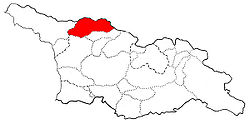
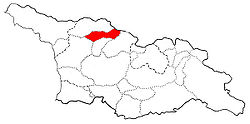 Surrounded by 3,000–5,000 meter peaks, Svaneti is the highest inhabited area in the Caucasus
. Four of the 10 highest peaks of the Caucasus
are located in the region. The highest mountain in Georgia, Mount Shkhara
at 5,201 meters (17,059 feet), is located in the province. Prominent peaks include Tetnuld
i (4,974m./16,319ft.), Shota Rustaveli (4,960m./16,273ft.), Mt. Ushba
(4,710m./15,453ft.), Ailama
(4,525m./14,842ft.), as well as Lalveri
, Latsga
and others.
Situated on the southern slopes of the central Greater Caucasus
, Svaneti extends over the upper valleys of the Rioni
, Enguri and Tskhenistskali. Geographically and historically, the province has been divided into two parts—Upper Svaneti (Zemo Svaneti; the present day Mestia
Raioni) and Lower Svaneti (Kvemo Svaneti; the present day Lentekhi
Raioni)—centering on the valleys of the upper reaches of the two rivers Enguri and Cxenis-c’q’ali, respectively. They are distributed between the present-day regions of Samegrelo-Zemo Svaneti
and Racha-Lechkhumi and Kvemo Svaneti
respectively. Historical Svaneti also included the Kodori Gorge
in the adjoining rebel province of Abkhazia
, and part of the adjacent river valleys of Kuban
and Baksan
of Russia
.
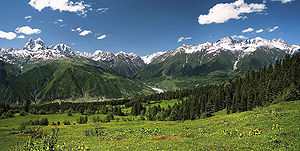
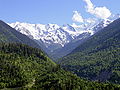 The landscape of Svaneti is dominated by mountains that are separated by deep gorges. Most of the region which lies below 1,800 meters (5,904ft.) above sea level is covered by mixed and coniferous forests. The forest zone is made up of tree species such as spruce
, fir
, beech
, oak
, and hornbeam
. Other species that are less common but may still be found in some areas include chestnut
, birch
, maple
, pine
and box
. The zone which extends from 1,800 meters to roughly about 3,000 meters (5,904–9,840ft.) above sea level consists of alpine meadows and grasslands. Eternal snows and glaciers take over in areas that are over 3,000 meters above sea level. The region is notable for its glaciers and picturesque summits. Svaneti's signature peak is probably Mt. Ushba
which towers over the Inguri Gorge and can be seen from many parts of the region.
throughout the year. Average temperatures and precipitation vary considerably with elevation. Annual precipitation ranges between 1000 and 3200mm (39 and 126 inches). The highest amount of precipitation falls on the Greater Caucasus
Mountains. The region is characterized by very heavy snowfall in the winter and avalanches are a frequent occurrence. Snow cover may reach 5 meters (16.4 feet) in some areas. In general, the lowest regions of Svaneti (800–1200 meters/2624–3936 feet above sea level) are characterized by long, warm summers and relatively cold and snowy winters. Middle altitudes (1200-1800 meters above sea level) experience relatively warm summers and cold winters. Areas above 2000 meters above sea level lie within a zone that experiences short, cool summers (less than 3 months) and long and cold winters. Large parts of Svaneti lie above 3000 meters (9840 feet) above sea level, a zone which does not have a real summer. Due to Svaneti's close proximity to the Black Sea, the region is spared from the extremely cold winter temperatures that are characteristic of high mountains.
 The Svans are usually identified with the Soanes mentioned by Greek geographer
Strabo
, who placed them more or less in the area still occupied by the modern-day Svans. The province had been a dependency of Colchis
, and of its successor kingdom of Lazica (Egrisi) until AD
552, when the Svans took advantage of the Lazic War
, repudiated this connexion and went over to the Persians
. The Byzantines
wanted the region, for if they secured its passes, they could prevent Persian raids on the border areas of Lazica. With the end of the war (562), Svanetia again became part of Lazica. Then, the province joined the Kingdom of Abkhazia to form a unified monarchy which was incorporated into the Kingdom of Georgia
in the early 11th century. Svanetia became a duchy (saeristavo) within it, governed by a duke (eristavi). The province’s Orthodox
culture flourished particularly during the Georgian “golden age” under Queen Tamar
(r. 1184-1213), who was respected almost as goddess by the Svanetians. The legend has it that the duchy was annually visited by Tamar. The Svans had been known as fierce warriors for centuries. Their inflatable war banner was named Lemi (Lion) because of its shape.
The marauding Mongols
never reached Svanetia and, for a time, the region became a cultural safe house. Following the final disintegration of the Kingdom of Georgia in the 1460s, fighting broke out for controlling the province. Part of Upper Svanetia formed an independent principality
under the Princes Dadeshkeliani
, a branch of the Gelovani
family, while Lower Svanetia, originally ruled by the Princes Gelovani
, was temporarily usurped and subdued by the Mingrelian princes Dadiani
. Facing serious internal conflict, Prince Tsioq’ Dadeshkeliani
of Svanetia signed a treaty of protectorate with the Russian Empire
on November 26, 1833. Difficult to access, the region retained significant autonomy until 1857, when Russia took advantage of the dynastic feud in Svanetia and effectively abolished the principality’s autonomy. In 1875, the Russians toughened their rule by imposing additional taxes. Protests ensued, and Russia deployed troops against the province. Despite having suffered heavy losses, the Russian army units eventually crushed the rebels burning their stronghold Khalde to the ground in 1876.
Part of the Russia
n governorate of Kutais
, Svanetia was divided into two raion
s (districts) – Mestia
(former Sethi) and Lentekhi
– under the Soviet
rule. The unsuccessful anti-Soviet Svanetian Uprising
took place in the region in 1921.
 In 1987, avalanche
s destroyed several homes and killed seventy, mostly school children. In the aftermath the Central Committee of the Communist Party of the Soviet Union and the Council of Ministers of the Soviet Union passed a decree to resettle some 2,500 families to districts of eastern Georgia (eco-migration to Marneuli, Tetritskaro, Bolnisi, Sagarejo, Gardabani, Dmanisi, Kaspi,Tskaltubo, Khoni, Ozurgeti, and Lanchkhuti rayons). Collapse of the Soviet Union
, and subsequent Georgian Civil War
created severe socioeconomic problems in the region. While the Svanetian population resisted the unpleasant conditions of the high mountain environment they lived in for centuries, the increasing economic difficulties of the last two decades and frequent natural disasters – flood
s and landslide
s as of April 2005 (http://edition.cnn.com/2005/WORLD/europe/04/26/georgia.floods.ap) have brought about a strong tendency towards migration. The province became a safe haven for criminals threatening local residents and tourists. Large-scale anti-criminal operations carried out by the Georgian Special Forces as of March 2004 (http://www.civil.ge/eng/article.php?id=6513) resulted in significant improvement of the situation.
The Svans, the indigenous population of Svanetia, are ethnic subgroup of the Georgians
. Until the 1930s, Mingrelians and Svans had their own census grouping, but were classified under the broader category of Georgian thereafter. They are Georgian Orthodox
Christians, and were Christianized in the 4th-6th centuries. However, some remnants of old paganism have been maintained. Saint George
(known as Jgëræg to the locals), a patron saint
of Georgia, is the most respected saint. The Svans have retained many of their old traditions, including blood revenge. Their families are small, and the husband is the head of his family. The Svan really respect the older women in families.
Typically bilingual, they use both Georgian
and their own, unwritten Svan language
, which together with the Georgian, Mingrelian, and Laz
languages constitute the South Caucasian
or Kartvelian language family. The Svan language is being largely replaced by the Georgian proper.
World Heritage Site
s.
Svan culture survives most wonderfully in its songs and dances. Svanetia boasts the most complex form of Georgian polyphonic singing, traditional to Georgian vocal music
.
Georgia (country)
Georgia is a sovereign state in the Caucasus region of Eurasia. Located at the crossroads of Western Asia and Eastern Europe, it is bounded to the west by the Black Sea, to the north by Russia, to the southwest by Turkey, to the south by Armenia, and to the southeast by Azerbaijan. The capital of...
, in the northwestern part of the country. It is inhabited by the Svans, a geographic subgroup of the Georgians
Georgians
The Georgians are an ethnic group that have originated in Georgia, where they constitute a majority of the population. Large Georgian communities are also present throughout Russia, European Union, United States, and South America....
.
Geography
Caucasus
The Caucasus, also Caucas or Caucasia , is a geopolitical region at the border of Europe and Asia, and situated between the Black and the Caspian sea...
. Four of the 10 highest peaks of the Caucasus
Caucasus Mountains
The Caucasus Mountains is a mountain system in Eurasia between the Black Sea and the Caspian Sea in the Caucasus region .The Caucasus Mountains includes:* the Greater Caucasus Mountain Range and* the Lesser Caucasus Mountains....
are located in the region. The highest mountain in Georgia, Mount Shkhara
Shkhara
Shkhara , is the highest point in the nation of Georgia. Located in the Svaneti region along the Russian frontier, Shkhara lies north of the city of Kutaisi, Georgia's second largest city. The summit lies in the central part of the Greater Caucasus Mountain Range, to the south-east of Mount...
at 5,201 meters (17,059 feet), is located in the province. Prominent peaks include Tetnuld
Tetnuld
Tetnuldi is a prominent peak in the central part of the Greater Caucasus Mountain Range, located in the Svaneti region of Georgia. According to most sources, Tetnuldi is the 10th highest peak of the Caucasus. The slopes of the mountain are glaciated generally above the 3,000 metre line...
i (4,974m./16,319ft.), Shota Rustaveli (4,960m./16,273ft.), Mt. Ushba
Ushba
Ushba is one of the most notable peaks of the Caucasus Mountains. It is located in the Svaneti region of Georgia, just south of the border with the Kabardino-Balkaria region of Russia. Although it does not rank in the 10 highest peaks of the range, Ushba is known as the "Matterhorn of the...
(4,710m./15,453ft.), Ailama
Ailama
Ailama or Ahlama is a peak in the central part of the Svaneti section of the Greater Caucasus Mountain Range, located in the Samegrelo-Zemo Svaneti region of Georgia, at the source of the river Koruldashi. The lower slopes are covered with alpine and sub alpine meadows, while the upper slopes have...
(4,525m./14,842ft.), as well as Lalveri
Lalveri
Lalveri is a peak of the Greater Caucasus Mountain Range in the Svaneti region of Georgia. The elevation of the mountain is 4,350 meters above sea level. The most accessible climbing route to the summit of Lalveri is through the Tsaneri Glacier....
, Latsga
Latsga
Latsga is a peak of the Greater Caucasus Mountain Range in the Svaneti region of Georgia. Latsga's main glacier, Lekhzir, covers the mountain's southern slopes and portions of the adjacent valleys....
and others.
Situated on the southern slopes of the central Greater Caucasus
Caucasus Mountains
The Caucasus Mountains is a mountain system in Eurasia between the Black Sea and the Caspian Sea in the Caucasus region .The Caucasus Mountains includes:* the Greater Caucasus Mountain Range and* the Lesser Caucasus Mountains....
, Svaneti extends over the upper valleys of the Rioni
Rioni River
The Rioni or Rion River is the main river of western Georgia. It originates in the Caucasus Mountains, in the region of Racha and flows west to the Black Sea, entering it north of the city of Poti...
, Enguri and Tskhenistskali. Geographically and historically, the province has been divided into two parts—Upper Svaneti (Zemo Svaneti; the present day Mestia
Mestia
Mestia is a highland townlet in northwest Georgia, at an elevation of 1,500 meters in the Caucasus Mountains.-General information:According to the current administrative subdivision of Georgia, Mestia is located in the Samegrelo-Zemo Svaneti region , some 128 km northeast of the regional...
Raioni) and Lower Svaneti (Kvemo Svaneti; the present day Lentekhi
Lentekhi
Lentekhi is a small town and Lentekhi District's capital in Georgia's western region of Racha-Lechkhumi and Kvemo Svaneti, 323 km northwest to the nation's capital Tbilisi. Situated on the southern slope of the Central Caucasus, the district is a site of alpinism...
Raioni)—centering on the valleys of the upper reaches of the two rivers Enguri and Cxenis-c’q’ali, respectively. They are distributed between the present-day regions of Samegrelo-Zemo Svaneti
Samegrelo-Zemo Svaneti
Samegrelo-Zemo Svaneti is a region in western Georgia which includes the historical Georgian provinces of Samegrelo and Zemo Svaneti and has Zugdidi as its capital.-Geography:...
and Racha-Lechkhumi and Kvemo Svaneti
Racha-Lechkhumi and Kvemo Svaneti
Racha-Lechkhumi and Kvemo Svaneti is a region in northwestern Georgia which includes the historical provinces of Racha, Lechkhumi and Kvemo Svaneti . It covers an area of 4,954 km² and has a population of 50,969 . It is the most sparsely populated region in the country...
respectively. Historical Svaneti also included the Kodori Gorge
Kodori Valley
The Kodori Valley is a river valley in Abkhazia, Georgia's breakaway autonomous republic. The valley's upper part, populated by Svans, was the only corner of the post-1993 Abkhazia, directly controlled by the central Georgian government, which officially styles the area as Upper Abkhazia...
in the adjoining rebel province of Abkhazia
Abkhazia
Abkhazia is a disputed political entity on the eastern coast of the Black Sea and the south-western flank of the Caucasus.Abkhazia considers itself an independent state, called the Republic of Abkhazia or Apsny...
, and part of the adjacent river valleys of Kuban
Kuban River
The Kuban River is a river in Russia, in the North Caucasus region. It flows mostly through Krasnodar Krai but also in the Karachay-Cherkess Republic, Stavropol Krai and the Republic of Adygea....
and Baksan
Baksan River
Baksan River, also known as Azau is a river in Kabardino-Balkaria in Russia, a right tributary of the Malka River . The length of the Baksan is 173 km, the area of its drainage basin is 6,800 km². The Baksan originates in the glaciers of the Elbrus. The towns of Tyrnyauz and Baksan are located on...
of Russia
Russia
Russia or , officially known as both Russia and the Russian Federation , is a country in northern Eurasia. It is a federal semi-presidential republic, comprising 83 federal subjects...
.
Landscape
Spruce
A spruce is a tree of the genus Picea , a genus of about 35 species of coniferous evergreen trees in the Family Pinaceae, found in the northern temperate and boreal regions of the earth. Spruces are large trees, from tall when mature, and can be distinguished by their whorled branches and conical...
, fir
Nordmann Fir
Nordmann Fir is a fir native to the mountains south and east of the Black Sea, in Turkey, Georgia, Russian Caucasus and northern parts of Armenia. It occurs at altitudes of 900-2,200 m on mountains with a rainfall of over 1,000 mm.It is a large evergreen coniferous tree growing to 60 m tall...
, beech
Oriental Beech
Fagus orientalis, the Oriental Beech, is a deciduous tree in the beech family Fagaceae. The natural range extends from southeast Bulgaria's Strandja mountain through northwest Turkey east to the Caucasus and Alborz Mountains of Iran. It is restricted to mountain forests, at 500-2,100 m altitude...
, oak
Oak
An oak is a tree or shrub in the genus Quercus , of which about 600 species exist. "Oak" may also appear in the names of species in related genera, notably Lithocarpus...
, and hornbeam
Hornbeam
Hornbeams are relatively small hardwood trees in the genus Carpinus . Though some botanists grouped them with the hazels and hop-hornbeams in a segregate family, Corylaceae, modern botanists place the hornbeams in the birch subfamily Coryloideae...
. Other species that are less common but may still be found in some areas include chestnut
Chestnut
Chestnut , some species called chinkapin or chinquapin, is a genus of eight or nine species of deciduous trees and shrubs in the beech family Fagaceae, native to temperate regions of the Northern Hemisphere. The name also refers to the edible nuts they produce.-Species:The chestnut belongs to the...
, birch
Birch
Birch is a tree or shrub of the genus Betula , in the family Betulaceae, closely related to the beech/oak family, Fagaceae. The Betula genus contains 30–60 known taxa...
, maple
Maple
Acer is a genus of trees or shrubs commonly known as maple.Maples are variously classified in a family of their own, the Aceraceae, or together with the Hippocastanaceae included in the family Sapindaceae. Modern classifications, including the Angiosperm Phylogeny Group system, favour inclusion in...
, pine
Scots Pine
Pinus sylvestris, commonly known as the Scots Pine, is a species of pine native to Europe and Asia, ranging from Scotland, Ireland and Portugal in the west, east to eastern Siberia, south to the Caucasus Mountains, and as far north as well inside the Arctic Circle in Scandinavia...
and box
Buxus
Buxus is a genus of about 70 species in the family Buxaceae. Common names include box or boxwood ....
. The zone which extends from 1,800 meters to roughly about 3,000 meters (5,904–9,840ft.) above sea level consists of alpine meadows and grasslands. Eternal snows and glaciers take over in areas that are over 3,000 meters above sea level. The region is notable for its glaciers and picturesque summits. Svaneti's signature peak is probably Mt. Ushba
Ushba
Ushba is one of the most notable peaks of the Caucasus Mountains. It is located in the Svaneti region of Georgia, just south of the border with the Kabardino-Balkaria region of Russia. Although it does not rank in the 10 highest peaks of the range, Ushba is known as the "Matterhorn of the...
which towers over the Inguri Gorge and can be seen from many parts of the region.
Climate
The climate of Svaneti is humid and is influenced by the air masses coming in from the Black SeaBlack Sea
The Black Sea is bounded by Europe, Anatolia and the Caucasus and is ultimately connected to the Atlantic Ocean via the Mediterranean and the Aegean seas and various straits. The Bosphorus strait connects it to the Sea of Marmara, and the strait of the Dardanelles connects that sea to the Aegean...
throughout the year. Average temperatures and precipitation vary considerably with elevation. Annual precipitation ranges between 1000 and 3200mm (39 and 126 inches). The highest amount of precipitation falls on the Greater Caucasus
Greater Caucasus
Greater Caucasus , sometimes translated as "Caucasus Major", "Big Caucasus" or "Large Caucasus") is the major mountain range of the Caucasus Mountains....
Mountains. The region is characterized by very heavy snowfall in the winter and avalanches are a frequent occurrence. Snow cover may reach 5 meters (16.4 feet) in some areas. In general, the lowest regions of Svaneti (800–1200 meters/2624–3936 feet above sea level) are characterized by long, warm summers and relatively cold and snowy winters. Middle altitudes (1200-1800 meters above sea level) experience relatively warm summers and cold winters. Areas above 2000 meters above sea level lie within a zone that experiences short, cool summers (less than 3 months) and long and cold winters. Large parts of Svaneti lie above 3000 meters (9840 feet) above sea level, a zone which does not have a real summer. Due to Svaneti's close proximity to the Black Sea, the region is spared from the extremely cold winter temperatures that are characteristic of high mountains.
History
Geography
Geography is the science that studies the lands, features, inhabitants, and phenomena of Earth. A literal translation would be "to describe or write about the Earth". The first person to use the word "geography" was Eratosthenes...
Strabo
Strabo
Strabo, also written Strabon was a Greek historian, geographer and philosopher.-Life:Strabo was born to an affluent family from Amaseia in Pontus , a city which he said was situated the approximate equivalent of 75 km from the Black Sea...
, who placed them more or less in the area still occupied by the modern-day Svans. The province had been a dependency of Colchis
Colchis
In ancient geography, Colchis or Kolkhis was an ancient Georgian state kingdom and region in Western Georgia, which played an important role in the ethnic and cultural formation of the Georgian nation.The Kingdom of Colchis contributed significantly to the development of medieval Georgian...
, and of its successor kingdom of Lazica (Egrisi) until AD
Anno Domini
and Before Christ are designations used to label or number years used with the Julian and Gregorian calendars....
552, when the Svans took advantage of the Lazic War
Lazic War
The Lazic War or Colchic War, also known as the Great War of Egrisi in Georgian historiography, was fought between the Byzantine Empire and Sassanid Persia for control of the region of Lazica, in what is now western Georgia...
, repudiated this connexion and went over to the Persians
Sassanid Empire
The Sassanid Empire , known to its inhabitants as Ērānshahr and Ērān in Middle Persian and resulting in the New Persian terms Iranshahr and Iran , was the last pre-Islamic Persian Empire, ruled by the Sasanian Dynasty from 224 to 651...
. The Byzantines
Byzantine Empire
The Byzantine Empire was the Eastern Roman Empire during the periods of Late Antiquity and the Middle Ages, centred on the capital of Constantinople. Known simply as the Roman Empire or Romania to its inhabitants and neighbours, the Empire was the direct continuation of the Ancient Roman State...
wanted the region, for if they secured its passes, they could prevent Persian raids on the border areas of Lazica. With the end of the war (562), Svanetia again became part of Lazica. Then, the province joined the Kingdom of Abkhazia to form a unified monarchy which was incorporated into the Kingdom of Georgia
Georgia (country)
Georgia is a sovereign state in the Caucasus region of Eurasia. Located at the crossroads of Western Asia and Eastern Europe, it is bounded to the west by the Black Sea, to the north by Russia, to the southwest by Turkey, to the south by Armenia, and to the southeast by Azerbaijan. The capital of...
in the early 11th century. Svanetia became a duchy (saeristavo) within it, governed by a duke (eristavi). The province’s Orthodox
Georgian Orthodox and Apostolic Church
The Georgian Apostolic Autocephalous Orthodox Church is an autocephalous part of the Eastern Orthodox Church. Since the 4th century AD, Georgian Orthodoxy has been the state religion of Georgia, and it remains the country's largest religious institution....
culture flourished particularly during the Georgian “golden age” under Queen Tamar
Tamar of Georgia
Tamar , of the Bagrationi dynasty, was Queen Regnant of Georgia from 1184 to 1213. Tamar presided over the "Golden age" of the medieval Georgian monarchy...
(r. 1184-1213), who was respected almost as goddess by the Svanetians. The legend has it that the duchy was annually visited by Tamar. The Svans had been known as fierce warriors for centuries. Their inflatable war banner was named Lemi (Lion) because of its shape.
The marauding Mongols
Mongol Empire
The Mongol Empire , initially named as Greater Mongol State was a great empire during the 13th and 14th centuries...
never reached Svanetia and, for a time, the region became a cultural safe house. Following the final disintegration of the Kingdom of Georgia in the 1460s, fighting broke out for controlling the province. Part of Upper Svanetia formed an independent principality
Principality of Svaneti
The Principality of Svaneti was a small principality in the Greater Caucasus mountains that emerged following the breakup of the Kingdom of Georgia in the late 15th century...
under the Princes Dadeshkeliani
Dadeshkeliani
Dadeshkeliani or Dadishkeliani was an aristocratic family from the mountainous western Georgian province of Svaneti. They ruled the Principality of Svaneti from the 1720s to 1857....
, a branch of the Gelovani
Gelovani
House of Gelovani - is a Georgian princely family from the lower part of the mountainous province of Svaneti, formerly - rulers of Svaneti.The family can be traced back to...
family, while Lower Svanetia, originally ruled by the Princes Gelovani
Gelovani
House of Gelovani - is a Georgian princely family from the lower part of the mountainous province of Svaneti, formerly - rulers of Svaneti.The family can be traced back to...
, was temporarily usurped and subdued by the Mingrelian princes Dadiani
Dadiani
Dadiani was a Georgian family of nobles, dukes and princes, and a ruling dynasty of the western Georgian province of Samegrelo.- The House of Dadiani :...
. Facing serious internal conflict, Prince Tsioq’ Dadeshkeliani
Dadeshkeliani
Dadeshkeliani or Dadishkeliani was an aristocratic family from the mountainous western Georgian province of Svaneti. They ruled the Principality of Svaneti from the 1720s to 1857....
of Svanetia signed a treaty of protectorate with the Russian Empire
Russian Empire
The Russian Empire was a state that existed from 1721 until the Russian Revolution of 1917. It was the successor to the Tsardom of Russia and the predecessor of the Soviet Union...
on November 26, 1833. Difficult to access, the region retained significant autonomy until 1857, when Russia took advantage of the dynastic feud in Svanetia and effectively abolished the principality’s autonomy. In 1875, the Russians toughened their rule by imposing additional taxes. Protests ensued, and Russia deployed troops against the province. Despite having suffered heavy losses, the Russian army units eventually crushed the rebels burning their stronghold Khalde to the ground in 1876.
Part of the Russia
Russian Empire
The Russian Empire was a state that existed from 1721 until the Russian Revolution of 1917. It was the successor to the Tsardom of Russia and the predecessor of the Soviet Union...
n governorate of Kutais
Kutaisi
Kutaisi is Georgia's second largest city and the capital of the western region of Imereti. It is 221 km to the west of Tbilisi.-Geography:...
, Svanetia was divided into two raion
Raion
A raion is a type of administrative unit of several post-Soviet countries. The term, which is from French rayon 'honeycomb, department,' describes both a type of a subnational entity and a division of a city, and is commonly translated in English as "district"...
s (districts) – Mestia
Mestia
Mestia is a highland townlet in northwest Georgia, at an elevation of 1,500 meters in the Caucasus Mountains.-General information:According to the current administrative subdivision of Georgia, Mestia is located in the Samegrelo-Zemo Svaneti region , some 128 km northeast of the regional...
(former Sethi) and Lentekhi
Lentekhi
Lentekhi is a small town and Lentekhi District's capital in Georgia's western region of Racha-Lechkhumi and Kvemo Svaneti, 323 km northwest to the nation's capital Tbilisi. Situated on the southern slope of the Central Caucasus, the district is a site of alpinism...
– under the Soviet
Soviet Union
The Soviet Union , officially the Union of Soviet Socialist Republics , was a constitutionally socialist state that existed in Eurasia between 1922 and 1991....
rule. The unsuccessful anti-Soviet Svanetian Uprising
1921 Svanetian Uprising
The Svanetian Uprising of 1921 was an unsuccessful rebellion against the recently established Bolshevik regime in Georgia.The uprising broke out in Svaneti, a highland western Georgian province, almost immediately after the Red Army invasion of Georgia and the establishment of the Georgian SSR...
took place in the region in 1921.
Avalanche
An avalanche is a sudden rapid flow of snow down a slope, occurring when either natural triggers or human activity causes a critical escalating transition from the slow equilibrium evolution of the snow pack. Typically occurring in mountainous terrain, an avalanche can mix air and water with the...
s destroyed several homes and killed seventy, mostly school children. In the aftermath the Central Committee of the Communist Party of the Soviet Union and the Council of Ministers of the Soviet Union passed a decree to resettle some 2,500 families to districts of eastern Georgia (eco-migration to Marneuli, Tetritskaro, Bolnisi, Sagarejo, Gardabani, Dmanisi, Kaspi,Tskaltubo, Khoni, Ozurgeti, and Lanchkhuti rayons). Collapse of the Soviet Union
Soviet Union
The Soviet Union , officially the Union of Soviet Socialist Republics , was a constitutionally socialist state that existed in Eurasia between 1922 and 1991....
, and subsequent Georgian Civil War
Georgian Civil War
The Georgian Civil War consisted of inter-ethnic and intranational conflicts in the regions of South Ossetia and Abkhazia , as well as the violent military coup d'etat of December 21, 1991 - January 6, 1992 against the first democratically elected President of Georgia, Zviad Gamsakhurdia and his...
created severe socioeconomic problems in the region. While the Svanetian population resisted the unpleasant conditions of the high mountain environment they lived in for centuries, the increasing economic difficulties of the last two decades and frequent natural disasters – flood
Flood
A flood is an overflow of an expanse of water that submerges land. The EU Floods directive defines a flood as a temporary covering by water of land not normally covered by water...
s and landslide
Landslide
A landslide or landslip is a geological phenomenon which includes a wide range of ground movement, such as rockfalls, deep failure of slopes and shallow debris flows, which can occur in offshore, coastal and onshore environments...
s as of April 2005 (http://edition.cnn.com/2005/WORLD/europe/04/26/georgia.floods.ap) have brought about a strong tendency towards migration. The province became a safe haven for criminals threatening local residents and tourists. Large-scale anti-criminal operations carried out by the Georgian Special Forces as of March 2004 (http://www.civil.ge/eng/article.php?id=6513) resulted in significant improvement of the situation.
Population
Georgians
The Georgians are an ethnic group that have originated in Georgia, where they constitute a majority of the population. Large Georgian communities are also present throughout Russia, European Union, United States, and South America....
. Until the 1930s, Mingrelians and Svans had their own census grouping, but were classified under the broader category of Georgian thereafter. They are Georgian Orthodox
Georgian Orthodox and Apostolic Church
The Georgian Apostolic Autocephalous Orthodox Church is an autocephalous part of the Eastern Orthodox Church. Since the 4th century AD, Georgian Orthodoxy has been the state religion of Georgia, and it remains the country's largest religious institution....
Christians, and were Christianized in the 4th-6th centuries. However, some remnants of old paganism have been maintained. Saint George
Saint George
Saint George was, according to tradition, a Roman soldier from Syria Palaestina and a priest in the Guard of Diocletian, who is venerated as a Christian martyr. In hagiography Saint George is one of the most venerated saints in the Catholic , Anglican, Eastern Orthodox, and the Oriental Orthodox...
(known as Jgëræg to the locals), a patron saint
Patron saint
A patron saint is a saint who is regarded as the intercessor and advocate in heaven of a nation, place, craft, activity, class, clan, family, or person...
of Georgia, is the most respected saint. The Svans have retained many of their old traditions, including blood revenge. Their families are small, and the husband is the head of his family. The Svan really respect the older women in families.
Typically bilingual, they use both Georgian
Georgian language
Georgian is the native language of the Georgians and the official language of Georgia, a country in the Caucasus.Georgian is the primary language of about 4 million people in Georgia itself, and of another 500,000 abroad...
and their own, unwritten Svan language
Svan language
The Svan language is a Kartvelian language spoken in the Western Georgian region of Svaneti primarily by the Georgians of Svan origin...
, which together with the Georgian, Mingrelian, and Laz
Laz language
The Laz language is a South Caucasian language spoken by the Laz people on the Southeast shore of the Black Sea...
languages constitute the South Caucasian
South Caucasian languages
The Kartvelian languages are spoken primarily in Georgia, with a large group of ethnic Georgian speakers in Russia, the United States, the European Union, and northeastern parts of Turkey. There are approximately 5.2 million speakers of this language family worldwide.It is not known to be related...
or Kartvelian language family. The Svan language is being largely replaced by the Georgian proper.
Culture and tourism
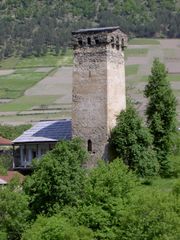
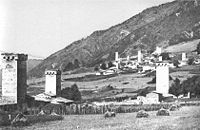
Svanetia is known for their architectural treasures and picturesque landscapes. The Botany of Svanetia is legendary among travelers. The famous Svanetian towers erected mainly in the 9th-12th centuries, make the region’s villages more attractive. In the province are dozens of Georgian Orthodox churches and various fortified buildings. Architectural monuments of Upper Svanetia are included in a list of UNESCOUNESCO
The United Nations Educational, Scientific and Cultural Organization is a specialized agency of the United Nations...
World Heritage Site
World Heritage Site
A UNESCO World Heritage Site is a place that is listed by the UNESCO as of special cultural or physical significance...
s.
Svan culture survives most wonderfully in its songs and dances. Svanetia boasts the most complex form of Georgian polyphonic singing, traditional to Georgian vocal music
Music of Georgia
Georgia has rich and still vibrant traditional music, which is primarily known as arguably the earliest polyphonic tradition of the Christian world. Situated on the border of Europe and Asia, Georgia is also a home of variety of urban singing styles with the mixture of native polyphony, Middle...
.
See also
Muradi Chartolani,s Guesthause in Mestia Svaneti http://www.tbilisiairporttransferhelphire.com/about_svaneti_3.html- Samegrelo-Zemo SvanetiSamegrelo-Zemo SvanetiSamegrelo-Zemo Svaneti is a region in western Georgia which includes the historical Georgian provinces of Samegrelo and Zemo Svaneti and has Zugdidi as its capital.-Geography:...
- Racha-Lechkhumi and Kvemo SvanetiRacha-Lechkhumi and Kvemo SvanetiRacha-Lechkhumi and Kvemo Svaneti is a region in northwestern Georgia which includes the historical provinces of Racha, Lechkhumi and Kvemo Svaneti . It covers an area of 4,954 km² and has a population of 50,969 . It is the most sparsely populated region in the country...
- Kodori ValleyKodori ValleyThe Kodori Valley is a river valley in Abkhazia, Georgia's breakaway autonomous republic. The valley's upper part, populated by Svans, was the only corner of the post-1993 Abkhazia, directly controlled by the central Georgian government, which officially styles the area as Upper Abkhazia...
- DadeshkelianiDadeshkelianiDadeshkeliani or Dadishkeliani was an aristocratic family from the mountainous western Georgian province of Svaneti. They ruled the Principality of Svaneti from the 1720s to 1857....
- UshguliUshguliUshguli or Ushkuli is a community of villages located at the head of the Enguri gorge in Upper Svaneti, Georgia.Ushguli comprises four villages: Zhibiani some 2100 m above sea level; Chvibiani or Chubiani ; Chazhashi or Chajashi ;...
- GelovaniGelovaniHouse of Gelovani - is a Georgian princely family from the lower part of the mountainous province of Svaneti, formerly - rulers of Svaneti.The family can be traced back to...
External links
Muradi Chartolani,s Guesthause in Mestia Svaneti http://www.tbilisiairporttransferhelphire.com/about_svaneti_3.html- Frescos and icons from Svanetia
- "Svan language'. Encyclopædia BritannicaEncyclopædia BritannicaThe Encyclopædia Britannica , published by Encyclopædia Britannica, Inc., is a general knowledge English-language encyclopaedia that is available in print, as a DVD, and on the Internet. It is written and continuously updated by about 100 full-time editors and more than 4,000 expert...
. - Svan language. TITUSTITUS (project)TITUS is a project of Johann Wolfgang Goethe University in Frankfurt am Main, maintained by Professor Dr...
. - Ski Tourism – Svaneti Project. Svaneti Project.
- Muradi Chartolani's Guesthause in Mestia Svaneti
- Svaneti tour