

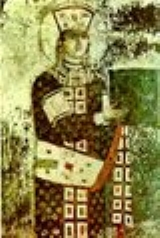
Tamar of Georgia

Encyclopedia
Tamar ( 1160 – 18 January 1213), of the Bagrationi dynasty
, was Queen Regnant
of Georgia
from 1184 to 1213. Tamar presided over the "Golden age
" of the medieval Georgian monarchy. Her unique position as the first woman to rule Georgia in her own right was emphasized by the title mep'e ("king
"), commonly afforded to Tamar in the medieval Georgian sources.
Tamar was proclaimed heir apparent
and co-ruler by her reigning father George III
in 1178, but she faced significant opposition from the aristocracy upon her ascension to full ruling powers after George's death. Nevertheless, Tamar was successful in neutralizing this opposition and embarked on an energetic foreign policy aided by the downfall of the rival powers of the Seljuqids
and the Byzantine Empire
. Supported by a powerful military élite, Tamar was able to build on the successes of her predecessors to consolidate an empire which dominated the Caucasus
until its collapse under the Mongol
attacks within two decades after Tamar's death.
Tamar was married twice, her first union being, from 1185 to 1187, to to the Rus'
prince Yuri, whom she divorced and expelled from the country, defeating his subsequent attempts at coup. For her second consort Tamar chose, in 1191, the Alan
prince David Soslan
, by whom she had two children, George
and Rusudan
, the two successive monarchs on the throne of Georgia.
Tamar's association with the period of political and military success and cultural achievements, combined with her role as a female ruler, has led to her idealization and romantization in Georgian arts and historical memory. She remains an important symbol in Georgian popular culture and has been canonized
by the Georgian Orthodox Church, with her feast day
commemorated on 1 May
.
, King of Georgia, and his consort Burdukhan, a daughter of the king of Alania
. It is possible that Tamar had a younger sister, Rusudan; but she is only mentioned once in all contemporary accounts of Tamar's reign. The name Tamar
is of Hebrew
origin and, like other biblical
names, was favored by the Georgian Bagrationi dynasty because of their claim to be descended from David
, the second king of Israel
.
Tamar's youth coincided with a major upheaval in Georgia; in 1177, her father, George III, was confronted by a rebellious faction of nobles. The rebels intended to dethrone George in favor of the king's fraternal nephew, Demna, who was considered by many to be a legitimate royal heir of his murdered father, David V
. Demna's cause was little but a pretext for the nobles, led by the pretender's father-in-law, the amirspasalar
("constable") Ivane Orbeli, to weaken the crown. George III was able to crush the revolt and embarked on a campaign of crackdown on the defiant aristocratic clans; Ivane Orbeli was put to death and the surviving members of his family were driven out of Georgia. Prince Demna, castrated and blinded on his uncle's order, did not survive the mutilation and soon died in prison. Once the rebellion was suppressed and the pretender eliminated, George went ahead to co-opt Tamar into government with him and crowned her as co-ruler in 1178. By doing so, the king attempted to preempt any dispute after his death and legitimize his line on the throne of Georgia. At the same time, he raised men from the gentry and unranked classes to keep the aristocracy from the center of power.
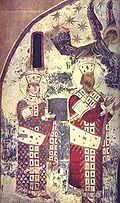 For six years, Tamar was a co-ruler with her father upon whose death, in 1184, Tamar continued as the sole monarch and was crowned a second time at the Gelati cathedral
near Kutaisi
, western Georgia. She inherited a relatively strong kingdom, but the centrifugal tendencies fostered by the great nobles were far from being quelled. There was a considerable opposition to Tamar's succession; this was sparked by a reaction against the repressive policies of her father and encouraged by the new sovereign's other perceived weakness, her sex. As Georgia had never previously had a female ruler, a part of the aristocracy questioned Tamar's legitimacy, while others tried to exploit her youth and supposed weakness to assert greater autonomy for themselves. The energetic involvement of Tamar's influential aunt, Rusudan
, and the Georgian catholicos
Michael IV Mirianisdze was crucial for legitimizing Tamar's succession to the throne. However, the young queen was forced into making significant concessions to the aristocracy. She had to reward the catholicos Michael's support by making him a chancellor
, thus placing him at the top of both the clerical and secular hierarchies.
Tamar was also pressured into dismissing her father's appointees, among them the constable Qubasar, a Georgianized Kipchak
of ignoble birth, who had helped George III in his crackdown on the defiant nobility. One of the few untitled servitors of George III to escape this fate was the treasurer
Qutlu Arslan
who now led a group of nobles and wealthy citizens in a struggle to limit the royal authority by creating a new council, karavi, whose members would alone deliberate and decide policy. This attempt at "feudal constitutionalism
" was rendered abortive when Tamar had Qutlu Arslan arrested and his supporters were inveigled into submission. Yet, Tamar’s first moves to reduce the power of the aristocratic élite were unsuccessful. She failed in her attempt to use a church synod
to dismiss the catholicos Michael, and the noble council, darbazi, asserted the right to approve royal decrees. Even the queen’s first husband, the Rus'
prince Yuri
, was forced on her by the nobles.
Pursuant to dynastic imperatives and the ethos of the time, the nobles required Tamar to marry in order to have a leader for the army and to provide an heir to the throne. Their choice fell on Yuri, son of the murdered prince Andrei I Bogolyubsky of Vladimir-Suzdal
, who then lived as a refuge among the Kipchaks
of the North Caucasus
. The choice was approved by Tamar’s aunt Rusudan and the prince was brought to Georgia to marry the queen in 1185. Yuri proved to be an able soldier, but a difficult person and he soon ran afoul of his wife. The strained spousal relations paralleled a factional struggle at the royal court in which Tamar was becoming more and more assertive of her rights as a queen regnant. The turning point in Tamar's fortunes came with the death of the powerful catholicos Michael whom the queen replaced, as a chancellor, with her supporter, Anton Glonistavisdze. Tamar gradually expanded her own powerbase and elevated her loyal nobles to high positions at the court, most notably the Armenian family of Zachariads, known in Georgia as the Mkhargrdzeli.
", and sent off to Constantinople
. Assisted by several Georgian aristocrats anxious to check Tamar’s growing power, Yuri made two attempts at coup, but failed and went off to obscurity after 1191. The queen chose her second husband herself. He was David Soslan
, an Alan
prince, to whom the 18th-century Georgian scholar Prince Vakhushti
ascribes descent from the early 11th-century Georgian king George I
. David, a capable military commander, became Tamar's major supporter and was instrumental in defeating the rebellious nobles rallied behind Yuri.
Tamar and David had two children. In 1192 or 1194, the queen gave birth to a son, George-Lasha, the future king George IV
. The daughter, Rusudan
, was born 1195 and would succeed her brother as a sovereign of Georgia.
David Soslan's status of a king consort
, as well as his presence in art, on charters, and on coins, was dictated by the necessity of male aspects of kingship, but he remained a subordinate ruler who shared throne with and derived his power from Tamar. Tamar continued to be styled as mep’et’a mep’e – "king of kings
". In Georgian, a language with no grammatical gender
s, mep'e ("king") does not necessarily imply a masculine connotation and can be rendered as a "sovereign". The female equivalent of mep'e is dedop'ali ("queen"), which was applied to queens consort
or the king's closest, senior female relatives. Tamar is occasionally called dedop'ali in the Georgian chronicles and on some charters. Thus, the title of mep'e might have been applied to Tamar to mark out her unique position among women.
, and other noble families, she revived the expansionist foreign policy of her predecessors. Repeated occasions of dynastic strife in Georgia combined with the efforts of regional successors of the Great Seljuq Empire
, such as the Ildenizid atabegs of Azerbaijan
, Shirvanshah
s, and the Ahlatshahs
, had slowed down the dynamic of the Georgians achieved during the reigns of Tamar's great-grandfather, David IV
, and her father, George III. However, the Georgians became again active under Tamar, more prominently in the second decade of her rule.
Early in the 1190s, the Georgian government began to interfere in the affairs of the Ildenizids and of the Shirvanshahs, aiding rivaling local princes and reducing Shirvan
to a tributary state. The Ildenizid atabeg Abu Bakr attempted to stem the Georgian advance, but suffered a defeat at the hands of David Soslan at Shamkir
and lost his capital to a Georgian protégé in 1195. Although Abu Bakr was able to resume his reign a year later, the Ildenizids were only barely able to contain further Georgian forays.
In 1199, Tamar's armies scored another major victory when two brothers, Zak'are and Ivane Mkhargrdzeli, dislodged the Shaddadid
dynasty from Ani
, the erstwhile capital of the Armenian kingdom, and received it from the queen as their fief. From their base at Ani, the brothers surged ahead into the central Armenian lands, reclaiming one after another fortress and district from local Muslim dynasts: Bjni
was taken in 1201 and Dvin
fell in 1203.
Alarmed by the Georgian successes, Süleymanshah II
, the resurgent Seljuqid sultan of Rûm, rallied his vassal emir
s into a coalition and launched an offensive against Georgia, but was attacked and defeated by David Soslan at the battle of Basian
in 1203 or 1204. The chronicler of Tamar describes how the army was assembled at the rock-hewn town of Vardzia
before marching on to Basian and how the queen addressed the troops from the balcony of the church.
The Mkhargrdzeli captured Kars
on behalf of the Georgian crown in 1206, but were repelled from the walls of Akhlat in 1209. This brought the struggle for the Armenian lands to a stall, leaving the Lake Van
region in a relatively secure possession of its new masters – the Ayyubids
of Damascus
. In 1209, the brothers Mkhargrdzeli laid waste to Ardabil
– according to the Georgian and Armenian annals – as a revenge for the local Muslim ruler's attack on Ani and his massacre of the city’s Christian population. In a great final burst, the brothers led an army marshaled throughout Tamar's possessions and vassal territories in a march, through Nakhchivan and Julfa, to Marand
, Tabriz
, and Qazvin
in northern Iran
, pillaging several settlements on their way.
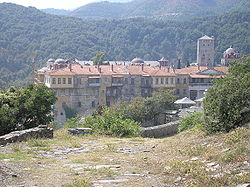
 Among the remarkable events of Tamar's reign was the foundation of the empire of Trebizond
on the Black Sea
in 1204. This state was established by Alexios Comnenus
and his brother, David
, in the northeastern – Pontic
– provinces of the crumbling Byzantine Empire
with the aid of Georgian troops. Alexios and David, Tamar's relatives, were fugitive Byzantine princes raised at the Georgian court. According to Tamar's historian, the aim of the Georgian expedition to Trebizond was to punish the Byzantine emperor Alexius IV Angelus for his confiscation of a shipment of money from the Georgian queen to the monasteries of Antioch
and Mount Athos
. However, Tamar's Pontic endeavor can better be explained by her desire to take advantage of the Western Europe
an Fourth Crusade
against Constantinople to set up a friendly state in Georgia's immediate southwestern neighborhood, as well as by the dynastic solidarity to the dispossessed Comnenoi.
Tamar sought to make use of the weakness of the Byzantine Empire and the crusaders' defeat at the hands of the Ayyubid sultan
Saladin
in order to gain Georgia's position on the international stage and to assume the traditional role of the Byzantine crown as a protector of the Christians of the Middle East
. Georgian Christian missionaries were active in the North Caucasus
and the expatriate monastic communities were scattered throughout the eastern Mediterranean
. Tamar's chronicle praises her universal protection of Christianity and her support of churches and monasteries from Egypt
to Bulgaria
and Cyprus
.
The Georgian court was primarily concerned with the protection of the Georgian monastic centers in the Holy Land
. By the 12th century, eight Georgian monasteries were listed in Jerusalem. Saladin's biographer Bahā' ad-Dīn ibn Šaddād reports that, after the Ayyubid conquest of Jerusalem in 1187, Tamar sent envoys to the sultan to request that the confiscated possessions of the Georgian monasteries in Jerusalem be returned. Saladin's response is not recorded, but the queen's efforts seem to have been successful: Jacques de Vitry
, who attained to the bishopric of Acre
shortly after Tamar's death, gives further evidence of the Georgians’ presence in Jerusalem. He writes that the Georgians were – in contrast to the other Christian pilgrims – allowed a free passage into the city, with their banners unfurled. Ibn Šaddād furthermore claims that Tamar outbid the Byzantine emperor in her efforts to obtain the relics of the True Cross
, offering 200,000 gold pieces to Saladin who had taken the relics as booty at the battle of Hattin
– to no avail, however.
 Georgia's political and cultural exploits of Tamar's epoch were rooted in a long and complex past. Tamar owned her accomplishments most immediately to the reforms of her great-grandfather David IV (r. 1089–1125) and, more remotely, to the unifying efforts of David III
and Bagrat III
who became architects of a political unity of Georgian kingdoms and principalities in the opening decade of the 11th century. Tamar was able to build upon their successes.
By the last years of Tamar's reign, the Georgian state had reached the zenith of its power and prestige in the Middle Ages
. Tamar's realm stretched from the Greater Caucasus
crest in the north to Erzurum
in the south, and from the Zygii
in the northwest to the vicinities of Ganja
in the southeast, forming a pan-Caucasian empire, with the loyal Zachariad regime in northern and central Armenia, Shirvan as a vassal and Trebizond as an ally. A contemporary Georgian historian extols Tamar as the master of the lands "from the Sea of Pontus [that is, the Black Sea] to the Sea of Gurgan
[the Caspian Sea
], from Speri to Derbend, and all the Hither and the Thither Caucasus up to Khazaria and Scythia
."
The royal title was correspondingly aggrandized. It now reflected not only Tamar's sway over the traditional subdivisions of the Georgian realm, but also included new components, emphasizing the Georgian crown's hegemony over the neighboring lands. Thus, on the coins and charters issued in her name, Tamar is identified as "by the will of God, King of Kings and Queen of Queens of the Abkhazians, Kartvelians
, Arranians, Kakheti
ans, and Armenians
; Shirvanshah
and Shahanshah; Autocrat
of all the East and the West, Glory of the World and Faith; Champion of the Messiah
."
The queen never achieved autocratic powers and the noble council continued to function. However, Tamar's own prestige and the expansion of patronq'moba
– a Georgian version of feudalism
– kept the more powerful dynastic princes from fragmenting the kingdom. This was a classical period in the history of Georgian feudalism. Attempts at transplanting feudal practices in the areas where they had previously been almost unknown did not pass without resistance. Thus, there was a revolt among the mountaineers of Pkhovi
and Dido
on Georgia's northeastern frontier in 1212, which was put down by Ivane Mkhargrdzeli after three months of heavy fighting.
With flourishing commercial centers now under Georgia's control, industry and commerce brought new wealth to the country and the court. Tribute extracted from the neighbors and war booty added to the royal treasury, giving rise to the saying that "the peasants were like nobles, the nobles like princes, and the princes like kings."
and secular influences, with affinities to both the Byzantine West and the Iranian East. The Georgian monarchy sought to underscore its association with Christianity and present its position as God-given
. It was in that period that the canon of Georgian Orthodox architecture was redesigned and a series of large-scale domed cathedrals were built. The Byzantine-derived expression of royal power was modified in various ways to bolster Tamar's unprecedented position as a woman ruling in her own right. The five extant monumental church portraits of the queen are clearly modeled on the Byzantine imagery, but also highlight specifically Georgian themes with an affinity to Iranian-type ideals of female beauty. The intimate connection of Georgia with the Middle East was also emphasized on contemporary Georgian coinage whose legends are composed in Georgian and Arabic
. A series of coins minted c. 1200 in the name of Queen Tamar depicted a local variant of the Byzantine obverse
and an Arabic inscription on the reverse
proclaiming Tamar as the "Champion of the Messiah".
The contemporary Georgian chronicles enshrined Christian morality and patristic literature continued to flourish, but it had, by that time, lost its earlier dominant position to secular literature, which was highly original, even though it developed in close contact with the neighboring cultures. The trend culminated in Shota Rustaveli
's epic poem
The Knight in the Panther's Skin
(Vepkhistq'aosani), which celebrates the ideals of an "Age of Chivalry
" and is revered in Georgia as the greatest achievement of native literature.
, having previously crowned her son, George-Lasha, coregent. Tamar's historian relates that the queen suddenly fell ill when discussing the state affairs with her ministers at the Nacharmagevi castle near the town of Gori
. She was transported to Tbilisi and then to the nearby castle of Agarani where Tamar died and was mourned by her subjects. Her remains were transferred to the cathedral at Mtskheta
and then to the Gelati monastery, a family burial ground of the Georgian royal dynasty. The prevalent scholarly opinion is that Tamar died in 1213, although there are some vague indications that she might have died earlier, in 1207 or 1210.
In later times, a number of legends emerged about Tamar's place of burial. One of them has it that Tamar was buried in a secret niche
at Gelati Monastery
so as to prevent the grave from being profaned by her enemies. Another version suggests that Tamar's remains were reburied in a remote location, possibly in the Holy Land. The French
knight Guillaume de Bois in his letter, dating from the early 13th century, written in Palestine
and addressed to the bishop of Besançon, claimed that he had heard that the king of the Georgians was heading towards Jerusalem with a huge army and had already conquered many cities of the Saracen
s. He was carrying, the report said, the remains of his mother, the "powerful queen Tamar" (regina potentissima Thamar), who had been unable to make a pilgrimage to the Holy Land in her lifetime and had bequeathed her body to be buried near the Holy Sepulchre.
In the 20th century, the quest for Tamar's grave became a subject of scholarly research as well as a focus of a broader public interest. The Georgian writer Grigol Robakidze
wrote in his 1918 essay on Tamar: "Thus far, nobody knows where Tamar's grave is. She belongs to everyone and to no one: her grave is in the heart of the Georgian. And in the Georgians' perception, this is not a grave, but a beautiful vase in which an unfading flower, the great Tamar, flourishes." An orthodox academic view still places Tamar's grave at Gelati, but a series of archaeological studies, beginning with Taqaishvili
in 1920, has failed to locate it at the monastery.
 Over the centuries, Queen Tamar has emerged as a dominant figure in the Georgian historical pantheon. However, the construction of her reign as a "Golden age" began in the reign itself and Tamar became the focus of the era. Several medieval Georgian poets, including Shota Rustaveli, claimed Tamar as the inspiration for their works. A legend has it that Rustaveli was even consumed with love for the queen and ended his days in a monastery. A dramatic scene from Rustaveli's poem where the seasoned king Rostevan crowns his daughter Tinatin is an allegory to George III's co-option of Tamar. Rustaveli comments on this: "A lion cub is just as good, be it female or male".
The queen became a subject of several contemporary panegyric
s, such as Chakhrukhadze
's Tamariani and Ioane Shavteli
's Abdul-Mesia. She was eulogized
in the chroniclers, most notably in the two accounts centered on her reign – The Life of Tamar, Queen of Queens and The Histories and Eulogies of the Sovereigns – which became the primary sources of Tamar's sanctification in the Georgian literature. The chroniclers exalt her as a "protector of the widowed" and "the thrice blessed", and place a particular emphasis on Tamar's virtues as a woman: beauty, humility, love of mercy, fidelity, and purity. Although Tamar was canonized
by the Georgian church much later, she was even named as a saint
in her lifetime in a bilingual Greco
-Georgian colophon
attached to the manuscript of the Vani Gospels
.
The idealization of Tamar was further accentuated by the events that took place under her immediate successors; within two decades of Tamar's death, the Khwarezmian
and Mongol
invasions brought the Georgian ascendancy to an abrupt end. Later periods of national revival were too ephemeral to match the achievements of Tamar's reign. All of these contributed to the cult of Tamar which blurred the distinction between the idealized queen and the real personality.
In popular memory, Tamar's image has acquired a legendary and romantic façade. A diverse set of folk songs, poems and tales illustrate her as an ideal ruler, a holy woman onto whom certain attributes of pagan
deities
and Christian saints were sometimes projected. For example, in an old Ossetian legend, Queen Tamar conceives her son of a sunbeam which shines through the window. Another myth, from the Georgian mountains, equates Tamar with the pagan deity of weather, Pirimze, who controls winter. Similarly, in the highland district of Pshavi
, Tamar's image fused with a pagan goddess of healing and female fertility.
While Tamar occasionally accompanied her army and is described as planning some campaigns, she was never directly involved in the fighting. Yet, the memory of the military victories of her reign contributed to Tamar's other popular image, that of a model warrior-queen. It also echoed in the Tale of Queen Dinara
, a popular 16th-century Russian
story about a fictional Georgian queen fighting against the Persians
.
and growing nationalism
among Georgian intellectuals of that time. In the Russian and Western literatures of the 19th century, the image of Queen Tamar reflected the European conceptions of the Orient
– of which Georgia was perceived as a part – and the position and characteristics of women in it. The Tyrolean
writer Jakob Philipp Fallmerayer
described Tamar as a "Caucasian Semiramis
". Fascinated by the "exotic
" Caucasus, the Russian poet Mikhail Lermontov
wrote the romantic poem Tamara in which he utilized the old Georgian legend about a siren
-like mountainous princess whom the poet gave the name of Queen Tamar. Although Lermontov's depiction of the Georgian queen as a destructive seductress had no apparent historical background, it has been influential enough to raise the issue of Tamar's sexuality, a question that was given some prominence by the 19th-century European authors. Knut Hamsun
's 1903 play Dronning Tamara ("Queen Tamara") was less successful; the theatre critics saw in it "a modern woman dressed in a medieval costume" and read the play as "a commentary on the new woman of the 1890s."
In Georgian literature, Tamar was also romanticized, but very differently from the Russian and Western European view. The Georgian romanticists followed a medieval tradition in Tamar's portrayal as a gentle, saintly woman who ruled a country permanently at war. This sentiment was further inspired by the rediscovery of a contemporary, 13th-century wall painting of Tamar in the then-ruined Betania monastery
, which was uncovered and restored by Prince Grigory Gagarin
in the 1840s. The fresco became a source of numerous engravings circulating in Georgia at that time and inspired the poet Grigol Orbeliani
to dedicate a romantic poem to it. Furthermore, the Georgian literati, reacting to the Russian
rule in Georgia and the suppression of national institutions, contrasted Tamar's era to their contemporary situation, lamenting the irretrievably lost past in their writings. Hence, Tamar became a personification of the heyday of Georgia, a perception that has persisted down to the present time.
Tamar's marriage to the Rus prince Yuri has become a subject of two resonant prose works in modern Georgia. Shalva Dadiani
's play, originally entitled The Unfortunate Russian (უბედური რუსი; 1916–1926), was attacked by the Soviet
critics for distorting the "centuries-long friendship of the Russian and Georgian peoples." Under the Communist Party
pressure, Dadiani had to revise both the title and the plot to bring it into line of the official ideology. In 2002, a satyrical short-story The First Russian (პირველი რუსი) penned by the young Georgian writer Lasha Bughadze and focused on a frustrated wedding night of Tamar and Yuri outraged many conservatives and triggered a nationwide controversy, including heated discussions in the media
, the Parliament of Georgia
and the Patriarchate of the Georgian Orthodox Church.
Bagrationi Dynasty
The Bagrationi dynasty was the ruling family of Georgia. Their ascendency lasted from the early Middle Ages until the early 19th century. In modern usage, this royal line is frequently referred to as the Georgian Bagratids, a Hellenized form of their dynastic name.The origin of the Bagrationi...
, was Queen Regnant
Queen regnant
A queen regnant is a female monarch who reigns in her own right, in contrast to a queen consort, who is the wife of a reigning king. An empress regnant is a female monarch who reigns in her own right over an empire....
of Georgia
Kingdom of Georgia
The Kingdom of Georgia was a medieval monarchy established in AD 978 by Bagrat III.It flourished during the 11th and 12th centuries, the so-called "golden age" of the history of Georgia. It fell to the Mongol invasions of the 13th century, but managed to re-assert sovereignty by 1327...
from 1184 to 1213. Tamar presided over the "Golden age
Golden Age
The term Golden Age comes from Greek mythology and legend and refers to the first in a sequence of four or five Ages of Man, in which the Golden Age is first, followed in sequence, by the Silver, Bronze, and Iron Ages, and then the present, a period of decline...
" of the medieval Georgian monarchy. Her unique position as the first woman to rule Georgia in her own right was emphasized by the title mep'e ("king
King
- Centers of population :* King, Ontario, CanadaIn USA:* King, Indiana* King, North Carolina* King, Lincoln County, Wisconsin* King, Waupaca County, Wisconsin* King County, Washington- Moving-image works :Television:...
"), commonly afforded to Tamar in the medieval Georgian sources.
Tamar was proclaimed heir apparent
Heir apparent
An heir apparent or heiress apparent is a person who is first in line of succession and cannot be displaced from inheriting, except by a change in the rules of succession....
and co-ruler by her reigning father George III
George III of Georgia
Giorgi III , of the Bagrationi dynasty, was king of Georgia from 1156 to 1184. His reign, and that of Tamar, are seen as the 'golden age' of Georgian history, the era of empire, diplomatic success, military triumphs, great learning, cultural, spiritual, and artistic flowering.-Life:He succeeded on...
in 1178, but she faced significant opposition from the aristocracy upon her ascension to full ruling powers after George's death. Nevertheless, Tamar was successful in neutralizing this opposition and embarked on an energetic foreign policy aided by the downfall of the rival powers of the Seljuqids
Great Seljuq Empire
The Great Seljuq Empire was a medieval Persianate, Turko-Persian Sunni Muslim empire, originating from the Qynyq branch of Oghuz Turks. The Seljuq Empire controlled a vast area stretching from the Hindu Kush to eastern Anatolia and from Central Asia to the Persian Gulf...
and the Byzantine Empire
Byzantine Empire
The Byzantine Empire was the Eastern Roman Empire during the periods of Late Antiquity and the Middle Ages, centred on the capital of Constantinople. Known simply as the Roman Empire or Romania to its inhabitants and neighbours, the Empire was the direct continuation of the Ancient Roman State...
. Supported by a powerful military élite, Tamar was able to build on the successes of her predecessors to consolidate an empire which dominated the Caucasus
Caucasus
The Caucasus, also Caucas or Caucasia , is a geopolitical region at the border of Europe and Asia, and situated between the Black and the Caspian sea...
until its collapse under the Mongol
Mongol Empire
The Mongol Empire , initially named as Greater Mongol State was a great empire during the 13th and 14th centuries...
attacks within two decades after Tamar's death.
Tamar was married twice, her first union being, from 1185 to 1187, to to the Rus'
Kievan Rus'
Kievan Rus was a medieval polity in Eastern Europe, from the late 9th to the mid 13th century, when it disintegrated under the pressure of the Mongol invasion of 1237–1240....
prince Yuri, whom she divorced and expelled from the country, defeating his subsequent attempts at coup. For her second consort Tamar chose, in 1191, the Alan
Alania
Alania may refer to:*Alania, the medieval state of the Alans or Alani people in the North Caucasus*The short name of the modern North Ossetia-Alania, one of the Caucasian republics in the Russian Federation...
prince David Soslan
David Soslan
David Soslan was an Alan prince and a King Consort of Georgia as the second husband of Queen Regnant Tamar who married him c. 1189. He is chiefly known for his military exploits during Georgia’s wars against its Muslim neighbors.- Origins :...
, by whom she had two children, George
George IV of Georgia
George IV Lasha of the Bagrationi Dynasty, was a king of Georgia from 1213 to 1223....
and Rusudan
Rusudan of Georgia
Queen Rusudan , from the Bagrationi dynasty, ruled Georgia in 1223–1245.- Life :Daughter of Queen Tamar of Georgia by David Soslan, she succeeded her brother George IV of Georgia on January 18, 1223. George’s untimely death marked the beginning of the end of the Georgian “golden age”...
, the two successive monarchs on the throne of Georgia.
Tamar's association with the period of political and military success and cultural achievements, combined with her role as a female ruler, has led to her idealization and romantization in Georgian arts and historical memory. She remains an important symbol in Georgian popular culture and has been canonized
Canonization
Canonization is the act by which a Christian church declares a deceased person to be a saint, upon which declaration the person is included in the canon, or list, of recognized saints. Originally, individuals were recognized as saints without any formal process...
by the Georgian Orthodox Church, with her feast day
Calendar of saints
The calendar of saints is a traditional Christian method of organizing a liturgical year by associating each day with one or more saints and referring to the feast day of said saint...
commemorated on 1 May
May 1 (Eastern Orthodox liturgics)
Apr. 30 - Eastern Orthodox Church calendar - May 2.All fixed commemorations below celebrated on May 14 by Old Calendarists.-Saints:* Prophet Jeremiah Apr. 30 - Eastern Orthodox Church calendar - May 2.All fixed commemorations below celebrated on May 14 by Old Calendarists.-Saints:* Prophet Jeremiah...
.
Early life and ascent to the throne
Tamar was born, c. 1160, to George IIIGeorge III of Georgia
Giorgi III , of the Bagrationi dynasty, was king of Georgia from 1156 to 1184. His reign, and that of Tamar, are seen as the 'golden age' of Georgian history, the era of empire, diplomatic success, military triumphs, great learning, cultural, spiritual, and artistic flowering.-Life:He succeeded on...
, King of Georgia, and his consort Burdukhan, a daughter of the king of Alania
Alania
Alania may refer to:*Alania, the medieval state of the Alans or Alani people in the North Caucasus*The short name of the modern North Ossetia-Alania, one of the Caucasian republics in the Russian Federation...
. It is possible that Tamar had a younger sister, Rusudan; but she is only mentioned once in all contemporary accounts of Tamar's reign. The name Tamar
Tamar (name)
Tamar is a female name of Hebrew origin, meaning "date" , "date palm" or just "palm tree". There are two characters in the Bible with this name, see Tamar . Variants include "Tamara" and "Tamera"...
is of Hebrew
Hebrew language
Hebrew is a Semitic language of the Afroasiatic language family. Culturally, is it considered by Jews and other religious groups as the language of the Jewish people, though other Jewish languages had originated among diaspora Jews, and the Hebrew language is also used by non-Jewish groups, such...
origin and, like other biblical
Bible
The Bible refers to any one of the collections of the primary religious texts of Judaism and Christianity. There is no common version of the Bible, as the individual books , their contents and their order vary among denominations...
names, was favored by the Georgian Bagrationi dynasty because of their claim to be descended from David
David
David was the second king of the united Kingdom of Israel according to the Hebrew Bible and, according to the Gospels of Matthew and Luke, an ancestor of Jesus Christ through both Saint Joseph and Mary...
, the second king of Israel
United Monarchy
According to Biblical tradition, the united Kingdom of Israel was a kingdom that existed in the Land of Israel, a period referred to by scholars as the United Monarchy. Biblical historians date the kingdom from c. 1020 BCE to c...
.
Tamar's youth coincided with a major upheaval in Georgia; in 1177, her father, George III, was confronted by a rebellious faction of nobles. The rebels intended to dethrone George in favor of the king's fraternal nephew, Demna, who was considered by many to be a legitimate royal heir of his murdered father, David V
David V of Georgia
David V , of the Bagrationi Dynasty, was a king of Georgia c. 1154/5.He was an elder son of King Demetre I. Fearing that Demetre would make his younger son Giorgi an heir to the throne, David attempted a revolt in 1130...
. Demna's cause was little but a pretext for the nobles, led by the pretender's father-in-law, the amirspasalar
Amirspasalar
Amirspasalar was the commander in chief of the medieval Georgian army and one of the highest officials of the Kingdom of Georgia, commonly rendered as Lord High Constable in English...
("constable") Ivane Orbeli, to weaken the crown. George III was able to crush the revolt and embarked on a campaign of crackdown on the defiant aristocratic clans; Ivane Orbeli was put to death and the surviving members of his family were driven out of Georgia. Prince Demna, castrated and blinded on his uncle's order, did not survive the mutilation and soon died in prison. Once the rebellion was suppressed and the pretender eliminated, George went ahead to co-opt Tamar into government with him and crowned her as co-ruler in 1178. By doing so, the king attempted to preempt any dispute after his death and legitimize his line on the throne of Georgia. At the same time, he raised men from the gentry and unranked classes to keep the aristocracy from the center of power.
Early reign and the first marriage
Gelati Monastery
The Monastery of Gelati is a monastic complex near Kutaisi, Imereti, western Georgia. It contains the Church of the Virgin founded by the King of Georgia David the Builder in 1106, and the 13th-century churches of St George and St Nicholas....
near Kutaisi
Kutaisi
Kutaisi is Georgia's second largest city and the capital of the western region of Imereti. It is 221 km to the west of Tbilisi.-Geography:...
, western Georgia. She inherited a relatively strong kingdom, but the centrifugal tendencies fostered by the great nobles were far from being quelled. There was a considerable opposition to Tamar's succession; this was sparked by a reaction against the repressive policies of her father and encouraged by the new sovereign's other perceived weakness, her sex. As Georgia had never previously had a female ruler, a part of the aristocracy questioned Tamar's legitimacy, while others tried to exploit her youth and supposed weakness to assert greater autonomy for themselves. The energetic involvement of Tamar's influential aunt, Rusudan
Rusudan, daughter of Demetre I of Georgia
Rusudan was a 12th-13th-century Georgian princess of the Bagrationi royal family. She was a daughter of King Demetrius I of Georgia, sister of the kings David V and George III, and a paternal aunt of the famous Queen Tamar of Georgia....
, and the Georgian catholicos
Catholicos-Patriarch of All Georgia
Catholicos–Patriarch has been the title of the heads of the Georgian Orthodox Church since 1010. The first Catholicos–Patriarch of All Georgia was Melkisedek I...
Michael IV Mirianisdze was crucial for legitimizing Tamar's succession to the throne. However, the young queen was forced into making significant concessions to the aristocracy. She had to reward the catholicos Michael's support by making him a chancellor
Chancellor
Chancellor is the title of various official positions in the governments of many nations. The original chancellors were the Cancellarii of Roman courts of justice—ushers who sat at the cancelli or lattice work screens of a basilica or law court, which separated the judge and counsel from the...
, thus placing him at the top of both the clerical and secular hierarchies.
Tamar was also pressured into dismissing her father's appointees, among them the constable Qubasar, a Georgianized Kipchak
Kipchaks in Georgia
Kipchaks are an ancient nomadic, Turkic people who occupied large territories from Central Asia to Eastern Europe. They, together with the Cumans played an important role in the history of many nations in the region, Georgia among them...
of ignoble birth, who had helped George III in his crackdown on the defiant nobility. One of the few untitled servitors of George III to escape this fate was the treasurer
Treasurer
A treasurer is the person responsible for running the treasury of an organization. The adjective for a treasurer is normally "tresorial". The adjective "treasurial" normally means pertaining to a treasury, rather than the treasurer.-Government:...
Qutlu Arslan
Qutlu Arslan
Qutlu Arslan was the 12th-century Georgian politician and statesman sometimes referred to as the Georgian Simon de Montfort for his rebellion, in circa 1184, against the unlimited royal power.A Georgianized Kipchak Qutlu Arslan was the 12th-century Georgian politician and statesman sometimes...
who now led a group of nobles and wealthy citizens in a struggle to limit the royal authority by creating a new council, karavi, whose members would alone deliberate and decide policy. This attempt at "feudal constitutionalism
Constitutionalism
Constitutionalism has a variety of meanings. Most generally, it is "a complex of ideas, attitudes, and patterns of behavior elaborating the principle that the authority of government derives from and is limited by a body of fundamental law"....
" was rendered abortive when Tamar had Qutlu Arslan arrested and his supporters were inveigled into submission. Yet, Tamar’s first moves to reduce the power of the aristocratic élite were unsuccessful. She failed in her attempt to use a church synod
Synod
A synod historically is a council of a church, usually convened to decide an issue of doctrine, administration or application. In modern usage, the word often refers to the governing body of a particular church, whether its members are meeting or not...
to dismiss the catholicos Michael, and the noble council, darbazi, asserted the right to approve royal decrees. Even the queen’s first husband, the Rus'
Rus' (people)
The Rus' were a group of Varangians . According to the Primary Chronicle of Rus, compiled in about 1113 AD, the Rus had relocated from the Baltic region , first to Northeastern Europe, creating an early polity which finally came under the leadership of Rurik...
prince Yuri
Yuri Bogolyubsky
Yury Bogolyubsky , known as Giorgi Rusi in Georgia, was a Rus' prince of Novgorod . Married to Queen Regnant Tamar of Georgia, he was a consort of the Kingdom of Georgia from 1185 until being expelled from the country in 1188....
, was forced on her by the nobles.
Pursuant to dynastic imperatives and the ethos of the time, the nobles required Tamar to marry in order to have a leader for the army and to provide an heir to the throne. Their choice fell on Yuri, son of the murdered prince Andrei I Bogolyubsky of Vladimir-Suzdal
Vladimir-Suzdal
The Vladimir-Suzdal Principality or Vladimir-Suzdal Rus’ was one of the major principalities which succeeded Kievan Rus' in the late 12th century and lasted until the late 14th century. For a long time the Principality was a vassal of the Mongolian Golden Horde...
, who then lived as a refuge among the Kipchaks
Kipchaks
Kipchaks were a Turkic tribal confederation...
of the North Caucasus
North Caucasus
The North Caucasus is the northern part of the Caucasus region between the Black and Caspian Seas and within European Russia. The term is also used as a synonym for the North Caucasus economic region of Russia....
. The choice was approved by Tamar’s aunt Rusudan and the prince was brought to Georgia to marry the queen in 1185. Yuri proved to be an able soldier, but a difficult person and he soon ran afoul of his wife. The strained spousal relations paralleled a factional struggle at the royal court in which Tamar was becoming more and more assertive of her rights as a queen regnant. The turning point in Tamar's fortunes came with the death of the powerful catholicos Michael whom the queen replaced, as a chancellor, with her supporter, Anton Glonistavisdze. Tamar gradually expanded her own powerbase and elevated her loyal nobles to high positions at the court, most notably the Armenian family of Zachariads, known in Georgia as the Mkhargrdzeli.
Second marriage
In 1187, Tamar persuaded the noble council to approve her divorce with Yuri who was accused of addiction to drunkenness and "sodomySodomy
Sodomy is an anal or other copulation-like act, especially between male persons or between a man and animal, and one who practices sodomy is a "sodomite"...
", and sent off to Constantinople
Constantinople
Constantinople was the capital of the Roman, Eastern Roman, Byzantine, Latin, and Ottoman Empires. Throughout most of the Middle Ages, Constantinople was Europe's largest and wealthiest city.-Names:...
. Assisted by several Georgian aristocrats anxious to check Tamar’s growing power, Yuri made two attempts at coup, but failed and went off to obscurity after 1191. The queen chose her second husband herself. He was David Soslan
David Soslan
David Soslan was an Alan prince and a King Consort of Georgia as the second husband of Queen Regnant Tamar who married him c. 1189. He is chiefly known for his military exploits during Georgia’s wars against its Muslim neighbors.- Origins :...
, an Alan
Alania
Alania may refer to:*Alania, the medieval state of the Alans or Alani people in the North Caucasus*The short name of the modern North Ossetia-Alania, one of the Caucasian republics in the Russian Federation...
prince, to whom the 18th-century Georgian scholar Prince Vakhushti
Vakhushti
Vakhushti was a Georgian prince , geographer, historian and cartographer.- Life :A son of King Vakhtang VI of Kartli , he was born in Tbilisi, 1696...
ascribes descent from the early 11th-century Georgian king George I
George I of Georgia
Giorgi I , of the House of Bagrationi, was the king of Georgia from 1014 until his death in 1027. He spent most of his seven-year-long reign waging a bloody and fruitless territorial war with the Byzantine Empire.-Early reign:...
. David, a capable military commander, became Tamar's major supporter and was instrumental in defeating the rebellious nobles rallied behind Yuri.
Tamar and David had two children. In 1192 or 1194, the queen gave birth to a son, George-Lasha, the future king George IV
George IV of Georgia
George IV Lasha of the Bagrationi Dynasty, was a king of Georgia from 1213 to 1223....
. The daughter, Rusudan
Rusudan of Georgia
Queen Rusudan , from the Bagrationi dynasty, ruled Georgia in 1223–1245.- Life :Daughter of Queen Tamar of Georgia by David Soslan, she succeeded her brother George IV of Georgia on January 18, 1223. George’s untimely death marked the beginning of the end of the Georgian “golden age”...
, was born 1195 and would succeed her brother as a sovereign of Georgia.
David Soslan's status of a king consort
King consort
King consort is an alternative title to the more usual "prince consort" - which is a position given in some monarchies to the husband of a reigning queen. It is a symbolic title only, the sole constitutional function of the holder being similar to a prince consort, which is the male equivalent of a...
, as well as his presence in art, on charters, and on coins, was dictated by the necessity of male aspects of kingship, but he remained a subordinate ruler who shared throne with and derived his power from Tamar. Tamar continued to be styled as mep’et’a mep’e – "king of kings
King of Kings
King of Kings is a title that has been used by several monarchies and empires throughout history. The title originates in the Ancient Near East. It is broadly the equivalent of the later title Emperor....
". In Georgian, a language with no grammatical gender
Grammatical gender
Grammatical gender is defined linguistically as a system of classes of nouns which trigger specific types of inflections in associated words, such as adjectives, verbs and others. For a system of noun classes to be a gender system, every noun must belong to one of the classes and there should be...
s, mep'e ("king") does not necessarily imply a masculine connotation and can be rendered as a "sovereign". The female equivalent of mep'e is dedop'ali ("queen"), which was applied to queens consort
Queen consort
A queen consort is the wife of a reigning king. A queen consort usually shares her husband's rank and holds the feminine equivalent of the king's monarchical titles. Historically, queens consort do not share the king regnant's political and military powers. Most queens in history were queens consort...
or the king's closest, senior female relatives. Tamar is occasionally called dedop'ali in the Georgian chronicles and on some charters. Thus, the title of mep'e might have been applied to Tamar to mark out her unique position among women.
Muslim neighbors
Once Tamar succeeded in consolidating her power and found a reliable support in David Soslan, the Mkhargrdzeli, ToreliToreli
The Toreli , earlier known as the Gamrekeli , were a noble family in medieval Georgia, known from the 10th century and prominent into the 14th...
, and other noble families, she revived the expansionist foreign policy of her predecessors. Repeated occasions of dynastic strife in Georgia combined with the efforts of regional successors of the Great Seljuq Empire
Great Seljuq Empire
The Great Seljuq Empire was a medieval Persianate, Turko-Persian Sunni Muslim empire, originating from the Qynyq branch of Oghuz Turks. The Seljuq Empire controlled a vast area stretching from the Hindu Kush to eastern Anatolia and from Central Asia to the Persian Gulf...
, such as the Ildenizid atabegs of Azerbaijan
Atabegs of Azerbaijan
The Ildegizids, Eldiguzids or Ildenizids, also known as Atabegs of Azerbaijan were a Turkic dynasty of Kipchak origin which controlled most of northwestern Persia/eastern Transcaucasia, including Arran, most of Azerbaijan, and Djibal...
, Shirvanshah
Shirvanshah
Shirvanshah also spelled as Shīrwān Shāh or Sharwān Shāh, was the title in mediaeval Islamic times of an Arab in Ethnos but speedily Persianized dynasty within their culturally Persian environment. The Shirvanshah established a native state in Shirvan...
s, and the Ahlatshahs
Ahlatshahs
Ahlahshahs were the 11th-12th century rulers of an Anatolian beylik of the first period founded after the Battle of Manzikert, and centered in Ahlat on the northwestern shore of the Lake Van in Eastern Anatolia...
, had slowed down the dynamic of the Georgians achieved during the reigns of Tamar's great-grandfather, David IV
David IV of Georgia
David IV "the Builder", also known as David II , of the Bagrationi dynasty, was a king of Georgia from 1089 until his death in 1125....
, and her father, George III. However, the Georgians became again active under Tamar, more prominently in the second decade of her rule.
Early in the 1190s, the Georgian government began to interfere in the affairs of the Ildenizids and of the Shirvanshahs, aiding rivaling local princes and reducing Shirvan
Shirvan
Shirvan , also spelled as Shirwan, Shervan, Sherwan and Šervān, is a historical region in the eastern Caucasus, known by this name in both Islamic and modern times...
to a tributary state. The Ildenizid atabeg Abu Bakr attempted to stem the Georgian advance, but suffered a defeat at the hands of David Soslan at Shamkir
Battle of Shamkor
Battle of Shamkor was fought on June 1, 1195 near the city of Shamkor, Arran , the Battle of Shamkor was a major victory won by the Georgian army, commanded by David Soslan, over the army of the Azerbaijani Atabeg Abu Bakr.The battle was fought as part of several conflicts between the Atabeg State...
and lost his capital to a Georgian protégé in 1195. Although Abu Bakr was able to resume his reign a year later, the Ildenizids were only barely able to contain further Georgian forays.
In 1199, Tamar's armies scored another major victory when two brothers, Zak'are and Ivane Mkhargrdzeli, dislodged the Shaddadid
Shaddadid
The Shaddadids were a Kurdish dynasty who ruled in various parts of Armenia and Arran from 951-1174 AD. They were established in Dvin. Through their long tenure in Armenia, they often intermarried with the Bagratuni royal family of Armenia....
dynasty from Ani
Ani
Ani is a ruined and uninhabited medieval Armenian city-site situated in the Turkish province of Kars, near the border with Armenia. It was once the capital of a medieval Armenian kingdom that covered much of present day Armenia and eastern Turkey...
, the erstwhile capital of the Armenian kingdom, and received it from the queen as their fief. From their base at Ani, the brothers surged ahead into the central Armenian lands, reclaiming one after another fortress and district from local Muslim dynasts: Bjni
Bjni
Bjni is a village in the Kotayk Province of Armenia. It is situated in a valley between canyon walls and a small river. Throughout Bjni's history, it has remained one of the main centers of education in Armenia. Some manuscripts from Bjni dated to the 12th to 17th centuries have survived...
was taken in 1201 and Dvin
Dvin
Dvin was a large commercial city and the capital of early medieval Armenia. It was situated north of the previous ancient capital of Armenia, the city of Artaxata, along the banks of the Metsamor River, 35 km to the south of modern Yerevan...
fell in 1203.
Alarmed by the Georgian successes, Süleymanshah II
Süleymanshah II
Suleiman II aka Rukn ad-Din Suleiman Shah , was the Seljuk Sultan of Rûm between 1196–1204.Son of Kilij Arslan II, he overthrew his brother, Sultan Kaykhusraw I who had succeeded their father in 1192 and became sultan in 1196....
, the resurgent Seljuqid sultan of Rûm, rallied his vassal emir
Emir
Emir , meaning "commander", "general", or "prince"; also transliterated as Amir, Aamir or Ameer) is a title of high office, used throughout the Muslim world...
s into a coalition and launched an offensive against Georgia, but was attacked and defeated by David Soslan at the battle of Basian
Battle of Basian
The Battle of Basian was fought, in the 13th century, between the armies of the Kingdom of Georgia and the Seljuqid Sultanate of Rüm in the Basian vale 60 km northeast of the city of Erzurum in what is now northeast Republic of Turkey. The battle is variously dated between 1202 and 1205, but...
in 1203 or 1204. The chronicler of Tamar describes how the army was assembled at the rock-hewn town of Vardzia
Vardzia
The cave city of Vardzia is a cave monastery dug into the side of the Erusheli mountain in southern Georgia near Aspindza on the left bank of the Mtkvari River. It was founded by Queen Tamar in 1185....
before marching on to Basian and how the queen addressed the troops from the balcony of the church.
The Mkhargrdzeli captured Kars
Kars
Kars is a city in northeast Turkey and the capital of Kars Province. The population of the city is 73,826 as of 2010.-Etymology:As Chorzene, the town appears in Roman historiography as part of ancient Armenia...
on behalf of the Georgian crown in 1206, but were repelled from the walls of Akhlat in 1209. This brought the struggle for the Armenian lands to a stall, leaving the Lake Van
Lake Van
Lake Van is the largest lake in Turkey, located in the far east of the country in Van district. It is a saline and soda lake, receiving water from numerous small streams that descend from the surrounding mountains. Lake Van is one of the world's largest endorheic lakes . The original outlet from...
region in a relatively secure possession of its new masters – the Ayyubids
Ayyubid dynasty
The Ayyubid dynasty was a Muslim dynasty of Kurdish origin, founded by Saladin and centered in Egypt. The dynasty ruled much of the Middle East during the 12th and 13th centuries CE. The Ayyubid family, under the brothers Ayyub and Shirkuh, originally served as soldiers for the Zengids until they...
of Damascus
Damascus
Damascus , commonly known in Syria as Al Sham , and as the City of Jasmine , is the capital and the second largest city of Syria after Aleppo, both are part of the country's 14 governorates. In addition to being one of the oldest continuously inhabited cities in the world, Damascus is a major...
. In 1209, the brothers Mkhargrdzeli laid waste to Ardabil
Ardabil
Ardabil is a historical city in north-western Iran. The name Ardabil probably comes from the Zoroastrian name of "Artavil" which means a holy place. Ardabil is the center of Ardabil Province. At the 2006 census, its population was 412,669, in 102,818 families...
– according to the Georgian and Armenian annals – as a revenge for the local Muslim ruler's attack on Ani and his massacre of the city’s Christian population. In a great final burst, the brothers led an army marshaled throughout Tamar's possessions and vassal territories in a march, through Nakhchivan and Julfa, to Marand
Marand
Marand is a city in and the capital of Marand County, East Azerbaijan Province, Iran. At the 2006 census, its population was 114,165, in 29,755 families....
, Tabriz
Tabriz
Tabriz is the fourth largest city and one of the historical capitals of Iran and the capital of East Azerbaijan Province. Situated at an altitude of 1,350 meters at the junction of the Quri River and Aji River, it was the second largest city in Iran until the late 1960s, one of its former...
, and Qazvin
Qazvin
Qazvin is the largest city and capital of the Province of Qazvin in Iran. At the 2006 census, its population was 349,821, in 96,420 families....
in northern Iran
Iran
Iran , officially the Islamic Republic of Iran , is a country in Southern and Western Asia. The name "Iran" has been in use natively since the Sassanian era and came into use internationally in 1935, before which the country was known to the Western world as Persia...
, pillaging several settlements on their way.
Trebizond and the Middle East
Empire of Trebizond
The Empire of Trebizond, founded in April 1204, was one of three Byzantine successor states of the Byzantine Empire. However, the creation of the Empire of Trebizond was not directly related to the capture of Constantinople by the Fourth Crusade, rather it had broken away from the Byzantine Empire...
on the Black Sea
Black Sea
The Black Sea is bounded by Europe, Anatolia and the Caucasus and is ultimately connected to the Atlantic Ocean via the Mediterranean and the Aegean seas and various straits. The Bosphorus strait connects it to the Sea of Marmara, and the strait of the Dardanelles connects that sea to the Aegean...
in 1204. This state was established by Alexios Comnenus
Alexios I of Trebizond
Alexios I Megas Komnenos or Alexius I Comnenus was Emperor of Trebizond from 1204 to 1222. He was the eldest son of Manuel Komnenos and of Rusudan, daughter of George III of Georgia. He was thus a grandson of the Byzantine Emperor Andronikos I. Andronikos was dethroned and killed in 1185...
and his brother, David
David Komnenos
David Komnenos was one of the founders of the Empire of Trebizond and its joint ruler together with his brother Alexios until his death.-Early life:...
, in the northeastern – Pontic
Pontus
Pontus or Pontos is a historical Greek designation for a region on the southern coast of the Black Sea, located in modern-day northeastern Turkey. The name was applied to the coastal region in antiquity by the Greeks who colonized the area, and derived from the Greek name of the Black Sea: Πόντος...
– provinces of the crumbling Byzantine Empire
Byzantine Empire
The Byzantine Empire was the Eastern Roman Empire during the periods of Late Antiquity and the Middle Ages, centred on the capital of Constantinople. Known simply as the Roman Empire or Romania to its inhabitants and neighbours, the Empire was the direct continuation of the Ancient Roman State...
with the aid of Georgian troops. Alexios and David, Tamar's relatives, were fugitive Byzantine princes raised at the Georgian court. According to Tamar's historian, the aim of the Georgian expedition to Trebizond was to punish the Byzantine emperor Alexius IV Angelus for his confiscation of a shipment of money from the Georgian queen to the monasteries of Antioch
Antioch
Antioch on the Orontes was an ancient city on the eastern side of the Orontes River. It is near the modern city of Antakya, Turkey.Founded near the end of the 4th century BC by Seleucus I Nicator, one of Alexander the Great's generals, Antioch eventually rivaled Alexandria as the chief city of the...
and Mount Athos
Mount Athos
Mount Athos is a mountain and peninsula in Macedonia, Greece. A World Heritage Site, it is home to 20 Eastern Orthodox monasteries and forms a self-governed monastic state within the sovereignty of the Hellenic Republic. Spiritually, Mount Athos comes under the direct jurisdiction of the...
. However, Tamar's Pontic endeavor can better be explained by her desire to take advantage of the Western Europe
Western Europe
Western Europe is a loose term for the collection of countries in the western most region of the European continents, though this definition is context-dependent and carries cultural and political connotations. One definition describes Western Europe as a geographic entity—the region lying in the...
an Fourth Crusade
Fourth Crusade
The Fourth Crusade was originally intended to conquer Muslim-controlled Jerusalem by means of an invasion through Egypt. Instead, in April 1204, the Crusaders of Western Europe invaded and conquered the Christian city of Constantinople, capital of the Eastern Roman Empire...
against Constantinople to set up a friendly state in Georgia's immediate southwestern neighborhood, as well as by the dynastic solidarity to the dispossessed Comnenoi.
Tamar sought to make use of the weakness of the Byzantine Empire and the crusaders' defeat at the hands of the Ayyubid sultan
Sultan of Egypt
Sultan of Egypt was the status held by the rulers of Egypt after the establishment of the Ayyubid Dynasty of Saladin in 1174 until the Ottoman conquest of Egypt in 1517. Though the extent of the Egyptian Sultanate ebbed and flowed, it generally included Sham and Hejaz, with the consequence that the...
Saladin
Saladin
Ṣalāḥ ad-Dīn Yūsuf ibn Ayyūb , better known in the Western world as Saladin, was an Arabized Kurdish Muslim, who became the first Sultan of Egypt and Syria, and founded the Ayyubid dynasty. He led Muslim and Arab opposition to the Franks and other European Crusaders in the Levant...
in order to gain Georgia's position on the international stage and to assume the traditional role of the Byzantine crown as a protector of the Christians of the Middle East
Middle East
The Middle East is a region that encompasses Western Asia and Northern Africa. It is often used as a synonym for Near East, in opposition to Far East...
. Georgian Christian missionaries were active in the North Caucasus
North Caucasus
The North Caucasus is the northern part of the Caucasus region between the Black and Caspian Seas and within European Russia. The term is also used as a synonym for the North Caucasus economic region of Russia....
and the expatriate monastic communities were scattered throughout the eastern Mediterranean
Mediterranean Basin
In biogeography, the Mediterranean Basin refers to the lands around the Mediterranean Sea that have a Mediterranean climate, with mild, rainy winters and hot, dry summers, which supports characteristic Mediterranean forests, woodlands, and scrub vegetation...
. Tamar's chronicle praises her universal protection of Christianity and her support of churches and monasteries from Egypt
Egypt
Egypt , officially the Arab Republic of Egypt, Arabic: , is a country mainly in North Africa, with the Sinai Peninsula forming a land bridge in Southwest Asia. Egypt is thus a transcontinental country, and a major power in Africa, the Mediterranean Basin, the Middle East and the Muslim world...
to Bulgaria
Bulgaria
Bulgaria , officially the Republic of Bulgaria , is a parliamentary democracy within a unitary constitutional republic in Southeast Europe. The country borders Romania to the north, Serbia and Macedonia to the west, Greece and Turkey to the south, as well as the Black Sea to the east...
and Cyprus
Cyprus
Cyprus , officially the Republic of Cyprus , is a Eurasian island country, member of the European Union, in the Eastern Mediterranean, east of Greece, south of Turkey, west of Syria and north of Egypt. It is the third largest island in the Mediterranean Sea.The earliest known human activity on the...
.
The Georgian court was primarily concerned with the protection of the Georgian monastic centers in the Holy Land
Holy Land
The Holy Land is a term which in Judaism refers to the Kingdom of Israel as defined in the Tanakh. For Jews, the Land's identifiction of being Holy is defined in Judaism by its differentiation from other lands by virtue of the practice of Judaism often possible only in the Land of Israel...
. By the 12th century, eight Georgian monasteries were listed in Jerusalem. Saladin's biographer Bahā' ad-Dīn ibn Šaddād reports that, after the Ayyubid conquest of Jerusalem in 1187, Tamar sent envoys to the sultan to request that the confiscated possessions of the Georgian monasteries in Jerusalem be returned. Saladin's response is not recorded, but the queen's efforts seem to have been successful: Jacques de Vitry
Jacques de Vitry
Jacques de Vitry was a theologian chronicler and cardinal from 1229 – 40.He was born in central France and studied at the University of Paris, becoming a regular canon in 1210 at the church of Saint-Nicolas d'Oignies in the Diocese of Liège, a post he maintained until 1216...
, who attained to the bishopric of Acre
Bishop of Acre
The Bishop of Acre was a suffragan bishop of the Crusader Archbishop of Tyre. Acre is present-day Akko.-List of bishops of Acre:*Hugh of le Mans?*c.1150 Frederick, Archbishop of Tyre*William*1172 Joscius, Archbishop of Tyre...
shortly after Tamar's death, gives further evidence of the Georgians’ presence in Jerusalem. He writes that the Georgians were – in contrast to the other Christian pilgrims – allowed a free passage into the city, with their banners unfurled. Ibn Šaddād furthermore claims that Tamar outbid the Byzantine emperor in her efforts to obtain the relics of the True Cross
True Cross
The True Cross is the name for physical remnants which, by a Christian tradition, are believed to be from the cross upon which Jesus was crucified.According to post-Nicene historians, Socrates Scholasticus and others, the Empress Helena The True Cross is the name for physical remnants which, by a...
, offering 200,000 gold pieces to Saladin who had taken the relics as booty at the battle of Hattin
Battle of Hattin
The Battle of Hattin took place on Saturday, July 4, 1187, between the Crusader Kingdom of Jerusalem and the forces of the Ayyubid dynasty....
– to no avail, however.
Feudal monarchy
David III of Tao
David III Kuropalates or David III the Great , also known as David II, was a Georgian prince of the Bagratid family of Tao/Tayk, a historic region in the Georgian–Armenian marchlands, from 966 until his murder in 1000...
and Bagrat III
Bagrat III of Georgia
Bagrat III , of the Georgian Bagrationi dynasty, was King of the Abkhazians from 978 on and King of Georgia from 1008 on. He united these two titles by dynastic inheritance and, through conquest and diplomacy, added some more lands to his realm, effectively becoming the first king of what is...
who became architects of a political unity of Georgian kingdoms and principalities in the opening decade of the 11th century. Tamar was able to build upon their successes.
By the last years of Tamar's reign, the Georgian state had reached the zenith of its power and prestige in the Middle Ages
Middle Ages
The Middle Ages is a periodization of European history from the 5th century to the 15th century. The Middle Ages follows the fall of the Western Roman Empire in 476 and precedes the Early Modern Era. It is the middle period of a three-period division of Western history: Classic, Medieval and Modern...
. Tamar's realm stretched from the Greater Caucasus
Greater Caucasus
Greater Caucasus , sometimes translated as "Caucasus Major", "Big Caucasus" or "Large Caucasus") is the major mountain range of the Caucasus Mountains....
crest in the north to Erzurum
Erzurum
Erzurum is a city in Turkey. It is the largest city, the capital of Erzurum Province. The city is situated 1757 meters above sea level. Erzurum had a population of 361,235 in the 2000 census. .Erzurum, known as "The Rock" in NATO code, served as NATO's southeastern-most air force post during the...
in the south, and from the Zygii
Zygii
The Zygii has been described by the ancient Greek intellectual Strabo as a nation to the north of Colchis.He wrote:...
in the northwest to the vicinities of Ganja
Ganja, Azerbaijan
Ganja is Azerbaijan's second-largest city with a population of around 313,300. It was named Yelizavetpol in the Russian Empire period. The city regained its original name—Ganja—from 1920–1935 during the first part of its incorporation into the Soviet Union. However, its name was changed again and...
in the southeast, forming a pan-Caucasian empire, with the loyal Zachariad regime in northern and central Armenia, Shirvan as a vassal and Trebizond as an ally. A contemporary Georgian historian extols Tamar as the master of the lands "from the Sea of Pontus [that is, the Black Sea] to the Sea of Gurgan
Gürgan
Gürgan is a village in Baku, Azerbaijan. It forms part of the municipality of Gürgən-Pirallahı....
[the Caspian Sea
Caspian Sea
The Caspian Sea is the largest enclosed body of water on Earth by area, variously classed as the world's largest lake or a full-fledged sea. The sea has a surface area of and a volume of...
], from Speri to Derbend, and all the Hither and the Thither Caucasus up to Khazaria and Scythia
Scythia
In antiquity, Scythian or Scyths were terms used by the Greeks to refer to certain Iranian groups of horse-riding nomadic pastoralists who dwelt on the Pontic-Caspian steppe...
."
The royal title was correspondingly aggrandized. It now reflected not only Tamar's sway over the traditional subdivisions of the Georgian realm, but also included new components, emphasizing the Georgian crown's hegemony over the neighboring lands. Thus, on the coins and charters issued in her name, Tamar is identified as "by the will of God, King of Kings and Queen of Queens of the Abkhazians, Kartvelians
Kartli
Kartli is a historical region in central-to-eastern Georgia traversed by the river Mtkvari , on which Georgia's capital, Tbilisi, is situated. Known to the Classical authors as Iberia, Kartli played a crucial role in ethnic and political consolidation of the Georgians in the Middle Ages...
, Arranians, Kakheti
Kakheti
Kakheti is a historical province in Eastern Georgia inhabited by Kakhetians who speak a local dialect of Georgian. It is bordered by the small mountainous province of Tusheti and the Greater Caucasus mountain range to the north, Russian Federation to the Northeast, Azerbaijan to the Southeast, and...
ans, and Armenians
Armenians
Armenian people or Armenians are a nation and ethnic group native to the Armenian Highland.The largest concentration is in Armenia having a nearly-homogeneous population with 97.9% or 3,145,354 being ethnic Armenian....
; Shirvanshah
Shirvanshah
Shirvanshah also spelled as Shīrwān Shāh or Sharwān Shāh, was the title in mediaeval Islamic times of an Arab in Ethnos but speedily Persianized dynasty within their culturally Persian environment. The Shirvanshah established a native state in Shirvan...
and Shahanshah; Autocrat
Autocracy
An autocracy is a form of government in which one person is the supreme power within the state. It is derived from the Greek : and , and may be translated as "one who rules by himself". It is distinct from oligarchy and democracy...
of all the East and the West, Glory of the World and Faith; Champion of the Messiah
Messiah
A messiah is a redeemer figure expected or foretold in one form or another by a religion. Slightly more widely, a messiah is any redeemer figure. Messianic beliefs or theories generally relate to eschatological improvement of the state of humanity or the world, in other words the World to...
."
The queen never achieved autocratic powers and the noble council continued to function. However, Tamar's own prestige and the expansion of patronq'moba
Georgian feudalism
Georgian feudalism, or patronqmoba , as the system of personal dependence or vassalage in ancient and medieval Georgia is referred to, arose from a tribal-dynastic organization of society upon which was imposed, by royal authority, an official hierarchy of regional governors, local officials and...
– a Georgian version of feudalism
Feudalism
Feudalism was a set of legal and military customs in medieval Europe that flourished between the 9th and 15th centuries, which, broadly defined, was a system for ordering society around relationships derived from the holding of land in exchange for service or labour.Although derived from the...
– kept the more powerful dynastic princes from fragmenting the kingdom. This was a classical period in the history of Georgian feudalism. Attempts at transplanting feudal practices in the areas where they had previously been almost unknown did not pass without resistance. Thus, there was a revolt among the mountaineers of Pkhovi
Pkhovi
Pkhovi , also known as Pkhoet'i , is a medieval term for the mountainous district in northeast Georgia comprising the latter-day provinces of Pshavi and Khevsureti along the upper reaches of the Aragvi, and in three alpine valleys just north of the main crest of the Greater Caucasus...
and Dido
Tsez people
The Tsez are an indigenous people of the North Caucasus, also known as the Dido or the Didoi. Their unwritten language, also called Tsez or Dido, belongs to the Northeast Caucasian group with some 15,354 speakers. For demographic purposes, today they are classified with the Avars with whom the...
on Georgia's northeastern frontier in 1212, which was put down by Ivane Mkhargrdzeli after three months of heavy fighting.
With flourishing commercial centers now under Georgia's control, industry and commerce brought new wealth to the country and the court. Tribute extracted from the neighbors and war booty added to the royal treasury, giving rise to the saying that "the peasants were like nobles, the nobles like princes, and the princes like kings."
Culture
With this prosperity came an outburst of the distinct Georgian culture, an amalgam of ChristianChristianity
Christianity is a monotheistic religion based on the life and teachings of Jesus as presented in canonical gospels and other New Testament writings...
and secular influences, with affinities to both the Byzantine West and the Iranian East. The Georgian monarchy sought to underscore its association with Christianity and present its position as God-given
Divine Right of Kings
The divine right of kings or divine-right theory of kingship is a political and religious doctrine of royal and political legitimacy. It asserts that a monarch is subject to no earthly authority, deriving his right to rule directly from the will of God...
. It was in that period that the canon of Georgian Orthodox architecture was redesigned and a series of large-scale domed cathedrals were built. The Byzantine-derived expression of royal power was modified in various ways to bolster Tamar's unprecedented position as a woman ruling in her own right. The five extant monumental church portraits of the queen are clearly modeled on the Byzantine imagery, but also highlight specifically Georgian themes with an affinity to Iranian-type ideals of female beauty. The intimate connection of Georgia with the Middle East was also emphasized on contemporary Georgian coinage whose legends are composed in Georgian and Arabic
Arabic language
Arabic is a name applied to the descendants of the Classical Arabic language of the 6th century AD, used most prominently in the Quran, the Islamic Holy Book...
. A series of coins minted c. 1200 in the name of Queen Tamar depicted a local variant of the Byzantine obverse
Obverse and reverse
Obverse and its opposite, reverse, refer to the two flat faces of coins and some other two-sided objects, including paper money, flags , seals, medals, drawings, old master prints and other works of art, and printed fabrics. In this usage, obverse means the front face of the object and reverse...
and an Arabic inscription on the reverse
Obverse and reverse
Obverse and its opposite, reverse, refer to the two flat faces of coins and some other two-sided objects, including paper money, flags , seals, medals, drawings, old master prints and other works of art, and printed fabrics. In this usage, obverse means the front face of the object and reverse...
proclaiming Tamar as the "Champion of the Messiah".
The contemporary Georgian chronicles enshrined Christian morality and patristic literature continued to flourish, but it had, by that time, lost its earlier dominant position to secular literature, which was highly original, even though it developed in close contact with the neighboring cultures. The trend culminated in Shota Rustaveli
Shota Rustaveli
Shota Rustaveli was a Georgian poet of the 12th century, and one of the greatest contributors to Georgian literature. He is author of "The Knight in the Panther's Skin" , the Georgian national epic poem....
's epic poem
Epic poetry
An epic is a lengthy narrative poem, ordinarily concerning a serious subject containing details of heroic deeds and events significant to a culture or nation. Oral poetry may qualify as an epic, and Albert Lord and Milman Parry have argued that classical epics were fundamentally an oral poetic form...
The Knight in the Panther's Skin
The Knight in the Panther's Skin
The Knight in the Panther's Skin is an epic poem, consisting of over 1600 shairi quatrains, was written in the 12th century by the Georgian epic-poet Shota Rustaveli, who was a Prince and Treasurer at the royal court of Queen Tamar of Georgia. The Knight in the Panther's Skin is often seen as...
(Vepkhistq'aosani), which celebrates the ideals of an "Age of Chivalry
Chivalry
Chivalry is a term related to the medieval institution of knighthood which has an aristocratic military origin of individual training and service to others. Chivalry was also the term used to refer to a group of mounted men-at-arms as well as to martial valour...
" and is revered in Georgia as the greatest achievement of native literature.
Death and burial
Tamar outlived her consort, David Soslan, and died of a "devastating disease" not far from her capital TbilisiTbilisi
Tbilisi is the capital and the largest city of Georgia, lying on the banks of the Mt'k'vari River. The name is derived from an early Georgian form T'pilisi and it was officially known as Tiflis until 1936...
, having previously crowned her son, George-Lasha, coregent. Tamar's historian relates that the queen suddenly fell ill when discussing the state affairs with her ministers at the Nacharmagevi castle near the town of Gori
Gori, Georgia
Gori is a city in eastern Georgia, which serves as the regional capital of Shida Kartli and the centre of the homonymous administrative district. The name is from Georgian gora , that is, "heap", or "hill"...
. She was transported to Tbilisi and then to the nearby castle of Agarani where Tamar died and was mourned by her subjects. Her remains were transferred to the cathedral at Mtskheta
Mtskheta
Mtskheta , one of the oldest cities of the country of Georgia , is located approximately 20 kilometers north of Tbilisi at the confluence of the Aragvi and Kura rivers. The city is now the administrative centre of the Mtskheta-Mtianeti region...
and then to the Gelati monastery, a family burial ground of the Georgian royal dynasty. The prevalent scholarly opinion is that Tamar died in 1213, although there are some vague indications that she might have died earlier, in 1207 or 1210.
In later times, a number of legends emerged about Tamar's place of burial. One of them has it that Tamar was buried in a secret niche
Niche (architecture)
A niche in classical architecture is an exedra or an apse that has been reduced in size, retaining the half-dome heading usual for an apse. Nero's Domus Aurea was the first semi-private dwelling that possessed rooms that were given richly varied floor plans, shaped with niches and exedras;...
at Gelati Monastery
Gelati Monastery
The Monastery of Gelati is a monastic complex near Kutaisi, Imereti, western Georgia. It contains the Church of the Virgin founded by the King of Georgia David the Builder in 1106, and the 13th-century churches of St George and St Nicholas....
so as to prevent the grave from being profaned by her enemies. Another version suggests that Tamar's remains were reburied in a remote location, possibly in the Holy Land. The French
France
The French Republic , The French Republic , The French Republic , (commonly known as France , is a unitary semi-presidential republic in Western Europe with several overseas territories and islands located on other continents and in the Indian, Pacific, and Atlantic oceans. Metropolitan France...
knight Guillaume de Bois in his letter, dating from the early 13th century, written in Palestine
Palestine
Palestine is a conventional name, among others, used to describe the geographic region between the Mediterranean Sea and the Jordan River, and various adjoining lands....
and addressed to the bishop of Besançon, claimed that he had heard that the king of the Georgians was heading towards Jerusalem with a huge army and had already conquered many cities of the Saracen
Saracen
Saracen was a term used by the ancient Romans to refer to a people who lived in desert areas in and around the Roman province of Arabia, and who were distinguished from Arabs. In Europe during the Middle Ages the term was expanded to include Arabs, and then all who professed the religion of Islam...
s. He was carrying, the report said, the remains of his mother, the "powerful queen Tamar" (regina potentissima Thamar), who had been unable to make a pilgrimage to the Holy Land in her lifetime and had bequeathed her body to be buried near the Holy Sepulchre.
In the 20th century, the quest for Tamar's grave became a subject of scholarly research as well as a focus of a broader public interest. The Georgian writer Grigol Robakidze
Grigol Robakidze
Grigol Robakidze was a Georgian writer, publicist, and public figure primarily known for his exotic prose and anti-Soviet émigré activities....
wrote in his 1918 essay on Tamar: "Thus far, nobody knows where Tamar's grave is. She belongs to everyone and to no one: her grave is in the heart of the Georgian. And in the Georgians' perception, this is not a grave, but a beautiful vase in which an unfading flower, the great Tamar, flourishes." An orthodox academic view still places Tamar's grave at Gelati, but a series of archaeological studies, beginning with Taqaishvili
Ekvtime Takaishvili
Ekvtime Takaishvili was a Georgian historian, archaeologist and public benefactor....
in 1920, has failed to locate it at the monastery.
Medieval
The queen became a subject of several contemporary panegyric
Panegyric
A panegyric is a formal public speech, or written verse, delivered in high praise of a person or thing, a generally highly studied and discriminating eulogy, not expected to be critical. It is derived from the Greek πανηγυρικός meaning "a speech fit for a general assembly"...
s, such as Chakhrukhadze
Chakhrukhadze
Chakhrukhadze is a Georgian poet of the late 12th/early 13th century traditionally credited to have written Tamariani , a collection of twenty two odes and one elegy praising, often deifying Queen Tamar of Georgia...
's Tamariani and Ioane Shavteli
Ioane Shavteli
Ioane Shavteli was a Georgian poet of the late 12th and early 13th centuries credited to have written the encomiastic poem traditionally, and unsuitably, known as Abdulmesia , i.e., "Slave of the Messiah" ....
's Abdul-Mesia. She was eulogized
Eulogy
A eulogy is a speech or writing in praise of a person or thing, especially one recently deceased or retired. Eulogies may be given as part of funeral services. However, some denominations either discourage or do not permit eulogies at services to maintain respect for traditions...
in the chroniclers, most notably in the two accounts centered on her reign – The Life of Tamar, Queen of Queens and The Histories and Eulogies of the Sovereigns – which became the primary sources of Tamar's sanctification in the Georgian literature. The chroniclers exalt her as a "protector of the widowed" and "the thrice blessed", and place a particular emphasis on Tamar's virtues as a woman: beauty, humility, love of mercy, fidelity, and purity. Although Tamar was canonized
Canonization
Canonization is the act by which a Christian church declares a deceased person to be a saint, upon which declaration the person is included in the canon, or list, of recognized saints. Originally, individuals were recognized as saints without any formal process...
by the Georgian church much later, she was even named as a saint
Saint
A saint is a holy person. In various religions, saints are people who are believed to have exceptional holiness.In Christian usage, "saint" refers to any believer who is "in Christ", and in whom Christ dwells, whether in heaven or in earth...
in her lifetime in a bilingual Greco
Greek language
Greek is an independent branch of the Indo-European family of languages. Native to the southern Balkans, it has the longest documented history of any Indo-European language, spanning 34 centuries of written records. Its writing system has been the Greek alphabet for the majority of its history;...
-Georgian colophon
Colophon (publishing)
In publishing, a colophon is either:* A brief description of publication or production notes relevant to the edition, in modern books usually located at the reverse of the title page, but can also sometimes be located at the end of the book, or...
attached to the manuscript of the Vani Gospels
Vani Gospels
The Vani Gospels is an illuminated manuscript of the gospels in the Georgian Nuskhuri script dating from the end of the 12th–early 13th centuries. The manuscript was composed at the queen Tamar of Georgia's request by the Georgian monk John the Unworthy at the Romani Monastery at Constantinople...
.
The idealization of Tamar was further accentuated by the events that took place under her immediate successors; within two decades of Tamar's death, the Khwarezmian
Khwarezmian Empire
The Khwarazmian dynasty or Khwarezmian dynasty, also known as Khwarezmids, dynasty of Khwarazm Shahs or Khwarezm-Shah dynasty was a Persianate Sunni Muslim dynasty of Turkic mamluk origin.They ruled Greater Iran in the High Middle Ages, in the period of about 1077 to 1231, first as vassals of...
and Mongol
Mongol invasions of Georgia
The Mongol invasions reached the kingdom of Georgia and the Armenian Kingdom of Cilicia in 1234, forcing Georgia into submission by 1238....
invasions brought the Georgian ascendancy to an abrupt end. Later periods of national revival were too ephemeral to match the achievements of Tamar's reign. All of these contributed to the cult of Tamar which blurred the distinction between the idealized queen and the real personality.
In popular memory, Tamar's image has acquired a legendary and romantic façade. A diverse set of folk songs, poems and tales illustrate her as an ideal ruler, a holy woman onto whom certain attributes of pagan
Paganism
Paganism is a blanket term, typically used to refer to non-Abrahamic, indigenous polytheistic religious traditions....
deities
Deity
A deity is a recognized preternatural or supernatural immortal being, who may be thought of as holy, divine, or sacred, held in high regard, and respected by believers....
and Christian saints were sometimes projected. For example, in an old Ossetian legend, Queen Tamar conceives her son of a sunbeam which shines through the window. Another myth, from the Georgian mountains, equates Tamar with the pagan deity of weather, Pirimze, who controls winter. Similarly, in the highland district of Pshavi
Pshavi
Pshavi is a small historic-geographic area in Georgia, included in today’s Mtskheta-Mtianeti region and laying chiefly on the southern foothills of the Greater Caucasus mountains along Aragvi River and the lower Iori River. The Pshavs, who are locally called the Pshaveli, speak a Georgian dialect...
, Tamar's image fused with a pagan goddess of healing and female fertility.
While Tamar occasionally accompanied her army and is described as planning some campaigns, she was never directly involved in the fighting. Yet, the memory of the military victories of her reign contributed to Tamar's other popular image, that of a model warrior-queen. It also echoed in the Tale of Queen Dinara
The Tale of Tsaritsa Dinara
"The Tale of Tsaritsa Dinara" is the 16th-century Russian story of Dinara, a Christian queen of Iveria , who is glorified as a pious helmswoman renowned for her wisdom and valor...
, a popular 16th-century Russian
Russian literature
Russian literature refers to the literature of Russia or its émigrés, and to the Russian-language literature of several independent nations once a part of what was historically Russia or the Soviet Union...
story about a fictional Georgian queen fighting against the Persians
Iran
Iran , officially the Islamic Republic of Iran , is a country in Southern and Western Asia. The name "Iran" has been in use natively since the Sassanian era and came into use internationally in 1935, before which the country was known to the Western world as Persia...
.
Modern
Much of the modern perception of Queen Tamar was shaped under the influence of 19th-century RomanticismRomanticism
Romanticism was an artistic, literary and intellectual movement that originated in the second half of the 18th century in Europe, and gained strength in reaction to the Industrial Revolution...
and growing nationalism
Nationalism
Nationalism is a political ideology that involves a strong identification of a group of individuals with a political entity defined in national terms, i.e. a nation. In the 'modernist' image of the nation, it is nationalism that creates national identity. There are various definitions for what...
among Georgian intellectuals of that time. In the Russian and Western literatures of the 19th century, the image of Queen Tamar reflected the European conceptions of the Orient
Orientalism
Orientalism is a term used for the imitation or depiction of aspects of Eastern cultures in the West by writers, designers and artists, as well as having other meanings...
– of which Georgia was perceived as a part – and the position and characteristics of women in it. The Tyrolean
County of Tyrol
The County of Tyrol, Princely County from 1504, was a State of the Holy Roman Empire, from 1814 a province of the Austrian Empire and from 1867 a Cisleithanian crown land of Austria-Hungary...
writer Jakob Philipp Fallmerayer
Jakob Philipp Fallmerayer
Jakob Philipp Fallmerayer was a Tyrolean traveller, journalist, politician and historian, best known for his controversial theories concerning the racial origins of the Greeks, and for his travel writings.-Education:Fallmerayer was born, the seventh of ten children, in Weiler Pairdorf, a village...
described Tamar as a "Caucasian Semiramis
Semiramis
The real and historical Shammuramat , was the Assyrian queen of Shamshi-Adad V , King of Assyria and ruler of the Neo Assyrian Empire, and its regent for four years until her son Adad-nirari III came of age....
". Fascinated by the "exotic
Exoticism
Exoticism is a trend in art and design, influenced by some ethnic groups or civilizations since the late 19th-century. In music exoticism is a genre in which the rhythms, melodies, or instrumentation are designed to evoke the atmosphere of far-off lands or ancient times Exoticism (from 'exotic')...
" Caucasus, the Russian poet Mikhail Lermontov
Mikhail Lermontov
Mikhail Yuryevich Lermontov , a Russian Romantic writer, poet and painter, sometimes called "the poet of the Caucasus", became the most important Russian poet after Alexander Pushkin's death in 1837. Lermontov is considered the supreme poet of Russian literature alongside Pushkin and the greatest...
wrote the romantic poem Tamara in which he utilized the old Georgian legend about a siren
Siren
In Greek mythology, the Sirens were three dangerous mermaid like creatures, portrayed as seductresses who lured nearby sailors with their enchanting music and voices to shipwreck on the rocky coast of their island. Roman poets placed them on an island called Sirenum scopuli...
-like mountainous princess whom the poet gave the name of Queen Tamar. Although Lermontov's depiction of the Georgian queen as a destructive seductress had no apparent historical background, it has been influential enough to raise the issue of Tamar's sexuality, a question that was given some prominence by the 19th-century European authors. Knut Hamsun
Knut Hamsun
Knut Hamsun was a Norwegian author, who was awarded the Nobel Prize in Literature in 1920. He was praised by King Haakon VII of Norway as Norway's soul....
's 1903 play Dronning Tamara ("Queen Tamara") was less successful; the theatre critics saw in it "a modern woman dressed in a medieval costume" and read the play as "a commentary on the new woman of the 1890s."
In Georgian literature, Tamar was also romanticized, but very differently from the Russian and Western European view. The Georgian romanticists followed a medieval tradition in Tamar's portrayal as a gentle, saintly woman who ruled a country permanently at war. This sentiment was further inspired by the rediscovery of a contemporary, 13th-century wall painting of Tamar in the then-ruined Betania monastery
Betania monastery
The Betania Monastery of the Nativity of the Mother of God commonly known as Betania or Bethania is a medieval Georgian Orthodox monastery in eastern Georgia, southwest of Tbilisi, the nation’s capital...
, which was uncovered and restored by Prince Grigory Gagarin
Grigory Gagarin
Prince Grigory Grigorievich Gagarin was a Russian painter, Major General and administrator.-Noble youth:Grigory Gagarin was born in Saint Petersburg to the noble Rurikid princely Gagarin family. His father, Prince Grigory Ivanovich Gagarin , was a Russian diplomat in France and later the...
in the 1840s. The fresco became a source of numerous engravings circulating in Georgia at that time and inspired the poet Grigol Orbeliani
Grigol Orbeliani
Grigol Orbeliani was a Georgian Romanticist poet and soldier in the Imperial Russian service. One of the most colorful figures in the 19th-century Georgian culture, Orbeliani is noted for his patriotic poetry, lamenting Georgia's lost past and independent monarchy...
to dedicate a romantic poem to it. Furthermore, the Georgian literati, reacting to the Russian
Russian Empire
The Russian Empire was a state that existed from 1721 until the Russian Revolution of 1917. It was the successor to the Tsardom of Russia and the predecessor of the Soviet Union...
rule in Georgia and the suppression of national institutions, contrasted Tamar's era to their contemporary situation, lamenting the irretrievably lost past in their writings. Hence, Tamar became a personification of the heyday of Georgia, a perception that has persisted down to the present time.
Tamar's marriage to the Rus prince Yuri has become a subject of two resonant prose works in modern Georgia. Shalva Dadiani
Shalva Dadiani
Shalva Dadiani was a Georgian novelist, playwright, and a theatre actor.Born in Zestaponi, western Georgia , into the family of a writer and translator Prince Nikoloz Dadiani , a member of the Dadiani noble family...
's play, originally entitled The Unfortunate Russian (უბედური რუსი; 1916–1926), was attacked by the Soviet
Soviet Union
The Soviet Union , officially the Union of Soviet Socialist Republics , was a constitutionally socialist state that existed in Eurasia between 1922 and 1991....
critics for distorting the "centuries-long friendship of the Russian and Georgian peoples." Under the Communist Party
Communist Party of the Soviet Union
The Communist Party of the Soviet Union was the only legal, ruling political party in the Soviet Union and one of the largest communist organizations in the world...
pressure, Dadiani had to revise both the title and the plot to bring it into line of the official ideology. In 2002, a satyrical short-story The First Russian (პირველი რუსი) penned by the young Georgian writer Lasha Bughadze and focused on a frustrated wedding night of Tamar and Yuri outraged many conservatives and triggered a nationwide controversy, including heated discussions in the media
Georgian Media
The Media in Georgia is relatively accessible and caters to a wide variety of audiences. A large percentage of households have a television, and most have at least one radio...
, the Parliament of Georgia
Parliament of Georgia
Parliament of Georgia is the supreme legislature of Georgia. It is unicameral and has 150 members, known as deputies, from which 75 members are proportional representatives and 75 are elected through single-member district plurality system, representing their constituencies...
and the Patriarchate of the Georgian Orthodox Church.
Genealogy
The chart below shows the abbreviated genealogy of Tamar and her family, tracing it from Tamar's grandfather to her grandchildren.English
- Alemany, Agusti (2000), Sources of the Alans: A Critical Compilation. Brill PublishersBrill PublishersBrill is an international academic publisher founded in 1683 in Leiden, the Netherlands. With offices in Leiden and Boston, Brill today publishes more than 134 journals and around 600 new books and reference works each year...
. ISBN 90-04-11442-4. - Allen, William Edward DavidWilliam Edward David AllenWilliam Edward David Allen was a British scholar, Foreign Service officer, politician and businessman, best known as a historian of South Caucasus. He was closely involved in the politics of Northern Ireland, and had fascist tendencies.-Early career:Born in London, he was educated at Eton College...
(1932, reissued 1971), A History of the Georgian People: From the Beginning Down to the Russian Conquest in the Nineteenth Century. Taylor & Francis, ISBN 0-7100-6959-6. - Ciggaar, Krijnie & Teule, Herman (ed., 1996), East and West in the Crusader States. Peeters Publishers, ISBN 90-429-1287-1.
- Eastmond, Antony (1998), Royal Imagery in Medieval Georgia. Penn State Press, ISBN 0-271-01628-0.
- Humphreys, Stephen R. (1977), From Saladin to the Mongols: The Ayyubids of Damascus, 1193-1260. SUNY PressState University of New York PressThe State University of New York Press , is a university press and a Center for Scholarly Communication. The Press is part of the State University of New York system and is located in Albany, New York.- History :...
, ISBN 0-87395-263-4. - James, Liz (ed., 1997), Women, Men and Eunuchs: Gender in Byzantium. RoutledgeRoutledgeRoutledge is a British publishing house which has operated under a succession of company names and latterly as an academic imprint. Its origins may be traced back to the 19th-century London bookseller George Routledge...
, ISBN 0-415-14686-0. - Khazanov, Anatoly M.Anatoly KhazanovAnatoly Khazanov is an anthropologist and historian.Born in Moscow, Khazanov attended Moscow State University, where he received a B.A. and M.A.in 1960. He earned a Ph.D. degree in 1966 and Dr.Sc. in 1976 from the USSR Academy of Sciences. Since 1990, he has been Professor of the Anthropology...
& Wink, André (2001), Nomads in the Sedentary World. Routledge, ISBN 0-7007-1369-7. - Lordkipanidze, Mariam (1987), Georgia in the XI-XII Centuries. Tbilisi: Ganatleba.
- Rapp Jr., Stephen H. (1993), "Coinage of T'amar, Sovereign of Georgia in Caucasia", Le Muséon 106/3–4: pp. 309–330.
- Rapp, Stephen H. (2003), Studies In Medieval Georgian Historiography: Early Texts And Eurasian Contexts. Peeters Publishers, ISBN 90–429–1318–5.
- Rayfield, DonaldDonald RayfieldDonald Rayfield is professor of Russian and Georgian at Queen Mary, University of London. He is an author of books about Russian and Georgian literature, and about Joseph Stalin and his secret police...
(2000), The Literature of Georgia: A HistoryThe Literature of Georgia: A HistoryThe Literature of Georgia: A History by Donald Rayfield, professor of Russian and Georgian at the University of London, is the first and the most comprehensive study of the literature of Georgia that has ever appeared in English...
. Routledge, ISBN 0–7007–1163–5. - Salia, KalistratKalistrat SaliaKalistrate Salia was a Georgian émigré historian and philologist active in France.Salia was born on July 18, 1901, in Mingrelia, western Georgia. He studied at Zugdidi and Khashuri before enrolling into the University of Tbilisi in 1920...
(1983). History of the Georgian Nation. (trans., Katharine Vivian.) (2nd ed.) ParisParisParis is the capital and largest city in France, situated on the river Seine, in northern France, at the heart of the Île-de-France region...
: Académie françaiseAcadémie françaiseL'Académie française , also called the French Academy, is the pre-eminent French learned body on matters pertaining to the French language. The Académie was officially established in 1635 by Cardinal Richelieu, the chief minister to King Louis XIII. Suppressed in 1793 during the French Revolution,...
. - Suny, Ronald GrigorRonald Grigor SunyRonald Grigor Suny is currently director of the Eisenberg Institute for Historical Studies and the Charles Tilly Collegiate Professor of Social and Political History at the University of Michigan, as well as Emeritus Professor of political science and history at the University of Chicago...
(1994), The Making of the Georgian Nation. Indiana University PressIndiana University PressIndiana University Press, also known as IU Press, is an academic publisher at Indiana University that specializes in the humanities and social sciences. It was founded in 1950. Its headquarters are located in Bloomington, Indiana....
, ISBN 0-253-20915-3. - Toumanoff, CyrilCyril ToumanoffCyril Leo Heraclius, Prince Toumanoff was an United States-based historian and genealogist who mostly specialized in the history and genealogies of medieval Georgia, Armenia, the Byzantine Empire, and Iran...
(1966), "Armenia and Georgia," The Cambridge Medieval History, vol. 4, pp. 593-637. Cambridge England: Cambridge University Press (Online version from Robert Bedrosian's Armenian History Workshop). - Toumanoff, Cyril (July 1940), "On the Relationship between the Founder of the Empire of Trebizond and the Georgian Queen Thamar", SpeculumSpeculum (journal)Speculum: A Journal of Medieval Studies is a quarterly academic journal published by the Medieval Academy of America. It was established in 1926. The journal's primary focus is on the time period from 500-1500 in Western Europe, but also on related subjects such as Byzantine, Hebrew, Arabic, and...
, Vol. 15, No. 3: pp. 299–312. - Vasiliev, Alexander (January 1936), "The Foundation of the Empire of Trebizond (1204-1222)", Speculum, Vol. 11, No. 1: pp. 3–37.
Georgian
- Javakhishvili, IvaneIvane JavakhishviliIvane Javakhishvili was a Georgian historian whose voluminous works heavily influenced the modern scholarship of the history and culture of Georgia...
(1983), ქართველი ერის ისტორია, ტ. 2. (History of the Georgian Nation, vol. 2). Tbilisi: Metsniereba. - Melikishvili, GiorgiGiorgi MelikishviliGiorgi Melikishvili was a Georgian historian known for his fundamental works in the history of Georgia, Caucasia and the Middle East. He earned an international recognition for his research of Urartu....
& Anchabadze, Zurab (ed., 1979), საქართველოს ისტორიის ნარკვევები, ტ. 3: საქართველო XI–XV საუკუნეებში (Studies in the History of Georgia, vol. 3: Georgia in the 11th–15th centuries). Tbilisi: Sabchota Sakartvelo. - Metreveli, RoinRoin MetreveliRoin Metreveli is a Georgian Academician and historian.He was the first elected rector of the Tbilisi State University, after Petre Melikishvili and Ivane Javakhishvili. He was a major editor of the Georgian Encyclopedia. He is the author of more than 300 scientific publications and books about...
(1992), მეფე თამარი ("Queen Tamar"). Tbilisi: Ganatleba, ISBN 5–520–01229–6.
Russian
- Dondua, Varlam & Berdzenishvili, Niko (transl., comment., 1985), Жизнь царицы цариц Тамар (The Life of the Queen of Queens Tamar), English summary. Tbilisi: Metsniereba.
- Vateĭshvili, Dzhuansher Levanovich (2003), Грузия и европейские страны. Очерки истории взаимоотношений, XIII-XIX века. Том 1. Грузия и Западная Европа, XIII-XVII века. Книга 1. ("Georgia and the European countries: studies of interrelationship in the 13th–19th centuries. Volume 1: Georgia and Western Europe, 13th–17th centuries. Book 1."). NaukaNaukaNauka is a Russian publisher of academic books and journals. Established in the USSR in 1923, it was called USSR Academy of Sciences Publisher until 1963. Until 1934 the publisher was based in Leningrad, then moved to Moscow. Its logo depicts an open book with Sputnik 1 above it.Nauka was the main...
, ISBN 5–02–008869–2.
External links
- Georgian coins minted in Tamar's reign, Zeno.Ru – Oriental Coins Database.