

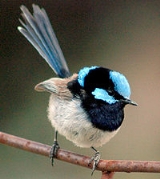
Superb Fairy-wren

Encyclopedia
The Superb Fairywren also known as the Superb Blue-wren or colloquially as the Blue Wren, is a passerine
bird
of the Maluridae
family, common and familiar across south-eastern Australia. The species is sedentary and territorial
, also exhibiting a high degree of sexual dimorphism
; the male in breeding plumage has a striking bright blue forehead, ear coverts
, mantle, and tail, with a black mask and black or dark blue throat. Non-breeding males, females and juveniles are predominantly grey-brown in colour; this gave the early impression that males were polygamous, as all dull-coloured birds were taken for females. Two subspecies are recognized: the larger and darker Tasmania
n form cyaneus and the smaller and paler mainland form cyanochlamys.
Like other fairywrens, the Superb Fairywren is notable for several peculiar behavioural characteristics; the birds are socially monogamous and sexually promiscuous, meaning that although they form pairs between one male and one female, each partner will mate with other individuals and even assist in raising the young from such pairings. Male wrens pluck yellow petals and display them to females as part of a courtship display.
The Superb Fairywren can be found in almost any area that has at least a little dense undergrowth for shelter, including grasslands with scattered shrubs, moderately thick forest, woodland, heaths, and domestic garden
s. It has adapted well to the urban environment and is common in suburban Sydney, Canberra
and Melbourne
. The Superb Fairywren mainly eats insects and supplements its diet with seeds.
Malurus
, commonly known as fairywrens, found in Australia
and lowland New Guinea
. Within the genus, the Superb Fairywren's closest relative is the Splendid Fairywren; these two "Blue wrens" are also related to the Purple-crowned Fairywren of northwestern Australia.
William Anderson, surgeon and naturalist
on Captain James Cook's
third voyage, collected the first Superb Fairywren specimen in 1777 while traveling off the coast of eastern Tasmania, in Bruny Island's Adventure Bay
. He named it Motacilla cyanea because its tail reminded him of the European Wagtail
s of the genus Motacilla. Anderson did not live to publish his findings, although his assistant William Ellis described the bird in 1782. The genus Malurus was later described by Louis Jean Pierre Vieillot
in 1816, giving the bird its current scientific name.
Shortly after the First Fleet
's arrival at Port Jackson
, Sydney, the bird gained the common name Superb Warbler. In the 1920s came common names Wren and Wren-warbler—both from its similarity to the European Wren
—and Fairywren. The bird has also been called Mormon Wren, a reference to observations of one blue-plumage
d bird accompanied by many brown-plumaged birds, which were incorrectly assumed to be all female. The Ngarrindjeri
people of the Murray River
and Coorong
regions called it Waatji pulyeri, meaning "little one of the waatji (lignum) bush", and the Gunai
called it Deeydgun, meaning "little bird with long tail". Both it and the Variegated Fairywren were known as muruduwin the local Eora
and Darug
inhabitants of the Sydney basin.
Like other fairywrens, the Superb Fairywren is unrelated to the true wren
. It was previously classified as a member of the old world flycatcher family Muscicapidae and later as a member of the warbler family Sylviidae
before being placed in the newly recognised Maluridae
in 1975. More recently, DNA
analysis has shown the Maluridae family to be related to the Meliphagidae (honeyeater
s), and the Pardalotidae (pardalotes, scrubwrens, thornbills, gerygones and allies) in the large superfamily Meliphagoidea
.
are currently recognized, though future DNA
studies may prompt reclassification.
proposed a southern origin for the common ancestor of the Superb and Splendid Fairywrens. At some time in the past it was split into southwestern (Splendid) and southeastern (Superb) enclaves. As the southwest was dryer than the southeast, once conditions were more favourable, the Splendid forms were more able to spread into inland areas. In the east, the Superb Fairywren spread into Tasmania during a glacial period when the sea level was low and the island was connected with the rest of the continent via a land bridge. What gave rise to subspecies cyaneus became isolated as the sea levels rose. The Bass Strait forms were isolated from Tasmania but more recently and so their subspecific status was not maintained. Further molecular studies may result in this hypothesis being modified.
Like other fairywrens, the Superb Fairywren is notable for its marked sexual dimorphism
, males adopting a highly visible breeding plumage of brilliant iridescent blue contrasting with black and grey-brown. The brightly coloured crown and ear tufts are prominently featured in breeding displays. The breeding male has a bright-blue forehead, ear coverts, mantle and tail, brown wings, and black throat, eye band, breast and bill. Females, immatures, and non-breeding males are a plain fawn colour with a lighter underbelly and a fawn (females and immatures) or dull greyish blue (males) tail. The bill is brown in females and juveniles and black in males after their first winter. Immature males moult into breeding plumage the first breeding season after hatching, though incomplete moulting sometimes leaves residual brownish plumage that takes another year or two to perfect. Both sexes moult in autumn after breeding, with males assuming an eclipse non-breeding plumage. They moult again into nuptial plumage in winter or spring. Breeding males' blue plumage, particularly the ear-coverts, is highly iridescent because of the flattened and twisted surface of the barbules. The blue plumage also reflects ultraviolet
light strongly, and so may be even more prominent to other fairywrens, whose colour vision extends into this part of the spectrum
.
Vocal communication among Superb Fairywrens is used primarily for communication between birds in a social group and for advertising and mobbing
, or defending a territory. The basic, or Type I, song is a 1–4 second high-pitched reel consisting of 10–20 short elements per second; it is sung by both males and females. Males also possess a peculiar song-like Type II vocalization, which is given in response to the calls of predatory birds, commonly Grey Butcherbird
s (Cracticus torquatus). The purpose of this behaviour, which does not elicit a response from other nearby wrens, remains unknown. It is not a warning call, but in fact gives away the location of the vocalizing male to the predator. It may serve to announce male fitness, but this is far from certain. Superb Fairywrens' alarm call is a series of brief sharp chits, universally given and understood by small birds in response to predators. Females also emit a purr while incubating.
(including Kangaroo Island
and Adelaide) and the tip of the Eyre Peninsula
, through all of Victoria, Tasmania
, coastal and sub-coastal New South Wales
and Queensland, through the Brisbane
area and extending inland – north to the Dawson River and west to Blackall
; it is a common bird in the suburbs of Sydney, Melbourne
and Canberra
. It is found in wooded areas, generally with plenty of undergrowth, and has also adapted to urban existence and can be found in gardens and urban parks as long as there is an undergrowth of native plants nearby. Lantana (Lantana camara
), a prolific weed in Australia, has also been beneficial in providing shelter in disturbed areas, as has the introduced and invasive blackberry
(Rubus spp.) Unlike other fairywrens, it appears to benefit from the urban environment and has out-competed the introduced House Sparrow
(Passer domesticus) in one study on the grounds of the Australian National University
in Canberra. Colonies of wrens can be found in Hyde Park
and the Royal Botanic Gardens
in Sydney's urbanized centre. It is not found in dense forest nor in alpine environments. Forestry plantations of pine (Pinus spp.) and eucalypts are also unsuitable as they lack undergrowth.
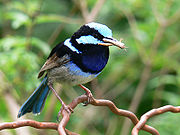 Like all fairywrens, the Superb Fairywren is an active and restless feeder, particularly on open ground near shelter, but also through the lower foliage. Movement is a series of jaunty hops and bounces, with its balance assisted by a proportionally large tail, which is usually held upright, and rarely still. The short, rounded wings provide good initial lift and are useful for short flights, though not for extended jaunts. During spring and summer, birds are active in bursts through the day and accompany their foraging with song. Insects are numerous and easy to catch, which allows the birds to rest between forays. The group often shelters and rests together during the heat of the day. Food is harder to find during winter and they are required to spend the day foraging continuously.
The Superb Fairywren is a cooperative breeding
species, with pairs or groups of 3–5 birds maintaining and defending small territories
year-round. The group consists of a social pair with one or more male or female helper birds that were hatched in the territory, though they may not necessarily be the offspring of the main pair. These birds assist in defending the territory and feeding and rearing the young. Birds in a group roost side-by-side in dense cover as well as engaging in mutual preening.
Major nest predators include Australian Magpie
s (Gymnorhina tibicen), butcherbird
s (Cracticus spp.), Laughing Kookaburra
(Dacelo novaeguineae), currawong
s (Strepera spp.), crow
s and raven
s (Corvus spp.), shrike-thrush
es (Colluricincla spp.) as well as introduced mammals such as the Red Fox
(Vulpes vulpes), cat
and Black Rat
(Rattus rattus). Superb Fairywrens may utilise a 'Rodent-run' display to distract predators from nests with young birds. The head, neck and tail are lowered, wings held out and feathers fluffed as the bird runs rapidly and voices a continuous alarm call.
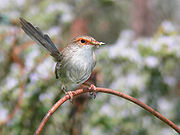 Superb Fairywrens are predominantly insectivorous. They eat a wide range of small creatures (mostly insects such as ants, grasshoppers, shield bug
s, flies, weevil
s and various larvae) as well as small quantities of seeds, flowers, and fruit. Their foraging, termed 'hop-searching', occurs on the ground or in shrubs that are less than two metres high. Because this foraging practice renders them vulnerable to predators, birds tend to stick fairly close to cover and forage in groups. During winter, when food may be scarce, ants are an important 'last resort' food, constituting a much higher proportion of the diet. Nestlings, in contrast to adult birds, are fed a diet of larger items such as caterpillars and grasshoppers.
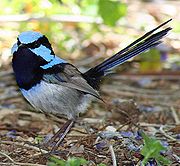 Several courtship displays by Superb Fairywren males have been recorded. The 'sea horse flight', named for its seahorse
-like undulations, is one such display. During this exaggerated flight, the male—with his neck extended and his head feathers erect—tilts his body from horizontal to vertical, and descends slowly and springs upwards by rapidly beating his wings after alighting on the ground. The 'face fan' display may be seen as a part of aggressive or sexual display behaviours; it involves the flaring of the blue ear tufts by erecting the feathers.
During the reproductive season, males of this and other fairywren species pluck yellow petals, which contrast with their plumage, and show them to female fairywrens. The petals often form part of a courtship display and are presented to a female in the male fairywren's own or another territory. Males sometimes show petals to females in other territories even outside the breeding season, presumably to promote themselves. Fairywrens are socially monogamous
and sexually promiscuous: pairs will bond for life, though both males and females will regularly mate with other individuals; a proportion of young will have been fathered by males from outside the group. Young are often raised not by the pair alone, but with other males who also mated with the pair's female assisting.
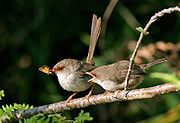 Breeding occurs from spring through to late summer; the nest is a round or domed structure made of loosely woven grasses and spider web
s, with an entrance in one side generally close to the ground, under 1 m (3 ft), and in thick vegetation. Two or more broods may be laid in an extended breeding season. A clutch of three or four matte white eggs with reddish-brown splotches and spots, measuring 12 x 16 mm (0.45 x 0.6 in). The eggs are incubated for 14 days, after which they hatch within 24 hours. Newborn chicks are blind, red and featherless, though quickly darken as feathers grow. Their eyes open by day five or six and are fully feathered by day 10. All group members feed and remove fecal sac
s for 10–14 days. Fledglings are able to feed themselves by day 40 but remain in the family group as helpers for a year or more before moving to another group or assuming a dominant position in the original group. In this role they feed and care for subsequent broods and repel cuckoos or predators. Superb Fairywrens also commonly play host to the brood parasite Horsfield's Bronze Cuckoo (Chrysococcyx basalis) and, less commonly, the Shining Bronze Cuckoo (C. lucidus) and Fan-tailed Cuckoo
(Cacomantis flabelliformis).
45c pre-stamped envelope meant to depict a Splendid Fairywren. Called the Blue Wren as it was then known, it had previously featured on a 2s.5d. stamp, released in 1964, which was discontinued with the advent of decimal currency.
Passerine
A passerine is a bird of the order Passeriformes, which includes more than half of all bird species. Sometimes known as perching birds or, less accurately, as songbirds, the passerines form one of the most diverse terrestrial vertebrate orders: with over 5,000 identified species, it has roughly...
bird
Bird
Birds are feathered, winged, bipedal, endothermic , egg-laying, vertebrate animals. Around 10,000 living species and 188 families makes them the most speciose class of tetrapod vertebrates. They inhabit ecosystems across the globe, from the Arctic to the Antarctic. Extant birds range in size from...
of the Maluridae
Maluridae
The Maluridae are a family of small, insectivorous passerine birds endemic to Australia and New Guinea. Commonly known as wrens, they are unrelated to the true wrens of the Northern Hemisphere...
family, common and familiar across south-eastern Australia. The species is sedentary and territorial
Territory (animal)
In ethology the term territory refers to any sociographical area that an animal of a particular species consistently defends against conspecifics...
, also exhibiting a high degree of sexual dimorphism
Sexual dimorphism
Sexual dimorphism is a phenotypic difference between males and females of the same species. Examples of such differences include differences in morphology, ornamentation, and behavior.-Examples:-Ornamentation / coloration:...
; the male in breeding plumage has a striking bright blue forehead, ear coverts
Covert (feather)
A covert feather on a bird is one of a set of feathers, called coverts, which as the name implies, cover other feathers. The coverts help to smooth airflow over the wings and tail.- Wing-coverts :...
, mantle, and tail, with a black mask and black or dark blue throat. Non-breeding males, females and juveniles are predominantly grey-brown in colour; this gave the early impression that males were polygamous, as all dull-coloured birds were taken for females. Two subspecies are recognized: the larger and darker Tasmania
Tasmania
Tasmania is an Australian island and state. It is south of the continent, separated by Bass Strait. The state includes the island of Tasmania—the 26th largest island in the world—and the surrounding islands. The state has a population of 507,626 , of whom almost half reside in the greater Hobart...
n form cyaneus and the smaller and paler mainland form cyanochlamys.
Like other fairywrens, the Superb Fairywren is notable for several peculiar behavioural characteristics; the birds are socially monogamous and sexually promiscuous, meaning that although they form pairs between one male and one female, each partner will mate with other individuals and even assist in raising the young from such pairings. Male wrens pluck yellow petals and display them to females as part of a courtship display.
The Superb Fairywren can be found in almost any area that has at least a little dense undergrowth for shelter, including grasslands with scattered shrubs, moderately thick forest, woodland, heaths, and domestic garden
Garden
A garden is a planned space, usually outdoors, set aside for the display, cultivation, and enjoyment of plants and other forms of nature. The garden can incorporate both natural and man-made materials. The most common form today is known as a residential garden, but the term garden has...
s. It has adapted well to the urban environment and is common in suburban Sydney, Canberra
Canberra
Canberra is the capital city of Australia. With a population of over 345,000, it is Australia's largest inland city and the eighth-largest city overall. The city is located at the northern end of the Australian Capital Territory , south-west of Sydney, and north-east of Melbourne...
and Melbourne
Melbourne
Melbourne is the capital and most populous city in the state of Victoria, and the second most populous city in Australia. The Melbourne City Centre is the hub of the greater metropolitan area and the Census statistical division—of which "Melbourne" is the common name. As of June 2009, the greater...
. The Superb Fairywren mainly eats insects and supplements its diet with seeds.
Taxonomy
The Superb Fairywren is one of 12 species of the genusGenus
In biology, a genus is a low-level taxonomic rank used in the biological classification of living and fossil organisms, which is an example of definition by genus and differentia...
Malurus
Malurus
Malurus is a genus of bird in the Maluridae family.It contains the following species:* White-shouldered Fairywren * Lovely Fairywren * Purple-crowned Fairywren...
, commonly known as fairywrens, found in Australia
Australia
Australia , officially the Commonwealth of Australia, is a country in the Southern Hemisphere comprising the mainland of the Australian continent, the island of Tasmania, and numerous smaller islands in the Indian and Pacific Oceans. It is the world's sixth-largest country by total area...
and lowland New Guinea
New Guinea
New Guinea is the world's second largest island, after Greenland, covering a land area of 786,000 km2. Located in the southwest Pacific Ocean, it lies geographically to the east of the Malay Archipelago, with which it is sometimes included as part of a greater Indo-Australian Archipelago...
. Within the genus, the Superb Fairywren's closest relative is the Splendid Fairywren; these two "Blue wrens" are also related to the Purple-crowned Fairywren of northwestern Australia.
William Anderson, surgeon and naturalist
Naturalist
Naturalist may refer to:* Practitioner of natural history* Conservationist* Advocate of naturalism * Naturalist , autobiography-See also:* The American Naturalist, periodical* Naturalism...
on Captain James Cook's
James Cook
Captain James Cook, FRS, RN was a British explorer, navigator and cartographer who ultimately rose to the rank of captain in the Royal Navy...
third voyage, collected the first Superb Fairywren specimen in 1777 while traveling off the coast of eastern Tasmania, in Bruny Island's Adventure Bay
Adventure Bay
Adventure Bay is a bay on Bruny Island in southeastern Tasmania. Discovered in 1773 by Tobias Furneaux, it was named after his ship, HMS Adventure. James Cook explored the region in 1777, as did William Bligh in 1788 and 1792....
. He named it Motacilla cyanea because its tail reminded him of the European Wagtail
Wagtail
The wagtails form the passerine bird genus Motacilla. They are small birds with long tails which they wag frequently. Motacilla, the root of the family and genus name, means moving tail...
s of the genus Motacilla. Anderson did not live to publish his findings, although his assistant William Ellis described the bird in 1782. The genus Malurus was later described by Louis Jean Pierre Vieillot
Louis Jean Pierre Vieillot
Louis Jean Pierre Vieillot was a French ornithologist.Vieillot described a large number of birds for the first time, especially those he encountered during the time he spent in the West Indies and North America, and 26 genera established by him are still in use...
in 1816, giving the bird its current scientific name.
Shortly after the First Fleet
First Fleet
The First Fleet is the name given to the eleven ships which sailed from Great Britain on 13 May 1787 with about 1,487 people, including 778 convicts , to establish the first European colony in Australia, in the region which Captain Cook had named New South Wales. The fleet was led by Captain ...
's arrival at Port Jackson
Port Jackson
Port Jackson, containing Sydney Harbour, is the natural harbour of Sydney, Australia. It is known for its beauty, and in particular, as the location of the Sydney Opera House and Sydney Harbour Bridge...
, Sydney, the bird gained the common name Superb Warbler. In the 1920s came common names Wren and Wren-warbler—both from its similarity to the European Wren
Wren
The wrens are passerine birds in the mainly New World family Troglodytidae. There are approximately 80 species of true wrens in approximately 20 genera....
—and Fairywren. The bird has also been called Mormon Wren, a reference to observations of one blue-plumage
Plumage
Plumage refers both to the layer of feathers that cover a bird and the pattern, colour, and arrangement of those feathers. The pattern and colours of plumage vary between species and subspecies and can also vary between different age classes, sexes, and season. Within species there can also be a...
d bird accompanied by many brown-plumaged birds, which were incorrectly assumed to be all female. The Ngarrindjeri
Ngarrindjeri
The Ngarrindjeri are a nation of eighteen "tribes" consisting of numerous family clans who speak similar dialects of the Ngarrindjeri language and are the traditional Aboriginal people of the lower Murray River, western Fleurieu Peninsula, and the Coorong of southern, central...
people of the Murray River
Murray River
The Murray River is Australia's longest river. At in length, the Murray rises in the Australian Alps, draining the western side of Australia's highest mountains and, for most of its length, meanders across Australia's inland plains, forming the border between New South Wales and Victoria as it...
and Coorong
Coorong National Park
The Coorong is a national park and lagoon ecosystem in South Australia , 156 km southeast of Adelaide. Its name is thought to be a corruption of the local Aboriginal people's word kurangh, meaning "long neck"; a reference to the shape of the lagoon system...
regions called it Waatji pulyeri, meaning "little one of the waatji (lignum) bush", and the Gunai
Gunai
The Gunai or Kurnai is an Indigenous Australian nation of south-east Australia whose territory occupied most of present-day Gippsland and much of the southern slopes of the Victorian Alps. The nation was not on friendly terms with the neighbouring Wurundjeri and Bunurong nations...
called it Deeydgun, meaning "little bird with long tail". Both it and the Variegated Fairywren were known as muruduwin the local Eora
Eora
The Eora are the Aboriginal people of the Sydney area, south to the Georges River, north to the Hawkesbury River, and west to Parramatta. The indigenous people used this word to describe where they came from to the British. "Eora" was then used by the British to refer to those Aboriginal people...
and Darug
Darug people
The Darug people are a language group of Indigenous Australians, who are traditional custodians of much of what is modern day Sydney. There is some dispute about the extent of the Darug nation. Some historians believe the coastal Eora people were a separate tribe to the Darug...
inhabitants of the Sydney basin.
Like other fairywrens, the Superb Fairywren is unrelated to the true wren
Wren
The wrens are passerine birds in the mainly New World family Troglodytidae. There are approximately 80 species of true wrens in approximately 20 genera....
. It was previously classified as a member of the old world flycatcher family Muscicapidae and later as a member of the warbler family Sylviidae
Sylviidae
Sylviidae is a family of passerine birds that was part of an assemblage known as the Old World warblers. The family was formerly a wastebin taxon with over 400 species of bird in over 70 genera. The family was poorly defined with many characteristics shared with other families...
before being placed in the newly recognised Maluridae
Maluridae
The Maluridae are a family of small, insectivorous passerine birds endemic to Australia and New Guinea. Commonly known as wrens, they are unrelated to the true wrens of the Northern Hemisphere...
in 1975. More recently, DNA
DNA
Deoxyribonucleic acid is a nucleic acid that contains the genetic instructions used in the development and functioning of all known living organisms . The DNA segments that carry this genetic information are called genes, but other DNA sequences have structural purposes, or are involved in...
analysis has shown the Maluridae family to be related to the Meliphagidae (honeyeater
Honeyeater
The honeyeaters are a large and diverse family of small to medium sized birds most common in Australia and New Guinea, but also found in New Zealand, the Pacific islands as far east as Samoa and Tonga, and the islands to the north and west of New Guinea known as Wallacea...
s), and the Pardalotidae (pardalotes, scrubwrens, thornbills, gerygones and allies) in the large superfamily Meliphagoidea
Meliphagoidea
Meliphagoidea is a superfamily of passerine birds. They contain a vast diversity of small to mid-sized songbirds widespread in the Austropacific region. The Australian Continent has the largest richness in genera and species.-Systematics:...
.
Subspecies
Two subspeciesSubspecies
Subspecies in biological classification, is either a taxonomic rank subordinate to species, ora taxonomic unit in that rank . A subspecies cannot be recognized in isolation: a species will either be recognized as having no subspecies at all or two or more, never just one...
are currently recognized, though future DNA
DNA
Deoxyribonucleic acid is a nucleic acid that contains the genetic instructions used in the development and functioning of all known living organisms . The DNA segments that carry this genetic information are called genes, but other DNA sequences have structural purposes, or are involved in...
studies may prompt reclassification.
- M. c. cyaneus, the nominate subspecies described in 1782, is found throughout Tasmania and on the Bass Strait Islands. Birds are larger and darker than the mainland subspecies, with males having a deeper azure blue coloration. Those of King Island were first described as a separate species elizabethae by A.J. Campbell in 1901, with a deeper blue colour still. Birds of Flinders IslandFlinders IslandFlinders Island may refer to:In Australia:* Flinders Island , in the Furneaux Group, is the largest and best known* Flinders Island * Flinders Island , in the Investigator Group* Flinders Island...
are of intermediate colour between the King Island and Tasmanian forms. Schodde in his 1982 review reclassified elizabethae under cyaneus.
- M. c. cyanochlamys, described by Richard Sharpe in 1881, is found on mainland Australia; in general, birds are smaller and paler than those of Tasmania, with Queensland male birds bearing a pale silvery blue crown, ear tufts and mantle.
Evolutionary history
In his 1982 monograph, ornithologist Richard SchoddeRichard Schodde
Richard Schodde, OAM is an Australian botanist and ornithologist.Schodde studied at the University of Adelaide where he received a BSc in 1960 and a PhD in 1970. During the 1960s he was a botanist with the CSIRO Division of Land Research and Regional Survey in Papua New Guinea...
proposed a southern origin for the common ancestor of the Superb and Splendid Fairywrens. At some time in the past it was split into southwestern (Splendid) and southeastern (Superb) enclaves. As the southwest was dryer than the southeast, once conditions were more favourable, the Splendid forms were more able to spread into inland areas. In the east, the Superb Fairywren spread into Tasmania during a glacial period when the sea level was low and the island was connected with the rest of the continent via a land bridge. What gave rise to subspecies cyaneus became isolated as the sea levels rose. The Bass Strait forms were isolated from Tasmania but more recently and so their subspecific status was not maintained. Further molecular studies may result in this hypothesis being modified.
Description
The Superb Fairywren is 14 cm (5½ in) long and weighs 8–13 g (0.28–0.46 oz), with males on average slightly larger than females. The average tail length is 5.9 cm (2⅓ in), among the shortest in the genus. Averaging 9 mm (0.354330708661417 in) in subspecies cyaneus and 8 mm (0.31496062992126 in) in subspecies cyanochlamys, the bill is relatively long, narrow and pointed and wider at the base. Wider than it is deep, the bill is similar in shape to those of other birds that feed by probing for or picking insects off their environs.Like other fairywrens, the Superb Fairywren is notable for its marked sexual dimorphism
Sexual dimorphism
Sexual dimorphism is a phenotypic difference between males and females of the same species. Examples of such differences include differences in morphology, ornamentation, and behavior.-Examples:-Ornamentation / coloration:...
, males adopting a highly visible breeding plumage of brilliant iridescent blue contrasting with black and grey-brown. The brightly coloured crown and ear tufts are prominently featured in breeding displays. The breeding male has a bright-blue forehead, ear coverts, mantle and tail, brown wings, and black throat, eye band, breast and bill. Females, immatures, and non-breeding males are a plain fawn colour with a lighter underbelly and a fawn (females and immatures) or dull greyish blue (males) tail. The bill is brown in females and juveniles and black in males after their first winter. Immature males moult into breeding plumage the first breeding season after hatching, though incomplete moulting sometimes leaves residual brownish plumage that takes another year or two to perfect. Both sexes moult in autumn after breeding, with males assuming an eclipse non-breeding plumage. They moult again into nuptial plumage in winter or spring. Breeding males' blue plumage, particularly the ear-coverts, is highly iridescent because of the flattened and twisted surface of the barbules. The blue plumage also reflects ultraviolet
Ultraviolet
Ultraviolet light is electromagnetic radiation with a wavelength shorter than that of visible light, but longer than X-rays, in the range 10 nm to 400 nm, and energies from 3 eV to 124 eV...
light strongly, and so may be even more prominent to other fairywrens, whose colour vision extends into this part of the spectrum
Electromagnetic spectrum
The electromagnetic spectrum is the range of all possible frequencies of electromagnetic radiation. The "electromagnetic spectrum" of an object is the characteristic distribution of electromagnetic radiation emitted or absorbed by that particular object....
.
Vocal communication among Superb Fairywrens is used primarily for communication between birds in a social group and for advertising and mobbing
Mobbing
Mobbing in the context of human beings either means bullying of an individual by a group in any context. Identified as emotional abuse in the workplace, such as "ganging up" by co-workers, subordinates or superiors, to force someone out of the workplace through rumor, innuendo, intimidation,...
, or defending a territory. The basic, or Type I, song is a 1–4 second high-pitched reel consisting of 10–20 short elements per second; it is sung by both males and females. Males also possess a peculiar song-like Type II vocalization, which is given in response to the calls of predatory birds, commonly Grey Butcherbird
Grey Butcherbird
The Grey Butcherbird is a widely distributed species endemic to Australia. The Grey Butcherbird occurs in a range of different habitats including arid, semi-arid and temperate zones. It has a characteristic "rollicking" birdsong...
s (Cracticus torquatus). The purpose of this behaviour, which does not elicit a response from other nearby wrens, remains unknown. It is not a warning call, but in fact gives away the location of the vocalizing male to the predator. It may serve to announce male fitness, but this is far from certain. Superb Fairywrens' alarm call is a series of brief sharp chits, universally given and understood by small birds in response to predators. Females also emit a purr while incubating.
Distribution and habitat
The Superb Fairywren is common throughout most of the relatively wet and fertile south-eastern corner of the continent, from the south-east of South AustraliaSouth Australia
South Australia is a state of Australia in the southern central part of the country. It covers some of the most arid parts of the continent; with a total land area of , it is the fourth largest of Australia's six states and two territories.South Australia shares borders with all of the mainland...
(including Kangaroo Island
Kangaroo Island
Kangaroo Island is Australia's third-largest island after Tasmania and Melville Island. It is southwest of Adelaide at the entrance of Gulf St Vincent. Its closest point to the mainland is off Cape Jervis, on the tip of the Fleurieu Peninsula in the state of South Australia. The island is long...
and Adelaide) and the tip of the Eyre Peninsula
Eyre Peninsula
Eyre Peninsula is a triangular peninsula in South Australia. It is bounded on the east by Spencer Gulf, the west by the Great Australian Bight, and the north by the Gawler Ranges. It is named after explorer Edward John Eyre who explored some of it in 1839-1841. The coastline was first explored by...
, through all of Victoria, Tasmania
Tasmania
Tasmania is an Australian island and state. It is south of the continent, separated by Bass Strait. The state includes the island of Tasmania—the 26th largest island in the world—and the surrounding islands. The state has a population of 507,626 , of whom almost half reside in the greater Hobart...
, coastal and sub-coastal New South Wales
New South Wales
New South Wales is a state of :Australia, located in the east of the country. It is bordered by Queensland, Victoria and South Australia to the north, south and west respectively. To the east, the state is bordered by the Tasman Sea, which forms part of the Pacific Ocean. New South Wales...
and Queensland, through the Brisbane
Brisbane
Brisbane is the capital and most populous city in the Australian state of Queensland and the third most populous city in Australia. Brisbane's metropolitan area has a population of over 2 million, and the South East Queensland urban conurbation, centred around Brisbane, encompasses a population of...
area and extending inland – north to the Dawson River and west to Blackall
Blackall, Queensland
-External links:*...
; it is a common bird in the suburbs of Sydney, Melbourne
Melbourne
Melbourne is the capital and most populous city in the state of Victoria, and the second most populous city in Australia. The Melbourne City Centre is the hub of the greater metropolitan area and the Census statistical division—of which "Melbourne" is the common name. As of June 2009, the greater...
and Canberra
Canberra
Canberra is the capital city of Australia. With a population of over 345,000, it is Australia's largest inland city and the eighth-largest city overall. The city is located at the northern end of the Australian Capital Territory , south-west of Sydney, and north-east of Melbourne...
. It is found in wooded areas, generally with plenty of undergrowth, and has also adapted to urban existence and can be found in gardens and urban parks as long as there is an undergrowth of native plants nearby. Lantana (Lantana camara
Lantana camara
Lantana camara, also known as Spanish Flag or West Indian Lantana, is a species of flowering plant in the verbena family, Verbenaceae, that is native to the American tropics. It has been introduced into other parts of the world as an ornamental plant and is considered an invasive species in many...
), a prolific weed in Australia, has also been beneficial in providing shelter in disturbed areas, as has the introduced and invasive blackberry
Blackberry
The blackberry is an edible fruit produced by any of several species in the Rubus genus of the Rosaceae family. The fruit is not a true berry; botanically it is termed an aggregate fruit, composed of small drupelets. The plants typically have biennial canes and perennial roots. Blackberries and...
(Rubus spp.) Unlike other fairywrens, it appears to benefit from the urban environment and has out-competed the introduced House Sparrow
House Sparrow
The House Sparrow is a bird of the sparrow family Passeridae, found in most parts of the world. One of about 25 species in the genus Passer, the House Sparrow occurs naturally in most of Europe, the Mediterranean region, and much of Asia...
(Passer domesticus) in one study on the grounds of the Australian National University
Australian National University
The Australian National University is a teaching and research university located in the Australian capital, Canberra.As of 2009, the ANU employs 3,945 administrative staff who teach approximately 10,000 undergraduates, and 7,500 postgraduate students...
in Canberra. Colonies of wrens can be found in Hyde Park
Hyde Park, Sydney
Hyde Park is a large park in Sydney, New South Wales, Australia. Hyde Park is on the eastern side of the Sydney central business district. It is the southernmost of a chain of parkland that extends north to the shore of Port Jackson . It is approximately rectangular in shape, being squared at the...
and the Royal Botanic Gardens
Royal Botanic Gardens, Sydney
The Royal Botanic Gardens in Sydney, Australia, are the most central of the three major botanical gardens open to the public in Sydney....
in Sydney's urbanized centre. It is not found in dense forest nor in alpine environments. Forestry plantations of pine (Pinus spp.) and eucalypts are also unsuitable as they lack undergrowth.
Behaviour
The Superb Fairywren is a cooperative breeding
Cooperative breeding
Cooperative breeding is a social system in which individuals contribute care to offspring that are not their own at the expense of their own reproduction . When reproduction is monopolized by one or few of the adult group members and most adults do not reproduce, but help rear the breeder’s...
species, with pairs or groups of 3–5 birds maintaining and defending small territories
Territory (animal)
In ethology the term territory refers to any sociographical area that an animal of a particular species consistently defends against conspecifics...
year-round. The group consists of a social pair with one or more male or female helper birds that were hatched in the territory, though they may not necessarily be the offspring of the main pair. These birds assist in defending the territory and feeding and rearing the young. Birds in a group roost side-by-side in dense cover as well as engaging in mutual preening.
Major nest predators include Australian Magpie
Australian Magpie
The Australian Magpie is a medium-sized black and white passerine bird native to Australia and southern New Guinea. A member of the Artamidae, it is closely related to the butcherbirds...
s (Gymnorhina tibicen), butcherbird
Butcherbird
Butcherbirds are magpie-like birds in the genus Cracticus. They are native to Australasia. Their closest relatives are the three species of currawong...
s (Cracticus spp.), Laughing Kookaburra
Laughing Kookaburra
The Laughing Kookaburra, Dacelo novaeguineae, is a carnivorous bird in the kingfisher family Halcyonidae. Native to eastern Australia, it has also been introduced to parts of New Zealand, Tasmania and Western Australia. Male and female adults are similar in plumage, which is predominantly brown and...
(Dacelo novaeguineae), currawong
Currawong
Currawongs are three species of medium-sized passerine birds belonging to the genus Strepera in the family Artamidae native to Australasia. These are the Grey Currawong , Pied Currawong , and Black Currawong . The common name comes from the call of the familiar Pied Currawong of eastern Australia...
s (Strepera spp.), crow
Crow
Crows form the genus Corvus in the family Corvidae. Ranging in size from the relatively small pigeon-size jackdaws to the Common Raven of the Holarctic region and Thick-billed Raven of the highlands of Ethiopia, the 40 or so members of this genus occur on all temperate continents and several...
s and raven
Raven
Raven is the common name given to several larger-bodied members of the genus Corvus—but in Europe and North America the Common Raven is normally implied...
s (Corvus spp.), shrike-thrush
Shrike-thrush
Colluricincla is a bird genus in the family Colluricinclidae, which was formerly included in the Pachycephalidae. Its members are known as the shrikethrushes.It contains the following species:* Bower's Shrikethrush, Colluricincla boweri...
es (Colluricincla spp.) as well as introduced mammals such as the Red Fox
Red Fox
The red fox is the largest of the true foxes, as well as being the most geographically spread member of the Carnivora, being distributed across the entire northern hemisphere from the Arctic Circle to North Africa, Central America, and the steppes of Asia...
(Vulpes vulpes), cat
Cat
The cat , also known as the domestic cat or housecat to distinguish it from other felids and felines, is a small, usually furry, domesticated, carnivorous mammal that is valued by humans for its companionship and for its ability to hunt vermin and household pests...
and Black Rat
Black Rat
The black rat is a common long-tailed rodent of the genus Rattus in the subfamily Murinae . The species originated in tropical Asia and spread through the Near East in Roman times before reaching Europe by the 1st century and spreading with Europeans across the world.-Taxonomy:The black rat was...
(Rattus rattus). Superb Fairywrens may utilise a 'Rodent-run' display to distract predators from nests with young birds. The head, neck and tail are lowered, wings held out and feathers fluffed as the bird runs rapidly and voices a continuous alarm call.
Diet
Shield bug
Pentatomoidea is a superfamily of insects in the Heteroptera suborder of the Hemiptera order and, as such, share a common arrangement of sucking mouthparts...
s, flies, weevil
Weevil
A weevil is any beetle from the Curculionoidea superfamily. They are usually small, less than , and herbivorous. There are over 60,000 species in several families, mostly in the family Curculionidae...
s and various larvae) as well as small quantities of seeds, flowers, and fruit. Their foraging, termed 'hop-searching', occurs on the ground or in shrubs that are less than two metres high. Because this foraging practice renders them vulnerable to predators, birds tend to stick fairly close to cover and forage in groups. During winter, when food may be scarce, ants are an important 'last resort' food, constituting a much higher proportion of the diet. Nestlings, in contrast to adult birds, are fed a diet of larger items such as caterpillars and grasshoppers.
Courtship
Seahorse
Seahorses compose the fish genus Hippocampus within the family Syngnathidae, in order Syngnathiformes. Syngnathidae also includes the pipefishes. "Hippocampus" comes from the Ancient Greek hippos meaning "horse" and kampos meaning “sea monster”.There are nearly 50 species of seahorse...
-like undulations, is one such display. During this exaggerated flight, the male—with his neck extended and his head feathers erect—tilts his body from horizontal to vertical, and descends slowly and springs upwards by rapidly beating his wings after alighting on the ground. The 'face fan' display may be seen as a part of aggressive or sexual display behaviours; it involves the flaring of the blue ear tufts by erecting the feathers.
During the reproductive season, males of this and other fairywren species pluck yellow petals, which contrast with their plumage, and show them to female fairywrens. The petals often form part of a courtship display and are presented to a female in the male fairywren's own or another territory. Males sometimes show petals to females in other territories even outside the breeding season, presumably to promote themselves. Fairywrens are socially monogamous
Monogamy
Monogamy /Gr. μονός+γάμος - one+marriage/ a form of marriage in which an individual has only one spouse at any one time. In current usage monogamy often refers to having one sexual partner irrespective of marriage or reproduction...
and sexually promiscuous: pairs will bond for life, though both males and females will regularly mate with other individuals; a proportion of young will have been fathered by males from outside the group. Young are often raised not by the pair alone, but with other males who also mated with the pair's female assisting.
Breeding
Spider web
A spider web, spiderweb, spider's web or cobweb is a device built by a spider out of proteinaceous spider silk extruded from its spinnerets....
s, with an entrance in one side generally close to the ground, under 1 m (3 ft), and in thick vegetation. Two or more broods may be laid in an extended breeding season. A clutch of three or four matte white eggs with reddish-brown splotches and spots, measuring 12 x 16 mm (0.45 x 0.6 in). The eggs are incubated for 14 days, after which they hatch within 24 hours. Newborn chicks are blind, red and featherless, though quickly darken as feathers grow. Their eyes open by day five or six and are fully feathered by day 10. All group members feed and remove fecal sac
Fecal sac
A fecal sac is a mucous membrane, generally white or clear with a dark end, that surrounds the feces of some species of nestling birds. It allows parent birds to more easily remove fecal material from the nest...
s for 10–14 days. Fledglings are able to feed themselves by day 40 but remain in the family group as helpers for a year or more before moving to another group or assuming a dominant position in the original group. In this role they feed and care for subsequent broods and repel cuckoos or predators. Superb Fairywrens also commonly play host to the brood parasite Horsfield's Bronze Cuckoo (Chrysococcyx basalis) and, less commonly, the Shining Bronze Cuckoo (C. lucidus) and Fan-tailed Cuckoo
Fan-tailed Cuckoo
The Fan-tailed Cuckoo is a species of cuckoo in the Cuculidae family.It is found in Australia, Fiji, Indonesia, New Caledonia, New Zealand, Papua New Guinea, Solomon Islands, and Vanuatu.-Habitat:...
(Cacomantis flabelliformis).
Cultural depictions
The Superb Fairywren is used as an emblem by the Bird Observation & Conservation Australia. On 12 August 1999, a Superb Fairywren was mistakenly illustrated for an Australia PostAustralia Post
Australia Post is the trading name of the Australian Government-owned Australian Postal Corporation .-History:...
45c pre-stamped envelope meant to depict a Splendid Fairywren. Called the Blue Wren as it was then known, it had previously featured on a 2s.5d. stamp, released in 1964, which was discontinued with the advent of decimal currency.
External links
- Superb Fairy-wren videos, photos and sounds on the Internet Bird Collection
- Factsheets: Superb Fairy-wren – Australian Museum online
- Make your garden friendlier for superb fairy-wrens NSW National Parks & Wildlife Service (incl. call)
- Meliphagoidea – Highlighting relationships of MaluridaeMaluridaeThe Maluridae are a family of small, insectivorous passerine birds endemic to Australia and New Guinea. Commonly known as wrens, they are unrelated to the true wrens of the Northern Hemisphere...
on Tree Of Life Web Project - Fairy-wrens are able to learn alarm calls from other species, New Scientist, 12 November 2008