

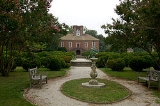
Stratford Hall Plantation

Encyclopedia
Stratford Hall Plantation in Westmoreland County, Virginia
, was the home of four generations of the Lee family
of Virginia, including two signers of the Declaration of Independence
, and it was the birthplace of Robert Edward Lee (1807 - 70), who became the Confederate General-in-chief during the American Civil War
, and then became the president of Washington College
, which later became Washington and Lee University
.
Thomas Lee
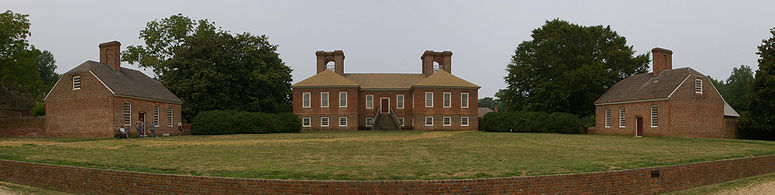
(1690 - 1750), a Virginian who served as the acting Governor of the colony, and who advocated strongly for westward expansion, purchased the land for Stratford Hall in 1717, recognizing the potential for the waterfront site both agriculturally and commercially. Construction of the Georgian
Great House however did not begin until the late 1730s. Designed by an unknown architect, the brick Great House is a two story H-shaped structure, surrounded on its four corners by attending outbuildings, all of which still stand today. Following construction of the Great House, Thomas Lee expanded the site into a bustling hive of activity, and soon the working plantation became "a towne in itself" as one visitor to Stratford marveled. A wharf on the Potomac River
was the destination of a large number of merchant ships; a grist mill ground wheat and corn there; and slaves and indentured servants farmed tobacco and other crops on the thousands of acres of farm
land of the plantation. Blacksmith
s, cooper
s, carpenters, tailors, gardeners, and weavers all plied their trades at Thomas Lee's Stratford. Stratford Hall is set in the Historic Northern Neck - a rural peninsula in Virginia where the historic Christ Church is located.

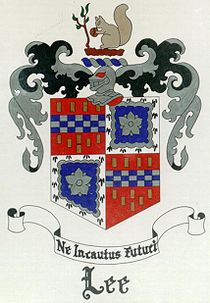 In the middle of this busy world, Thomas Lee
and his wife Hannah Harrison Ludwell (1701 - 49) raised eight children, six sons and two daughters. They played important roles in shaping the early history of the nation. His eldest son, Philip Ludwell Lee, Sr., Esquire (1727 - 75) inherited Stratford Hall. Richard Henry Lee
(1732 - 94) and Francis Lightfoot Lee
(1734 - 97), both of whom were delegates from Virginia to the Second Continental Congress
, were signers of the Declaration of Independence. Richard Henry was later instrumental in guiding the fledgling nation, serving as President of Congress
in 1784 - 85. Thomas Ludwell Lee
, active in local politics, served as a Virginian legislator and helped compose the Virginia Declaration of Rights
. William Lee
(1739 - 95) and Dr. Arthur Lee
(1740 - 92) were both diplomats to England
during the turbulent struggle for American independence. Hannah Lee was an early proponent of women's rights, and Alice Lee married the prominent physician William Shippen, Jr. (1736 - 1808) of Philadelphia.
Philip Ludwell Lee, Sr. (1727 - 75), a member of the House of Burgesses
and the King's Council, continued to expand the plantation following his inheritance of Stratford until it eventually encompassed almost 6600 acres (26.7 km²). A lover of horses and music, Philip and his wife Elizabeth Steptoe (1743 - 89) had two daughters, the oldest of whom was known as the "divine Matilda". Philip died in 1775, and Elizabeth continued to reside there. In 1780, she married Philip Richard Fendall I
(1734 - 1805). The new couple resided at Stratford Hall along with her two daughters and her son-in-law (and later a hero of the Revolutionary War
, Henry "Light Horse Harry" Lee (1756 - 1818), who had married her daughter Matilda. An arrangement was reached in 1784 - 85 that the Fendall’s would turn over their rights to Stratford Hall, and at the same time, Henry would sell a one-half acre lot, situated on Oronoco Street in Alexandria, Virginia
for 300 pounds. It was there that Philip R. Fendall built the "Lee-Fendall House
". As a result of this agreement, Matilda inherited Stratford Hall, and she resided there with her husband Harry and her second cousin. However, the couple's time together was cut short when Matilda died after eight years of marriage.
 Several years passed before "Light Horse Harry" married a second time, marrying Ann Hill Carter (1773 - 1827) of Shirley Plantation
. Their fourth child, Robert Edward Lee (1807 - 70), was born at Stratford Hall in 1807. Robert E. Lee spent only his first four years at Stratford Hall, yet he remembered it fondly throughout the remainder of his life. In the middle of the Civil War, Lee wrote to his wife that "In the absence of a home I wish I could purchase Stratford. That is the only place I could go to, now accessible to us, that would inspire me with feelings of pleasure and local love. You and the girls could remain there in quiet. It is a poor place, but we could make enough cornbread and bacon for our support and the girls could weave us clothes. I wonder if it is for sale and at how much."
With debts mounting, "Light Horse Harry" and his wife and children departed from Stratford Hall during the winter of 1810 - 11, and they moved to Alexandria, Va. Stratford Hall passed into the hands of Harry and Matilda's surviving son Major Henry Lee IV
"Black Horse" (1787 - 1837), but financial troubles forced him to sell the plantation several years later.
's wife, Anne Robinson McCarty. Besty Storke lived on the property until her death in 1879 and was buried there.
In 1929, a group of women dedicated to preserving the memory of Robert E. Lee and the Lee family joined together to form the Robert E. Lee Memorial Association and to purchase Stratford Hall from the Storkes' heirs. These women worked tirelessly to fund the purchase and restoration of the property. Today, the site is still maintained by the Robert E. Lee Memorial Association, and is open to the public.
Visitors today can tour the Great House, numerous outbuildings, the restored working grist mill and can explore the gardens, walking trails, and Miocene Era cliffs found on the site.
Westmoreland County, Virginia
As of the census of 2000, there were 16,718 people, 6,846 households, and 4,689 families residing in the county. The population density was . There were 9,286 housing units at an average density of...
, was the home of four generations of the Lee family
Lee family
The Lee family of the United States is a historically significant Virginia and Maryland political family, whose many prominent members are known for their accomplishments in politics and the military. Through the past few hundred years it was believed that Colonel Richard Lee of Virginia descended...
of Virginia, including two signers of the Declaration of Independence
United States Declaration of Independence
The Declaration of Independence was a statement adopted by the Continental Congress on July 4, 1776, which announced that the thirteen American colonies then at war with Great Britain regarded themselves as independent states, and no longer a part of the British Empire. John Adams put forth a...
, and it was the birthplace of Robert Edward Lee (1807 - 70), who became the Confederate General-in-chief during the American Civil War
American Civil War
The American Civil War was a civil war fought in the United States of America. In response to the election of Abraham Lincoln as President of the United States, 11 southern slave states declared their secession from the United States and formed the Confederate States of America ; the other 25...
, and then became the president of Washington College
Washington and Lee University
Washington and Lee University is a private liberal arts college in Lexington, Virginia, United States.The classical school from which Washington and Lee descended was established in 1749 as Augusta Academy, about north of its present location. In 1776 it was renamed Liberty Hall in a burst of...
, which later became Washington and Lee University
Washington and Lee University
Washington and Lee University is a private liberal arts college in Lexington, Virginia, United States.The classical school from which Washington and Lee descended was established in 1749 as Augusta Academy, about north of its present location. In 1776 it was renamed Liberty Hall in a burst of...
.
History
ColonelColonel
Colonel , abbreviated Col or COL, is a military rank of a senior commissioned officer. It or a corresponding rank exists in most armies and in many air forces; the naval equivalent rank is generally "Captain". It is also used in some police forces and other paramilitary rank structures...
Thomas Lee
Thomas Lee (Virginia colonist)
Thomas Lee was a leading political figure of colonial Virginia. He was a member of the Lee family, a political dynasty which included many figures from the pre-American Revolutionary War era until the late 20th century. Lee became involved in politics in 1710 and he became the resident manager of...
(1690 - 1750), a Virginian who served as the acting Governor of the colony, and who advocated strongly for westward expansion, purchased the land for Stratford Hall in 1717, recognizing the potential for the waterfront site both agriculturally and commercially. Construction of the Georgian
Georgian architecture
Georgian architecture is the name given in most English-speaking countries to the set of architectural styles current between 1720 and 1840. It is eponymous for the first four British monarchs of the House of Hanover—George I of Great Britain, George II of Great Britain, George III of the United...
Great House however did not begin until the late 1730s. Designed by an unknown architect, the brick Great House is a two story H-shaped structure, surrounded on its four corners by attending outbuildings, all of which still stand today. Following construction of the Great House, Thomas Lee expanded the site into a bustling hive of activity, and soon the working plantation became "a towne in itself" as one visitor to Stratford marveled. A wharf on the Potomac River
Potomac River
The Potomac River flows into the Chesapeake Bay, located along the mid-Atlantic coast of the United States. The river is approximately long, with a drainage area of about 14,700 square miles...
was the destination of a large number of merchant ships; a grist mill ground wheat and corn there; and slaves and indentured servants farmed tobacco and other crops on the thousands of acres of farm
Farm
A farm is an area of land, or, for aquaculture, lake, river or sea, including various structures, devoted primarily to the practice of producing and managing food , fibres and, increasingly, fuel. It is the basic production facility in food production. Farms may be owned and operated by a single...
land of the plantation. Blacksmith
Blacksmith
A blacksmith is a person who creates objects from wrought iron or steel by forging the metal; that is, by using tools to hammer, bend, and cut...
s, cooper
Cooper (profession)
Traditionally, a cooper is someone who makes wooden staved vessels of a conical form, of greater length than breadth, bound together with hoops and possessing flat ends or heads...
s, carpenters, tailors, gardeners, and weavers all plied their trades at Thomas Lee's Stratford. Stratford Hall is set in the Historic Northern Neck - a rural peninsula in Virginia where the historic Christ Church is located.
Thomas Lee (Virginia colonist)
Thomas Lee was a leading political figure of colonial Virginia. He was a member of the Lee family, a political dynasty which included many figures from the pre-American Revolutionary War era until the late 20th century. Lee became involved in politics in 1710 and he became the resident manager of...
and his wife Hannah Harrison Ludwell (1701 - 49) raised eight children, six sons and two daughters. They played important roles in shaping the early history of the nation. His eldest son, Philip Ludwell Lee, Sr., Esquire (1727 - 75) inherited Stratford Hall. Richard Henry Lee
Richard Henry Lee
Richard Henry Lee was an American statesman from Virginia best known for the motion in the Second Continental Congress calling for the colonies' independence from Great Britain. He was a signatory to the Articles of Confederation and his famous resolution of June 1776 led to the United States...
(1732 - 94) and Francis Lightfoot Lee
Francis Lightfoot Lee
Francis Lightfoot Lee was a member of the House of Burgesses in the Colony of Virginia. As an active protester of issues such as the Stamp Act, Lee helped move the colony in the direction of independence from Britain. Lee was a delegate to the Virginia Conventions and the Continental Congress...
(1734 - 97), both of whom were delegates from Virginia to the Second Continental Congress
Second Continental Congress
The Second Continental Congress was a convention of delegates from the Thirteen Colonies that started meeting on May 10, 1775, in Philadelphia, Pennsylvania, soon after warfare in the American Revolutionary War had begun. It succeeded the First Continental Congress, which met briefly during 1774,...
, were signers of the Declaration of Independence. Richard Henry was later instrumental in guiding the fledgling nation, serving as President of Congress
President of the Continental Congress
The President of the Continental Congress was the presiding officer of the Continental Congress, the convention of delegates that emerged as the first national government of the United States during the American Revolution...
in 1784 - 85. Thomas Ludwell Lee
Thomas Ludwell Lee
Thomas Ludwell Lee, Sr. was an editor of the Virginia Declaration of Rights. He was the older brother of Richard Henry Lee, Francis Lightfoot Lee, William Lee, and Arthur Lee. He was a member of the House of Burgesses from 1758-1765, but refused to enter into national politics...
, active in local politics, served as a Virginian legislator and helped compose the Virginia Declaration of Rights
Virginia Declaration of Rights
The Virginia Declaration of Rights is a document drafted in 1776 to proclaim the inherent rights of men, including the right to rebel against "inadequate" government...
. William Lee
William Lee (diplomat)
William Lee was an American diplomat during the Revolutionary War.-Background:He was born at Stratford Hall Plantation in Westmoreland County, Virginia to Hon. Thomas Lee and Hannah Harrison Ludwell...
(1739 - 95) and Dr. Arthur Lee
Arthur Lee (diplomat)
Dr. Arthur Lee was an American diplomat during the American Revolutionary War. He was the son of Hon. Thomas Lee and Hannah Harrison Ludwell...
(1740 - 92) were both diplomats to England
England
England is a country that is part of the United Kingdom. It shares land borders with Scotland to the north and Wales to the west; the Irish Sea is to the north west, the Celtic Sea to the south west, with the North Sea to the east and the English Channel to the south separating it from continental...
during the turbulent struggle for American independence. Hannah Lee was an early proponent of women's rights, and Alice Lee married the prominent physician William Shippen, Jr. (1736 - 1808) of Philadelphia.
Philip Ludwell Lee, Sr. (1727 - 75), a member of the House of Burgesses
House of Burgesses
The House of Burgesses was the first assembly of elected representatives of English colonists in North America. The House was established by the Virginia Company, who created the body as part of an effort to encourage English craftsmen to settle in North America...
and the King's Council, continued to expand the plantation following his inheritance of Stratford until it eventually encompassed almost 6600 acres (26.7 km²). A lover of horses and music, Philip and his wife Elizabeth Steptoe (1743 - 89) had two daughters, the oldest of whom was known as the "divine Matilda". Philip died in 1775, and Elizabeth continued to reside there. In 1780, she married Philip Richard Fendall I
Philip Richard Fendall I
Philip Richard Fendall I was an influential banker, lawyer, and merchant in Alexandria, Virginia. He was a member of the Lee family and a friend and business partner to George Washington...
(1734 - 1805). The new couple resided at Stratford Hall along with her two daughters and her son-in-law (and later a hero of the Revolutionary War
American Revolution
The American Revolution was the political upheaval during the last half of the 18th century in which thirteen colonies in North America joined together to break free from the British Empire, combining to become the United States of America...
, Henry "Light Horse Harry" Lee (1756 - 1818), who had married her daughter Matilda. An arrangement was reached in 1784 - 85 that the Fendall’s would turn over their rights to Stratford Hall, and at the same time, Henry would sell a one-half acre lot, situated on Oronoco Street in Alexandria, Virginia
Alexandria, Virginia
Alexandria is an independent city in the Commonwealth of Virginia. As of 2009, the city had a total population of 139,966. Located along the Western bank of the Potomac River, Alexandria is approximately six miles south of downtown Washington, D.C.Like the rest of northern Virginia, as well as...
for 300 pounds. It was there that Philip R. Fendall built the "Lee-Fendall House
Lee-Fendall House
The Lee-Fendall House is an urban plantation family home in Old Town Alexandria, Virginia. Since its construction in 1785 the house has served as home to thirty-seven members of the Lee family , hundreds of convalescing Union soldiers , the prominent Downham family , and powerful labor leader John L...
". As a result of this agreement, Matilda inherited Stratford Hall, and she resided there with her husband Harry and her second cousin. However, the couple's time together was cut short when Matilda died after eight years of marriage.
Shirley Plantation
Shirley Plantation is an estate located on the north bank of the James River in Charles City County, Virginia. It is located on State Route 5, a scenic byway which runs between the independent cities of Richmond and Williamsburg...
. Their fourth child, Robert Edward Lee (1807 - 70), was born at Stratford Hall in 1807. Robert E. Lee spent only his first four years at Stratford Hall, yet he remembered it fondly throughout the remainder of his life. In the middle of the Civil War, Lee wrote to his wife that "In the absence of a home I wish I could purchase Stratford. That is the only place I could go to, now accessible to us, that would inspire me with feelings of pleasure and local love. You and the girls could remain there in quiet. It is a poor place, but we could make enough cornbread and bacon for our support and the girls could weave us clothes. I wonder if it is for sale and at how much."
With debts mounting, "Light Horse Harry" and his wife and children departed from Stratford Hall during the winter of 1810 - 11, and they moved to Alexandria, Va. Stratford Hall passed into the hands of Harry and Matilda's surviving son Major Henry Lee IV
Henry Lee IV
Henry Lee IV was a Biographer and historian, born in Stratford, Virginia, to Major General Light Horse Harry and Matilda Lee. He was a half-brother of Confederate General Robert E. Lee. In 1808 he graduated from William and Mary College. He served as a speech writer for the statesman John C...
"Black Horse" (1787 - 1837), but financial troubles forced him to sell the plantation several years later.
Ownerships After Lees
Stratford Hall remained in private hands for more than a century. William C. Somerville of Maryland purchased the property from Henry Lee IV in 1822. However, after his death his heirs discovered that obligations incurred by Henry Lee IV continued to encumber the property. The plantation was foreclosed in 1828 and purchased by Henry D. Storke of Westmoreland County, who was married to Elizabeth "Besty" McCarty, sister of Henry Lee IVHenry Lee IV
Henry Lee IV was a Biographer and historian, born in Stratford, Virginia, to Major General Light Horse Harry and Matilda Lee. He was a half-brother of Confederate General Robert E. Lee. In 1808 he graduated from William and Mary College. He served as a speech writer for the statesman John C...
's wife, Anne Robinson McCarty. Besty Storke lived on the property until her death in 1879 and was buried there.
In 1929, a group of women dedicated to preserving the memory of Robert E. Lee and the Lee family joined together to form the Robert E. Lee Memorial Association and to purchase Stratford Hall from the Storkes' heirs. These women worked tirelessly to fund the purchase and restoration of the property. Today, the site is still maintained by the Robert E. Lee Memorial Association, and is open to the public.
Visitors today can tour the Great House, numerous outbuildings, the restored working grist mill and can explore the gardens, walking trails, and Miocene Era cliffs found on the site.