

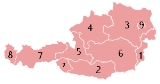
States of Austria

Encyclopedia
Austria
is a federal republic
made up of nine states, known in German
as Länder (singular Land). Since Land is also the German word for a country, the term Bundesländer ("Federal States"; singular Bundesland) is often used instead to avoid ambiguity. The Constitution of Austria
uses both terms. In English, the term (Bundes)land is commonly rendered as "state" or "province".
, the Landtag
, a state government, the Landesregierung, and a governor, the Landeshauptmann
. Elections are held every five years (six years in Upper Austria
). The state constitution, among other things, determines how the seats in the state government are assigned to political parties, with most states having a system of proportional representation based on the number of delegates in the Landtag in place. The Landeshauptmann is always elected by the Landtag, meaning that it may be necessary to form a coalition in order to secure the election of a particular candidate. Vienna
, the capital of Austria, plays a double role as city and "Bundesland", meaning that the mayor serves as governor and the city council as Landtag
at the same time.
It must be noted, however, that Austrian federalism
is generally considered largely theoretical as the states are granted comparatively few actual legislative powers. While it is true that the federal constitution initially granted all legislative powers to the states initially, so many powers have been subsequently taken away to such an extent that only relatively few matters remain (most importantly, planning and zoning codes, nature protection, hunting, fishing, farming, youth protection, certain issues of public health and welfare and the right to levy certain taxes).
Almost all matters of practical importance, including but not limited to criminal law, civil law, corporate law, most other aspects of economic law, defense, most educational matters and academia, telecommunications, and much of the healthcare system are regulated by federal laws. There is also no stand-alone judiciary
of the Länder, the federal constitution defining jurisdiction as an exclusively federal matter.
This is largely due to historic reasons, as central power during the time of the empire was largely concentrated in Vienna. This historical development is in stark contrast to developments in Germany, which had been composed of various small states without power centralised in one place.
However, the state governor (Landeshauptmann
) is also in charge of the administration of much of federal administrative law within the respective state, which makes this post an important political position. Furthermore, state competences include zoning laws, planning issues and public procurement on the regional level, which adds considerable weight to state politics. As a practical matter, there have been cases where states have been able to block projects endorsed by the federal government, as in the case of a railway tunnel that was to be built below the Semmering
.
Nonetheless, Austrian Länder are endowed formally and practically with a much smaller degree of statehood than American
or even German states
. Even so, Austrians tend to identify passionately with their respective Land and often defend what little independent governance their states have. It is not unheard of for Austrians to consider themselves, for instance, Tyrol
ean first, Austrian second.
name, are:
The majority of the land area in the states of Upper Austria, Lower Austria, Vienna, and Burgenland is situated in the Danube
valley and thus consists almost completely of accessible and easily arable terrain. The other five states, in contrast, are located in the Alps
and thus are comparatively unsuitable for agriculture. Their terrain is also relatively unfavourable to heavy industry and long-distance trade. Accordingly, the population of what now is the Republic of Austria has been concentrated in the former four states since prehistoric times. Austria's most densely populated state is the city-state of Vienna, the heart of what is Austria's only metropolitan area
. Lower Austria ranks fourth with regard to population density even though containing Vienna's suburbs; this is due to large areas of land being predominantly agricultural. The alpine state of Tyrol, the less alpine but geographically more remote state of Carinthia, and the non-alpine but near-exclusively agricultural state of Burgenland are Austria's least densely populated states. The wealthy alpine state of Vorarlberg is somewhat of an anomaly due to its small size, isolated location and distinct alemanic culture.
population estimates from January 1, 2011 http://www.statistik.at/web_de/statistiken/regionales/regionale_gliederungen/bundeslaender/index.html:
The population figures cited are generally assumed to be accurate to within five percent. Area
s are given in square kilometres, population density
is expressed in inhabitants per square kilometre. For the purpose of the above list, a city
is a community defined to be a city by Austrian law; a town is a community not defined to be a city. Many of Austria's cities have population figures on the order of ten thousand inhabitants; some are even smaller.
was the extensive multiethnic empire
with a German-speaking
nucleus, which emerged as the Republic of Austria after the empire was torn apart by nationalist
and republicanist
forces around the end of World War I
. The states of Upper Austria and Lower Austria are essentially equivalent to what were formerly the two autonomous halves of the Archduchy of Austria, a principality which formed the empire's historic heartland. Similarly, the state of Carinthia descends from the Duchy of Carinthia, the state of Styria descends from the Duchy of Styria, and the state of Tyrol descends from the Princely County of Tyrol; these states had to cede territories to Italy
and Yugoslavia
when Austria emerged in its present form. Also, the state of Vorarlberg had been a semi-autonomous part of the County of Tyrol up until 1918. The city state of Vienna was a part of Lower Austria up until 1921. The state of Burgenland is made up of the predominantly German-speaking area that Hungary
ceded to Austria after World War I
as a result of the Treaties of Trianon
and Saint-Germain-en-Laye.
Austria
Austria , officially the Republic of Austria , is a landlocked country of roughly 8.4 million people in Central Europe. It is bordered by the Czech Republic and Germany to the north, Slovakia and Hungary to the east, Slovenia and Italy to the south, and Switzerland and Liechtenstein to the...
is a federal republic
Federation
A federation , also known as a federal state, is a type of sovereign state characterized by a union of partially self-governing states or regions united by a central government...
made up of nine states, known in German
German language
German is a West Germanic language, related to and classified alongside English and Dutch. With an estimated 90 – 98 million native speakers, German is one of the world's major languages and is the most widely-spoken first language in the European Union....
as Länder (singular Land). Since Land is also the German word for a country, the term Bundesländer ("Federal States"; singular Bundesland) is often used instead to avoid ambiguity. The Constitution of Austria
Constitution of Austria
The Constitution of Austria is the body of all constitutional law of the Republic of Austria on the federal level. It is split up over many different acts...
uses both terms. In English, the term (Bundes)land is commonly rendered as "state" or "province".
Federalism and state responsibilities
Each Austrian state has an elected legislatureLegislature
A legislature is a kind of deliberative assembly with the power to pass, amend, and repeal laws. The law created by a legislature is called legislation or statutory law. In addition to enacting laws, legislatures usually have exclusive authority to raise or lower taxes and adopt the budget and...
, the Landtag
Landtag
A Landtag is a representative assembly or parliament in German-speaking countries with some legislative authority.- Name :...
, a state government, the Landesregierung, and a governor, the Landeshauptmann
Landeshauptmann
Landeshauptmann is a former German gubernatorial title equivalent to that of a governor of a province or a state....
. Elections are held every five years (six years in Upper Austria
Upper Austria
Upper Austria is one of the nine states or Bundesländer of Austria. Its capital is Linz. Upper Austria borders on Germany and the Czech Republic, as well as on the other Austrian states of Lower Austria, Styria, and Salzburg...
). The state constitution, among other things, determines how the seats in the state government are assigned to political parties, with most states having a system of proportional representation based on the number of delegates in the Landtag in place. The Landeshauptmann is always elected by the Landtag, meaning that it may be necessary to form a coalition in order to secure the election of a particular candidate. Vienna
Vienna
Vienna is the capital and largest city of the Republic of Austria and one of the nine states of Austria. Vienna is Austria's primary city, with a population of about 1.723 million , and is by far the largest city in Austria, as well as its cultural, economic, and political centre...
, the capital of Austria, plays a double role as city and "Bundesland", meaning that the mayor serves as governor and the city council as Landtag
Landtag
A Landtag is a representative assembly or parliament in German-speaking countries with some legislative authority.- Name :...
at the same time.
It must be noted, however, that Austrian federalism
Federation
A federation , also known as a federal state, is a type of sovereign state characterized by a union of partially self-governing states or regions united by a central government...
is generally considered largely theoretical as the states are granted comparatively few actual legislative powers. While it is true that the federal constitution initially granted all legislative powers to the states initially, so many powers have been subsequently taken away to such an extent that only relatively few matters remain (most importantly, planning and zoning codes, nature protection, hunting, fishing, farming, youth protection, certain issues of public health and welfare and the right to levy certain taxes).
Almost all matters of practical importance, including but not limited to criminal law, civil law, corporate law, most other aspects of economic law, defense, most educational matters and academia, telecommunications, and much of the healthcare system are regulated by federal laws. There is also no stand-alone judiciary
Judiciary
The judiciary is the system of courts that interprets and applies the law in the name of the state. The judiciary also provides a mechanism for the resolution of disputes...
of the Länder, the federal constitution defining jurisdiction as an exclusively federal matter.
This is largely due to historic reasons, as central power during the time of the empire was largely concentrated in Vienna. This historical development is in stark contrast to developments in Germany, which had been composed of various small states without power centralised in one place.
However, the state governor (Landeshauptmann
Landeshauptmann
Landeshauptmann is a former German gubernatorial title equivalent to that of a governor of a province or a state....
) is also in charge of the administration of much of federal administrative law within the respective state, which makes this post an important political position. Furthermore, state competences include zoning laws, planning issues and public procurement on the regional level, which adds considerable weight to state politics. As a practical matter, there have been cases where states have been able to block projects endorsed by the federal government, as in the case of a railway tunnel that was to be built below the Semmering
Semmering
For the town of the same name, see Semmering, Austria.Semmering is a mountain pass in the Eastern Northern Limestone Alps connecting Lower Austria and Styria, between which it forms a natural border.-Location:...
.
Nonetheless, Austrian Länder are endowed formally and practically with a much smaller degree of statehood than American
United States
The United States of America is a federal constitutional republic comprising fifty states and a federal district...
or even German states
States of Germany
Germany is made up of sixteen which are partly sovereign constituent states of the Federal Republic of Germany. Land literally translates as "country", and constitutionally speaking, they are constituent countries...
. Even so, Austrians tend to identify passionately with their respective Land and often defend what little independent governance their states have. It is not unheard of for Austrians to consider themselves, for instance, Tyrol
Tyrol (state)
Tyrol is a state or Bundesland, located in the west of Austria. It comprises the Austrian part of the historical region of Tyrol.The state is split into two parts–called North Tyrol and East Tyrol–by a -wide strip of land where the state of Salzburg borders directly on the Italian province of...
ean first, Austrian second.
Geography
The nine states of Austria, listed alphabetically by their official GermanGerman language
German is a West Germanic language, related to and classified alongside English and Dutch. With an estimated 90 – 98 million native speakers, German is one of the world's major languages and is the most widely-spoken first language in the European Union....
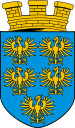
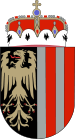
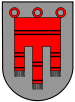
name, are:
| Coat of Arms | State (Bundesland) | Capital | |||
|---|---|---|---|---|---|
| English | Native | English | Native | ||
| Burgenland Burgenland Burgenland is the easternmost and least populous state or Land of Austria. It consists of two Statutarstädte and seven districts with in total 171 municipalities. It is 166 km long from north to south but much narrower from west to east... |
Eisenstadt Eisenstadt - Politics :The current mayor of Eisenstadt is Andrea Fraunschiel ÖVP.The district council is composed as follows :* ÖVP: 17 seats* SPÖ: 8 seats* Austrian Green Party: 2 seats* FPÖ: 2 seats- Castles and palaces :... |
||||
 |
Carinthia Carinthia (state) Carinthia is the southernmost Austrian state or Land. Situated within the Eastern Alps it is chiefly noted for its mountains and lakes.The main language is German. Its regional dialects belong to the Southern Austro-Bavarian group... |
Kärnten | Klagenfurt Klagenfurt -Name:Carinthia's eminent linguists Primus Lessiak and Eberhard Kranzmayer assumed that the city's name, which literally translates as "ford of lament" or "ford of complaints", had something to do with the superstitious thought that fateful fairies or demons tend to live around treacherous waters... |
||
 |
Lower Austria Lower Austria Lower Austria is the northeasternmost state of the nine states in Austria. The capital of Lower Austria since 1986 is Sankt Pölten, the most recently designated capital town in Austria. The capital of Lower Austria had formerly been Vienna, even though Vienna is not officially part of Lower Austria... |
Niederösterreich | St. Pölten | ||
 |
Upper Austria Upper Austria Upper Austria is one of the nine states or Bundesländer of Austria. Its capital is Linz. Upper Austria borders on Germany and the Czech Republic, as well as on the other Austrian states of Lower Austria, Styria, and Salzburg... |
Oberösterreich | Linz Linz Linz is the third-largest city of Austria and capital of the state of Upper Austria . It is located in the north centre of Austria, approximately south of the Czech border, on both sides of the river Danube. The population of the city is , and that of the Greater Linz conurbation is about... |
||
 |
Salzburg Salzburg (state) Salzburg is a state or Land of Austria with an area of 7,156 km2, located adjacent to the German border. It is also known as Salzburgerland, to distinguish it from its capital city, also named Salzburg... |
Salzburg Salzburg -Population development:In 1935, the population significantly increased when Salzburg absorbed adjacent municipalities. After World War II, numerous refugees found a new home in the city. New residential space was created for American soldiers of the postwar Occupation, and could be used for... |
|||
 |
Styria Styria (state) Styria is a state or Bundesland, located in the southeast of Austria. In area it is the second largest of the nine Austrian federated states, covering 16,401 km². It borders Slovenia as well as the other Austrian states of Upper Austria, Lower Austria, Salzburg, Burgenland, and Carinthia. ... |
Steiermark | Graz Graz The more recent population figures do not give the whole picture as only people with principal residence status are counted and people with secondary residence status are not. Most of the people with secondary residence status in Graz are students... |
||
| Tyrol Tyrol (state) Tyrol is a state or Bundesland, located in the west of Austria. It comprises the Austrian part of the historical region of Tyrol.The state is split into two parts–called North Tyrol and East Tyrol–by a -wide strip of land where the state of Salzburg borders directly on the Italian province of... |
Tirol | Innsbruck Innsbruck - Main sights :- Buildings :*Golden Roof*Kaiserliche Hofburg *Hofkirche with the cenotaph of Maximilian I, Holy Roman Emperor*Altes Landhaus... |
|||
 |
Vorarlberg Vorarlberg Vorarlberg is the westernmost federal-state of Austria. Although it is the second smallest in terms of area and population , it borders three countries: Germany , Switzerland and Liechtenstein... |
Bregenz Bregenz -Culture:The annual summer music festival Bregenzer Festspiele is a world-famous festival which takes place on and around a stage on Lake Constance, where a different opera is performed every second year.-Sport:* A1 Bregenz HB is a handball team.... |
|||
 |
Vienna Vienna Vienna is the capital and largest city of the Republic of Austria and one of the nine states of Austria. Vienna is Austria's primary city, with a population of about 1.723 million , and is by far the largest city in Austria, as well as its cultural, economic, and political centre... |
Wien | – | ||
The majority of the land area in the states of Upper Austria, Lower Austria, Vienna, and Burgenland is situated in the Danube
Danube
The Danube is a river in the Central Europe and the Europe's second longest river after the Volga. It is classified as an international waterway....
valley and thus consists almost completely of accessible and easily arable terrain. The other five states, in contrast, are located in the Alps
Alps
The Alps is one of the great mountain range systems of Europe, stretching from Austria and Slovenia in the east through Italy, Switzerland, Liechtenstein and Germany to France in the west....
and thus are comparatively unsuitable for agriculture. Their terrain is also relatively unfavourable to heavy industry and long-distance trade. Accordingly, the population of what now is the Republic of Austria has been concentrated in the former four states since prehistoric times. Austria's most densely populated state is the city-state of Vienna, the heart of what is Austria's only metropolitan area
Metropolitan area
The term metropolitan area refers to a region consisting of a densely populated urban core and its less-populated surrounding territories, sharing industry, infrastructure, and housing. A metropolitan area usually encompasses multiple jurisdictions and municipalities: neighborhoods, townships,...
. Lower Austria ranks fourth with regard to population density even though containing Vienna's suburbs; this is due to large areas of land being predominantly agricultural. The alpine state of Tyrol, the less alpine but geographically more remote state of Carinthia, and the non-alpine but near-exclusively agricultural state of Burgenland are Austria's least densely populated states. The wealthy alpine state of Vorarlberg is somewhat of an anomaly due to its small size, isolated location and distinct alemanic culture.
State populations and capitals
The following ranked list of Austrian states cites official Statistik AustriaStatistik Austria
The Statistik Austria is the name with which the Austrian statistical office appears in public matters.In 2000 a bill transformed the Österreichisches Statistisches Zentralamt into the Statistik Austria.Statistik Austria is an independent, not profit-seeking institution with public...
population estimates from January 1, 2011 http://www.statistik.at/web_de/statistiken/regionales/regionale_gliederungen/bundeslaender/index.html:
| State | Capital | Population | Area (km²) | Pop. density Population density Population density is a measurement of population per unit area or unit volume. It is frequently applied to living organisms, and particularly to humans... |
Cities | Towns | |
|---|---|---|---|---|---|---|---|
| 1 | Vienna Vienna Vienna is the capital and largest city of the Republic of Austria and one of the nine states of Austria. Vienna is Austria's primary city, with a population of about 1.723 million , and is by far the largest city in Austria, as well as its cultural, economic, and political centre... |
– | 1,707,000 | 414.65 | 4,113.3 | 1 | 0 |
| 2 | Lower Austria Lower Austria Lower Austria is the northeasternmost state of the nine states in Austria. The capital of Lower Austria since 1986 is Sankt Pölten, the most recently designated capital town in Austria. The capital of Lower Austria had formerly been Vienna, even though Vienna is not officially part of Lower Austria... |
Sankt Pölten Sankt Pölten Sankt Pölten is the capital city of the State of Lower Austria in northeast Austria. With inhabitants , it is Lower Austria's largest city... |
1,609,800 | 19,186.26 | 83.9 | 75 | 498 |
| 3 | Upper Austria Upper Austria Upper Austria is one of the nine states or Bundesländer of Austria. Its capital is Linz. Upper Austria borders on Germany and the Czech Republic, as well as on the other Austrian states of Lower Austria, Styria, and Salzburg... |
Linz Linz Linz is the third-largest city of Austria and capital of the state of Upper Austria . It is located in the north centre of Austria, approximately south of the Czech border, on both sides of the river Danube. The population of the city is , and that of the Greater Linz conurbation is about... |
1,412,300 | 11,979.91 | 117.9 | 32 | 412 |
| 4 | Styria Styria (state) Styria is a state or Bundesland, located in the southeast of Austria. In area it is the second largest of the nine Austrian federated states, covering 16,401 km². It borders Slovenia as well as the other Austrian states of Upper Austria, Lower Austria, Salzburg, Burgenland, and Carinthia. ... |
Graz Graz The more recent population figures do not give the whole picture as only people with principal residence status are counted and people with secondary residence status are not. Most of the people with secondary residence status in Graz are students... |
1,208,900 | 16,401.04 | 73.7 | 34 | 508 |
| 5 | Tyrol Tyrol (state) Tyrol is a state or Bundesland, located in the west of Austria. It comprises the Austrian part of the historical region of Tyrol.The state is split into two parts–called North Tyrol and East Tyrol–by a -wide strip of land where the state of Salzburg borders directly on the Italian province of... |
Innsbruck Innsbruck - Main sights :- Buildings :*Golden Roof*Kaiserliche Hofburg *Hofkirche with the cenotaph of Maximilian I, Holy Roman Emperor*Altes Landhaus... |
708,900 | 12,640.17 | 56.1 | 11 | 268 |
| 6 | Carinthia Carinthia (state) Carinthia is the southernmost Austrian state or Land. Situated within the Eastern Alps it is chiefly noted for its mountains and lakes.The main language is German. Its regional dialects belong to the Southern Austro-Bavarian group... |
Klagenfurt Klagenfurt -Name:Carinthia's eminent linguists Primus Lessiak and Eberhard Kranzmayer assumed that the city's name, which literally translates as "ford of lament" or "ford of complaints", had something to do with the superstitious thought that fateful fairies or demons tend to live around treacherous waters... |
560,700 | 9,538.01 | 58.8 | 17 | 115 |
| 7 | Salzburg Salzburg (state) Salzburg is a state or Land of Austria with an area of 7,156 km2, located adjacent to the German border. It is also known as Salzburgerland, to distinguish it from its capital city, also named Salzburg... |
Salzburg Salzburg -Population development:In 1935, the population significantly increased when Salzburg absorbed adjacent municipalities. After World War II, numerous refugees found a new home in the city. New residential space was created for American soldiers of the postwar Occupation, and could be used for... |
531,800 | 7,156.03 | 74.3 | 10 | 109 |
| 8 | Vorarlberg Vorarlberg Vorarlberg is the westernmost federal-state of Austria. Although it is the second smallest in terms of area and population , it borders three countries: Germany , Switzerland and Liechtenstein... |
Bregenz Bregenz -Culture:The annual summer music festival Bregenzer Festspiele is a world-famous festival which takes place on and around a stage on Lake Constance, where a different opera is performed every second year.-Sport:* A1 Bregenz HB is a handball team.... |
370,200 | 2,601.12 | 142.3 | 5 | 91 |
| 9 | Burgenland Burgenland Burgenland is the easternmost and least populous state or Land of Austria. It consists of two Statutarstädte and seven districts with in total 171 municipalities. It is 166 km long from north to south but much narrower from west to east... |
Eisenstadt Eisenstadt - Politics :The current mayor of Eisenstadt is Andrea Fraunschiel ÖVP.The district council is composed as follows :* ÖVP: 17 seats* SPÖ: 8 seats* Austrian Green Party: 2 seats* FPÖ: 2 seats- Castles and palaces :... |
284,000 | 3,961.80 | 71.7 | 13 | 158 |
The population figures cited are generally assumed to be accurate to within five percent. Area
Area
Area is a quantity that expresses the extent of a two-dimensional surface or shape in the plane. Area can be understood as the amount of material with a given thickness that would be necessary to fashion a model of the shape, or the amount of paint necessary to cover the surface with a single coat...
s are given in square kilometres, population density
Population density
Population density is a measurement of population per unit area or unit volume. It is frequently applied to living organisms, and particularly to humans...
is expressed in inhabitants per square kilometre. For the purpose of the above list, a city
City
A city is a relatively large and permanent settlement. Although there is no agreement on how a city is distinguished from a town within general English language meanings, many cities have a particular administrative, legal, or historical status based on local law.For example, in the U.S...
is a community defined to be a city by Austrian law; a town is a community not defined to be a city. Many of Austria's cities have population figures on the order of ten thousand inhabitants; some are even smaller.
Historical development
In terms of boundaries, the present-day state of Salzburg is coterminous with the former Austro-Hungarian Duchy of Salzburg. Austria-HungaryAustria-Hungary
Austria-Hungary , more formally known as the Kingdoms and Lands Represented in the Imperial Council and the Lands of the Holy Hungarian Crown of Saint Stephen, was a constitutional monarchic union between the crowns of the Austrian Empire and the Kingdom of Hungary in...
was the extensive multiethnic empire
Empire
The term empire derives from the Latin imperium . Politically, an empire is a geographically extensive group of states and peoples united and ruled either by a monarch or an oligarchy....
with a German-speaking
German language
German is a West Germanic language, related to and classified alongside English and Dutch. With an estimated 90 – 98 million native speakers, German is one of the world's major languages and is the most widely-spoken first language in the European Union....
nucleus, which emerged as the Republic of Austria after the empire was torn apart by nationalist
Nationalism
Nationalism is a political ideology that involves a strong identification of a group of individuals with a political entity defined in national terms, i.e. a nation. In the 'modernist' image of the nation, it is nationalism that creates national identity. There are various definitions for what...
and republicanist
Republicanism
Republicanism is the ideology of governing a nation as a republic, where the head of state is appointed by means other than heredity, often elections. The exact meaning of republicanism varies depending on the cultural and historical context...
forces around the end of World War I
World War I
World War I , which was predominantly called the World War or the Great War from its occurrence until 1939, and the First World War or World War I thereafter, was a major war centred in Europe that began on 28 July 1914 and lasted until 11 November 1918...
. The states of Upper Austria and Lower Austria are essentially equivalent to what were formerly the two autonomous halves of the Archduchy of Austria, a principality which formed the empire's historic heartland. Similarly, the state of Carinthia descends from the Duchy of Carinthia, the state of Styria descends from the Duchy of Styria, and the state of Tyrol descends from the Princely County of Tyrol; these states had to cede territories to Italy
Italy
Italy , officially the Italian Republic languages]] under the European Charter for Regional or Minority Languages. In each of these, Italy's official name is as follows:;;;;;;;;), is a unitary parliamentary republic in South-Central Europe. To the north it borders France, Switzerland, Austria and...
and Yugoslavia
Yugoslavia
Yugoslavia refers to three political entities that existed successively on the western part of the Balkans during most of the 20th century....
when Austria emerged in its present form. Also, the state of Vorarlberg had been a semi-autonomous part of the County of Tyrol up until 1918. The city state of Vienna was a part of Lower Austria up until 1921. The state of Burgenland is made up of the predominantly German-speaking area that Hungary
Hungary
Hungary , officially the Republic of Hungary , is a landlocked country in Central Europe. It is situated in the Carpathian Basin and is bordered by Slovakia to the north, Ukraine and Romania to the east, Serbia and Croatia to the south, Slovenia to the southwest and Austria to the west. The...
ceded to Austria after World War I
World War I
World War I , which was predominantly called the World War or the Great War from its occurrence until 1939, and the First World War or World War I thereafter, was a major war centred in Europe that began on 28 July 1914 and lasted until 11 November 1918...
as a result of the Treaties of Trianon
Treaty of Trianon
The Treaty of Trianon was the peace agreement signed in 1920, at the end of World War I, between the Allies of World War I and Hungary . The treaty greatly redefined and reduced Hungary's borders. From its borders before World War I, it lost 72% of its territory, which was reduced from to...
and Saint-Germain-en-Laye.
See also
- Distribution of seats in the Austrian LandtageDistribution of seats in the Austrian LandtageEight political parties are represented in the Landtage legislative assemblies of the nine Austrian states. Currently the Austrian People's Party , the Social Democratic Party of Austria and The Greens are represented in all state diets, while the Freedom Party of Austria lost its seats in the...
- Districts of AustriaDistricts of AustriaAustria is divided into 84 political districts , and 15 Statutarstädte which form their own districts.-Function:The Austrian Bezirk is roughly equivalent to the Landkreis in Germany and County in the United States. The administrative office of a district, the Bezirkshauptmannschaft is headed by the...
- Flags of Austrian statesFlags of Austrian statesThe flags of the Austrian states show two stripes in the main colours of the respective arms. These flags are the state flags and are shown with the coats of arms, although it is common for them to be shown without it. Without the coats of arms, some flags are very similar, such as those of Tyrol...
- Coats of arms of the Austrian statesCoats of arms of the Austrian statesThe coats of arms of the states of Austria are presented below...
- ISO 3166-2:ATISO 3166-2:ATISO 3166-2:AT is the entry for Austria in ISO 3166-2, part of the ISO 3166 standard published by the International Organization for Standardization , which defines codes for the names of the principal subdivisions of all countries coded in ISO 3166-1.Currently for Austria, ISO 3166-2 codes are...