

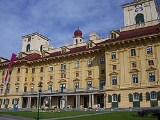
Eisenstadt

Encyclopedia
Politics
The current mayorMayor
In many countries, a Mayor is the highest ranking officer in the municipal government of a town or a large urban city....
of Eisenstadt is Andrea Fraunschiel ÖVP
OVP
OVP is a three-letter abbreviation that may refer to:*The Office of the Vice President of the United States*The Office of the Vice President of the Philippines*OVP , a light sub-machine gun developed in Italy...
.
The district council is composed as follows (as of 2007):
- ÖVPOVPOVP is a three-letter abbreviation that may refer to:*The Office of the Vice President of the United States*The Office of the Vice President of the Philippines*OVP , a light sub-machine gun developed in Italy...
: 17 seats - SPÖSPO- Technology :SPO: Microsoft SharePoint Online, Microsoft Cloud Computing, Office 365. See Microsoft Online Services-Economics:* Secondary Public Offering, an equity capital market instrument...
: 8 seats - Austrian Green PartyAustrian Green PartyThe Greens – The Green Alternative is a political party in the Austrian parliament.The party was formed in 1986 with the name Grüne Alternative, following the merger of the more conservative Green party Vereinte Grüne Österreichs and the more progressive party Alternative Liste Österreichs The...
: 2 seats - FPÖFPOFPO may refer to:*Fleet Post Office, a "city" designation in military mail *Field post office, a term for military post offices in military mail systems *For position only, a designation for placeholder graphics...
: 2 seats
Castles and palaces
- Schloss EsterházySchloss Esterházy----The Schloss Esterházy is a palace in Eisenstadt, Austria, the capital of the Burgenland state. It was constructed in the late 13th century, and came under ownership of the Hungarian Esterházy family in 1622...
and Schlosspark, the Esterházy castle and park.- Orangerie
- Lindenstadion
- Gloriette, the former Esterházy hunting lodge.
Religious edifices
- Bergkirche, housing HaydnJoseph HaydnFranz Joseph Haydn , known as Joseph Haydn , was an Austrian composer, one of the most prolific and prominent composers of the Classical period. He is often called the "Father of the Symphony" and "Father of the String Quartet" because of his important contributions to these forms...
's tomb - Domkirche, late Gothic former military church, began in 1460
- Franziskanerkirche (Franciscan church), Built in 1629, it contains the crypt of the Esterházy family
- Jewish quarterJewish quarter (diaspora)In the Jewish Diaspora, a Jewish quarter is the area of a city traditionally inhabited by Jews. Jewish quarters, like the Jewish ghettos in Europe, were often the outgrowths of segregated ghettos instituted by the surrounding Christian authorities. A Yiddish term for a Jewish quarter or...
of city central (Oberberg)- Jewish Community of Eisenstadt (1732–1938, 1945-)
- Jerusalemplatz & gate, Judengasse (Unterberggasse)
- Österreichisches Jüdisches Museum and Samnson Wertheimer's house ' onMouseout='HidePop("54095")' href="/topics/Synagogue">SynagogueSynagogueA synagogue is a Jewish house of prayer. This use of the Greek term synagogue originates in the Septuagint where it sometimes translates the Hebrew word for assembly, kahal...
of Eisenstadt); there was the chief rabbinateChief RabbiChief Rabbi is a title given in several countries to the recognized religious leader of that country's Jewish community, or to a rabbinic leader appointed by the local secular authorities...
of Hungarian Kingdom: Around Gloriettenallee, Alexander Wolf-Gasse, Meierhofgasse, Museumsgasse, Wertheimergasse, Carl Moreau-Strasse, Alois Tomasini-Gasse, Weingartenstrasse, etc. - Jewish cemeteriesJewish cemeteryA Jewish cemetery is a cemetery where members of the Jewish faith are buried in keeping with Jewish tradition....
of Eisenstadt
Buildings
- Haydn-Mausoleum
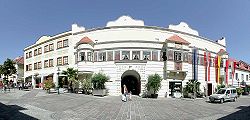
- Rathaus (City Hall)
- Pulverturm (lit. "Powder tower")
Museums
- Haydnmuseum, a museum dedicated to Joseph HaydnJoseph HaydnFranz Joseph Haydn , known as Joseph Haydn , was an Austrian composer, one of the most prolific and prominent composers of the Classical period. He is often called the "Father of the Symphony" and "Father of the String Quartet" because of his important contributions to these forms...
, who lived in the building between 1766 and 1778. - Landesmuseum (regional museum).
- Österreichisches Jüdisches Museum(Austrian Jewish Museum).
- Diözesanmuseum (museum of the local Roman Catholic diocese).
- Feuerwehrmuseum (fire department museum).
Twin towns — Sister cities
Eisenstadt is twinnedTown twinning
Twin towns and sister cities are two of many terms used to describe the cooperative agreements between towns, cities, and even counties in geographically and politically distinct areas to promote cultural and commercial ties.- Terminology :...
with: Bad Kissingen
Bad Kissingen
Bad Kissingen is a spa town in the Bavarian region of Lower Franconia and is the seat of the district Bad Kissingen. Situated to the south of the Rhön Mountains on the Franconian Saale river, it is a world-famous health resort.- Town structure :...
, Germany
Germany
Germany , officially the Federal Republic of Germany , is a federal parliamentary republic in Europe. The country consists of 16 states while the capital and largest city is Berlin. Germany covers an area of 357,021 km2 and has a largely temperate seasonal climate...
Colmar
Colmar
Colmar is a commune in the Haut-Rhin department in Alsace in north-eastern France.It is the capital of the department. Colmar is also the seat of the highest jurisdiction in Alsace, the appellate court....
, France
France
The French Republic , The French Republic , The French Republic , (commonly known as France , is a unitary semi-presidential republic in Western Europe with several overseas territories and islands located on other continents and in the Indian, Pacific, and Atlantic oceans. Metropolitan France...
Lignano Sabbiadoro
Lignano Sabbiadoro
Lignano Sabbiadoro is a village and comune within the province of Udine, in the Friuli-Venezia Giulia region . It is one of the main summer resorts in northern Italy and in the Adriatic Sea coast.-History:...
, Italy
Italy
Italy , officially the Italian Republic languages]] under the European Charter for Regional or Minority Languages. In each of these, Italy's official name is as follows:;;;;;;;;), is a unitary parliamentary republic in South-Central Europe. To the north it borders France, Switzerland, Austria and...
Sanuki
Sanuki, Kagawa
is a city located in Kagawa, Japan.As of March 31, 2011, the city has an estimated population of 53,865, with 20,237 households and the density of 339.01 persons per km²...
, Japan
Japan
Japan is an island nation in East Asia. Located in the Pacific Ocean, it lies to the east of the Sea of Japan, China, North Korea, South Korea and Russia, stretching from the Sea of Okhotsk in the north to the East China Sea and Taiwan in the south...
Sopron
Sopron
In 1910 Sopron had 33,932 inhabitants . Religions: 64.1% Roman Catholic, 27.8% Lutheran, 6.6% Jewish, 1.2% Calvinist, 0.3% other. In 2001 the city had 56,125 inhabitants...
, Hungary
Hungary
Hungary , officially the Republic of Hungary , is a landlocked country in Central Europe. It is situated in the Carpathian Basin and is bordered by Slovakia to the north, Ukraine and Romania to the east, Serbia and Croatia to the south, Slovenia to the southwest and Austria to the west. The...
Nearby municipalities
- GroßhöfleinGroßhöfleinGroßhöflein is a market town in eastern Austria, in the state of Burgenland. The town had 1,853 inhabitants as of May 15, 2001.- People :* Nikolaus Esterházy , lived and died here- Nearby municipalities :...
, MüllendorfMüllendorfMüllendorf is a town in the district of Eisenstadt-Umgebung in Burgenland in Austria.-References:...
, SteinbrunnSteinbrunnSteinbrunn is a town in the district of Eisenstadt-Umgebung in Burgenland in Austria....
, Neufeld/LeithaNeufeld an der LeithaNeufeld an der Leitha is a town in the district of Eisenstadt-Umgebung in Burgenland in Austria, upon the river Leitha, which forms here the border with Lower Austria.-Nearby places:- Natives :...
& EbenfurthEbenfurthEbenfurth is a municipality in the district of Wiener Neustadt-Land in Lower Austria, Austria.- Neiboughring municipalities :* Neufeld an der Leitha , Hornstein* Eggendorf, Zillingdorf, Lichtenwörth... - HornsteinHornstein- Family names :* Frank Hornstein* Harvey A. Hornstein, PhD, author of Brutal Bosses and their Prey: How to Identify and Overcome Abuse in the Workplace...
- WulkaprodersdorfWulkaprodersdorfWulkaprodersdorf is a town in the district of Eisenstadt-Umgebung in Burgenland in Austria....
, Trausdorf/WulkaTrausdorf an der WulkaTrausdorf an der Wulka is a town in the district of Eisenstadt-Umgebung in Burgenland in Austria....
(on the Wulka and EisbachEisbachThe Eisbach is a small man-made river in Munich. It flows through the park Englischer Garten and is a tributary of the Isar River. A manmade wave has been created on one section....
)
Natives
- Moritz BenediktMoritz BenediktMoritz Benedikt was an Hungarian-Austrian neurologist who was a native of Eisenstadt. He was an instructor and professor of neurology at the University of Vienna...
(1835–1920) neurologist - Isaiah BerlinIsaiah Berlin (rabbi)Isaiah Berlin was the most eminent critic among the German Talmudists of the eighteenth century.-Biography:...
(1725–1799) rabbi - Stefan Billes (1909, Kleinhöflein – 2002) politician
- Akiva Eiger (1761–1837) rabbiRabbiIn Judaism, a rabbi is a teacher of Torah. This title derives from the Hebrew word רבי , meaning "My Master" , which is the way a student would address a master of Torah...
and champion of Orthodox JudaismOrthodox JudaismOrthodox Judaism , is the approach to Judaism which adheres to the traditional interpretation and application of the laws and ethics of the Torah as legislated in the Talmudic texts by the Sanhedrin and subsequently developed and applied by the later authorities known as the Gaonim, Rishonim, and... - Paul I, 1st Prince Esterházy of GalánthaPaul I, 1st Prince Esterházy of GalánthaPaul I, Prince Esterházy of Galántha was the first Prince Esterházy of Galántha from 1687 to 1713, Palatine of the Kingdom of Hungary from 1681 to 1713, and an Imperial Field Marshal...
- Prince Paul II Anton EsterházyPaul II Anton EsterházyPrince Paul II Anton Esterházy de Galantha was a prince of the Esterházy family. He had a distinguished career as a soldier and patron of music.-Life:...
(1711–1762) soldier and patron of music - Gyula FarkasGyula Farkas (linguistic scientist)Farkas Gyula, or Julius von Farkas was a Hungarian literary historian and Finno-Ugric linguist....
(1894–1958) linguist - Andrea Fraunschiel (1955 – ) mayor
- Josef HyrtlJosef HyrtlJosef Hyrtl was an Austrian anatomist.Hyrtl was born at Kismarton, in Hungary. He began his medical studies in Vienna in 1831, having received his preliminary education in his native town. His parents were poor, and he had to find some means to help defray the expenses of his medical education...
(1810–1894) anatomist - Andreas IvanschitzAndreas IvanschitzAndreas Ivanschitz is an Austrian footballer of Croatian origin who currently plays as an attacking midfielder for Mainz.-Club career:...
(1983 – ) football player, lived in BaumgartenBaumgarten, BurgenlandBaumgarten is a town in the district of Mattersburg in Burgenland in Austria....
, about 12 km from Eisenstadt - Josef Kirchknopf (1930, Kleinhöflein – ), politician
- Maria PerschyMaria PerschyMaria Perschy was an Austrian actress.Perschy was born in Eisenstadt, Burgenland, Austria and moved to Vienna at the age of 17 to study acting. After completing her education, she moved to Germany for more training, leading to a movie career. Her first major success came with Nasser Asphalt where...
(1938–2004, Vienna) actress - Rudolf SimekRudolf SimekRudolf Simek is an Austrian Germanist and Philologian.Simek studied German literature, philosophy and Catholic theology in the University of Vienna, before becoming a librarian and a docent at the institution. He taught among others in the universities of Edinburgh, Tromsø and Sydney...
(1954 – ) Germanist and Philologian. - Martin VukovichMartin VukovichMartin Vukovich is a former Austrian diplomat.After obtaining a Baccalauréat from Lycée Francais de Vienne in 1962 and a PhD in law from University of Vienna in 1967 Vukovich entered into the Austrian Foreign Service in 1969...
(1944 – ) diplomat - Joseph Franz WeiglJoseph Franz WeiglJoseph Franz Weigl was a Bavarian and Austrian cellist. He was a cellist in the orchestra of the Esterházy family. He played under the directorship of Joseph Haydn, who also was godfather to the cellist's son, and it is thought that Haydn wrote his cello concerto in C major Joseph Franz Weigl (19...
(1740–1820) cellist - Joseph WeiglJoseph WeiglJoseph Weigl , was an Austrian composer and conductor.The son of Joseph Franz Weigl , the principal cellist in the orchestra of the Esterházy family, he was born in Eisenstadt and studied music under Johann Georg Albrechtsberger and Antonio Salieri...
(1766–1846) composer and conductor - Anton PauschenweinAnton PauschenweinAnton Pauschenwein is an Austrian professional association football player, currently playing for Austrian Football Bundesliga side SV Mattersburg. He plays as a defender.-External links:* at transfermarkt.de...
(1981 – ) football player - Thomas MandlThomas MandlThomas Mandl is an Austrian football goalkeeper, who currently plays for Trenkwalder Admira in the Austrian Football First League.-Club career:...
(1979 – ) football player - Michael MörzMichael MörzMichael Mörz is an Austrian professional footballer who currently plays as a midfielder for SV Mattersburg.-International career:...
(1980 – ) football player - Johann DihanichJohann DihanichJohann Dihanich is a retired Austrian football player.-Club career:A Rapid Wien fan by origin, Hansi Dihanich started his professional career at city rivals Austria Wien and played 8 seasons for them, split in two periods by a season at SS Wacker Innsbruck...
(1958 – ) football player
Other residents
- Samuel Löw BrillSamuel Löw BrillSamuel Löw Brill was a Hungarian rabbi and Talmudical scholar born in Budapest. He was educated by his father, Azriel Brill , who was teacher and associate rabbi at Pest, Hungary, and the author of several works in the Hebrew language...
(1814–1897), rabbi and Talmudical scholar; born in BudapestBudapestBudapest is the capital of Hungary. As the largest city of Hungary, it is the country's principal political, cultural, commercial, industrial, and transportation centre. In 2011, Budapest had 1,733,685 inhabitants, down from its 1989 peak of 2,113,645 due to suburbanization. The Budapest Commuter...
; attended yeshiva - Meir EisenstadtMeir EisenstadtMeir ben Izsak Eisenstadt was the author of responsa and other works of rabbinic literature. An authority on Halakha, he was consulted by rabbis from Turkey, Germany and Italy. He is known as the Panim Me'irot after his major work called Shu"t Panim Me'irot...
(1670–1744) rabbi of the SiebengemeindenSiebengemeindenThe Siebengemeinden were 7 Jewish communities located in Eisenstadt and its surrounding area. The groups are known as Sheva Kehillot in Hebrew.... - Joseph HaydnJoseph HaydnFranz Joseph Haydn , known as Joseph Haydn , was an Austrian composer, one of the most prolific and prominent composers of the Classical period. He is often called the "Father of the Symphony" and "Father of the String Quartet" because of his important contributions to these forms...
(1732–1809), musician, born in RohrauRohrauRohrau may refer to:* Rohrau, Austria, a town in Lower Austria* Schloss Rohrau, a castle in Rohrau, Austria* Rohrau , a village in the municipality of Gärtringen, Baden-Württemberg* Count Friedrich August von Harrach-Rohrau... - Azriel HildesheimerAzriel HildesheimerEsriel Hildesheimer was a German rabbi and leader of Orthodox Judaism. He is regarded as a pioneering modernizer of Orthodox Judaism in Germany and as a founder of Modern Orthodox Judaism.-Biography:...
(1820–1899), German rabbi, founder of Torah im Derech EretzTorah im Derech EretzTorah im Derech Eretz is a philosophy of Orthodox Judaism articulated by Rabbi Samson Raphael Hirsch , which formalizes a relationship between traditionally observant Judaism and the modern world...
; in 1851, he was called to the rabbinate of Eisenstadt - Markus HorovitzMarkus HorovitzMarkus Horovitz was a Hungarian rabbi and historian.He was born at Ladány , Borsod-Abaúj-Zemplén County, Hungary. The descendant of an ancient family of scholars, he pursued his rabbinical studies at the yeshivot of Ujhely, Verbé, and Eisenstadt...
(1844–1915), German rabbi and historian; born March 14, 1844, in TiszaladányTiszaladányTiszaladány is a village in Borsod-Abaúj-Zemplén County in northeastern Hungary.-References:...
, Hungary, pursued his rabbinical studies at the yeshiva - Johann Nepomuk HummelJohann Nepomuk HummelJohann Nepomuk Hummel or Jan Nepomuk Hummel was an Austrian composer and virtuoso pianist. His music reflects the transition from the Classical to the Romantic musical era.- Life :...
(1778–1837), musician - Adam LisztAdam LisztÁdám Liszt - was a Hungarian musician and father of composer and pianist Franz Liszt.He was born in Nemesvölgy, Kingdom of Hungary as the second child of György Liszt and Barbara Slezák...
(1776–1827), musician, father of Franz LisztFranz LisztFranz Liszt ; ), was a 19th-century Hungarian composer, pianist, conductor, and teacher.Liszt became renowned in Europe during the nineteenth century for his virtuosic skill as a pianist. He was said by his contemporaries to have been the most technically advanced pianist of his age... - Leopold LöwLeopold LöwLeopold Löw was a Hungarian rabbi.-Biography:Born in Černá Hora, Moravia, he received his preliminary education at the yeshibot of Třebíč, Kolín, Lipník nad Bečvou and Eisenstadt , and then studied philology, pedagogics, and Christian theology at the Lyceum of Bratislava and at the universities...
(1811–1875), born in Černá HoraCerná Hora (Blansko District)Černá Hora is a market town in the South Moravian Region of the Czech Republic. It has around 1,900 inhabitants.Name of the place come from a hill whose vegetation is darker than the neighbourhood....
, MoraviaMoraviaMoravia is a historical region in Central Europe in the east of the Czech Republic, and one of the former Czech lands, together with Bohemia and Silesia. It takes its name from the Morava River which rises in the northwest of the region...
, studied at the yeshiva of Eisenstadt - Mordecai MokiachMordecai MokiachMordecai Mokiach was a Jewish Sabbatean "prophet" and false Messiah; born in Alsace about 1650; died at Pressburg May 18, 1729.The death of Sabbatai Zevi seems to have encouraged his followers, who claimed that he had returned to his heavenly abode and would come back in three years to finish his...
(ca. 1650–1724), "pseudo"-MessiahMessiahA messiah is a redeemer figure expected or foretold in one form or another by a religion. Slightly more widely, a messiah is any redeemer figure. Messianic beliefs or theories generally relate to eschatological improvement of the state of humanity or the world, in other words the World to...
, born in AlsaceAlsaceAlsace is the fifth-smallest of the 27 regions of France in land area , and the smallest in metropolitan France. It is also the seventh-most densely populated region in France and third most densely populated region in metropolitan France, with ca. 220 inhabitants per km²... - Robert MusilRobert MusilRobert Musil was an Austrian writer. His unfinished long novel The Man Without Qualities is generally considered to be one of the most important modernist novels...
(1880–1942), author - Ignaz PleyelIgnaz PleyelIgnace Joseph Pleyel , ; was an Austrian-born French composer and piano builder of the Classical period.-Early years:...
(1757–1831), musician - Emanuel SchreiberEmanuel SchreiberEmanuel Schreiber was an American rabbi originally from Leipnik, Moravia.Schreiber received his education at the Talmudical college of his native town, the rabbinical seminary at Eisenstadt, Hungary, and the Hochschule in Berlin...
(1852–1932), rabbi - Fritz SpieglFritz SpieglFritz Spiegl was born at Zurndorf, Austria, the son of an agricultural merchant and his Jewish wife. He became a musician, journalist, broadcaster, humorist and collector who lived and worked in England from 1939....
(1926–2003) musician, journalist, broadcaster, humorist and collector - Isaac Hirsch WeissIsaac Hirsch WeissIsaac Hirsch Weiss, also Eisik Hirsch Weiss was an Austrian Talmudist and historian of literature born at Velké Meziříčí, Moravia....
(1815–1905), talmudist and historian of literature; born at Velké MeziříčíVelké MezirícíVelké Meziříčí is a town in the Vysočina Region, Czech Republic. It is situated under the original Gothic castle in a valley framed by the hills of the Bohemian-Moravian Highlands....
, Moravia; studied at yeshiva - Samson WertheimerSamson WertheimerSamson Wertheimer was chief rabbi of Hungary and Moravia, and rabbi of Eisenstadt. He was also an Austrian financier, court Jew and Shtadlan to Austrian Emperor Leopold I.-Family:...
(1658–1724), rabbi - Aaron WiseAaron WiseAaron Wise was an American Rabbi.Wise was educated in the Talmudic schools of Hungary, including the seminary at Eisenstadt, where he studied under Dr. Hildesheimer. Later he attended the universities of Leipzig and Halle, receiving his doctorate at the latter institution...
(1844–1896), rabbi, born in EgerEgerEger is the second largest city in Northern Hungary, the county seat of Heves, east of the Mátra Mountains. Eger is best known for its castle, thermal baths, historic buildings , and red and white wines.- Name :...
, Hungary, studied at yeshiva; the father of Stephen Samuel WiseStephen Samuel WiseStephen Samuel Wise was an Austro-Hungarian-born American Reform rabbi and Zionist leader.-Early life:...
As a surname
Eisenstadt (also Ajzenstat, Eisenstaedter, Asch, etc.), a Jewish surnameJewish surname
Jews have historically used Hebrew patronymic names. In the Jewish patronymic system the first name is followed by either ben- or bat- , and then the father's name....
, derives from this city. Some people with this surname or its variants include:
- Alfred EisenstaedtAlfred EisenstaedtAlfred Eisenstaedt was a German-American photographer and photojournalist. He is renowned for his candid photographs, frequently made using various models of a 35mm Leica rangefinder camera...
- Meir EisenstadtMeir EisenstadtMeir ben Izsak Eisenstadt was the author of responsa and other works of rabbinic literature. An authority on Halakha, he was consulted by rabbis from Turkey, Germany and Italy. He is known as the Panim Me'irot after his major work called Shu"t Panim Me'irot...
- Shmuel EisenstadtShmuel EisenstadtShmuel Noah Eisenstadt was an Israeli sociologist. In 1959 he was appointed to a teaching post in the sociology department of the Hebrew University in Jerusalem. From 1990 until his death in September of 2010 he had been a professor emeritus...
Israeli sociologist - Stuart E. EizenstatStuart E. EizenstatStuart Eizenstat is a partner at Washington, D.C. law firm, Covington & Burling and senior strategist at APCO Worldwide. He is married to Frances Eizenstat, and has two sons and six grandchildren....
- Moses AschMoses AschMoses Asch was the founder of Folkways Records. Asch ran the label from 1948 until his death...
External links
- Official site
- Official Eisenstadt Tourism Site
- Eisenstadt on the official Burgenland site
- Österreichisches Jüdisches Museum (Austrian Jewish Museum)
- Jewish Encyclopedia article on the Jewish community of Eisenstadt
- Schloss Esterházy (Esterházy Castle)
- Haydn festival
- Fachhochschul-Studiengänge Burgenland University of applied sciences.
- "Iron City", Eisenstadt page for young adult activities.
- Eisenstadt in English