


St Austell

Encyclopedia
St Austell is a civil parish and a major town in Cornwall
, England, United Kingdom. It is situated on the south coast approximately ten miles (16 km) south of Bodmin
and 30 miles (48 km) west of the border with Devon
at Saltash
. The town is known locally as "Snozzle"
St Austell is the largest town in Cornwall: in the 2001 census, the population was 22,658 (larger than the county town
, Truro
, which had a population of 20,920). St Austell civil parish (see below) is entirely urban in character.
Not long after William Cookworthy
discovered china clay
in Tregonning, the same mineral was found in greater quantity in the hills north of St Austell town. Clay mining
soon took over from tin
and copper
mining as the principal industry in the area, and this eventually contributed enormously to the growth of the town. The clay industry really only came into its own during the mid 19th to early 20th century, at a time when the falling prices of tin and other metals forced many mines to close down or convert to clay mining. The success and high profitability of the industry attracted many families whose breadwinner had been put out of work by the depression in the local metal mining industry, and increased the population of the town considerably. This meant that more shops and businesses took root, providing more jobs and improving trade. This, along with other factors, led to St Austell becoming one of the ten most important commercial centres of Cornwall.
The town centre recently underwent a £75 million redevelopment process. The redevelopment attracted heavy opposition from its outset, with the main argument coming from Friends for a Better St Austell. In August 2007, developers David McLean and demolition team Gilpin moved onto the town centre site to complete the preparation, with the Filmcentre which was originally an Odeon
cinema dating back to 1936, being demolished in late September/early October.
In October 2007, the South West of England Regional Development Agency (SWRDA) and project developers David McLean announced that the new development would be named 'White River Place'. It was also announced that 50% of shop units had been leased to high street stores, with New Look, Peacocks, Bonmarché and Wilkinson opening new stores. This would mean New Look relocating from its current premises in Fore Street and the return of Peacocks to St Austell following the demolition of its old store to make way for the new development.
In October 2008 it was announced that the developer David McLean Developments had gone into administration and concern was expressed that this could jeopardise the completion of the project
In December 2008, the new White River Cinema opened its doors for the first time: the cinema is technically advanced and the first purpose-built cinema in Cornwall for over 60 years.
In late October 2009, White River Place first opened its doors to the public. At the same time, a weekly local Produce Market started, located on Market Street between St Austell Market House and the Parish Church, which takes place every Saturday, between 10.00hrs and 15.00hrs.
The Torchlight Carnival took place on 21 November 2009 to huge acclaim, and is due to be repeated on 20 November 2010. Both these initiatives were spearheaded by the new Town Council, which was responding to public demand voiced through a survey conducted prior to the establishment of the Town Council. The Market House CIC was also involved and is the lead partner in establishing the Produce Market in St Austell.
The St Austell and Clay Country Eco-town is a plan for several new settlements around St Austell on old Imerys sites. It was given outline government approval in July 2009.
On 6 July 2011, Cornwall
Council's strategic planning committee voted unanimously to approve a £250 million beach resort scheme at Carlyon Bay
, St Austell, after a 20-year development battle. UK property entrepreneur
Johnny Sandelson
initially proposed the 1000000 sq ft (92,903 m²) development in 2003.
created as part of the 2009 structural changes to local government in England
. The six former Districts and the former Cornwall County Council were abolished and replaced by Cornwall Council on 1 April 2009.
Also on 1 April 2009, four new parishes
were created for the St Austell area. They are:
The town's economy is supported by its town centre shops and supporting businesses.
The St Austell Brewery
, which celebrated its 150th anniversary in 2001, supplies cask ale
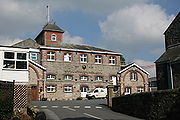
to pubs in Cornwall and the rest of the UK. They are best known for their flagship beer, St Austell Tribute; a number of other ales are brewed but are rarely seen outside Cornwall. St Austell Brewery's original brewery 'The Seven Stars Inn' still stands today in the main town on East Hill.
 As in much of Cornwall and neighbouring counties, tourism is increasingly important to St Austell's economy. Tourists are drawn to the area by nearby beaches and attractions such as the Eden Project
, sited in a former clay pit
, and the Lost Gardens of Heligan
. Summer visitors to the town make a big contribution to the local economy. The China Clay Country Park, in a former china-clay pit two miles north of the town, tells the story of the men, women and children who lived, worked and played in the shadow of the clay tips around St Austell.
St Austell is home to several public house
s, numerous high street
retailers, and several independent shops, many of which cater for tourists.
series published by Cornwall and Devon Media Ltd. The newspaper has a long history in the town.
The St Austell Voice, sister paper to the Newquay Voice
has offices at Truro Road, close to the town centre. Both papers publish on Wednesdays.
St Austell is also home to Radio St Austell Bay
, a local radio station which broadcasts from studios at Tregorrick Park, St Austell. Radio St Austell Bay launched in January 2008 to a potential audience of approximately 30,000 in the St Austell area from Trewoon
in the west to Tywardreath in the east.
designed many of St Austell's buildings and houses, including the Thin End and the Moorland Road terrace (originally known as Work House Lane, said work house having since been razed to the ground by arsonists). Of other notable architects from St Austell, John Goode contributed considerably during the 1970s to residential developments in the area.
Pevsner remarks in his guide to Cornwall that the following buildings are notable:
The Masonic Hall in South Street, had its cornerstones laid on 20 June 1900, it is an outstanding building, with the apex crowned with a pentagonal star, various Masonic symbols abound the front, as well as the coat of arms of the United Grand Lodge of England.
was opened by the Cornwall Railway
on 4 May 1859 on the hillside above the town centre. Two branch lines west of the town were later opened to serve the china clay industry; the Newquay and Cornwall Junction Railway
which is still partly open, and the short-lived Trenance Valley line. The independent narrow gauge
Pentewan Railway
ran from West Hill to the coast at Pentewan
. The Cornish Main Line
in St Austell is quite renowned for its viaduct
which passes through the Gover Valley and Trenance areas of the town. the original timber structure was designed by Isambard Kingdom Brunel
, it was 115 feet (35.1 m) high, 720 feet (219.5 m) long on 10 piers; it was replaced by a new stone viaduct in 1899. There was a siding located west of the viaduct. In the early years trains from St Austell had to push wagons over the tall, curving viaduct to shunt this siding. The Great Western Railway
's instructions stated that: "Trucks may be pushed from St Austell to the Siding, but when this is done the speed of the Train between the two places must not exceed 8 miles an hour, and the head Guard must ride on the leading vehicle, unless it be a bonnet end one, in which case he must ride in the first low sided vehicle from it, to keep a good look out, and be prepared to give a signal to the Driver either by Day or Night, as may be required". Train services today operate west to and , and east to and London. There are also three services on most days to the North of England and Scotland.
The town's bus station
faces the entrance to the railway station to offer an easy interchange between buses and trains. National Express
coach services call here, a dedicated link operates to the Eden Project
, and local buses operate to villages such as Fowey
and Mevagissey
. The town can be accessed by the A390
which by-passes the town to the south on its way from Liskeard
to Truro
, or by the A391 from Bodmin
, or by the A3058 from Newquay
. In addition there are the B3273 to Mevagissey, the B3274 to Padstow
and the A3082 to Fowey.
s, Poltair School
, formerly the grammar school
, and Penrice Community College
. Brannel School is in the St Austell area but not in the town itself.
Cornwall College
St Austell is a Further & Higher Education institution incorporating the former St Austell Sixth Form Centre and Mid Cornwall College of Further Education. The College is based at John Keay House, which is also home to the college group's headquarters.
St Austell has eight primary schools: Charlestown County Primary School, Bishop Bronescombe School, Carclaze Community Infant School, Carclaze Community Junior School, Mount Charles School, Pondhu Primary School, St Mewan Primary School, and Sandy Hill Community Primary School.
, a Breton saint associated with St Meven, but is now dedicated to the Holy Trinity. By 1150 it had been appropriated to the Priory of Tywardreath
by the Cardinham
s: this continued until 1535. There was originally a Norman church here, of which some remains may be seen. The present church is of the 15th century and is large because the mediaeval parish was also a large one: the tower is impressive. All four outside walls bear sculptural groups in carved niches: the Twelve Apostles in three groups on the north, east and south; the Holy Trinity above the Annunciation and below that the Risen Christ between two saints on the west. The tower can be dated to between 1478 and 1487 by the arms of Bishop Courtenay, and the walls are faced in Pentewan stone
.
On the south side of the church, a formerly separate chantry
has been incorporated into the church when it was extended. (The chantry itself was abolished in 1543.) There are holy wells at Menacuddle and Towan. In the 19th century the following parishes were created out of St Austell parish: St Blazey (1845); Charlestown (1846), Treverbyn (1847), and Par (1846 out of St Blazey and Tywardreath).
A new rural deanery of St Austell was established within the Diocese of Truro
in 1875.
Other Masonic bodies meeting in St Austell are: Mount Edgcumbe Royal Arch Chapter No. 496, formed in 1874; Tewington Royal Arch Chapter No. 5698, formed on 11 November 1987; St Austell Mark Master Masons Lodge No. 275, consecrated on 22 February 1881; St Austell Lodge of Royal Ark Mariners No. 275, formed on 22 September 1962 and the St Austell Rose Croix Chapter No. 744, consecrated on 16 October 1973.
racing first took place a venue called Rocky Park, under the name "St Austell Gulls
". The sport was a hit during various years, between 1949 and 1963 at the Cornish Stadium – now Stadium Retail Park, home of Cornish Market World. The sport returned to the area in the late 1990s, in the Clay Country Moto Parc, located at Old Pound, Nanpean
. The club operated as the St Austell Gulls for four years, until the club changed ownership, and moved up a league to the Speedway Premier League
, re-formed as the Trelawny JAG Tigers
, until site owners Imerys Minerals Ltd ended the lease. Speedway has not been held in Cornwall since. Many attempts have been made to re-introduce the sport, but none have got past planning permission. The two highest profile bids were at Par Moor Motor Museum and St Eval Raceway. The owner of the land for the Par Moor bid confirmed that he would rent the land for speedway but locals objected. The St Eval bid failed after residents expressed fears about noise.
Stock car racing
, promoted by 1950s Kiwi Speedway star Trevor Redmond
, ran side by side with speedway on numerous occasions. Numerous championships were run here, including the 1972 BriSCA
World Championship for Formula 2 cars, won by Jimmy Murray from N.Ireland. It closed its doors in 1987.
St Austell Football Club
was formed on 17 September 1890. In 1908 the club won its first trophy: the Cornwall Charity Cup. The club achieved some success in the late 1920s and 1930s, winning the Senior Cup and Charity Cup twice. In May 2009, the team won the Senior Cup with a closely fought 3–2 victory over Saltash United
.
Wheal Eliza
cricket ground is the home of St Austell Cricket Club, and is also used for Minor Counties matches.
Cornwall
Cornwall is a unitary authority and ceremonial county of England, within the United Kingdom. It is bordered to the north and west by the Celtic Sea, to the south by the English Channel, and to the east by the county of Devon, over the River Tamar. Cornwall has a population of , and covers an area of...
, England, United Kingdom. It is situated on the south coast approximately ten miles (16 km) south of Bodmin
Bodmin
Bodmin is a civil parish and major town in Cornwall, England, United Kingdom. It is situated in the centre of the county southwest of Bodmin Moor.The extent of the civil parish corresponds fairly closely to that of the town so is mostly urban in character...
and 30 miles (48 km) west of the border with Devon
Devon
Devon is a large county in southwestern England. The county is sometimes referred to as Devonshire, although the term is rarely used inside the county itself as the county has never been officially "shired", it often indicates a traditional or historical context.The county shares borders with...
at Saltash
Saltash
Saltash is a town and civil parish in Cornwall, England, United Kingdom. It has a population of 14,964. It lies in the south east of Cornwall, facing Plymouth over the River Tamar. It was in the Caradon district until March 2009 and is known as "the gateway to Cornwall". Saltash means ash tree by...
. The town is known locally as "Snozzle"
St Austell is the largest town in Cornwall: in the 2001 census, the population was 22,658 (larger than the county town
County town
A county town is a county's administrative centre in the United Kingdom or Ireland. County towns are usually the location of administrative or judicial functions, or established over time as the de facto main town of a county. The concept of a county town eventually became detached from its...
, Truro
Truro
Truro is a city and civil parish in Cornwall, England, United Kingdom. The city is the centre for administration, leisure and retail in Cornwall, with a population recorded in the 2001 census of 17,431. Truro urban statistical area, which includes parts of surrounding parishes, has a 2001 census...
, which had a population of 20,920). St Austell civil parish (see below) is entirely urban in character.
History
One of the earliest references to St Austell is in John Leland's Itinerary, where he says "At S. Austelles is nothing notable but the paroch chirch".Not long after William Cookworthy
William Cookworthy
-Bibliography:*Early New Church Worthies by the Rev Dr Jonathon Bayley*Cookworthy's Plymouth and Bristol Porcelain by F.Severne Mackenna published by F.Lewis...
discovered china clay
Kaolinite
Kaolinite is a clay mineral, part of the group of industrial minerals, with the chemical composition Al2Si2O54. It is a layered silicate mineral, with one tetrahedral sheet linked through oxygen atoms to one octahedral sheet of alumina octahedra...
in Tregonning, the same mineral was found in greater quantity in the hills north of St Austell town. Clay mining
Clay pit
A clay pit is a quarry or mine for the extraction of clay, which is generally used for manufacturing pottery, bricks or Portland cement.The brickyard or brickworks is often located alongside the clay pit to reduce the transport costs of the raw material. These days pottery producers are often not...
soon took over from tin
Tin
Tin is a chemical element with the symbol Sn and atomic number 50. It is a main group metal in group 14 of the periodic table. Tin shows chemical similarity to both neighboring group 14 elements, germanium and lead and has two possible oxidation states, +2 and the slightly more stable +4...
and copper
Copper
Copper is a chemical element with the symbol Cu and atomic number 29. It is a ductile metal with very high thermal and electrical conductivity. Pure copper is soft and malleable; an exposed surface has a reddish-orange tarnish...
mining as the principal industry in the area, and this eventually contributed enormously to the growth of the town. The clay industry really only came into its own during the mid 19th to early 20th century, at a time when the falling prices of tin and other metals forced many mines to close down or convert to clay mining. The success and high profitability of the industry attracted many families whose breadwinner had been put out of work by the depression in the local metal mining industry, and increased the population of the town considerably. This meant that more shops and businesses took root, providing more jobs and improving trade. This, along with other factors, led to St Austell becoming one of the ten most important commercial centres of Cornwall.
Redevelopment
Work began in 1963 on the pedestrian precinct which included shops, offices and flats: the design was by Alister MacDonald & Partners and the materials reinforced concrete with some stone facing.The town centre recently underwent a £75 million redevelopment process. The redevelopment attracted heavy opposition from its outset, with the main argument coming from Friends for a Better St Austell. In August 2007, developers David McLean and demolition team Gilpin moved onto the town centre site to complete the preparation, with the Filmcentre which was originally an Odeon
Odeon Cinemas
Odeon Cinemas is a British chain of cinemas, one of the largest in Europe. It is owned by Odeon & UCI Cinemas Group whose ultimate parent is Terra Firma Capital Partners.-History:Odeon Cinemas was created in 1928 by Oscar Deutsch...
cinema dating back to 1936, being demolished in late September/early October.
In October 2007, the South West of England Regional Development Agency (SWRDA) and project developers David McLean announced that the new development would be named 'White River Place'. It was also announced that 50% of shop units had been leased to high street stores, with New Look, Peacocks, Bonmarché and Wilkinson opening new stores. This would mean New Look relocating from its current premises in Fore Street and the return of Peacocks to St Austell following the demolition of its old store to make way for the new development.
In October 2008 it was announced that the developer David McLean Developments had gone into administration and concern was expressed that this could jeopardise the completion of the project
In December 2008, the new White River Cinema opened its doors for the first time: the cinema is technically advanced and the first purpose-built cinema in Cornwall for over 60 years.
In late October 2009, White River Place first opened its doors to the public. At the same time, a weekly local Produce Market started, located on Market Street between St Austell Market House and the Parish Church, which takes place every Saturday, between 10.00hrs and 15.00hrs.
The Torchlight Carnival took place on 21 November 2009 to huge acclaim, and is due to be repeated on 20 November 2010. Both these initiatives were spearheaded by the new Town Council, which was responding to public demand voiced through a survey conducted prior to the establishment of the Town Council. The Market House CIC was also involved and is the lead partner in establishing the Produce Market in St Austell.
The St Austell and Clay Country Eco-town is a plan for several new settlements around St Austell on old Imerys sites. It was given outline government approval in July 2009.
On 6 July 2011, Cornwall
Cornwall
Cornwall is a unitary authority and ceremonial county of England, within the United Kingdom. It is bordered to the north and west by the Celtic Sea, to the south by the English Channel, and to the east by the county of Devon, over the River Tamar. Cornwall has a population of , and covers an area of...
Council's strategic planning committee voted unanimously to approve a £250 million beach resort scheme at Carlyon Bay
Carlyon Bay
For the parish council see CarlyonCarlyon Bay is a bay and beach in St Austell on the south coast of Cornwall, United Kingdom. It is located approximately east of the town centre.Carlyon Bay was formerly the location of the Cornwall Coliseum...
, St Austell, after a 20-year development battle. UK property entrepreneur
Entrepreneur
An entrepreneur is an owner or manager of a business enterprise who makes money through risk and initiative.The term was originally a loanword from French and was first defined by the Irish-French economist Richard Cantillon. Entrepreneur in English is a term applied to a person who is willing to...
Johnny Sandelson
Johnny Sandelson
Johnny Sandelson is a UK businessman, entrepreneur and award-winning real estate developer. He is best known for investing in a number of high profile property ventures. He proposed the 1,000,000 sq. ft...
initially proposed the 1000000 sq ft (92,903 m²) development in 2003.
Governance
Parliamentary
St Austell is in the new parliamentary constituency of St Austell and Newquay which was created by the Boundary Commission for England (increasing the number of seats in Cornwall from five to six).Local government
The main local authority is Cornwall Council, the unitary authorityUnitary authority
A unitary authority is a type of local authority that has a single tier and is responsible for all local government functions within its area or performs additional functions which elsewhere in the relevant country are usually performed by national government or a higher level of sub-national...
created as part of the 2009 structural changes to local government in England
2009 structural changes to local government in England
Structural changes to local government in England were effected on 1 April 2009, whereby a number of new unitary authorities were created in parts of the country which previously operated a 'two-tier' system of counties and districts...
. The six former Districts and the former Cornwall County Council were abolished and replaced by Cornwall Council on 1 April 2009.
Also on 1 April 2009, four new parishes
St Austell parishes
Four new parishes were created for the St Austell area on 1 April 2009. The parishes are:* St Austell Town Council covering Bethel, Gover, Mount Charles, Poltair and St Austell Bay ; represented by 20 councillors....
were created for the St Austell area. They are:
- St Austell Town Council covering Bethel, Gover, Mount Charles, Poltair and Holmbush; represented by 20 councillors.
- CarlyonCarlyonCarlyon is one of four new civil parishes created on 1 April 2009 for the St Austell area of south Cornwall, United Kingdom.The new parish is part coastal and part rural in character...
Parish Council covering Carlyon Bay and Tregrehan; represented by 9 councillors. - St Austell BaySt Austell BaySt Austell Bay is a bay on Cornwall's south coast which is bounded to the east by Gribbin Head and to the west by Black Head.Since 1 April 2009 it has also been the name of a civil parish, one of four new parishes created on for the St Austell area. It lies southeast of the town of St Austell and...
Parish Council covering Charlestown, Duporth, Porthpean and Trenarren; represented by 7 councillors. - Pentewan ValleyPentewan ValleyPentewan Valley is one of four new civil parishes created on 1 April 2009 for the St Austell area of south Cornwall, United Kingdom.The new parish is the largest of the four by area and is rural in character...
Parish Council covering Tregorrick, Trewhiddle, London Apprentice and Pentewan; represented by 9 councillors.
Economy
The china clay industry now employs only just over 2000 people, a mere fraction of the workforce in the early 20th century. However, the industry still achieves a higher annual output than ever before.The town's economy is supported by its town centre shops and supporting businesses.
The St Austell Brewery
St Austell Brewery
St Austell Brewery is a brewery founded in 1851 by Walter Hicks in St Austell, Cornwall, England. The brewery's flagship beer is Tribute Ale, which accounts for around 80% of sales...
, which celebrated its 150th anniversary in 2001, supplies cask ale
Cask ale
Cask ale or cask-conditioned beer is the term for unfiltered and unpasteurised beer which is conditioned and served from a cask without additional nitrogen or carbon dioxide pressure...
to pubs in Cornwall and the rest of the UK. They are best known for their flagship beer, St Austell Tribute; a number of other ales are brewed but are rarely seen outside Cornwall. St Austell Brewery's original brewery 'The Seven Stars Inn' still stands today in the main town on East Hill.
Tourism
Eden Project
The Eden Project is a visitor attraction in Cornwall in the United Kingdom, including the world's largest greenhouse. Inside the artificial biomes are plants that are collected from all around the world....
, sited in a former clay pit
Clay pit
A clay pit is a quarry or mine for the extraction of clay, which is generally used for manufacturing pottery, bricks or Portland cement.The brickyard or brickworks is often located alongside the clay pit to reduce the transport costs of the raw material. These days pottery producers are often not...
, and the Lost Gardens of Heligan
Lost Gardens of Heligan
The Lost Gardens of Heligan, near Mevagissey in Cornwall, are one of the most popular botanical gardens in the UK. The style of the gardens is typical of the nineteenth century Gardenesque style, with areas of different character and in different design styles.The gardens were created by members of...
. Summer visitors to the town make a big contribution to the local economy. The China Clay Country Park, in a former china-clay pit two miles north of the town, tells the story of the men, women and children who lived, worked and played in the shadow of the clay tips around St Austell.
St Austell is home to several public house
Public house
A public house, informally known as a pub, is a drinking establishment fundamental to the culture of Britain, Ireland, Australia and New Zealand. There are approximately 53,500 public houses in the United Kingdom. This number has been declining every year, so that nearly half of the smaller...
s, numerous high street
High Street
High Street, or the High Street, is a metonym for the generic name of the primary business street of towns or cities, especially in the United Kingdom. It is usually a focal point for shops and retailers in city centres, and is most often used in reference to retailing...
retailers, and several independent shops, many of which cater for tourists.
Newspaper and radio
The town has two weekly newspapers, the St Austell Guardian and the St Austell Voice. The St Austell Guardian is part of the Cornish GuardianCornish Guardian
Cornish Guardian is a weekly newspaper in Cornwall, UK, which is part of the Cornwall & Devon Media group. It is published in 7 separate editions:*Bodmin edition*Lostwithiel and Fowey edition*Newquay edition*North Cornwall edition...
series published by Cornwall and Devon Media Ltd. The newspaper has a long history in the town.
The St Austell Voice, sister paper to the Newquay Voice
Newquay Voice
The Newquay Voice is a local weekly newspaper, published every Wednesday from Newquay, Cornwall, United Kingdom covering the northern part of the former borough of Restormel, which is effectively ‘Greater Newquay’. It has a sister newspaper, the St. Austell Voice, covering the south of the old...
has offices at Truro Road, close to the town centre. Both papers publish on Wednesdays.
St Austell is also home to Radio St Austell Bay
Radio St Austell Bay
Radio St Austell Bay is a not for profit, community radio station. The radio station is funded by a combination of grants from the National Lottery and the Arts Council, alongside a small amount of commercial advertising and sponsorship. Partners include the Eden Project, the Lost Gardens of...
, a local radio station which broadcasts from studios at Tregorrick Park, St Austell. Radio St Austell Bay launched in January 2008 to a potential audience of approximately 30,000 in the St Austell area from Trewoon
Trewoon
Trewoon, pronounced true-un, is a village in south Cornwall, United Kingdom in St Mewan civil parish. It is situated on the western outskirts of St Austell on the A3058 road, about one mile from the town centre....
in the west to Tywardreath in the east.
Landmarks
Most of the shops on the old high street near the centre occupy original buildings either in renovated or modified form. Notable Cornish architect Silvanus TrevailSilvanus Trevail
Silvanus Trevail was a British architect, and the most prominent Cornish architect of the 19th century. He was born in Luxulyan, Cornwall in October 1851. He rose to become Mayor of Truro and, nationally, President of the architects' professional body, the Society of Architects. His success...
designed many of St Austell's buildings and houses, including the Thin End and the Moorland Road terrace (originally known as Work House Lane, said work house having since been razed to the ground by arsonists). Of other notable architects from St Austell, John Goode contributed considerably during the 1970s to residential developments in the area.
Pevsner remarks in his guide to Cornwall that the following buildings are notable:
- The Parish Church (see Church history above)
- The Town Hall, in Italian Renaissance style, 1844
- Friends Meeting House, 1829, a plain granite structure
- White Hart Hotel: once contained panoramic wallpaper of the Bay of Naples by DufourJoseph Dufour et CieJoseph Dufour et Cie, founded 1797 by Joseph and Pierre Dufour, was a s a French Manufacture de Papier Peints et Tissus manufacturer located in Mâcon, France.-General:...
(now in the Victoria and Albert MuseumVictoria and Albert MuseumThe Victoria and Albert Museum , set in the Brompton district of The Royal Borough of Kensington and Chelsea, London, England, is the world's largest museum of decorative arts and design, housing a permanent collection of over 4.5 million objects...
) - Holy Well at Menacuddle.
- Three buildings of the 1960s: Penrice School, 1960; Public Library, 1961; Magistrates' Court, 1966.
The Masonic Hall in South Street, had its cornerstones laid on 20 June 1900, it is an outstanding building, with the apex crowned with a pentagonal star, various Masonic symbols abound the front, as well as the coat of arms of the United Grand Lodge of England.
Transport
St Austell railway stationSt Austell railway station
St Austell Station serves the town of St Austell, Cornwall, United Kingdom. The station is operated by First Great Western, as is every other station in Cornwall....
was opened by the Cornwall Railway
Cornwall Railway
The Cornwall Railway was a broad gauge railway from Plymouth in Devon to Falmouth in Cornwall, United Kingdom. The section from Plymouth to Truro opened in 1859, the extension to Falmouth in 1863...
on 4 May 1859 on the hillside above the town centre. Two branch lines west of the town were later opened to serve the china clay industry; the Newquay and Cornwall Junction Railway
Newquay and Cornwall Junction Railway
The Newquay and Cornwall Junction Railway was a broad gauge railway intended to link the Cornwall Railway with the horse-worked Newquay Railway. It opened a short section to Nanpean in 1869, the remainder being built by the Cornwall Minerals Railway who took over the company in 1874...
which is still partly open, and the short-lived Trenance Valley line. The independent narrow gauge
Narrow gauge
A narrow gauge railway is a railway that has a track gauge narrower than the of standard gauge railways. Most existing narrow gauge railways have gauges of between and .- Overview :...
Pentewan Railway
Pentewan Railway
The Pentewan Railway was a British narrow gauge railway in Cornwall. It was built as a horse-drawn tramway carrying china clay from St Austell to the harbour at Pentewan. In 1874 the line was rebuilt by engineer John Barraclough Fell and converted to locomotive working, at which time the gauge was...
ran from West Hill to the coast at Pentewan
Pentewan
Pentewan is a coastal village and former port in south Cornwall, United Kingdom. It is situated at three miles south of St Austell at the mouth of the St Austell River....
. The Cornish Main Line
Cornish Main Line
The Cornish Main Line is a railway line in the United Kingdom, which forms the backbone for rail services in Cornwall, as well as providing a direct line to London.- History :...
in St Austell is quite renowned for its viaduct
Viaduct
A viaduct is a bridge composed of several small spans. The term viaduct is derived from the Latin via for road and ducere to lead something. However, the Ancient Romans did not use that term per se; it is a modern derivation from an analogy with aqueduct. Like the Roman aqueducts, many early...
which passes through the Gover Valley and Trenance areas of the town. the original timber structure was designed by Isambard Kingdom Brunel
Isambard Kingdom Brunel
Isambard Kingdom Brunel, FRS , was a British civil engineer who built bridges and dockyards including the construction of the first major British railway, the Great Western Railway; a series of steamships, including the first propeller-driven transatlantic steamship; and numerous important bridges...
, it was 115 feet (35.1 m) high, 720 feet (219.5 m) long on 10 piers; it was replaced by a new stone viaduct in 1899. There was a siding located west of the viaduct. In the early years trains from St Austell had to push wagons over the tall, curving viaduct to shunt this siding. The Great Western Railway
Great Western Railway
The Great Western Railway was a British railway company that linked London with the south-west and west of England and most of Wales. It was founded in 1833, received its enabling Act of Parliament in 1835 and ran its first trains in 1838...
's instructions stated that: "Trucks may be pushed from St Austell to the Siding, but when this is done the speed of the Train between the two places must not exceed 8 miles an hour, and the head Guard must ride on the leading vehicle, unless it be a bonnet end one, in which case he must ride in the first low sided vehicle from it, to keep a good look out, and be prepared to give a signal to the Driver either by Day or Night, as may be required". Train services today operate west to and , and east to and London. There are also three services on most days to the North of England and Scotland.
The town's bus station
St Austell Bus Station
St Austell bus station is the main bus and coach terminus for the town of St Austell, Cornwall, United Kingdom. The bus station is located in the forecourt of the railway station, formerly a railway goods yard.-History:...
faces the entrance to the railway station to offer an easy interchange between buses and trains. National Express
National Express
National Express Coaches, more commonly known as National Express, is a brand and company, owned by the National Express Group, under which the majority of long distance bus and coach services in Great Britain are operated,...
coach services call here, a dedicated link operates to the Eden Project
Eden Project
The Eden Project is a visitor attraction in Cornwall in the United Kingdom, including the world's largest greenhouse. Inside the artificial biomes are plants that are collected from all around the world....
, and local buses operate to villages such as Fowey
Fowey
Fowey is a small town, civil parish and cargo port at the mouth of the River Fowey in south Cornwall, United Kingdom. According to the 2001 census it had a population of 2,273.-Early history:...
and Mevagissey
Mevagissey
Mevagissey is a village, fishing port and civil parish in Cornwall, United Kingdom. The village is situated approximately five miles south of St Austell....
. The town can be accessed by the A390
A390 road
The A390 is a road in Cornwall and Devon, England. It runs from Tavistock to north west of the city of Truro. Starting in Tavistock, it heads south-westwards towards Liskeard, crossing over the River Tamar and into Cornwall, then through Gunnislake and Callington. Immediately before Liskeard, it...
which by-passes the town to the south on its way from Liskeard
Liskeard
Liskeard is an ancient stannary and market town and civil parish in south east Cornwall, England, United Kingdom.Liskeard is situated approximately 20 miles west of Plymouth, west of the River Tamar and the border with Devon, and 12 miles east of Bodmin...
to Truro
Truro
Truro is a city and civil parish in Cornwall, England, United Kingdom. The city is the centre for administration, leisure and retail in Cornwall, with a population recorded in the 2001 census of 17,431. Truro urban statistical area, which includes parts of surrounding parishes, has a 2001 census...
, or by the A391 from Bodmin
Bodmin
Bodmin is a civil parish and major town in Cornwall, England, United Kingdom. It is situated in the centre of the county southwest of Bodmin Moor.The extent of the civil parish corresponds fairly closely to that of the town so is mostly urban in character...
, or by the A3058 from Newquay
Newquay
Newquay is a town, civil parish, seaside resort and fishing port in Cornwall, England. It is situated on the North Atlantic coast of Cornwall approximately west of Bodmin and north of Truro....
. In addition there are the B3273 to Mevagissey, the B3274 to Padstow
Padstow
Padstow is a town, civil parish and fishing port on the north coast of Cornwall, England, United Kingdom. The town is situated on the west bank of the River Camel estuary approximately five miles northwest of Wadebridge, ten miles northwest of Bodmin and ten miles northeast of Newquay...
and the A3082 to Fowey.
Education
St Austell has two comprehensive schoolComprehensive school
A comprehensive school is a state school that does not select its intake on the basis of academic achievement or aptitude. This is in contrast to the selective school system, where admission is restricted on the basis of a selection criteria. The term is commonly used in relation to the United...
s, Poltair School
Poltair School
Poltair School, located on the site of the former St Austell Grammar School, is a specialist Sports College.-Admissions:It has educational links with schools in Dithmarschen, Germany, notably the Gymnasium Heide-Ost...
, formerly the grammar school
Grammar school
A grammar school is one of several different types of school in the history of education in the United Kingdom and some other English-speaking countries, originally a school teaching classical languages but more recently an academically-oriented secondary school.The original purpose of mediaeval...
, and Penrice Community College
Penrice Community College
Penrice Community College is an age 11-16 state school and specialist Language College in St Austell, Cornwall, United Kingdom. Almost 1300 pupils-History:...
. Brannel School is in the St Austell area but not in the town itself.
Cornwall College
Cornwall College
Cornwall College is a further education college situated on various sites throughout Cornwall with its main centre in St Austell. The college is a member of the 157 Group of high performing schools...
St Austell is a Further & Higher Education institution incorporating the former St Austell Sixth Form Centre and Mid Cornwall College of Further Education. The College is based at John Keay House, which is also home to the college group's headquarters.
St Austell has eight primary schools: Charlestown County Primary School, Bishop Bronescombe School, Carclaze Community Infant School, Carclaze Community Junior School, Mount Charles School, Pondhu Primary School, St Mewan Primary School, and Sandy Hill Community Primary School.
Religious sites
The church was originally dedicated to St AustolAustol
Saint Austol was a 6th century Cornish holy man who lived for much of his life in Brittany.He was a companion of Saint Meven in the foundation of the Abbey of Saint-Méen in Brittany. Meven is said to have been his godfather. The parish and village of St Austell in Cornwall is named in his honour...
, a Breton saint associated with St Meven, but is now dedicated to the Holy Trinity. By 1150 it had been appropriated to the Priory of Tywardreath
Tywardreath
Tywardreath is a small hilltop village in southern Cornwall, United Kingdom. about north west of Fowey. It is located in a sheltered spot overlooking a silted up estuary opposite Par and near the beach of Par Sands...
by the Cardinham
Cardinham
Cardinham is a civil parish and a village in central Cornwall, United Kingdom. The village is situated approximately three-and-a-half miles , east-northeast of Bodmin....
s: this continued until 1535. There was originally a Norman church here, of which some remains may be seen. The present church is of the 15th century and is large because the mediaeval parish was also a large one: the tower is impressive. All four outside walls bear sculptural groups in carved niches: the Twelve Apostles in three groups on the north, east and south; the Holy Trinity above the Annunciation and below that the Risen Christ between two saints on the west. The tower can be dated to between 1478 and 1487 by the arms of Bishop Courtenay, and the walls are faced in Pentewan stone
Elvan
Elvan is a name used in Cornwall and Devon for the native varieties of quartz-porphyry. They are dispersed irregularly in the Upper Devonian series of rocks and some of them make very fine building stones...
.
On the south side of the church, a formerly separate chantry
Chantry
Chantry is the English term for a fund established to pay for a priest to celebrate sung Masses for a specified purpose, generally for the soul of the deceased donor. Chantries were endowed with lands given by donors, the income from which maintained the chantry priest...
has been incorporated into the church when it was extended. (The chantry itself was abolished in 1543.) There are holy wells at Menacuddle and Towan. In the 19th century the following parishes were created out of St Austell parish: St Blazey (1845); Charlestown (1846), Treverbyn (1847), and Par (1846 out of St Blazey and Tywardreath).
A new rural deanery of St Austell was established within the Diocese of Truro
Diocese of Truro
The Diocese of Truro is a Church of England diocese in the Province of Canterbury.-Geography and history:The diocese's area is that of the county of Cornwall including the Isles of Scilly. It was formed on 15 December 1876 from the Archdeaconry of Cornwall in the Diocese of Exeter, it is thus one...
in 1875.
Quakers
There was formerly a Quaker burial ground at Tregongeeves, just outside the town on the Truro Road. It was covered by about 6 feet of earth removed from the building of the new road in the 1960s. A high stone wall bounds the remaining acre of land; access can be gained through a wrought iron gate. About 40 of the headstones from Tregongeeves were removed and are now located at the Friends meeting house in the High Street in St Austell, just below the high wall which surrounds St Austell railway station. That meeing house is still in use.Freemasons
St Austell has a very large Masonic presence. The Masonic Hall in South Street is home to four Craft Lodges: Peace & Harmony Lodge No. 496 which was formed on 23 March 1844, and its three daughter Lodges established over the years: Tewington Lodge No. 5698, consecrated in March 1938; Carlyon Lodge No. 7392, consecrated in November 1955 and St Denys Lodge No. 8250, which was consecrated in January 1969.Other Masonic bodies meeting in St Austell are: Mount Edgcumbe Royal Arch Chapter No. 496, formed in 1874; Tewington Royal Arch Chapter No. 5698, formed on 11 November 1987; St Austell Mark Master Masons Lodge No. 275, consecrated on 22 February 1881; St Austell Lodge of Royal Ark Mariners No. 275, formed on 22 September 1962 and the St Austell Rose Croix Chapter No. 744, consecrated on 16 October 1973.
Sport
SpeedwayMotorcycle speedway
Motorcycle speedway, usually referred to as speedway, is a motorcycle sport involving four and sometimes up to six riders competing over four anti-clockwise laps of an oval circuit. Speedway motorcycles use only one gear and have no brakes and racing takes place on a flat oval track usually...
racing first took place a venue called Rocky Park, under the name "St Austell Gulls
St Austell Gulls
The St Austell Gulls were a Speedway team which operated from 1949 until their closure in 1964 at the Cornish Stadium at Par, St Austell in Cornwall...
". The sport was a hit during various years, between 1949 and 1963 at the Cornish Stadium – now Stadium Retail Park, home of Cornish Market World. The sport returned to the area in the late 1990s, in the Clay Country Moto Parc, located at Old Pound, Nanpean
Nanpean
Nanpean is a village in the civil parish of St Stephen-in-Brannel in Cornwall, United Kingdom. It is situated on the B3279 road approximately four miles northwest of St Austell in the heart of 'clay country', the china clay quarrying area of mid-Cornwall.Nanpean church was built in 1879...
. The club operated as the St Austell Gulls for four years, until the club changed ownership, and moved up a league to the Speedway Premier League
Speedway Premier League
The Premier League is the second division of Speedway in the United Kingdom and goverened by the Speedway Control Board , in conjunction with the British Speedway Promoters' Association . The Premier League was founded in 1995 when it replaced the British League as the first division...
, re-formed as the Trelawny JAG Tigers
Trelawny Tigers
Trelawny Tigers operated as a British Premier League Speedway team during the 2001-2003 seasons at the Clay Country Moto Parc. The track, 230m in length, was unique in its setting being situated in a disused china clay pit near St Austell, Cornwall...
, until site owners Imerys Minerals Ltd ended the lease. Speedway has not been held in Cornwall since. Many attempts have been made to re-introduce the sport, but none have got past planning permission. The two highest profile bids were at Par Moor Motor Museum and St Eval Raceway. The owner of the land for the Par Moor bid confirmed that he would rent the land for speedway but locals objected. The St Eval bid failed after residents expressed fears about noise.
Stock car racing
Stock car racing
Stock car racing is a form of automobile racing found mainly in the United States, Canada, New Zealand, Great Britain, Brazil and Argentina. Traditionally, races are run on oval tracks measuring approximately in length...
, promoted by 1950s Kiwi Speedway star Trevor Redmond
Trevor Redmond
Trevor Redmond - died 1997) was a speedway rider who mainly rode for the Aldershot Shots, and the Wembley Lions. Redmond also opened a speedway track in Neath, Wales in 1962.-Rider:...
, ran side by side with speedway on numerous occasions. Numerous championships were run here, including the 1972 BriSCA
British Stock Car Association
BriSCA Formula 1 Stock Cars is a class of single seater auto racing in the UK. Cars are custom-built and race on oval tracks of either shale or tarmac.-History:...
World Championship for Formula 2 cars, won by Jimmy Murray from N.Ireland. It closed its doors in 1987.
St Austell Football Club
St Austell F.C.
St Austell F.C. is a football club based in St Austell, Cornwall, England in the United Kingdom.They were founding members of the South Western League in 1951, and remained in that competition until 2007 when they joined the newly formed South West Peninsula League Division One West...
was formed on 17 September 1890. In 1908 the club won its first trophy: the Cornwall Charity Cup. The club achieved some success in the late 1920s and 1930s, winning the Senior Cup and Charity Cup twice. In May 2009, the team won the Senior Cup with a closely fought 3–2 victory over Saltash United
Saltash United F.C.
Saltash United Football Club is a football club based in Saltash, Cornwall, in the United Kingdom. They were founding members of the South Western League in 1951 and won the title two times in their history...
.
Wheal Eliza
Wheal Eliza
Wheal Eliza is a cricket ground in St Austell, Cornwall, UK. The ground was established in 1982, when Cornwall played Dorset in the grounds first Minor Counties Championship match...
cricket ground is the home of St Austell Cricket Club, and is also used for Minor Counties matches.
Public services
St Austell has its own hospital, St Austell Community Hospital, formerly called Penrice Hospital. The hospital is only a minor injury unit, and the main Royal Cornwall Hospital at Treliske, Truro handles more serious cases.See also
- BoscoppaBoscoppaBoscoppa is a settlement northeast of St Austell, Cornwall, United Kingdom. Originally Boscoppa was a separate village but is now a suburb of St Austell and is situated west of the recently-constructed A391 bypass road. The village lies in a former mining area...
, a district of St Austell - CharlestownCharlestown, CornwallCharlestown is a village and port on the south coast of Cornwall, United Kingdom, in the parish of St Austell Bay. It is situated approximately south east of St Austell town centre....
, the port of St Austell - Cornwall Council
- HMS St Austell Bay (K634)HMS St Austell Bay (K634)HMS St Austell Bay was a anti-aircraft frigate of the British Royal Navy, named after St Austell Bay on the south coast of Cornwall. In commission from 1945 until 1956, she served in the Mediterranean Fleet and on the America and West Indies Squadron.-Construction:The ship was originally ordered...
- People from St Austell
- St. Austell with FoweySt. Austell with FoweySt Austell with Fowey was a municipal borough in Cornwall, United Kingdom. It was created in 1968 by a merger of the historic borough of Fowey and the much more populous St Austell urban district....
- St Stephen-in-BrannelSt Stephen-in-BrannelSt Stephen-in-Brannel is a civil parish and village in central Cornwall, United Kingdom. St Stephen village is four miles west of St Austell on the southern edge of Cornwall's china clay district.In medieval times the parish lay within the royal manor of Brannel...
, a district of St Austell - StickerStickerA sticker is a type of a piece of paper or plastic, adhesive, sticky on one side, and usually with a design on the other. They can be used for decoration, depending on the situation. They can come in many different shapes, sizes and colours and are put on things such as lunchboxes, in children's...
, a district of St Austell - TreverbynTreverbynTreverbyn is a civil parish and village in mid-Cornwall, United Kingdom.The church of St Peter is modern as the medieval chapel was closed at the time of the Reformation. The parish was formed from part of St Austell parish in 1847...
, a nearby parish - TrewoonTrewoonTrewoon, pronounced true-un, is a village in south Cornwall, United Kingdom in St Mewan civil parish. It is situated on the western outskirts of St Austell on the A3058 road, about one mile from the town centre....
, a district of St Austell
Further reading
- Hammond, Joseph (1897) St Austell: being an account of St Austell, town, church, district and people. London: Skeffington & Son
- Rowse, A. L. (1960) St Austell: Church, Town, Parish. St Austell: H. E. Warne