
Home      Discussion      Topics      Dictionary      Almanac
Signup       Login
Cask ale

Cask ale

Overview
Cask ale or cask-conditioned beer is the term for unfiltered
Filtration
Filtration is commonly the mechanical or physical operation which is used for the separation of solids from fluids by interposing a medium through which only the fluid can pass...

 and unpasteurised
Pasteurization
Pasteurization is a process of heating a food, usually liquid, to a specific temperature for a definite length of time, and then cooling it immediately. This process slows microbial growth in food...

 beer
Beer
Beer is the world's most widely consumed andprobably oldest alcoholic beverage; it is the third most popular drink overall, after water and tea. It is produced by the brewing and fermentation of sugars, mainly derived from malted cereal grains, most commonly malted barley and malted wheat...

 which is conditioned (including secondary fermentation) and served from a cask
Barrel
A barrel or cask is a hollow cylindrical container, traditionally made of vertical wooden staves and bound by wooden or metal hoops. Traditionally, the barrel was a standard size of measure referring to a set capacity or weight of a given commodity. A small barrel is called a keg.For example, a...

 without additional nitrogen or carbon dioxide
Carbon dioxide
Carbon dioxide is a naturally occurring chemical compound composed of two oxygen atoms covalently bonded to a single carbon atom...

 pressure
Pressure
Pressure is the force per unit area applied in a direction perpendicular to the surface of an object. Gauge pressure is the pressure relative to the local atmospheric or ambient pressure.- Definition :...

. Cask ale may also be referred to as real ale, a term coined by the Campaign for Real Ale
Campaign for Real Ale
The Campaign for Real Ale is an independent voluntary consumer organisation based in St Albans, England, whose main aims are promoting real ale, real cider and the traditional British pub...

, often now extended to cover bottle-conditioned beer as well.
Discussion
Ask a question about 'Cask ale'
Start a new discussion about 'Cask ale'
Answer questions from other users
Full Discussion Forum
 
Unanswered Questions
Recent Discussions
Encyclopedia
Cask ale or cask-conditioned beer is the term for unfiltered
Filtration
Filtration is commonly the mechanical or physical operation which is used for the separation of solids from fluids by interposing a medium through which only the fluid can pass...

 and unpasteurised
Pasteurization
Pasteurization is a process of heating a food, usually liquid, to a specific temperature for a definite length of time, and then cooling it immediately. This process slows microbial growth in food...

 beer
Beer
Beer is the world's most widely consumed andprobably oldest alcoholic beverage; it is the third most popular drink overall, after water and tea. It is produced by the brewing and fermentation of sugars, mainly derived from malted cereal grains, most commonly malted barley and malted wheat...

 which is conditioned (including secondary fermentation) and served from a cask
Barrel
A barrel or cask is a hollow cylindrical container, traditionally made of vertical wooden staves and bound by wooden or metal hoops. Traditionally, the barrel was a standard size of measure referring to a set capacity or weight of a given commodity. A small barrel is called a keg.For example, a...

 without additional nitrogen or carbon dioxide
Carbon dioxide
Carbon dioxide is a naturally occurring chemical compound composed of two oxygen atoms covalently bonded to a single carbon atom...

 pressure
Pressure
Pressure is the force per unit area applied in a direction perpendicular to the surface of an object. Gauge pressure is the pressure relative to the local atmospheric or ambient pressure.- Definition :...

. Cask ale may also be referred to as real ale, a term coined by the Campaign for Real Ale
Campaign for Real Ale
The Campaign for Real Ale is an independent voluntary consumer organisation based in St Albans, England, whose main aims are promoting real ale, real cider and the traditional British pub...

, often now extended to cover bottle-conditioned beer as well.

The history of cask and keg beer


Cask
CASK
Peripheral plasma membrane protein CASK is a protein that in humans is encoded by the CASK gene. This gene is also known by several other names: CMG 2 , calcium/calmodulin-dependent serine protein kinase 3 and membrane-associated guanylate kinase 2.-Genomics:This gene is located on the short arm of...

 means container. The word comes from the Spanish
Spanish language
Spanish , also known as Castilian , is a Romance language in the Ibero-Romance group that evolved from several languages and dialects in central-northern Iberia around the 9th century and gradually spread with the expansion of the Kingdom of Castile into central and southern Iberia during the...

 cáscara which means tree bark, in the sense that the bark surrounds and holds the tree in the way that a cask surrounds and holds the beer. The Histories of Herodotus
Histories (Herodotus)
The Histories of Herodotus is considered one of the seminal works of history in Western literature. Written from the 450s to the 420s BC in the Ionic dialect of classical Greek, The Histories serves as a record of the ancient traditions, politics, geography, and clashes of various cultures that...

, written in 424 BC, refers to "casks of palm-wood filled with wine" being moved by boat to Babylon
Babylon
Babylon was an Akkadian city-state of ancient Mesopotamia, the remains of which are found in present-day Al Hillah, Babil Province, Iraq, about 85 kilometers south of Baghdad...

, though clay vessels would also have been used. Stout wooden barrels held together with an iron hoop were developed by the north European Celt
Celt
The Celts were a diverse group of tribal societies in Iron Age and Roman-era Europe who spoke Celtic languages.The earliest archaeological culture commonly accepted as Celtic, or rather Proto-Celtic, was the central European Hallstatt culture , named for the rich grave finds in Hallstatt, Austria....

s during the Iron Age
Iron Age
The Iron Age is the archaeological period generally occurring after the Bronze Age, marked by the prevalent use of iron. The early period of the age is characterized by the widespread use of iron or steel. The adoption of such material coincided with other changes in society, including differing...

 for storing goods. Over the centuries other methods have been developed for preserving and storing beer but this method is still used, particularly in Britain
United Kingdom
The United Kingdom of Great Britain and Northern IrelandIn the United Kingdom and Dependencies, other languages have been officially recognised as legitimate autochthonous languages under the European Charter for Regional or Minority Languages...

.

Bottled beers were commonplace by the 17th century for the well off who wished to drink outside of public inns
Public house
A public house, informally known as a pub, is a drinking establishment fundamental to the culture of Britain, Ireland, Australia and New Zealand. There are approximately 53,500 public houses in the United Kingdom. This number has been declining every year, so that nearly half of the smaller...

, or who wanted to take a beer with them when fishing. Such as the famous story of Alexander Nowell
Alexander Nowell
Alexander Nowell was an English Puritan theologian and clergyman, who served as dean of St Paul's during much of Elizabeth I's reign.-Biography:...

, the Dean of St Paul's
Dean of St Paul's
The Dean of St Paul's is the head of the Chapter of St Paul's Cathedral in London, England in the Church of England. The most recent Dean, Graeme Knowles, formerly Bishop of Sodor and Man, was installed on 1 October 2007 and resigned on 31 October 2011...

, who, in 1568, left his bottled beer by the river bank, and upon returning a few days later discovered the bottle opened with a bang and that the contents were very tasty. But while the middle and upper classes could indulge themselves with such expensive luxuries, the ordinary folk continued to drink their beer served direct from the cask. India Pale Ale
India Pale Ale
India Pale Ale or IPA is a style of beer within the broader category of pale ale. It was first brewed in England in the 19th century.The first known use of the expression "India pale ale" comes from an advertisement in the Liverpool Mercury newspaper published January 30, 1835...

 (IPA), the famous ale that was shipped to India
India
India , officially the Republic of India , is a country in South Asia. It is the seventh-largest country by geographical area, the second-most populous country with over 1.2 billion people, and the most populous democracy in the world...

 was delivered in casks, and only transferred to the bottle for the civilian middle classes; the troops drank their beer the same way they drank it back home, from flagons filled direct from the cask. But as beer developed and became paler and lower in alcohol, so it became more difficult to keep it fresh tasting in the cask, especially in countries with warmer climates. By the late 19th century commercial refrigeration and Louis Pasteur
Louis Pasteur
Louis Pasteur was a French chemist and microbiologist born in Dole. He is remembered for his remarkable breakthroughs in the causes and preventions of diseases. His discoveries reduced mortality from puerperal fever, and he created the first vaccine for rabies and anthrax. His experiments...

's flash heating method of sterilisation prolonged the life of beer. In Britain's cooler climate these methods did not catch on at this time.

Not all beer in mainland Europe
Europe
Europe is, by convention, one of the world's seven continents. Comprising the westernmost peninsula of Eurasia, Europe is generally 'divided' from Asia to its east by the watershed divides of the Ural and Caucasus Mountains, the Ural River, the Caspian and Black Seas, and the waterways connecting...

 is pasteurised; there are plenty of examples of unfiltered, unpasteurised beers, but these will commonly be served from a chilled container under pressure: a keg
Keg
A keg is a small barrel.Traditionally, a wooden keg is made by a cooper used to transport items such as nails, gunpowder., and a variety of liquids....

.

Traditionally draught beer
Draught beer
Draught beer is beer served from a cask or a pressurised keg.-History of draught:Until Joseph Bramah patented the beer engine in 1785, beer was served directly from the barrel and carried to the customer. The Old English word for carry was dragen which developed into a series of related words,...

 came from wooden barrels, also called casks. In the 1950s these began to be replaced by metal casks of stainless steel or aluminium, mainly for quality reasons as they could be sterilised and the beer was therefore less likely to spoil, but also for economic reasons. An additional benefit of the switch to metal casks was that staling from oxygen in the air could be reduced. Subsequently, in the early 1960s a form of metal cask, known as a keg, was introduced which allowed for more efficient cleaning and filling in the brewery.

The essential differences between a traditional cask and a keg are that the latter has a centrally located downtube and a valve that allows beer in and gas out when filling and vice versa when beer is dispensed. Also kegs have a simple concave bottom whilst the barrel or cask design allowed sediment to be retained in the cask. This aspect of keg design meant that all the beer in the keg was dispensed which therefore required that the beer be processed by filtration, fining or centrifuging, or some combination of these, to prevent sediment formation. Lastly, kegs have straight sides unlike the traditional barrel or cask shape. In order to get the beer out of a keg and into a customer's glass, it can be forced out with gas pressure, although if air or gas at low pressure is admitted to the top of the keg it can also be dispensed using a traditional hand pump at the bar.

By the early 1970s most beer in Britain was keg beer, filter
Filter (chemistry)
In chemistry and common usage, a filter is a device that is designed to physically block certain objects or substances while letting others through. Filters are often used to remove solid substances suspended in fluids, for example to remove air pollution, to make water drinkable, and to prepare...

ed, pasteurised and artificially carbonated
Carbonation
Carbonation is the process of dissolving carbon dioxide in water. The process usually involves carbon dioxide under high pressure. When the pressure is reduced, the carbon dioxide is released from the solution as small bubbles, which cause the solution to "fizz." This effect is seen in carbonated...

. This change was largely driven by customers' dislike of sediment in their beer. However, most British brewers used carbon dioxide for dispensing keg beers. This led to beers containing more dissolved gas in the glass than the traditional ale and to a consumer demand for a return to these ales. By contrast, in Ireland, where stout
Stout
Stout is a dark beer made using roasted malt or barley, hops, water and yeast. Stouts were traditionally the generic term for the strongest or stoutest porters, typically 7% or 8%, produced by a brewery....

 was dominant, the use of a mixture of carbon dioxide and nitrogen for dispensing prevented the beer from becoming over-carbonated. Some of the last remaining natural beers in the world were about to disappear forever. Though rare examples of natural beers could still be found in the farmhouse beers of Northern Europe
Northern Europe
Northern Europe is the northern part or region of Europe. Northern Europe typically refers to the seven countries in the northern part of the European subcontinent which includes Denmark, Estonia, Latvia, Lithuania, Norway, Finland and Sweden...

 and the maize
Maize
Maize known in many English-speaking countries as corn or mielie/mealie, is a grain domesticated by indigenous peoples in Mesoamerica in prehistoric times. The leafy stalk produces ears which contain seeds called kernels. Though technically a grain, maize kernels are used in cooking as a vegetable...

 beers of South America
South America
South America is a continent situated in the Western Hemisphere, mostly in the Southern Hemisphere, with a relatively small portion in the Northern Hemisphere. The continent is also considered a subcontinent of the Americas. It is bordered on the west by the Pacific Ocean and on the north and east...

 for example, in essence the last great stronghold of natural beer was about to be wiped out. In 1973 the Campaign for Real Ale
Campaign for Real Ale
The Campaign for Real Ale is an independent voluntary consumer organisation based in St Albans, England, whose main aims are promoting real ale, real cider and the traditional British pub...

 (CAMRA) was founded in Britain to save what they came to term "real ale".

Real ale


Real ale is the name coined by the Campaign for Real Ale
Campaign for Real Ale
The Campaign for Real Ale is an independent voluntary consumer organisation based in St Albans, England, whose main aims are promoting real ale, real cider and the traditional British pub...

 (CAMRA) in 1973 for a type of beer
Beer
Beer is the world's most widely consumed andprobably oldest alcoholic beverage; it is the third most popular drink overall, after water and tea. It is produced by the brewing and fermentation of sugars, mainly derived from malted cereal grains, most commonly malted barley and malted wheat...

 defined as "beer brewed from traditional ingredients, matured by secondary fermentation in the container from which it is dispensed, and served without the use of extraneous carbon dioxide
Carbonation
Carbonation is the process of dissolving carbon dioxide in water. The process usually involves carbon dioxide under high pressure. When the pressure is reduced, the carbon dioxide is released from the solution as small bubbles, which cause the solution to "fizz." This effect is seen in carbonated...

". The heart of the definition is the maturation requirements. If the beer is unfiltered, unpasteurised and still active on the yeast
Yeast
Yeasts are eukaryotic micro-organisms classified in the kingdom Fungi, with 1,500 species currently described estimated to be only 1% of all fungal species. Most reproduce asexually by mitosis, and many do so by an asymmetric division process called budding...

, it is a real beer; it is irrelevant whether the container is a cask or a bottle. If the yeast is still alive and still conditioning the beer, it is "real".

Bright beer


Cask ale has finings
Finings
FiningsThe term is a mass noun rather than a plural. are substances that are usually added at or near the completion of the processing of brewing wine, beer and various nonalcoholic juice beverages. Their purpose is for removal of organic compounds; to either improve clarity or adjust flavor/aroma...

 added which drag the yeast to the bottom; when the finings have cleared the beer it is said to have "dropped bright" and the beer will look clear rather than cloudy. However, if a beer has been filtered, or has been cleared of yeast by using finings, and then "racked"—transferred to another container—this is "bright" or re-racked beer. Bright beer is essentially unpasteurised beer that has been cleared of yeast and placed in a different container. It no longer sits on the yeast. As such, strictly speaking, it is not real ale because it cannot continue to ferment in the container in which it now finds itself. A more useful definition would recognise that, since bright racking and drinking quickly is technically no different to filling up a glass from the original cask, the important elements of real ale are the secondary fermentation, that it is free from extraneous carbon dioxide, unfiltered, not lagered, etc. Putting beer into another container before your glass for ease of quick use does not change any of this.

Filtered beer


The fundamental distinction between real and other ales is that the yeast
Yeast
Yeasts are eukaryotic micro-organisms classified in the kingdom Fungi, with 1,500 species currently described estimated to be only 1% of all fungal species. Most reproduce asexually by mitosis, and many do so by an asymmetric division process called budding...

 is still present and living in the container from which the real ale is served, although it will have settled to the bottom and is usually not poured into the glass. Because the yeast is still alive, a slow process of fermentation continues in the cask or bottle on the way to the consumer, allowing the beer to retain its freshness. Another distinction is that real ale should be served without the aid of added carbon dioxide
Carbon dioxide
Carbon dioxide is a naturally occurring chemical compound composed of two oxygen atoms covalently bonded to a single carbon atom...

, or "top pressure" as it is commonly known. Common dispensing methods are the handpump
Beer engine
A beer engine is a device for pumping beer, originally manually operated and typically used to dispense beer from a cask or container in a pub's basement or cellar. It was invented by the locksmith and hydraulic engineer Joseph Bramah in 1797...

, or "by gravity" direct from the cask. Electric pumps are occasionally seen, especially in the Midlands
English Midlands
The Midlands, or the English Midlands, is the traditional name for the area comprising central England that broadly corresponds to the early medieval Kingdom of Mercia. It borders Southern England, Northern England, East Anglia and Wales. Its largest city is Birmingham, and it was an important...

 and Scotland
Scotland
Scotland is a country that is part of the United Kingdom. Occupying the northern third of the island of Great Britain, it shares a border with England to the south and is bounded by the North Sea to the east, the Atlantic Ocean to the north and west, and the North Channel and Irish Sea to the...

.

Cask breather


When a cask has been tapped, the beer starts to come into contact with oxygen—and a beer in contact with oxygen has a limited life. Stronger beers last longer, but for most ales with an ABV
Alcohol by volume
Alcohol by volume is a standard measure of how much alcohol is contained in an alcoholic beverage .The ABV standard is used worldwide....

 in the low 4% region, three days is typical. If the pub doesn't have a high turnover, or if a beer is not popular, such as dark milds
Mild ale
Mild ale is a low-gravity beer, or beer with a predominantly malty palate, that originated in Britain in the 17th century or earlier. Modern mild ales are mainly dark coloured with an abv of 3% to 3.6%, though there are lighter hued examples, as well as stronger examples reaching 6% abv and...

, three days will not be enough to sell all the beer in the cask. A cask breather allows a small amount of CO2
Carbon dioxide
Carbon dioxide is a naturally occurring chemical compound composed of two oxygen atoms covalently bonded to a single carbon atom...

 to replace the oxygen in the cask. Not enough CO2 to enter the beer or push it up to the bar—that's "top pressure"—but enough "blanket pressure" to keep the beer fresh tasting for longer by replacing some or most of the oxygen that has made it into the cask with CO2, an inert gas.

The use of cask breathers is considered "extraneous carbon dioxide", so CAMRA does not endorse this method.

Preparation for drinking


Broadly speaking, cask ale brewing starts the same as that of keg beer. The same brew run could be used to make cask, keg, and bottled beer. The difference is what happens after the primary fermentation is finished and the beer has been left to condition. Typically keg and bottled beers are either sterile-filtered or pasteurised or both, but beer destined for cask is simply 'racked' (poured) into the cask in its natural state. Finings
Finings
FiningsThe term is a mass noun rather than a plural. are substances that are usually added at or near the completion of the processing of brewing wine, beer and various nonalcoholic juice beverages. Their purpose is for removal of organic compounds; to either improve clarity or adjust flavor/aroma...

 are placed in the cask to assist 'dropping' the yeast
Yeast
Yeasts are eukaryotic micro-organisms classified in the kingdom Fungi, with 1,500 species currently described estimated to be only 1% of all fungal species. Most reproduce asexually by mitosis, and many do so by an asymmetric division process called budding...

 giving a clear beer. Extra hops
Hops
Hops are the female flower clusters , of a hop species, Humulus lupulus. They are used primarily as a flavoring and stability agent in beer, to which they impart a bitter, tangy flavor, though hops are also used for various purposes in other beverages and herbal medicine...

 and priming sugar may also be added. The cask is sealed and sent off to the pub. In this state it is like a bottle-conditioned beer and, like bottle-conditioned beers, the beer will continue to develop for a certain period of time. Also like bottle-conditioned beers, the length of time the beer can last in the cask will depend on the nature of the beer itself: unopened, stronger beers can last for months; light, delicate beers need to be tapped and sold quickly. Stronger beers may also need longer to settle and mature. Some pubs have been known to keep very strong beers in a sealed cask for a year or more to allow them to fully develop.

When the landlord feels the beer has settled, and he is ready to serve it, he will knock a soft spile
Spile
A spile is a small wooden peg used to control the flow of air into, and carbon dioxide out of, a cask of ale.Cask ale is served without externally-supplied carbon dioxide or nitrogen...

 into the shive
Shive
A shive is a wooden or plastic fitting used in ale casks. It is found on the curved side of the cask, arranged so that when the cask is on its side and the keystone is at the lowest part of the rim, the shive will be the highest point of the cask....

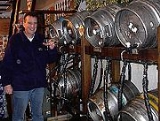
 on the side of the cask. The major difference in appearance between a keg and a cask is the shive. A keg does not have a shive on the side. The majority of casks these days are metal, and look similar to a keg, but with the rounded traditional barrel shape (kegs are often straight-sided). Even though there are still some wooden casks around, these are rare; in fact there are more plastic casks around than wooden ones. Plastic casks are increasing in popularity because they are cheaper to buy and lighter to carry, though they don't last as long, they are also less likely to be stolen as they have no melt-down value. Beer casks come in a number of sizes, but by far the most common in the pub trade are those of 9 gallon
Gallon
The gallon is a measure of volume. Historically it has had many different definitions, but there are three definitions in current use: the imperial gallon which is used in the United Kingdom and semi-officially within Canada, the United States liquid gallon and the lesser used United States dry...

s (72 pints or roughly 41 litres) which is known as a Firkin
Firkin
A firkin is an old English unit of volume. The name is derived from the Middle Dutch word vierdekijn, which means fourth, i.e. a quarter of a full-size barrel.Nor need you mind the serial ordealOf being watched from forty cellar holes...

 and 18 gallons (144 pints or roughly 83 litres) known as a Kilderkin
Kilderkin
The kilderkin is an old English unit of volume equal to half a barrel or two firkins. It was used as standard size for brewery casks. The word kilderkin comes from Dutch for a small cask. The kilderkin has historically been in the general range of 16 to 18 gallons. Based on the current imperial...

. (N.B. These are imperial
Imperial unit
The system of imperial units or the imperial system is the system of units first defined in the British Weights and Measures Act of 1824, which was later refined and reduced. The system came into official use across the British Empire...

 gallons, equal to 1.201 US gallons each.)

The soft spile in the shive allows gas to vent off. This can be seen by the bubbles foaming around the spile. The landlord will periodically check the bubbles by wiping the spile clean and then watching to see how fast the bubbles reform. There still has to be some life in the beer otherwise it will taste flat. When the beer is judged to be ready, the landlord will replace the soft spile with a hard one (which doesn't allow air in or gas out) and let the beer settle for 24 hours. He will also knock a tap into the end of the cask. This might simply be a tap if the cask is stored behind the bar. The beer will then be served simply under gravity pressure: turn on the tap, and the beer comes out. But if the cask is in the cellar, the beer needs to travel via tubes, or beer lines, and be pumped up to the bar area, normally using a handpump also known as a 'beer engine'.

Serving cask ale


A beer engine
Beer engine
A beer engine is a device for pumping beer, originally manually operated and typically used to dispense beer from a cask or container in a pub's basement or cellar. It was invented by the locksmith and hydraulic engineer Joseph Bramah in 1797...

, also known as a handpump, is used to siphon the beer from the cellar. The beer engine is a 0.5 imp pt (0.2841305 l), sometimes 0.25 imp pt (0.14206525 l), airtight piston chamber; pulling down on the handle raises the piston which drags up a half pint of beer. When a cask is first tapped into the beer engine, or after the lines have been washed through, the pump needs to be pulled several times to clear the lines of air or water. The line will continue to hold beer, which will tend to go stale overnight, so the first beer pulled through will be bad beer, and this will be simply thrown away. Most pubs will pull through at least a pint of beer on each beer engine before they open, while others will wait for the first order of beer on that pump before pulling through. Experienced bar staff will serve a pint with long, smooth, slow pulls of the pump handle, plus a short final pull just to make sure the glass is full.

A small flip tap and a short spout is the standard neck for dispensing cask ale. An alternative is a long spout with a tight 180° turn, called a "swan-neck", which is designed to force the beer into the glass, agitating it so that a fuller head is created. Some drinkers disapprove of swan-necks, believing that flavour is reduced.

In some pubs a small device or cap is fitted to the end of the spout rather like a sprinkler at the end of a hose pipe. The device is known as a "sparkler". Like the sprinkler at the end of a hose, this can be twisted to regulate the flow of the beer. When the sparkler is tight, the beer is severely agitated resulting in a large head but a significant loss of flavour and mouthfeel.This is most common in the north of England
England
England is a country that is part of the United Kingdom. It shares land borders with Scotland to the north and Wales to the west; the Irish Sea is to the north west, the Celtic Sea to the south west, with the North Sea to the east and the English Channel to the south separating it from continental...

 and Wales. Many drinkers in the north prefer their beer this way; it is softer and creamier with less bitterness. Drinkers in the South tend to prefer their beer with a touch more bitterness, and a slightly harder mouthfeel.

Some pubs disguise keg beer by having an imitation pump handle on the bar. If the bar staff have merely turned on a tap, or are just resting their hand on a very small handle with no pump action, then this is a keg beer. Exceptions are some pubs (in the north and occasionally elsewhere) which use electric pumps or the pubs in Scotland that use traditional air-pressure founts on cask ale.

It is considered perfectly acceptable to dispense beer directly from the cask, as in pubs which have a tap room rather than a cellar. Gravity dispense is often used in beer festivals as well.

Cask Marque


Cask Marque is a voluntary accreditation scheme that allows publicans to display a special symbol indicating that their cask ale is of good quality, as judged by a series of surprise inspections.

See also


  • Beer engine
    Beer engine
    A beer engine is a device for pumping beer, originally manually operated and typically used to dispense beer from a cask or container in a pub's basement or cellar. It was invented by the locksmith and hydraulic engineer Joseph Bramah in 1797...

  • Draught beer
    Draught beer
    Draught beer is beer served from a cask or a pressurised keg.-History of draught:Until Joseph Bramah patented the beer engine in 1785, beer was served directly from the barrel and carried to the customer. The Old English word for carry was dragen which developed into a series of related words,...

  • Filtered beer
    Filtered beer
    Bright beer is beer in which yeast is no longer in suspension. There are several methods used for clearing yeast from beer, from waiting for the yeast to drop of its own accord to filtering it.-Dropping bright:...

  • Microbrewery
    Microbrewery
    A microbrewery or craft brewer is a brewery which produces a limited amount of beer, and is associated by consumers with innovation and uniqueness....


External links