

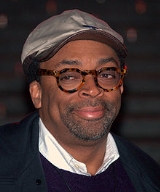
Spike Lee

Encyclopedia
Shelton Jackson "Spike" Lee (born March 20, 1957) is an American film director
, producer
, writer
, and actor
. His production company, 40 Acres & A Mule Filmworks
, has produced over 35 films since 1983.
Lee's movies have examined race relations, the role of media
in contemporary life, urban
crime
and poverty
, and other political issues. Lee has won numerous awards, including an Emmy Award
. He has also received two Academy Award nominations.
, the son of Jacqueline Carroll (née Shelton), a teacher of arts and black literature, and William James Edward Lee III
, a jazz musician and composer. Lee moved with his family to Brooklyn
, New York
when he was a small child. (The Fort Greene neighborhood is home to Lee's production company, 40 Acres & A Mule Filmworks
, and other Lee-owned or related businesses.) As a child, his mother nicknamed him "Spike." In Brooklyn, he attended John Dewey High School
. Lee enrolled in Morehouse College
where he made his first student film, Last Hustle in Brooklyn. He took film courses at Clark Atlanta University
and graduated with a B.A.
in Mass Communication
from Morehouse College
. He then enrolled in New York University
's Tisch School of the Arts
, where he earned a Master of Fine Arts
in Film & Television.
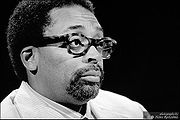 Lee's thesis
film, Joe's Bed-Stuy Barbershop: We Cut Heads
, was the first student film to be showcased in Lincoln Center's New Directors New Films Festival.
In 1985, Lee began work on his first feature film
, She's Gotta Have It
. With a budget of $175,000, the film was shot in two weeks. When the film was released in 1986, it grossed over $7,000,000 at the U.S. box office
.
The reception of She's Gotta Have It led Lee down a second career avenue. Marketing executives from Nike
offered Lee a job directing commercials for the company. They wanted to pair Lee's character from She's Gotta Have It, the Michael Jordan-loving Mars Blackmon
, and Jordan himself in their marketing campaign for the Air Jordan
line. Later, Lee would be a central figure in the controversy surrounding the inner-city rash of violence involving Air Jordans. Lee countered that instead of blaming manufacturers of apparel, "deal with the conditions that make a kid put so much importance on a pair of sneakers, a jacket and gold". Through the marketing wing of 40 Acres and a Mule, Lee has also directed commercials for Converse, Jaguar
, Taco Bell
and Ben & Jerry's
.
was nominated for an Academy Award
for Best Original Screenplay in 1989. Many people, including Hollywood's Kim Basinger
(who announced her feelings live during that year's Oscar telecast), believed that Do the Right Thing
also deserved a Best Picture nomination. Driving Miss Daisy
won Best Picture that year and according to Lee in an April 7, 2006 interview with New York
magazine, this hurt him more than his film not receiving the nomination.
His documentary
4 Little Girls
was nominated for the Best Feature Documentary Academy Award
in 1997.
On May 2, 2007, the 50th San Francisco International Film Festival honored Spike Lee with the San Francisco Film Society's Directing Award. He was the recipient of the 2008 Wexner Prize.
. Lee often appears in his films, from cameos
(Clockers) to leading roles (Do the Right Thing
). His films are referred to in their credits as "A Spike Lee Joint," except When the Levees Broke
, which is referred to as "A Spike Lee Film."
Lee films commonly feature a sequence depicting a "floating" effect, when a character seems to glide in the air like a ghost instead of walking, which is achieved by filming the actor on a camera dolly
, framed so that his or her feet are not seen. Denzel Washington
has been the focus of this shot in Mo' Better Blues
, Malcolm X
, and Inside Man
. Mekhi Phifer
is given the same treatment in Clockers, as well as Laurence Fishburne
in School Daze
, and Zelda Harris
in Crooklyn
. Philip Seymour Hoffman
and Anna Paquin
have similar shots in 25th Hour
. This also occurs with Damon Wayans
in the opening scene of Bamboozled
.
Lee incorporates baseball-related motifs in his movies. Examples include the New York Mets
in Mo' Better Blues
and Jungle Fever
, Dwight Gooden
and Roger Clemens
in Do The Right Thing
, Willie Mays
and Roberto Clemente
in Clockers, Reggie Jackson
and the New York Yankees
in Summer of Sam
, and Jackie Robinson
in Malcolm X
, amongst other recurring themes in his movies such as She Hate Me
.
, and John Turturro
lead the list at nine films, followed by Roger Guenveur Smith
and the late Ossie Davis
, with seven films.
s have appeared in Spike Lee films portraying characters other than themselves. They include
Senator Trent Lott
regarding Senator Strom Thurmond
's failed presidential bid, Lee charged that Lott was a "card-carrying member of the Ku Klux Klan
" on ABC
's Good Morning America
.
After the 1990 release of Mo' Better Blues
, Lee was accused of antisemitism by the Anti-Defamation League
and several film critics, who pointed to the characters of club owners Josh and Moe Flatbush in the film, which have been described as "Shylock
s". Lee denied the charge, explaining that he wrote those characters in order to depict how black artists struggled against exploitation. Lee further expressed skepticism that Lew Wasserman
, Sidney Sheinberg
or Tom Pollock, the Jewish heads of MCA and Universal Studios
, would have allowed antisemitic content in a film they produced. He also said he could not make an antisemitic film because Jews run Hollywood, and "that's a fact."
In the Knicks' 93–86 loss to the Indiana Pacers
in Game 5 of the 1994 Eastern Conference Finals
, Reggie Miller
scored 25 points in the 4th quarter. Lee was apparently taunting Miller throughout the 4th quarter, and Miller responded by making shot after shot. Miller also gave the choke sign to Lee. The headline of the New York Daily News
the next day sarcastically said, "Thanks A Lot Spike". This was parodied in the Seinfeld
episode "The Susie
", in which Kramer
, Lee and Miller ultimately reconcile and go to a strip club together.
In May 1999 The New York Post
reported that Lee said of National Rifle Association
President Charlton Heston
, "Shoot him with a .44 Bulldog." Lee contended, "I intended it as ironic, as a joke to show how violence begets more violence," Lee said. "I told everyone there it was a joke. I said I did not want to read in the papers, 'Shoot Charlton Heston.'" Insisting that he had no reason to apologize, Lee further explained that his remark was in response to a question about whether Hollywood was responsible for the then-recent rash of school shootings, saying, "The problem is guns," he said. Republican
House
Majority Leader
Dick Armey
issued a statement condemning Lee as having "nothing to offer the debate on school violence except more violence and more hate."
Lee sparked controversy on a March 28, 2004 segment on ABC
when he said that basketball player Larry Bird
was overrated because of his race, saying, "The most overrated player of all time, I would say it'd be Larry Bird
. Now, Larry Bird is one of the greatest players of all time, but listen to the white media, it's like this guy was like nobody ever played basketball before him—Larry Bird, Larry Bird, Larry Bird, Larry Bird, Larry Bird."
In October 2005, Lee commented on the federal government's response to the 2005 Hurricane Katrina catastrophe. Responding to a CNN
anchor's question as to whether the government intentionally ignored the plight of black Americans during the disaster, Lee replied, "It's not too far-fetched. I don't put anything past the United States government. I don't find it too far-fetched that they tried to displace all the black people out of New Orleans." On Real Time with Bill Maher
, Lee cited the government's past atrocities including the Tuskegee Study of Untreated Syphilis in the Negro Male.
At the 2008 Cannes Film Festival, Lee, who was then making Miracle at St. Anna
, about an all-black U.S. division fighting in Italy during World War II
, criticized director Clint Eastwood
for not depicting black Marines in his own WWII film, Flags of Our Fathers
. Citing historical accuracy, Eastwood responded that his film was specifically about the soldiers who raised the flag on Mount Suribachi at Iwo Jima
, pointing out that while black soldiers did fight at Iwo Jima, the U.S. military was segregated during WWII, and none of the men who raised the flag were black. Eastwood also pointed out that his 1988 film Bird, about the Jazz musician Charlie Parker
featured 90% black actors, and sarcastically said that Invictus
, his then-upcoming movie about post-apartheid South Africa
, would not feature a white actor in the role of Nelson Mandela
. He angrily said that Lee should "shut his face". Lee responded that Eastwood was acting like an "angry old man", and argued that despite making two Iwo Jima films back to back, Letters from Iwo Jima
and Flags of Our Fathers, "there was not one black soldier in both of those films". He added that he and Eastwood were "not on a plantation." In fact, black Marines are seen in scenes during which the mission is outlined, as well as during the initial landings, when a wounded black Marine is carried away. During the end credits, historical photographs taken during the Battle of Iwo Jima show black Marines. Although black Marines fought in the battle, they were restricted to auxiliary roles such as ammunition supply, and were not involved in the battle's major assaults, but took part in defensive actions. Lee later claimed that the event was exaggerated by the media and that he and Eastwood had reconciled through mutual friend Steven Spielberg
, culminating in his sending Eastwood a print of Miracle at St. Anna.
During a lecture at Concordia University in Montreal, Canada on February 11, 2009, Lee criticized how some in the black community wrongfully associate "intelligence with acting white, and ignorance with acting black", admonishing students and parents to maintain more positive attitudes in order to follow their dreams and achieving their goals.
Tonya Lewis, had their first child, daughter Satchel, in December 1994. Spike Lee is a fan of the American baseball team the New York Yankees
, basketball team the New York Knicks
, and the English football team . One of the documentaries in ESPN
's 30 for 30
series, Winning Time: Reggie Miller
vs. The New York Knicks, focuses partly on Lee's interaction with Miller at Knicks games in Madison Square Garden
.
Film director
A film director is a person who directs the actors and film crew in filmmaking. They control a film's artistic and dramatic nathan roach, while guiding the technical crew and actors.-Responsibilities:...
, producer
Film producer
A film producer oversees and delivers a film project to all relevant parties while preserving the integrity, voice and vision of the film. They will also often take on some financial risk by using their own money, especially during the pre-production period, before a film is fully financed.The...
, writer
Screenwriter
Screenwriters or scriptwriters or scenario writers are people who write/create the short or feature-length screenplays from which mass media such as films, television programs, Comics or video games are based.-Profession:...
, and actor
Actor
An actor is a person who acts in a dramatic production and who works in film, television, theatre, or radio in that capacity...
. His production company, 40 Acres & A Mule Filmworks
40 Acres & A Mule Filmworks
40 Acres & A Mule Filmworks is the production company of noted American filmmaker Spike Lee .The company is named after a famous episode of early Reconstruction. In 1865, General Sherman issued "Special Field Order 15", which ordered the distribution of lots of to some freed black families on the...
, has produced over 35 films since 1983.
Lee's movies have examined race relations, the role of media
Mass media
Mass media refers collectively to all media technologies which are intended to reach a large audience via mass communication. Broadcast media transmit their information electronically and comprise of television, film and radio, movies, CDs, DVDs and some other gadgets like cameras or video consoles...
in contemporary life, urban
Urban area
An urban area is characterized by higher population density and vast human features in comparison to areas surrounding it. Urban areas may be cities, towns or conurbations, but the term is not commonly extended to rural settlements such as villages and hamlets.Urban areas are created and further...
crime
Crime
Crime is the breach of rules or laws for which some governing authority can ultimately prescribe a conviction...
and poverty
Poverty
Poverty is the lack of a certain amount of material possessions or money. Absolute poverty or destitution is inability to afford basic human needs, which commonly includes clean and fresh water, nutrition, health care, education, clothing and shelter. About 1.7 billion people are estimated to live...
, and other political issues. Lee has won numerous awards, including an Emmy Award
Emmy Award
An Emmy Award, often referred to simply as the Emmy, is a television production award, similar in nature to the Peabody Awards but more focused on entertainment, and is considered the television equivalent to the Academy Awards and the Grammy Awards .A majority of Emmys are presented in various...
. He has also received two Academy Award nominations.
Early life
Spike Lee was born in Atlanta, GeorgiaGeorgia (U.S. state)
Georgia is a state located in the southeastern United States. It was established in 1732, the last of the original Thirteen Colonies. The state is named after King George II of Great Britain. Georgia was the fourth state to ratify the United States Constitution, on January 2, 1788...
, the son of Jacqueline Carroll (née Shelton), a teacher of arts and black literature, and William James Edward Lee III
Bill Lee (musician)
William James Edwards "Bill" Lee III is an American musician. He has played the bass for many artists including Cat Stevens, Harry Belafonte, Chad Mitchell Trio, Gordon Lightfoot, Aretha Franklin, Odetta, Simon and Garfunkel, and Bob Dylan...
, a jazz musician and composer. Lee moved with his family to Brooklyn
Brooklyn
Brooklyn is the most populous of New York City's five boroughs, with nearly 2.6 million residents, and the second-largest in area. Since 1896, Brooklyn has had the same boundaries as Kings County, which is now the most populous county in New York State and the second-most densely populated...
, New York
New York
New York is a state in the Northeastern region of the United States. It is the nation's third most populous state. New York is bordered by New Jersey and Pennsylvania to the south, and by Connecticut, Massachusetts and Vermont to the east...
when he was a small child. (The Fort Greene neighborhood is home to Lee's production company, 40 Acres & A Mule Filmworks
40 Acres & A Mule Filmworks
40 Acres & A Mule Filmworks is the production company of noted American filmmaker Spike Lee .The company is named after a famous episode of early Reconstruction. In 1865, General Sherman issued "Special Field Order 15", which ordered the distribution of lots of to some freed black families on the...
, and other Lee-owned or related businesses.) As a child, his mother nicknamed him "Spike." In Brooklyn, he attended John Dewey High School
John Dewey High School
John Dewey High School, commonly referred to as JDHS or just Dewey is a public school in Brooklyn, New York City, New York, founded and based on the educational principles of John Dewey. It opened in the Fall of 1969 and is located at 50 Avenue X at the Gravesend/Bensonhurst-Bath Beach border of...
. Lee enrolled in Morehouse College
Morehouse College
Morehouse College is a private, all-male, liberal arts, historically black college located in Atlanta, Georgia. Along with Hampden-Sydney College and Wabash College, Morehouse is one of three remaining traditional men's colleges in the United States....
where he made his first student film, Last Hustle in Brooklyn. He took film courses at Clark Atlanta University
Clark Atlanta University
Clark Atlanta University is a private, historically black university in Atlanta, Georgia. It was formed in 1988 with the consolidation of Clark College and Atlanta University...
and graduated with a B.A.
Bachelor of Arts
A Bachelor of Arts , from the Latin artium baccalaureus, is a bachelor's degree awarded for an undergraduate course or program in either the liberal arts, the sciences, or both...
in Mass Communication
Mass communication
Mass communication is the term used to describe the academic study of the various means by which individuals and entities relay information through mass media to large segments of the population at the same time...
from Morehouse College
Morehouse College
Morehouse College is a private, all-male, liberal arts, historically black college located in Atlanta, Georgia. Along with Hampden-Sydney College and Wabash College, Morehouse is one of three remaining traditional men's colleges in the United States....
. He then enrolled in New York University
New York University
New York University is a private, nonsectarian research university based in New York City. NYU's main campus is situated in the Greenwich Village section of Manhattan...
's Tisch School of the Arts
Tisch School of the Arts
Tisch School of the Arts is one of the 15 schools that make up New York University ....
, where he earned a Master of Fine Arts
Master of Fine Arts
A Master of Fine Arts is a graduate degree typically requiring 2–3 years of postgraduate study beyond the bachelor's degree , although the term of study will vary by country or by university. The MFA is usually awarded in visual arts, creative writing, filmmaking, dance, or theatre/performing arts...
in Film & Television.
Film career
Thesis
A dissertation or thesis is a document submitted in support of candidature for an academic degree or professional qualification presenting the author's research and findings...
film, Joe's Bed-Stuy Barbershop: We Cut Heads
Joe's Bed-Stuy Barbershop: We Cut Heads
Joe's Bed-Stuy Barbershop: We Cut Heads is a 1983 independent film that Spike Lee submitted as his master's degree thesis at the Tisch School of the Arts....
, was the first student film to be showcased in Lincoln Center's New Directors New Films Festival.
In 1985, Lee began work on his first feature film
Feature film
In the film industry, a feature film is a film production made for initial distribution in theaters and being the main attraction of the screening, rather than a short film screened before it; a full length movie...
, She's Gotta Have It
She's Gotta Have It
She's Gotta Have It is a 1986 American comedy-drama film written and directed by Spike Lee. It was also Lee's first feature-length film. The film stars Tracy Camilla Johns, Tommy Redmond Hicks and John Canada Terrell. Also appearing are cinematographer Ernest Dickerson as a Brooklyn resident and...
. With a budget of $175,000, the film was shot in two weeks. When the film was released in 1986, it grossed over $7,000,000 at the U.S. box office
Box office
A box office is a place where tickets are sold to the public for admission to an event. Patrons may perform the transaction at a countertop, through an unblocked hole through a wall or window, or at a wicket....
.
The reception of She's Gotta Have It led Lee down a second career avenue. Marketing executives from Nike
Nike, Inc.
Nike, Inc. is a major publicly traded sportswear and equipment supplier based in the United States. The company is headquartered near Beaverton, Oregon, which is part of the Portland metropolitan area...
offered Lee a job directing commercials for the company. They wanted to pair Lee's character from She's Gotta Have It, the Michael Jordan-loving Mars Blackmon
Mars Blackmon
Mars Blackmon is a fictional character in the film She's Gotta Have It , played by its writer/director, Spike Lee. In the film, he is a "Brooklyn-loving", sports-loving, die-hard New York Knicks fan. During the late 1980s and early 1990s, "Mars Blackmon" became the primary pitchman in Nike...
, and Jordan himself in their marketing campaign for the Air Jordan
Air Jordan
Air Jordan, also known simply as Jordans, are a brand of shoes and athletic apparel produced by Nike originally designed for and endorsed by NBA Hall of Famer and Six Time NBA Champion Michael Jordan. The Air Jordan line is now sold by the Jordan Brand subsidiary of Nike...
line. Later, Lee would be a central figure in the controversy surrounding the inner-city rash of violence involving Air Jordans. Lee countered that instead of blaming manufacturers of apparel, "deal with the conditions that make a kid put so much importance on a pair of sneakers, a jacket and gold". Through the marketing wing of 40 Acres and a Mule, Lee has also directed commercials for Converse, Jaguar
Jaguar (car)
Jaguar Cars Ltd, known simply as Jaguar , is a British luxury car manufacturer, headquartered in Whitley, Coventry, England. It is part of the Jaguar Land Rover business, a subsidiary of the Indian company Tata Motors....
, Taco Bell
Taco Bell
Taco Bell is an American chain of fast-food restaurants based in Irvine, California. A subsidiary of Yum! Brands, Inc., which serves American-adapted Mexican food. Taco Bell serves tacos, burritos, quesadillas, nachos, other specialty items, and a variety of "Value Menu" items...
and Ben & Jerry's
Ben & Jerry's
Ben & Jerry's is an American ice cream company, a division of the British-Dutch Unilever conglomerate, that manufactures ice cream, frozen yogurt, sorbet, and ice cream novelty products, manufactured by Ben & Jerry's Homemade Holdings, Inc., headquartered in South Burlington, Vermont, United...
.
Awards, honors and nominations
Lee's film Do the Right ThingDo the Right Thing
Do the Right Thing is a 1989 American dramedy produced, written, and directed by Spike Lee, who is also a featured actor in the film. Other members of the cast include Danny Aiello, Ossie Davis, Ruby Dee, Richard Edson, Giancarlo Esposito, Bill Nunn, and John Turturro. It is also notably the...
was nominated for an Academy Award
Academy Awards
An Academy Award, also known as an Oscar, is an accolade bestowed by the American Academy of Motion Picture Arts and Sciences to recognize excellence of professionals in the film industry, including directors, actors, and writers...
for Best Original Screenplay in 1989. Many people, including Hollywood's Kim Basinger
Kim Basinger
Kimila Ann "Kim" Basinger is an American actress and former fashion model.She is known for her portrayals of Domino Petachi, the Bond girl in Never Say Never Again , and Vicki Vale, the female lead in Batman . Basinger received a Golden Globe Award for Best Supporting Actress – Motion Picture...
(who announced her feelings live during that year's Oscar telecast), believed that Do the Right Thing
Do the Right Thing
Do the Right Thing is a 1989 American dramedy produced, written, and directed by Spike Lee, who is also a featured actor in the film. Other members of the cast include Danny Aiello, Ossie Davis, Ruby Dee, Richard Edson, Giancarlo Esposito, Bill Nunn, and John Turturro. It is also notably the...
also deserved a Best Picture nomination. Driving Miss Daisy
Driving Miss Daisy
Driving Miss Daisy is a 1989 American comedy-drama film adapted from the Alfred Uhry play of the same name. The film was directed by Bruce Beresford, with Morgan Freeman reprising his role as Hoke Colburn and Jessica Tandy playing Miss Daisy...
won Best Picture that year and according to Lee in an April 7, 2006 interview with New York
New York (magazine)
New York is a weekly magazine principally concerned with the life, culture, politics, and style of New York City. Founded by Milton Glaser and Clay Felker in 1968 as a competitor to The New Yorker, it was brasher and less polite than that magazine, and established itself as a cradle of New...
magazine, this hurt him more than his film not receiving the nomination.
His documentary
Documentary film
Documentary films constitute a broad category of nonfictional motion pictures intended to document some aspect of reality, primarily for the purposes of instruction or maintaining a historical record...
4 Little Girls
4 Little Girls
4 Little Girls is a 1997 American historical documentary film about the 1963 murder of four African-American girls during the 16th Street Baptist Church bombing in Birmingham, Alabama, United States. It was directed by Spike Lee and nominated for an Academy Award for "Best Documentary".The incident...
was nominated for the Best Feature Documentary Academy Award
Academy Awards
An Academy Award, also known as an Oscar, is an accolade bestowed by the American Academy of Motion Picture Arts and Sciences to recognize excellence of professionals in the film industry, including directors, actors, and writers...
in 1997.
On May 2, 2007, the 50th San Francisco International Film Festival honored Spike Lee with the San Francisco Film Society's Directing Award. He was the recipient of the 2008 Wexner Prize.
Themes and style
Many of Lee's films are set in BrooklynBrooklyn
Brooklyn is the most populous of New York City's five boroughs, with nearly 2.6 million residents, and the second-largest in area. Since 1896, Brooklyn has had the same boundaries as Kings County, which is now the most populous county in New York State and the second-most densely populated...
. Lee often appears in his films, from cameos
Cameo appearance
A cameo role or cameo appearance is a brief appearance of a known person in a work of the performing arts, such as plays, films, video games and television...
(Clockers) to leading roles (Do the Right Thing
Do the Right Thing
Do the Right Thing is a 1989 American dramedy produced, written, and directed by Spike Lee, who is also a featured actor in the film. Other members of the cast include Danny Aiello, Ossie Davis, Ruby Dee, Richard Edson, Giancarlo Esposito, Bill Nunn, and John Turturro. It is also notably the...
). His films are referred to in their credits as "A Spike Lee Joint," except When the Levees Broke
When the Levees Broke
When the Levees Broke: A Requiem in Four Acts is a 2006 documentary film directed by Spike Lee about the devastation of New Orleans, Louisiana due to the failure of the levees during Hurricane Katrina. It was filmed in late August and early September 2005, and premiered at the New Orleans Arena on...
, which is referred to as "A Spike Lee Film."
Lee films commonly feature a sequence depicting a "floating" effect, when a character seems to glide in the air like a ghost instead of walking, which is achieved by filming the actor on a camera dolly
Camera dolly
A camera dolly is a specialized piece of filmmaking and television production equipment designed to create smooth camera movements . The camera is mounted to the dolly and the camera operator and focus puller or camera assistant, usually ride on the dolly to operate the camera...
, framed so that his or her feet are not seen. Denzel Washington
Denzel Washington
Denzel Hayes Washington Jr. is an American actor, screenwriter, director, and film producer. He first rose to prominence when he joined the cast of the medical drama, St. Elsewhere, playing Dr...
has been the focus of this shot in Mo' Better Blues
Mo' Better Blues
Mo' Better Blues is a 1990 drama film starring Denzel Washington, Wesley Snipes, and Spike Lee, who also directed. It follows a period in the life of a fictional jazz trumpeter Bleek Gilliam as a series of bad decisions result in his jeopardizing both his relationships and his playing career...
, Malcolm X
Malcolm X (film)
Malcolm X is a 1992 biographical motion picture about the Muslim-American figure Malcolm X . It was co-written, co-produced, and directed by Spike Lee. It stars Denzel Washington as the titular character. It co-stars Angela Bassett, Albert Hall, Al Freeman, Jr., and Delroy Lindo...
, and Inside Man
Inside Man
Inside Man is a 2006 crime-drama film directed by Spike Lee. It stars Denzel Washington, Clive Owen, Willem Dafoe and Jodie Foster. The film's screenplay was written by Russell Gewirtz and produced by Brian Grazer...
. Mekhi Phifer
Mekhi Phifer
Mekhi Thira Phifer is an American actor. He is perhaps best known for his multi-year role as Dr. Greg Pratt on NBC's long-running medical drama ER and his co-starring role opposite Eminem in the feature film 8 Mile...
is given the same treatment in Clockers, as well as Laurence Fishburne
Laurence Fishburne
Laurence John Fishburne III is an American film and stage actor, playwright, director, and producer. He is perhaps best known for his roles as Morpheus in the Matrix science fiction film trilogy, as Cowboy Curtis on the 1980's television show Pee-wee's Playhouse, and as singer-musician Ike Turner...
in School Daze
School Daze
School Daze is a 1988 American musical-drama film, written and directed by Spike Lee, and starring Laurence Fishburne, Giancarlo Esposito, and Tisha Campbell-Martin...
, and Zelda Harris
Zelda Harris
Zelda Harris is an American actress.Harris was born in New York City, New York to Karen and Philip Harris. She has a sister, Kenya. She attended Princeton University, where she was a member of the Class of 2007.- Filmography :...
in Crooklyn
Crooklyn
Crooklyn is a 1994 semi-autobiographical film co-written and directed by Spike Lee. The film takes place in Brooklyn, New York and the neighborhood of Bedford-Stuyvesant during the summer of 1973. Its primary focus is a young girl, Troy , and her family...
. Philip Seymour Hoffman
Philip Seymour Hoffman
Philip Seymour Hoffman is an American actor and director. Hoffman began acting in television in 1991, and the following year started to appear in films...
and Anna Paquin
Anna Paquin
Anna Helene Paquin is a Canadian-born New Zealand actress. Paquin's first critically successful film was The Piano, for which she won the Academy Award for Best Supporting Actress in 1994 at the age of 11 – the second youngest winner in history...
have similar shots in 25th Hour
25th Hour
25th Hour is a 2002 American drama film directed by Spike Lee and is based on the novel The 25th Hour written by David Benioff, who also wrote the screenplay. The film stars Edward Norton, Philip Seymour Hoffman, Barry Pepper, Rosario Dawson, Anna Paquin, and Brian Cox...
. This also occurs with Damon Wayans
Damon Wayans
Damon Kyle Wayans is an American stand-up comedian, writer and actor, one of the Wayans brothers.-Early life:Wayans was born in New York City, New York, the son of Elvira, a homemaker and social worker, and Howell Wayans, a supermarket manager...
in the opening scene of Bamboozled
Bamboozled
Bamboozled is a 2000 satirical film written and directed by Spike Lee about a modern televised minstrel show featuring black actors donning blackface makeup and the violent fall-out from the show's success...
.
Lee incorporates baseball-related motifs in his movies. Examples include the New York Mets
New York Mets
The New York Mets are a professional baseball team based in the borough of Queens in New York City, New York. They belong to Major League Baseball's National League East Division. One of baseball's first expansion teams, the Mets were founded in 1962 to replace New York's departed National League...
in Mo' Better Blues
Mo' Better Blues
Mo' Better Blues is a 1990 drama film starring Denzel Washington, Wesley Snipes, and Spike Lee, who also directed. It follows a period in the life of a fictional jazz trumpeter Bleek Gilliam as a series of bad decisions result in his jeopardizing both his relationships and his playing career...
and Jungle Fever
Jungle Fever
Jungle Fever is a 1991 American drama film directed by Spike Lee, starring Wesley Snipes and Annabella Sciorra. It was Lee's fifth feature-length film. The film mainly explores interracial relationships...
, Dwight Gooden
Dwight Gooden
Dwight Eugene Gooden , nicknamed "Doc Gooden" or "Dr. K", is a former Major League Baseball pitcher. He was one of the most dominant and feared pitchers in the National League in the middle and late 1980s.-Career:...
and Roger Clemens
Roger Clemens
William Roger Clemens , nicknamed "Rocket", is a former Major League Baseball pitcher who broke into the league with the Boston Red Sox, whose pitching staff he would help anchor for 12 years. Clemens won seven Cy Young Awards, more than any other pitcher. He played for four different teams over...
in Do The Right Thing
Do the Right Thing
Do the Right Thing is a 1989 American dramedy produced, written, and directed by Spike Lee, who is also a featured actor in the film. Other members of the cast include Danny Aiello, Ossie Davis, Ruby Dee, Richard Edson, Giancarlo Esposito, Bill Nunn, and John Turturro. It is also notably the...
, Willie Mays
Willie Mays
Willie Howard Mays, Jr. is a retired American professional baseball player who played the majority of his major league career with the New York and San Francisco Giants before finishing with the New York Mets. Nicknamed The Say Hey Kid, Mays was elected to the Baseball Hall of Fame in 1979, his...
and Roberto Clemente
Roberto Clemente
Roberto Clemente Walker was a Puerto Rican Major League Baseball right fielder. He was born in Carolina, Puerto Rico, the youngest of seven children. Clemente played his entire 18-year baseball career with the Pittsburgh Pirates . He was awarded the National League's Most Valuable Player Award in...
in Clockers, Reggie Jackson
Reggie Jackson
Reginald Martinez "Reggie" Jackson , nicknamed "Mr. October" for his clutch hitting in the postseason with the New York Yankees, is a former American Major League Baseball right fielder. During a 21-year baseball career, he played from 1967-1987 for four different teams. Jackson currently serves as...
and the New York Yankees
New York Yankees
The New York Yankees are a professional baseball team based in the The Bronx, New York. They compete in Major League Baseball in the American League's East Division...
in Summer of Sam
Summer of Sam
Summer of Sam is a 1999 crime-drama based around the Son of Sam serial murders. It was directed and produced by Spike Lee.-Plot:Summer of Sam is the story of a group of people in New York City in the summer of 1977, a time when the headlines were dominated by the Son of Sam serial killer...
, and Jackie Robinson
Jackie Robinson
Jack Roosevelt "Jackie" Robinson was the first black Major League Baseball player of the modern era. Robinson broke the baseball color line when he debuted with the Brooklyn Dodgers in 1947...
in Malcolm X
Malcolm X (film)
Malcolm X is a 1992 biographical motion picture about the Muslim-American figure Malcolm X . It was co-written, co-produced, and directed by Spike Lee. It stars Denzel Washington as the titular character. It co-stars Angela Bassett, Albert Hall, Al Freeman, Jr., and Delroy Lindo...
, amongst other recurring themes in his movies such as She Hate Me
She Hate Me
She Hate Me is a 2004 independent comedy-drama film directed by Spike Lee and starring Anthony Mackie, Kerry Washington, Ellen Barkin, Monica Bellucci, Brian Dennehy, Woody Harrelson, Bai Ling and John Turturro....
.
Recurring actors
A number of actors have appeared in multiple Spike Lee productions. Spike's sister, Joie LeeJoie Lee
Joie Susannah Lee is an American screenwriter, film producer and actress. She has appeared in many of the films directed by her brother, Spike Lee, including She's Gotta Have It , School Daze , Do the Right Thing , and Mo' Better Blues...
, and John Turturro
John Turturro
John Michael Turturro is an American actor, writer and director known for his roles in the films Do the Right Thing , Miller's Crossing , Barton Fink , Quiz Show , The Big Lebowski , O Brother, Where Art Thou? and the Transformers film series...
lead the list at nine films, followed by Roger Guenveur Smith
Roger Guenveur Smith
Roger Guenveur Smith is an American actor, director, and writer.-Early life:Smith was born in Berkeley, California, the son of Helen Guenveur, a dentist, and Sherman Smith, a judge...
and the late Ossie Davis
Ossie Davis
Ossie Davis was an American film actor, director, poet, playwright, writer, and social activist.-Early years:...
, with seven films.
| Actor | Joe's Bed-Stuy Barbershop: We Cut Heads Joe's Bed-Stuy Barbershop: We Cut Heads Joe's Bed-Stuy Barbershop: We Cut Heads is a 1983 independent film that Spike Lee submitted as his master's degree thesis at the Tisch School of the Arts.... (1983) | She's Gotta Have It She's Gotta Have It She's Gotta Have It is a 1986 American comedy-drama film written and directed by Spike Lee. It was also Lee's first feature-length film. The film stars Tracy Camilla Johns, Tommy Redmond Hicks and John Canada Terrell. Also appearing are cinematographer Ernest Dickerson as a Brooklyn resident and... (1986) | School Daze School Daze School Daze is a 1988 American musical-drama film, written and directed by Spike Lee, and starring Laurence Fishburne, Giancarlo Esposito, and Tisha Campbell-Martin... (1988) | Do the Right Thing Do the Right Thing Do the Right Thing is a 1989 American dramedy produced, written, and directed by Spike Lee, who is also a featured actor in the film. Other members of the cast include Danny Aiello, Ossie Davis, Ruby Dee, Richard Edson, Giancarlo Esposito, Bill Nunn, and John Turturro. It is also notably the... (1989) | Mo' Better Blues Mo' Better Blues Mo' Better Blues is a 1990 drama film starring Denzel Washington, Wesley Snipes, and Spike Lee, who also directed. It follows a period in the life of a fictional jazz trumpeter Bleek Gilliam as a series of bad decisions result in his jeopardizing both his relationships and his playing career... (1990) | Jungle Fever Jungle Fever Jungle Fever is a 1991 American drama film directed by Spike Lee, starring Wesley Snipes and Annabella Sciorra. It was Lee's fifth feature-length film. The film mainly explores interracial relationships... (1991) | Malcolm X Malcolm X (film) Malcolm X is a 1992 biographical motion picture about the Muslim-American figure Malcolm X . It was co-written, co-produced, and directed by Spike Lee. It stars Denzel Washington as the titular character. It co-stars Angela Bassett, Albert Hall, Al Freeman, Jr., and Delroy Lindo... (1992) | Crooklyn Crooklyn Crooklyn is a 1994 semi-autobiographical film co-written and directed by Spike Lee. The film takes place in Brooklyn, New York and the neighborhood of Bedford-Stuyvesant during the summer of 1973. Its primary focus is a young girl, Troy , and her family... (1994) | Clockers (1995) | Girl 6 Girl 6 Girl 6 may refer to:*Girl 6, a 1996 film by Spike Lee*Girl 6 , the soundtrack for the film, composed by Prince*“Girl 6” , the title song for the soundtrack... (1995) | Get on the Bus Get on the Bus Get on the Bus is a 1996 film about a group of African-American men who are taking a cross-country bus trip in order to participate in the Million Man March. The film was directed by Spike Lee and premiered on the one-year anniversary of the march.... (1996) | 4 Little Girls 4 Little Girls 4 Little Girls is a 1997 American historical documentary film about the 1963 murder of four African-American girls during the 16th Street Baptist Church bombing in Birmingham, Alabama, United States. It was directed by Spike Lee and nominated for an Academy Award for "Best Documentary".The incident... (1997) | He Got Game He Got Game He Got Game is a 1998 American sports-drama film written and directed by Spike Lee. It stars Denzel Washington as Jake Shuttlesworth, a prison inmate convicted for killing his wife... (1998) | Freak Freak (film) Freak is a 1998 film directed by Spike Lee. The film is a live performance of John Leguizamo's one man show on Broadway of the same name. Leguizamo's show was semi-autobiographical as he would talk about many aspects of his life. In the routine, he also talks about family members such as his... (1998) | Summer of Sam Summer of Sam Summer of Sam is a 1999 crime-drama based around the Son of Sam serial murders. It was directed and produced by Spike Lee.-Plot:Summer of Sam is the story of a group of people in New York City in the summer of 1977, a time when the headlines were dominated by the Son of Sam serial killer... (1999) | The Original Kings of Comedy The Original Kings of Comedy The Original Kings of Comedy is a 2000 stand-up comedy film, directed by Spike Lee, and featuring the comedy routines of Steve Harvey, D.L. Hughley, Cedric the Entertainer, and Bernie Mac. Filmed in front of an audience at the Charlotte Coliseum in Charlotte, North Carolina, the comedians give the... (2000) | Bamboozled Bamboozled Bamboozled is a 2000 satirical film written and directed by Spike Lee about a modern televised minstrel show featuring black actors donning blackface makeup and the violent fall-out from the show's success... (2000) | A Huey P. Newton Story A Huey P. Newton Story A Huey P. Newton Story is an American documentary directed by Spike Lee. The movie was created, written and performed, as a solo performance, by Roger Guenveur Smith at The Joseph Papp Public Theatre. In this performance, Smith creates a representation of the activist Huey P. Newton’s life and time... (2001) | 25th Hour 25th Hour 25th Hour is a 2002 American drama film directed by Spike Lee and is based on the novel The 25th Hour written by David Benioff, who also wrote the screenplay. The film stars Edward Norton, Philip Seymour Hoffman, Barry Pepper, Rosario Dawson, Anna Paquin, and Brian Cox... (2002) | She Hate Me She Hate Me She Hate Me is a 2004 independent comedy-drama film directed by Spike Lee and starring Anthony Mackie, Kerry Washington, Ellen Barkin, Monica Bellucci, Brian Dennehy, Woody Harrelson, Bai Ling and John Turturro.... (2004) | Inside Man Inside Man Inside Man is a 2006 crime-drama film directed by Spike Lee. It stars Denzel Washington, Clive Owen, Willem Dafoe and Jodie Foster. The film's screenplay was written by Russell Gewirtz and produced by Brian Grazer... (2006) | When the Levees Broke When the Levees Broke When the Levees Broke: A Requiem in Four Acts is a 2006 documentary film directed by Spike Lee about the devastation of New Orleans, Louisiana due to the failure of the levees during Hurricane Katrina. It was filmed in late August and early September 2005, and premiered at the New Orleans Arena on... (2006) | Miracle at St. Anna Miracle at St. Anna Miracle at St. Anna is a 2008 war film, directed by Spike Lee and written by James McBride, based on McBride's novel of the same name. The film was released on September 26, 2008, and is set during World War II, in fall of 1944 in Tuscany and in the winter of 1983 in New York City and Rome... (2008) |
|---|---|---|---|---|---|---|---|---|---|---|---|---|---|---|---|---|---|---|---|---|---|---|---|
| Danny Aiello Danny Aiello Daniel Louis "Danny" Aiello, Jr. is an American actor who has appeared in numerous motion pictures, including Once Upon a Time in America, Ruby, The Godfather: Part II, Hudson Hawk, The Purple Rose of Cairo, Moonstruck, Léon, Two Days in the Valley, and Dinner Rush... |
|||||||||||||||||||||||
| Michael Badalucco Michael Badalucco Michael Badalucco is an American actor most famous for his role as lawyer Jimmy Berluti on the ABC legal drama The Practice... |
|||||||||||||||||||||||
| Thomas Jefferson Byrd Thomas Jefferson Byrd Thomas Jefferson Byrd is an American actor. He is a member of Omega Psi Phi Fraternity.-Filmography:* Clockers * Girl 6 * Get on the Bus * Set It Off * Touch Me * He Got Game... |
|||||||||||||||||||||||
| Ossie Davis Ossie Davis Ossie Davis was an American film actor, director, poet, playwright, writer, and social activist.-Early years:... |
|||||||||||||||||||||||
| Rosario Dawson Rosario Dawson Rosario Isabel Dawson is an American actress, singer, and writer. She has appeared in films such as Kids, Men in Black II, 25th Hour, Sin City, Clerks II, Rent, Death Proof, The Rundown, Eagle Eye, Alexander, Seven Pounds, Percy Jackson and the Olympians: The Lightning Thief and Unstoppable.-Early... |
|||||||||||||||||||||||
| Kim Director Kim Director -Biography:Director was born in Florida, graduated from Upper St. Clair High School, in Upper St. Clair Township, Pittsburgh, Allegheny County, Pennsylvania, in 1993 and attended Carnegie Mellon University where she earned a Bachelor of Fine Arts in Acting... |
|||||||||||||||||||||||
| Chiwetel Ejiofor Chiwetel Ejiofor Chiwetelu Umeadi "Chiwetel" Ejiofor, OBE is an English actor of stage and screen. He has received numerous acting awards and award nominations, including the 2006 BAFTA Awards Rising Star, three Golden Globe Awards' nominations, and the 2008 Laurence Olivier Award for Best Actor for his... |
|||||||||||||||||||||||
| Giancarlo Esposito Giancarlo Esposito Giancarlo Giuseppe Alessandro Esposito is a Danish-born American film and television actor and director.-Early life:Esposito was born in Copenhagen, Denmark to an Italian father and African-American mother. His mother was an opera and nightclub singer from Alabama, who once appeared on the same... |
|||||||||||||||||||||||
| Robin Harris Robin Harris Robin Hughes Harris was an American comedian and actor, known for his recurring comic sketch about Bébé's Kids.-Childhood:... |
|||||||||||||||||||||||
| Zelda Harris Zelda Harris Zelda Harris is an American actress.Harris was born in New York City, New York to Karen and Philip Harris. She has a sister, Kenya. She attended Princeton University, where she was a member of the Class of 2007.- Filmography :... |
|||||||||||||||||||||||
| Michael Imperioli Michael Imperioli James Michael Imperioli , commonly known as Michael Imperioli, is an American actor and television writer. He is perhaps best known for his role as Christopher Moltisanti on The Sopranos for which he won the Primetime Emmy Award for Outstanding Supporting Actor in a Drama Series in 2004. He also... |
|||||||||||||||||||||||
| Samuel L. Jackson Samuel L. Jackson Samuel Leroy Jackson is an American film and television actor and film producer. After becoming involved with the Civil Rights Movement, he moved on to acting in theater at Morehouse College, and then films. He had several small roles such as in the film Goodfellas before meeting his mentor,... |
|||||||||||||||||||||||
| Joie Lee Joie Lee Joie Susannah Lee is an American screenwriter, film producer and actress. She has appeared in many of the films directed by her brother, Spike Lee, including She's Gotta Have It , School Daze , Do the Right Thing , and Mo' Better Blues... |
|||||||||||||||||||||||
| John Leguizamo John Leguizamo Jonathan Alberto "John" Leguizamo is an Colombian-American actor, producer, voice artist, and comedian.-Early life:... |
|||||||||||||||||||||||
| Delroy Lindo Delroy Lindo Delroy George Lindo is an English actor and theatre director. Lindo has been nominated for the Tony and Screen Actors Guild awards and has won a Satellite Award... |
|||||||||||||||||||||||
| Bernie Mac Bernie Mac Bernard Jeffrey McCullough , better known by his stage name, Bernie Mac, was an American actor and comedian. Born and raised on the South Side of Chicago, Mac gained popularity as a stand-up comedian. He joined comedians Steve Harvey, Cedric the Entertainer, and D. L... |
|||||||||||||||||||||||
| Lonette McKee Lonette McKee Lonette McKee is an American film and television actress, music composer/producer/songwriter, screenwriter and director.-Biography:... |
|||||||||||||||||||||||
| Coati Mundi Coati Mundi Coati Mundi is the stage name of American musician Andy Hernandez, percussionist, notably playing the vibraphone, and member of Dr. Buzzard's Original Savannah Band, then of Kid Creole and the Coconuts. He scored the Top 40 UK hit "Me No Pop I" in 1981, just before the release of Tropical Gangsters... |
|||||||||||||||||||||||
| Charlie Murphy Charlie Murphy Charles Quinton "Charlie" Murphy is an American actor, comedian, and writer notable as being a cast member and writer on the Comedy Central sketch-comedy series Chappelle's Show... |
|||||||||||||||||||||||
| Bill Nunn Bill Nunn -Early life:Nunn was born in Pittsburgh, Pennsylvania, the son of William G. Nunn, Jr., a well-known journalist and editor at the Pittsburgh Courier, as well as an NFL scout. Nunn's paternal grandfather was the first African American football player at George Westinghouse High School.Nunn was a... |
|||||||||||||||||||||||
| Christopher Perez | |||||||||||||||||||||||
| Wendell Pierce Wendell Pierce Wendell Pierce is an American actor, best known for his work in HBO dramas, including his portrayal of Detective Bunk Moreland in The Wire and trombonist Antoine Batiste in Treme.-Life and career:... |
|||||||||||||||||||||||
| Dania Ramirez Dania Ramirez Dania Ramirez is a Dominican-American TV and film actress.She is most recently known for playing Alex in Entourage, Maya Herrera in Heroes and Blanca during the last season of The Sopranos. She also played antagonist Callisto in X-Men: The Last Stand.-Early life:Ramirez was born in Santo Domingo,... |
|||||||||||||||||||||||
| Theresa Randle Theresa Randle Theresa E. Randle is an American stage, film and television actress.Randle was born in Los Angeles, California. She began her performing career by studying dance and comedy. She entered Beverly Hills College with a special program for the exceptionally gifted... |
|||||||||||||||||||||||
| Roger Guenveur Smith Roger Guenveur Smith Roger Guenveur Smith is an American actor, director, and writer.-Early life:Smith was born in Berkeley, California, the son of Helen Guenveur, a dentist, and Sherman Smith, a judge... |
|||||||||||||||||||||||
| Wesley Snipes Wesley Snipes Wesley Trent Snipes is an American actor, film producer, and martial artist, who has starred in numerous action films, thrillers, and dramatic feature films. Snipes is known for playing the Marvel Comics character Blade in the Blade film trilogy, among various other high profile roles... |
|||||||||||||||||||||||
| Leonard L. Thomas | |||||||||||||||||||||||
| John Turturro John Turturro John Michael Turturro is an American actor, writer and director known for his roles in the films Do the Right Thing , Miller's Crossing , Barton Fink , Quiz Show , The Big Lebowski , O Brother, Where Art Thou? and the Transformers film series... |
|||||||||||||||||||||||
| Nicholas Turturro Nicholas Turturro Nicholas Turturro, Jr. is an American film, television and prolific on-stage character actor, perhaps best known for his role as James Martinez, on NYPD Blue from 1993 to 2000.-Early life:... |
|||||||||||||||||||||||
| Denzel Washington Denzel Washington Denzel Hayes Washington Jr. is an American actor, screenwriter, director, and film producer. He first rose to prominence when he joined the cast of the medical drama, St. Elsewhere, playing Dr... |
|||||||||||||||||||||||
| Isaiah Washington Isaiah Washington Isaiah Washington IV is an American actor. A veteran of several Spike Lee films, Washington is best known for his role as Dr. Preston Burke on the ABC medical drama Grey's Anatomy from 2005 to 2007.-Personal life:... |
|||||||||||||||||||||||
| Kerry Washington Kerry Washington Kerry Washington is an American actress. She is known for her roles as Ray Charles's wife, Della Bea Robinson, in the film Ray , as Idi Amin's wife Kay in The Last King of Scotland, and as Alicia Masters, love interest of Ben Grimm, The Thing, in the live-action Fantastic Four films of 2005 and 2007... |
|||||||||||||||||||||||
| Steve White Steve White (actor) Steve White is an African American actor and comedian, best known for his roles in Spike Lee films. He has worked with Lee five times... |
|||||||||||||||||||||||
| Isiah Whitlock, Jr. Isiah Whitlock, Jr. Isiah Whitlock Jr. is an American actor.He is most famous for his role on the HBO television series, The Wire as corrupt state senator Clay Davis. He also is notable for appearing in Spike Lee films She Hate Me and 25th Hour as Agent Amos Flood... |
Public figures as actors
Several well-known public figurePublic figure
Public figure is a legal term applied in the context of defamation actions as well as invasion of privacy. A public figure cannot base a lawsuit on incorrect harmful statements unless there is proof that the writer or publisher acted with actual malice...
s have appeared in Spike Lee films portraying characters other than themselves. They include
- Ray AllenRay AllenWalter Ray Allen is an American professional basketball player who is currently playing for the Boston Celtics in the National Basketball Association. He has played professionally for the Milwaukee Bucks, Seattle SuperSonics, and the Boston Celtics; and collegiately for the University of...
(He Got Game) - Travis BestTravis BestTravis Eric Best is an American former professional basketball player, who played in the NBA and in Europe.-High school career:...
(He Got Game) - Mark BrelandMark BrelandMark Anthony Breland is a former world champion boxer, who won five New York Golden Gloves Titles and a gold medal at the 1984 Olympics...
(Summer of Sam) - Jim BrownJim BrownJames Nathaniel "Jim" Brown is an American former professional football player who has also made his mark as an actor. He is best known for his exceptional and record-setting nine-year career as a running back for the NFL Cleveland Browns from 1957 to 1965. In 2002, he was named by Sporting News...
(He Got Game, She Hate Me, Sucker Free City) - Rick FoxRick FoxUlrich Alexander "Rick" Fox is a Canadian television actor and retired professional basketball player who last played for the NBA's Los Angeles Lakers in 2004.-Early life:...
(He Got Game) - Evander HolyfieldEvander HolyfieldEvander Holyfield is a professional boxer from the United States. He is a former undisputed world champion in both the cruiserweight and heavyweight divisions, earning him the nickname "The Real Deal"...
(Summer of Sam) - William KunstlerWilliam KunstlerWilliam Moses Kunstler was an American self-described "radical lawyer" and civil rights activist, known for his controversial clients...
(Malcolm X) - Nelson MandelaNelson MandelaNelson Rolihlahla Mandela served as President of South Africa from 1994 to 1999, and was the first South African president to be elected in a fully representative democratic election. Before his presidency, Mandela was an anti-apartheid activist, and the leader of Umkhonto we Sizwe, the armed wing...
(Malcolm X) - Bobby SealeBobby SealeRobert George "Bobby" Seale , is an activist. He is known for co-founding the Black Panther Party with Huey Newton.-Early life:...
(Malcolm X) - Al SharptonAl SharptonAlfred Charles "Al" Sharpton, Jr. is an American Baptist minister, civil rights activist, and television/radio talk show host. In 2004, he was a candidate for the Democratic nomination for the U.S. presidential election...
(Malcolm X, Bamboozled) - Wyatt Tee WalkerWyatt Tee WalkerWyatt Tee Walker is a United States black pastor, national civil rights leader, theologian, and cultural historian. He was a Chief of Staff for Dr. Martin Luther King, Jr., and in 1958 became an early board member of the Southern Christian Leadership Conference . He helped found the Congress for...
(Malcolm X)
Controversy
In 2002, after remarks made by MississippiMississippi
Mississippi is a U.S. state located in the Southern United States. Jackson is the state capital and largest city. The name of the state derives from the Mississippi River, which flows along its western boundary, whose name comes from the Ojibwe word misi-ziibi...
Senator Trent Lott
Trent Lott
Chester Trent Lott, Sr. , is a former United States Senator from Mississippi and has served in numerous leadership positions in the House of Representatives and the Senate....
regarding Senator Strom Thurmond
Strom Thurmond
James Strom Thurmond was an American politician who served as a United States Senator. He also ran for the Presidency of the United States in 1948 as the segregationist States Rights Democratic Party candidate, receiving 2.4% of the popular vote and 39 electoral votes...
's failed presidential bid, Lee charged that Lott was a "card-carrying member of the Ku Klux Klan
Ku Klux Klan
Ku Klux Klan, often abbreviated KKK and informally known as the Klan, is the name of three distinct past and present far-right organizations in the United States, which have advocated extremist reactionary currents such as white supremacy, white nationalism, and anti-immigration, historically...
" on ABC
American Broadcasting Company
The American Broadcasting Company is an American commercial broadcasting television network. Created in 1943 from the former NBC Blue radio network, ABC is owned by The Walt Disney Company and is part of Disney-ABC Television Group. Its first broadcast on television was in 1948...
's Good Morning America
Good Morning America
Good Morning America is an American morning news and talk show that is broadcast on the ABC television network; it debuted on November 3, 1975. The weekday program airs for two hours; a third hour aired between 2007 and 2008 exclusively on ABC News Now...
.
After the 1990 release of Mo' Better Blues
Mo' Better Blues
Mo' Better Blues is a 1990 drama film starring Denzel Washington, Wesley Snipes, and Spike Lee, who also directed. It follows a period in the life of a fictional jazz trumpeter Bleek Gilliam as a series of bad decisions result in his jeopardizing both his relationships and his playing career...
, Lee was accused of antisemitism by the Anti-Defamation League
Anti-Defamation League
The Anti-Defamation League is an international non-governmental organization based in the United States. Describing itself as "the nation's premier civil rights/human relations agency", the ADL states that it "fights anti-Semitism and all forms of bigotry, defends democratic ideals and protects...
and several film critics, who pointed to the characters of club owners Josh and Moe Flatbush in the film, which have been described as "Shylock
Shylock
Shylock is a fictional character in Shakespeare's The Merchant of Venice.-In the play:In The Merchant of Venice, Shylock is a Jewish moneylender who lends money to his Christian rival, Antonio, setting the security at a pound of Antonio's flesh...
s". Lee denied the charge, explaining that he wrote those characters in order to depict how black artists struggled against exploitation. Lee further expressed skepticism that Lew Wasserman
Lew Wasserman
Lewis Robert "Lew" Wasserman was an American talent agent and studio executive, sometimes credited with creating and later taking apart the studio system in a career spanning more than six decades...
, Sidney Sheinberg
Sidney Sheinberg
Sidney "Sid" Jay Sheinberg is a lawyer and American entertainment executive. He is married to actress Lorraine Gary.-Early life and education:...
or Tom Pollock, the Jewish heads of MCA and Universal Studios
Universal Studios
Universal Pictures , a subsidiary of NBCUniversal, is one of the six major movie studios....
, would have allowed antisemitic content in a film they produced. He also said he could not make an antisemitic film because Jews run Hollywood, and "that's a fact."
In the Knicks' 93–86 loss to the Indiana Pacers
Indiana Pacers
The Indiana Pacers are a professional basketball team based in Indianapolis, Indiana. They are members of the Central Division of the Eastern Conference of the National Basketball Association...
in Game 5 of the 1994 Eastern Conference Finals
NBA Conference Finals
The National Basketball Association Conference Finals are the Eastern Conference and Western Conference Championship series of the National Basketball Association , a major professional basketball league in North America. The NBA was founded in 1946 as the Basketball Association of America...
, Reggie Miller
Reggie Miller
Reginald Wayne "Reggie" Miller is a retired American professional basketball player who played his entire 18-year National Basketball Association career with the Indiana Pacers...
scored 25 points in the 4th quarter. Lee was apparently taunting Miller throughout the 4th quarter, and Miller responded by making shot after shot. Miller also gave the choke sign to Lee. The headline of the New York Daily News
New York Daily News
The Daily News of New York City is the fourth most widely circulated daily newspaper in the United States with a daily circulation of 605,677, as of November 1, 2011....
the next day sarcastically said, "Thanks A Lot Spike". This was parodied in the Seinfeld
Seinfeld
Seinfeld is an American television sitcom that originally aired on NBC from July 5, 1989, to May 14, 1998, lasting nine seasons, and is now in syndication. It was created by Larry David and Jerry Seinfeld, the latter starring as a fictionalized version of himself...
episode "The Susie
The Susie
"The Susie" is the 149th episode of the sitcom Seinfeld. This was the 15th episode for the 8th season. It aired on February 13, 1997.-Plot:...
", in which Kramer
Cosmo Kramer
Cosmo Kramer, usually referred to as simply "Kramer", is a fictional character on the American television sitcom Seinfeld , played by Michael Richards...
, Lee and Miller ultimately reconcile and go to a strip club together.
In May 1999 The New York Post
New York Post
The New York Post is the 13th-oldest newspaper published in the United States and is generally acknowledged as the oldest to have been published continuously as a daily, although – as is the case with most other papers – its publication has been periodically interrupted by labor actions...
reported that Lee said of National Rifle Association
National Rifle Association
The National Rifle Association of America is an American non-profit 501 civil rights organization which advocates for the protection of the Second Amendment of the United States Bill of Rights and the promotion of firearm ownership rights as well as marksmanship, firearm safety, and the protection...
President Charlton Heston
Charlton Heston
Charlton Heston was an American actor of film, theatre and television. Heston is known for heroic roles in films such as The Ten Commandments, Ben-Hur for which he won the Academy Award for Best Actor, El Cid, and Planet of the Apes...
, "Shoot him with a .44 Bulldog." Lee contended, "I intended it as ironic, as a joke to show how violence begets more violence," Lee said. "I told everyone there it was a joke. I said I did not want to read in the papers, 'Shoot Charlton Heston.'" Insisting that he had no reason to apologize, Lee further explained that his remark was in response to a question about whether Hollywood was responsible for the then-recent rash of school shootings, saying, "The problem is guns," he said. Republican
Republican Party (United States)
The Republican Party is one of the two major contemporary political parties in the United States, along with the Democratic Party. Founded by anti-slavery expansion activists in 1854, it is often called the GOP . The party's platform generally reflects American conservatism in the U.S...
House
United States House of Representatives
The United States House of Representatives is one of the two Houses of the United States Congress, the bicameral legislature which also includes the Senate.The composition and powers of the House are established in Article One of the Constitution...
Majority Leader
Majority leader
In U.S. politics, the majority floor leader is a partisan position in a legislative body.In the federal Congress, the role differs slightly in the two houses. In the House of Representatives, which chooses its own presiding officer, the leader of the majority party is elected the Speaker of the...
Dick Armey
Dick Armey
Richard Keith "Dick" Armey is a former U.S. Representative from Texas's and House Majority Leader . He was one of the engineers of the "Republican Revolution" of the 1990s, in which Republicans were elected to majorities of both houses of Congress for the first time in four decades. Armey was...
issued a statement condemning Lee as having "nothing to offer the debate on school violence except more violence and more hate."
Lee sparked controversy on a March 28, 2004 segment on ABC
American Broadcasting Company
The American Broadcasting Company is an American commercial broadcasting television network. Created in 1943 from the former NBC Blue radio network, ABC is owned by The Walt Disney Company and is part of Disney-ABC Television Group. Its first broadcast on television was in 1948...
when he said that basketball player Larry Bird
Larry Bird
Larry Joe Bird is a former American NBA basketball player and coach. Drafted into the NBA sixth overall by the Boston Celtics in 1978, Bird started at small forward and power forward for thirteen seasons, spearheading one of the NBA's most formidable frontcourts that included center Robert Parish...
was overrated because of his race, saying, "The most overrated player of all time, I would say it'd be Larry Bird
Larry Bird
Larry Joe Bird is a former American NBA basketball player and coach. Drafted into the NBA sixth overall by the Boston Celtics in 1978, Bird started at small forward and power forward for thirteen seasons, spearheading one of the NBA's most formidable frontcourts that included center Robert Parish...
. Now, Larry Bird is one of the greatest players of all time, but listen to the white media, it's like this guy was like nobody ever played basketball before him—Larry Bird, Larry Bird, Larry Bird, Larry Bird, Larry Bird."
In October 2005, Lee commented on the federal government's response to the 2005 Hurricane Katrina catastrophe. Responding to a CNN
CNN
Cable News Network is a U.S. cable news channel founded in 1980 by Ted Turner. Upon its launch, CNN was the first channel to provide 24-hour television news coverage, and the first all-news television channel in the United States...
anchor's question as to whether the government intentionally ignored the plight of black Americans during the disaster, Lee replied, "It's not too far-fetched. I don't put anything past the United States government. I don't find it too far-fetched that they tried to displace all the black people out of New Orleans." On Real Time with Bill Maher
Real Time with Bill Maher
Real Time with Bill Maher is a talk show that airs weekly on HBO, hosted by comedian and political satirist Bill Maher. Much like his previous show, Politically Incorrect on ABC , Real Time features a panel of guests that discuss current events in politics and the media...
, Lee cited the government's past atrocities including the Tuskegee Study of Untreated Syphilis in the Negro Male.
At the 2008 Cannes Film Festival, Lee, who was then making Miracle at St. Anna
Miracle at St. Anna
Miracle at St. Anna is a 2008 war film, directed by Spike Lee and written by James McBride, based on McBride's novel of the same name. The film was released on September 26, 2008, and is set during World War II, in fall of 1944 in Tuscany and in the winter of 1983 in New York City and Rome...
, about an all-black U.S. division fighting in Italy during World War II
World War II
World War II, or the Second World War , was a global conflict lasting from 1939 to 1945, involving most of the world's nations—including all of the great powers—eventually forming two opposing military alliances: the Allies and the Axis...
, criticized director Clint Eastwood
Clint Eastwood
Clinton "Clint" Eastwood, Jr. is an American film actor, director, producer, composer and politician. Eastwood first came to prominence as a supporting cast member in the TV series Rawhide...
for not depicting black Marines in his own WWII film, Flags of Our Fathers
Flags of Our Fathers (film)
is a 2006 American war film directed, co-produced and scored by Clint Eastwood and written by William Broyles, Jr. and Paul Haggis. It is based on the book of the same name written by James Bradley and Ron Powers about the Battle of Iwo Jima, the five Marines and one Navy Corpsman who were involved...
. Citing historical accuracy, Eastwood responded that his film was specifically about the soldiers who raised the flag on Mount Suribachi at Iwo Jima
Iwo Jima
Iwo Jima, officially , is an island of the Japanese Volcano Islands chain, which lie south of the Ogasawara Islands and together with them form the Ogasawara Archipelago. The island is located south of mainland Tokyo and administered as part of Ogasawara, one of eight villages of Tokyo...
, pointing out that while black soldiers did fight at Iwo Jima, the U.S. military was segregated during WWII, and none of the men who raised the flag were black. Eastwood also pointed out that his 1988 film Bird, about the Jazz musician Charlie Parker
Charlie Parker
Charles Parker, Jr. , famously called Bird or Yardbird, was an American jazz saxophonist and composer....
featured 90% black actors, and sarcastically said that Invictus
Invictus (film)
Invictus is a 2009 biographical sports drama film directed by Clint Eastwood starring Morgan Freeman and Matt Damon.The story is based on the John Carlin book Playing the Enemy: Nelson Mandela and the Game That Changed a Nation about the events in South Africa before and during the 1995 Rugby World...
, his then-upcoming movie about post-apartheid South Africa
South Africa
The Republic of South Africa is a country in southern Africa. Located at the southern tip of Africa, it is divided into nine provinces, with of coastline on the Atlantic and Indian oceans...
, would not feature a white actor in the role of Nelson Mandela
Nelson Mandela
Nelson Rolihlahla Mandela served as President of South Africa from 1994 to 1999, and was the first South African president to be elected in a fully representative democratic election. Before his presidency, Mandela was an anti-apartheid activist, and the leader of Umkhonto we Sizwe, the armed wing...
. He angrily said that Lee should "shut his face". Lee responded that Eastwood was acting like an "angry old man", and argued that despite making two Iwo Jima films back to back, Letters from Iwo Jima
Letters from Iwo Jima
is a 2006 war film directed and co-produced by Clint Eastwood, and starring Ken Watanabe and Kazunari Ninomiya. The film portrays the Battle of Iwo Jima from the perspective of the Japanese soldiers and is a companion piece to Eastwood's Flags of Our Fathers, which depicts the same battle from the...
and Flags of Our Fathers, "there was not one black soldier in both of those films". He added that he and Eastwood were "not on a plantation." In fact, black Marines are seen in scenes during which the mission is outlined, as well as during the initial landings, when a wounded black Marine is carried away. During the end credits, historical photographs taken during the Battle of Iwo Jima show black Marines. Although black Marines fought in the battle, they were restricted to auxiliary roles such as ammunition supply, and were not involved in the battle's major assaults, but took part in defensive actions. Lee later claimed that the event was exaggerated by the media and that he and Eastwood had reconciled through mutual friend Steven Spielberg
Steven Spielberg
Steven Allan Spielberg KBE is an American film director, screenwriter, producer, video game designer, and studio entrepreneur. In a career of more than four decades, Spielberg's films have covered many themes and genres. Spielberg's early science-fiction and adventure films were seen as an...
, culminating in his sending Eastwood a print of Miracle at St. Anna.
During a lecture at Concordia University in Montreal, Canada on February 11, 2009, Lee criticized how some in the black community wrongfully associate "intelligence with acting white, and ignorance with acting black", admonishing students and parents to maintain more positive attitudes in order to follow their dreams and achieving their goals.
Personal life
Lee and his wife, attorneyLawyer
A lawyer, according to Black's Law Dictionary, is "a person learned in the law; as an attorney, counsel or solicitor; a person who is practicing law." Law is the system of rules of conduct established by the sovereign government of a society to correct wrongs, maintain the stability of political...
Tonya Lewis, had their first child, daughter Satchel, in December 1994. Spike Lee is a fan of the American baseball team the New York Yankees
New York Yankees
The New York Yankees are a professional baseball team based in the The Bronx, New York. They compete in Major League Baseball in the American League's East Division...
, basketball team the New York Knicks
New York Knicks
The New York Knickerbockers, prominently known as the Knicks, are a professional basketball team based in New York City. They are part of the Atlantic Division of the Eastern Conference in the National Basketball Association...
, and the English football team . One of the documentaries in ESPN
ESPN
Entertainment and Sports Programming Network, commonly known as ESPN, is an American global cable television network focusing on sports-related programming including live and pre-taped event telecasts, sports talk shows, and other original programming....
's 30 for 30
30 for 30
30 for 30 is the umbrella title for a series of documentaries airing on ESPN and its sister networks. The series, which premiered in October 2009 and concluded in December 2010, chronicles 30 stories from the "ESPN era," each of which detail the issues, trends, people, teams, or events that...
series, Winning Time: Reggie Miller
Reggie Miller
Reginald Wayne "Reggie" Miller is a retired American professional basketball player who played his entire 18-year National Basketball Association career with the Indiana Pacers...
vs. The New York Knicks, focuses partly on Lee's interaction with Miller at Knicks games in Madison Square Garden
Madison Square Garden
Madison Square Garden, often abbreviated as MSG and known colloquially as The Garden, is a multi-purpose indoor arena in the New York City borough of Manhattan and located at 8th Avenue, between 31st and 33rd Streets, situated on top of Pennsylvania Station.Opened on February 11, 1968, it is the...
.
External links
in 2010- Ubben Lecture at DePauw University
- Criterion Collection Essay on Spike Lee's Do the Right Thing
- Lee's Lens Exposes Inequalities, but he's no Revolutionary by Brendan Kelly, Canwest, April 11, 2009