Encyclopedia
00:22, 24 September 2006
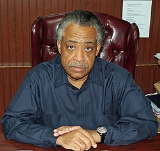
Alfred Charles "Al" Sharpton Jr. is a Pentecostal minister, a political activist,
civil rights activist, and film
actor. In 2004 Sharpton was a candidate for the Democratic nomination for
President of the United States.
Early years
Al Sharpton was born in 1954 to a prosperous family in Lake Charles, Louisiana. His father was a
boxer and landlord. Until the age of ten, he lived a comfortable life in
Queens. He preached his first sermon at the age of four, and soon became famous in Brooklyn as the "wonderboy preacher," even touring with gospel singer
Mahalia Jackson. He was licensed and ordained a Minister at age 10 by Bishop F.D. Washington in 1964. He graduated from Tilden High School in Brooklyn and attended
Brooklyn College but did not graduate.
In 1963, his parents separated. Sharpton recalls in a 2002 interview "My daddy walked out on us, and he married my half-sister, Tina. Tina was my mother's daughter from a previous marriage." His mother took a job as a maid, earning very little, and qualified for welfare; the family moved from their middle class home in Queens to the
projects in Brownsville.
Political activism
Sharpton's first experiences in organizing people were in high school, where he protested against poor cafeteria food and the dress code. In 1969, he was appointed by
Jesse Jackson as youth director of Operation Breadbasket, a group that focused on the promotion of new and better jobs for black Americans.
In the
1970s, after two years at
Brooklyn College, Sharpton became a tour manager for
James Brown, where he met his future wife, Kathy Jordan, a backup singer. Sharpton and Jordan married in 1983.
In 1971, Sharpton founded the National Youth Movement to fight drugs and raise money for impoverished youth.
In 1991, Sharpton founded the National Action Network to increase voter education, services aiding the poor, supporting economically small community businesses, confronting racism and violation of civil and human rights.
In 1999, Sharpton lead protest in the shooting death of
Amadou Diallo, a West African immigrant. There was an immense wave of protests after Diallo, who was unarmed at the time, was shot dead by police in the vestibule of his apartment building. Sharpton was in the forefront in claiming police brutality and racial profiling. Diallo's Family was later awarded $3million in a wrongful death suit filed against the city.
In a similar case in 2003, Sharpton was also involved in protests in the death of another West African immigrant Ousmane Zongo. Zongo who was also unarmed was shot by a plain clothes policeman during a raid on a warehouse in Chelsea. Sharpton met with the family and also provided some legal services. Zongo's family was also awarded $3million in a wrongful death suit.
He has also spoken out against cruelty to animals in a video recorded for
People for the Ethical Treatment of Animals .
To his supporters, Sharpton is seen as a loyal defender of the underrepresented poor and disenfranchised who has been supporting his community for 30 years. Critics of Sharpton have portrayed him as a racial agitator , citing his involvement in the
Tawana Brawley case and claiming that he seems to insert himself into instances of racial tension in order to increase his own popularity at the expense of making situations even more tense.
Assassination attempt
On January 12, 1991, Michael Riccardi stabbed Sharpton with a five-inch knife into his chest and tried to flee as Sharpton was preparing to lead a protest in a Brooklyn schoolyard. Sharpton suffered a punctured lung and spent five days at Coney Island Hospital. He has a 1-inch scar on his chest and says he suffered lung damage that still disrupts his breathing.
Candidacies
Sharpton has never held elected office. However, he ran for the
United States Senate seat from
New York in 1988, 1992, and 1994. In 1997, he also ran for Mayor of
New York City.
On January 5, 2003 Sharpton announced his candidacy for the
2004 presidential election as a member of the
Democratic Party. Precisely one year later, days before the Iowa caucus, allegations of connection between Sharpton's campaign management and entrenched
Republican Party organizers surfaced.
Sharpton has been critical of the
news media, charging it with ignoring his campaign due to deep-seated
racial prejudice. .
On March 15, 2004, Sharpton announced his endorsement of leading Democratic candidate
John Kerry. However, Sharpton did not withdraw from the race, continuing instead to campaign and striving to win delegates for the
2004 Democratic National Convention.
On December 15, 2005 Sharpton agreed to repay $100,000 in public funds he received from the federal government for his 2004 Presidential campaign. The repayment was required because Sharpton had exceeded federal limits on personal expenditures for his campaign. At that time his most recent Federal Election Commission filings stated that Sharpton's campaign still had debts of $479,050 and owed Sharpton himself $145,146 for an item listed as "Fundraising Letter Preparation — Kinko's."
Controversy
Televised scuffle with Roy Innis
With what began as a political debate, he was in a televised scuffle with Congress of Racial Equality National Chairman,
Roy Innis on The Morton Downey Jr. Show in
Harlem's
Apollo Theater in 1988.
Tawana Brawley
In the
Tawana Brawley case, a 15-year-old black girl was found smeared with
feces, lying in a garbage bag, her clothing torn and burned and with various slurs and epithets written on her body in charcoal. Brawley claimed that she had been assaulted and
raped by six white men, some of them police officers, on November 28, 1987, in the town of Wappingers Falls, New York.
The
FBI was called in, and Brawley was questioned about what had happened. She claimed she had been raped by unidentified white men. When a rape exam came back inconclusive, she changed her story, saying that she hadn't been raped, but had been sexually abused. Further examinations revealed that Brawley had received no real injuries, nor did she show signs of exposure. Testimony from her schoolmates also indicated that she had been at a local party during the time of her supposed abduction.
The incident made headlines nationwide, and her cause was taken up by Sharpton, along with Alton H. Maddox and C. Vernon Mason. The three turned the incident into a media sensation; among other acts, they identified New York prosecutor Steven Pagones as one of the men involved, despite the lack of any evidence, and they likewise attempted to implicate higher officials in the State government.
Accusations continued to be levied; an ex-boyfriend of Brawley's told
Newsday is a daily tabloid [i]-size newspaper [i] which primarily serves Long Island [i] and the New York City [i]...
that Brawley had admitted to him that she had made up the story of the attack. She may have feared punishment from her stepfather and her mother, who had beaten her after previous runaway episodes. A grand jury was convened, and after seven months of examining police and medical records, the jury determined that Brawley's assault was a
hoax.
Disbarment proceedings were begun against Maddox and Mason, and Brawley and her family moved hastily to Virginia, taking with them a "defense fund" of $300,000, which had been contributed by well-wishers.
In 1998, Pagones, whose career and marriage had been shattered, was awarded $345,000 in a suit for defamation of character that he brought against Sharpton, Maddox, and Mason. Sharpton still refused to apologize to Pagones, and one of his friends paid the judgment money.
Crown Height Riots
The Crown Heights Riot occurred after a car accident involving the motorcade for the Lubavitcher Rebbe killing a young boy Gavin Cato. A riot was sparked after a private
Hasidic ambulance came to the scene and removed the hasidic driver from the scene leaving Gavin Cato and his cousin Angela still trapped beneath the vehicle. Caribbean-American and African-American residents of the neighborhood then rioted for four consecutive days fueled by a belief that the treatment of the car accident victims was unequal.There had been long standing suspicion in the African-American community that the Hasidic community had received preferrential treatment from the city and in particular the police.
Al Sharpton became the de-facto representative for the Cato family. During the funeral he referred to "diamond merchants" considered a code word for Hasidic Jews, for shedding "the blood of innocent babies" leading marchers shouting "No Justice No Peace". Sharpton did not start the riots but his rhetoric was seen as inflammatory and unhelpful in easing the tension between the black and jewish communities. A visiting rabbinical student from Australia by the name of Yankel Rosenbaum, 29 years old, was killed during the rioting by a mob shouting "Kill the Jew".
Freddie's Fashion Mart
It is also alleged that after calling a Jewish shopkeeper a "white interloper," he looked on while an associate of his suggested the man's shop should be burned down. When a black member of the crowd did so, killing several people and himself, Sharpton initially denied having been present. When confronted with a video tape showing his presence, he said: "What's wrong with denouncing white interlopers?" Sharpton later apologized for his remarks. Other such controversies center on purported offenses by Jews against black Americans, although in one case it is alleged he verbally attacked
Korean shopkeepers.
Encounter with the FBI
HBO's Real Sports with Bryant Gumbel aired a FBI videotape of an undercover sting operation allegedly showing Al Sharpton discussing the selling of
cocaine with a FBI agent posing as a drug dealer. The meeting between Sharpton and the agent was arranged by Michael Franzese, a Mafia captain who is said to have had a relationship with Sharpton and Don King. It is said that Sharpton was offered a 10% commission for arranging drug sales. Sharpton mostly nods and allows the FBI agent to do most of the talking but at one point he is seen by some viewers as incriminating himself when he states, "Well, if [the unnamed buyer] can, if he's gonna do it, he'll do it much more than that."
It is important to note, however, that the drug deal was never consummated, and no charges were brought against Sharpton as a result of the tape. Law enforcement sources have said the FBI used the tape as leverage to enlist Sharpton as a government informant against fellow black activists and others. "The question is: Why would the government say that?" Sharpton said, and denied he was a snitch. "If they have an agreement with me, where is it?".
Sharpton denounced the tape as a set-up. "If anything it will rally people around me," Sharpton said. "For 18 years, the government has been trying to find a way to get me."
LoanMax spokesman
More recently, Sharpton has been criticized for appearing in advertisements for LoanMax, an automobile title loan company. Loanmax has been accused of predatory lending charging fees which are the equivalent of 300% APR loans, and for marketing them to primarily poor, urban and African American audiences. The ads featuring Sharpton were to be run in predominantly African American markets.
Stance on Gay Rights
Sharpton recently announced that he is a supporter of equal rights for gays and lesbians, including their
right to marry. Despite earlier media portrayals of him as virulently anti-gay, he has now taken it upon himself to head a grassroots movement to eliminate
homophobia within the Black Church.
Celebrity status
Because of his demeanor and personality, Sharpton has become something of a minor celebrity and has been featured in many
movies and
television shows. He had
cameo appearances in the movies
Cold Feet is a British [i] comedy/drama, made by Granada Television [i], broadcast on ...
,
Bamboozled and
Mr. Deeds and in episodes of the television shows
New York Undercover was a one-hour urban police [i] drama [i], which ran on the Fox [i] ...
,
,
Girlfriends is a popular American [i] sitcom [i] centered on the live ...
,
My Wife and Kids was an American [i] sitcom [i] that ran on ABC [i] ...
, and
Boston Legal is an American [i] television series [i] that began airing on ABC [i] ...
. He also hosted the original Spike TV
reality television show,
I Hate My Job. He also played a small role in the
Spike Lee movie,
Malcolm X. During the 2005 Tony Awards, Sharpton appeared in a number put on by the cast of
The 25th Annual Putnam County Spelling Bee. He was recently a guest on
Weekends at the DL on
Comedy Central. He was recently featured dancing to
salsa music in television ads for the
Fernando Ferrer campaign for the New York City mayoral election, 2005. He has also hosted the late-night comedy show
Saturday Night Live.
In June 2005, Sharpton signed a contract with Matrix Media, Incorporated, to produce and host a live two-hour daily talk program, which did not air. However, in November 2005, Sharpton signed with
Radio One to host a daily national talk radio program. The program started on January 30, 2006.
In late 2005, Sharpton indicated that he was considering starring in a
sitcom, tentatively called
Al in the Family, which would be an updated version of
All in the Family is a popular and acclaimed American [i] situation comedy [i] that wa ...
. Later in the year he decided he would not be in the show, instead concentrating on a possible
bid for President of the United States in 2008.
Trivia
For his 50th birthday, Al Sharpton bought himself a
Rolls Royce Phantom.
Author of books
- Sharpton, Al, Go and Tell Pharaoh , Doubleday, 1996. ISBN 0-385-47583-7
- Sharpton, Al, Al on America , Dafina Books, 2002. ISBN 0-7582-0350-0
- Sharpton, Al, Al on America , Dafina Books, 2003. ISBN 0-7582-0351-9
External links
;Official
;Biographical
;General
;Criticism
- . National Review, March 20, 2000.