

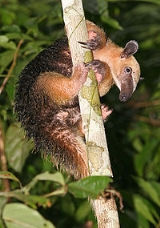
Southern Tamandua

Encyclopedia
The southern tamandua, also called a collared anteater, or lesser anteater (Tamandua tetradactyla), is a species
of anteater
from South America
. It is a solitary animal, found in many habitats from mature to highly disturbed secondary forests and arid savannas. It feeds on ants, termites and bees. It has very strong foreclaws that can be used to break insect nests or to defend itself.
and Trinidad
to northern Argentina
, southern Brazil
, and Uruguay
at elevations to 1600 metres (5,249.3 ft). It inhabits both wet and dry forests, including tropical rainforest
, savanna
, and thorn scrub. It seems to be most common in habitats near streams
and rivers, especially those thick with vine
s and epiphytes (presumably because its prey is common in these areas).
The oldest fossil tamanduas date from the Pleistocene
of South America, although genetic evidence
suggests that they may have diverged from their closest relative, the giant anteater, in the late Miocene
, 12.9 million years ago.
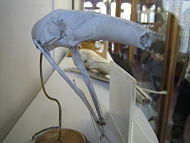 The southern tamandua is a medium-sized anteater, with a combined head and body length ranging from 34 to 65 cm (13.4 to 25.6 ), and a prehensile tail 37 to 67 cm (14.6 to 26.4 ) long. Adults weigh from 3.4 to 8.4 kg (7.5 to 18.5 ); there is no significant difference in size between males and females. Like their close relative, the northern tamandua
, they have four clawed digits on the forefeet and five on the hindfeet, and walk on the outer surface of their forefeet, to avoid puncturing their palms with their sharp claws. The underside and the tip of the tail are hairless. The snout is long and decurved with an opening only as wide as the diameter of a stick, from which the tongue is protruded. Although there are also some differences in the shape of the skull, they can most easily be distinguished from the northern tamandua by their slightly longer ears, which average around 5 centimetres (2 in), instead of 4 centimetres (1.6 in) as in the northern species.
The individual and geographic variation observed in the southern tamandua has made the taxonomic description of these animals a difficult task. Animals from the southeastern part of the range are "strongly vested", meaning that they have black markings from shoulder to rump; the black patch widens near the shoulders and encircles the forelimbs . The rest of the body can be blonde, tan, or brown. Animals from northern Brazil
and Venezuela
to west of the Andes
are solid blonde, brown, or black, or are only lightly vested.
ranges from 130 to 190 days and one young is born in the spring. At birth the young anteater does not resemble its parents; its coat varies from white to black. It rides on the mother's back for a period of time and is sometimes deposited on a safe branch while the mother forages.
s. They are solitary, occupying home ranges that average from 100 to 375 ha (247.1 to 926.6 ), depending on the local environment.
They may communicate when aggravated by hissing and releasing an unpleasant scent from the anal gland. It spends much of its time foraging arboreally; a study in various habitats in Venezuela showed that this anteater spends 13 to 64 percent of its time in trees. In fact, the southern tamandua is quite clumsy on the ground and ambles along, incapable of the gallop that its relative, the giant anteater
, can achieve.
The southern tamandua uses its powerful forearms in self-defense. If it is threatened in a tree it grasps a branch with its hindfeet and tail, leaving its arms and long, curved claws free for combat. If attacked on the ground, this anteater backs up against a rock or a tree and grabs the opponent with its forearms. In the rainforest, the southern tamandua is surrounded during the day by a cloud of flies and mosquitoes and is often seen wiping these insects from its eyes. This animal has small eyes and poor vision, but its large, upright ears indicate that hearing is an important sense.
s, carpenter ant
s, and Nasutitermes
. They avoid eating ants that are armed with strong chemical defenses, such as leaf-eating ants. Tamanduas are also thought to eat honey
and bees and, in captivity, have been known to eat fruit
and meat
as well. Anteaters extract their prey by using their extremely strong forelimbs to rip open nests and their elongated snouts and rounded tongues (up to 40 centimetres (15.7 in) in length) to lick up the insects.
Although it has the same diet as the giant anteater, both animals are able to live alongside one another, perhaps because the southern tamandua is able to reach nests in trees, while its larger cousin cannot.
.png) The southern anteater is listed as CITES Appendix II in southeastern Brazil. Although widespread, they are uncommon. They are killed by hunters, who claim that tamanduas kill dogs. They are also killed for the thick tendons in their tails, from which rope is made. Tamanduas are sometimes used by Amazonian Indians to rid their homes of ants and termites.
The southern anteater is listed as CITES Appendix II in southeastern Brazil. Although widespread, they are uncommon. They are killed by hunters, who claim that tamanduas kill dogs. They are also killed for the thick tendons in their tails, from which rope is made. Tamanduas are sometimes used by Amazonian Indians to rid their homes of ants and termites.
Species
In biology, a species is one of the basic units of biological classification and a taxonomic rank. A species is often defined as a group of organisms capable of interbreeding and producing fertile offspring. While in many cases this definition is adequate, more precise or differing measures are...
of anteater
Anteater
Anteaters, also known as antbear, are the four mammal species of the suborder Vermilingua commonly known for eating ants and termites. Together with the sloths, they compose the order Pilosa...
from South America
South America
South America is a continent situated in the Western Hemisphere, mostly in the Southern Hemisphere, with a relatively small portion in the Northern Hemisphere. The continent is also considered a subcontinent of the Americas. It is bordered on the west by the Pacific Ocean and on the north and east...
. It is a solitary animal, found in many habitats from mature to highly disturbed secondary forests and arid savannas. It feeds on ants, termites and bees. It has very strong foreclaws that can be used to break insect nests or to defend itself.
Distribution and habitat
The southern tamandua is found in South America from VenezuelaVenezuela
Venezuela , officially called the Bolivarian Republic of Venezuela , is a tropical country on the northern coast of South America. It borders Colombia to the west, Guyana to the east, and Brazil to the south...
and Trinidad
Trinidad
Trinidad is the larger and more populous of the two major islands and numerous landforms which make up the island nation of Trinidad and Tobago. It is the southernmost island in the Caribbean and lies just off the northeastern coast of Venezuela. With an area of it is also the fifth largest in...
to northern Argentina
Argentina
Argentina , officially the Argentine Republic , is the second largest country in South America by land area, after Brazil. It is constituted as a federation of 23 provinces and an autonomous city, Buenos Aires...
, southern Brazil
Brazil
Brazil , officially the Federative Republic of Brazil , is the largest country in South America. It is the world's fifth largest country, both by geographical area and by population with over 192 million people...
, and Uruguay
Uruguay
Uruguay ,officially the Oriental Republic of Uruguay,sometimes the Eastern Republic of Uruguay; ) is a country in the southeastern part of South America. It is home to some 3.5 million people, of whom 1.8 million live in the capital Montevideo and its metropolitan area...
at elevations to 1600 metres (5,249.3 ft). It inhabits both wet and dry forests, including tropical rainforest
Rainforest
Rainforests are forests characterized by high rainfall, with definitions based on a minimum normal annual rainfall of 1750-2000 mm...
, savanna
Savanna
A savanna, or savannah, is a grassland ecosystem characterized by the trees being sufficiently small or widely spaced so that the canopy does not close. The open canopy allows sufficient light to reach the ground to support an unbroken herbaceous layer consisting primarily of C4 grasses.Some...
, and thorn scrub. It seems to be most common in habitats near streams
STREAMS
In computer networking, STREAMS is the native framework in Unix System V for implementing character devices.STREAMS was designed as a modular architecture for implementing full-duplex I/O between kernel or user space processes and device drivers. Its most frequent uses have been in developing...
and rivers, especially those thick with vine
Vine
A vine in the narrowest sense is the grapevine , but more generally it can refer to any plant with a growth habit of trailing or scandent, that is to say climbing, stems or runners...
s and epiphytes (presumably because its prey is common in these areas).
The oldest fossil tamanduas date from the Pleistocene
Pleistocene
The Pleistocene is the epoch from 2,588,000 to 11,700 years BP that spans the world's recent period of repeated glaciations. The name pleistocene is derived from the Greek and ....
of South America, although genetic evidence
Mitochondrial DNA
Mitochondrial DNA is the DNA located in organelles called mitochondria, structures within eukaryotic cells that convert the chemical energy from food into a form that cells can use, adenosine triphosphate...
suggests that they may have diverged from their closest relative, the giant anteater, in the late Miocene
Miocene
The Miocene is a geological epoch of the Neogene Period and extends from about . The Miocene was named by Sir Charles Lyell. Its name comes from the Greek words and and means "less recent" because it has 18% fewer modern sea invertebrates than the Pliocene. The Miocene follows the Oligocene...
, 12.9 million years ago.
Subspecies
There are four recognised subspecies:- Tamandua tetradactyla tetradactyla (Linnaeus, 1758) - southern and eastern Brazil, Uruguay
- Tamandua tetradactyla nigra (GeoffroyÉtienne Geoffroy Saint-HilaireÉtienne Geoffroy Saint-Hilaire was a French naturalist who established the principle of "unity of composition". He was a colleague of Jean-Baptiste Lamarck and expanded and defended Lamarck's evolutionary theories...
, 1803) - northern Brazil, ColombiaColombiaColombia, officially the Republic of Colombia , is a unitary constitutional republic comprising thirty-two departments. The country is located in northwestern South America, bordered to the east by Venezuela and Brazil; to the south by Ecuador and Peru; to the north by the Caribbean Sea; to the...
, Venezuela, Trinidad, the GuianasThe GuianasThe Guyanas or the Guianas refers to a region in north-eastern South America which includes the following three territories:* French Guiana, an overseas department of France;... - Tamandua tetradactyla quichua (ThomasOldfield ThomasOldfield Thomas FRS was a British zoologist.Thomas worked at the Natural History Museum on mammals, describing about 2,000 new species and sub-species for the first time. He was appointed to the Museum Secretary's office in 1876, transferring to the Zoological Department in 1878...
, 1927) - PeruPeruPeru , officially the Republic of Peru , is a country in western South America. It is bordered on the north by Ecuador and Colombia, on the east by Brazil, on the southeast by Bolivia, on the south by Chile, and on the west by the Pacific Ocean....
, EcuadorEcuadorEcuador , officially the Republic of Ecuador is a representative democratic republic in South America, bordered by Colombia on the north, Peru on the east and south, and by the Pacific Ocean to the west. It is one of only two countries in South America, along with Chile, that do not have a border...
, extreme western Brazil - Tamandua tetradactyla straminea (CopeEdward Drinker CopeEdward Drinker Cope was an American paleontologist and comparative anatomist, as well as a noted herpetologist and ichthyologist. Born to a wealthy Quaker family, Cope distinguished himself as a child prodigy interested in science; he published his first scientific paper at the age of nineteen...
, 1889) - southern Brazil, ParaguayParaguayParaguay , officially the Republic of Paraguay , is a landlocked country in South America. It is bordered by Argentina to the south and southwest, Brazil to the east and northeast, and Bolivia to the northwest. Paraguay lies on both banks of the Paraguay River, which runs through the center of the...
, BoliviaBoliviaBolivia officially known as Plurinational State of Bolivia , is a landlocked country in central South America. It is the poorest country in South America...
, Argentina
Physical description
Northern Tamandua
The northern tamandua is a species of tamandua, a small anteater in the family Myrmecophagidae. They live in tropical and subtropical forests from southern Mexico, through Central America, and to the edge of the northern Andes....
, they have four clawed digits on the forefeet and five on the hindfeet, and walk on the outer surface of their forefeet, to avoid puncturing their palms with their sharp claws. The underside and the tip of the tail are hairless. The snout is long and decurved with an opening only as wide as the diameter of a stick, from which the tongue is protruded. Although there are also some differences in the shape of the skull, they can most easily be distinguished from the northern tamandua by their slightly longer ears, which average around 5 centimetres (2 in), instead of 4 centimetres (1.6 in) as in the northern species.
The individual and geographic variation observed in the southern tamandua has made the taxonomic description of these animals a difficult task. Animals from the southeastern part of the range are "strongly vested", meaning that they have black markings from shoulder to rump; the black patch widens near the shoulders and encircles the forelimbs . The rest of the body can be blonde, tan, or brown. Animals from northern Brazil
Brazil
Brazil , officially the Federative Republic of Brazil , is the largest country in South America. It is the world's fifth largest country, both by geographical area and by population with over 192 million people...
and Venezuela
Venezuela
Venezuela , officially called the Bolivarian Republic of Venezuela , is a tropical country on the northern coast of South America. It borders Colombia to the west, Guyana to the east, and Brazil to the south...
to west of the Andes
Andes
The Andes is the world's longest continental mountain range. It is a continual range of highlands along the western coast of South America. This range is about long, about to wide , and of an average height of about .Along its length, the Andes is split into several ranges, which are separated...
are solid blonde, brown, or black, or are only lightly vested.
Reproduction
Females are polyestrous; mating generally takes place in the fall. GestationGestation
Gestation is the carrying of an embryo or fetus inside a female viviparous animal. Mammals during pregnancy can have one or more gestations at the same time ....
ranges from 130 to 190 days and one young is born in the spring. At birth the young anteater does not resemble its parents; its coat varies from white to black. It rides on the mother's back for a period of time and is sometimes deposited on a safe branch while the mother forages.
Behavior
The tamandua is mainly nocturnal but is occasionally active during the day. They nest in hollow tree trunks or in the burrows of other animals, such as armadilloArmadillo
Armadillos are New World placental mammals, known for having a leathery armor shell. Dasypodidae is the only surviving family in the order Cingulata, part of the superorder Xenarthra along with the anteaters and sloths. The word armadillo is Spanish for "little armored one"...
s. They are solitary, occupying home ranges that average from 100 to 375 ha (247.1 to 926.6 ), depending on the local environment.
They may communicate when aggravated by hissing and releasing an unpleasant scent from the anal gland. It spends much of its time foraging arboreally; a study in various habitats in Venezuela showed that this anteater spends 13 to 64 percent of its time in trees. In fact, the southern tamandua is quite clumsy on the ground and ambles along, incapable of the gallop that its relative, the giant anteater
Giant Anteater
The Giant Anteater, Myrmecophaga tridactyla, is the largest species of anteater. It is the only species in the genus Myrmecophaga. It is found in Central and South America from Honduras to northern Argentina...
, can achieve.
The southern tamandua uses its powerful forearms in self-defense. If it is threatened in a tree it grasps a branch with its hindfeet and tail, leaving its arms and long, curved claws free for combat. If attacked on the ground, this anteater backs up against a rock or a tree and grabs the opponent with its forearms. In the rainforest, the southern tamandua is surrounded during the day by a cloud of flies and mosquitoes and is often seen wiping these insects from its eyes. This animal has small eyes and poor vision, but its large, upright ears indicate that hearing is an important sense.
Diet
Southern tamanduas eat ants and termites in roughly equal proportions, although they may also eat a small quantity of fruit. They locate their food by scent, and prey on a wide range of species, including army antArmy ant
The name army ant is applied to over 200 ant species, in different lineages, due to their aggressive predatory foraging groups, known as "raids", in which huge numbers of ants forage simultaneously over a certain area, attacking prey en masse.Another shared feature is that, unlike most ant...
s, carpenter ant
Carpenter ant
Carpenter ants are large ants indigenous to many parts of the world. They prefer dead, damp wood in which to build nests. They do not eat it, however, unlike termites. Sometimes carpenter ants will hollow out sections of trees. The most likely species to be infesting a house in the United States...
s, and Nasutitermes
Nasutitermes
Nasutitermes is a genus of termites. It consists of the following species:*Nasutitermes bikpelanus*Nasutitermes corniger*Nasutitermes ephratae*Nasutitermes exitiosus*Nasutitermes magnus*Nasutitermes matangensiformis...
. They avoid eating ants that are armed with strong chemical defenses, such as leaf-eating ants. Tamanduas are also thought to eat honey
Honey
Honey is a sweet food made by bees using nectar from flowers. The variety produced by honey bees is the one most commonly referred to and is the type of honey collected by beekeepers and consumed by humans...
and bees and, in captivity, have been known to eat fruit
Fruit
In broad terms, a fruit is a structure of a plant that contains its seeds.The term has different meanings dependent on context. In non-technical usage, such as food preparation, fruit normally means the fleshy seed-associated structures of certain plants that are sweet and edible in the raw state,...
and meat
Meat
Meat is animal flesh that is used as food. Most often, this means the skeletal muscle and associated fat and other tissues, but it may also describe other edible tissues such as organs and offal...
as well. Anteaters extract their prey by using their extremely strong forelimbs to rip open nests and their elongated snouts and rounded tongues (up to 40 centimetres (15.7 in) in length) to lick up the insects.
Although it has the same diet as the giant anteater, both animals are able to live alongside one another, perhaps because the southern tamandua is able to reach nests in trees, while its larger cousin cannot.
Conservation