

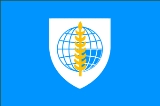
Southeast Asia Treaty Organization

Encyclopedia
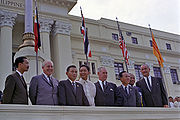
International organization
An intergovernmental organization, sometimes rendered as an international governmental organization and both abbreviated as IGO, is an organization composed primarily of sovereign states , or of other intergovernmental organizations...
for collective defense
Collective security
Collective security can be understood as a security arrangement, regional or global, in which each state in the system accepts that the security of one is the concern of all, and agrees to join in a collective response to threats to, and breaches of, the peace...
in Southeast Asia
Southeast Asia
Southeast Asia, South-East Asia, South East Asia or Southeastern Asia is a subregion of Asia, consisting of the countries that are geographically south of China, east of India, west of New Guinea and north of Australia. The region lies on the intersection of geological plates, with heavy seismic...
created by the Southeast Asia Collective Defense Treaty, or Manila Pact, signed in September 1954 in Manila
Manila
Manila is the capital of the Philippines. It is one of the sixteen cities forming Metro Manila.Manila is located on the eastern shores of Manila Bay and is bordered by Navotas and Caloocan to the north, Quezon City to the northeast, San Juan and Mandaluyong to the east, Makati on the southeast,...
, Philippines
Philippines
The Philippines , officially known as the Republic of the Philippines , is a country in Southeast Asia in the western Pacific Ocean. To its north across the Luzon Strait lies Taiwan. West across the South China Sea sits Vietnam...
. The formal institution of SEATO was established on 19 February 1955 at a meeting of treaty partners in Bangkok
Bangkok
Bangkok is the capital and largest urban area city in Thailand. It is known in Thai as Krung Thep Maha Nakhon or simply Krung Thep , meaning "city of angels." The full name of Bangkok is Krung Thep Mahanakhon Amon Rattanakosin Mahintharayutthaya Mahadilok Phop Noppharat Ratchathani Burirom...
, Thailand. The organization's headquarters were also located in Bangkok.
Primarily created to block further communist
Communism
Communism is a social, political and economic ideology that aims at the establishment of a classless, moneyless, revolutionary and stateless socialist society structured upon common ownership of the means of production...
gains in Southeast Asia, SEATO is generally considered a failure because internal conflict and dispute hindered general use of the SEATO military; however, SEATO-funded cultural and educational programs left long-standing effects in Southeast Asia. SEATO was dissolved on 30 June 1977 after multiple members lost interest and withdrew.
Origins and structure
SEATO was created by the Southeast Asia Collective Defense Treaty, or Manila Pact, signed on 8 September 1954 in ManilaManila
Manila is the capital of the Philippines. It is one of the sixteen cities forming Metro Manila.Manila is located on the eastern shores of Manila Bay and is bordered by Navotas and Caloocan to the north, Quezon City to the northeast, San Juan and Mandaluyong to the east, Makati on the southeast,...
, as part of the American Truman Doctrine
Truman Doctrine
The Truman Doctrine was a policy set forth by U.S. President Harry S Truman in a speech on March 12, 1947 stating that the U.S. would support Greece and Turkey with economic and military aid to prevent their falling into the Soviet sphere...
of creating anti-communist bilateral and collective defense treaties. These treaties and agreements were intended to create alliances that would contain communist powers (Communist China
People's Republic of China
China , officially the People's Republic of China , is the most populous country in the world, with over 1.3 billion citizens. Located in East Asia, the country covers approximately 9.6 million square kilometres...
, in SEATO's case). This policy was considered to have been largely developed by American diplomat and Soviet expert George F. Kennan
George F. Kennan
George Frost Kennan was an American adviser, diplomat, political scientist and historian, best known as "the father of containment" and as a key figure in the emergence of the Cold War...
. President Dwight D. Eisenhower
Dwight D. Eisenhower
Dwight David "Ike" Eisenhower was the 34th President of the United States, from 1953 until 1961. He was a five-star general in the United States Army...
's Secretary of State John Foster Dulles
John Foster Dulles
John Foster Dulles served as U.S. Secretary of State under President Dwight D. Eisenhower from 1953 to 1959. He was a significant figure in the early Cold War era, advocating an aggressive stance against communism throughout the world...
(1953–1959) was the primary force behind the creation of SEATO, which expanded the concept of anti-communist collective defense to Southeast Asia.
SEATO was planned to be a Southeast Asian version of the North Atlantic Treaty Organization (NATO), in which the military forces of each member would be coordinated to provide for the collective defense of the members' country. Organizationally, SEATO was headed by the Secretary General, whose office was created in 1957 at a meeting in Canberra
Canberra
Canberra is the capital city of Australia. With a population of over 345,000, it is Australia's largest inland city and the eighth-largest city overall. The city is located at the northern end of the Australian Capital Territory , south-west of Sydney, and north-east of Melbourne...
, with a council of representatives from member nations and an international staff. Also present were committees for economics, security, and information. SEATO's first Secretary General was Pote Sarasin
Pote Sarasin
Pote Sarasin was a Thai diplomat and politician. He served as foreign minister from 1949 to 1951 and then served as ambassador to the United States. In September 1957 when Sarit Thanarat seized power in a military coup, he appointed Pote to be the acting prime minister. He resigned in December 1957...
, a Thai diplomat and politician who had served as Thailand's ambassador to the U.S. between 1952 and 1957, and as Prime Minister of Thailand from September 1957 to 1 January 1958.
Unlike the NATO alliance, SEATO had no joint commands with standing forces. In addition, SEATO's response protocol in the event of communism presenting a "common danger" to the member nations was vague and ineffective, though membership in the SEATO alliance did provide a rationale for a large-scale U.S. military intervention in the region during the Vietnam War
Vietnam War
The Vietnam War was a Cold War-era military conflict that occurred in Vietnam, Laos, and Cambodia from 1 November 1955 to the fall of Saigon on 30 April 1975. This war followed the First Indochina War and was fought between North Vietnam, supported by its communist allies, and the government of...
(1955–1975).
Membership
SEATO's members included Australia, France, New Zealand, Pakistan (including East Pakistan, now BangladeshBangladesh
Bangladesh , officially the People's Republic of Bangladesh is a sovereign state located in South Asia. It is bordered by India on all sides except for a small border with Burma to the far southeast and by the Bay of Bengal to the south...
), the Philippines, Thailand, the United Kingdom, and the United States. The membership reflected a mid-1950s combination of anti-communist Western nations and such nations in Southeast Asia. The United Kingdom, Australia and the United States, the latter of which joined after the U.S. Senate ratified the treaty by a 82–1 vote, represented the strongest Western powers.
Because of the 1954 Geneva Conference
Geneva Conference (1954)
The Geneva Conference was a conference which took place in Geneva, Switzerland, whose purpose was to attempt to find a way to unify Korea and discuss the possibility of restoring peace in Indochina...
settling the First Indochina War
First Indochina War
The First Indochina War was fought in French Indochina from December 19, 1946, until August 1, 1954, between the French Union's French Far East...
(1946–1954), South Vietnam, Cambodia, and Laos were not SEATO members. They were, however, granted military protection, though Cambodia rejected the protection in 1956. Canada considered joining, but decided against it in order to concentrate on its NATO responsibilities.
Military aspects
After its creation, SEATO quickly became insignificant militarily, as most of its member nations contributed very little to the alliance. While SEATO military forces held joint military training, they were never employed because of internal disagreements. SEATO was unable to intervene in conflicts in Laos because France and Britain rejected use of military action. As a result, the U.S. provided unilateral support for Laos after 1962. Though sought by the U.S., involvement of SEATO in the Vietnam WarVietnam War
The Vietnam War was a Cold War-era military conflict that occurred in Vietnam, Laos, and Cambodia from 1 November 1955 to the fall of Saigon on 30 April 1975. This war followed the First Indochina War and was fought between North Vietnam, supported by its communist allies, and the government of...
was denied because of lack of British and French cooperation.
Both the United States and Australia cited the alliance as justification for involvement in Vietnam. American membership in SEATO provided the United States with a rationale for a large-scale U.S. military intervention in Southeast Asia. Other countries, such as Great Britain and key nations in Asia, accepted the rationale. In 1962, as part of its commitment to SEATO, the Royal Australian Air Force
Royal Australian Air Force
The Royal Australian Air Force is the air force branch of the Australian Defence Force. The RAAF was formed in March 1921. It continues the traditions of the Australian Flying Corps , which was formed on 22 October 1912. The RAAF has taken part in many of the 20th century's major conflicts...
deployed CAC Sabre
CAC Sabre
|-See also:-Bibliography:* Allward, Maurice. F-86 Sabre. London: Ian Allen, 1978. ISBN 0-71100-860-4.* Curtis, Duncan. North American F-86 Sabre. Ramsbury, UK: Crowood, 2000. ISBN 1-86126-358-9....
s of its No. 79 Squadron
No. 79 Squadron RAAF
No. 79 Squadron is a Royal Australian Air Force flight training unit which has been formed on four occasions since 1943. The squadron was established in May 1943 as a fighter unit equipped with Supermarine Spitfires, and subsequently saw combat in the South West Pacific theatre of World War II...
to Ubon Royal Thai Air Force Base
Ubon Royal Thai Air Force Base
Ubon Royal Thai Air Force Base is a Royal Thai Air Force facility and is the home of Wing 21 of the RTAF 2nd Air Division. It is located in East-Central Thailand, near the city of Ubon Ratchathani, in the Ubon Ratchathani Province. It is approximately 305 miles North-East of Bangkok...
, Thailand. The Sabres began to play a role in the Vietnam War in 1965, when their air defence responsibilities expanded to include protection of USAF
United States Air Force
The United States Air Force is the aerial warfare service branch of the United States Armed Forces and one of the American uniformed services. Initially part of the United States Army, the USAF was formed as a separate branch of the military on September 18, 1947 under the National Security Act of...
aircraft using Ubon as a base for strikes against North Vietnam.
Cultural effects
In addition to joint military training, SEATO member states worked on improving mutual social and economic issues. Such activities were overseen by SEATO's Committee of Information, Culture, Education, and Labor Activities, and proved to be some of SEATO's greatest successes. In 1959, SEATO's first Secretary General, Pote Sarasin, created the SEATO Graduate School of EngineeringAsian Institute of Technology
The Asian Institute of Technology is an international institution for higher education in engineering, advanced technologies, and management and planning...
(currently the Asian Institute of Technology) in Thailand to train engineers. SEATO also sponsored the creation of the Teacher Development Center in Bangkok, as well as the Thai Military Technical Training School, which offered technical programs for supervisors and workmen. SEATO's Skilled Labor Project (SLP) created artisan training facilities, especially in Thailand, where ninety-one training workshops were established.
SEATO also provided research funding and grants in agriculture and medical fields. In 1959, SEATO set up the Cholera Research Laboratory in Bangkok, later establishing a second Cholera Research Laboratory in Dhaka, Bangladesh
Dhaka
Dhaka is the capital of Bangladesh and the principal city of Dhaka Division. Dhaka is a megacity and one of the major cities of South Asia. Located on the banks of the Buriganga River, Dhaka, along with its metropolitan area, had a population of over 15 million in 2010, making it the largest city...
. The Dhaka laboratory soon became the world's leading cholera
Cholera
Cholera is an infection of the small intestine that is caused by the bacterium Vibrio cholerae. The main symptoms are profuse watery diarrhea and vomiting. Transmission occurs primarily by drinking or eating water or food that has been contaminated by the diarrhea of an infected person or the feces...
research facility and was later renamed the International Centre for Diarrhoeal Disease Research, Bangladesh
International Centre for Diarrhoeal Disease Research, Bangladesh
The International Centre for Diarrhoeal Disease Research, Bangladesh is an international health research organization located in Dhaka, Bangladesh. Dedicated to saving lives through research and treatment, ICDDR,B addresses some of the most critical health concerns facing the world today, ranging...
. SEATO was also interested in literature, and a SEATO Literature Award was created and given to writers from member states.
Criticism and dissolution
Though Secretary of State Dulles considered SEATO an essential element in American foreign policy in Asia, historians have considered the Manila Pact a failure and the pact is rarely mentioned in history books. In The Geneva Conference of 1954 on Indochina, Sir James Cable, a diplomat and naval strategist, described SEATO as "a fig leaf for the nakedness of American policy", citing the Manila Pact as a "zoo of paper tigers".Consequently, questions of dissolving the organization arose. Pakistan withdrew in 1972 after the Bangladesh Liberation War
Bangladesh Liberation War
The Bangladesh Liberation War was an armed conflict pitting East Pakistan and India against West Pakistan. The war resulted in the secession of East Pakistan, which became the independent nation of Bangladesh....
of 1971, in which East Pakistan successfully seceded with the aid of India. France withdrew financial support in 1975. After a final exercise on 20 February 1976, the organization was formally dissolved on 30 June 1977.
See also
- Australia, New Zealand, United States Security TreatyANZUSThe Australia, New Zealand, United States Security Treaty is the military alliance which binds Australia and New Zealand and, separately, Australia and the United States to cooperate on defence matters in the Pacific Ocean area, though today the treaty is understood to relate to attacks...
(ANZUS) - Association of Southeast Asian NationsAssociation of Southeast Asian NationsThe Association of Southeast Asian Nations, commonly abbreviated ASEAN rarely ), is a geo-political and economic organization of ten countries located in Southeast Asia, which was formed on 8 August 1967 by Indonesia, Malaysia, the Philippines, Singapore and Thailand. Since then, membership has...
(ASEAN) - Central Treaty OrganizationCentral Treaty OrganizationThe Central Treaty Organization was formed in 1955 by Iran, Iraq, Pakistan, Turkey, and the United Kingdom. It was dissolved in 1979.U.S...
(CENTO) - Organization of American StatesOrganization of American StatesThe Organization of American States is a regional international organization, headquartered in Washington, D.C., United States...
(OAS)
External links
- Copy of the Southeast Asia Collective Defense Treaty (Manila Pact); September 8, 1954, from Yale Law School