

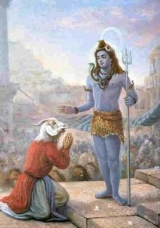
Daksha

Encyclopedia
In Hinduism
, Daksha, "the skilled one", is an ancient creator god
, one of the Prajapati
s, the Rishi
s and the Adityas. Daksha is said to be the son of Aditi
and Brahma. (In another source, Daksha is said to be the father of Diti and Aditi, Kashyapa's wives and Sati's
sisters).
With his wife Prasuti
, he is the father of thirteen daughters, namely Aditi
, Diti
, Dānu
, Kala, Danāyū, Sinhika
, Krodha, Pradha, Viswa, Vinata
, Kapila, Muni, and Kadru
. Many of whom were married to Soma
. Daksha found that Soma overly favored one daughter (Rohini) over the others, thus neglecting their needs and flouting his responsibilities. For this, Daksha cursed him to wither and die. The daughters intervened and made his death periodic, symbolized by the waxing and waning of the moon
.
or one of the Brahma
's sons. The equivalent meaning in English is ALERT.
One of the daughter of Prajapati
(often said to be the youngest) was Shakti
or Dakshayani
, who had always wished to marry Shiva
. Daksha forbade it, but she disobeyed him and did so anyway, finding in Shiva a doting and loving husband. Daksha disliked Shiva intensely, calling him a dirty, roaming ascetic and reviling the great yogi
's cohort of goblins and ghouls.
/Shakti
, and his son-in-law, Shiva
. This enmity culminated in a great sacrifice
he had been hosting, one to which he invited all and sundry, family and allies, gods and rishis, courtiers and subjects. Consciously excluding Shakti from the list, he also set up a statue of Shiva, which he defiled and mocked, at the entrance to his hall. Shakti, ebullient at the thought of such a great event, and assuming that the daughter of the king was welcome no matter what, attended the festival. Snubbed by her father and treated with disdain, Shakti nonetheless maintained her composure. Indeed, even her father's refusal to invite Shiva, her husband and thus a traditionally honored member of any Hindu family, was to some extent borne.
 However, on seeing the shameless insult to her husband in his absence, and the repeated slights King Daksha and his courtiers railed at Shiva, she committed suicide in grief for her beloved. Hearing the news, Shiva's attendants rushed inside the ceremony hall and started attacking all the guests present there, however, the demons invoked by Bhrigu defeated Shivas attendants and they retreated back to his abode. Upon hearing the news of his beloved wife's death, Shiva was furious that Daksha could so callously cause the harm of his (Daksha's) own daughter in so ignoble a manner. Shiva grabbed a lock of his matted hair and dashed it to the ground. From the two pieces rose the ferocious Virabhadra
and the terrible Rudrakali, while Bhadrakali
arose from the wrath of Devi
herself. Upon Shiva's orders they stormed the ceremony and killed Daksha as well as many of the guests. Terrified and with remorse the others propitiated Lord Shiva and begged his mercy to restore Daksha's life and to allow the sacrifice to be completed. Shiva, the all-merciful One, restored Daksha's life, with the head of a goat
. In his humility, and repentance for his graceless and sinful acts, Daksha became one of Shiva's most devoted, attendants.
Shakti
/Dakshayani
later incarnated as Parvati
in her next life, and remarried Shiva, henceforth never to part with him again. It is for this reason that Shiva, while monogamous, has had two wives in reality, but the same soul in two incarnations.
One place that is associated with this Yagna of Daksha, and where it is supposed to have actually taken place according to the Sthala Purana, is known as Kottiyur
, which is in a largely forested area of Kannur
District, Kerala
. At Kottiyur, there are two temples - Sri Akkare Kottiyur Temple and Sri Ikkare Kottiyur Temple, located on opposite banks of Bavali river. Sri Akkare Kottiyur Temple is open during the Kottiyoor Vaisakha Mahothsavam festival only.
Another place that claims to be the site of Daksha's Yagna is Shri Daksheshwar Temple, about 4 KM from Haridwar. There is a pit within the grounds of the temple which supposedly marks the exact location of the sacrificial fire.
Local legend has it that Draksharama was where the Daksha yagna was performed. It is one of the Pancharama sites and is located near Kakinada in East godavari district, AP.
and Anuradha, married Chandra
. Another, Rati
, married Kama. Another daughter, Danu, gave birth to the evil Danavas. According to the Monnier-Williams dictionary Samkalpa (initiative/volition) is mentioned as a daughter of Daksha. There is a theory identifying Samkalpa with Lubhyati, the Sanskrit name-word etymologically related to love
and libido
.
Hinduism
Hinduism is the predominant and indigenous religious tradition of the Indian Subcontinent. Hinduism is known to its followers as , amongst many other expressions...
, Daksha, "the skilled one", is an ancient creator god
Creator deity
A creator deity is a deity responsible for the creation of the world . In monotheism, the single God is often also the creator deity, while polytheistic traditions may or may not have creator deities...
, one of the Prajapati
Prajapati
In Hinduism, Prajapati "lord of creatures" is a Hindu deity presiding over procreation, and protector of life. He appears as a creator deity or supreme God Viswakarma Vedic deities in RV 10 and in Brahmana literature...
s, the Rishi
Rishi
Rishi denotes the composers of Vedic hymns. However, according to post-Vedic tradition, the rishi is a "seer" to whom the Vedas were "originally revealed" through states of higher consciousness. The rishis were prominent when Vedic Hinduism took shape, as far back as some three thousand years...
s and the Adityas. Daksha is said to be the son of Aditi
Aditi
Aditi in Sanskrit, an ancient Indian language. In the Vedas Aditi is mother of the gods from whose cosmic matrix the heavenly bodies were born...
and Brahma. (In another source, Daksha is said to be the father of Diti and Aditi, Kashyapa's wives and Sati's
Dakshayani
Dākshāyani or Satī is a Hindu Goddess of marital felicity and longevity. She is worshipped particularly by Hindu women to seek the long life of their husbands...
sisters).
With his wife Prasuti
Prasuti
Prasuti is a Hindu goddess, who is the daughter of Svayambhuva Manu and Shatroopa, wife of Daksha and mother of many daughters by him.-Marriage and children:Marriage of Daksha and Prasuti was the first official marriage of first Manvantara...
, he is the father of thirteen daughters, namely Aditi
Aditi
Aditi in Sanskrit, an ancient Indian language. In the Vedas Aditi is mother of the gods from whose cosmic matrix the heavenly bodies were born...
, Diti
Diti
In Hinduism, Diti is an earth goddess and mother of the Maruts with Rudra. She is also the mother of the Daityas with the sage Kashyapa. She wanted to have a son who would be more powerful than Indra and so she practiced magic and kept herself pregnant for one year. Indra used a thunderbolt to...
, Dānu
Danu (Asura)
Dānu, a Hindu primordial goddess, is mentioned in the Rigveda, mother of the Danavas. The word Danu described the primeval waters which this deity perhaps embodied. In the Rigveda , she is identified as the mother of Vrtra, the demonic serpent slain by Indra...
, Kala, Danāyū, Sinhika
Sinhika
Sinhika was the daughter of Rishi Kashyap and Diti who was one amongst the 13 wives of Kashyap and the eldest daughter of Daksha. Sinhika had two brothers Hiranyaksha and Hiranyakashipu. She got married to the Danava Viprachitti and bore a son named Rahu....
, Krodha, Pradha, Viswa, Vinata
Vinata
Vinata . One of the thirteen daughters of Prajapati Daksha. Married to Kashyapa along with her 12 sisters. She bore him two sons, named Aruṇá and Garuda known as the Suparnas....
, Kapila, Muni, and Kadru
Kadru
In the mythology of India, Kadru , is usually the daughter of Daksha, wife of Kashyapa, and the mother of the Nagas. This is according to the Mahabharata ....
. Many of whom were married to Soma
Chandra
In Hinduism, Chandra is a lunar deity and a Graha. Chandra is also identified with the Vedic Lunar deity Soma . The Soma name refers particularly to the juice of sap in the plants and thus makes the Moon the lord of plants and vegetation. He is described as young, beautiful, fair; two-armed and...
. Daksha found that Soma overly favored one daughter (Rohini) over the others, thus neglecting their needs and flouting his responsibilities. For this, Daksha cursed him to wither and die. The daughters intervened and made his death periodic, symbolized by the waxing and waning of the moon
Moon
The Moon is Earth's only known natural satellite,There are a number of near-Earth asteroids including 3753 Cruithne that are co-orbital with Earth: their orbits bring them close to Earth for periods of time but then alter in the long term . These are quasi-satellites and not true moons. For more...
.
Story of Shakti and Shiva
Daksha is a Sanskrit word said to be a PrajapatiPrajapati
In Hinduism, Prajapati "lord of creatures" is a Hindu deity presiding over procreation, and protector of life. He appears as a creator deity or supreme God Viswakarma Vedic deities in RV 10 and in Brahmana literature...
or one of the Brahma
Brahma
Brahma is the Hindu god of creation and one of the Trimurti, the others being Vishnu and Shiva. According to the Brahma Purana, he is the father of Mānu, and from Mānu all human beings are descended. In the Ramayana and the...
's sons. The equivalent meaning in English is ALERT.
One of the daughter of Prajapati
Prajapati
In Hinduism, Prajapati "lord of creatures" is a Hindu deity presiding over procreation, and protector of life. He appears as a creator deity or supreme God Viswakarma Vedic deities in RV 10 and in Brahmana literature...
(often said to be the youngest) was Shakti
Shakti
Shakti from Sanskrit shak - "to be able," meaning sacred force or empowerment, is the primordial cosmic energy and represents the dynamic forces that are thought to move through the entire universe in Hinduism. Shakti is the concept, or personification, of divine feminine creative power, sometimes...
or Dakshayani
Dakshayani
Dākshāyani or Satī is a Hindu Goddess of marital felicity and longevity. She is worshipped particularly by Hindu women to seek the long life of their husbands...
, who had always wished to marry Shiva
Shiva
Shiva is a major Hindu deity, and is the destroyer god or transformer among the Trimurti, the Hindu Trinity of the primary aspects of the divine. God Shiva is a yogi who has notice of everything that happens in the world and is the main aspect of life. Yet one with great power lives a life of a...
. Daksha forbade it, but she disobeyed him and did so anyway, finding in Shiva a doting and loving husband. Daksha disliked Shiva intensely, calling him a dirty, roaming ascetic and reviling the great yogi
Yoga
Yoga is a physical, mental, and spiritual discipline, originating in ancient India. The goal of yoga, or of the person practicing yoga, is the attainment of a state of perfect spiritual insight and tranquility while meditating on Supersoul...
's cohort of goblins and ghouls.
The Yagna of Daksha
From then on, he distanced himself from his daughter, DakshayaniDakshayani
Dākshāyani or Satī is a Hindu Goddess of marital felicity and longevity. She is worshipped particularly by Hindu women to seek the long life of their husbands...
/Shakti
Shakti
Shakti from Sanskrit shak - "to be able," meaning sacred force or empowerment, is the primordial cosmic energy and represents the dynamic forces that are thought to move through the entire universe in Hinduism. Shakti is the concept, or personification, of divine feminine creative power, sometimes...
, and his son-in-law, Shiva
Shiva
Shiva is a major Hindu deity, and is the destroyer god or transformer among the Trimurti, the Hindu Trinity of the primary aspects of the divine. God Shiva is a yogi who has notice of everything that happens in the world and is the main aspect of life. Yet one with great power lives a life of a...
. This enmity culminated in a great sacrifice
Yajna
In Hinduism, yajna is a ritual of sacrifice derived from the practice of Vedic times. It is performed to please the gods or to attain certain wishes...
he had been hosting, one to which he invited all and sundry, family and allies, gods and rishis, courtiers and subjects. Consciously excluding Shakti from the list, he also set up a statue of Shiva, which he defiled and mocked, at the entrance to his hall. Shakti, ebullient at the thought of such a great event, and assuming that the daughter of the king was welcome no matter what, attended the festival. Snubbed by her father and treated with disdain, Shakti nonetheless maintained her composure. Indeed, even her father's refusal to invite Shiva, her husband and thus a traditionally honored member of any Hindu family, was to some extent borne.
Virabhadra
According to Hindu mythology, Virabhadra or Veerabhadra was a super being created by the wrath of Rudra , when he stepped in to destroy the Yagna of Daksha, after his daughter Dakshayani - consort of Shiva, self-immolated in yagna fire...
and the terrible Rudrakali, while Bhadrakali
Bhadrakali
Bhadrakāli , is one of the forms of the Great Goddess mentioned in the Devi Mahatmyam. In Sanskrit, the word Bhadra means "blessed", "auspicious", "fair", "beautiful", "good", "fortunate", "prosperous"....
arose from the wrath of Devi
Devi
Devī is the Sanskrit word for Goddess, used mostly in Hinduism, its related masculine term is deva. Devi is synonymous with Shakti, the female aspect of the divine, as conceptualized by the Shakta tradition of Hinduism. She is the female counterpart without whom the male aspect, which represents...
herself. Upon Shiva's orders they stormed the ceremony and killed Daksha as well as many of the guests. Terrified and with remorse the others propitiated Lord Shiva and begged his mercy to restore Daksha's life and to allow the sacrifice to be completed. Shiva, the all-merciful One, restored Daksha's life, with the head of a goat
Goat
The domestic goat is a subspecies of goat domesticated from the wild goat of southwest Asia and Eastern Europe. The goat is a member of the Bovidae family and is closely related to the sheep as both are in the goat-antelope subfamily Caprinae. There are over three hundred distinct breeds of...
. In his humility, and repentance for his graceless and sinful acts, Daksha became one of Shiva's most devoted, attendants.
Shakti
Shakti
Shakti from Sanskrit shak - "to be able," meaning sacred force or empowerment, is the primordial cosmic energy and represents the dynamic forces that are thought to move through the entire universe in Hinduism. Shakti is the concept, or personification, of divine feminine creative power, sometimes...
/Dakshayani
Dakshayani
Dākshāyani or Satī is a Hindu Goddess of marital felicity and longevity. She is worshipped particularly by Hindu women to seek the long life of their husbands...
later incarnated as Parvati
Parvati
Parvati is a Hindu goddess. Parvati is Shakti, the wife of Shiva and the gentle aspect of Mahadevi, the Great Goddess...
in her next life, and remarried Shiva, henceforth never to part with him again. It is for this reason that Shiva, while monogamous, has had two wives in reality, but the same soul in two incarnations.
One place that is associated with this Yagna of Daksha, and where it is supposed to have actually taken place according to the Sthala Purana, is known as Kottiyur
Kottiyur
Kottiyur, located in Kannur District, Kerala, India, is a place which has a very ancient temple by the same name and is dedicated to Lord Shiva. According to the Sthala Purana, it is supposed to be the location of the famous Yagna of Daksha, also called the Daksha Yagna or the Dakshayaagam....
, which is in a largely forested area of Kannur
Kannur
Kannur , also known as Cannanore, is a city in Kannur district in the Indian state of Kerala. It is the administrative headquarters of the District of Kannur and 518km north of state capital Trivandrum. During British rule in India, Kannur was known by its old name Cannanore, which is still in...
District, Kerala
Kerala
or Keralam is an Indian state located on the Malabar coast of south-west India. It was created on 1 November 1956 by the States Reorganisation Act by combining various Malayalam speaking regions....
. At Kottiyur, there are two temples - Sri Akkare Kottiyur Temple and Sri Ikkare Kottiyur Temple, located on opposite banks of Bavali river. Sri Akkare Kottiyur Temple is open during the Kottiyoor Vaisakha Mahothsavam festival only.
Another place that claims to be the site of Daksha's Yagna is Shri Daksheshwar Temple, about 4 KM from Haridwar. There is a pit within the grounds of the temple which supposedly marks the exact location of the sacrificial fire.
Local legend has it that Draksharama was where the Daksha yagna was performed. It is one of the Pancharama sites and is located near Kakinada in East godavari district, AP.
Other daughters
Some of Daksha's other daughters include BharaniBharani
Bharani is the second nakshatra in Hindu astronomy, corresponding to 35, 39, and 41 Arietis. In Jyotiṣa, Bharani is ruled by Shukra ....
and Anuradha, married Chandra
Chandra
In Hinduism, Chandra is a lunar deity and a Graha. Chandra is also identified with the Vedic Lunar deity Soma . The Soma name refers particularly to the juice of sap in the plants and thus makes the Moon the lord of plants and vegetation. He is described as young, beautiful, fair; two-armed and...
. Another, Rati
Rati
Rati is the Hindu goddess of love, carnal desire, lust, passion and sexual pleasure. Usually described as the daughter of Prajapati Daksha, Rati is the female counterpart, the chief consort and the assistant of Kama , the god of love. A constant companion of Kama, she is often depicted with him in...
, married Kama. Another daughter, Danu, gave birth to the evil Danavas. According to the Monnier-Williams dictionary Samkalpa (initiative/volition) is mentioned as a daughter of Daksha. There is a theory identifying Samkalpa with Lubhyati, the Sanskrit name-word etymologically related to love
Love
Love is an emotion of strong affection and personal attachment. In philosophical context, love is a virtue representing all of human kindness, compassion, and affection. Love is central to many religions, as in the Christian phrase, "God is love" or Agape in the Canonical gospels...
and libido
Libido
Libido refers to a person's sex drive or desire for sexual activity. The desire for sex is an aspect of a person's sexuality, but varies enormously from one person to another, and it also varies depending on circumstances at a particular time. A person who has extremely frequent or a suddenly...
.
See also
- Dakshayagnam (film)
- KumharKumharKumhar or Kumbhar ; also known as Prajapati, is a caste or community of India, mainly belonging to the Hindu religion. The word "Kumhar" literally means "potter" in Indian languages, pottery being the traditional occupation of the Kumhars....
- PrajapatiPrajapatiIn Hinduism, Prajapati "lord of creatures" is a Hindu deity presiding over procreation, and protector of life. He appears as a creator deity or supreme God Viswakarma Vedic deities in RV 10 and in Brahmana literature...
- DakshayaniDakshayaniDākshāyani or Satī is a Hindu Goddess of marital felicity and longevity. She is worshipped particularly by Hindu women to seek the long life of their husbands...
- DakshinaDakshinaDakshina in the historical Vedic religion is the term for the recompense paid by the sacrificer for the services of a priest, originally consisting of a cow...
- DraksharamaDraksharamaDraksharama is one of the Pancharama Kshetras in South India. It is located approximately 28 km southwest of the city of Kakinada, in the East Godavari District of Andhra Pradesh....
- KankhalKankhalKankhal is a small colony in Haridwar in the Haridwar district of Uttarakhand state in India.Mentioned in the Vayu Purana and the Mahabharata as Kanakhala , Kankhal is one of 'Panch Tirth' within Haridwar, with other spots being Gangadwara , Kushwart , Bilwa Teerth and Neel Parvat...
- KottiyurKottiyurKottiyur, located in Kannur District, Kerala, India, is a place which has a very ancient temple by the same name and is dedicated to Lord Shiva. According to the Sthala Purana, it is supposed to be the location of the famous Yagna of Daksha, also called the Daksha Yagna or the Dakshayaagam....
External links
- Lineage of Daksha, The Mahabharata/Book 1: Adi Parva/Section LXV
- Legend of the Draksharama temple http://www.shaktipeethas.org/draksharamam-bheemeswara-swamy-t174.html