


Somali Civil War

Encyclopedia
The Somali Civil War is an ongoing civil war
taking place in Somalia
. The conflict, which began in 1991, has caused destabilisation throughout the country, with the current phase
of the conflict seeing the Somali government losing substantial control of the state to rebel forces. The unrest initially consisted of a series of clashes between various tribalist factions, but since the mid-2000s took a militant Islamist tone.
From 2006–2009, the National Defense Force of Ethiopia
was involved in the conflict. Somalia's government declared a state of emergency
in June 2009, requesting immediate international support, and the military intervention of neighbouring East African states.
began attacking clan-based dissident groups opposed to his rule with his special forces, the "Red Berets" (Duub Cas). The first phase of the civil war stemmed from the insurrections against the repressive regime of Siad Barre
. After his ousting from power on January 26, 1991, a counter-revolution took place to attempt to reinstate him as leader of the country.
The increasingly violent and chaotic situation evolved to a humanitarian crisis and to a state of anarchy
.
Later in 1991, to insulate it from the more violent fighting in the south, the Somaliland
region of Somalia declared itself independent, though its sovereignty is not recognized by any nation or international organization. It comprises the northwestern section of the country, between Djibouti
and the northeastern area known as Puntland
.
and UN Security Council Resolution 746
led to the creation of UNOSOM I, the first mission to provide humanitarian relief and help restore order in Somalia after the dissolution of its central government.
UN Security Council Resolution 794
was unanimously passed on December 3, 1992, which approved a coalition of United Nations peacekeepers led by the United States to form UNITAF
, tasked with ensuring humanitarian aid be distributed and peace be established in Somalia. The UN humanitarian troops landed in 1993 and started a two-year effort (primarily in the south) to alleviate famine
conditions.
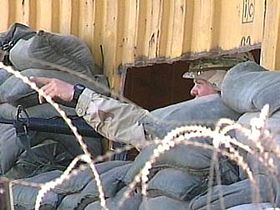 Critics of US involvement argued that the US government was stepping in to gain control of oil concessions for American companies. While Somalia has no proven reserves of oil, there might be oil in Puntland. They pointed out that just before pro-U.S. President Mohamed Siad Barre
was overthrown in 1991, nearly two-thirds of the country's territory had been granted as oil concessions to Conoco
, Amoco
, Chevron
and Phillips
. Conoco even lent its Mogadishu
corporate compound to the U.S. embassy a few days before the Marine
s landed, with the first Bush administration's special envoy using it as his temporary headquarters." Oil exploration remains controversial and the Transitional Federal Government
has warned investors to not make deals until stability is once again brought to the country.
Between June and October 1993, several gun battles in Mogadishu between local gunmen and peacekeepers resulted in the death of 24 Pakistani soldiers and 19 US soldiers (total US deaths were 31), most of whom were killed in the Battle of Mogadishu. 1,000 Somali militia were killed in that battle. The Security Council in Resolution 837
condemned the attacks. The incident later became the basis for the book and movie, Black Hawk Down. The UN withdrew on March 3, 1995, having suffered more significant casualties.
 In 2004, the Transitional Federal Government
(TFG) was founded in Nairobi
, Kenya
. Matters were still too chaotic inside Somalia to convene in Mogadishu. In early 2006, the TFG moved to establish a temporary seat of government in Baidoa
.
During the early part of 2006, the Alliance for the Restoration of Peace and Counter-Terrorism
(ARPCT) was formed as an alliance of mostly secular Mogadishu-based warlords. The warlords were backed by funding from the US CIA. They were opposed to the rise of the Sharia
law oriented Islamic Courts Union (ICU), which had been rapidly consolidating power. This led to increasing conflict in the capital.
, in the Second Battle of Mogadishu. They drove the ARPCT out of Mogadishu, and succeeded in persuading or forcing other warlords to join their faction. Their power base grew as they expanded to the borders of Puntland
and took over southern and middle Jubaland
.
The Islamic movement's growing power base and militancy led to increasingly open warfare between the Islamists and the other factions of Somalia, including the Transitional Federal Government
(TFG), Puntland
and Galmudug
, the latter of which formed as an autonomous state specifically to resist the Islamists. It also caused the intervention of Ethiopia
, who supported the secular forces of Somalia. The ICU allegedly obtained the support of Ethiopia's rival, Eritrea
and foreign mujahideen
, and declared Jihad
against Ethiopia in response to its occupation of Gedo
and deployment around Baidoa
.
. Fighting also broke out around the Somali town of Bandiradley in Mudug
and Beledweyn in the Hiran region. The ICU aimed to force the Ethiopians off Somali soil. However, they were defeated in all major battles and forced to withdraw to Mogadishu. After the brief final action at the Battle of Jowhar
on December 27, the leaders of the ICU resigned.
Following the Battle of Jilib
, fought on December 31, 2006, Kismayo fell to the TFG and Ethiopian forces, on January 1, 2007. Prime Minister Ali Mohammed Ghedi
called for the country to begin disarming
.
gunships against Islamist positions in Ras Kamboni
, as part of efforts to catch or kill Al Qaeda operatives supposedly embedded within the ICU forces. Unconfirmed reports also stated that US advisors had been on the ground with Somali and Ethiopian forces since the beginning of the war. Naval forces were also deployed offshore to prevent escape by sea, and the border to Kenya was closed.
against Ethiopian and Somali government forces. Simultaneously, the end of the war was followed by a continuation of existing tribal conflicts.
To help establish security, a proposed African Union Mission to Somalia (AMISOM) was authorized to deploy as many as 8,000 peacekeepers to the country. This mission widened the scope of countries that could participate over the earlier proposed mission led by the Horn of Africa
-based nations of IGAD. The Islamist group leading the insurgency, known as the Popular Resistance Movement in the Land of the Two Migrations
(PRM), vowed to oppose the presence of foreign troops.
contingent of several thousand troops to help the fragile coalition government and its troops enforce their authority. Following Ethiopia's withdrawal from Somalia, the southern half of the country rapidly fell into the hands of radical Islamist rebels. The rebels quickly routed the government and AU troops in several key provinces, establishing sharia
law in areas under their control. On May 7, 2009, the rebels attacked the capital city of Mogadishu
, capturing most of the city but failing to overthrow the government, which maintained control over a few square kilometers of the city.
Former UN Secretary General Boutros Boutros Ghali and Ahmedou Ould Abdallah, UN special envoy to Somalia have referred to the killing of civilians in the Somalian Civil War as a "genocide", and the Genocide Intervention Network
lists Somalia as an area of concern.
In October 2011, in a coordinated military operation with the Somalian military
, troops from Kenya
crossed the border into southern Somalia
in pursuit of Al-Shabaab militants that are alleged to have kidnapped several foreign tourists and workers inside Kenya. The incursion was reportedly spearheaded by Kenya's Minister of Defence, Mohamed Yusuf Haji, an ethnic Somali. Although the Kenyan Army's role in the operation is active, a spokesman for the Transitional Federal Government
of Somalia (TFG) indicated that Kenyan troops were only supplying "logistical and moral support" and that Somalian military officers were actually combating the Islamist militants.
Civil war
A civil war is a war between organized groups within the same nation state or republic, or, less commonly, between two countries created from a formerly-united nation state....
taking place in Somalia
Somalia
Somalia , officially the Somali Republic and formerly known as the Somali Democratic Republic under Socialist rule, is a country located in the Horn of Africa. Since the outbreak of the Somali Civil War in 1991 there has been no central government control over most of the country's territory...
. The conflict, which began in 1991, has caused destabilisation throughout the country, with the current phase
War in Somalia (2009–)
The 2009–present phase of the Somali Civil War is concentrated in southern Somalia. It began in early February 2009, with the conflict between, on the one hand, the forces of the Somali Transitional Federal Government assisted by African Union peacekeeping troops, and on the other, various militant...
of the conflict seeing the Somali government losing substantial control of the state to rebel forces. The unrest initially consisted of a series of clashes between various tribalist factions, but since the mid-2000s took a militant Islamist tone.
From 2006–2009, the National Defense Force of Ethiopia
Ethiopia
Ethiopia , officially known as the Federal Democratic Republic of Ethiopia, is a country located in the Horn of Africa. It is the second-most populous nation in Africa, with over 82 million inhabitants, and the tenth-largest by area, occupying 1,100,000 km2...
was involved in the conflict. Somalia's government declared a state of emergency
State of emergency
A state of emergency is a governmental declaration that may suspend some normal functions of the executive, legislative and judicial powers, alert citizens to change their normal behaviours, or order government agencies to implement emergency preparedness plans. It can also be used as a rationale...
in June 2009, requesting immediate international support, and the military intervention of neighbouring East African states.
Downfall of Siad Barre (1986–1991)
The Somali Revolution started in 1986 when Siad BarreSiad Barre
Mohamed Siad Barre was the military dictator and President of the Somali Democratic Republic from 1969 to 1991. During his rule, he styled himself as Jaalle Siyaad ....
began attacking clan-based dissident groups opposed to his rule with his special forces, the "Red Berets" (Duub Cas). The first phase of the civil war stemmed from the insurrections against the repressive regime of Siad Barre
Siad Barre
Mohamed Siad Barre was the military dictator and President of the Somali Democratic Republic from 1969 to 1991. During his rule, he styled himself as Jaalle Siyaad ....
. After his ousting from power on January 26, 1991, a counter-revolution took place to attempt to reinstate him as leader of the country.
The increasingly violent and chaotic situation evolved to a humanitarian crisis and to a state of anarchy
Anarchy
Anarchy , has more than one colloquial definition. In the United States, the term "anarchy" typically is meant to refer to a society which lacks publicly recognized government or violently enforced political authority...
.
Later in 1991, to insulate it from the more violent fighting in the south, the Somaliland
Somaliland
Somaliland is an unrecognised self-declared sovereign state that is internationally recognised as an autonomous region of Somalia. The government of Somaliland regards itself as the successor state to the British Somaliland protectorate, which was independent for a few days in 1960 as the State of...
region of Somalia declared itself independent, though its sovereignty is not recognized by any nation or international organization. It comprises the northwestern section of the country, between Djibouti
Djibouti
Djibouti , officially the Republic of Djibouti , is a country in the Horn of Africa. It is bordered by Eritrea in the north, Ethiopia in the west and south, and Somalia in the southeast. The remainder of the border is formed by the Red Sea and the Gulf of Aden at the east...
and the northeastern area known as Puntland
Puntland
Puntland , officially the Puntland State of Somalia , is a region in northeastern Somalia, centered on Garowe in the Nugaal province. Its leaders declared the territory an autonomous state in 1998....
.
United Nations intervention (1992–1995)
UN Security Council Resolution 733United Nations Security Council Resolution 733
United Nations Security Council Resolution 733, adopted unanimously on January 23, 1992, after expressing its alarm at the situation in Somalia regarding the heavy loss of life, destruction to property and threat to regional stability, the Council, acting under Chapter VII of the United Nations...
and UN Security Council Resolution 746
United Nations Security Council Resolution 746
United Nations Security Council Resolution 746, adopted unanimously on March 17, 1992, after reaffirming Resolution 733 , noting a ceasefire agreement in Mogadishu and a report by the Secretary-General, the Council urged the continuation of the United Nations humanitarian work in Somalia and...
led to the creation of UNOSOM I, the first mission to provide humanitarian relief and help restore order in Somalia after the dissolution of its central government.
UN Security Council Resolution 794
United Nations Security Council Resolution 794
United Nations Security Council Resolution 794, adopted unanimously on December 3, 1992, after reaffirming resolutions 733 , 746 , 751 , 767 and 775 , the Council expressed grave concern at the deteriorating situation in Somalia and authorised the creation of the Unified Task Force to create a...
was unanimously passed on December 3, 1992, which approved a coalition of United Nations peacekeepers led by the United States to form UNITAF
UNITAF
Unified Task Force was a United States-led, United Nations-sanctioned multinational force which operated in Somalia between 5 December 1992 – 4 May 1993...
, tasked with ensuring humanitarian aid be distributed and peace be established in Somalia. The UN humanitarian troops landed in 1993 and started a two-year effort (primarily in the south) to alleviate famine
Famine
A famine is a widespread scarcity of food, caused by several factors including crop failure, overpopulation, or government policies. This phenomenon is usually accompanied or followed by regional malnutrition, starvation, epidemic, and increased mortality. Every continent in the world has...
conditions.
Siad Barre
Mohamed Siad Barre was the military dictator and President of the Somali Democratic Republic from 1969 to 1991. During his rule, he styled himself as Jaalle Siyaad ....
was overthrown in 1991, nearly two-thirds of the country's territory had been granted as oil concessions to Conoco
Conoco Inc.
Conoco Inc. was an American oil company founded in 1875 as the Continental Oil and Transportation Company. It is now a brand of gasoline and service station in the United States which belongs to the ConocoPhillips Company...
, Amoco
Amoco
Amoco Corporation, originally Standard Oil Company , was a global chemical and oil company, founded in 1889 around a refinery located in Whiting, Indiana, United States....
, Chevron
Chevron Corporation
Chevron Corporation is an American multinational energy corporation headquartered in San Ramon, California, United States and active in more than 180 countries. It is engaged in every aspect of the oil, gas, and geothermal energy industries, including exploration and production; refining,...
and Phillips
Chevron Phillips
Chevron Phillips is a chemical producer jointly owned by Chevron Corporation and ConocoPhillips. The company was formed July 1, 2000 by merging the chemicals operations of both Chevron Corporation and Phillips Petroleum Company. A 50/50 venture, the company continues to be governed by a board of...
. Conoco even lent its Mogadishu
Mogadishu
Mogadishu , popularly known as Xamar, is the largest city in Somalia and the nation's capital. Located in the coastal Benadir region on the Indian Ocean, the city has served as an important port for centuries....
corporate compound to the U.S. embassy a few days before the Marine
United States Marine Corps
The United States Marine Corps is a branch of the United States Armed Forces responsible for providing power projection from the sea, using the mobility of the United States Navy to deliver combined-arms task forces rapidly. It is one of seven uniformed services of the United States...
s landed, with the first Bush administration's special envoy using it as his temporary headquarters." Oil exploration remains controversial and the Transitional Federal Government
Transitional Federal Government
The Transitional Federal Government is the current internationally recognized government of the Republic of Somalia. It was established as one of the Transitional Federal Institutions of government as defined in the Transitional Federal Charter adopted in November 2004 by the Transitional...
has warned investors to not make deals until stability is once again brought to the country.
Between June and October 1993, several gun battles in Mogadishu between local gunmen and peacekeepers resulted in the death of 24 Pakistani soldiers and 19 US soldiers (total US deaths were 31), most of whom were killed in the Battle of Mogadishu. 1,000 Somali militia were killed in that battle. The Security Council in Resolution 837
United Nations Security Council Resolution 837
United Nations Security Council Resolution 837, adopted unanimously on June 6, 1993, after reaffirming resolutions 733 , 746 , 751 , 767 , 775 , 794 and 814 , the Council condemned the attacks on the United Nations Operation in Somalia II in which 24 Pakistani troops deployed in the Unified Task...
condemned the attacks. The incident later became the basis for the book and movie, Black Hawk Down. The UN withdrew on March 3, 1995, having suffered more significant casualties.
Rise and fall of the ICU, Ethiopian intervention, and the TFG (2006–2009)
Transitional Federal Government
The Transitional Federal Government is the current internationally recognized government of the Republic of Somalia. It was established as one of the Transitional Federal Institutions of government as defined in the Transitional Federal Charter adopted in November 2004 by the Transitional...
(TFG) was founded in Nairobi
Nairobi
Nairobi is the capital and largest city of Kenya. The city and its surrounding area also forms the Nairobi County. The name "Nairobi" comes from the Maasai phrase Enkare Nyirobi, which translates to "the place of cool waters". However, it is popularly known as the "Green City in the Sun" and is...
, Kenya
Kenya
Kenya , officially known as the Republic of Kenya, is a country in East Africa that lies on the equator, with the Indian Ocean to its south-east...
. Matters were still too chaotic inside Somalia to convene in Mogadishu. In early 2006, the TFG moved to establish a temporary seat of government in Baidoa
Baidoa
Baidoa is a city in south-central Somalia, situated by road northwest of the capital Mogadishu. It is the capital of the Bay region, which is traditionally inhabited by the Digil and Mirifle clans....
.
During the early part of 2006, the Alliance for the Restoration of Peace and Counter-Terrorism
Alliance for the Restoration of Peace and Counter-Terrorism
The Alliance for the Restoration of Peace and Counter-Terrorism was a Somali alliance created by various warlords and businesspeople. The alliance included Botan Ise Alin, Mohammed Dheere, Mohamed Qanyare, Musa Sudi Yalahow, Nuur Daqle, Abdi Hasan Awale Qeybdiid, Omar Muhamoud Finnish and others...
(ARPCT) was formed as an alliance of mostly secular Mogadishu-based warlords. The warlords were backed by funding from the US CIA. They were opposed to the rise of the Sharia
Sharia
Sharia law, is the moral code and religious law of Islam. Sharia is derived from two primary sources of Islamic law: the precepts set forth in the Quran, and the example set by the Islamic prophet Muhammad in the Sunnah. Fiqh jurisprudence interprets and extends the application of sharia to...
law oriented Islamic Courts Union (ICU), which had been rapidly consolidating power. This led to increasing conflict in the capital.
Height of ICU power
By June 2006, the ICU succeeded in capturing the capital, MogadishuMogadishu
Mogadishu , popularly known as Xamar, is the largest city in Somalia and the nation's capital. Located in the coastal Benadir region on the Indian Ocean, the city has served as an important port for centuries....
, in the Second Battle of Mogadishu. They drove the ARPCT out of Mogadishu, and succeeded in persuading or forcing other warlords to join their faction. Their power base grew as they expanded to the borders of Puntland
Puntland
Puntland , officially the Puntland State of Somalia , is a region in northeastern Somalia, centered on Garowe in the Nugaal province. Its leaders declared the territory an autonomous state in 1998....
and took over southern and middle Jubaland
Jubaland
Jubaland , also known as Azania or the Juba Valley and formerly as Trans-Juba , is an autonomous region in southern Somalia. Its eastern border lies 40–60 km east of the Jubba River, stretching from Gedo to the Indian Ocean, while its western side flanks the North Eastern Province in...
.
The Islamic movement's growing power base and militancy led to increasingly open warfare between the Islamists and the other factions of Somalia, including the Transitional Federal Government
Transitional Federal Government
The Transitional Federal Government is the current internationally recognized government of the Republic of Somalia. It was established as one of the Transitional Federal Institutions of government as defined in the Transitional Federal Charter adopted in November 2004 by the Transitional...
(TFG), Puntland
Puntland
Puntland , officially the Puntland State of Somalia , is a region in northeastern Somalia, centered on Garowe in the Nugaal province. Its leaders declared the territory an autonomous state in 1998....
and Galmudug
Galmudug
Galmudug is an autonomous region in central Somalia. It is bordered to its north by the Puntland region, to the west by Ethiopia, and to the south by other regions of Somalia.Galmudug's name is derived from a conflation of the Galguduud and Mudug provinces...
, the latter of which formed as an autonomous state specifically to resist the Islamists. It also caused the intervention of Ethiopia
Ethiopia
Ethiopia , officially known as the Federal Democratic Republic of Ethiopia, is a country located in the Horn of Africa. It is the second-most populous nation in Africa, with over 82 million inhabitants, and the tenth-largest by area, occupying 1,100,000 km2...
, who supported the secular forces of Somalia. The ICU allegedly obtained the support of Ethiopia's rival, Eritrea
Eritrea
Eritrea , officially the State of Eritrea, is a country in the Horn of Africa. Eritrea derives it's name from the Greek word Erethria, meaning 'red land'. The capital is Asmara. It is bordered by Sudan in the west, Ethiopia in the south, and Djibouti in the southeast...
and foreign mujahideen
Mujahideen
Mujahideen are Muslims who struggle in the path of God. The word is from the same Arabic triliteral as jihad .Mujahideen is also transliterated from Arabic as mujahedin, mujahedeen, mudžahedin, mudžahidin, mujahidīn, mujaheddīn and more.-Origin of the concept:The beginnings of Jihad are traced...
, and declared Jihad
Jihad
Jihad , an Islamic term, is a religious duty of Muslims. In Arabic, the word jihād translates as a noun meaning "struggle". Jihad appears 41 times in the Quran and frequently in the idiomatic expression "striving in the way of God ". A person engaged in jihad is called a mujahid; the plural is...
against Ethiopia in response to its occupation of Gedo
Gedo
Gedo is an administrative region , formerly part of the historic Upper Juba Region in southern Somalia. Its regional capital is Garbahaarreey. Gedo is a region created in 1980s and is bordered by the Ogaden in Ethiopia, the North Eastern Province in Kenya, and the Somali regions of Bakool, Bay,...
and deployment around Baidoa
Baidoa
Baidoa is a city in south-central Somalia, situated by road northwest of the capital Mogadishu. It is the capital of the Bay region, which is traditionally inhabited by the Digil and Mirifle clans....
.
Ethiopian intervention and collapse of the ICU
In December 2006, the ICU and TFG began the Battle of BaidoaBattle of Baidoa
The Battle of Baidoa began on December 20, 2006 when the Somali Transitional Federal Government's forces allied with Ethiopian forces stationed there attacked advancing Islamic Courts Union forces along with 500 alleged Eritrean troops and mujahideen arrayed against them.The battle began with...
. Fighting also broke out around the Somali town of Bandiradley in Mudug
Mudug
Mudug is an administrative region in north-central Somalia. Bordered by the Ogaden, the Somalian regions of Nugaal and Galguduud, and the Indian Ocean, its capital is the city of Galkacyo.-Districts:...
and Beledweyn in the Hiran region. The ICU aimed to force the Ethiopians off Somali soil. However, they were defeated in all major battles and forced to withdraw to Mogadishu. After the brief final action at the Battle of Jowhar
Battle of Jowhar
The Battle of Jowhar was a battle in the 2006 Somali War fought between the Islamic Courts Union and affiliated militias against Ethiopian and Transitional Federal Government forces for control of the town of Jowhar . It began on December 27, 2006, when retreating ICU forces regrouped near their...
on December 27, the leaders of the ICU resigned.
Following the Battle of Jilib
Battle of Jilib
The Battle of Jilib was a battle in the 2006 Somali War fought by the Islamic Courts Union and affiliated militias against Ethiopian and Transitional Federal Government forces for control of the town of Jilib...
, fought on December 31, 2006, Kismayo fell to the TFG and Ethiopian forces, on January 1, 2007. Prime Minister Ali Mohammed Ghedi
Ali Mohammed Ghedi
Ali Mohamed Ghedi was the Prime Minister of the Transitional Federal Government of Somalia from 2004 to 2007. He was relatively unknown in political circles upon his appointment as prime minister in November 2004. He is affiliated with the Abgaal subclan of Mogadishu's Hawiye clan, one of...
called for the country to begin disarming
Disarmament in Somalia
After two decades of violence and civil war and after the Transitional Federal Government of Somalia captured Mogadishu and Kismayo, the TFG attempted to disarm the militias of the country in late 2006...
.
US intervention
In January 2007, the United States officially militarily interceded in the country for the first time since the UN deployment of the 1990s by conducting airstrikes using AC-130Lockheed AC-130
The Lockheed AC-130 gunship is a heavily-armed ground-attack aircraft variant of the C-130 Hercules transport plane. The basic airframe is manufactured by Lockheed, while Boeing is responsible for the conversion into a gunship and for aircraft support...
gunships against Islamist positions in Ras Kamboni
Ras Kamboni
Ras Kamboni is a town in the Badhaadhe district of Lower Juba region, Somalia, which lies on a peninsula near the border with Kenya. American officials have said that it has served as a training camp for extremists with connections to Al-Qaeda; al-Sharq al-Awsat reported in May 1999 that al-Qaeda...
, as part of efforts to catch or kill Al Qaeda operatives supposedly embedded within the ICU forces. Unconfirmed reports also stated that US advisors had been on the ground with Somali and Ethiopian forces since the beginning of the war. Naval forces were also deployed offshore to prevent escape by sea, and the border to Kenya was closed.
Islamist insurgency and reappearance of inter-clan fighting
No sooner had the ICU been routed from the battlefield than their troops dispersed to begin a guerrilla warfareGuerrilla warfare
Guerrilla warfare is a form of irregular warfare and refers to conflicts in which a small group of combatants including, but not limited to, armed civilians use military tactics, such as ambushes, sabotage, raids, the element of surprise, and extraordinary mobility to harass a larger and...
against Ethiopian and Somali government forces. Simultaneously, the end of the war was followed by a continuation of existing tribal conflicts.
To help establish security, a proposed African Union Mission to Somalia (AMISOM) was authorized to deploy as many as 8,000 peacekeepers to the country. This mission widened the scope of countries that could participate over the earlier proposed mission led by the Horn of Africa
Horn of Africa
The Horn of Africa is a peninsula in East Africa that juts hundreds of kilometers into the Arabian Sea and lies along the southern side of the Gulf of Aden. It is the easternmost projection of the African continent...
-based nations of IGAD. The Islamist group leading the insurgency, known as the Popular Resistance Movement in the Land of the Two Migrations
Al-Shabaab (Somalia)
Harakat al-Shabaab al-Mujahideen , more commonly known as al-Shabaab , is a terrorist group of militants fighting to overthrow the government of Somalia. As of 2011, the group controls large swathes of the southern parts of Somalia, where it is said to have imposed its own strict form of Sharia law...
(PRM), vowed to oppose the presence of foreign troops.
War in Somalia (2009–present)
In December 2008, Ethiopian soldiers withdrew from Somalia, leaving behind an African UnionAfrican Union
The African Union is a union consisting of 54 African states. The only all-African state not in the AU is Morocco. Established on 9 July 2002, the AU was formed as a successor to the Organisation of African Unity...
contingent of several thousand troops to help the fragile coalition government and its troops enforce their authority. Following Ethiopia's withdrawal from Somalia, the southern half of the country rapidly fell into the hands of radical Islamist rebels. The rebels quickly routed the government and AU troops in several key provinces, establishing sharia
Sharia
Sharia law, is the moral code and religious law of Islam. Sharia is derived from two primary sources of Islamic law: the precepts set forth in the Quran, and the example set by the Islamic prophet Muhammad in the Sunnah. Fiqh jurisprudence interprets and extends the application of sharia to...
law in areas under their control. On May 7, 2009, the rebels attacked the capital city of Mogadishu
Mogadishu
Mogadishu , popularly known as Xamar, is the largest city in Somalia and the nation's capital. Located in the coastal Benadir region on the Indian Ocean, the city has served as an important port for centuries....
, capturing most of the city but failing to overthrow the government, which maintained control over a few square kilometers of the city.
Former UN Secretary General Boutros Boutros Ghali and Ahmedou Ould Abdallah, UN special envoy to Somalia have referred to the killing of civilians in the Somalian Civil War as a "genocide", and the Genocide Intervention Network
Genocide Intervention Network
thumb|right|300px|Genocide Intervention Network logoThe Genocide Intervention Network is a non-profit organization that "envisions a world in which the global community is willing and able to protect civilians from genocide and mass atrocities...
lists Somalia as an area of concern.
In October 2011, in a coordinated military operation with the Somalian military
Military of Somalia
The Military of Somalia was, up until 1991, made up of the army, navy, air force, and air defense command. The outbreak of the Somali Civil War during that year led to the de facto dissolution of the national armed forces. However, efforts to re-establish a regular armed force by a re-constituted...
, troops from Kenya
Kenya
Kenya , officially known as the Republic of Kenya, is a country in East Africa that lies on the equator, with the Indian Ocean to its south-east...
crossed the border into southern Somalia
Somalia
Somalia , officially the Somali Republic and formerly known as the Somali Democratic Republic under Socialist rule, is a country located in the Horn of Africa. Since the outbreak of the Somali Civil War in 1991 there has been no central government control over most of the country's territory...
in pursuit of Al-Shabaab militants that are alleged to have kidnapped several foreign tourists and workers inside Kenya. The incursion was reportedly spearheaded by Kenya's Minister of Defence, Mohamed Yusuf Haji, an ethnic Somali. Although the Kenyan Army's role in the operation is active, a spokesman for the Transitional Federal Government
Transitional Federal Government
The Transitional Federal Government is the current internationally recognized government of the Republic of Somalia. It was established as one of the Transitional Federal Institutions of government as defined in the Transitional Federal Charter adopted in November 2004 by the Transitional...
of Somalia (TFG) indicated that Kenyan troops were only supplying "logistical and moral support" and that Somalian military officers were actually combating the Islamist militants.
See also
- Factions in the Somali Civil WarFactions in the Somali Civil WarOver the course of the Somali Civil War, there have been many revolutionary movements and militia groups run by competing warlords which have held de facto control over vast areas of the country.- Somali Salvation Democratic Front :...
- Mogadishu LineMogadishu LineThe "Mogadishu Line" is a foreign policy term used to describe the point at which foreign involvement in a conflict shifts from peacekeeping or diplomacy to combat operations...
- Northern Somali Unionist Movement (NSUM)Northern Somali Unionist Movement (NSUM)-Overview:The Northern Somali Unionist Movement is a Somali organization that was formed in 1991, by Mr Ahmed Mohamed Mohamoud and whose members and supporters hail from Sool, Sanaag and Cayn regions in the Northern regions of Somalia...
- Operation DeliveranceOperation DeliveranceOperation Deliverance was a Canadian Forces peace keeping military operation in Somalia and formed part of the United Nations peacekeeping deployment to that country...
- Puntland–Somaliland dispute
- 2010 Ayn clashes2010 Ayn clashesThe 2010 Ayn clashes saw Ethiopian and Somaliland forces engage Dulbahante clan militia in Puntland's Ayn region in a bid to reconquer the region ahead of the Somaliland presidential election, 2010...
External links
News coverage of conflict- Somalia in crisis collection of articles on the BBCBBCThe British Broadcasting Corporation is a British public service broadcaster. Its headquarters is at Broadcasting House in the City of Westminster, London. It is the largest broadcaster in the world, with about 23,000 staff...
- Somalia's Struggle for Stability from The NewsHour with Jim LehrerThe NewsHour with Jim LehrerPBS NewsHour is an evening television news program broadcast weeknights on the Public Broadcasting Service in the United States. The show is produced by MacNeil/Lehrer Productions, a company co-owned by former anchors Jim Lehrer and Robert MacNeil, and Liberty Media, which owns a 65% stake in the...
- The Somalia Affair from CBCCBC NewsCBC News is the department within the Canadian Broadcasting Corporation responsible for the news gathering and production of news programs on CBC television, radio and online services...
- Somalia - War situation since 1991 on France 24 Special Report on France 24France 24France 24 is an international news and current affairs television channel. The service is aimed at the overseas market, similar to BBC World News, DW-TV, NHK World and RT, and broadcast through satellite and cable operators throughout the world. During 2010 the channel started broadcasting through...
news channel - U.S. Special Envoy Cites Widespread ‘Lack of Confidence’ in Somali Government from the Council on Foreign RelationsCouncil on Foreign RelationsThe Council on Foreign Relations is an American nonprofit nonpartisan membership organization, publisher, and think tank specializing in U.S. foreign policy and international affairs...
- ITN/CNN Report "War tears Somalia apart", an up-to-date report on Mogadishu, October, 10th, 2007.
- HRW claims US involved in secret detention of Somalis, Breaking Legal News 2007/04/01
- Anarchy and Invention: How Does Somalia's Private Sector Cope without Government? from the World BankWorld BankThe World Bank is an international financial institution that provides loans to developing countries for capital programmes.The World Bank's official goal is the reduction of poverty...
- Turbulent Waters in a Maritime Black Hole The Hague Centre for Strategic Studies May 2008
- Condemn US-Ethiopian aggression against Somalia Lalkar January 2007
- Somali - U.S. Relations from the Dean Peter Krogh Foreign Affairs Digital Archives
- Somalia Operations: Lessons Learned by Kenneth Allard (CCRP, 1995)
- "Preserving American Security Ties to Somalia," by Michael Johns, Heritage FoundationHeritage FoundationThe Heritage Foundation is a conservative American think tank based in Washington, D.C. Heritage's stated mission is to "formulate and promote conservative public policies based on the principles of free enterprise, limited government, individual freedom, traditional American values, and a strong...
, December 26, 1989. - Changed Arab attitudes to Somalia Conflict
- http://walrusmagazine.com/articles/2008.03-field-notes-chronic-ptsd/"Separation Anxiety", article in The WalrusThe WalrusThe Walrus is a Canadian general interest magazine which publishes long form journalism on Canadian and international affairs, along with fiction and poetry by Canadian writers. It launched in September 2003, as an attempt to create a Canadian equivalent to American magazines such as Harper's, The...
about post-traumatic stress disorder among Somali warriors] - Between Kat and Katyushas Elaborated Article on the Contemporary History of Somalia