

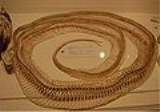
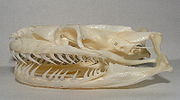
Snake skeleton

Encyclopedia
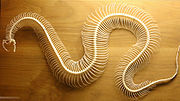
A snake
Snake
Snakes are elongate, legless, carnivorous reptiles of the suborder Serpentes that can be distinguished from legless lizards by their lack of eyelids and external ears. Like all squamates, snakes are ectothermic, amniote vertebrates covered in overlapping scales...
skeleton
Skeleton
The skeleton is the body part that forms the supporting structure of an organism. There are two different skeletal types: the exoskeleton, which is the stable outer shell of an organism, and the endoskeleton, which forms the support structure inside the body.In a figurative sense, skeleton can...
consists primarily of the skull
Skull
The skull is a bony structure in the head of many animals that supports the structures of the face and forms a cavity for the brain.The skull is composed of two parts: the cranium and the mandible. A skull without a mandible is only a cranium. Animals that have skulls are called craniates...
, vertebrae, and rib
Rib
In vertebrate anatomy, ribs are the long curved bones which form the rib cage. In most vertebrates, ribs surround the chest, enabling the lungs to expand and thus facilitate breathing by expanding the chest cavity. They serve to protect the lungs, heart, and other internal organs of the thorax...
s, with only vestigial remnants of the limbs.
Skull
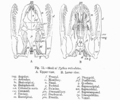
Skull
The skull is a bony structure in the head of many animals that supports the structures of the face and forms a cavity for the brain.The skull is composed of two parts: the cranium and the mandible. A skull without a mandible is only a cranium. Animals that have skulls are called craniates...
of a snake
Snake
Snakes are elongate, legless, carnivorous reptiles of the suborder Serpentes that can be distinguished from legless lizards by their lack of eyelids and external ears. Like all squamates, snakes are ectothermic, amniote vertebrates covered in overlapping scales...
is a very complex structure, with numerous joint
Joint
A joint is the location at which two or more bones make contact. They are constructed to allow movement and provide mechanical support, and are classified structurally and functionally.-Classification:...
s to allow the snake to swallow prey far larger than its head.
The typical snake skull has a solidly ossified braincase, with the separate frontal bone
Frontal bone
The frontal bone is a bone in the human skull that resembles a cockleshell in form, and consists of two portions:* a vertical portion, the squama frontalis, corresponding with the region of the forehead....
s and the united parietal bone
Parietal bone
The parietal bones are bones in the human skull which, when joined together, form the sides and roof of the cranium. Each bone is roughly quadrilateral in form, and has two surfaces, four borders, and four angles. It is named from the Latin pariet-, wall....
s extending downward to the basisphenoid, which is large and extends forward into a rostrum
Rostrum (anatomy)
The term rostrum is used for a number of unrelated structures in different groups of animals:*In crustaceans, the rostrum is the forward extension of the carapace in front of the eyes....
extending to the ethmoidal region. The nose is less ossified, and the paired nasal bone
Nasal bone
The nasal bones are two small oblong bones, varying in size and form in different individuals; they are placed side by side at the middle and upper part of the face, and form, by their junction, "the bridge" of the nose.Each has two surfaces and four borders....
s are often attached only at their base. The occipital condyle
Occipital condyle
The occipital condyles are undersurface facets of the occipital bone in vertebrates, which function in articulation with the superior facets of the atlas vertebra....
is either trilobate and formed by the basioccipital and the exoccipitals, or a simple knob formed by the basioccipital; the supraoccipital is excluded from the foramen magnum. The basioccipital may bear a strong, curved ventral process or hypapophysis in the vipers
Viperidae
The Viperidae are a family of venomous snakes found all over the world, except in Antarctica, Australia, Ireland, Madagascar, Hawaii, various other isolated islands, and above the Arctic Circle. All have relatively long, hinged fangs that permit deep penetration and injection of venom. Four...
.
The prefrontal bone
Prefrontal bone
The prefrontal bone is a bone separating the lacrimal and frontal bones in many tetrapod skulls. It first evolved in the sarcopterygian clade Rhipidistia, which includes lungfish and the Tetrapodomorpha. The prefrontal is found in most modern and extinct lungfish, amphibians and reptiles...
is situated, on each side, between the frontal bone and the maxilla
Maxilla
The maxilla is a fusion of two bones along the palatal fissure that form the upper jaw. This is similar to the mandible , which is also a fusion of two halves at the mental symphysis. Sometimes The maxilla (plural: maxillae) is a fusion of two bones along the palatal fissure that form the upper...
, and may or may not be in contact with the nasal bone.
The postfrontal bone, usually present, borders the orbit
Orbit (anatomy)
In anatomy, the orbit is the cavity or socket of the skull in which the eye and its appendages are situated. "Orbit" can refer to the bony socket, or it can also be used to imply the contents...
behind, rarely also above, and in the pythons a supraorbital bone is intercalated between it and the prefrontal bone.
The premaxillary bone is single and small, and as a rule connected with the maxillary only by ligament
Ligament
In anatomy, the term ligament is used to denote any of three types of structures. Most commonly, it refers to fibrous tissue that connects bones to other bones and is also known as articular ligament, articular larua, fibrous ligament, or true ligament.Ligament can also refer to:* Peritoneal...
.
The paired vomer
Vomer
The vomer is one of the unpaired facial bones of the skull. It is located in the midsagittal line, and articulates with the sphenoid, the ethmoid, the left and right palatine bones, and the left and right maxillary bones.-Biology:...
is narrow.
The palatine bone
Palatine bone
The palatine bone is a bone in many species of the animal kingdom, commonly termed the palatum .-Human anatomy:...
and pterygoid
Pterygoid
Pterygoid can refer to:* Pterygoid processes of the sphenoid bone** The Lateral pterygoid plate by it* a muscle such as Lateral pterygoid muscle or Medial pterygoid muscle* a branch of the Mandibular nerve...
are long and parallel to the axis of the skull, the latter diverging behind and extending to the quadrate
Quadrate bone
The quadrate bone is part of a skull in most tetrapods, including amphibians, sauropsids , and early synapsids. In these animals it connects to the quadratojugal and squamosal in the skull, and forms part of the jaw joint .- Evolutionary variation :In snakes, the quadrate bone has become elongated...
or to the articular extremity of the mandible; the pterygoid is connected with the maxillary by the ectopterygoid or transverse bone, which may be very long, and the maxillary often emits a process towards the palatine, the latter bone being usually produced inwards and upwards towards the anterior extremity of the basisphenoid.
The quadrate is usually large and elongate, and attached to the cranium through the supratemporal (often regarded as the squamosal
Squamosal
The squamosal is a bone of the head of higher vertebrates. It is the principal component of the cheek region in the skull, lying below the temporal series and otic notch and bounded anteriorly by postorbital. Posteriorly, the squamosal articulates with the posterior elements of the palatal complex,...
).
In rare cases, (Miodon, Polemon
Polemon
-Philosophers:*Polemon , the head of the Platonic Academy from 314-269 BC*Polemon of Athens, a 2nd century BC Stoic philosopher, also referred to as Polemon of Ilium*Polemon of Laodiceia, a 2nd century sophist-Kings:...
) the transverse bone is forked, and articulates with two branches of the maxilla.
The quadrate and the maxillary and palatopterygoid arches are more or less movable to allow for the distension
Distension
Distension generally refers to an enlargement or ballooning effect:* Gastric distension - bloating of the stomach when air is pumped into it, as in a medical procedure* Abdominal distension - abdominal bloating, a symptom of several medical conditions...
required by the passage of prey, often much exceeding the size of the mouth. For the same reason, the rami
Rami
Rami or RAMI can refer to:*Rami, the plural of ramus, literally a branch, as of a plant, nerve, or blood vessel*Specifically, rami are upward portions on both sides of the mandible...
of the lower jaw, which consist of dentary, splenial
Splenial
The splenial is a small bone in the lower jaw of reptiles, amphibians and birds, usually located on the lingual side between the angular and suprangular....
, angular
Angular
The angular is a large bone in the lower jaw of amphibians and reptiles , which is connected to all other lower jaw bones: the dentary , the splenial, the suprangular, and the articular...
, and articular
Articular
The articular bone is part of the lower jaw of most tetrapods, including amphibians, sauropsids and early synapsids. In these animals it is connected to two other lower jaw bones, the suprangular and the angular...
elements, with the addition of a coronoid in the boa
Boa (genus)
Boa is a genus of non-venomous boas found in Mexico, Central and South America, Madagascar and on Reunion Island. Four species are currently recognized.The largest member of this group, B...
s and a few other small families, are connected at the symphysis
Symphysis
A symphysis is a fibrocartilaginous fusion between two bones. It is a type of cartilaginous joint, specifically a secondary cartilaginous joint.1.A symphysis is an amphiarthrosis, a slightly movable joint.2.A growing together of parts or structures...
by a very extensible elastic ligament.
The hyoid apparatus is reduced to a pair of cartilaginous filaments situated below the trachea, and united in front.
There are various modifications according to the genera
Genus
In biology, a genus is a low-level taxonomic rank used in the biological classification of living and fossil organisms, which is an example of definition by genus and differentia...
. A large hole may be present between the frontal bone
Frontal bone
The frontal bone is a bone in the human skull that resembles a cockleshell in form, and consists of two portions:* a vertical portion, the squama frontalis, corresponding with the region of the forehead....
s and the basisphenoid (Psammophis
Psammophis
Psammophis is a genus of colubrid snakes.-Description:Maxillary teeth 10 to 13, one or two in the middle much enlarged and fang-like, preceded and followed by an interspace, the two posterior grooved. Anterior mandibular teeth long, posterior small. Head elongate and distinct from neck, with...
, Coelopeltis); the maxillary may be much abbreviated and movable vertically, as in the Viperidae
Viperidae
The Viperidae are a family of venomous snakes found all over the world, except in Antarctica, Australia, Ireland, Madagascar, Hawaii, various other isolated islands, and above the Arctic Circle. All have relatively long, hinged fangs that permit deep penetration and injection of venom. Four...
; the pterygoids may taper and converge posteriorly, without any connection with the quadrate, as in the Amblycephalidae; the supratemporal may be much reduced, and wedged in between the adjacent bones of the cranium; the quadrate may be short or extremely large; the prefrontals may join in a median suture in front of the frontals; the dentary may be freely movable, and detached from the articular posteriorly.
The deviation from the normal type is much greater still when we consider the degraded wormlike members of the families Typhlopidae
Typhlopidae
The Typhlopidae are a family of blind snakes. They are found mostly in the tropical regions of Africa, Asia, the Americas, and all mainland Australia and various islands. The rostral scale overhangs the mouth to form a shovel like burrowing structure. They live underground in burrows, and since...
and Glauconiidae, in which the skull is very compact and the maxillary much reduced. In the former this bone is loosely attached to the lower aspect of the cranium; in the latter it borders the mouth, and is suturally joined to the premaxillary and the prefrontal. In both the transverse bone and the supratemporal are absent, but the coronoid element is present in the mandible.
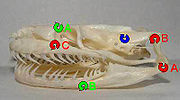
Joints of the snake skull
Joint
A joint is the location at which two or more bones make contact. They are constructed to allow movement and provide mechanical support, and are classified structurally and functionally.-Classification:...
between the mandible
Mandible
The mandible pronunciation or inferior maxillary bone forms the lower jaw and holds the lower teeth in place...
and quadrate. It is analogous to the joint in mammal jaws.
Red B: the joint between the quadrate and the supratemporal. It is highly mobile in most directions, allowing a wider gape (i.e., the snake can open its mouth wider) and greater jaw flexibility.
Red C: the joint between the prefrontal and maxilla
Maxilla
The maxilla is a fusion of two bones along the palatal fissure that form the upper jaw. This is similar to the mandible , which is also a fusion of two halves at the mental symphysis. Sometimes The maxilla (plural: maxillae) is a fusion of two bones along the palatal fissure that form the upper...
. It allows the maxilla to pivot in the plane of the photograph, and while it does not increase gape, it does facilitate the complex action by which the snake draws prey into its mouth.
Green A: the joint between the frontal bone
Frontal bone
The frontal bone is a bone in the human skull that resembles a cockleshell in form, and consists of two portions:* a vertical portion, the squama frontalis, corresponding with the region of the forehead....
and nasal bone
Nasal bone
The nasal bones are two small oblong bones, varying in size and form in different individuals; they are placed side by side at the middle and upper part of the face, and form, by their junction, "the bridge" of the nose.Each has two surfaces and four borders....
. It allows the nose
Nose
Anatomically, a nose is a protuberance in vertebrates that houses the nostrils, or nares, which admit and expel air for respiration in conjunction with the mouth. Behind the nose are the olfactory mucosa and the sinuses. Behind the nasal cavity, air next passes through the pharynx, shared with the...
to upturn slightly, increasing gape and assisting in swallow
Swallow
The swallows and martins are a group of passerine birds in the family Hirundinidae which are characterised by their adaptation to aerial feeding...
ing.
Green B: allows the lower jaws to bow outwards, further increasing the gape.
Blue: the joint between the supratemporal and parietal. Immobile, except for Dasypeltis
Dasypeltis
Dasypeltis is a genus of colubrid snakes. It is one of only two taxonomic groups of snakes known to have adapted to feed exclusively on eggs...
.
Snake dentition
In most snakes, teeth are located on the dentary of the lower jaw, the maxillaMaxilla
The maxilla is a fusion of two bones along the palatal fissure that form the upper jaw. This is similar to the mandible , which is also a fusion of two halves at the mental symphysis. Sometimes The maxilla (plural: maxillae) is a fusion of two bones along the palatal fissure that form the upper...
, the palatine bone
Palatine bone
The palatine bone is a bone in many species of the animal kingdom, commonly termed the palatum .-Human anatomy:...
and the lateral pterygoid plate
Lateral pterygoid plate
The lateral pterygoid plate of the sphenoid is broad, thin, and everted; its lateral surface forms part of the medial wall of the infratemporal fossa, and gives attachment to the lateral pterygoid muscle; its medial surface forms part of the pterygoid fossa, and gives attachment to the medial...
. The latter form an "inner row" of teeth that can move separately from the rest of the jaws and are used to help "walk" the jaws over prey. While most snakes are not hazardous to humans, several lineages have evolved venom
Snake venom
Snake venom is highly modified saliva that is produced by special glands of certain species of snakes. The glands which secrete the zootoxin are a modification of the parotid salivary gland of other vertebrates, and are usually situated on each side of the head below and behind the eye,...
which is typically delivered by specialized teeth called fang
Fang
Fang is a mammal's canine tooth.Fang may also refer to:* A snake's poison-injecting tooth: see snake venom* Fang people, in Central Africa* Fang language, spoken by Fang people...
s located on the maxilla
Maxilla
The maxilla is a fusion of two bones along the palatal fissure that form the upper jaw. This is similar to the mandible , which is also a fusion of two halves at the mental symphysis. Sometimes The maxilla (plural: maxillae) is a fusion of two bones along the palatal fissure that form the upper...
.
Most snakes can be placed into one of four groups, based on their teeth, which correlate strongly with venom and lineage.
Aglyph
Synapomorphy
In cladistics, a synapomorphy or synapomorphic character is a trait that is shared by two or more taxa and their most recent common ancestor, whose ancestor in turn does not possess the trait. A synapomorphy is thus an apomorphy visible in multiple taxa, where the trait in question originates in...
.
Opisthoglyph
Opisthoglyphous snakes (rearward grooves) possess weak venom injected by a pair of enlarged teeth at the back of the maxillae which normally angle backwards and are grooved to channel venom into the puncture. Since these fangs and are not located at the front of the mouth this arrangement is vernacularly called rear-fanged. In order to envenomate prey, an opisthoglyphous snake must move the prey into the rear of its mouth and then penetrate it with its fangs, presenting difficulties with large prey although they can quickly move smaller prey (or a human handler's finger) into position. The opisthoglyphous dentition appears at least two times in the history of snakes. While the venom of most opisthoglyphous snakes is too weak to harm humans, sometimes this is not the case. Notably, herpetologists Karl SchmidtKarl Patterson Schmidt
Karl Patterson Schmidt was an American herpetologist.-Biography:Schmidt was the son of George W. Schmidt and Margaret Patterson Schmidt. Schmidt's father was a German professor who, at the time of Schmidt's birth, was teaching in Lake Forest, Illinois. His family left the city in 1907 and settled...
and Robert Mertens
Robert Mertens
Robert Mertens was a German herpetologist. The Robert Mertens' day gecko is a species named after him, and he also postulated Mertensian mimicry....
were killed by a boomslang
Boomslang
The boomslang is a large venomous colubrid snake.-Taxonomy & etymology:It is currently the only species in its genus, although several species and subspecies have been described in the past...
and twig snake
Twig snake
The twig or bird snakes of the genus Thelotornis are a group of back-fanged, colubrid snakes in the family Colubridae. All species have a slender and elongated profile, a long tail, narrow head and pointed snout. The eyes of each species have horizontal pupils, shaped like keyholes, which gives...
, respectively, after each underestimated the effects of the bite and failed to seek medical help. Opisthoglyphous snakes are found in family Colubridae.
Proteroglyph
Proteroglyphous snakes (forward grooved) have shortened maxillae bearing few teeth except for a substantially enlarged fang pointing downwards and completely folded around the venom channel, forming a hollow needle. Because the fangs are only a fraction of an inch long in even the largest species these snakes must hang on, at least momentarily, as they inject their venom, the most toxic of all snakes. Some spitting cobraSpitting cobra
A spitting cobra is one of several species of cobras that have the ability to eject venom from their fangs when defending themselves against predators. The sprayed venom is harmless to intact skin...
s have modified fang tips allowing them to spray venom at an attacker's eyes. This form of dentition is unique to elapids.
Solenoglyph
Solenoglyphous snakes (pipe grooved) have the most advanced venom delivery method of any snake. Each maxilla is reduced to a nub supporting a single hollow fang tooth. The fangs, which can be as long as half the length of the head, are folded against the roof of the mouth, pointing posteriorly. The skull has a series of interacting elements which ensure that the fangs rotate into biting position when the jaws open. Solenoglyphous snakes open their mouths almost 180 degrees, and the fangs swing into a position to allow them to penetrate deep into the prey. While solenoglyph venom is typically less toxic than that of proteroglyphs, this system allows them to deeply inject large quantities of venom. This form of dentition is unique to viperViperidae
The Viperidae are a family of venomous snakes found all over the world, except in Antarctica, Australia, Ireland, Madagascar, Hawaii, various other isolated islands, and above the Arctic Circle. All have relatively long, hinged fangs that permit deep penetration and injection of venom. Four...
s.
Exceptions
A few snakes do not conform to these categories. AtractaspisAtractaspis
Atractaspis is a genus of venomous snakes found in Africa. Currently, 15 species are recognized by ITIS. Others recognize 19 species. 16 are listed here.-Common names:Burrowing vipers, burrowing asps, mole vipers, stiletto snakes, side-stabbing snakes....
is solenoglyphous but the fangs swing out sideways, allowing it to strike without opening its mouth, perhaps allowing it to hunt in small tunnels. Scolecophidia
Scolecophidia
The Scolecophidia are an infraorder of snakes. They range in size from 10-100 cm in length, but may only be as small as 2 mm. All are fossorial. Currently, 3 families and 12 genera are recognized.-Families:-See also:...
(blind burrowing snakes) typically have few teeth, often only in the upper jaw or lower jaw.
Taxonomic key of skull modifications
Modifications of the skull in the European genera:- I. Quadrate articulating with the cranium, supratemporal absent; mandible much shorter than the skull, with coronoid bone; maxillary small, on lower aspect of cranium; pterygoids not extending to quadrate; nasals forming long sutures with the premaxillary, prefrontals, and frontal: TyphlopsTyphlopsTyphlops is a genus of blind snakes found in Europe, Africa, Asia and Central and South America. Currently, 120 species are recognized.-Geographic range:...
. - II. Quadrate suspended from the supratemporal; mandible at least as long as the skull; pterygoids extending to quadrate or mandible.
- A. Mandible with coronoid bone; nasals in sutural contact with frontals and prefrontals; transverse bone short, not projecting much beyond cranium; maxillary not half as long as mandible, which is not longer than skull (to occiput): EryxEryx (genus)Eryx is a genus of nonvenomous boas found in southeastern Europe, northern Africa, the Middle East and southwestern Asia. Eight species are currently recognized.-Geographic range:...
. - B. No coronoid bone; nasals isolated.
-
-
- 1. Maxillary elongate, not movable vertically.
-
- a. Maxillary half as long as mandible.
-
- Supratemporal half as long as skull, projecting far beyond cranium; mandible much longer than skull: Tropidonotus.
- Supratemporal not half as long as skull, projecting far beyond cranium; mandible much longer than skull: ZamenisZamenisZamenis is a genus of snake in the Colubridae family.It contains the following species:* Transcaucasian ratsnake * Italian Aesculapian Snake * Aesculapian Snake...
. - Supratemporal not half as long as skull, projecting but slightly beyond cranium; mandible much longer than skull: ColuberColuberColuber is a genus of thin bodied, fast moving, colubrid snakes commonly known as racers. They are widespread around the world and vary greatly in habitat and behaviour. In the past, Coluber was a catch-all genus which included almost all snake species known at the time...
. - Supratemporal not half as long as skull, not projecting beyond cranium; mandible not longer than skull: CoronellaCoronellaCoronella is a genus of harmless colubrids found in Europe, North Africa and West Asia. Three species are currently recognized.-Description:...
, Contia.
- b. Maxillary not half as long as mandible, which is longer than skull; supratemporal not half as long as skull, projecting beyond cranium.
-
- Quadrate longer than supratemporal; maxillary much longer than quadrate, nearly straight in front of prefrontal; a large vacuity between the frontal bones and the basisphenoid: Coelopeltis.
- Quadrate not longer than supratemporal; maxillary little longer than quadrate, strongly curved in front of prefrontal:MacroprotodonMacroprotodonMacroprotodon is a genus of snakes in the Colubridae family. All of the members of the genus are commonly known as false smooth snakes.It contains the following species:* Macroprotodon abubakeri* Macroprotodon brevis...
- Quadrate longer than supratemporal; maxillary little longer than quadrate, nearly straight in front of prefrontal: Tarbophis
- 2. Maxillary much abbreviated and erectile; supratemporal not half as long as skull; mandible much longer than skull; basioccipital with a strong process.
-
- Maxillary bone solid: ViperaViperaVipera is a genus of venomous vipers. It has a very wide range, being found from North Africa to just within the Arctic Circle and from Great Britain to Pacific Asia. The name is possibly derived from the Latin words vivus and pario, meaning "alive" and "bear" or "bring forth"; likely a reference...
. - Maxillary bone hollow: AncistrodonAncistrodonAncistrodon is a taxonomic synonym that may refer to any of the following genera:* Agkistrodon, a.k.a. copperheads and moccasins, a group of venomous pitvipers found in Central and North America....
. - The vertebrae number 130 to 500 - in the European forms 147 (Vipera ursiniiVipera ursiniiVipera ursinii is a venomous viper and a very widespread species, found from southeastern France all the way to China . No subspecies are currently recognized...
) to 330 (Coluber leopardinus).
- Maxillary bone solid: Vipera
-
Vertebrae and ribs
The vertebral columnVertebral column
In human anatomy, the vertebral column is a column usually consisting of 24 articulating vertebrae, and 9 fused vertebrae in the sacrum and the coccyx. It is situated in the dorsal aspect of the torso, separated by intervertebral discs...
consists of an atlas
Atlas (anatomy)
In anatomy, the atlas is the most superior cervical vertebra of the spine.It is named for the Atlas of Greek mythology, because it supports the globe of the head....
(composed of two vertebrae) without rib
Rib
In vertebrate anatomy, ribs are the long curved bones which form the rib cage. In most vertebrates, ribs surround the chest, enabling the lungs to expand and thus facilitate breathing by expanding the chest cavity. They serve to protect the lungs, heart, and other internal organs of the thorax...
s; numerous precaudal vertebrae, all of which, except the first or first three, bear long, movable, curved ribs with a small posterior tubercle
Tubercle
A tubercle is generally a wart-like projection, but it has slightly different meaning depending on which family of plants or animals it is used to refer to....
at the base, the last of these ribs sometimes forked; two to ten so-called lumbar vertebrae
Lumbar vertebrae
The lumbar vertebrae are the largest segments of the movable part of the vertebral column, and are characterized by the absence of the foramen transversarium within the transverse process, and by the absence of facets on the sides of the body...
without ribs, but with bifurcate transverse processes (lymphapophyses) enclosing the lymphatic vessels; and a number of ribless caudal vertebrae with simple transverse processes. When bifid
Bifid
Bifid refers to something that is split or cleft into two parts. It may refer to:* bifid rib, a congenital abnormality of the human anatomy* bifid penis* bifid cipher, a type of cipher in cryptography...
, the ribs or transverse processes have the branches regularly superposed.
The centra
Centra
Centra is a convenience store chain in Ireland.The chain is run by Musgrave, the Irish food wholesaler, however the stores are all owned by individual franchisees. The chain has three different formats available to franchisees — smaller Quick Stop outlets, mid-sized Foodmarkets, and larger...
have the usual ball and socket joint
Ball and socket joint
A ball and socket joint is a joint in which the distal bone is capable of motion around an indefinite number of axes, which have one common center...
, with the nearly hemispherical or transversely elliptic condyle at the back (procoelous vertebrae), while the neural arch is provided with additional articular surfaces in the form of pre- and post-zygapophyses, broad, flattened, and overlapping, and of a pair of anterior wedge-shaped processes called zygosphene, fitting into a pair of corresponding concavities, zygantrum, just below the base of the neural spine. Thus the vertebrae of snakes articulate with each other by eight joint
Joint
A joint is the location at which two or more bones make contact. They are constructed to allow movement and provide mechanical support, and are classified structurally and functionally.-Classification:...
s in addition to the cup-and-ball on the centrum, and interlock by parts reciprocally receiving and entering one another, like the mortise and tenon
Mortise and tenon
The mortise and tenon joint has been used for thousands of years by woodworkers around the world to join pieces of wood, mainly when the adjoining pieces connect at an angle of 90°. In its basic form it is both simple and strong. Although there are many joint variations, the basic mortise and tenon...
jointery. The precaudal vertebrae have a more or less high neural spine which, as a rare exception (Xenopholis), may be expanded and plate-like above, and short or moderately long transverse processes to which the ribs are attached by a single facet. The centra of the anterior vertebrae emit more or less developed descending processes, or haemapophyses, which are sometimes continued throughout, as in Tropidonotus, Vipera
Vipera
Vipera is a genus of venomous vipers. It has a very wide range, being found from North Africa to just within the Arctic Circle and from Great Britain to Pacific Asia. The name is possibly derived from the Latin words vivus and pario, meaning "alive" and "bear" or "bring forth"; likely a reference...
, and Ancistrodon
Ancistrodon
Ancistrodon is a taxonomic synonym that may refer to any of the following genera:* Agkistrodon, a.k.a. copperheads and moccasins, a group of venomous pitvipers found in Central and North America....
, among Europe
Europe
Europe is, by convention, one of the world's seven continents. Comprising the westernmost peninsula of Eurasia, Europe is generally 'divided' from Asia to its east by the watershed divides of the Ural and Caucasus Mountains, the Ural River, the Caspian and Black Seas, and the waterways connecting...
an genera.
In the caudal region, elongate transverse processes take the place of ribs, and the haemapophyses are paired, one on each side of the haemal canal. In the rattlesnake
Rattlesnake
Rattlesnakes are a group of venomous snakes of the genera Crotalus and Sistrurus of the subfamily Crotalinae . There are 32 known species of rattlesnake, with between 65-70 subspecies, all native to the Americas, ranging from southern Alberta and southern British Columbia in Canada to Central...
s the seven or eight last vertebrae are enlarged and fused into one.
Vestigial limbs
No living snake shows any remains of the pectoral arch, but remains of the pelvisPelvis
In human anatomy, the pelvis is the lower part of the trunk, between the abdomen and the lower limbs .The pelvis includes several structures:...
are found in:
- BoaBoa (genus)Boa is a genus of non-venomous boas found in Mexico, Central and South America, Madagascar and on Reunion Island. Four species are currently recognized.The largest member of this group, B...
s and Pythons: a long iliumIlium (bone)The ilium is the uppermost and largest bone of the pelvis, and appears in most vertebrates including mammals and birds, but not bony fish. All reptiles have an ilium except snakes, although some snake species have a tiny bone which is considered to be an ilium.The name comes from the Latin ,...
, attached to the lower branch of the first bifurcate transverse process of the lumbar vertebrae, bearing three short bones, the longest of which, regarded as the femurFemurThe femur , or thigh bone, is the most proximal bone of the leg in tetrapod vertebrates capable of walking or jumping, such as most land mammals, birds, many reptiles such as lizards, and amphibians such as frogs. In vertebrates with four legs such as dogs and horses, the femur is found only in...
, terminates in a claw-like pelvic spur which usually appears externally on each side of the cloacaCloacaIn zoological anatomy, a cloaca is the posterior opening that serves as the only such opening for the intestinal, reproductive, and urinary tracts of certain animal species...
. - LeptotyphlopidaeLeptotyphlopidaeThe Leptotyphlopidae are a family of snakes found in North and South America, Africa, and Asia. All are fossorial and adapted to burrowing, feeding on ants and termites...
: ilium, pubisPubis (bone)In vertebrates, the pubic bone is the ventral and anterior of the three principal bones composing either half of the pelvis.It is covered by a layer of fat, which is covered by the mons pubis....
, and ischium, and rudimentary femur, the ischium forming a ventral symphysisSymphysisA symphysis is a fibrocartilaginous fusion between two bones. It is a type of cartilaginous joint, specifically a secondary cartilaginous joint.1.A symphysis is an amphiarthrosis, a slightly movable joint.2.A growing together of parts or structures...
. - AniliidaeAniliidaeThe Aniliidae are a monotypic family created for the monotypic genus Anilius that contains the species A. scytale, found in South America. This snake possesses a vestigial pelvic girdle that is visible as a pair of cloacal spurs. It is ovoviviparous. The diet consists mainly of amphibians and...
- TyphlopidaeTyphlopidaeThe Typhlopidae are a family of blind snakes. They are found mostly in the tropical regions of Africa, Asia, the Americas, and all mainland Australia and various islands. The rostral scale overhangs the mouth to form a shovel like burrowing structure. They live underground in burrows, and since...
: a single bone on each side.
External Links
- Snake Anatomy External and Internal snake anatomy with postmortem images.