

Siege of Burgos

Encyclopedia
At the Siege of Burgos, from 19 September to 21 October 1812, the Anglo-Portuguese Army
led by General Arthur Wellesley, Marquess of Wellington
tried to capture the castle of Burgos
from its French
garrison under the command of General of Brigade Jean-Louis Dubreton
. The French repulsed every attempt to seize the fortress, resulting in one of Wellington's rare defeats. The siege took place during the Peninsular War
, part of the Napoleonic Wars
. Burgos
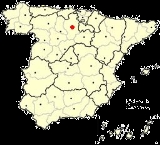
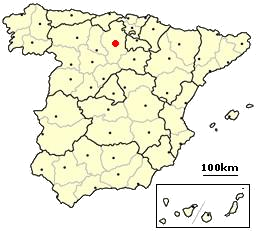
is located about 210 kilometres (130 mi) north of Madrid
.
After crushing Marshal
Auguste Marmont
's French army at the Battle of Salamanca
in July 1812, Wellington exploited his great victory by advancing on Madrid. After the disaster, King Joseph Bonaparte
and Marshal Jean-Baptiste Jourdan
retreated to Valencia where they sought refuge with Marshal Louis Gabriel Suchet
. The magnitude of Wellington's triumph also compelled Marshal Nicolas Soult to evacuate Andalucia in the south and withdraw to Valencia. The combined armies of Soult and Joseph soon posed a serious menace to Wellington's grasp on Madrid. The recently-defeated French army in the north also built up its strength. Wellington made plans to counter the southern French threat while hoping to quickly capture the strategically important Burgos position, which was an important French supply base.
Instead, Dubreton led a masterful defense, thwarting Wellington's assaults time after time. The British commander's hopes were blasted when his attempts to contain the twin French offensives failed. With large French relief armies approaching Burgos from the northeast and Madrid from the southeast, the British commander withdrew to the west, abandoning large areas of Spain that had been recently liberated. That fall, the French lost an opportunity to defeat Wellington's army. Nevertheless, during the withdrawal to Portugal the Anglo-Portuguese army lost many men to pursuing French cavalry and starvation.
on 22 July 1812 undermined the French position in Spain. On 30 July, his army reached Valladolid
, northwest of Madrid. In a panic, King Joseph Bonaparte
ordered Marshal Nicolas Soult
to abandon Andalusia in the south of Spain and join with him to resist the Allied forces. At first, Soult refused to give up his petty kingdom in the south.
On 11 August, General of Division Anne-François-Charles Trelliard
's dragoon division fought an inconclusive skirmish with the Allies at the Battle of Majadahonda
northwest of Madrid. At first, the French dragoons routed Brigadier General
Benjamin D'Urban
's Portuguese cavalry. Reinforced by Major General
George Bock's King's German Legion (KGL) heavy dragoons and some infantry, the Allies drove the French back. The next day, King Joseph evacuated Madrid
and the Anglo-Portuguese entered the city in triumph. On 13 August, the Retiro forts surrendered to Wellington, yielding 2,000 prisoners, clothing, equipment and the eagles of the 13th Dragoons and the 51st Line Infantry Regiments.
Harassed by Spanish
guerillas, Joseph retreated all the way to the east coast city of Valencia, which was held by Marshal Louis Suchet
. Wellington knew that if Joseph and Soult joined forces, his position in central Spain would become perilous. He counted on the autumn rains keeping the Tagus
River high and preventing Joseph and Soult from threatening his southern flank. He also hoped that Spanish forces under General Francisco Ballesteros
and an Anglo-Sicilian force under Lieutenant General
Thomas Maitland would keep the French army busy in the south. He knew that the capture of Burgos would help secure his northern flank.
and Badajoz
, he was loath to mount a massive attack.
Dubreton's 2,000-man garrison included two battalions of the 34th Line, one battalion of 130th Line, one artillery company and one sapper company. Throughout the siege, he conducted a highly aggressive defence. An assault captured the San Miguel hornwork on 20 September, with 421 British and 198 French casualties. Attacks on 23 and 29 September failed to carry the castle. Rain flooded the siege trenches. Mines were exploded under the walls, but with little effect.
At the time, the British army's sapper corps -- then called Military Artificers
-- was very small. At Burgos, there were only five engineer officers and eight sappers. One of the sappers was killed and other seven wounded. Wellington wrote, "This is altogether the most difficult job I ever had in hand with such trifling means." Finally, on 2 October, Wellington requested two 24-pound cannon from Santander, but they would fail to reach Burgos in time.
On 25 August, Soult raised the Siege of Cadiz
and began to fall back to the northeast toward Valencia. Ballesteros mutinied, refusing to obey Wellington's orders to obstruct Soult's move. The 8,000 Anglo-Sicilians at Alicante
on the east coast remained completely inert during this crisis. By 3 October, Soult and Joseph joined and concentrated 61,000 Frenchmen and 84 artillery pieces for the retaking of Madrid. Defending Madrid and the line of the Tagus was Lieutenant General Rowland Hill
with 31,000 Anglo-Portuguese and 12,000 Spaniards. Wellington was 150 miles (241 km) north of Madrid at Burgos, dangerously separated from Hill's army. To make matters worse, the Tagus was not a serious military obstacle because of unexpectedly low water.
 In the north, General of Division Joseph Souham
's 41,000-man Army of Portugal was swollen to 53,000 by transferring 6,500 infantry and 2,300 cavalry from the Army of the North and by 3,400 reinforcements from France. Souham began closing in on Wellington's outposts. Wellington later wrote, "I had no reason to believe the enemy were so strong till I saw them. Fortunately, they did not attack me: if they had, I must have been destroyed."
was fought. Wellington retreated to the southwest, closely pursued by Souham. Several actions occurred during the retreat including one at Tordesillas
.
Meanwhile, after a clash at Tajuña
, Hill evacuated Madrid and fell back to the west. Joseph re-entered the city on 2 November. The retreat continued until the two Anglo-Portuguese armies joined on 8 November in the neighborhood of Alba de Tormes
. On 15 November, Soult's 80,000 Frenchmen faced Wellington's 65,000 Allies on the old Salamanca
battlefield. But Soult did not attack, so Wellington retired to Portugal
for the winter.
It appeared that all of Wellington's efforts in 1812 had been for nothing. Yet, his Anglo-Portuguese army had gained a moral ascendancy over the French that it would never relinquish. The stage was set for the decisive campaign and Battle of Vitoria
in 1813.
Anglo-Portuguese Army
The Anglo-Portuguese Army was the combined British and Portuguese army that won the Peninsular War, under the command of Arthur Wellesley. The Army is also referred to as the British-Portuguese Army and, in Portuguese, as the Exército Anglo-Luso or the Exército Anglo-Português.The Anglo-Portuguese...
led by General Arthur Wellesley, Marquess of Wellington
Arthur Wellesley, 1st Duke of Wellington
Field Marshal Arthur Wellesley, 1st Duke of Wellington, KG, GCB, GCH, PC, FRS , was an Irish-born British soldier and statesman, and one of the leading military and political figures of the 19th century...
tried to capture the castle of Burgos
Burgos
Burgos is a city of northern Spain, historic capital of Castile. It is situated at the edge of the central plateau, with about 178,966 inhabitants in the city proper and another 20,000 in its suburbs. It is the capital of the province of Burgos, in the autonomous community of Castile and León...
from its French
First French Empire
The First French Empire , also known as the Greater French Empire or Napoleonic Empire, was the empire of Napoleon I of France...
garrison under the command of General of Brigade Jean-Louis Dubreton
Jean-Louis Dubreton
Jean-Louis Dubreton enlisted in the French army in 1790 and served during the French Revolutionary Wars where he gained advancement. During the War of the First Coalition he fought against the allies in the north and against the Revolt in the Vendée. By 1801 he commanded a battalion in Italy...
. The French repulsed every attempt to seize the fortress, resulting in one of Wellington's rare defeats. The siege took place during the Peninsular War
Peninsular War
The Peninsular War was a war between France and the allied powers of Spain, the United Kingdom, and Portugal for control of the Iberian Peninsula during the Napoleonic Wars. The war began when French and Spanish armies crossed Spain and invaded Portugal in 1807. Then, in 1808, France turned on its...
, part of the Napoleonic Wars
Napoleonic Wars
The Napoleonic Wars were a series of wars declared against Napoleon's French Empire by opposing coalitions that ran from 1803 to 1815. As a continuation of the wars sparked by the French Revolution of 1789, they revolutionised European armies and played out on an unprecedented scale, mainly due to...
. Burgos
Burgos
Burgos is a city of northern Spain, historic capital of Castile. It is situated at the edge of the central plateau, with about 178,966 inhabitants in the city proper and another 20,000 in its suburbs. It is the capital of the province of Burgos, in the autonomous community of Castile and León...
is located about 210 kilometres (130 mi) north of Madrid
Madrid
Madrid is the capital and largest city of Spain. The population of the city is roughly 3.3 million and the entire population of the Madrid metropolitan area is calculated to be 6.271 million. It is the third largest city in the European Union, after London and Berlin, and its metropolitan...
.
After crushing Marshal
Marshal of France
The Marshal of France is a military distinction in contemporary France, not a military rank. It is granted to generals for exceptional achievements...
Auguste Marmont
Auguste Marmont
Auguste Frédéric Louis Viesse de Marmont, 1st Duke of Ragusa was a French General, nobleman and Marshal of France.-Biography:...
's French army at the Battle of Salamanca
Battle of Salamanca
The Battle of Salamanca saw Anglo-Portuguese and Spanish armies under the Duke of Wellington defeat Marshal Auguste Marmont's French forces among the hills around Arapiles south of Salamanca, Spain on July 22, 1812 during the Peninsular War....
in July 1812, Wellington exploited his great victory by advancing on Madrid. After the disaster, King Joseph Bonaparte
Joseph Bonaparte
Joseph-Napoléon Bonaparte was the elder brother of Napoleon Bonaparte, who made him King of Naples and Sicily , and later King of Spain...
and Marshal Jean-Baptiste Jourdan
Jean-Baptiste Jourdan
Jean-Baptiste Jourdan, 1st Comte Jourdan , enlisted as a private in the French royal army and rose to command armies during the French Revolutionary Wars. Emperor Napoleon I of France named him a Marshal of France in 1804 and he also fought in the Napoleonic Wars. After 1815, he became reconciled...
retreated to Valencia where they sought refuge with Marshal Louis Gabriel Suchet
Louis Gabriel Suchet
Louis Gabriel Suchet, 1st Duc d'Albufera was a Marshal of France and one of Napoleon's most brilliant generals.-Early career:...
. The magnitude of Wellington's triumph also compelled Marshal Nicolas Soult to evacuate Andalucia in the south and withdraw to Valencia. The combined armies of Soult and Joseph soon posed a serious menace to Wellington's grasp on Madrid. The recently-defeated French army in the north also built up its strength. Wellington made plans to counter the southern French threat while hoping to quickly capture the strategically important Burgos position, which was an important French supply base.
Instead, Dubreton led a masterful defense, thwarting Wellington's assaults time after time. The British commander's hopes were blasted when his attempts to contain the twin French offensives failed. With large French relief armies approaching Burgos from the northeast and Madrid from the southeast, the British commander withdrew to the west, abandoning large areas of Spain that had been recently liberated. That fall, the French lost an opportunity to defeat Wellington's army. Nevertheless, during the withdrawal to Portugal the Anglo-Portuguese army lost many men to pursuing French cavalry and starvation.
Background
Wellington's victory at the Battle of SalamancaBattle of Salamanca
The Battle of Salamanca saw Anglo-Portuguese and Spanish armies under the Duke of Wellington defeat Marshal Auguste Marmont's French forces among the hills around Arapiles south of Salamanca, Spain on July 22, 1812 during the Peninsular War....
on 22 July 1812 undermined the French position in Spain. On 30 July, his army reached Valladolid
Valladolid
Valladolid is a historic city and municipality in north-central Spain, situated at the confluence of the Pisuerga and Esgueva rivers, and located within three wine-making regions: Ribera del Duero, Rueda and Cigales...
, northwest of Madrid. In a panic, King Joseph Bonaparte
Joseph Bonaparte
Joseph-Napoléon Bonaparte was the elder brother of Napoleon Bonaparte, who made him King of Naples and Sicily , and later King of Spain...
ordered Marshal Nicolas Soult
Nicolas Jean de Dieu Soult
Nicolas Jean-de-Dieu Soult, 1st Duke of Dalmatia , the Hand of Iron, was a French general and statesman, named Marshal of the Empire in 1804. He was one of only six officers in French history to receive the distinction of Marshal General of France...
to abandon Andalusia in the south of Spain and join with him to resist the Allied forces. At first, Soult refused to give up his petty kingdom in the south.
On 11 August, General of Division Anne-François-Charles Trelliard
Anne-François-Charles Trelliard
Anne-François-Charles Trelliard or Treillard or Treilhard, born 7 February 1764 – died 14 May 1832, joined the cavalry of the French Royal Army as a cadet gentleman in 1780. During the French Revolutionary Wars he fought in Germany and Holland, eventually rising in rank to become a general...
's dragoon division fought an inconclusive skirmish with the Allies at the Battle of Majadahonda
Battle of Majadahonda
In the Battle of Majadahonda on 11 August 1812, a British-Portuguese cavalry force under Major-General George Bock and Brigadier-General Benjamin d'Urban fought a French cavalry division led by General of Division Anne-François-Charles Trelliard. The French scored an initial success by routing a...
northwest of Madrid. At first, the French dragoons routed Brigadier General
Brigadier General
Brigadier general is a senior rank in the armed forces. It is the lowest ranking general officer in some countries, usually sitting between the ranks of colonel and major general. When appointed to a field command, a brigadier general is typically in command of a brigade consisting of around 4,000...
Benjamin D'Urban
Benjamin d'Urban
Lieutenant-General Sir Benjamin d'Urban, GCB, KCH, KCTS was a British general and colonial administrator, who is best known for his frontier policy when he was the Governor in the Cape Colony .-Early career:...
's Portuguese cavalry. Reinforced by Major General
Major General
Major general or major-general is a military rank used in many countries. It is derived from the older rank of sergeant major general. A major general is a high-ranking officer, normally subordinate to the rank of lieutenant general and senior to the ranks of brigadier and brigadier general...
George Bock's King's German Legion (KGL) heavy dragoons and some infantry, the Allies drove the French back. The next day, King Joseph evacuated Madrid
Madrid
Madrid is the capital and largest city of Spain. The population of the city is roughly 3.3 million and the entire population of the Madrid metropolitan area is calculated to be 6.271 million. It is the third largest city in the European Union, after London and Berlin, and its metropolitan...
and the Anglo-Portuguese entered the city in triumph. On 13 August, the Retiro forts surrendered to Wellington, yielding 2,000 prisoners, clothing, equipment and the eagles of the 13th Dragoons and the 51st Line Infantry Regiments.
Harassed by Spanish
Spain
Spain , officially the Kingdom of Spain languages]] under the European Charter for Regional or Minority Languages. In each of these, Spain's official name is as follows:;;;;;;), is a country and member state of the European Union located in southwestern Europe on the Iberian Peninsula...
guerillas, Joseph retreated all the way to the east coast city of Valencia, which was held by Marshal Louis Suchet
Louis Gabriel Suchet
Louis Gabriel Suchet, 1st Duc d'Albufera was a Marshal of France and one of Napoleon's most brilliant generals.-Early career:...
. Wellington knew that if Joseph and Soult joined forces, his position in central Spain would become perilous. He counted on the autumn rains keeping the Tagus
Tagus
The Tagus is the longest river on the Iberian Peninsula. It is long, in Spain, along the border between Portugal and Spain and in Portugal, where it empties into the Atlantic Ocean at Lisbon. It drains an area of . The Tagus is highly utilized for most of its course...
River high and preventing Joseph and Soult from threatening his southern flank. He also hoped that Spanish forces under General Francisco Ballesteros
Francisco Ballesteros
Francisco Ballesteros, emerged as a career Spanish General during the Peninsular War.Ballasteros served against the First French Republic in the 1793 War of the Pyrenees...
and an Anglo-Sicilian force under Lieutenant General
Lieutenant General
Lieutenant General is a military rank used in many countries. The rank traces its origins to the Middle Ages where the title of Lieutenant General was held by the second in command on the battlefield, who was normally subordinate to a Captain General....
Thomas Maitland would keep the French army busy in the south. He knew that the capture of Burgos would help secure his northern flank.
Siege
Accordingly, the 35,000-man Anglo-Portuguese army laid siege to the castle of Burgos on 19 September. For heavy artillery, Wellington had only three 18-pound cannon and 1,300 rounds. Admiral Sir Home Popham of the Royal Navy offered to land more heavy guns at Santander, but Wellington declined to use this resource because he felt that he had limited time. After costly assaults at the sieges of Ciudad RodrigoSiege of Ciudad Rodrigo
In the Siege of Ciudad Rodrigo, the Duke of Wellington's Anglo-Portuguese Army seized the city from its French garrison under Brigadier General Baron Barrié on January 20, 1812 after a siege that started on January 7...
and Badajoz
Battle of Badajoz (1812)
In the Battle of Badajoz , the Anglo-Portuguese Army, under the Earl of Wellington, besieged Badajoz, Spain and forced the surrender of the French garrison....
, he was loath to mount a massive attack.
Dubreton's 2,000-man garrison included two battalions of the 34th Line, one battalion of 130th Line, one artillery company and one sapper company. Throughout the siege, he conducted a highly aggressive defence. An assault captured the San Miguel hornwork on 20 September, with 421 British and 198 French casualties. Attacks on 23 and 29 September failed to carry the castle. Rain flooded the siege trenches. Mines were exploded under the walls, but with little effect.
At the time, the British army's sapper corps -- then called Military Artificers
Royal Engineers
The Corps of Royal Engineers, usually just called the Royal Engineers , and commonly known as the Sappers, is one of the corps of the British Army....
-- was very small. At Burgos, there were only five engineer officers and eight sappers. One of the sappers was killed and other seven wounded. Wellington wrote, "This is altogether the most difficult job I ever had in hand with such trifling means." Finally, on 2 October, Wellington requested two 24-pound cannon from Santander, but they would fail to reach Burgos in time.
On 25 August, Soult raised the Siege of Cadiz
Siege of Cádiz
The Siege of Cádiz was a siege of the large Spanish naval base of Cádiz by a French army from February 5, 1810 to August 24, 1812 during the Peninsular War. Following the occupation of Madrid on March 23, 1808, Cádiz became the Spanish seat of power, and was targeted by 60,000 French troops under...
and began to fall back to the northeast toward Valencia. Ballesteros mutinied, refusing to obey Wellington's orders to obstruct Soult's move. The 8,000 Anglo-Sicilians at Alicante
Alicante
Alicante or Alacant is a city in Spain, the capital of the province of Alicante and of the comarca of Alacantí, in the south of the Valencian Community. It is also a historic Mediterranean port. The population of the city of Alicante proper was 334,418, estimated , ranking as the second-largest...
on the east coast remained completely inert during this crisis. By 3 October, Soult and Joseph joined and concentrated 61,000 Frenchmen and 84 artillery pieces for the retaking of Madrid. Defending Madrid and the line of the Tagus was Lieutenant General Rowland Hill
Rowland Hill, 1st Viscount Hill
General Rowland Hill, 1st Viscount Hill of Almaraz GCB, GCH served in the Napoleonic Wars as a trusted brigade, division and corps commander under the command of the Duke of Wellington. He became Commander-in-Chief of the British Army in 1829.-Early career:Educated at a school in Chester, Hill was...
with 31,000 Anglo-Portuguese and 12,000 Spaniards. Wellington was 150 miles (241 km) north of Madrid at Burgos, dangerously separated from Hill's army. To make matters worse, the Tagus was not a serious military obstacle because of unexpectedly low water.
Joseph Souham
Joseph Souham was a French general who fought in the French Revolutionary Wars and the Napoleonic Wars. He was born at Lubersac and died at Versailles.-French revolutionary years:...
's 41,000-man Army of Portugal was swollen to 53,000 by transferring 6,500 infantry and 2,300 cavalry from the Army of the North and by 3,400 reinforcements from France. Souham began closing in on Wellington's outposts. Wellington later wrote, "I had no reason to believe the enemy were so strong till I saw them. Fortunately, they did not attack me: if they had, I must have been destroyed."
Aftermath
Wellington raised the siege of Burgos on 21 October. He quietly slipped away, undetected by the French until late on 22 October. The following day, the drawn Battle of Venta del PozoBattle of Venta del Pozo
In the Battle of Venta del Pozo on October 23, 1812, an Anglo-German force led by Major-General Stapleton Cotton fought a rear-guard action against French cavalry under Major-Generals Jean-Baptiste Curto and Pierre Boyer.-Background:...
was fought. Wellington retreated to the southwest, closely pursued by Souham. Several actions occurred during the retreat including one at Tordesillas
Tordesillas
Tordesillas is a town and municipality in the province of Valladolid, Castile and León, central Spain.It is located 25 km southwest of the provincial capital, Valladolid at an elevation of 704 meters. The population was c. 9,000 in 2009....
.
Meanwhile, after a clash at Tajuña
Perales de Tajuña
Perales de Tajuña is a small town in Spain, in the province and autonomous community of Madrid, located about 40 km to the southeast of Madrid in the area known as the Comarca de Las Vegas. The municipality covers 48.92 km², has a population of 2,738 inhabitants and a population density of...
, Hill evacuated Madrid and fell back to the west. Joseph re-entered the city on 2 November. The retreat continued until the two Anglo-Portuguese armies joined on 8 November in the neighborhood of Alba de Tormes
Alba de Tormes
Alba de Tormes is a municipality in the province of Salamanca, western Spain, part of the autonomous community of Castile-Leon. The town is on the River Tormes upstream from the city of Salamanca. Alba gave its name to one of Spain's most important dukedoms. St Teresa of Ávila died at a convent...
. On 15 November, Soult's 80,000 Frenchmen faced Wellington's 65,000 Allies on the old Salamanca
Salamanca
Salamanca is a city in western Spain, in the community of Castile and León. Because it is known for its beautiful buildings and urban environment, the Old City was declared a UNESCO World Heritage Site in 1988. It is the most important university city in Spain and is known for its contributions to...
battlefield. But Soult did not attack, so Wellington retired to Portugal
Portugal
Portugal , officially the Portuguese Republic is a country situated in southwestern Europe on the Iberian Peninsula. Portugal is the westernmost country of Europe, and is bordered by the Atlantic Ocean to the West and South and by Spain to the North and East. The Atlantic archipelagos of the...
for the winter.
It appeared that all of Wellington's efforts in 1812 had been for nothing. Yet, his Anglo-Portuguese army had gained a moral ascendancy over the French that it would never relinquish. The stage was set for the decisive campaign and Battle of Vitoria
Battle of Vitoria
At the Battle of Vitoria an allied British, Portuguese, and Spanish army under General the Marquess of Wellington broke the French army under Joseph Bonaparte and Marshal Jean-Baptiste Jourdan near Vitoria in Spain, leading to eventual victory in the Peninsular War.-Background:In July 1812, after...
in 1813.