


Semi-automatic rifle

Encyclopedia
A semi-automatic rifle is a type of rifle
that fires a single bullet
each time the trigger is pulled, automatically ejects the spent cartridge, chambers a fresh cartridge from its magazine, and is immediately ready to fire another shot. They may be operated by a number of mechanisms, all of which derive their power from the explosion of the powder in the cartridge that also fires the bullet. Historically, the self-loading design was the successor to the repeating rifle, which stored a number of cartridges within the weapon, but required manual action to load a fresh cartridge before each shot. Automatically loading the next round more easily allows for rapid fire. These rifles are also commonly known as self-loading rifles ('SLR') or auto-loading rifles.
A semi-automatic rifle is distinguished from a fully automatic rifle
or machine gun
in that it can only fire once each time the trigger is pulled. In some contexts, the term "automatic rifle" may refer to a semi-automatic/self-loading rifle, not a fully automatic rifle. The magazine in a semi-automatic rifle is usually of a box-type which protrudes underneath the receiver and feeds cartridges vertically into the action. These may be fixed (as with M1 Garand
, in which case cartridges are loaded from the top of the weapon, with the bolt locked back. Most modern designs use a detachable magazine, which is removed for reloading. Some detachable-magazine rifles, such as the M14
, can also be top-loaded. Some designs use a horizontal tubular magazine similar to lever-action and pump-action weapons, which may be located underneath the barrel or in the butt stock.
s are available, and their external appearance can be nearly identical to their automatic counterparts. However, modern semi-automatic rifles are designed so that they cannot be easily converted to fully automatic fire. In the U.S., BATF regulations require that semi-automatic rifles be manufactured so that they cannot accept parts or modifications that would allow them to be capable of fully automatic fire.
advocates, who have introduced and passed legislation restricting the sale, importation, ownership, and manufacture of semi-automatic rifles. In the United States
, new semi-automatic rifles with a military-style appearance were prohibited from retail sale or importation by the Federal Assault Weapons Ban
, which was enacted in 1994 and was sunset in 2004. Certain U.S. states such as California
, Massachusetts
, New Jersey
and New York
have their own restrictive laws regarding to the ownership and sale of semi-automatic rifles.
While there is some public perception that military-style semiautomatic rifles often see criminal use, a 2001 Justice Department study revealed that fewer than 2% of State and Federal inmates used, carried, or possessed a military-style semiautomatic gun or a fully automatic gun during their current offense. Semi-automatic rifles are mistakenly believed to be capable of fully automatic fire or easily convertible to full-automatic functionality. While it is theoretically possible to convert almost any semi-automatic firearm to fully automatic, extensive equipment and machining knowledge would be required. The BATFE has specific design requirements for all firearms sold in the U.S. in order to ensure that they are not readily convertible. For example, the internal lower receiver of civilian AR-15
rifles is milled differently and has a much smaller cavity than that of the military-issue M16, and M16 parts such as the fire-control group cannot fit in a civilian rifle without extensive machining. The small number of automatic weapons confiscated from criminals are weapons smuggled illegally into the country, rather than converted semi-automatic weapons.
In Finland, military-style semiautomatic rifles, or reservist rifles (reserviläiskivääri) as they are called in Finland, are popular among reservists who actively take part in volunteer defence training. The law allowing possession of reservist rifles for such purposes was approved in 1998. Popular weapons are AR-15
and semiautomatic variants of AK-47
and Finnish RKs, such as RK-92S and a semiautomatic variant of RK-76.
In other countries, semi-automatic rifles are allowed with certain restrictions, i.e. that the rifle not be chambered in a military caliber.
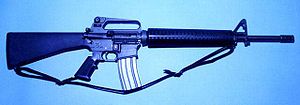
In a gas-operated mechanism, a portion of the combustion gases propelling the bullet within the barrel are diverted and used to unlock the bolt and cycle the action rearward. In most designs the gas port is located relatively close to the muzzle, which ensures that chamber pressure has dropped to a safe level before the breech is opened. There are two primary mechanisms used to achieve this. The first method, called a "gas piston," uses the high pressure gas ported from the barrel to drive an enclosed piston back against an operating rod or linkage (they are often one piece), which in turn unlocks the bolt and drives it rearward, ejecting the spent case and cocking the hammer or striker spring. The bolt moving rearward also compresses a strong recoil spring which subsequently returns the bolt forward, stripping a fresh round from the weapon's magazine and forcing it into the chamber in the process. The AK-47/74 uses this piston-based mechanism.
The second method of operation, called direct impingement
, is somewhat simplified. Here, the tube carrying the high pressure gas ported from the barrel emerges inside the action of the rifle, where it mates up with a "gas key" which is integral to the bolt carrier. Thus, the bolt carrier itself functions as a piston as in the French MAS 49 and 49-56 rifles. The AR-15
and its military versions, the M16
and M4 Carbine
, are the most common and well-known weapons which utilize this system.
Rifle
A rifle is a firearm designed to be fired from the shoulder, with a barrel that has a helical groove or pattern of grooves cut into the barrel walls. The raised areas of the rifling are called "lands," which make contact with the projectile , imparting spin around an axis corresponding to the...
that fires a single bullet
Bullet
A bullet is a projectile propelled by a firearm, sling, or air gun. Bullets do not normally contain explosives, but damage the intended target by impact and penetration...
each time the trigger is pulled, automatically ejects the spent cartridge, chambers a fresh cartridge from its magazine, and is immediately ready to fire another shot. They may be operated by a number of mechanisms, all of which derive their power from the explosion of the powder in the cartridge that also fires the bullet. Historically, the self-loading design was the successor to the repeating rifle, which stored a number of cartridges within the weapon, but required manual action to load a fresh cartridge before each shot. Automatically loading the next round more easily allows for rapid fire. These rifles are also commonly known as self-loading rifles ('SLR') or auto-loading rifles.
A semi-automatic rifle is distinguished from a fully automatic rifle
Automatic rifle
Automatic rifle is a term generally used to describe a semi-automatic rifle chambered for a rifle cartridge, capable of delivering both semi- and full automatic fire...
or machine gun
Machine gun
A machine gun is a fully automatic mounted or portable firearm, usually designed to fire rounds in quick succession from an ammunition belt or large-capacity magazine, typically at a rate of several hundred rounds per minute....
in that it can only fire once each time the trigger is pulled. In some contexts, the term "automatic rifle" may refer to a semi-automatic/self-loading rifle, not a fully automatic rifle. The magazine in a semi-automatic rifle is usually of a box-type which protrudes underneath the receiver and feeds cartridges vertically into the action. These may be fixed (as with M1 Garand
M1 Garand
The M1 Garand , was the first semi-automatic rifle to be generally issued to the infantry of any nation. Called "the greatest battle implement ever devised" by General George S...
, in which case cartridges are loaded from the top of the weapon, with the bolt locked back. Most modern designs use a detachable magazine, which is removed for reloading. Some detachable-magazine rifles, such as the M14
M14 rifle
The M14 rifle, formally the United States Rifle, 7.62 mm, M14, is an American selective fire automatic rifle firing 7.62x51mm NATO ammunition. It was the standard issue U.S. rifle from 1959 to 1970. The M14 was used for U.S...
, can also be top-loaded. Some designs use a horizontal tubular magazine similar to lever-action and pump-action weapons, which may be located underneath the barrel or in the butt stock.
Military-style semiautomatic rifle
Many semi-automatic-only versions (also known as "sporting" or "civilian" versions) of fully automatic assault rifleAssault rifle
An assault rifle is a selective fire rifle that uses an intermediate cartridge and a detachable magazine. Assault rifles are the standard infantry weapons in most modern armies...
s are available, and their external appearance can be nearly identical to their automatic counterparts. However, modern semi-automatic rifles are designed so that they cannot be easily converted to fully automatic fire. In the U.S., BATF regulations require that semi-automatic rifles be manufactured so that they cannot accept parts or modifications that would allow them to be capable of fully automatic fire.
Controversy
So-called "military-style" weapons have attracted the attention of gun controlGun politics
Gun politics addresses safety issues and ideologies related to firearms through criminal and noncriminal use. Gun politics deals with rules, regulations, and restrictions on the use, ownership, and distribution of firearms.-National sovereignty:...
advocates, who have introduced and passed legislation restricting the sale, importation, ownership, and manufacture of semi-automatic rifles. In the United States
United States
The United States of America is a federal constitutional republic comprising fifty states and a federal district...
, new semi-automatic rifles with a military-style appearance were prohibited from retail sale or importation by the Federal Assault Weapons Ban
Federal assault weapons ban
The Federal Assault Weapons Ban was a subtitle of the Violent Crime Control and Law Enforcement Act of 1994, a federal law in the United States that included a prohibition on the manufacture for civilian use of certain semi-automatic firearms, so called "assault weapons"...
, which was enacted in 1994 and was sunset in 2004. Certain U.S. states such as California
California
California is a state located on the West Coast of the United States. It is by far the most populous U.S. state, and the third-largest by land area...
, Massachusetts
Massachusetts
The Commonwealth of Massachusetts is a state in the New England region of the northeastern United States of America. It is bordered by Rhode Island and Connecticut to the south, New York to the west, and Vermont and New Hampshire to the north; at its east lies the Atlantic Ocean. As of the 2010...
, New Jersey
New Jersey
New Jersey is a state in the Northeastern and Middle Atlantic regions of the United States. , its population was 8,791,894. It is bordered on the north and east by the state of New York, on the southeast and south by the Atlantic Ocean, on the west by Pennsylvania and on the southwest by Delaware...
and New York
New York
New York is a state in the Northeastern region of the United States. It is the nation's third most populous state. New York is bordered by New Jersey and Pennsylvania to the south, and by Connecticut, Massachusetts and Vermont to the east...
have their own restrictive laws regarding to the ownership and sale of semi-automatic rifles.
While there is some public perception that military-style semiautomatic rifles often see criminal use, a 2001 Justice Department study revealed that fewer than 2% of State and Federal inmates used, carried, or possessed a military-style semiautomatic gun or a fully automatic gun during their current offense. Semi-automatic rifles are mistakenly believed to be capable of fully automatic fire or easily convertible to full-automatic functionality. While it is theoretically possible to convert almost any semi-automatic firearm to fully automatic, extensive equipment and machining knowledge would be required. The BATFE has specific design requirements for all firearms sold in the U.S. in order to ensure that they are not readily convertible. For example, the internal lower receiver of civilian AR-15
AR-15
The AR-15 is a lightweight, 5.56 mm, air-cooled, gas-operated, magazine-fed semi-automatic rifle, with a rotating-lock bolt, actuated by direct impingement gas operation. It is manufactured with the extensive use of aluminum alloys and synthetic materials....
rifles is milled differently and has a much smaller cavity than that of the military-issue M16, and M16 parts such as the fire-control group cannot fit in a civilian rifle without extensive machining. The small number of automatic weapons confiscated from criminals are weapons smuggled illegally into the country, rather than converted semi-automatic weapons.
In Finland, military-style semiautomatic rifles, or reservist rifles (reserviläiskivääri) as they are called in Finland, are popular among reservists who actively take part in volunteer defence training. The law allowing possession of reservist rifles for such purposes was approved in 1998. Popular weapons are AR-15
AR-15
The AR-15 is a lightweight, 5.56 mm, air-cooled, gas-operated, magazine-fed semi-automatic rifle, with a rotating-lock bolt, actuated by direct impingement gas operation. It is manufactured with the extensive use of aluminum alloys and synthetic materials....
and semiautomatic variants of AK-47
AK-47
The AK-47 is a selective-fire, gas-operated 7.62×39mm assault rifle, first developed in the Soviet Union by Mikhail Kalashnikov. It is officially known as Avtomat Kalashnikova . It is also known as a Kalashnikov, an "AK", or in Russian slang, Kalash.Design work on the AK-47 began in the last year...
and Finnish RKs, such as RK-92S and a semiautomatic variant of RK-76.
In other countries, semi-automatic rifles are allowed with certain restrictions, i.e. that the rifle not be chambered in a military caliber.
Blowback
In "blowback" operation, the bolt is not mechanically locked at the moment of firing. The bolt is relatively massive and is kept forward by spring tension alone. This simple design is mainly seen in firearms designed around relatively low-power cartridges, where spring tension and the mass of the bolt (or slide) are sufficient to keep the bolt forward until chamber pressures have receded to a safe level.Gas operated
In a gas-operated mechanism, a portion of the combustion gases propelling the bullet within the barrel are diverted and used to unlock the bolt and cycle the action rearward. In most designs the gas port is located relatively close to the muzzle, which ensures that chamber pressure has dropped to a safe level before the breech is opened. There are two primary mechanisms used to achieve this. The first method, called a "gas piston," uses the high pressure gas ported from the barrel to drive an enclosed piston back against an operating rod or linkage (they are often one piece), which in turn unlocks the bolt and drives it rearward, ejecting the spent case and cocking the hammer or striker spring. The bolt moving rearward also compresses a strong recoil spring which subsequently returns the bolt forward, stripping a fresh round from the weapon's magazine and forcing it into the chamber in the process. The AK-47/74 uses this piston-based mechanism.
The second method of operation, called direct impingement
Direct impingement
Direct impingement is a type of gas operation for a firearm that directs gas from a fired cartridge directly to the bolt carrier or slide assembly to cycle the action.- Evaluation :...
, is somewhat simplified. Here, the tube carrying the high pressure gas ported from the barrel emerges inside the action of the rifle, where it mates up with a "gas key" which is integral to the bolt carrier. Thus, the bolt carrier itself functions as a piston as in the French MAS 49 and 49-56 rifles. The AR-15
AR-15
The AR-15 is a lightweight, 5.56 mm, air-cooled, gas-operated, magazine-fed semi-automatic rifle, with a rotating-lock bolt, actuated by direct impingement gas operation. It is manufactured with the extensive use of aluminum alloys and synthetic materials....
and its military versions, the M16
M16 rifle
The M16 is the United States military designation for the AR-15 rifle adapted for both semi-automatic and full-automatic fire. Colt purchased the rights to the AR-15 from ArmaLite, and currently uses that designation only for semi-automatic versions of the rifle. The M16 fires the 5.56×45mm NATO...
and M4 Carbine
M4 Carbine
The M4 carbine is a family of firearms tracing its lineage back to earlier carbine versions of the M16, all based on the original AR-15 designed by Eugene Stoner and made by ArmaLite. It is a shorter and lighter variant of the M16A2 assault rifle, with 80% parts commonality.It is a gas-operated,...
, are the most common and well-known weapons which utilize this system.
Recoil operated
Recoil-operated arms operate similarly to blowback arms, except that the bolt is mechanically locked or "delayed" in some manner at the moment of firing. In some designs, the barrel is locked to the bolt and travels a short distance rearward with it until it unlocks, allowing the bolt to continue rearward in its cycle. In other systems, the bolt is delayed by spring-loaded rollers. The delay function allows higher-powered chamberings, since it ensures that chamber pressures have dropped to a safe level before the breech opens.Commercial semi-automatic rifles
- Italy
- BenelliBenelli (firearms)Benelli Armi SpA is an Italian firearm manufacturer founded in 1967, located in Urbino, Italy, best known for high quality shotguns used by military, law enforcement and civilians all over the world. Particularly famous is the Benelli M3 12 gauge, used extensively by American SWAT teams...
- BerettaBerettaFabbrica d'Armi Pietro Beretta is an Italian firearms manufacturer. Their firearms are used worldwide for a variety of civilian, law enforcement, and military purposes. It is also known for manufacturing shooting clothes and accessories. Beretta is the oldest active firearms manufacturer in the...
- Benelli
- United States
- Alexander ArmsAlexander ArmsAlexander Arms is an American manufacturer of firearms. It is most known for the .50 Beowulf cartridge designed by its founder, Bill Alexander. The company produces AR-15s chambered in .50 Beowulf and 6.5mm Grendel, which it designed in cooperation with Competition Shooting Sports...
- ArmaLiteArmaLiteArmaLite is the name of a small arms engineering facility founded in the early 1950s, and once associated with the Fairchild Engine and Airplane Corporation. ArmaLite was formally incorporated as a subdivision of Fairchild on October 1, 1954...
- Barrett Firearms Manufacturing
- Browning Arms CompanyBrowning Arms CompanyBrowning Arms Company is a maker of firearms, bows and fishing gear. Founded in Utah in 1927, it offers a wide variety of firearms, including shotguns, rifles, pistols, and rimfire firearms and sport bows, as well as fishing rods and reels....
- Bushmaster Firearms International
- Colt's Manufacturing CompanyColt's Manufacturing CompanyColt's Manufacturing Company is a United States firearms manufacturer, whose first predecessor corporation was founded in 1836 by Sam Colt. Colt is best known for the engineering, production, and marketing of firearms over the later half of the 19th and the 20th century...
- DPMS Panther ArmsDPMS Panther ArmsDPMS Panther Arms manufactures a wide range of military and civilian rifles in St. Cloud, Minnesota. The rifles are chambered for the .223 Remington, 5.56x45mm NATO, .308 Winchester, .260 Remington, .300 Remington SA Ultra Mag, 6.8mm Remington SPC, and .204 Ruger cartridges, among others...
- FNH USA (Subsidiary of FN Herstal of Belgium)
- Kahr ArmsKahr ArmsKahr Arms is an American small arms manufacturer founded by Kook Jin "Justin" Moon , who currently serves as CEO and President. It is owned by the Saeilo Corporation , a subsidiary of Tongil Group, a South Korean business group associated with the Unification Church...
- Kel-TecKel-TecKel-Tec CNC Industries Inc. is a United States manufacturer of firearms. Founded in 1991 and based in Cocoa, Florida, the company has manufactured firearms since 1995, starting with small, affordable semi-automatic pistols and expanding to rifles. Kel-Tec is a privately-owned Florida corporation....
- Les BaerLes BaerLes Baer Custom Inc. is an American weapons manufacturer of semi-custom M1911-pattern pistols and AR-15 type rifles. Les Baer Custom was founded by the gunsmith Les Baer, Sr. in 1991 in LeClaire, Iowa.-History:Les Baer Custom Inc...
- Lewis Machine and Tool CompanyLewis Machine and Tool CompanyLewis Machine & Tool Company was founded by Karl Lewis in 1980. LMT started its business by providing law enforcement and government agencies with military type weapons and accessories. Today, LMT still provides law enforcement and government agencies with weapons, but they have now also...
- Magpul IndustriesMagpul IndustriesMagpul Industries Corporation is a designer and manufacturer of polymer firearms accessories and concept firearms. The company is based in Erie, Colorado in the United States...
- Marlin FirearmsMarlin FirearmsMarlin Firearms Co., formerly of North Haven, Connecticut, is a manufacturer of high power, center fire, lever action, and .22 caliber rimfire rifles. In the past, the company made shotguns, derringers and revolvers...
- O.F. Mossberg & SonsO.F. Mossberg & SonsO.F. Mossberg & Sons is an American firearms manufacturer, specializing in shotguns, rifles, scopes and firearm accessories. From the 1940s through the 1960s, it also produced a line of .22 caliber target and sporting rifles....
- Olympic ArmsOlympic ArmsOlympic Arms, Inc. manufactures and markets AR-15 and M16 pattern rifles, carbines and pistols. Olympic also manufactures Colt 1911 series 70 style pistols. All products currently manufactured by Olympic are sold under the Olympic Arms brand name....
- Para-OrdnancePara-OrdnancePara-Ordnance, is a Canadian firearms manufacturer founded in Toronto in 1985 by two childhood friends, Ted Szabo and Thanos Polyzos. Szabo was born in Hungary and his family fled the country when the Russians invaded during the Hungarian Revolution in 1956. Polyzos was born in Greece and later...
- RemingtonRemington ArmsRemington Arms Company, Inc. was founded in 1816 by Eliphalet Remington in Ilion, New York, as E. Remington and Sons. It is the oldest company in the United States which still makes its original product, and is the oldest continuously operating manufacturer in North America. It is the only U.S....
- Rock River ArmsRock River ArmsRock River Arms, Incorporated is a manufacturing company based in Colona, Illinois that manufacturers parts and accessories for AR-15/M16 type rifles, as well as complete firearms.-Law Enforcement Use:...
- Sabre DefenceSabre DefenceSabre Defence Industries is an American manufacturer of firearms and firearm parts and accessories. It is contracted by the United States armed forces for parts and mounts for the M2 Browning machine gun and Minigun...
- Savage ArmsSavage ArmsThe Savage Arms Company is a firearms manufacturing company based in Westfield, Massachusetts, with a division located in Canada. The company makes a variety of rimfire and centerfire rifles, as well as marketing the Stevens single-shot rifles and shotguns...
- RugerSturm, RugerSturm, Ruger & Company, Incorporated is a Southport, Connecticut-based firearm manufacturing company, better known by the shortened name Ruger. Sturm, Ruger produces bolt-action, semi-automatic, full-automatic, and single-shot rifles, shotguns, semi-automatic pistols, and single- and double-action...
- Smith & WessonSmith & WessonSmith & Wesson is the largest manufacturer of handguns in the United States. The corporate headquarters is in Springfield, Massachusetts. Founded in 1852, Smith & Wesson's pistols and revolvers have become standard issue to police and armed forces throughout the world...
- Springfield Armory, Inc.Springfield Armory, Inc.Springfield Armory, Inc. is a firearms manufacturer and importer based in Geneseo, Illinois, founded in 1974. It is one of the largest firearms marketers of imported firearms in the United States and is a four-time recipient of the National Rifle Association Gun of the Year Award.-Formation:After...
- Stag ArmsStag ArmsStag Arms is a firearms manufacturer founded in May 2003 and located in New Britain, Connecticut. Stag Arms is a manufacturer of the AR-15 type rifle, marketed as Stag-15 rifles. Stag advertises that all their weapons and accessories are made in the United States...
- Thompson Center ArmsThompson Center ArmsThompson/Center Arms Company is an American firearms company based in Rochester, New Hampshire. The company is best known for its line of interchangeable barrel single-shot pistols and rifles. Thompson Center manufactures muzzleloading rifles and is credited with creating the resurgence of their...
- Troy IndustriesTroy IndustriesTroy Industries is an American manufacturer of firearms and firearm parts. It is the manufacturer of parts on the Smith & Wesson M&P rifle and the Ruger SR-556 and is a United States government contractor. Troy is most known for its M14 rifle parts and its M7A1 carbine, which was reviewed by the...
- Wilson CombatWilson CombatWilson Combat is a custom pistol manufacturer located in Berryville, Arkansas that specializes in customizing and manufacturing M1911 pistols. First started under the name "Wilson's Gun Shop" in 1977, Bill Wilson started his new gunsmith business in the back of the family jewelry store, “Wilson's...
- WinchesterWinchester Repeating Arms CompanyThe Winchester Repeating Arms Company was a prominent American maker of repeating firearms, located in New Haven, Connecticut. The Winchester brand is today used under license by two subsidiaries of the Herstal Group, Fabrique Nationale of Belgium and the Browning Arms Company of Morgan, Utah.-...
- Alexander Arms
- Russia
- Izhmash
Military semi-automatic rifles (and commercial derivatives)
- BelgiumBelgiumBelgium , officially the Kingdom of Belgium, is a federal state in Western Europe. It is a founding member of the European Union and hosts the EU's headquarters, and those of several other major international organisations such as NATO.Belgium is also a member of, or affiliated to, many...
:- FN Model 1949FN Model 1949The Fabrique Nationale Model 1949 is a semi-automatic rifle designed by Dieudonné Saive and manufactured by Fabrique Nationale...
- FN FALFN FALThe Fusil Automatique Léger or FAL is a self-loading, selective fire battle rifle produced by the Belgian armaments manufacturer Fabrique Nationale de Herstal . During the Cold War it was adopted by many North Atlantic Treaty Organization countries, with the notable exception of the United States...
(has both semi-automatic and fully automatic variants) - FN PS90 (a semi-automatic variant of the fully automatic FN P90FN P90The FN P90 is a selective fire personal defense weapon designed and manufactured by FN Herstal in Belgium. The P90's name is taken from 1990, the year it was introduced...
)
- FN Model 1949
- BrazilBrazilBrazil , officially the Federative Republic of Brazil , is the largest country in South America. It is the world's fifth largest country, both by geographical area and by population with over 192 million people...
:- Itajubá Model 954 MosquetãoItajubá Model 954 MosquetãoThe Itajubá Model 954 Mosquetão is a battle rifle of Brazilian origin. The weapon is a derivative of the Gewehr 43 but chambered in the .30-06 round.-See also:*Beretta BM59*MAS-49 rifle*Vz. 52 rifle...
- Itajubá Model 954 Mosquetão
- ChileChileChile ,officially the Republic of Chile , is a country in South America occupying a long, narrow coastal strip between the Andes mountains to the east and the Pacific Ocean to the west. It borders Peru to the north, Bolivia to the northeast, Argentina to the east, and the Drake Passage in the far...
:- FAMAE FD-200FAMAE FD-200The FAMAE FD-200 is a semi automatic designated marksman rifle of Chilean origin and is chambered in the 7.62x51mm NATO round.It saw a very limited production run in the early 2000s, and was based upon their license-made SIG SG 540 assault rifle action and frame, although all mechanics were...
- FAMAE FD-200
- People's Republic of ChinaPeople's Republic of ChinaChina , officially the People's Republic of China , is the most populous country in the world, with over 1.3 billion citizens. Located in East Asia, the country covers approximately 9.6 million square kilometres...
:- Type 56
- CzechoslovakiaCzechoslovakiaCzechoslovakia or Czecho-Slovakia was a sovereign state in Central Europe which existed from October 1918, when it declared its independence from the Austro-Hungarian Empire, until 1992...
- ZH-29ZH-29The ZH-29 was a semi-automatic rifle developed in Czechoslovakia during the late 1920s and used by Chinese military forces. The ZH-29 is one of the first successful self loading rifles in service.-Overview:...
- vz. 52/57
- ZH-29
- EgyptEgyptEgypt , officially the Arab Republic of Egypt, Arabic: , is a country mainly in North Africa, with the Sinai Peninsula forming a land bridge in Southwest Asia. Egypt is thus a transcontinental country, and a major power in Africa, the Mediterranean Basin, the Middle East and the Muslim world...
:- Hakim RifleHakim RifleThe Hakim Rifle is a gas operated semi-automatic rifle. It was originally designed by Sweden and produced as the AG-42 Ljungman for the Swedish Army. The tooling and design were later sold to Egypt, and the Hakim was produced there during the 1950s and 1960s. The gas operated system is adjustable...
- Rasheed CarbineRasheed CarbineThe Rasheed is a semi-automatic carbine, derived from the Hakim Rifle and used by the Egyptian military. Only about 8,000 Rasheeds were produced, making it a very rare rifle...
- Hakim Rifle
- FranceFranceThe French Republic , The French Republic , The French Republic , (commonly known as France , is a unitary semi-presidential republic in Western Europe with several overseas territories and islands located on other continents and in the Indian, Pacific, and Atlantic oceans. Metropolitan France...
:- fusil semi automatique de 8 mm RSC modèle 1917Manufacture d'armes de Saint-Étienne (MAS)The Manufacture d'armes de Saint-Étienne was a French state-owned manufacturing company located in the town of Saint-Étienne. It has since been merged into the state-owned Nexter defence conglomerate....
- fusil semi automatique de 8 mm RSC modèle 1918Manufacture d'armes de Saint-Étienne (MAS)The Manufacture d'armes de Saint-Étienne was a French state-owned manufacturing company located in the town of Saint-Étienne. It has since been merged into the state-owned Nexter defence conglomerate....
- Fusil semi automatique MAS 40
- Fusil semi automatique MAS 44
- Fusil semi automatique MAS 49
- fusil semi automatique de 8 mm RSC modèle 1917
- GermanyGermanyGermany , officially the Federal Republic of Germany , is a federal parliamentary republic in Europe. The country consists of 16 states while the capital and largest city is Berlin. Germany covers an area of 357,021 km2 and has a largely temperate seasonal climate...
:- Gewehr 41(W)Gewehr 41The Gewehr 41 rifles, commonly known as the G41 or G41, were semi-automatic rifles used by Nazi Germany during World War II-Background:...
- Gewehr 43Gewehr 43The Gewehr 43 or Karabiner 43 is an 8x57mm IS caliber semi-automatic rifle developed by Nazi Germany during World War II...
- H&K G3Heckler & Koch G3The G3 is a 7.62mm battle rifle developed in the 1950s by the German armament manufacturer Heckler & Koch GmbH in collaboration with the Spanish state-owned design and development agency CETME ....
(has both semi-automatic and fully automatic variants) - H&K G36Heckler & Koch G36The Heckler & Koch G36 is a 5.56×45mm assault rifle, designed in the early 1990s by Heckler & Koch in Germany as a replacement for the 7.62mm G3 battle rifle. It was accepted into service with the Bundeswehr in 1997, replacing the G3...
(successor of the G3) - Heckler & Koch PSG-1
- Gewehr 41(W)
- MexicoMexicoThe United Mexican States , commonly known as Mexico , is a federal constitutional republic in North America. It is bordered on the north by the United States; on the south and west by the Pacific Ocean; on the southeast by Guatemala, Belize, and the Caribbean Sea; and on the east by the Gulf of...
:- Mondragón automatic and semi-automatic rifle, M-1908
- Mendoza RM2Mendoza RM2The Mendoza RM2 was a light machine gun similar to the M1918 BAR manufactured in Mexico by Productos Mendoza, S.A. It was chambered in .30-06 Calibre and had a 20 round magazine fed from the top....
- PolandPolandPoland , officially the Republic of Poland , is a country in Central Europe bordered by Germany to the west; the Czech Republic and Slovakia to the south; Ukraine, Belarus and Lithuania to the east; and the Baltic Sea and Kaliningrad Oblast, a Russian exclave, to the north...
- kbsp wz.38MKbsp wz.38MThe Karabin samopowtarzalny wzór 38M , was a Polish 7.9 mm semi-automatic rifle used by the Polish Army during the Invasion of Poland of 1939.-History:...
- kbsp wz.38M
- RussiaRussiaRussia or , officially known as both Russia and the Russian Federation , is a country in northern Eurasia. It is a federal semi-presidential republic, comprising 83 federal subjects...
:- KalashnikovKalashnikovKalashnikov is commonly used to refer to a type of rifle, but it and similar words also have other meanings:-People:*Mikhail Kalashnikov , Russian small arms designer*Maxim Kalashnikov , Russian writer and political activist...
- Saiga semi-automatic rifleSaiga semi-automatic rifleThe Saiga Semi-Automatic Rifles are a family of Russian semi-automatic rifles manufactured by Izhmash, who also manufacture the original AK-series assault rifles and SVD sniper rifles...
- Saiga semi-automatic rifle
- Simonov
- SKS Carbine
- Tokarev
- SVT-40
- Kalashnikov
- SwedenSwedenSweden , officially the Kingdom of Sweden , is a Nordic country on the Scandinavian Peninsula in Northern Europe. Sweden borders with Norway and Finland and is connected to Denmark by a bridge-tunnel across the Öresund....
:- AG-42 Ljungman
- SpainSpainSpain , officially the Kingdom of Spain languages]] under the European Charter for Regional or Minority Languages. In each of these, Spain's official name is as follows:;;;;;;), is a country and member state of the European Union located in southwestern Europe on the Iberian Peninsula...
- CETMECETMECETME is an acronym for Centro de Estudios Técnicos de Materiales Especiales , a Spanish government design and development establishment. While being involved in many projects CETME was mostly known for its small arms research and development...
- CETME
- United StatesUnited StatesThe United States of America is a federal constitutional republic comprising fifty states and a federal district...
:- M1941 Johnson rifle
- M1947 Johnson auto carbineM1947 Johnson auto carbineThe M1947 Johnson auto carbine is a semi automatic derivative of the actual machine gun. It was intended as a replacement of the M1 rifle but not accepted....
- M1 Garand rifle
- M1A rifleM1A RifleThe M1A is a civilian version of the M14 rifle designed and manufactured by Springfield Armory, Inc. in 1974. The term "M1A" is a proprietary title for Springfield Armory's M14 pattern rifle. Early M1A rifles were built with surplus G.I. parts until Springfield Armory, Inc...
(Civilian version of the M14 rifleM14 rifleThe M14 rifle, formally the United States Rifle, 7.62 mm, M14, is an American selective fire automatic rifle firing 7.62x51mm NATO ammunition. It was the standard issue U.S. rifle from 1959 to 1970. The M14 was used for U.S...
) - AR-15 rifleAR-15The AR-15 is a lightweight, 5.56 mm, air-cooled, gas-operated, magazine-fed semi-automatic rifle, with a rotating-lock bolt, actuated by direct impingement gas operation. It is manufactured with the extensive use of aluminum alloys and synthetic materials....
- Bushmaster ACR
- Robinson XCR
- YugoslaviaYugoslaviaYugoslavia refers to three political entities that existed successively on the western part of the Balkans during most of the 20th century....
- Zastava M76
- M59/66