

Scheria

Encyclopedia
Scheria –also known as Scherie or Phaeacia– was a geographical region in Greek mythology
, first mentioned in Homer
's Odyssey
as the home of the Phaiakians (Phaeacians) and the last destination of Odysseus
before returning home to Ithaca
.
 In the Odyssey, after Odysseus sails from Ogygia
, his raft is wrecked by a storm and he is washed up on Scheria. Meanwhile, the goddess Athena
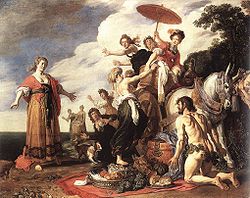
, who sneaks into the palace, disguises herself as a sea-captain's daughter and instructs princess Nausikaa, the daughter of King Alkinoös in her sleep to go to the seashore to wash her clothes. The next morning Nausikaa and her maids go to the seashore, and after washing the clothes, they start to play a ball game on the beach, with laughs, giggles and shouts. Odysseus, who was exhausted from his adventure and was sleeping nearby, is awakened by the shouts. He covers his nakedness with thick leaves and goes to ask for help from the playing team. On seeing the unkempt Odysseus in this state, the maids run away, but Nausikaa, encouraged by Athena, stands her ground and talks to him. To excuse the maids she admits that the Phaeacians are "the farthermost of men, and no other mortals are conversant with them", so they run away since they have never seen a stranger before. Nausikaa, being hospitable, provides clothes, food and drink to Odysseus, then she directs him to the palace of King Alkinoös, since she doesn't want to be seen with a stranger, let alone a man, as she is yet unmarried and people watch and talk and may raise rumors of her befriending men.
 On his way to the palace, Odysseus meets Athena disguised as a little local girl. Athena advises him clearly on how to enter the palace, which is guarded by mechanical dogs made of silver and gold, constructed by Hephaestus
. The palace is surrounded by bronze walls that "shine like the sun", secured with gates made of gold. Within the walls there is a magnificent garden with trees that grow all kinds of fruit, pears, pomegranates, and apples, all the year round. The palace is even equipped with a lighting system consisting of golden statues of young men with lighted torches in their hands to give light during the night. Following her through the town, he is told to enter the palace and plead for mercy from the queen Arete. Odysseus, covered with a cloaking cloud provided by Athena, passes through all the protection systems of the palace and enters the chamber of King Alkinoös. He throws his arms around the queen's legs and appeals to her. Naturally, Alkinoös and his court were surprised to see a stranger walking in to their secured palace, but immediately offer him hospitality and to help him on his journey.
After Odysseus tells Alkinoös
and his court the story of his adventures after the Trojan War
, the Phaiakians bring him to Ithaca on one of their sophisticated ships.
He also explains to Odysseus what sort of information the Phaeacian ships require in order to take him home to Ithaca.
Homer
describes the Phaeacian ships as fast as a falcon
and gives a vivid description of the ship's departure.
, which is within 80 miles of Ithaca. Locals on Corfu had long claimed this, based on the rock outside Corfu harbour, which is supposedly the ship that carried Odysseus
back to Ithaca, but was turned to stone by Poseidon
, to punish the Phaiakians for helping his enemy:
The Phaiakians did not participate in the Trojan War
. The Greek word Phaiakians (Φαίακες) is derived from phaios (φαιός) meaning gray, hence Phaiakians means "dark-skinned". The Phaiakians in the Odyssey did not know Odysseus (although they knew of him, as evidenced by the tales of Demodocus), so they called him a "stranger". Odysseus however was the king of the majority of the Ionian Islands
, not only of Ithaca
, but also "of Cephallenia, Neritum
, Crocylea, Aegilips
, Same
and Zacynthus" so if Schería was Corfu, it would be surprising that the citizens of one of the Ionian Islands did not know Odysseus. Furthermore, when Odysseus reveals his identity, he says to the nobles: "...if I outlive this time of sorrow, I may be counted as your friend, though I live so far away from all of you" indicating that Schería was far away from Ithaca. From the ancient times, some scholars having examined the work and the geography of Homer have suggested that Scheria was located in the Atlantic Ocean
. Among them were Strabo
and Plutarch
. Many characteristics of the Phaiakians, including their seafaring and relaxed lifestyle are suggestive of Minoan Crete.
The latter similarities make Scheria also suggestive of Atlantis. Helena Blavatsky proposed in her Secret Doctrine (1888) that it was Homer
before Plato who first wrote of Atlantis. Aside from the seafaring prowess, the palace walls that shone like the sun are read to be covered not by bronze but orichalcum
.
, Strabo
, the geographer criticized Polybius
on the Geography of the Odyssey
. Strabo proposed that Schería and Ogygia
were located in the middle of the Atlantic Ocean
.
Greek mythology
Greek mythology is the body of myths and legends belonging to the ancient Greeks, concerning their gods and heroes, the nature of the world, and the origins and significance of their own cult and ritual practices. They were a part of religion in ancient Greece...
, first mentioned in Homer
Homer
In the Western classical tradition Homer , is the author of the Iliad and the Odyssey, and is revered as the greatest ancient Greek epic poet. These epics lie at the beginning of the Western canon of literature, and have had an enormous influence on the history of literature.When he lived is...
's Odyssey
Odyssey
The Odyssey is one of two major ancient Greek epic poems attributed to Homer. It is, in part, a sequel to the Iliad, the other work ascribed to Homer. The poem is fundamental to the modern Western canon, and is the second—the Iliad being the first—extant work of Western literature...
as the home of the Phaiakians (Phaeacians) and the last destination of Odysseus
Odysseus
Odysseus or Ulysses was a legendary Greek king of Ithaca and the hero of Homer's epic poem the Odyssey. Odysseus also plays a key role in Homer's Iliad and other works in the Epic Cycle....
before returning home to Ithaca
Homer's Ithaca
The location of Homer's Ithaca, i.e. Ithaca as featured in Homer's Odyssey, is a matter for debate.The central characters of the epic such as Odysseus, Achilles, Agamemnon and Hector are generally believed to be fictional characters. Yet there are many claims that some Homeric hero long ago had...
.
Odysseus meets Nausikaa
Ogygia
Ogygia , is an island mentioned in Homer's Odyssey, Book V, as the home of the nymph Calypso, the daughter of the Titan Atlas, also known as Atlantis in ancient Greek. In Homer's Odyssey Calypso detained Odysseus on Ogygia for 7 years and kept him from returning to his home of Ithaca, wanting to...
, his raft is wrecked by a storm and he is washed up on Scheria. Meanwhile, the goddess Athena
Athena
In Greek mythology, Athena, Athenê, or Athene , also referred to as Pallas Athena/Athene , is the goddess of wisdom, courage, inspiration, civilization, warfare, strength, strategy, the arts, crafts, justice, and skill. Minerva, Athena's Roman incarnation, embodies similar attributes. Athena is...
, who sneaks into the palace, disguises herself as a sea-captain's daughter and instructs princess Nausikaa, the daughter of King Alkinoös in her sleep to go to the seashore to wash her clothes. The next morning Nausikaa and her maids go to the seashore, and after washing the clothes, they start to play a ball game on the beach, with laughs, giggles and shouts. Odysseus, who was exhausted from his adventure and was sleeping nearby, is awakened by the shouts. He covers his nakedness with thick leaves and goes to ask for help from the playing team. On seeing the unkempt Odysseus in this state, the maids run away, but Nausikaa, encouraged by Athena, stands her ground and talks to him. To excuse the maids she admits that the Phaeacians are "the farthermost of men, and no other mortals are conversant with them", so they run away since they have never seen a stranger before. Nausikaa, being hospitable, provides clothes, food and drink to Odysseus, then she directs him to the palace of King Alkinoös, since she doesn't want to be seen with a stranger, let alone a man, as she is yet unmarried and people watch and talk and may raise rumors of her befriending men.
The palace of King Alkinoös
Hephaestus
Hephaestus was a Greek god whose Roman equivalent was Vulcan. He is the son of Zeus and Hera, the King and Queen of the Gods - or else, according to some accounts, of Hera alone. He was the god of technology, blacksmiths, craftsmen, artisans, sculptors, metals, metallurgy, fire and volcanoes...
. The palace is surrounded by bronze walls that "shine like the sun", secured with gates made of gold. Within the walls there is a magnificent garden with trees that grow all kinds of fruit, pears, pomegranates, and apples, all the year round. The palace is even equipped with a lighting system consisting of golden statues of young men with lighted torches in their hands to give light during the night. Following her through the town, he is told to enter the palace and plead for mercy from the queen Arete. Odysseus, covered with a cloaking cloud provided by Athena, passes through all the protection systems of the palace and enters the chamber of King Alkinoös. He throws his arms around the queen's legs and appeals to her. Naturally, Alkinoös and his court were surprised to see a stranger walking in to their secured palace, but immediately offer him hospitality and to help him on his journey.
After Odysseus tells Alkinoös
Alcinous
Alcinous or Alkínoös was, in Greek mythology, a son of Nausithous, or of Phaeax , and father of Nausicaa, Halius, Clytoneus and Laodamas with Arete. His name literally means "mighty mind"...
and his court the story of his adventures after the Trojan War
Trojan War
In Greek mythology, the Trojan War was waged against the city of Troy by the Achaeans after Paris of Troy took Helen from her husband Menelaus, the king of Sparta. The war is among the most important events in Greek mythology and was narrated in many works of Greek literature, including the Iliad...
, the Phaiakians bring him to Ithaca on one of their sophisticated ships.
The Phaeacian ships
The Phaeacians possessed remarkable ships. They were quite different from the ancient galleys, the ships used during the Trojan War, and they were steered by thought. King Alkinoös says that Phaeacians carried Rhadamanthus to Euboea, "which is the furthest of any place" and came back on the same day.He also explains to Odysseus what sort of information the Phaeacian ships require in order to take him home to Ithaca.
Homer
Homer
In the Western classical tradition Homer , is the author of the Iliad and the Odyssey, and is revered as the greatest ancient Greek epic poet. These epics lie at the beginning of the Western canon of literature, and have had an enormous influence on the history of literature.When he lived is...
describes the Phaeacian ships as fast as a falcon
Falcon
A falcon is any species of raptor in the genus Falco. The genus contains 37 species, widely distributed throughout Europe, Asia, and North America....
and gives a vivid description of the ship's departure.
Geographical location of Scheria
Many ancient and modern interpreters favour identification of Scheria with the island of CorfuCorfu
Corfu is a Greek island in the Ionian Sea. It is the second largest of the Ionian Islands, and, including its small satellite islands, forms the edge of the northwestern frontier of Greece. The island is part of the Corfu regional unit, and is administered as a single municipality. The...
, which is within 80 miles of Ithaca. Locals on Corfu had long claimed this, based on the rock outside Corfu harbour, which is supposedly the ship that carried Odysseus
Odysseus
Odysseus or Ulysses was a legendary Greek king of Ithaca and the hero of Homer's epic poem the Odyssey. Odysseus also plays a key role in Homer's Iliad and other works in the Epic Cycle....
back to Ithaca, but was turned to stone by Poseidon
Poseidon
Poseidon was the god of the sea, and, as "Earth-Shaker," of the earthquakes in Greek mythology. The name of the sea-god Nethuns in Etruscan was adopted in Latin for Neptune in Roman mythology: both were sea gods analogous to Poseidon...
, to punish the Phaiakians for helping his enemy:
The Phaiakians did not participate in the Trojan War
Trojan War
In Greek mythology, the Trojan War was waged against the city of Troy by the Achaeans after Paris of Troy took Helen from her husband Menelaus, the king of Sparta. The war is among the most important events in Greek mythology and was narrated in many works of Greek literature, including the Iliad...
. The Greek word Phaiakians (Φαίακες) is derived from phaios (φαιός) meaning gray, hence Phaiakians means "dark-skinned". The Phaiakians in the Odyssey did not know Odysseus (although they knew of him, as evidenced by the tales of Demodocus), so they called him a "stranger". Odysseus however was the king of the majority of the Ionian Islands
Ionian Islands
The Ionian Islands are a group of islands in Greece. They are traditionally called the Heptanese, i.e...
, not only of Ithaca
Homer's Ithaca
The location of Homer's Ithaca, i.e. Ithaca as featured in Homer's Odyssey, is a matter for debate.The central characters of the epic such as Odysseus, Achilles, Agamemnon and Hector are generally believed to be fictional characters. Yet there are many claims that some Homeric hero long ago had...
, but also "of Cephallenia, Neritum
Neritum
Neritum is an Ancient Greek name of an island in the Ionian Sea, near Ithaca and Cephalonia. In Homer's Iliad, book II, Neritum is part of Odysseus's kingdom....
, Crocylea, Aegilips
Aegilips
Aegilips is an Ancient Greek name of an island in the Ionian Sea, near Ithaca. In Homer's Iliad, book II, Aegilips is part of Odysseus's kingdom. Some researchers, including Wilhelm Dörpfeld estimate that Aegilips is present day island of Meganisi....
, Same
Same (Ancient Greece)
Same is an Ancient Greek name of a Homeric and unidentified island in the Ionian Sea, near Ithaca and Cephalonia. In Homer's Iliad, book II, in the Catalogue of Ships, Same is described as part of Odysseus's kingdom...
and Zacynthus" so if Schería was Corfu, it would be surprising that the citizens of one of the Ionian Islands did not know Odysseus. Furthermore, when Odysseus reveals his identity, he says to the nobles: "...if I outlive this time of sorrow, I may be counted as your friend, though I live so far away from all of you" indicating that Schería was far away from Ithaca. From the ancient times, some scholars having examined the work and the geography of Homer have suggested that Scheria was located in the Atlantic Ocean
Atlantic Ocean
The Atlantic Ocean is the second-largest of the world's oceanic divisions. With a total area of about , it covers approximately 20% of the Earth's surface and about 26% of its water surface area...
. Among them were Strabo
Strabo
Strabo, also written Strabon was a Greek historian, geographer and philosopher.-Life:Strabo was born to an affluent family from Amaseia in Pontus , a city which he said was situated the approximate equivalent of 75 km from the Black Sea...
and Plutarch
Plutarch
Plutarch then named, on his becoming a Roman citizen, Lucius Mestrius Plutarchus , c. 46 – 120 AD, was a Greek historian, biographer, essayist, and Middle Platonist known primarily for his Parallel Lives and Moralia...
. Many characteristics of the Phaiakians, including their seafaring and relaxed lifestyle are suggestive of Minoan Crete.
The latter similarities make Scheria also suggestive of Atlantis. Helena Blavatsky proposed in her Secret Doctrine (1888) that it was Homer
Homer
In the Western classical tradition Homer , is the author of the Iliad and the Odyssey, and is revered as the greatest ancient Greek epic poet. These epics lie at the beginning of the Western canon of literature, and have had an enormous influence on the history of literature.When he lived is...
before Plato who first wrote of Atlantis. Aside from the seafaring prowess, the palace walls that shone like the sun are read to be covered not by bronze but orichalcum
Orichalcum
Orichalcum is a metal mentioned in several ancient writings, most notably the story of Atlantis as recounted in the Critias dialogue, recorded by Plato. According to Critias, orichalcum was considered second only to gold in value, and was found and mined in many parts of Atlantis in ancient times....
.
Geographical account by Strabo
Approximately eight centuries after HomerHomer
In the Western classical tradition Homer , is the author of the Iliad and the Odyssey, and is revered as the greatest ancient Greek epic poet. These epics lie at the beginning of the Western canon of literature, and have had an enormous influence on the history of literature.When he lived is...
, Strabo
Strabo
Strabo, also written Strabon was a Greek historian, geographer and philosopher.-Life:Strabo was born to an affluent family from Amaseia in Pontus , a city which he said was situated the approximate equivalent of 75 km from the Black Sea...
, the geographer criticized Polybius
Polybius
Polybius , Greek ) was a Greek historian of the Hellenistic Period noted for his work, The Histories, which covered the period of 220–146 BC in detail. The work describes in part the rise of the Roman Republic and its gradual domination over Greece...
on the Geography of the Odyssey
Geography of the Odyssey
Events in the main sequence of the Odyssey take place in the Peloponnese and in what are now called the Ionian Islands . Incidental mentions of Troy and its house Phoenicia, Egypt and Crete hint at geographical knowledge equal to, or perhaps slightly more extensive than that of the Iliad...
. Strabo proposed that Schería and Ogygia
Ogygia
Ogygia , is an island mentioned in Homer's Odyssey, Book V, as the home of the nymph Calypso, the daughter of the Titan Atlas, also known as Atlantis in ancient Greek. In Homer's Odyssey Calypso detained Odysseus on Ogygia for 7 years and kept him from returning to his home of Ithaca, wanting to...
were located in the middle of the Atlantic Ocean
Atlantic Ocean
The Atlantic Ocean is the second-largest of the world's oceanic divisions. With a total area of about , it covers approximately 20% of the Earth's surface and about 26% of its water surface area...
.