
See Also

Odysseus

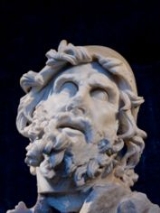
Odysses Lartides , or simply Odysseus, is the main character in Homer Homer

Homer was a legendary early Greek [i] poet [i] and rhapsode [i] traditionally credited ... 

's epic poem, the Odyssey Odyssey

The Odyssey is one of the two major ancient Greek [i] epic poem [i] ... 

, and plays a key role in the Iliad Iliad

The Iliad is, together with the Odyssey [i], one of two ancient Greek [i] epic [i]... 

. He is renowned for his guile and resourcefulness, and is most famous for the ten years it took him to return home after the Trojan War Trojan War

The Trojan War was a war waged, according to legend, against the city of Troy [i] in Asia Minor [i] , by ... 

. He was the king of Ithaca, husband of Penelope Penelope

Penlop is a character in the Odyssey [i], one of the two great epic poems [i] of ancie ... 

 and father of Telemachus Telemachus

Telemachus is a figure in Greek mythology [i], the son of Odysseus [i] and Penelope [i]. ... 

, and son of Laertes and Anticlea, though some sources, prominent among them Iphigenia at Aulis Iphigeneia at Aulis

Iphigeneia at Aulis, written in 410 BC, is the last surviving work of the playwright [i] Euripides [i] ... 

by Euripides Euripides

Euripides was the last of the three great tragedians [i] of classical Athens [i] . ... 

, give Sisyphus Sisyphus

Sisyphus, in Greek mythology [i], was a king punished in the underworld [i] by being set to rol ... 

 as his father. For a character of such prominence in the Iliad, one of Agamemnon Agamemnon

Agammnon , one of the two best-known Atrides [i], is one of the most distinguished heroes of Greek mythology [i] ... 

's principal lieutenants, Odysseus' pedigree is relatively obscure.

Discussions

  Discussion Features

   Ask a question about 'Odysseus'

   Start a new discussion about 'Odysseus'

   Answer questions about 'Odysseus'

   'Odysseus' discussion forum

Timeline

1178 BC   A solar eclipse Solar eclipse

A solar eclipse occurs when the Moon [i] passes between Earth [i] and the Sun [i], thereby totally or pa ... 

 may mark the return of Odysseus, legendary King of Ithaca, to his kingdom after the Trojan War Trojan War

The Trojan War was a war waged, according to legend, against the city of Troy [i] in Asia Minor [i] , by ... 

. He discovers a number of suitors competing to marry his wife Penelope Penelope

Penlop is a character in the Odyssey [i], one of the two great epic poems [i] of ancie ... 

, whom they believe to be a widow, in order to succeed him on the throne. He organizes their slaying and re-establishes himself on the throne.


Encyclopedia


Odysseùs Laërtiádes , or simply Odysseus, is the main character in Homer Homer

Homer was a legendary early Greek [i] poet [i] and rhapsode [i] traditionally credited ... 

's epic poem, the Odyssey Odyssey

The Odyssey is one of the two major ancient Greek [i] epic poem [i] ... 

, and plays a key role in the Iliad Iliad

The Iliad is, together with the Odyssey [i], one of two ancient Greek [i] epic [i]... 

. He is renowned for his guile and resourcefulness, and is most famous for the ten years it took him to return home after the Trojan War Trojan War

The Trojan War was a war waged, according to legend, against the city of Troy [i] in Asia Minor [i] , by ... 

. He was the king of Ithaca, husband of Penelope Penelope

Penlop is a character in the Odyssey [i], one of the two great epic poems [i] of ancie ... 

 and father of Telemachus Telemachus

Telemachus is a figure in Greek mythology [i], the son of Odysseus [i] and Penelope [i]. ... 

, and son of Laertes and Anticlea, though some sources, prominent among them Iphigenia at Aulis Iphigeneia at Aulis

Iphigeneia at Aulis, written in 410 BC, is the last surviving work of the playwright [i] Euripides [i] ... 

by Euripides Euripides

Euripides was the last of the three great tragedians [i] of classical Athens [i] .
... 

, give Sisyphus Sisyphus

Sisyphus, in Greek mythology [i], was a king punished in the underworld [i] by being set to rol ... 

 as his father.

For a character of such prominence in the Iliad, one of Agamemnon Agamemnon

Agammnon , one of the two best-known Atrides [i], is one of the most distinguished heroes of Greek mythology [i] ... 

's principal lieutenants, Odysseus' pedigree is relatively obscure. Laertes' father is Arceisius, a son of Cephalus Cephalus

There are two characters named Cephalus in Greek mythology [i]. ... 

 , and grandson of Aeolus Aeolus

Aiolos , Latin [i]ized as olus, Eolus, olos,Aeolus, or Aiolus, was the nam ... 

. Ithaca was one of several islands that formed Odysseus' kingdom, along the Ionian Ionian Islands

The Ionian Islands are a group of islands [i] in Greece [i]. ... 

 coastline of Ancient Greece Ancient Greece

Ancient Greece is the period in Greek history [i] which lasted for around one thousand years and ended w ... 

. Odysseus' realm also appears to have included a small foothold on the mainland, near the mouth of the river Achelous. The exact extent of the Cephallenian realm, and the identities of the individual islands given by Homer, is unclear.

Etymology

The name has several variants: Olysseus , Oulixeus , Oulixes , and he was known as Ulysses or Ulixes in Roman mythology. His name means "son of pain" according to Homer Homer

Homer was a legendary early Greek [i] poet [i] and rhapsode [i] traditionally credited ... 

, or perhaps more likely, it comes from the Greek ?d????: odegós, "a guide; the one showing the way". It may also mean "pain" in the sense of the "the one inflicting and suffering pain" - ironically, nearly always he suffers pain in return if he inflicts pain on some one and vice versa.

Before the Trojan War

Odysseus was one of the suitors for Helen Helen

Helen , often known as Helen of Troy, was reputed to be the most beautiful mortal woman in Greek mythology [i] ... 

, daughter of Tyndareus. But when Tyndareus, afraid of offending the many famous and powerful suitors, would not choose among them, Odysseus promised to solve the dilemma, in return for Tyndareus' support for Odysseus suit for Penelope Penelope

Penlop is a character in the Odyssey [i], one of the two great epic poems [i] of ancie ... 

, daughter of Icarius. Odysseus proposed that Tyndareus require all the suitors to swear an oath to defend whomever Helen chose as husband from among the oath-takers. The suitors, including Odysseus, swore and Helen chose Menelaus, the most powerful of them.

When Helen was abducted by Paris Paris

native_name = Ville de Paris
|common_name = Paris
... 

 of Troy Troy

Troy is a legendary city and center of the Trojan War [i], as described in the Trojan War cycle [i], es... 

 , the suitors were called upon to honor their oaths and help Menelaus retrieve Helen. Because an oracle had prophesied he would not return for a long time, Odysseus didn't want to go to war. He pretended to be insane, ploughing his fields and sowing salt instead of seeds. Agamemnon Agamemnon

Agammnon , one of the two best-known Atrides [i], is one of the most distinguished heroes of Greek mythology [i] ... 

, Menelaus' brother, sent Palamedes to convince Odysseus to join the expedition. Palamedes was very intelligent, and placed Telemachus Telemachus

Telemachus is a figure in Greek mythology [i], the son of Odysseus [i] and Penelope [i]. ... 

, Odysseus' infant son, in front of the plough. Odysseus could not kill his son, thus revealing his sanity, and then left for the Trojan War Trojan War

The Trojan War was a war waged, according to legend, against the city of Troy [i] in Asia Minor [i] , by ... 

.

With Odysseus now in the Argive Argos

Argos is a city in Greece in the Peloponnese [i] near Nafplio [i], which was its historic harbor, named ... 

 army, Agamemnon now set his goals on enlisting Achilles Achilles

In Greek mythology [i], Achilles, also Akhilleus or Achilleus was a hero [i] of the Trojan War [i] ... 

 , because it was foretold that Troy could not be taken without him. Odysseus was one of the ambassadors that went to Scyros to fetch him. In most accounts Achilles was disguised as a women by his mother Thetis Thetis

In Greek mythology [i], silver-footed Thetis is a sea nymph [i], one of the fifty Nereid [i]s, daughters ... 

, so he would not be sent off to war. An oracle had predicted he would either live a long but boring life or a short one full of excitement, and she was fearful of the consequence if he went off with the expedition to Troy. So Odysseus asked if he could make presents to the women of the court. He laid out some jewels and also a sword, spear, and shield. All but one of the girls were interested in the jewelry; the exception was interested in the weapons and picked up a sword. 'She' turned out to be Achilles. Thus was Odysseus able to identify Achilles. Odysseus told Achilles' mother, Thetis, to send for Peleus' Myrmidon arms and armor made by the god Hephaestus Hephaestus

[i] whose approximate Roman equivalent is [[Vulcan |Vulcan]... 

 to protect him at Troy. Odysseus let Achilles keep the sword, spear, and shield. Another account of Odysseus' ruse to identify Achilleus states that after the jewels and weapons were displayed Odysseus had a war trumpet sound, which caused Achilleus to instinctively grab the weapons brought by Odysseus.

According to some accounts, it was Odysseus who planned the scheme of bringing Iphigenia Iphigeneia

----

Iphigeneia was a daughter of Agamemnon [i] and Clytemnestra [i] in Greek mythology [i]. ... 

 to be sacrificed under the pretext of marring Achilleus when the crew was without wind. This was due to a prophecy that the human sacrifice would be the only way to appease Artemis Artemis

Artemis , in Greek mythology [i] was daughter of Zeus [i] and of Leto [i] and the twin sister of Apollo [i]... 

 to cause favourable winds. After the sacrifice the crew was able to set sail for Troy.

On the way to Troy, Philoctetes was bitten by a snake on Chryse. Agemmemnon advised that he be left behind because the wound was festering, smelled bad, and recovery seemed unlikely. Some people suggest it was Odysseus who did this but the Illiad recounts that it was Agammemnon.

At some point just before the actual war started, Odysseus accompanied Menelaus and Palamedes in an envoy to try to bring back Helen peacefully. While Menelaus' arguments to retrieve Helen were emotional and unpersuasive, Odysseus' arguments very nearly persuaded the court and elders to give back Helen, but ultimately failed. According to some accounts, after the disscusion with Priam's court, the Trojans insulted and disrespected Menelaus and Odysseus except for Antenor who treated the Greeks with hospitality, because of this hospitality Antenor was spared during the destruction of Troy.

During the Trojan War

Main article: Iliad Iliad

The Iliad is, together with the Odyssey [i], one of two ancient Greek [i] epic [i]... 

.


Odysseus was one of the main Achaean characters in the Trojan War. The others were "godlike" Achilles Achilles

In Greek mythology [i], Achilles, also Akhilleus or Achilleus was a hero [i] of the Trojan War [i] ... 

, Agamemnon Agamemnon

Agammnon , one of the two best-known Atrides [i], is one of the most distinguished heroes of Greek mythology [i] ... 

 "lord of men", Menelaus, Nestor, Telamonian Ajax and Ajax the Lesser Ajax the Lesser

Ajax , a Greek [i] hero, son of Oleus [i] the king of Locris [i], called the "les ... 

, Diomedes Diomedes

Diomds is a hero [i] in Greek mythology [i], mostly known for his participation in the Trojan War [i]. ... 

 and Teucer the master archer.

When the Achaean ships reached the shores of Troy, no one would jump ashore, since there was an oracle that the first Achaean to jump on Trojan soil would die. Odysseus tossed his shield on the shore and jumped on his shield. He was followed by Protesilaus who jumped on Trojan soil, and later became the first to die.

Odysseus Never forgave Palamedes for unmasking his madness ruse. He framed Palamedes
to look like a traitor. Odysseus compelled a Trojan captive to write a letter that looked as if it was sent by Palamedes, in which a sum of gold sent as a reward for Palamedes Treachory was mentioned. Odysseus then killed the prisoner and hid the gold in Palamedes tent. He caused the letter to be found and received by Agammenon and also gave hints as to direct the Argives to the gold. This was evidence enough for the Greeks and they had Palamedes stoned. Other sources say Odysseus and Diomedes goaded Palamedes to descend a wall with the prospect of treasure being at the bottom. When Palamedes reached the bottom the two then proceeded to bury Palamedes with stones, killing him.

Odysseus was one of the most influential Greek champions during the Trojan War. Along with Nestor and Idomeneus he was one the most trusted advisors and councilers. He always championed the Achean cause and was unwavering in his cause to continue on with the war and always supportive of Agamemnon when the king was in question, such as the time Thersites spoke against him. When Agamemnon announced his intentions to depart Troy, it was Odysseus who restored order to the Greek camp. Later on in the Iliad, after many of the heroes were put out of action due to injuries , Odysseus once again persuaded Agamemnon not to withdraw. Odysseus, along with two other envoys, was chosen in the failed embassy to try to persuade Achilles to return to combat.

When Hector Hector

In Greek mythology [i], Hector , or Hektor, was a Trojan [i] prince and one of the greatest f ... 

 proposed a single combat duel, Odysseus was one of the Dannans who volunteered to battle him . Odysseus aided Diomedes during the successful night operations in order to kill King Rhesus, because it was fortold that if his horses drank from the Scamander river Troy could not be taken.

After Patroclus had been slain, it was Odysseus who counselled Achilles Achilles

In Greek mythology [i], Achilles, also Akhilleus or Achilleus was a hero [i] of the Trojan War [i] ... 

 to let the Achaean men eat and rest, for Achilles Achilles

In Greek mythology [i], Achilles, also Akhilleus or Achilleus was a hero [i] of the Trojan War [i] ... 

, driven by rage, wanted to go back on the offensive - and kill Trojans - immediately. Eventually, Achilles reluctantly consents.
During the Funeral Games for Patroclus Patroclus

In Greek mythology [i], as recorded in the Iliad [i] by Homer [i], Patroclus, or Ptroklos, son ... 

, Odysseus becomes involved in a wrestling match with Telamonian Ajax, as well as a foot race. With the help of Athena Athena

In Greek mythology [i], Athena was the goddess of wisdom [i], weaving [i], crafts [i], and war [i]. ... 

, who favors him, and despite Apollo Apollo

In Greek [i] and Roman mythology [i], Apollo , the ideal of the kouros [i], was the ... 

 helping another of the competitors, he wins the race, and manages to draw the wrestling match, to the surprise of all.

When Achilles was slain in battle, it was Odysseus and Telmonian Ajax, who successfully retrieved the fallen warriors' body and armour in the thick of heavy fighting. During the funeral games for Achilles, once again Odysseus competed with Telamonian Ajax in funeral games. Thetis said that the arms of Achilleus would go to the bravest of the Greeks, only these two warriors dared to lay claim to that title. The two Argives then got in a heavy dispute about eachothers merits to revieve the reward. The Greeks feared to decide a winner, for they did not want one of the heroes insulted and abandoning the war effort so Nestor suggested that they allow the captive Trojans decide the winner. Some accounts say a secret vote was held by the Greeks to decide the winner. In either case Odysseus was the winner and Ajax was defeated, enraged, and humiliated killed himself by the sword Hector had given him after being driven mad by Athena to protect Odysseus from his vengeance.

Later on it was learned that the war could not be won without the bow of Heracles Heracles

In Greek mythology [i], Heracles or Herakles was a divine hero [i], the son of Zeus [i] and ... 

, which were owned by the abandoned Philoctetes. Odysseus and Diomedes went out to retrieve them, or according to some accounts Odysseus and Neoptolemus Neoptolemus

In Greek mythology [i], Neoptolemus, also Neoptlemos or Pyrrhus, was the son of the warrior ... 

. In any event upon their arrival Philoctetes was still very angry with the Danaans, especially Odysseus, for abandoning him. While his first instinct was to shoot Odysseus when they arrived to retrieve him, Philoctetes anger was eventually diffused due to Odysseus' persuasive powers and the influence of the gods. Odysseus returned with Philoctetes and his arrows to the Argive camp.

Again with Diomedes, Odysseus went to fetch Achilles' son, Neoptolemus, to come to the aid of the Achaeans, because an oracle stated that Troy could not be taken without him. Upon the success of the mission Odysseus gave Neoptolemus the armaments of his father.

Later on in the war, Odysseus captured Priam's son Helenus the prophet. Helenus told the Greeks that Troy could not be taken without the capture of the Palladium Palladium

Palladium is a chemical element [i] with symbol Pd and atomic number [i] 46. ... 

, located in the city of Troy. Once again Odysseus and Diomedes went on a mission together to fulfill a prophecy. Some say that Diomedes crawled on Odysseus' shoulders to enter the city and would not let Odysseus up and into the city. When Diomedes returned from stealing the Palladium and met back up with Odysseus, who was infuriated at Diomedes for not letting him up, he thought to kill Diomedes and take credit for himself and stepped behind Diomedes in order to stab him with his sword. Diomeds caught the glint of the sword in the moonlight and spun around and disarmed the Ithacan king, and proceeded to drive Odysseus back to the Argive camp with the flat of his sword. Another account of the stealing of the Palladium states that both Odysseus and Diomedes entered the city together.

Some myths state that Odysseus in the guise of a begger covered in rags and blood eneterd the Trojan city secretly and alone. He was recognized by no one except for Helen and Hecuba, questioned by them, and allowed to return to the Greek camp unharmed.

The Trojan Horse Trojan Horse

The Trojan Horse is part of the myth of the Trojan War [i], as told in Virgil [i]'s Latin [i] epic poem [i] ... 

, the famous stratagem, was devised by Odysseus. It was built by Epeius and filled with Greek warriors led by Odysseus. When the Horse was brought inside Troy, Odysseus and Menelaus descended from it and went directly to Prince Deiphobos' house, where they engaged in a most ferocious battle. Ultimately, Deiphobos, who was then the leading son of Priam and Helen's third husband, was killed and Menelaus got Helen back. For his crimes, including slaying the Theban warriors in their sleep, Odysseus was compelled by the gods to endure 10 years of hardship before he achieved a nostos, a homecoming. However, other Greeks committed great evils in Troy, such as the execution of King Priam. The most significant crime was the rape of Cassandra Cassandra

In Greek mythology [i], Cassandra was a daughter of King Priam [i] and Queen Hecuba [i] of Troy [i] wh ... 

, carried out by Ajax, son of Oileus. This angered Athena, as Cassandra was a priestess of the goddess. It was Odysseus who advised the Greeks to stone Ajax to death for his crime. However the Greeks declined the life-saving advice. Athena was intensely infuriated, and as a result she sent a storm that destroyed much of the returning Greek fleet.

Journey home to Ithaca

Main article: Odyssey Odyssey

The Odyssey is one of the two major ancient Greek [i] epic poem [i] ... 

.

The Ciconians

After Odysseus and his men depart from Troy, they are greeted by friendly and calm waters. The ships near land and Eurylochus, convincing Odysseus that the gods were on their side, told him to go ashore and loot the nearby city. The crew had landed in Ismara. The city was not at all protected and all of the inhabitants fled without a fight into the nearby mountains. Odysseus and his men looted the city and robbed it of all its goods. Odysseus wisely told the men to board the ships quickly but they refused ate dinner and fell asleep on the beach. The next morning, the Ciconians  returned with their fierce kinsmen from the mountains. Odysseus and his men fled to the ships as fast as they could but they lost many men.

The Lotus-Eaters

When Odysseus and his men landed on the island of the Lotus-Eaters Lotophagi

In Greek mythology [i], the Lotophagi were a race of people from an island near Northern Africa [i] domi ... 

, Odysseus sent out a scouting party of three or so men who ate the lotus with the natives. This caused them to fall asleep and stop caring about ever going home. Odysseus went after the scouting party and dragged them back against their will to the ship and set sail.


Polyphemus

A scouting party led by Odysseus , lands in the territory of the Cyclops Cyclops

In Greek mythology [i] a Cyclops, or Kyklops , is a member of a primordial race of giants [i] ... 

 and ventures upon a large cave. They enter the cave and proceed to feast on food they find there. Unknown to them, the cave is the dwelling of Polyphemus Polyphemus

Polyphemus , a character in Greek Mythology [i], is a Cyclops [i], the one-eyed son of Poseidon [i] ... 

, a one-eyed giant who soon returns. Polyphemus refuses hospitality to his uninvited guests and traps them in the cave by blocking the entrance with a boulder that could not be moved by mortal men. He then proceeds to eat a pair of the men each day, but Odysseus devises a cunning plan for escape.

To make Polyphemus unwary, Odysseus gives him a bowl of strong, unwatered wine. When Polyphemus asks for his name, Odysseus tells him that it is "Nobody" . In appreciation for the wine, Polyphemus offers to return the favor by eating him last. Once the giant falls asleep, Odysseus and his men take a giant spear, which they had previously prepared while Polyphemus was out of the cave shepherding his flocks, and blind Polyphemus. Hearing Polyphemus' cries, other cyclops come to his cave and ask what is wrong, what man has put out his eye? Polyphemus replied that Nobody has put out his eye by cunning instead of by direct attack. The cyclops left, thinking that his outbursts must be madness or the gods' doing.

In the morning, Polyphemus rolls back the boulder to let the sheep out to graze. Now blind, Polyphemus cannot see the men, but feels the tops of his sheep to make sure the men are not riding them. Odysseus and his men escape, having tied themselves to to the undersides of the sheep. Once Odysseus and his men are out, they load the sheep on board their ship and set sail.

As Odysseus and his men are sailing away, and are at a safe distance, he reveals his identity to Polyphemus in an act of hubris. Enraged, Polyphemus tries to hit the ship with boulders, but because he is blind, he misses. When the ship appears to be getting away at last, Polyphemus raises his arms to his father, Poseidon, and asks him to not allow Odysseus to go back home to Ithaca, and if he does, he must arrive back alone, his crew dead and in a stranger's ship.

This event is the setting for the only surviving complete satyr play Satyr play

Satyr plays were an ancient Greek [i] form of comedy, similar to the modern-day burlesque [i] ... 

, Cyclops Cyclops

In Greek mythology [i] a Cyclops, or Kyklops , is a member of a primordial race of giants [i] ... 

by Euripides Euripides

Euripides was the last of the three great tragedians [i] of classical Athens [i] .
... 

. This version contains a more humorous version of the story by including the cowardly satyrs Satyr

In Greek mythology [i], satyrs are half-man and half-goat [i] nature entities that roamed the woods and ... 

.

According to Virgil Virgil

Publius Vergilius Maro , later called Virgilius, and known in English [i] as V ... 

's Aeneid Aeneid

The Aeneid : is a Latin [i] epic [i] written by Virgil [i] in the 1st century BC [i] th ... 

, Achaemenides was one of Odysseus' crew who stayed on Sicily Sicily

Sicily is an autonomous region [i] of Italy [i] and the larges ... 

 with Polyphemus Polyphemus

Polyphemus , a character in Greek Mythology [i], is a Cyclops [i], the one-eyed son of Poseidon [i] ... 

 until Aeneas Aeneas

Aeneas was a Trojan [i] hero, the son of prince Anchises [i] and the goddess Aphrodite [i] . ... 

 arrived and took him with him. Here, Virgil is probably trying to interweave his tale as much as possible with Homer's already ancient, great work, especially as Achaemenides has nothing to do with the story at all and is in fact never mentioned again.

Aeolus

Odysseus stopped at Aiolia Aeolus

Aiolos , Latin [i]ized as olus, Eolus, olos,Aeolus, or Aiolus, was the nam ... 

, home of Aeolus Aeolus

Aiolos , Latin [i]ized as olus, Eolus, olos,Aeolus, or Aiolus, was the nam ... 

, the favored mortal of the gods who received the power of controlling the winds. Aeolus gave Odysseus and his crew hospitality for a month in return for Odysseus telling interesting stories. Aeolus also provided for a west wind to carry them home. Unfortunately he also provided a gift of a bag containing each of the four winds, which Odysseus' crew members, suspecting that treasure was in the bag, because of Odysseus guarding the bag for the entire voyage home without a wink of sleep. A couple of the men decided to open it as soon as Odysseus fell asleep and just before their home was reached. They were blown by a violent storm back to Aiolia by Poseidon, where Aeolus refused to provide any more help because he thought Odysseus was cursed by the gods. Now, Odysseus has to start his journey from Aiolia to Ithaca over again; he is heartbroken, but he tries to hide his feelings from his crew.

The Laestrygonians

They came to Telepylos, the stronghold of Lamos, king of the Laestrygonians. The Laestyygonians were cannibals, eating the poor seafarers who came to their island. These people attacked the fleet with boulders, sinking all but one of the ships and killing hundreds of Odysseus' men.

Circe


The next stop was the island of Circe Circe

In Greek mythology [i], Circe or Krke was a goddess [i] living on the island [i] of Aeaea [i].
... 

 , where Odysseus sent a scouting party ahead of the rest of the group. She invited the scouting party to a feast, the food laced with one of her magical potions, and she then changed all the men into pigs with a wand after they gorged themselves on it. Only Eurylochus, suspecting treachery from the outset, escaped to warn Odysseus and the others who had stayed behind at the ships. Odysseus set out to rescue his men, but was intercepted and told by Hermes Hermes

Hermes , in Greek mythology [i], is the Olympian god [i] of boundaries and of the trave... 

 to procure some of the herb moly to protect him from the same fate. When her magic failed he was able to force her to return his men to human form by making her swear the Oath of the Immortals. She later fell in love with Odysseus and he was treated well in her abode. Later, quite reluctantly , she assisted him in his quest to reach his home after he and his crew spent one year with her on her island.
On Circe's island, Elpenor, the youngest of Odysseus' crew, got drunk and fell off Circe's roof. The fall killed him .
Some versions of the story differ in that Elpenor died not by a fall from Circe's roof but after leaving Circe's island. He went up the mast to scout ahead, meanwhile a very powerful west wind blew him off the mast and he died on the ship's deck. The crew regarded this as very suspicious since, when Elpenor fell a white bird flew up and guided them to the world of the dead. They believed that Athena killed Elpenor so that his soul would guide them.

Journey to the Underworld

Odysseus wanted to speak with Tiresias, so he and his men journeyed to the River Acheron in Hades Hades

Hades refers to both the ancient Greek Underworld [i] and the God of the Dead. ... 

, where they performed sacrifices which allowed them to speak to the dead, including his mother, Elpenor, Tiresias, and Achilles Achilles

In Greek mythology [i], Achilles, also Akhilleus or Achilleus was a hero [i] of the Trojan War [i] ... 

. They all gave him valuable advice on how to pass the rest of his journey. Odysseus sacrificed a ram and the dead spirits were attracted to the blood. He held them at bay and demanded to speak with Tiresias, who told him how to pass by Helios Helios

In Greek mythology [i] the sun [i] was personified as Hlios or Helius, as it is commonly spelt in Engli ... 

' cattle and the whirlpool Charybdis Charybdis

In Greek mythology [i], Charybdis or Kharybdis was a sea monster [i], daughter of Poseidon [i] an... 

. During the Trojan War Odysseus met a Trojan boy captured by Achilles who was later freed to Troy, named Helios. He didn't remember the name until he heard how to get by Helios, the god.

Tiresias tells Odysseus that after he returns to Ithaca, he must take a well-made oar and walk inland with it to parts where no one mixes sea salt Sea salt

Sea salt, a salt [i] obtained by evaporating seawater [i], is used in cooking and in such products as co ... 

 with their food, until someone asks him why he carries a winnowing fan. At that place, he was to fix the oar in the ground and make a sacrifice to appease Poseidon. He also told Odysseus that after all that was done, that he would die an old man, "full of years and peace of mind," that his death would come from the sea and that his life would ebb away very gently. Then, he went to Circe's island again

The Sirens


Circe warned Odysseus of the dangers of these singing creatures who lured men to their death. She advised him to avoid hearing the song but that if he really felt he had to hear then he should be tied to the mast. His men should have their ears stopped with wax and be ordered not to heed his screams. Odysseus moved by curiosity twisted the words and told the men that Circe had told him that he had to listen to the song. He obeyed her instructions and listened to the song while he was tied to the mast. This episode shows Odysseus's curious nature and also that he was prepared to risk the lives of others to satisfy it.

Scylla and Charybdis

Odysseus was told by Circe Circe

In Greek mythology [i], Circe or Krke was a goddess [i] living on the island [i] of Aeaea [i].
... 

  that he would have to sail pass two great hazards. On one side was a whirlpool Whirlpool

A whirlpool is a large, swirling body of water [i] produced by ocean tides. ... 

, called Charybdis who would sink the ship. However on the other side of the strait was a monster called Scylla Scylla

In Greek mythology [i], Scylla, or Skylla was a name shared by two characters, a female sea [i] monster [i] ... 

, daughter of Cratais with six heads who would seize and eat six men. The advice was to sail close to Scylla and lose six men. Odysseus initially queried this advice and asked if he could fight Scylla but was told not to. However, he did not dare tell his crew of the sacrifice, or they would have cowered below and not rowed and everyone would have ended up in Charybdis. Six men died and Odysseus announced that the desperate cries of the wretched betrayed men were the worst thing he had ever known. Undoubtedly this affected morale and left the survivors feeling mutinous.

Helios' Cattle

Finally, Odysseus and his surviving crew approached an island, Thrinacia, sacred to Helios Helios

In Greek mythology [i] the sun [i] was personified as Hlios or Helius, as it is commonly spelt in Engli ... 

, where he kept sacred cattle. Odysseus had been warned by Tiresias and Circe Circe

In Greek mythology [i], Circe or Krke was a goddess [i] living on the island [i] of Aeaea [i].
... 

 not to touch these cattle. Odysseus told his men that they would not be landing on the island. Eurylochus then threatened mutiny and Odysseus unwisely gave in. The men were trapped by adverse winds on the island and began to get hungry. Odysseus went inland to pray for help and fell asleep. In his absence Eurylochus incited the men to kill and eat the cattle. The guardians of the island, Helios' daughters, Lampetia and Phaethusa, told their father. Helios complained to Zeus and said that he would take the sun down to Hades Hades

Hades refers to both the ancient Greek Underworld [i] and the God of the Dead. ... 

 if justice was not done. Zeus destroyed the ship with a thunderbolt and all the men save Odysseus perished. Odysseus was swept past Scylla and Charybdis whom he luckily escaped and was washed up on Calypso's island.


Calypso

Odysseus was washed ashore on Ogygia Ogygia

Ogygia is a phantom island [i] mentioned in Homer [i]'s Odyssey [i] book 5 as the home of the nymph [i] ... 

, where the nymph Calypso lived. She made him her lover for seven years and would not let him leave, promising him immortality if he stayed. On behalf of Athena Athena

In Greek mythology [i], Athena was the goddess of wisdom [i], weaving [i], crafts [i], and war [i]. ... 

, Zeus Zeus

In Greek mythology [i], Zeus is the highest ranking god [i] among the Olympian gods [i] ... 

 intervened and sent Hermes Hermes

Hermes , in Greek mythology [i], is the Olympian god [i] of boundaries and of the trave... 

 to tell Calypso to let Odysseus go. Odysseus left on a small raft furnished with provisions of water, wine and food by Calypso, only to be hit by a storm launched by his old enemy Poseidon and washed up on the island of Scheria Scheria

S?e??a or Phaeacia was a phantom island [i] mentioned in the Greek mythology [i] and literature as... 

 and found by Nausicaa Nausicaa

In ancient Greek literature [i], Nausicaa, a daughter of King Alcinous [i] of the Phaeacians [i] ... 

, daughter of King Alcinous and Queen Arete of the Phaeacians Scheria

S?e??a or Phaeacia was a phantom island [i] mentioned in the Greek mythology [i] and literature as... 

, who entertained him well and escorted him to Ithaca. On the twentieth day of sailing he arrived at his home in Ithaca.

Odysseus reaches Ithaca

In Ithaca, Penelope was fending off countless suitors while Odysseus' mother, Anticlea, had died of grief. Odysseus, upon landing, was disguised as an old man or a beggar by Athena Athena

In Greek mythology [i], Athena was the goddess of wisdom [i], weaving [i], crafts [i], and war [i]. ... 

, and took the name Eperitus. Odysseus' faithful dog Argos Argos

Argos is a city in Greece in the Peloponnese [i] near Nafplio [i], which was its historic harbor, named ... 

 was the first to recognize him in his rags. He had waited twenty years to see his master. Aged and decrepit, he did his best to wag his tail, but Odysseus did not want to be found out, and had to feign ignorance, leading the dog to die. Odysseus was then welcomed by his old swineherd Swineherd

A Swineherd is a person who looks after pigs [i], rather like a shepherd [i] looks after sh... 

, Eumaeus, who did not recognize him in disguise, but still treated him well. The first person to recognize him was his old wet nurse, Euryclea Euryclea

In Greek mythology [i], Euryclea, or Eurkleia was the wet-nurse [i] of Odysseus [i].
... 

.

Odysseus learned that Penelope was faithful to him, pretending to knit or weave a burial shroud for Odysseus' father Laertes and claiming she would choose one suitor when she finished. Every night she undid part of the shroud, until one day, a maid of hers betrayed this secret to the suitors, and they demanded that she finally choose one of them to be her new husband. This occurred just before Odysseus' return, who was then able to watch the suitors drink and take advantage of his family's hospitality.

Still in his disguise, Odysseus went to Penelope and told her that he had met Odysseus, and he said that whoever could string Odysseus' bow and shoot an arrow through twelve axe-handles would be able to marry Penelope. This was to Odysseus' advantage, as only he could string his own bow . Penelope then announced what Odysseus had said. The suitors each tried to string the bow, but in vain. Odysseus then took the bow, strung it, and completed the task. Athena then took off his disguise and, with the help of his son Telemachus, Athena, and Eumaeus, the swineherd, killed all of them except Medôn, who had been polite to Penelope, and Phemius, a local singer who had only been forced to help the suitors against Penelope.

Penelope, still not quite sure that the stranger was indeed her husband, tested him. She ordered her maid to make up Odysseus' bed, and move it from their bedchamber. Odysseus was astonished because the bed was built into the trunk of an olive tree and thus cannot be moved; he tells her this, and since only Odysseus and Penelope knew this, Penelope accepted that he was her husband. She came running to him hoping that he would forgive her. He forgives her because he could understand why she did what she did.

One of the suitors' fathers, Eupeithes, tried to overthrow Odysseus after the death of Antinous. Laertes killed him, and Athena thereafter required the suitors' families and Odysseus to make peace; this ends the story of the Odyssey.

Odysseus had been told that he had one more journey to make after he had re-established his rule in Ithaca, and also that his death would come from the sea and would be peaceful and pleasant. The time frame of these events is left vague, however, perhaps because Homer intended to compose the continuation of the story and wanted room for improvisation.

Other stories

Odysseus is one of the most recurrent characters in Western Western culture

Western culture or Western civilization is a term used to refer to the culture [i]s of the people... 

 literature. He has been used by innumerable writers, who often interpret his character and actions in very different ways.

Classical

According to some late sources, most of them purely genealogical, Odysseus had many other children besides Telemachus Telemachus

Telemachus is a figure in Greek mythology [i], the son of Odysseus [i] and Penelope [i]. ... 

, the most famous being:
  • with Penelope Penelope

    Penlop is a character in the Odyssey [i], one of the two great epic poems [i] of ancie ... 

    : Poliporthes
  • with Circe Circe

    In Greek mythology [i], Circe or Krke was a goddess [i] living on the island [i] of Aeaea [i].

... 

: Telegonus, Ardeas
  • with Calypso: Nausinous, Nausithous
  • with Callidice: Polypoetes


Most such genealogies aimed to link Odysseus with the foundation of many Italic Italy

Italy, officially the Italian Republic , is a Southern European [i] country. ... 

 cities in remote antiquity Classical antiquity

Classical antiquity is a broad term for a long period of cultural history [i] centered on the Mediterranean Sea [i] ... 

.

He figures in the end of the story of King Telephus of Mysia Mysia

Mysia was a region in the northwest of Turkey [i].... 

. There may have been a sequel to the Odyssey, named Telegonia, after Telegonus, his son with Circe.

In 5th century BC Athens Athens

Athens is the capital [i] and the largest city of Greece [i]. ... 

, tales of the Trojan War were popular subjects for tragedies, and Odysseus figures centrally or indirectly in a number of the extant plays by Aeschylus Aeschylus

Aeschylus was a playwright [i] of ancient Greece [i].
... 

, Sophocles Sophocles

Sophocles was one of the three great ancient Greek [i] tragedians [i], together... 

, and Euripides Euripides

Euripides was the last of the three great tragedians [i] of classical Athens [i] .
... 

, and figured in still more that have not survived.

As Ulysses, he is mentioned regularly in Virgil Virgil

Publius Vergilius Maro , later called Virgilius, and known in English [i] as V ... 

's Aeneid Aeneid

The Aeneid : is a Latin [i] epic [i] written by Virgil [i] in the 1st century BC [i] th ... 

, and the poem's hero, Aeneas Aeneas

Aeneas was a Trojan [i] hero, the son of prince Anchises [i] and the goddess Aphrodite [i] . ... 

, rescues one of Ulysses' crew members who was left behind on the island of the Cyclops. He in turn offers a first-person account of some of the same events Homer relates, in which Ulysses appears directly. Virgil's Ulysses typifies his view of the Greeks: he is cunning but impious, and ultimately malicious and hedonistic.

Ovid Ovid

Publius Ovidius Naso , a Roman [i] poet known to the English [i]-speaking ... 

 retells parts of Ulysses' journeys, focusing on his romantic involvements with Circe and Calypso, and recasts him as, in Harold Bloom Harold Bloom

Harold Bloom, Ph.D. [i], is an American [i] professor [i] and promine ... 

's phrase, "one of the great wandering womanizers." Ovid also gives a detailed account of the contest between Ulysses and Ajax for the armor of Achilles.

A very old popular legend tells of Ulysses as the founder of Lisbon Lisbon

Lisbon is the capital [i] and largest city of Portugal [i]. ... 

, Portugal Portugal

Portugal, officially the Portuguese Republic is located in southwestern Europe [i] on the Iberian Peninsula [i] ... 

, calling it Ulisipo or Ulisseya, during his twenty-year errand on the Mediterranean and Atlantic seas. This is recounted by Estraban based on Asclepiades of Myrleia's words, by Pomponius Mela, by Gaius Julius Solinus , and finally by Camões in his epic poem Lusiads Os Lusíadas

Os Lusadas, by Lus Vaz de Cames [i], is a Portuguese [i] epic [i] poem ... 

 .

Middle Ages and Rennaisance

Dante Dante Alighieri


Durante degli Alighieri, better known as Dante Alighieri or simply Dante, was an Italian [i] ... 

, in Canto Twenty-Six of the Inferno The Divine Comedy

The Divine Comedy , written by Dante Alighieri [i] between 1308 [i] and his death in 1321 [i], is wi ... 

 of his Divine Comedy The Divine Comedy

The Divine Comedy , written by Dante Alighieri [i] between 1308 [i] and his death in 1321 [i], is wi ... 

, encounters Odysseus near the very bottom of Hell: with Diomedes Diomedes

Diomds is a hero [i] in Greek mythology [i], mostly known for his participation in the Trojan War [i]. ... 

, he walks wrapped in flame in the eighth ring of the Eighth circle , as punishment for his schemes and conspiracies that won the Trojan War. In a famous passage, Dante has Odysseus relate a different version of his final voyage and death from the one foreshadowed by Homer. He tells how he set out with his men for one final journey of exploration to sail beyond the Pillars of Hercules Pillars of Hercules

The Pillars of Hercules is the ancient name given to the promontories [i] that flank the entr ... 

 and into the western sea to find what adventures awaited them. After travelling east and south for five months, they saw in the distance a great mountain rising from the sea , before a storm sank them. Dante did not have access to the original Greek texts of the Homeric epics, so his knowledge of their subject-matter was based only on information from later sources, chiefly Virgil Virgil

Publius Vergilius Maro , later called Virgilius, and known in English [i] as V ... 

's Aeneid Aeneid

The Aeneid : is a Latin [i] epic [i] written by Virgil [i] in the 1st century BC [i] th ... 

 but also Ovid Ovid

Publius Ovidius Naso , a Roman [i] poet known to the English [i]-speaking ... 

; hence the discrepancy between Dante and Homer.

He appears in Shakespeare William Shakespeare

William Shakespeare was an English [i] poet [i] and playwright [i] widely regarded as the great ... 

's Troilus and Cressida Troilus and Cressida

The History of Troilus and Cressida is a play by William Shakespeare [i], believed to have been writ ... 

,
set during the Trojan War.

Modern

Alfred, Lord Tennyson Alfred Tennyson, 1st Baron Tennyson

Alfred Tennyson, 1st Baron Tennyson was Poet Laureate [i] of the United Kingdom after William Wordsworth [i] ... 

's Ulysses presents an aging king who has seen too much of the world to be happy sitting on a throne idling his days away. Leaving the task of civilizing his people to his son, he gathers together a band of old comrades "to sail beyond the sunset".

Dan Simmons Dan Simmons

Dan Simmons is an American [i] author [i] most widely known for his Hugo Award [i]-winnin ... 

' novel Ilium and its sequel, Olympos. In these books, Odysseus is encountered both at Troy, and on the futuristic Earth.

James Joyce James Joyce

James Augustine Aloysius Joyce was an expatriate [i] Irish [i] writer and poet, widely consider ... 

's novel Ulysses uses modern literary devices to narrate a single day in the life of a Dublin businessman named Leopold Bloom; which turns out to bear many elaborate parallels to Odysseus' twenty years of wandering.

Frederick Rolfe Frederick Rolfe

Frederick William Rolfe, better known as Baron Corvo, and also calling himself 'Frederick William ... 

's The Weird of the Wanderer has the hero Nicholas Crabbe travelling back in time, discovering that he is the reincarnation of Odysseus, marrying Helen Helen

Helen , often known as Helen of Troy, was reputed to be the most beautiful mortal woman in Greek mythology [i] ... 

, being deified and ending up as one of the three Magi Biblical Magi

In Christian [i] tradition the Magi, also known as the Three Wise Men, The Three K ... 

.

Nikos Kazantzakis Nikos Kazantzakis

Nikos Kazantzakis was a Greek [i] novelist [i], poet [i], playwright [i] and philosopher [i]. ... 

' , a 33,333 line epic poem, begins with Odysseus cleansing his body of the blood of Penelope Penelope

Penlop is a character in the Odyssey [i], one of the two great epic poems [i] of ancie ... 

's suitors. Odysseus soon leaves Ithaca in search of new adventures. Before his death he abducts Helen Helen

Helen , often known as Helen of Troy, was reputed to be the most beautiful mortal woman in Greek mythology [i] ... 

, incites revolutions in Crete Crete

Crete is the largest of the Greek [i] islands and the fifth largest in the Mediterranean Sea [i] ... 

 and Egypt Egypt

[i] country in [[North Africa]... 

, communes with God, and meets representatives of various historical and literary figures such as Vladimir Lenin Vladimir Lenin

Vladimir Ilyich Ulyanov, better known to the world as Vladimir Lenin , was the founder of Russian ... 

, Jesus Jesus

Jesus,Some of the historians and Biblical scholars who place the birth and death of Jesus within this ra... 

, and Don Quixote Don Quixote

or is a novel [i] by the Spanish [i] author Miguel de Cervantes Saavedra [i]. ... 

.

Ulysses 31 Ulysses 31

Ulysses 31 is a Japan [i]ese-French [i] anime [i] series which updates the Greek [i]... 

is a Japanese-French anime series which updates the Greek and Roman mythologies of Ulysses to the thirty-first century. In the series, the gods are angered when Ulysses, commander of the giant spaceship Odyssey, kills the giant Cyclops to rescue a group of enslaved children including Telemachus. Zeus sentences Ulysses to travel the universe with his crew frozen until he finds the Kingdom of Hades, at which point his crew will be revived and he will be able to return to Earth. In one episode, he travels back in time and meets the Odysseus of the Greek myth.

The Coen Brothers Coen Brothers

Joel and Ethan Coen, commonly known as "The Coen Brothers" have written and directed numerous succ... 

' film O Brother Where Art Thou? O Brother, Where Art Thou?

O Brother, Where Art Thou? is a comedy [i] film [i] written and directed by Joel and Ethan Coen [i], ... 

is loosely based on the Odyssey. However, they also admit to never having read the epic. George Clooney George Clooney

George Timothy Clooney is an Academy Award [i]-winning American [i] actor [i]... 

 plays Ulysses Everett McGill, leading a group of escapees from a chain gang through an adventure in search of the proceeds of an armoured truck heist. On their voyage, the gang encounter—amongst other characters—a trio of sirens and a one eyed bible salesman.

In S.M. Stirling's Island in the Sea of Time Trilogy, Odikweos is a 'historical' figure who is every bit as cunning as his legendary self and is one of the few Bronze Age inhabitants who discerns the time-traveller's real background. Odikweos first aids William Walker's rise to power in Achaea Achaea

ame = Achaea|
name_local = ???? ??a?a?|
... 

, and later helps bring Walker down after seeing his homeland turn into a police state.

Odysseus appears as a playable character in the video game Age of Mythology Age of Mythology

Age of Mythology is a mythology-based real-time strategy [i] computer game [i] ... 

. In addition, one of the levels in the game involves the player's rescue of Odysseus and his men from Circe Circe

In Greek mythology [i], Circe or Krke was a goddess [i] living on the island [i] of Aeaea [i].
... 

.

The Penelopiad The Penelopiad

The Penelopiad is a novel [i] by Margaret Atwood [i] in which Penelope [i] tells about the time her ... 

by Margaret Atwood Margaret Atwood

Margaret Eleanor Atwood, OC [i] is a Canadian writer [i].... 

 retells the story from the point of view of Penelope Penelope

Penlop is a character in the Odyssey [i], one of the two great epic poems [i] of ancie ... 

.

Lindsay Clarke's "The War at Troy" features Odysseus, and its sequel, "The Return from Troy" retells the voyage of Odysseus in a manner which combines myth with modern psychological insight.

Odysseus may be part of the basis for the character of Desmond Hume Desmond Hume

Desmond David Hume is a fictional character [i] on the ABC television series Lost [i] played by ... 

 on the television series Lost. He is attempting to finish a "race around the world" and return to his girlfriend Penelope when he is stranded on the island.

Other cultures

  • Nala and Rama Rama

    Ramachandra, or Rama

... 

. A similar story exists in Indian mythology with Nala and Damayanti where Nala separates from Damayanti and reunites with her. The story of stringing a bow is similar to the description in Ramayana of Rama stringing the bow to win Sita's hand in marriage.

References


Classical references

  • Homer Homer

    Homer was a legendary early Greek [i] poet [i] and rhapsode [i] traditionally credited ... 

    . Iliad Iliad

    The Iliad is, together with the Odyssey [i], one of two ancient Greek [i] epic [i]... 

  • Homer Homer

    Homer was a legendary early Greek [i] poet [i] and rhapsode [i] traditionally credited ... 

    . Odyssey Odyssey

    The Odyssey is one of the two major ancient Greek [i] epic poem [i] ... 

  • Sophocles Sophocles

    Sophocles was one of the three great ancient Greek [i] tragedians [i], together... 

    . Philoctetes
  • Sophocles Sophocles

    Sophocles was one of the three great ancient Greek [i] tragedians [i], together... 

    . Ajax
  • Euripides Euripides

    Euripides was the last of the three great tragedians [i] of classical Athens [i] .

... 

. Cyclops Cyclops

In Greek mythology [i] a Cyclops, or Kyklops , is a member of a primordial race of giants [i] ... 


  • Euripides Euripides

    Euripides was the last of the three great tragedians [i] of classical Athens [i] .

... 

. Hecuba
  • Anonymous. Rhesus
  • Apollodorus. Bibliotheke III, 8
  • Apollodorus. Epitome III, 7; V, 6-22; VII, 1-40
  • Ovid Ovid

    Publius Ovidius Naso , a Roman [i] poet known to the English [i]-speaking ... 

    . Metamorphoses XIII, 1-398
  • Dante Dante Alighieri


Durante degli Alighieri, better known as Dante Alighieri or simply Dante, was an Italian [i] ... 

. The Divine Comedy The Divine Comedy

The Divine Comedy , written by Dante Alighieri [i] between 1308 [i] and his death in 1321 [i], is wi ... 

: Inferno The Divine Comedy

The Divine Comedy , written by Dante Alighieri [i] between 1308 [i] and his death in 1321 [i], is wi ... 

, Canto XXVI

References

  • Vasil S. Tole, Odyssey and Sirens:A Temptation towards the Mystery of the Iso-polyphonic Regions of Epirus, A Homeric theme with variations, Tirana, Albania, 2005, ISBN 99943-31-63-9


See also

  • Homer's Ithaca Homer's Ithaca

    Where was Homer's "Ithaca"? The central character of Homer [i]'s epic, the Odyssey [i], long was thought ... 

  • Odysseus Unbound Odysseus Unbound

    According to Robert Bittlestone's Odysseus Unbound, written with the assistance of Professor James D... 


External links

  • Archaeological Discovery in Greece may be the tomb of Odysseus