

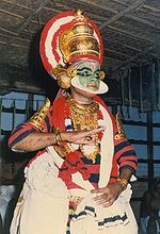
Sanskrit drama

Encyclopedia
The earliest-surviving fragments of Sanskrit drama date from the 1st century CE. The Mahābhāṣya by Patañjali
contains the earliest reference to what may have been the seeds of Sanskrit drama. This treatise on grammar
from 140 BCE provides a feasible date for the beginnings of theatre in India
.
Its drama is regarded as the highest achievement of Sanskrit literature
. It utilised stock character
s, such as the hero (nayaka), heroine (nayika), or clown (vidusaka). Actors may have specialised in a particular type. Kālidāsa
in the 3rd-4th century CE, is arguably one of ancient India
's greatest Sanskrit dramatist. Three famous romantic plays written by Kālidāsa are the Mālavikāgnimitram
(Mālavikā and Agnimitra), Vikramuurvashiiya (Pertaining to Vikrama and Urvashi), and Abhijñānaśākuntala (The Recognition of Shakuntala). The last was inspired by a story in the Mahabharata and is the most famous. It was the first to be translated into English
and German
. Śakuntalā
(in English translation) influenced Goethe's
Faust
(1808-1832). The next great Indian dramatist was Bhavabhuti
(c. 7th century CE). He is said to have written the following three plays: Malati-Madhava, Mahaviracharita and Uttar Ramacharita. Among these three, the last two cover between them the entire epic of Ramayana. The powerful Indian emperor Harsha
(606-648) is credited with having written three plays: the comedy Ratnavali
, Priyadarsika
, and the Buddhist drama Nagananda
. Other famous Sanskrit
drama
tists include Śhudraka, Bhasa
, and Asvaghosa
. Though numerous plays written by these playwrights are still available, little is known about the authors themselves.
(hymn
s from between 1500 to 1000 BCE that are among the earliest examples of literature in the world) contain no hint of it (although a small number are composed in a form of dialogue
) and the ritual
s of the Vedic period
do not appear to have developed into theatre. The Mahābhāṣya by Patañjali
contains the earliest reference to what may have been the seeds of Sanskrit drama. This treatise on grammar
from 140 BCE provides a feasible date for the beginnings of theatre in India
.
. The Treatise is the most complete work of dramaturgy in the ancient world. It addresses acting
, dance
, music
, dramatic construction
, architecture, costuming
, make-up
, props, the organisation of companies, the audience, competitions, and offers a mythological
account of the origin of theatre. In doing so, it provides indications about the nature of actual theatrical practices. Sanskrit theatre was performed on sacred ground by priests who had been trained in the necessary skills (dance, music, and recitation) in an hereditary process. Its aim was both to educate and to entertain.
Under the patronage of royal courts, performers belonged to professional companies that were directed by a stage manager (sutradhara), who may also have acted. This task was thought of as being analagous to that of a puppeteer
--the literal meaning of "sutradhara" is "holder of the strings or threads". The performers were trained rigorously in vocal and physical technique. There were no prohibitions against female performers; companies were all-male, all-female, and of mixed gender. Certain sentiments were considered inappropriate for men to enact, however, and were thought better suited to women. Some performers played character their own age, while others played those different to their own (whether younger or older). Of all the elements of theatre, the Treatise gives most attention to acting (abhinaya), which consists of two styles: realistic (lokadharmi) and conventional (natyadharmi), though the major focus is on the latter.
The theory of rasa described in the text has been a major influence on the modern theatre of India as well as Indian cinema
, particularly Bollywood
.
in the 2nd century BC. Rife with romance, sex, royal intrigue and comedy, the juicy plot of the play has numerous twists and turns. The main story is about a young man named Charudatta, and his love for Vasantasena, a rich courtesan or nagarvadhu
. The love affair is complicated by a royal courtier, who is also attracted to Vasantasena. The plot is further complicated by thieves and mistaken identities, and thus making it a greatly hilarious and entertaining play. It invited widespread admiration when staged in New York in 1924. The play was made into a 1984 Hindi
movie Utsav
, directed by Girish Karnad
. The Indian play depicted in the film Moulin Rouge!
may have been based on The Little Clay Cart.
. A 14th play was later discovered and attributed to Bhāsa, but its authorship is disputed.
Bhasa's most famous plays are Svapna Vasavadattam (Swapnavāsadatta) (Vasavadatta's dream), Pancharātra and Pratijna Yaugandharayaanam (The vows of Yaugandharayana). Some other plays being Pratimanātaka, Abhishekanātaka, Bālacharita, Dūtavākya, Karnabhāra, Dūtaghatotkacha, Chārudatta, Madhyamavyāyoga
and Ūrubhaṅga
.
Karnabhara is a critically acclaimed play and it is being subjected to lot of experimentation by the modern theatre groups in India
.
Bhasa is considered to be one of the best Sanskrit playwrights, second only to Kalidasa
. He is earlier than Kalidasa, and may date to any time between the 1st century BCE and the 4th century CE.
. He deals primarily with famous Hindu
legends and themes; three famous plays by Kālidāsa are Vikramōrvaśīyam
(Vikrama and Urvashi), Mālavikāgnimitram
(Malavika and Agnimitra), and the play that he is most known for: Abhijñānaśākuntalam
(The Recognition of Shakuntala). The last named play is considered to be greatest play in Sanskrit. More than a millennium later, it would so powerfully impress the famous German writer Goethe that he would write:
Kālidāsa also wrote two large epic poems, Raghuvaṃśa
("The Genealogy of Raghu") and Kumārasambhava
("Birth of Kumara"), and two smaller epics, Ṛitusaṃhāra ("Medley of Seasons") and Meghadūta
(The Cloud Messenger), another 'perfect' work.
Kālidāsa's writing is characterized by the usage of simple but beautiful Sanskrit, and by his extensive use of simile
s. His similes have earned him the saying, Upama Kalidasasya (Kālidāsa owns simile).
. His writings were all in Sanskrit.
He is also known for his complex sentences and creation of very long compound words (some of his sentences ran for half a page, and some of his words for half a line).
A shloka
that explains the strengths of different poets says: Dandinaha padalālityam ("Daṇḍin is the master of playful words").
, Nagananda
and Priyadarsika
by Sri Harsha
(7th century), Mahendravikramavarman's Mattavilasa Prahasana
, Shaktibhadra's Āścaryacūḍāmaṇi, Sri Harsha's Nagananda, Kulasekhara’s Subhadradhananjaya and Tapatisamvarana, Neelakantha's Kalyana Saugandhika and Sri Krishna Charita.
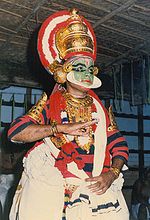
, which is preserved in Kerala
by the Chakyar
community. This form of Sanskrit drama is thought to be at least 2000 years old and is one of the oldest living theatrical traditions in the world. All major Sanskrit plays such as that of Bhasa, Sri Harsha, Shaktibhadra etc. are performed in Koodiyattam. Guru Nātyāchārya Vidūshakaratnam Padma Shri
Māni Mādhava Chākyār
choreographed and directed plays like Kalidasa's Abhijñānaśākuntala, Vikramorvaśīya and Mālavikāgnimitra; Bhasa's Swapnavāsadatta and Pancharātra for the first time in the history of Koodiyattam. He popularised Koodiyattam and rejuvenated the only surviving Sanskrit drama theatre in India.
One of the hypotheses (as yet without consensus) of the origins of the "Trivandrum plays" of Bhasa is that these 13 plays were adapted from their original sources and brought to Kerala for choreography in the Koodiyattam tradition.
, a modern Sanskrit play-write has written many plays and dance dramas. Some worth-mentioning plays are, Arjuna-Pratijnaa,Shrita-kamalam, Pada-pallavam, Divya-Jayadevam, Pingalaa, Mrtyuh, Sthitaprajnah, Tantra-mahasaktih, Purva-sakuntalam and Uttara-sakuntalam.
Prafulla kumar Mishra has written the plays Chitrangada and Karuna.
Patañjali
Patañjali is the compiler of the Yoga Sūtras, an important collection of aphorisms on Yoga practice. According to tradition, the same Patañjali was also the author of the Mahābhāṣya, a commentary on Kātyāyana's vārttikas on Pāṇini's Aṣṭādhyāyī as well as an unspecified work of medicine .In...
contains the earliest reference to what may have been the seeds of Sanskrit drama. This treatise on grammar
Grammar
In linguistics, grammar is the set of structural rules that govern the composition of clauses, phrases, and words in any given natural language. The term refers also to the study of such rules, and this field includes morphology, syntax, and phonology, often complemented by phonetics, semantics,...
from 140 BCE provides a feasible date for the beginnings of theatre in India
Theatre in India
The earliest form of the theatre of India was the Sanskrit theatre. It began after the development of Greek and Roman theatre and before the development of theatre in other parts of Asia...
.
Its drama is regarded as the highest achievement of Sanskrit literature
Sanskrit literature
Literature in Sanskrit begins with the Vedas, and continues with the Sanskrit Epics of Iron Age India; the golden age of Classical Sanskrit literature dates to late Antiquity . Literary production saw a late bloom in the 11th century before declining after 1100 AD...
. It utilised stock character
Stock character
A Stock character is a fictional character based on a common literary or social stereotype. Stock characters rely heavily on cultural types or names for their personality, manner of speech, and other characteristics. In their most general form, stock characters are related to literary archetypes,...
s, such as the hero (nayaka), heroine (nayika), or clown (vidusaka). Actors may have specialised in a particular type. Kālidāsa
Kalidasa
Kālidāsa was a renowned Classical Sanskrit writer, widely regarded as the greatest poet and dramatist in the Sanskrit language...
in the 3rd-4th century CE, is arguably one of ancient India
India
India , officially the Republic of India , is a country in South Asia. It is the seventh-largest country by geographical area, the second-most populous country with over 1.2 billion people, and the most populous democracy in the world...
's greatest Sanskrit dramatist. Three famous romantic plays written by Kālidāsa are the Mālavikāgnimitram
Malavikagnimitram
Mālavikāgnimitram is a Sanskrit play by Kālidāsa. It is his first play.The play tells the story of the love of King Agnimitra, the Shunga king of Vidisha , for the beautiful hand-maiden of his chief queen. He falls in love with the picture of an exiled servant girl named Mālavikā...
(Mālavikā and Agnimitra), Vikramuurvashiiya (Pertaining to Vikrama and Urvashi), and Abhijñānaśākuntala (The Recognition of Shakuntala). The last was inspired by a story in the Mahabharata and is the most famous. It was the first to be translated into English
English language
English is a West Germanic language that arose in the Anglo-Saxon kingdoms of England and spread into what was to become south-east Scotland under the influence of the Anglian medieval kingdom of Northumbria...
and German
German language
German is a West Germanic language, related to and classified alongside English and Dutch. With an estimated 90 – 98 million native speakers, German is one of the world's major languages and is the most widely-spoken first language in the European Union....
. Śakuntalā
Abhijñānaśākuntalam
Abhijñānashākuntala or Abhijñānaśākuntalam) , is a well-known Sanskrit play by Kālidāsa. Its date is uncertain, but Kalidasa is often placed in the period between the 1st century BCE and 4th century CE....
(in English translation) influenced Goethe's
Johann Wolfgang von Goethe
Johann Wolfgang von Goethe was a German writer, pictorial artist, biologist, theoretical physicist, and polymath. He is considered the supreme genius of modern German literature. His works span the fields of poetry, drama, prose, philosophy, and science. His Faust has been called the greatest long...
Faust
Goethe's Faust
Johann Wolfgang von Goethe's Faust is a tragic play in two parts: and . Although written as a closet drama, it is the play with the largest audience numbers on German-language stages...
(1808-1832). The next great Indian dramatist was Bhavabhuti
Bhavabhuti
Bhavabhuti was an 8th century scholar of India noted for his plays and poetry, written in Sanskrit. His plays are considered equivalent to the works of Kalidasa...
(c. 7th century CE). He is said to have written the following three plays: Malati-Madhava, Mahaviracharita and Uttar Ramacharita. Among these three, the last two cover between them the entire epic of Ramayana. The powerful Indian emperor Harsha
Harsha
Harsha or Harsha Vardhana or Harshvardhan was an Indian emperor who ruled northern India from 606 to 647 AD. He was the son of Prabhakara Vardhana and younger brother of Rajya Vardhana, a king of Thanesar, Haryana...
(606-648) is credited with having written three plays: the comedy Ratnavali
Ratnavali
Ratnavali is a Sanskrit drama about a beautiful princess named Ratnavali, and a great king named Udayana. It is attributed to the Indian emperor Harsha . It is a Natika in four acts. One of the first textual references to the celebration of Holi, the festival of Colours have been found in this text...
, Priyadarsika
Priyadarsika
Priyadarsika is a Sanskrit play attributed to king Harsha .-External links:*, translated by G. K. Nariman and A. V. Williams Jackson...
, and the Buddhist drama Nagananda
Nagananda
Nagananda is a Sanskrit play attributed to king Harsha .Nagananda is one of the best Sanskrit dramas in five acts dealing with the popular story of Jimutavahana's self-sacrifice to save the Nagas...
. Other famous Sanskrit
Sanskrit
Sanskrit , is a historical Indo-Aryan language and the primary liturgical language of Hinduism, Jainism and Buddhism.Buddhism: besides Pali, see Buddhist Hybrid Sanskrit Today, it is listed as one of the 22 scheduled languages of India and is an official language of the state of Uttarakhand...
drama
Drama
Drama is the specific mode of fiction represented in performance. The term comes from a Greek word meaning "action" , which is derived from "to do","to act" . The enactment of drama in theatre, performed by actors on a stage before an audience, presupposes collaborative modes of production and a...
tists include Śhudraka, Bhasa
Bhasa
Bhāsa is one of the earliest and most celebrated Indian playwrights in Sanskrit. However, very little is known about him.Kālidāsa in the introduction to his first play Malavikagnimitram writes -...
, and Asvaghosa
Asvaghosa
' was an Indian philosopher-poet, born in Saketa in northern India to a Brahmin family. He is believed to have been the first Sanskrit dramatist, and is considered the greatest Indian poet prior to Kālidāsa. He was the most famous in a group of Buddhist court writers, whose epics rivaled the...
. Though numerous plays written by these playwrights are still available, little is known about the authors themselves.
Beginnings
The earliest-surviving fragments of Sanskrit drama date from the 1st century CE. The wealth of archeological evidence from earlier periods offers no indication of the existence of a tradition of theatre. The ancient VedasVedas
The Vedas are a large body of texts originating in ancient India. Composed in Vedic Sanskrit, the texts constitute the oldest layer of Sanskrit literature and the oldest scriptures of Hinduism....
(hymn
Hymn
A hymn is a type of song, usually religious, specifically written for the purpose of praise, adoration or prayer, and typically addressed to a deity or deities, or to a prominent figure or personification...
s from between 1500 to 1000 BCE that are among the earliest examples of literature in the world) contain no hint of it (although a small number are composed in a form of dialogue
Dialogue
Dialogue is a literary and theatrical form consisting of a written or spoken conversational exchange between two or more people....
) and the ritual
Ritual
A ritual is a set of actions, performed mainly for their symbolic value. It may be prescribed by a religion or by the traditions of a community. The term usually excludes actions which are arbitrarily chosen by the performers....
s of the Vedic period
Vedic period
The Vedic period was a period in history during which the Vedas, the oldest scriptures of Hinduism, were composed. The time span of the period is uncertain. Philological and linguistic evidence indicates that the Rigveda, the oldest of the Vedas, was composed roughly between 1700–1100 BCE, also...
do not appear to have developed into theatre. The Mahābhāṣya by Patañjali
Patañjali
Patañjali is the compiler of the Yoga Sūtras, an important collection of aphorisms on Yoga practice. According to tradition, the same Patañjali was also the author of the Mahābhāṣya, a commentary on Kātyāyana's vārttikas on Pāṇini's Aṣṭādhyāyī as well as an unspecified work of medicine .In...
contains the earliest reference to what may have been the seeds of Sanskrit drama. This treatise on grammar
Grammar
In linguistics, grammar is the set of structural rules that govern the composition of clauses, phrases, and words in any given natural language. The term refers also to the study of such rules, and this field includes morphology, syntax, and phonology, often complemented by phonetics, semantics,...
from 140 BCE provides a feasible date for the beginnings of theatre in India
Theatre in India
The earliest form of the theatre of India was the Sanskrit theatre. It began after the development of Greek and Roman theatre and before the development of theatre in other parts of Asia...
.
Natya Shastra
The major source of evidence for Sanskrit theatre is A Treatise on Theatre (Nātyaśāstra), a compendium whose date of composition is uncertain (estimates range from 200 BCE to 200 CE) and whose authorship is attributed to Bharata MuniBharata Muni
Bharata was an ancient Indian musicologist who authored the Natya Shastra, a theoretical treatise on ancient Indian dramaturgy and histrionics, dated to between roughly 400 BC and 200 BC. Indian dance and music find their root in the Natyashastra...
. The Treatise is the most complete work of dramaturgy in the ancient world. It addresses acting
Acting
Acting is the work of an actor or actress, which is a person in theatre, television, film, or any other storytelling medium who tells the story by portraying a character and, usually, speaking or singing the written text or play....
, dance
Dance
Dance is an art form that generally refers to movement of the body, usually rhythmic and to music, used as a form of expression, social interaction or presented in a spiritual or performance setting....
, music
Music
Music is an art form whose medium is sound and silence. Its common elements are pitch , rhythm , dynamics, and the sonic qualities of timbre and texture...
, dramatic construction
Dramaturgy
Dramaturgy is the art of dramatic composition and the representation of the main elements of drama on the stage. Dramaturgy is a distinct practice separate from play writing and directing, although a single individual may perform any combination of the three. Some dramatists combine writing and...
, architecture, costuming
Costume design
Costume design is the fabrication of apparel for the overall appearance of a character or performer. This usually involves researching, designing and building the actual items from conception. Costumes may be for a theater or cinema performance but may not be limited to such...
, make-up
Theatrical makeup
In the performing arts, theatrical makeup is used to assist in creating the appearance of the characters that actors portray.-Background:In Greek and Roman theatre, makeup was unnecessary. Actors wore various masks, allowing them to portray another gender, age, or entirely different likeness....
, props, the organisation of companies, the audience, competitions, and offers a mythological
Hindu mythology
Hindu religious literature is the large body of traditional narratives related to Hinduism, notably as contained in Sanskrit literature, such as the Sanskrit epics and the Puranas. As such, it is a subset of Nepali and Indian culture...
account of the origin of theatre. In doing so, it provides indications about the nature of actual theatrical practices. Sanskrit theatre was performed on sacred ground by priests who had been trained in the necessary skills (dance, music, and recitation) in an hereditary process. Its aim was both to educate and to entertain.
Under the patronage of royal courts, performers belonged to professional companies that were directed by a stage manager (sutradhara), who may also have acted. This task was thought of as being analagous to that of a puppeteer
Puppetry
Puppetry is a form of theatre or performance which involves the manipulation of puppets. It is very ancient, and is believed to have originated 30,000 years BC. Puppetry takes many forms but they all share the process of animating inanimate performing objects...
--the literal meaning of "sutradhara" is "holder of the strings or threads". The performers were trained rigorously in vocal and physical technique. There were no prohibitions against female performers; companies were all-male, all-female, and of mixed gender. Certain sentiments were considered inappropriate for men to enact, however, and were thought better suited to women. Some performers played character their own age, while others played those different to their own (whether younger or older). Of all the elements of theatre, the Treatise gives most attention to acting (abhinaya), which consists of two styles: realistic (lokadharmi) and conventional (natyadharmi), though the major focus is on the latter.
The theory of rasa described in the text has been a major influence on the modern theatre of India as well as Indian cinema
Cinema of India
The cinema of India consists of films produced across India, which includes the cinematic culture of Andhra Pradesh, Assam, Gujarat, Haryana, Jammu and Kashmir, Karnataka, Kerala, Maharashtra, Orissa, Punjab, Tamil Nadu, and West Bengal. Indian films came to be followed throughout South Asia and...
, particularly Bollywood
Bollywood
Bollywood is the informal term popularly used for the Hindi-language film industry based in Mumbai , Maharashtra, India. The term is often incorrectly used to refer to the whole of Indian cinema; it is only a part of the total Indian film industry, which includes other production centers producing...
.
Mricchakatika (The Little Clay Cart)
One of the earliest known Sanskrit plays, this play was composed by ŚudrakaSudraka
' was an Indian King. Three Sanskrit plays are ascribed to him - Mricchakatika , Vinavasavadatta, and a bhana , Padmaprabhritaka.. He has been identified as Abhira King Indranigupta, who used the pen name Sudraka.- References :* Ryder, Arthur William. Translator...
in the 2nd century BC. Rife with romance, sex, royal intrigue and comedy, the juicy plot of the play has numerous twists and turns. The main story is about a young man named Charudatta, and his love for Vasantasena, a rich courtesan or nagarvadhu
Nagarvadhu
Nagarvadhu or Nagar Vadhu was a tradition followed in some parts of ancient India.Women competed to win the title of a Nagarvadhu, and it was not considered a taboo. The most beautiful woman was chosen as the Nagarvadhu....
. The love affair is complicated by a royal courtier, who is also attracted to Vasantasena. The plot is further complicated by thieves and mistaken identities, and thus making it a greatly hilarious and entertaining play. It invited widespread admiration when staged in New York in 1924. The play was made into a 1984 Hindi
Bollywood
Bollywood is the informal term popularly used for the Hindi-language film industry based in Mumbai , Maharashtra, India. The term is often incorrectly used to refer to the whole of Indian cinema; it is only a part of the total Indian film industry, which includes other production centers producing...
movie Utsav
Utsav
Utsav is a 1984 Hindi film, produced by Shashi Kapoor and directed by Girish Karnad.The film stars Shashi Kapoor, Rekha, Amjad Khan, Anuradha Patel, Shekhar Suman, Anupam Kher, Shankar Nag, Neena Gupta, Kulbhushan Kharbanda, Annu Kapoor, Sanjana Kapoor and Kunal Kapoor.The role played by Shashi...
, directed by Girish Karnad
Girish Karnad
Girish Raghunath Karnad is a contemporary writer, playwright, screenwriter, actor and movie director in Kannada language...
. The Indian play depicted in the film Moulin Rouge!
Moulin Rouge!
Moulin Rouge! is a 2001 romantic jukebox musical film directed, produced, and co-written by Baz Luhrmann. Following the Red Curtain Cinema principles, the film is based on the Orphean myth, La Traviata, and La Bohème...
may have been based on The Little Clay Cart.
Bhasa
The plays written by Bhāsa were only known to historians through the references of later writers, the manuscripts themselves being lost. Manuscripts of 13 plays written by him were discovered in an old library in Thiruvananthapuram (Trivandrum) in 1913 by the scholar Ganapati SastriGanapati Sastri
Ganapati Sastri is one of the Indian names.* Ayyala Somayajula Ganapati Sastri, better known as Kavyakanta.* Charla Ganapati Sastri, Vedic scholar and translator.* Pilaka Ganapati Sastri, poet, translator and editor....
. A 14th play was later discovered and attributed to Bhāsa, but its authorship is disputed.
Bhasa's most famous plays are Svapna Vasavadattam (Swapnavāsadatta) (Vasavadatta's dream), Pancharātra and Pratijna Yaugandharayaanam (The vows of Yaugandharayana). Some other plays being Pratimanātaka, Abhishekanātaka, Bālacharita, Dūtavākya, Karnabhāra, Dūtaghatotkacha, Chārudatta, Madhyamavyāyoga
Madhyamavyayoga
Madhyamavyayoga or Madhyama Vyāyoga , is a Sanskrit play attributed to Bhāsa. There is no real consensus regarding when the play was written, and it has been dated variously from 475 BCE to the 11th century CE...
and Ūrubhaṅga
Urubhanga
Urubhanga or Urubhangam, , is a Sanskrit play written by Bhasa in the 2nd or 3rd century AD. Based on the well-known epic, the Mahābhārata, by Vyasa, Urubhanga focuses on the story of the character Duryodhana during and after his fight with Bhima...
.
Karnabhara is a critically acclaimed play and it is being subjected to lot of experimentation by the modern theatre groups in India
India
India , officially the Republic of India , is a country in South Asia. It is the seventh-largest country by geographical area, the second-most populous country with over 1.2 billion people, and the most populous democracy in the world...
.
Bhasa is considered to be one of the best Sanskrit playwrights, second only to Kalidasa
Kalidasa
Kālidāsa was a renowned Classical Sanskrit writer, widely regarded as the greatest poet and dramatist in the Sanskrit language...
. He is earlier than Kalidasa, and may date to any time between the 1st century BCE and the 4th century CE.
Kālidāsa
Kālidāsa (3rd-4th century CE) is easily the greatest poet and playwright in Sanskrit, and occupies the same position in Sanskrit literature that Shakespeare occupies in English literatureEnglish literature
English literature is the literature written in the English language, including literature composed in English by writers not necessarily from England; for example, Robert Burns was Scottish, James Joyce was Irish, Joseph Conrad was Polish, Dylan Thomas was Welsh, Edgar Allan Poe was American, J....
. He deals primarily with famous Hindu
Hindu
Hindu refers to an identity associated with the philosophical, religious and cultural systems that are indigenous to the Indian subcontinent. As used in the Constitution of India, the word "Hindu" is also attributed to all persons professing any Indian religion...
legends and themes; three famous plays by Kālidāsa are Vikramōrvaśīyam
Vikramorvasiyam
Vikramōrvaśīyam is a Sanskrit play by medieval Indian poet Kalidasa who fluorished in the 4th Century CE, on the Vedic love story of king Pururavas and celestial nymph Urvashi...
(Vikrama and Urvashi), Mālavikāgnimitram
Malavikagnimitram
Mālavikāgnimitram is a Sanskrit play by Kālidāsa. It is his first play.The play tells the story of the love of King Agnimitra, the Shunga king of Vidisha , for the beautiful hand-maiden of his chief queen. He falls in love with the picture of an exiled servant girl named Mālavikā...
(Malavika and Agnimitra), and the play that he is most known for: Abhijñānaśākuntalam
Abhijñānaśākuntalam
Abhijñānashākuntala or Abhijñānaśākuntalam) , is a well-known Sanskrit play by Kālidāsa. Its date is uncertain, but Kalidasa is often placed in the period between the 1st century BCE and 4th century CE....
(The Recognition of Shakuntala). The last named play is considered to be greatest play in Sanskrit. More than a millennium later, it would so powerfully impress the famous German writer Goethe that he would write:
- "Wouldst thou the young year's blossoms and the fruits of its decline
- And all by which the soul is charmed, enraptured, feasted, fed,
- Wouldst thou the earth and heaven itself in one sole name combine?
- I name thee, O Shakuntala! and all at once is said. "
Kālidāsa also wrote two large epic poems, Raghuvaṃśa
Raghuvamsa
Raghuwamsa or Raghu race is a legendary lineage of warrior kings tracing its ancestry to the Hindu solar deity Surya. Kalidasa's famous work, Raghuvaṃśa depicts the legend of this race. The progenitor of the lineage was Raghu, son of the emperor Dileepa. Raghu was father of Aja, and thus...
("The Genealogy of Raghu") and Kumārasambhava
Kumarasambhava
Kumārasambhava is a Sanskrit epic poem by Kālidāsa; the first eight cantos are accepted as his authorship...
("Birth of Kumara"), and two smaller epics, Ṛitusaṃhāra ("Medley of Seasons") and Meghadūta
Meghadūta
Meghadūta is a lyric poem written by Kālidāsa, considered to be one of the greatest Sanskrit poets.A short poem of 111 stanzas, it is one of Kālidāsa's most famous works...
(The Cloud Messenger), another 'perfect' work.
Kālidāsa's writing is characterized by the usage of simple but beautiful Sanskrit, and by his extensive use of simile
Simile
A simile is a figure of speech that directly compares two different things, usually by employing the words "like", "as". Even though both similes and metaphors are forms of comparison, similes indirectly compare the two ideas and allow them to remain distinct in spite of their similarities, whereas...
s. His similes have earned him the saying, Upama Kalidasasya (Kālidāsa owns simile).
Daṇḍin
Daṇḍin is a 6th-7th century Sanskrit author of prose romances and expounder on poetics. Although he produced literature on his own, most notably the Daśakumāracarita, translated in 1927 as "The Adventures of the Ten Princes", he is best known for composing the Kāvyādarśa ("Mirror of Poetry"), the handbook of classical Sanskrit poetics, or kāvyaKavya
Kavya refers to the Sanskrit literary style used by Indian court poets flourishing from the first half of the seventh century AD. This literary style is characterised by abundant usage of figures of speech, metaphors, similes, and hyperbole to create its emotional effects...
. His writings were all in Sanskrit.
He is also known for his complex sentences and creation of very long compound words (some of his sentences ran for half a page, and some of his words for half a line).
A shloka
Shloka
A ' is a category of verse line developed from the Vedic Anuṣṭubh. It is the basis for Indian Epic verse, and may be considered the Indian verse form par excellence, occurring, as it does, far more frequently than any other meter in classical Sanskrit poetry. The Mahabharata and Ramayana, for...
that explains the strengths of different poets says: Dandinaha padalālityam ("Daṇḍin is the master of playful words").
Other Major Plays
There are lot of other great plays like RatnavaliRatnavali
Ratnavali is a Sanskrit drama about a beautiful princess named Ratnavali, and a great king named Udayana. It is attributed to the Indian emperor Harsha . It is a Natika in four acts. One of the first textual references to the celebration of Holi, the festival of Colours have been found in this text...
, Nagananda
Nagananda
Nagananda is a Sanskrit play attributed to king Harsha .Nagananda is one of the best Sanskrit dramas in five acts dealing with the popular story of Jimutavahana's self-sacrifice to save the Nagas...
and Priyadarsika
Priyadarsika
Priyadarsika is a Sanskrit play attributed to king Harsha .-External links:*, translated by G. K. Nariman and A. V. Williams Jackson...
by Sri Harsha
Harsha
Harsha or Harsha Vardhana or Harshvardhan was an Indian emperor who ruled northern India from 606 to 647 AD. He was the son of Prabhakara Vardhana and younger brother of Rajya Vardhana, a king of Thanesar, Haryana...
(7th century), Mahendravikramavarman's Mattavilasa Prahasana
Mattavilasa Prahasana
Mattavilasa Prahasana , is a short one-act Sanskrit play. It is one of the two great one act plays written by scholar King Mahendravarman I in the beginning of the seventh century....
, Shaktibhadra's Āścaryacūḍāmaṇi, Sri Harsha's Nagananda, Kulasekhara’s Subhadradhananjaya and Tapatisamvarana, Neelakantha's Kalyana Saugandhika and Sri Krishna Charita.
Performances
Sanskrit plays were very popular and were staged in ancient times all over India. Now the only surviving ancient Sanskrit drama theatre is KoodiyattamKoodiyattam
Koodiyattam or Kutiyattam is a form of Sanskrit theatre traditionally performed in the state of Kerala, India. Performed in the Sanskrit language in Hindu temples, it is believed to be 2,000 years old...
, which is preserved in Kerala
Kerala
or Keralam is an Indian state located on the Malabar coast of south-west India. It was created on 1 November 1956 by the States Reorganisation Act by combining various Malayalam speaking regions....
by the Chakyar
Chakyar
Chakyar is a Brahmin caste coming under the Ambalavasi community of Hindus in the Kerala state of South India. The women in this caste are called Illotammas....
community. This form of Sanskrit drama is thought to be at least 2000 years old and is one of the oldest living theatrical traditions in the world. All major Sanskrit plays such as that of Bhasa, Sri Harsha, Shaktibhadra etc. are performed in Koodiyattam. Guru Nātyāchārya Vidūshakaratnam Padma Shri
Padma Shri
Padma Shri is the fourth highest civilian award in the Republic of India, after the Bharat Ratna, the Padma Vibhushan and the Padma Bhushan...
Māni Mādhava Chākyār
Mani Madhava Chakyar
Guru Mani Madhava Chakyar was a celebrated master performance artist and Sanskrit scholar from Kerala, South India, considered to be the greatest Chakyar Koothu and Koodiyattam artist and authority of modern times...
choreographed and directed plays like Kalidasa's Abhijñānaśākuntala, Vikramorvaśīya and Mālavikāgnimitra; Bhasa's Swapnavāsadatta and Pancharātra for the first time in the history of Koodiyattam. He popularised Koodiyattam and rejuvenated the only surviving Sanskrit drama theatre in India.
One of the hypotheses (as yet without consensus) of the origins of the "Trivandrum plays" of Bhasa is that these 13 plays were adapted from their original sources and brought to Kerala for choreography in the Koodiyattam tradition.
Modern Sanskrit Plays
Manmohan AcharyaManmohan Acharya
Manmohan Acharya is a poet and lyricist from India. He is also a researcher and published author. His contribution appears significant by inspiring the classical dance, Odissi, for the first time to enter into Bollywood with his lucid Sanskrit lyrics.-Early life and education:Manmohan Acharya was...
, a modern Sanskrit play-write has written many plays and dance dramas. Some worth-mentioning plays are, Arjuna-Pratijnaa,Shrita-kamalam, Pada-pallavam, Divya-Jayadevam, Pingalaa, Mrtyuh, Sthitaprajnah, Tantra-mahasaktih, Purva-sakuntalam and Uttara-sakuntalam.
Prafulla kumar Mishra has written the plays Chitrangada and Karuna.
Sources
- Banham, Martin, ed. 1998. The Cambridge Guide to Theatre. Cambridge: Cambridge UP. ISBN 0521434378.
- Brandon, James R. 1981. Introduction. In Baumer and Brandon (1981, xvii-xx).
- ---, ed. 1997. The Cambridge Guide to Asian Theatre. 2nd, rev. ed. Cambridge: Cambridge UP. ISBN 978-0521588225.
- Brockett, Oscar G. and Franklin J. Hildy. 2003. History of the Theatre. Ninth edition, International edition. Boston: Allyn and Bacon. ISBN 0205410502.
- Baumer, Rachel Van M., and James R. Brandon, eds. 1981. Sanskrit Theatre in Performance. Delhi: Motilal Banarsidass, 1993. ISBN 978-8120807723.
- Richmond, Farley. 1998. "India." In Banham (1998, 516-525).
- Richmond, Farley P., Darius L. Swann, and Phillip B. Zarrilli, eds. 1993. Indian Theatre: Traditions of Performance. U of Hawaii P. ISBN 978-0824813222.