
All Topics  
Uesugi Kenshin

 
Uesugi Kenshin

   Email Print
   Bookmark   Link


Uesugi Kenshin


was a daimyo
Daimyo

The were powerful territorial lords who ruled most of Japan from their vast, hereditary land holdings. The term derives from a shortening of the title , which literally means "great named land" and originally simply referred to the owner of a large estate....
 who ruled Echigo province
Echigo Province

was an old provinces of Japan in north-central Japan, on the Sea of Japan side, northernmost part of the Hokurikudo Echigo was established by the division of Koshi province in the end of 7th century AD with Iwafune District, Niigata and Nutari District, Niigara....
 in the Sengoku period
Sengoku period

The was a time of social upheaval, political intrigue, and nearly constant military conflict in Japan that lasted roughly from the middle of the 15th century to the beginning of the 17th century....
 of Japan
Japan

Japan is an island country in East Asia. Located in the Pacific Ocean, it lies to the east of the Sea of Japan, People's Republic of China, North Korea, South Korea and Russia, stretching from the Sea of Okhotsk in the north to the East China Sea and Taiwan in the south....
.

He was one of the many powerful lords of the Sengoku period. He is famed for his prowess on the battlefield, the legendary rivalry with Takeda Shingen
Takeda Shingen

of Shinano Province and Kai Provinces, was a preeminent daimyo or feudal lord with military prestige who sought for the control of Japan in the late stage of Sengoku period or "warring states" period....
, his military expertise, strategy and his belief in the god of war — Bishamonten
Vaisravana

' or ' also known as Jambhala, is the name of the chief of the Four Heavenly Kings and an important figure in Buddhist mythology....
. In fact, many of his followers and others believed him to be the avatar
Avatar

Avatar or Avatara , often translated into English as incarnation, literally means descent and usually implies a deliberate descent from higher spiritual realms to lower realms of existence for special purposes....
 of Bishamonten, and called Kenshin god of war.

original name was Nagao Kagetora.


Discussion
Ask a question about 'Uesugi Kenshin'
Start a new discussion about 'Uesugi Kenshin'
Answer questions from other users
Full Discussion Forum


Encyclopedia


was a daimyo
Daimyo

The were powerful territorial lords who ruled most of Japan from their vast, hereditary land holdings. The term derives from a shortening of the title , which literally means "great named land" and originally simply referred to the owner of a large estate....
 who ruled Echigo province
Echigo Province

was an old provinces of Japan in north-central Japan, on the Sea of Japan side, northernmost part of the Hokurikudo Echigo was established by the division of Koshi province in the end of 7th century AD with Iwafune District, Niigata and Nutari District, Niigara....
 in the Sengoku period
Sengoku period

The was a time of social upheaval, political intrigue, and nearly constant military conflict in Japan that lasted roughly from the middle of the 15th century to the beginning of the 17th century....
 of Japan
Japan

Japan is an island country in East Asia. Located in the Pacific Ocean, it lies to the east of the Sea of Japan, People's Republic of China, North Korea, South Korea and Russia, stretching from the Sea of Okhotsk in the north to the East China Sea and Taiwan in the south....
.

He was one of the many powerful lords of the Sengoku period. He is famed for his prowess on the battlefield, the legendary rivalry with Takeda Shingen
Takeda Shingen

of Shinano Province and Kai Provinces, was a preeminent daimyo or feudal lord with military prestige who sought for the control of Japan in the late stage of Sengoku period or "warring states" period....
, his military expertise, strategy and his belief in the god of war — Bishamonten
Vaisravana

' or ' also known as Jambhala, is the name of the chief of the Four Heavenly Kings and an important figure in Buddhist mythology....
. In fact, many of his followers and others believed him to be the avatar
Avatar

Avatar or Avatara , often translated into English as incarnation, literally means descent and usually implies a deliberate descent from higher spiritual realms to lower realms of existence for special purposes....
 of Bishamonten, and called Kenshin god of war.

Name

His original name was Nagao Kagetora. He changed his name to Uesugi Masatora when he inherited the Uesugi family name in order to accept the official title of Kanto Kanrei. Later he changed his name again to Uesugi Terutora to honor the Shogun
Shogun

is a military rank and historical title for Hereditary Commanders in Chief of the Armed Forces of Japan. The Japanese word for "general", it is made up of two kanji characters: sho, meaning "commander", "general", or "admiral", and gun meaning military troops or warriors....
 Ashikaga Yoshiteru, and finally to Kenshin after he became a Buddhist monk; in particular, he would become renowned for being a devotee of Bishamonten
Vaisravana

' or ' also known as Jambhala, is the name of the chief of the Four Heavenly Kings and an important figure in Buddhist mythology....
. For the majority of this description, the name of Kenshin will be used.

Kenshin is sometimes referred to as "The Dragon of Echigo" because of his fearsome skills in the martial arts displayed on the battlefield. His rival Takeda Shingen
Takeda Shingen

of Shinano Province and Kai Provinces, was a preeminent daimyo or feudal lord with military prestige who sought for the control of Japan in the late stage of Sengoku period or "warring states" period....
 was called "The Tiger of Kai". In some versions of Chinese mythology
Chinese mythology

File:Nine-Dragons1.jpgChinese mythology is a collection of cultural history, folktales, and religions that have been passed down in oral or written form....
 (Shingen and Kenshin had always been interested in Chinese culture, especially the works of Sun Tzu
Sun Tzu

Sun Tzu , also called Sun Wu , is traditionally believed to be the author of The Art of War, sometimes called the Sun Tzu, an influential ancient China book on military strategy considered to be a prime example of Taoism strategy....
), the Dragon and Tiger have always been bitter rivals who try to defeat one another, but neither is ever able to gain the upper hand.

Life

Born the fourth son of the noted warrior Nagao Tamekage
Nagao Tamekage

Nagao Tamekage was a retainer of Japanese feudal lord Uesugi Fusayoshi, and a daimyo in his own right, during Japan's Sengoku period. According to some scholars, such as George Bailey Sansom, Nagao Tamekage's career makes him representative of the emergence of the daimyo, and the shift of regional power from Constables, Governors, and ot...
, Kenshin's early life presents a unique story. His father had gained some renown as a warlord through his military victories over Uesugi Sadanori and Uesugi Funayoshi. However, in later years, Tamekage found himself at odds with the neighboring Ikko-ikki
Ikko-ikki

The Japanese , literally "single-minded leagues", were mobs of peasant farmers, monks, Shinto priests and ji-samurai, who rose up against samurai rule in the 15th and 16th centuries....
 of Hokuriku
Hokuriku region

is a region in the northeastern part of Honshu, the main island of Japan. It lies along the Sea of Japan within the Chubu region.The Hokuriku region includes the prefectures of Toyama Prefecture, Ishikawa Prefecture and Fukui Prefecture....
, and as the political power in the region started to shift in favor of the Ikko (due largely to the sudden rise of the Honganji), the situation for Echigo quickly deteriorated. It came to a peak in 1536, when Kenshin's father gathered up an army and marched westward, his aim uncertain. However, upon arriving at Sendanno in Etchu
Etchu Province

was an old provinces of Japan in central Honshu, on the Sea of Japan side. It bordered Echigo Province, Shinano Province, Hida province, Kaga Province, and Noto Province provinces....
, his forces were suddenly attacked by Enami Kazuyori, and in the resulting battle Tamekage himself was slain, and his army put to flight.

The impact back at Echigo was immediate. Nagao Harukage
Nagao Harukage

was Uesugi Kenshin's older brother, and successor to his father Nagao Tamekage in 1536. Harukage, being weak willed and sickly, was leader in name only....
, Tamekage's eldest son, immediately made his bid for control of the Nagao
Nagao

The was a family of daimyo, feudal lords who built and controlled Kasugayama Castle and the surrounding fief, in what is now Niigata Prefecture....
, and succeeded in this claim after a power struggle which resulted in the death of one of his brothers, Kageyasu. Kagetora (Kenshin) was removed from the conflict and relocated to Rizen temple, where he spent his life from 7 to 14 dedicated to study.
Kasugayamacastle Print

Claim for power

At the age of fourteen, Kenshin was suddenly contacted by Usami Sadamitsu
Usami Sadamitsu

was a Japanese samurai of the Sengoku period, who served the Uesugi clan of Echigo Province....
 and a number of other acquaintances of his late father. They urged the young Nagao son to go to Echigo and contest his older brother's rule. It would seem that Harukage hadn't proven the most effective or inspiring leader, and his failure to exert control over the powerful kokujin families had resulted in a situation which was nearly to the point of tearing the province apart.

As the story is told, at first Kenshin was reluctant to take the field against his own brother, but was eventually convinced that it was necessary to the survival of Echigo. In a series of engagements led by himself and Usami Sadamitsu
Usami Sadamitsu

was a Japanese samurai of the Sengoku period, who served the Uesugi clan of Echigo Province....
, Kenshin succeeded in wresting control of the clan from Harukage in 1547. Harukage's own fate is uncertain, as some sources claim he was allowed to live, but others record his forced suicide.

Early rule

Though his rule over the Nagao clan was now unquestioned, much of Echigo was still independent of this young warlord's grasp. Kenshin immediately set out to cement his power in the region, but these efforts were still in their infant stages when far more pressing concerns appeared. Ogasawara Nagatoki
Ogasawara Nagatoki

was a daimyo of Shinano Province during the Sengoku Period in Japan. In 1542, Shinano Province was invaded by Takeda Shingen, and Ogasawara allied with Murakami Yoshikiyo, Suwa Yorishige, and Kiso Yoshiyasu in an attempt to stop him....
 and Murakami Yoshikiyo
Murakami Yoshikiyo

Murakami Yoshikiyo a retainer of the Japanese clan of Uesugi clan during the Sengoku Period of the 16th century. Yoshikiyo followed in fighting against both Takeda Nobutora and his son Takeda Shingen....
, two Shinano
Shinano Province

is an old provinces of Japan of Japan that is now present day Nagano Prefecture. Its abbreviation is Shinshu .Shinano bordered on Echigo Province, Etchu Province, Hida Province, Kai Province, Kozuke Province, Mikawa Province, Mino Province, Musashi Province, Suruga Province, and Totomi Province provinces....
 lords, both appeared before Kenshin requesting his help in halting the advances of the powerful warlord Takeda Shingen
Takeda Shingen

of Shinano Province and Kai Provinces, was a preeminent daimyo or feudal lord with military prestige who sought for the control of Japan in the late stage of Sengoku period or "warring states" period....
. Around the time Kenshin became the new lord of Echigo, Shingen had won major victories in Shinano Province. With the Takeda
Takeda family

The was a famous clan of daimyo in Japan's late Heian Period to Sengoku period.The Takeda were descendants of Emperor Seiwa and are a branch of the Minamoto clan , by Minamoto no Yoshimitsu , brother to the Chinjufu-shogun Minamoto no Yoshiie ....
's conquests taking them remarkably close to the borders of Echigo, Kenshin agreed to take the field.

Uesugi and Takeda

What followed was the beginning of a rivalry which became legendary. In the first conflict between the two, both Uesugi Kenshin and Takeda Shingen were very cautious, only committing themselves to indecisive skirmishes. Over the years, there would eventually be a total number of five such engagements at the famous site of Kawanakajima
Battles of Kawanakajima

The were fought in the Sengoku Period of Japan between Takeda Shingen of Kai Province and Uesugi Kenshin of Echigo Province in the plain of Kawanakajima, in the north of Shinano Province....
, though only the fourth would prove to be a serious, all-out battle between the two.

In 1561, Kenshin and Shingen fought the biggest battle they would fight, the fourth battle of Kawanakajima
Battles of Kawanakajima

The were fought in the Sengoku Period of Japan between Takeda Shingen of Kai Province and Uesugi Kenshin of Echigo Province in the plain of Kawanakajima, in the north of Shinano Province....
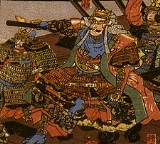
. Kenshin used an ingenious tactic: a special formation where the soldiers in the front would switch with their comrades in the rear, as those in the frontline became tired or wounded. This allowed the tired soldiers to take a break, while the soldiers who had not seen action would fight on the frontlines. This was extremely effective and because of this Kenshin nearly defeated Shingen. In this battle is the tale of Kenshin riding up to Shingen and slashing at him with his sword. Shingen fended off the blows with his iron war fan or tessen. However, Kenshin failed to finish Shingen off. A Takeda retainer drove him away, and Shingen made a counter-attack. The Uesugi army retreated and many drowned in a nearby river while others were cut down by Takeda's generals.

The result of the fourth battle of Kawanakajima is still uncertain. Many scholars are divided on who the actual victor was, if the battle was actually decisive enough to even declare one. Kenshin lost 3000 of his army while Shingen lost around 4000, but Shingen also lost two of his most important generals during the battle, namely his advisor Yamamoto Kansuke
Yamamoto Kansuke

was a Japanese samurai of the 16th century who was one of Takeda Shingen's most trusted Twenty-Four Generals of Takeda Shingen. Also known by his formal name, 'Haruyuki' ....
 and younger brother Takeda Nobushige
Takeda Nobushige

was a samurai of Japan's Sengoku period, and younger brother of Takeda Shingen. Takeda Nobushige held the favor of their father, and was meant to inherit the Takeda lands, wealth and power, becoming head of the clan....
.

Although Shingen and Kenshin were rivals for more than fourteen years, they are known to have exchanged gifts a number of times, most famously when Shingen gave away a precious sword, which he valued greatly, to Kenshin. Shingen died in 1573, and Kenshin was said to have wept aloud at the loss of so worthy an adversary, and reportedly vowed to never attack Takeda lands. The two sides became allies in 3 years. In addition, there was an incident when a number of other daimyo (including the Hojo clan
Late Hojo clan

The was one of the most powerful warrior clans in Japan in the Sengoku period and held domains primarily in the Kanto region.The clan began when Ise Shinkuro, a high ranking officer in the shogunate, began to conquer lands and build up his power at the beginning of the 16th century....
) boycotted salt supplies to Kai province. Kenshin heard of Shingen's problem with a daimyo of the Hojo clan who refused to send rice to him. Kenshin secretly sent salt to the Takeda (salt was a precious commodity as it was used in preserving food) and wrote to his enemy, Shingen, that in his opinion, the Hojo lord had committed a hostile act. Although he could have cut off Shingen's supplies and "lifeline", Kenshin decided not to do so because it would be dishonorable. In reflection, Kenshin made a statement "Wars are to be won with swords and spears, not with rice and salt." In this, Kenshin set a noble example for all time in his treatment of his rival Shingen. The statement is a common modern reference by peace advocates who in recognition of Kenshin states that "peace is to be achieved with rice and salt, not with swords and spears".

Outside events

Though his rivalry with Takeda Shingen
Takeda Shingen

of Shinano Province and Kai Provinces, was a preeminent daimyo or feudal lord with military prestige who sought for the control of Japan in the late stage of Sengoku period or "warring states" period....
 was legendary, Uesugi Kenshin actually had a number of other ventures occurring around the times of these famous battles (1553, 1555, 1557, 1561, 1564). In the year 1551, Kenshin was called upon to provide refuge for his nominal lord, Uesugi Norimasa
Uesugi Norimasa

was a daimyo of feudal Japan, and held the post of Kanto Kanrei, the shogun deputy in the Kanto. He is perhaps best known as the adoptive father of Uesugi Kenshin, one of the most famous warlords in Japanese history....
, who had been forced to flee there due to the expansion into the Kanto by the Hojo clan
Late Hojo clan

The was one of the most powerful warrior clans in Japan in the Sengoku period and held domains primarily in the Kanto region.The clan began when Ise Shinkuro, a high ranking officer in the shogunate, began to conquer lands and build up his power at the beginning of the 16th century....
. Kenshin agreed to give the warlord shelter, but was not in a position at the time to move against the Hojo. In the year 1559, he made a trip to pay homage to the shogun
Shogun

is a military rank and historical title for Hereditary Commanders in Chief of the Armed Forces of Japan. The Japanese word for "general", it is made up of two kanji characters: sho, meaning "commander", "general", or "admiral", and gun meaning military troops or warriors....
 in Kyoto
Kyoto

Sorry, no overview for this topic
, and visited many religious and historical sites in the area. This served to heighten his reputation considerably, and added to his image as a cultured leader as well as a warlord. This same year he was pushed once again by Uesugi Norimasa
Uesugi Norimasa

was a daimyo of feudal Japan, and held the post of Kanto Kanrei, the shogun deputy in the Kanto. He is perhaps best known as the adoptive father of Uesugi Kenshin, one of the most famous warlords in Japanese history....
 to take control of the Kanto back from the Hojo, and in 1560 he was able to comply. Heading a campaign against the Hojo, Kenshin was successful in taking a number of castles from the clan, which ended in his striking against the Odawara Castle
Odawara Castle

is a landmark in the Municipality of Japan of Odawara, Kanagawa in Kanagawa prefecture, Japan. It was the stronghold of various daimyo during the Muromachi period of History of Japan....
 in Sagami Province
Sagami Province

was an old provinces of Japan. It occupied most of the area that is today Kanagawa prefecture, but present-day Yokohama and Kawasaki, Kanagawa, now part of Kanagawa Prefecture, were not in Sagami....
. He managed to break the defenses and burn the town, but the castle itself remained unconquered, and lack of supplies forced his retreat soon after. However, it was during this time that he visited the Tsurugaoka Hachiman-gu and took the name Uesugi.

The other main area which interested Uesugi Kenshin was Etchu Province. The land was inhabited by two feuding clans, the Jinbo and the Shiina. Kenshin entered the dispute as a mediator for some time, but he later took sides with the Shiina and took over the Jinbo clan. A number of years later, he then took the field against the Shiina (for seeming a bit too friendly with the Takeda), and when he took their main castle in 1575, Etchu Province was effectively under his control.

Final years

Starting in the year 1576, Kenshin began to consider the issue of Oda Nobunaga, who had since grown to be Japan's most powerful warlord of the time. With both Takeda Shingen and Hojo Ujiyasu
Hojo Ujiyasu

was the son of Hojo Ujitsuna and a daimyo of the Late Hojo clan.Upon his father's death in 1541, a number of the Hojo's enemies sought to take advantage of the opportunity to seize major Hojo strongholds....
 dead, Kenshin was no longer blocked off from this realm of expansion. So, when the death of a Noto
Noto

Noto is a city in the Province of Syracuse, Sicily . Its located 32 km southwest of the city of Syracuse, Italy at the foot of the Iblean Mountains and gives its name to the surrounding valley, Val di Noto....
 lord in the area sparked up confusion and conflict, Kenshin was quick to use the opportunity, taking land from the weakened clan which put him in a position to threaten Nobunaga and his allies. In response, Nobunaga pulled together his own forces and those of two of his generals to meet Kenshin at Tedorigawa
Battle of Tedorigawa

The took place near the Tedori River in Japan's Kaga Province in 1577. The battle site is in the modern-day Ishikawa Prefecture....
. Nobunaga sent forth Shibata Katsuie
Shibata Katsuie

or was a Japanese military commander during the Sengoku Period who served Oda Nobunaga.Katsuie was born in the Shibata clan, a cadet branch of the Shiba clan ....
, one of his best generals, who served Nobunaga since the beginning. According to some accounts, Shibata led 18,000 men into battle first, and Nobunaga himself followed up with 20,000 reinforcements. If this information is accurate, it would make the battle between the two one of the largest fought in the Sengoku period.

Despite Nobunaga's overwhelming numbers, Kenshin managed to score a solid victory on the field, and Nobunaga pulled back to Omi Province
Omi Province

is an old provinces of Japan of Japan, which today comprises Shiga Prefecture. It was one of the provinces that made up the Tosando Circuit . It is nicknamed as ...
 while Kenshin contented himself with building a few forts in Kaga Province
Kaga Province

was an old provinces of Japan in the area that is today the southern part of Ishikawa Prefecture.Ruled by the Maeda clan, the capital of Kaga was Kanazawa, Ishikawa....
 before returning back to Echigo province. In the winter of 1577-1578, Uesugi Kenshin arranged to put forth a grand army to continue his assaults into Nobunaga's land. However, he was reported to be in horrid health during this time, and on April 9 he suffered a type of seizure while using the lavatory. He died four days later.

His death poem
Death poem

A is a poem written near the time of one's own death. It is a tradition for literate people to write one in a number of different cultures, especially in Culture of Japan....
 was ????????? ???????????"Forty Nine Years; One night's dream. A lifetime of prosperity; a cup of sake." (These 49 years of my life have passed like one night's dream. My life has been full of glory and prosperity, like a single cup filled with sake.)

Uesugi Kenshin's death

The cause of Kenshin's death has been questioned throughout the years. The theory accepted by most Japanese scholars is that a lifetime of heavy drinking and perhaps stomach cancer spelled the end for the great warlord.

Other sources hold that he was assassinated
Assassination

Assassination is the targeted killing of a public figure. Assassinations may be prompted by ideology, politics, or military reasons. Additionally, assassins may be motivated by contract killing, revenge, or celebrity or may be mental disorder....
 by a ninja who had been waiting in the cess pool beneath the latrine at Kenshin's camp with a short spear. (Note that the theories are not mutually exclusive — the assassin, if he existed, might simply have fatally wounded an already-dying man.) It is said that upon hearing of Kenshin's death, Oda Nobunaga remarked, "Now the empire is mine."

After death

Uesugi Kenshin's death was disastrous for the clan. He never had any sons but adopted two boys to be his heirs. Upon their adopted father's death, the two immediately entered into a power struggle, which ended with Uesugi Kagekatsu
Uesugi Kagekatsu

Uesugi Kagekatsu was a daimyo during the Sengoku period and Edo period of History of Japan. The son of Nagao Masakage and husband of Uesugi Kenshin's elder sister....
 being the clan's new ruler. However, the internal struggle had cost them too much time and energy, and Oda Nobunaga
Oda Nobunaga

was a major daimyo during the Sengoku period of History of Japan. He was the second son of Oda Nobuhide, a deputy shugo with land holdings in Owari province....
 had no problem taking over the majority of their lands quickly, going right up to the border of Echigo.

In popular culture

See People of the Sengoku period in popular culture
People of the Sengoku period in popular culture

Many significant Japanese historical people of the Sengoku period appear in works of popular culture such as anime, manga, and video games....
.

See also

  • Naoe Kanetsugu
    Naoe Kanetsugu

    was a Japanese samurai of the 16th-17th centuries. The eldest son of Higuchi Kanetoyo, Kanetsugu was famed for his service to two generations of the Uesugi daimyo....
  • Yoshikawa Eiji, historical fiction

External links

  • - (Japanese)-Kabuto(Samurai Helmet) Papercraft