

Samawah

Encyclopedia
Iraq
Iraq ; officially the Republic of Iraq is a country in Western Asia spanning most of the northwestern end of the Zagros mountain range, the eastern part of the Syrian Desert and the northern part of the Arabian Desert....
, 280 kilometres (174 mi) southeast of Baghdad
Baghdad
Baghdad is the capital of Iraq, as well as the coterminous Baghdad Governorate. The population of Baghdad in 2011 is approximately 7,216,040...
. .
The city of Samawah is the modern capital of the Al Muthanna Governorate. The city is located midway between Baghdad and Basra
Basra
Basra is the capital of Basra Governorate, in southern Iraq near Kuwait and Iran. It had an estimated population of two million as of 2009...
, at the northern edge of the governorate. The province was established in 1975; prior to that date it was a unified province along with Qadissiya (Diwaniya) and Najaf.
History and attractions
Banu Quda'a
Quda'a is a Himyarite tribe that was exiled from Yemen following the trials of the Lakhmids and they settled The Southern part of the Lakhmid Kingdom in the Samawa region....
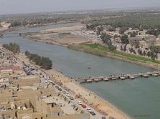
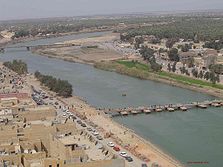
around the 3rd century AD. It is built on both sides of the Euphrates river; there are four bridges in the centre of town for crossing between the two sides. The west bank of the city contains the commercial heart of the city, and includes the old town and the Jewish quarter
Jewish quarter (diaspora)
In the Jewish Diaspora, a Jewish quarter is the area of a city traditionally inhabited by Jews. Jewish quarters, like the Jewish ghettos in Europe, were often the outgrowths of segregated ghettos instituted by the surrounding Christian authorities. A Yiddish term for a Jewish quarter or...
, agd al yahood.
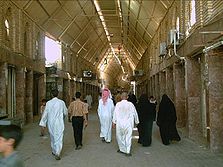
The west bank is the site of the covered market Suq Al Masgoof
Suq Al Masgoof
Suq Al Masgoof is an indoor market place in the centre of the city of Samawah in southern Iraq. Dating back to the Ottoman period, the area surrounding the Suq Al Masgoof is the old Byzantine city of other crowded markets and streets....
, which dates to the Ottoman period. The area surrounding the market is the old city with its Byzantine maze of crowded markets and streets.
The most famous attraction of Samawah is the ruins of the ancient Sumer
Sumer
Sumer was a civilization and historical region in southern Mesopotamia, modern Iraq during the Chalcolithic and Early Bronze Age....
ian city of Uruk
Uruk
Uruk was an ancient city of Sumer and later Babylonia, situated east of the present bed of the Euphrates river, on the ancient dry former channel of the Euphrates River, some 30 km east of modern As-Samawah, Al-Muthannā, Iraq.Uruk gave its name to the Uruk...
which dates to 4000 BC
5th millennium BC
The 5th millennium BC saw the spread of agriculture from the Near East throughout southern and central Europe.Urban cultures in Mesopotamia and Anatolia flourished, developing the wheel. Copper ornaments became more common, marking the Chalcolithic. Animal husbandry spread throughout Eurasia,...
. This was the largest city in Sumer, extending over 2 km². Uruk was not only the largest conurbation of the first urban civilisation on earth, but it is also the place where the first written script was discovered, the oldest dating back to 3300 BC
4th millennium BC
The 4th millennium BC saw major changes in human culture. It marked the beginning of the Bronze Age and of writing.The city states of Sumer and the kingdom of Egypt were established and grew to prominence. Agriculture spread widely across Eurasia...
.
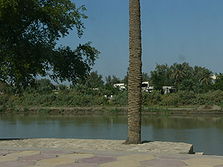
Euphrates
The Euphrates is the longest and one of the most historically important rivers of Western Asia. Together with the Tigris, it is one of the two defining rivers of Mesopotamia...
and is surrounded by hundreds of palm groves that give it a tropical feel, especially in the southern and northern suburbs. These groves provide cool respite from the scorching heat of Mesopotamia and were the inspiration for the famous Iraqi folk song "The Palm of Samawah".
Samawah has a large salt lake
Salt lake
A salt lake or saline lake is a landlocked body of water which has a concentration of salts and other dissolved minerals significantly higher than most lakes . In some cases, salt lakes have a higher concentration of salt than sea water, but such lakes would also be termed hypersaline lakes...
called Lake Sawa, which once had a tourist village that has since fallen into disrepair. The lake is located 25 km (15 mi) to the north of the city centre and is accessible by road. The lake has no obvious source, neither river nor ancient link to a sea. The water is extremely salty due to heavy evaporation in the searing heat of Mesopotamia and supports no marine life. A unique feature of the lake is that the water is above ground level surrounded by natural levee
Levee
A levee, levée, dike , embankment, floodbank or stopbank is an elongated naturally occurring ridge or artificially constructed fill or wall, which regulates water levels...
s. Due to the high levels of salt in the lake, the levees heal themselves if a break is made in the levee, stopping the water from flowing down to ground level. The salt levels also improve buoyancy, and many migratory birds walk on the lake, recalling the biblical tale of Jesus
Jesus
Jesus of Nazareth , commonly referred to as Jesus Christ or simply as Jesus or Christ, is the central figure of Christianity...
.
Dujail Massacre
The Dujail Massacre refers to the events following an assassination attempt against then Iraqi president, Saddam Hussein, on July 8, 1982, in the town of Dujail...
before their execution as well as Kurd
Kürd
Kürd or Kyurd or Kyurt may refer to:*Kürd Eldarbəyli, Azerbaijan*Kürd Mahrızlı, Azerbaijan*Kürd, Goychay, Azerbaijan*Kürd, Jalilabad, Azerbaijan*Kürd, Qabala, Azerbaijan*Qurdbayram, Azerbaijan...
ish prisoners since the first Kurdish revolts of the 1950s.
During 1964, the people of Samawah gained popular fame for rescuing over 1,000 political prisoners of the Iraqi Communist Party who were sent in a "Train of Death" (qutar al maut) in metal cargo rolling stock from Baghdad to Samawah en route to the Nigret Al Salman prison in 50°C (122°F) heat. The train was attacked by the city's people at the railway station, and the dehydrated prisoners were watered and fed. Over 100 of the prisoners had already perished.


Saddam Hussein
Saddam Hussein Abd al-Majid al-Tikriti was the fifth President of Iraq, serving in this capacity from 16 July 1979 until 9 April 2003...
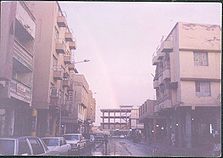
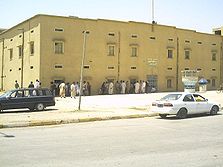
's rule (1979–2003). The wall paintings put up since 2003 depict the new life achieved since the liberation.
Religion
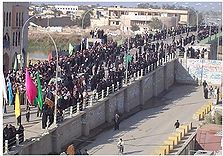
Shi'a Islam
Shia Islam is the second largest denomination of Islam. The followers of Shia Islam are called Shi'ites or Shias. "Shia" is the short form of the historic phrase Shīʻatu ʻAlī , meaning "followers of Ali", "faction of Ali", or "party of Ali".Like other schools of thought in Islam, Shia Islam is...
, the town was cut off almost entirely by Saddam after the Gulf War
Gulf War
The Persian Gulf War , commonly referred to as simply the Gulf War, was a war waged by a U.N.-authorized coalition force from 34 nations led by the United States, against Iraq in response to Iraq's invasion and annexation of Kuwait.The war is also known under other names, such as the First Gulf...
. Historically, however, Samawah has been a mixed Jewish and Shia city. The terrorisation of the Jewish minority by Arab nationalists in the 1940s and '50s drove most of them into exile. The Torat Synagogue, which has been abandoned since the flight of the Jews, still exists in the qushla quarter of the east bank of Samawah.
In 1979-81 an ethnic cleansing
Ethnic cleansing
Ethnic cleansing is a purposeful policy designed by one ethnic or religious group to remove by violent and terror-inspiring means the civilian population of another ethnic orreligious group from certain geographic areas....
campaign saw Shia Iraqis deemed to be of Persian
Persian people
The Persian people are part of the Iranian peoples who speak the modern Persian language and closely akin Iranian dialects and languages. The origin of the ethnic Iranian/Persian peoples are traced to the Ancient Iranian peoples, who were part of the ancient Indo-Iranians and themselves part of...
origin deported by the Baathist regime of Saddam Hussein
Saddam Hussein
Saddam Hussein Abd al-Majid al-Tikriti was the fifth President of Iraq, serving in this capacity from 16 July 1979 until 9 April 2003...
.
Today, there is still a small population of Assyrian Christians
Assyrian people
The Assyrian people are a distinct ethnic group whose origins lie in ancient Mesopotamia...
in the city.
Industries
The unemployment rate is high, though agriculture and mining are active. The city, in spite of the lack of high-value natural resources such as oil and gas and a lack of central government investment, has managed to maintain lively small-scale industrial, agricultural and alternative sectors.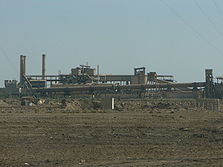
Cement
In the most general sense of the word, a cement is a binder, a substance that sets and hardens independently, and can bind other materials together. The word "cement" traces to the Romans, who used the term opus caementicium to describe masonry resembling modern concrete that was made from crushed...
factories in the Middle East during the 1970s, with a total production capacity of 2.85 million tonnes a year. These have since fallen into disrepair, exacerbating the unemployment situation, although the southern cement factory, the oldest, reopened in 2005. As of 2007, the four existing plants are producing a total of just 0.8 million tonnes a year due to the shortage of electricity. Five new cement factories with a capacity of 9 million tonnes a year are under construction on the outskirts of Samawah and will provide employment for several thousand skilled and unskilled workers as well as filling 45% of Iraq's total cement needs.
A small oil refinery
Oil refinery
An oil refinery or petroleum refinery is an industrial process plant where crude oil is processed and refined into more useful petroleum products, such as gasoline, diesel fuel, asphalt base, heating oil, kerosene, and liquefied petroleum gas...
was reopened in Samawah in 2005 after being idle for 15 years. The existing 10,000 bbl/d facility's capacity was doubled to 20000 oilbbl/d in 2006 and was to have increased to 30000 oilbbl/d by 2007. The facility is linked by pipeline to the new Kifl oil field in Samawah province that has an initial capacity of 40000 oilbbl/d. The major advantage of the refinery is that it is designed for processing heavy crude oil, allowing the light crude to be exported.
Saudi Arabia
The Kingdom of Saudi Arabia , commonly known in British English as Saudi Arabia and in Arabic as as-Sa‘ūdiyyah , is the largest state in Western Asia by land area, constituting the bulk of the Arabian Peninsula, and the second-largest in the Arab World...
ran through Samawah, and it has been a main trading thoroughfare for Iraqi produce to Saudi Arabia.
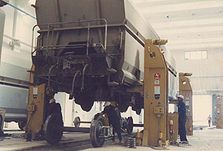
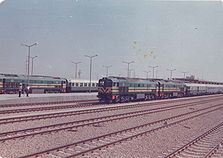
Samawah is home to a rail yard for overhauling and maintaining the rolling stock and locomotives along the Baghdad-Basra rail routes. Samawah railway station is conveniently located halfway between Baghdad and Basra. Overhaul facilities for the railways are an important source of employment opportunities in this Mesopotamian city.
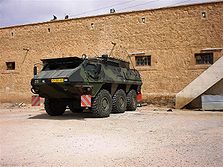
There was an overhaul facility for the Iraqi Armoured corps based in Samawah belonging to the military Industrial Commission.
In terms of agriculture, the staple Mesopotamian produce is grown in Samawah, such as dates, wheat, barley, citrus fruits, and tomatoes. In addition, Samawah is home to the small and rare trade in wild truffles, which grow in the desert regions of Muthanna province.
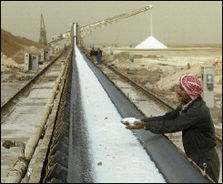
The Bahr al Milh, or Salt Sea, located 20 km (12 mi) to the southwest of Samawah, is the main source of industrial salts in Iraq, and large salt mining and processing facilities are located there to exploit this resource.
Brick
A brick is a block of ceramic material used in masonry construction, usually laid using various kinds of mortar. It has been regarded as one of the longest lasting and strongest building materials used throughout history.-History:...
manufacture exists on the outskirts of Samawah using primarily female labourers for forming and drying bricks. Large temporary kiln
Kiln
A kiln is a thermally insulated chamber, or oven, in which a controlled temperature regime is produced. Uses include the hardening, burning or drying of materials...
s with chimney stacks as high as 30 m (98 ft) are constructed by villagers in the surrounding region to make baked bricks with the same methods used during the Sumerian and Akkadian periods.
Samawah has its own media industry, with the recently reopened Muthanna TV broadcasting terrestrial transmission to Samawah and the province. It focuses primarily on local news and issues. The station gained notoriety as the "Robin Hood of Television" when it broadcast the 2006 World Cup games without licence using a single subscription to a pay-per-view satellite channel. The central government were unable to enforce a ruling against the TV station to stop the transmissions.
There is a small cottage industry of carpet
Carpet
A carpet is a textile floor covering consisting of an upper layer of "pile" attached to a backing. The pile is generally either made from wool or a manmade fibre such as polypropylene,nylon or polyester and usually consists of twisted tufts which are often heat-treated to maintain their...
makers in the city, primarily employing women. The advantages for the local carpet makers are the availability of cheap raw materials, wool from the desert Bedu who use Samawah as their main trading post, and the availability of cheap labour in this poor city.
Reaching Samawah
Samawah is also accessible via the Euphrates River.
Samawah Artists and Personalities
A number of prominent artists originate from Samawah, including poets, painters and sculptors. An indepth overview of both historical and current artists can be found in samawah artists.Due to the preponderance of both communists as well as Shia thinkers among the personalities and artists of Samawah, most of them ended up either being killed by the Baathists regime or lived in exile for much of their lives.
Security since 2003 invasion

2003 invasion of Iraq
The 2003 invasion of Iraq , was the start of the conflict known as the Iraq War, or Operation Iraqi Freedom, in which a combined force of troops from the United States, the United Kingdom, Australia and Poland invaded Iraq and toppled the regime of Saddam Hussein in 21 days of major combat operations...
, the town has had the least amount of problems with Coalition forces, with insurgent activity practically non-existent.
Elements of the U.S. 82nd Airborne Division
U.S. 82nd Airborne Division
The 82nd Airborne Division is an active airborne infantry division of the United States Army specializing in parachute landing operations. Based at Fort Bragg, North Carolina, the 82nd Airborne Division is the primary fighting arm of the XVIII Airborne Corps....
and 1-41 Infantry, 1st Armored Division, took the town in a fierce running battle with emplaced Fedayeen
Fedayeen
Fedayeen is a term used to describe several distinct militant groups and individuals in West Asia at different times in history. It is sometimes used colloquially to refer to suicide squads, especially those who are not bombers.-Overview:...
forces in the days after the initial invasion. After the initial combat phase ended in May 2003, the 82nd was relieved by U.S. Marines from RCT-5, 1st Marine Division. Control of the city was handed over to Dutch forces
Royal Netherlands Army
The Royal Netherlands Army is the land forces element of the military of the Netherlands.-Short history:The Royal Netherlands Army was raised on 9 January 1814, but its origins date back to 1572, when the so-called Staatse Leger was raised...
in August 2003.
Japan Self-Defense Forces
Deployment of Japanese troops to Iraq
The Japanese Iraq Reconstruction and Support Group or also known as the refers to a battalion-sized, largely humanitarian contingent of the Japan Self-Defense Forces that was sent to Samawah, Southern Iraq in early January 2004 and withdrawn by late July 2006....
, stationed in Samawah since January 2004, left in 2006. British and Australian troops departed, making Samawah's entire province the first to be responsible for its own security, dubbed in Iraqi parlance the first "green province", meaning that it is fully independent.
On December 24, 2006, political violence between Shiite militias hit Samawah, killing 9 people, among them 4 policemen. Reportedly, local members of the Mahdi Army
Mahdi Army
The Mahdi Army, also known as the Mahdi Militia or Jaish al-Mahdi , was an Iraqi paramilitary force created by the Iraqi Shia cleric Muqtada al-Sadr in June 2003....
tried to seize the city in a failed attempt and clashed with the police, who were aided by the Badr Organization
Badr Organization
The Badr Organization previously known as the Badr Brigades or Badr Corps is an Iraqi political party headed by Hadi al-Amiri...
. Internal fighting and division among the local tribes was reported. Associates of Mahdi leader Muqtada al-Sadr
Muqtada al-Sadr
Sayyid Muqtadā al-Ṣadr is an Iraqi Islamic political leader.Along with Ali al-Sistani and Ammar al-Hakim of the Islamic Supreme Council of Iraq, Sadr is one of the most influential religious and political figures in the country not holding any official title in the Iraqi government.-Titles:He is...
said he was distancing himself from the Samawah militia, led by "a renegade cleric".
See also
- List of places in Iraq
- Japanese Iraq Reconstruction and Support Group