

Salp

Encyclopedia
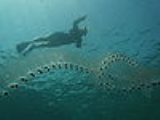
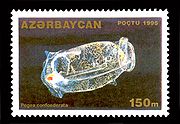
A salp or salpa (plural salpae or salpas) is a barrel-shaped, planktonic tunicate
. It moves by contracting, thus pumping water through its gelatinous body. The salp strains the pumped water through its internal feeding filters, feeding on phytoplankton
.
ial, temperate, and cold seas, where they can be seen at the surface, singly or in long, stringy colonies
. The most abundant concentrations of salps are in the Southern Ocean
(near Antarctica). Here they sometimes form enormous swarms, often in deep water, and are sometimes even more abundant than krill
. Over the last century, while krill populations in the Southern Ocean have declined, salp populations appear to be increasing.
Both portions of the life cycle exist together in the seas—they look quite different, but both are mostly-transparent, tubular, gelatinous animals that are typically between 1 and 10 cm (0.393700787401575 and 3.9 ) tall. The solitary life history phase, also known as an oozoid, is a single barrel-shaped animal that reproduces asexually
by producing a chain of tens to hundreds of individuals, which are released from the parent at a small size. The chain of salps is the aggregate portion of the life cycle. The aggregate individuals are also known as blastozooids; they remain attached together while swimming and feeding, and each individual grows in size. Each blastozooid in the chain reproduces sexually (the blastozooids are sequential hermaphrodites, first maturing as females, and are fertilized by male gametes produced by older chains), with a growing embryo oozoid attached to the body wall of the parent. The growing oozoids are eventually released from the parent blastozooids, then they continue to feed and grow as the solitary asexual phase, thus closing the life cycle of salps.
The alternation of generations allows for a fast generation time, with both solitary individuals and aggregate chains living and feeding together in the sea. When phytoplankton is abundant, this rapid reproduction leads to fairly short-lived blooms of salps, which eventually filter out most of the phytoplankton. The bloom ends when there is no longer enough food to sustain the enormous population of salps.
 One reason for the success of salps is how they respond to phytoplankton
bloom
s. When there is plenty of food, salps can quickly bud off clones
, which graze the phytoplankton and can grow at a rate which is probably faster than any other multicellular animal, quickly stripping the phytoplankton from the sea. But if the phytoplankton is too dense, the salps can clog and sink to the bottom. During these blooms, beaches can become slimy with mats of salp bodies, and other plankton
ic species can experience fluctuations in their numbers due to competition with the salps.
Sinking fecal
pellets and bodies of salps carry carbon
to the sea floor, and salps are abundant enough to have an effect on the ocean's biological pump
. Consequently, large changes in their abundance or distribution may alter the ocean's carbon cycle
, and potentially play a role in climate change
.
and pyrosoma
, as well as to other bottom-living (benthic) tunicates.
Although salps appear similar to jellyfish
because of the simple body form and planktonic behavior, they are structurally most closely related to vertebrate
s, animals with true backbone
s.
Salps appear to have a form preliminary to vertebrates, and are used as a starting point in models of how vertebrates evolved. Scientists speculate that the tiny groups of nerves in salps are one of the first instances of a primitive nervous system
, which eventually evolved into the more complex central nervous system
s of vertebrates.
and species
in the order Salpida:
Tunicate
Tunicates, also known as urochordates, are members of the subphylum Tunicata, previously known as Urochordata, a group of underwater saclike filter feeders with incurrent and excurrent siphons that is classified within the phylum Chordata. While most tunicates live on the ocean floor, others such...
. It moves by contracting, thus pumping water through its gelatinous body. The salp strains the pumped water through its internal feeding filters, feeding on phytoplankton
Phytoplankton
Phytoplankton are the autotrophic component of the plankton community. The name comes from the Greek words φυτόν , meaning "plant", and πλαγκτός , meaning "wanderer" or "drifter". Most phytoplankton are too small to be individually seen with the unaided eye...
.
Distribution
Salps are common in equatorEquator
An equator is the intersection of a sphere's surface with the plane perpendicular to the sphere's axis of rotation and containing the sphere's center of mass....
ial, temperate, and cold seas, where they can be seen at the surface, singly or in long, stringy colonies
Colony (biology)
In biology, a colony reference to several individual organisms of the same species living closely together, usually for mutual benefit, such as stronger defense or the ability to attack bigger prey. Some insects live only in colonies...
. The most abundant concentrations of salps are in the Southern Ocean
Southern Ocean
The Southern Ocean comprises the southernmost waters of the World Ocean, generally taken to be south of 60°S latitude and encircling Antarctica. It is usually regarded as the fourth-largest of the five principal oceanic divisions...
(near Antarctica). Here they sometimes form enormous swarms, often in deep water, and are sometimes even more abundant than krill
Krill
Krill is the common name given to the order Euphausiacea of shrimp-like marine crustaceans. Also known as euphausiids, these small invertebrates are found in all oceans of the world...
. Over the last century, while krill populations in the Southern Ocean have declined, salp populations appear to be increasing.
Life history
Salps have a complex life cycle, with an obligatory alternation of generations.Both portions of the life cycle exist together in the seas—they look quite different, but both are mostly-transparent, tubular, gelatinous animals that are typically between 1 and 10 cm (0.393700787401575 and 3.9 ) tall. The solitary life history phase, also known as an oozoid, is a single barrel-shaped animal that reproduces asexually
Asexual reproduction
Asexual reproduction is a mode of reproduction by which offspring arise from a single parent, and inherit the genes of that parent only, it is reproduction which does not involve meiosis, ploidy reduction, or fertilization. A more stringent definition is agamogenesis which is reproduction without...
by producing a chain of tens to hundreds of individuals, which are released from the parent at a small size. The chain of salps is the aggregate portion of the life cycle. The aggregate individuals are also known as blastozooids; they remain attached together while swimming and feeding, and each individual grows in size. Each blastozooid in the chain reproduces sexually (the blastozooids are sequential hermaphrodites, first maturing as females, and are fertilized by male gametes produced by older chains), with a growing embryo oozoid attached to the body wall of the parent. The growing oozoids are eventually released from the parent blastozooids, then they continue to feed and grow as the solitary asexual phase, thus closing the life cycle of salps.
The alternation of generations allows for a fast generation time, with both solitary individuals and aggregate chains living and feeding together in the sea. When phytoplankton is abundant, this rapid reproduction leads to fairly short-lived blooms of salps, which eventually filter out most of the phytoplankton. The bloom ends when there is no longer enough food to sustain the enormous population of salps.
Oceanographic importance
Phytoplankton
Phytoplankton are the autotrophic component of the plankton community. The name comes from the Greek words φυτόν , meaning "plant", and πλαγκτός , meaning "wanderer" or "drifter". Most phytoplankton are too small to be individually seen with the unaided eye...
bloom
Algal bloom
An algal bloom is a rapid increase or accumulation in the population of algae in an aquatic system. Algal blooms may occur in freshwater as well as marine environments. Typically, only one or a small number of phytoplankton species are involved, and some blooms may be recognized by discoloration...
s. When there is plenty of food, salps can quickly bud off clones
Cloning
Cloning in biology is the process of producing similar populations of genetically identical individuals that occurs in nature when organisms such as bacteria, insects or plants reproduce asexually. Cloning in biotechnology refers to processes used to create copies of DNA fragments , cells , or...
, which graze the phytoplankton and can grow at a rate which is probably faster than any other multicellular animal, quickly stripping the phytoplankton from the sea. But if the phytoplankton is too dense, the salps can clog and sink to the bottom. During these blooms, beaches can become slimy with mats of salp bodies, and other plankton
Plankton
Plankton are any drifting organisms that inhabit the pelagic zone of oceans, seas, or bodies of fresh water. That is, plankton are defined by their ecological niche rather than phylogenetic or taxonomic classification...
ic species can experience fluctuations in their numbers due to competition with the salps.
Sinking fecal
Feces
Feces, faeces, or fæces is a waste product from an animal's digestive tract expelled through the anus or cloaca during defecation.-Etymology:...
pellets and bodies of salps carry carbon
Carbon
Carbon is the chemical element with symbol C and atomic number 6. As a member of group 14 on the periodic table, it is nonmetallic and tetravalent—making four electrons available to form covalent chemical bonds...
to the sea floor, and salps are abundant enough to have an effect on the ocean's biological pump
Biological pump
In oceanic biogeochemistry, the biological pump is the sum of a suite of biologically-mediated processes that transport carbon from the surface euphotic zone to the ocean's interior.-Overview:...
. Consequently, large changes in their abundance or distribution may alter the ocean's carbon cycle
Carbon cycle
The carbon cycle is the biogeochemical cycle by which carbon is exchanged among the biosphere, pedosphere, geosphere, hydrosphere, and atmosphere of the Earth...
, and potentially play a role in climate change
Climate change
Climate change is a significant and lasting change in the statistical distribution of weather patterns over periods ranging from decades to millions of years. It may be a change in average weather conditions or the distribution of events around that average...
.
Nervous systems and relationships to other animals
Salps are related to the pelagic tunicate groups doliolidaDoliolida
Doliolida are small marine animals of the Tunicata phylum, related to salps and pyrosomas. The Doliolid body is small, typically 1–2 cm long, and barrel-shaped; it features two wide siphons, one at the front and the other at the back end, and eight or nine circular muscle strands reminiscent...
and pyrosoma
Pyrosoma
Pyrosomes, genus Pyrosoma, are free-floating colonial tunicates that live usually in the upper layers of the open ocean in warm seas, although some may be found at greater depths. Pyrosomes are cylindrical or conical shaped colonies made up of hundreds to thousands of individuals, known as zooids...
, as well as to other bottom-living (benthic) tunicates.
Although salps appear similar to jellyfish
Jellyfish
Jellyfish are free-swimming members of the phylum Cnidaria. Medusa is another word for jellyfish, and refers to any free-swimming jellyfish stages in the phylum Cnidaria...
because of the simple body form and planktonic behavior, they are structurally most closely related to vertebrate
Vertebrate
Vertebrates are animals that are members of the subphylum Vertebrata . Vertebrates are the largest group of chordates, with currently about 58,000 species described. Vertebrates include the jawless fishes, bony fishes, sharks and rays, amphibians, reptiles, mammals, and birds...
s, animals with true backbone
Vertebral column
In human anatomy, the vertebral column is a column usually consisting of 24 articulating vertebrae, and 9 fused vertebrae in the sacrum and the coccyx. It is situated in the dorsal aspect of the torso, separated by intervertebral discs...
s.
Salps appear to have a form preliminary to vertebrates, and are used as a starting point in models of how vertebrates evolved. Scientists speculate that the tiny groups of nerves in salps are one of the first instances of a primitive nervous system
Nervous system
The nervous system is an organ system containing a network of specialized cells called neurons that coordinate the actions of an animal and transmit signals between different parts of its body. In most animals the nervous system consists of two parts, central and peripheral. The central nervous...
, which eventually evolved into the more complex central nervous system
Central nervous system
The central nervous system is the part of the nervous system that integrates the information that it receives from, and coordinates the activity of, all parts of the bodies of bilaterian animals—that is, all multicellular animals except sponges and radially symmetric animals such as jellyfish...
s of vertebrates.
Classification
The World Register of Marine Species lists the following generaGenus
In biology, a genus is a low-level taxonomic rank used in the biological classification of living and fossil organisms, which is an example of definition by genus and differentia...
and species
Species
In biology, a species is one of the basic units of biological classification and a taxonomic rank. A species is often defined as a group of organisms capable of interbreeding and producing fertile offspring. While in many cases this definition is adequate, more precise or differing measures are...
in the order Salpida:
- Order Salpida
- Family Salpidae
- Genus Brooksia Metcalf, 1918
- Brooksia berneri van Soest, 1975
- Brooksia rostrata (Traustedt, 1893)
- Genus Cyclosalpa de Blainville, 1827
- Cyclosalpa affinis (Chamisso, 1819)
- Cyclosalpa bakeriCyclosalpa bakeriCyclosalpa bakeri is a salp, a marine tunicate in the class Thaliacea. It is found floating in the open sea in the Indo-Pacific region.-Description:Like other salps, Cyclosalpa bakeri has two different phases...
Ritter, 1905 - Cyclosalpa foxtoni Van Soest, 1974
- Cyclosalpa ihlei van Soest, 1974
- Cyclosalpa pinnata (Forskål, 1775)
- Cyclosalpa polae Sigl, 1912
- Cyclosalpa quadriluminis Berner, 1955
- Cyclosalpa sewelli Metcalf, 1927
- Cyclosalpa strongylenteron Berner, 1955
- Genus Helicosalpa Todaro, 1902
- Helicosalpa komaii (Ihle & Ihle-Landenberg, 1936)
- Helicosalpa virgula (Vogt, 1854)
- Helicosalpa younti Kashkina, 1973
- Genus Ihlea Metcalf, 1919
- Ihlea magalhanica (Apstein, 1894)
- Ihlea punctata (Forskål, 1775)
- Ihlea racovitzai (van Beneden & Selys Longchamp, 1913)
- Genus Metcalfina
- Metcalfina hexagona (Quoy & Gaimard, 1824)
- Genus Pegea Savigny, 1816
- Pegea bicaudata (Quoy & Gaimard, 1826)
- Pegea confederata (ForsskålPeter ForsskålPeter Forsskål, sometimes spelled Pehr Forsskål, Peter Forskaol, Petrus Forskål or Pehr Forsskåhl, was a Swedish explorer, orientalist, naturalist and an apostle of Carl Linnaeus.-Early life:...
, 1775) - Pegea confoederata (Forskål, 1775)
- Genus Brooksia Metcalf, 1918
- Family Salpidae
-
-
- Genus Salpa Forskål, 1775
- Salpa aspera Chamisso, 1819
- Salpa fusiformis Cuvier, 1804
- Salpa gerlachei Foxton, 1961
- Salpa maxima Forskål, 1775
- Salpa thompsoni (Foxton, 1961)
- Salpa tuberculata Metcalf, 1918
- Salpa younti van Soest, 1973
- Genus Soestia
- Soestia cylindrica (Cuvier, 1804)
- Soestia zonaria (Pallas, 1774)
- Genus Thalia
- Thalia cicar van Soest, 1973
- Thalia democratica (Forskål, 1775)
- Thalia longicauda (Quoy & Gaimard, 1824)
- Thalia orientalis Tokioka, 1937
- Thalia rhinoceros van Soest, 1975
- Thalia rhomboides (Quoy & Gaimard, 1824)
- Thalia sibogae van Soest, 1973
- Genus Thetys Tilesius, 1802
- Thetys vagina Tilesius, 1802
- Genus Traustedtia
- Traustedtia multitentaculata (Quoy & Gaimard, 1834)
- Genus Weelia Yount, 1954
- Weelia cylindrica (Cuvier, 1804)
- Genus Salpa Forskål, 1775
-
External links
- Pelagic tunicates (including salps) overview
- Scientific expedition to study salps near Antarctica - many details, with interviews, photos, videos, graphs
- Sludge of slimy organisms coats beaches of New England Boston Globe October 9, 2006
- The salps on earthlife.net
- The role of salps in the study of origin of the vertebrate brain
- Jellyfish-like Creatures May Play Major Role In Fate Of Carbon Dioxide In The Ocean, ScienceDaily.com, July 2, 2006
- "Ocean 'Gummy Bears' Fight Global Warming", LiveScience.com, July 20, 2006
- How salps might help counteract global warming BBC News, September 26, 2007
- Jelly blobs may hold key to climate change ABC Radio, The World Today - Monday, 17 November, 2008
- Salp Fact Sheet