


SPAD S.VII

Encyclopedia
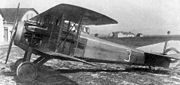
The SPAD S.VII was the first of a series of highly successful biplane
fighter aircraft
produced by Société Pour L'Aviation et ses Dérivés
(SPAD) during the First World War
. Like its successors, the S.VII was renowned as a sturdy and rugged aircraft with good climbing and diving characteristics. It was also a stable gun platform, although pilots used to the more manoeuvrable Nieuport
fighters found it heavy on the controls. It was flown by a number of the famous aces
, such as France's Georges Guynemer
, Italy's Francesco Baracca
and Australia's Alexander Pentland
.
modified his Hispano-Suiza
V8 automobile engine for use on aircraft, resulting in a 330 lb engine capable of producing 140 hp at 1,400 rpm. Further refinement of the engine brought the power to 150 hp by July 1915. Given the engine's excellent reputation, French officials ordered that production be set up as soon as possible and called upon aircraft designers to create a new high-performance fighter around the engine, called the Hispano-Suiza 8A.
Louis Béchereau, chief designer of the SPAD company, quickly produced drawings for a prototype fighter equipped with the new engine. The SPAD V was a smaller version of the SPAD A.2 although as a single seater it dispensed with the so-called "pulpit" which carried the observer in front of the propeller.
SPAD test pilot Bequet flew the SPAD V for the first time in April 1916. Flight testing revealed excellent maximum speed (192 km/h, 119 mph) and climb rate (4.5 min to 2,000 m or 6,500 ft). The airframe's sound construction also enabled remarkable diving performance. In comparison, the Nieuport
sesquiplane fighters that equipped a large part of the fighter units on the front suffered from overly light construction, and a tendency to shed its lower wings in steep dives, mostly from their single spar construction. The combination of high speed and good diving ability promised to give Allied pilots the initiative to engage or leave combat. If the new fighter was a rugged and stable shooting platform, some pilots regretted its lack of maneuverability, especially when compared to lighter types such as the Nieuport 11 or 17.
In the face of such performance, an initial production contract was made on 10 May 1916, calling for 268 machines, to be designated SPAD VII C.1 (C.1, from avion de chasse in French, indicating the aircraft was a single-seat fighter).
Early production aircraft suffered from a number of defects which took some time to solve and limited the delivery rate to units. While a few SPADs arrived to frontline units as early as August 1916, large numbers would only begin to appear in the first months of 1917. Among the problems encountered were problems with the Hispano-Suiza engine. In hot weather, the engine was prone to overheating. In cold weather, the engine would not warm up. Various field modifications were used to counter the problem, including cutting extra holes in the metal sheeting to provide more air flow over the engine. On the production lines, the cowling opening was first enlarged and eventually redesigned with vertical shutters to solve both problems. The engine mount also proved too weak and reinforcements were designed to counter that. Early production aircraft also had two ammunition drums: one for normal rounds and the other for empty ones. This system was prone to jamming and was only solved when Prideaux disintegrating ammo links were introduced.
With the initial teething problems solved, several subcontractors began producing the SPAD VII under license in order to supply frontline units with the fighter. The subcontractors were the firms Grémont, Janoir, Kellner et Fils, de Marçay
, Société d'Etudes Aéronautiques, Régy and Sommer. It was not, however, until February 1917 that the initial batch of 268 aircraft was delivered. In early 1917, an improved version of the engine developing 180 hp, the Hispano-Suiza 8Ab, was made available. This new powerplant provided the SPAD VII with even better performance, the top speed increasing from 192 km/h (119 mph) to 208 km/h (129 mph). The new engine gradually became the standard powerplant for the SPAD VII and by April 1917, all newly produced aircraft were equipped with it.
Very early in the development of the S.VII, the British RFC and RNAS had shown an interest in the new fighter. An initial order for 30 aircraft was made but difficulties in early production were such that the delivery rate was very low, production being barely enough for French units alone. As the RFC was encountering an increasing opposition over the Front, measures were taken to set up production of the S.VII in the United Kingdom. Blériot & SPAD Aircraft Works and Mann, Egerton & Co. Ltd. were supplied with plans and sample aircraft and ordered to initiate production as soon as possible.
The first British-built S.VII was flown and tested in April 1917, and the first aircraft was reported to have performance equal to that of French models. There were however differences between the two types. The British were worried about the light armament of the S.VII: most German fighters were now carrying two guns and various experiments were made to fit an extra machine gun on the S.VII. One aircraft was fitted with an extra Lewis machine gun on the top wing and tested at Martlesham Heath in May 1917, while frontline units also made field modifications with Foster mount
s as used on the S.E.5
. The resulting drop in performance was considered too drastic for the installation to become standard, and most SPAD S.VIIs continued to fly with a single Vickers.
Other distinguishing features of the British-built S.VIIs included a gun fairing and a solid cowling access panel. The gun fairing partially covered the gun and extended rearwards, replacing the windshield. This, however, seriously limited pilot vision to the front and, though it was retained on training aircraft, standing orders were given to have it removed on aircraft destined to frontline units in France. The bulged engine access panel located under the exhaust pipe on British models was made of a solid sheet of metal, in place of the louvered panel fitted on French production models. Some British SPADs were also fitted with small spinners on the prop hub.
It quickly became apparent that the British production lines of the S.VII had lower quality standards than their French counterparts, resulting in aircraft with lower performances and handling. Poor fabric sewing, fragile tailskids and radiators of insufficient effectiveness plagued the British SPADs. Photographic evidence shows that a number of British SPADs had the cylinder banks fairings, or even the entire upper engine cowling, cut out to compensate for the ill-functioning radiators. Most British S.VIIs were used for training purposes, front line units being equipped with French-built models. After some 220 aircraft had been produced, British production of the S.VII was halted in favour of better British types that were becoming available.
In a similar fashion, Russia produced approximately 100 S.VIIs under license in 1917 at the Duks factory in Moscow, with engines supplied by France. It would appear the engines were often used and/or of lower quality, and that the Duks factory used lower-grade material in building the airframes. This combination of extra weight and weaker powerplant resulted in aircraft with significantly lowered performance.
The total number of aircraft produced seems uncertain, sources varying from 3,825 to some 5,600 SPAD S.VIIs built in France, 220 in the United Kingdom and approximately 100 in Russia.
The SPAD XII was an extrapolation of the S.VII, equipped with a 37 mm cannon. However, it required a fair amount of redesign and should be considered as a distinct aircraft rather than just a variant of the S.VII.
In spite of these delays, some aircraft were delivered to frontline units as early as August 1916, to complement to Nieuport fighters. At this date, Allied designs such as the Nieuport 11
/17
and D.H.2 had been able to regain air superiority after the infamous "Fokker scourge
" episode but, by the second half of 1916, new types of more powerful German fighters threatened to give Germany mastery of the skies again. In this context, it was hoped the new SPAD VII would be able to fight the modern German fighters on equal terms. The first aircraft delivered to a frontline unit was S.112 flown by Lt Sauvage of N.65, followed by S.113, assigned to Georges Guynemer
of N.3. Guynemer was already credited with 15 victories at the time, but it was Armand Pinsard
of N.26 who was the first to score an aerial victory on 26 August, flying S.122.
The initial introduction of the SPAD VII was therefore not enough to change the balance of the air war but it allowed both pilots and mechanics to familiarize themselves with the new fighter. Quite a few pilots thought the SPAD lacked maneuverability and some even reverted to the nimble Nieuports they were accustomed to while waiting for the aircraft to become more reliable, but most were quick to realize its combat potential. René Fonck
, France's leading ace of World War I with 75 victories, said of the introduction of the SPAD that "it completely changed the face of aerial warfare". New tactics based primarily on speed were developed to take advantage of the SPAD's power, and to compensate for its relative lack of maneuverability. The aircraft's capacity to dive safely up to 400 km/h (249 mph) was a superb advantage that permitted to leave combat rapidly without fear of pursuit if the situation demanded it.
With early problems solved and production shared between several manufacturers, the SPAD VII finally began appearing in large numbers at the front in early 1917. By mid 1917, some 500 SPADs were in front-line service, having almost completely replaced the Nieuport. The aircraft was a solid performer in combat and could cope with most of its opponents. It also acquired a reputation of being capable of absorbing far more damage than its flimsier predecessors. Its principal shortcoming was its one machine-gun armament at a time when most opposition fighters were equipped with two.
The SPAD VII was gradually replaced by the improved SPAD XIII in frontline units but remained an important asset of the Aviation Militaire throughout the war, being latterly used as a trainer aircraft. It was also used as the standard pilot certificate test aircraft until 1928.
Squadrons) used it on the Western Front. In addition, fighter schools in the United-Kingdom and 30 Squadron
in Mesopotamia also received SPADs. British-built SPADs were generally used in the training units and in the Middle East, while fighting units in France used superior French-built models. The SPAD VII was replaced by the Sopwith Dolphin in 19 Squadron in January 1918 – but No. 23 Squadron kept theirs until they also received Dolphins in April (incidentally becoming perhaps the last squadron to use S.VIIs in France).
Russia received a batch of 43 aircraft in spring 1917 which were successfully used and supplemented by approximately 100 SPAD VII manufactured by the Duks factory under license.
Ironically another early user of the SPAD VII was Germany. Several SPAD VIIs were captured intact by German and Austro-Hungarian forces and were reportedly used both in combat and for training. Rudolph Windisch of Jasta 66 flew a SPAD VII in combat with German markings. That any aerial victories were obtained by German pilots flying SPADs remains unknown.
Belgium equipped the 5e Escadrille (later renamed 10e Escadrille) with the S.VII. Edmond Thieffry
was probably the most famous Belgian pilot to fly the type, most other aces preferring the Hanriot HD.1
.
Italy began using the SPAD VII in March 1917, nine Squadriglia being equipped with it. As was the case in other air services, pilots accustomed to more maneuverable mounts had a difficult time adapting to the new fighter, and again some reverted to the Nieuport 24/27 or the Hanriot HD.1, which eventually became the standard Italian Fighter. Francesco Baracca
, Italy's leading ace, was delighted with the new model and his personal aircraft is still preserved today in Italy.
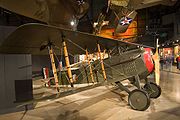 When America entered the war in 1917, an order for 189 SPAD VIIs was placed for the United States Army Air Service
of the American Expeditionary Force
. The first aircraft were delivered in December 1917. Most were used as advanced trainers to prepare the American pilots for the SPAD XIII.
After the war, surplus SPAD VIIs were used into the late 1920s by numerous countries, including Brazil, Czechoslovakia, Finland, Greece, Japan, the Netherlands, Peru, Poland, Portugal, Romania, Siam, the United States and Yugoslavia.
 : (Two aircraft)
: (15 aircraft)
: (One aircraft)
: (70–80 aircraft)
 Greece
 Italy: (214 aircraft)
: (One aircraft)
: (Two aircraft)
: (Post-war)
 Kingdom of Romania
 Russian Empire: (43 aircraft)
(Thailand)
 Ukraine
(two aircraft)
: (185 aircraft)
 Kingdom of Yugoslavia
Biplane
A biplane is a fixed-wing aircraft with two superimposed main wings. The Wright brothers' Wright Flyer used a biplane design, as did most aircraft in the early years of aviation. While a biplane wing structure has a structural advantage, it produces more drag than a similar monoplane wing...
fighter aircraft
Fighter aircraft
A fighter aircraft is a military aircraft designed primarily for air-to-air combat with other aircraft, as opposed to a bomber, which is designed primarily to attack ground targets...
produced by Société Pour L'Aviation et ses Dérivés
Société Pour L'Aviation et ses Dérivés
SPAD was a French aircraft manufacturer between 1911 and 1921. Its SPAD S.XIII biplane was the most popular French fighter airplane in World War I.-Deperdussin:...
(SPAD) during the First World War
World War I
World War I , which was predominantly called the World War or the Great War from its occurrence until 1939, and the First World War or World War I thereafter, was a major war centred in Europe that began on 28 July 1914 and lasted until 11 November 1918...
. Like its successors, the S.VII was renowned as a sturdy and rugged aircraft with good climbing and diving characteristics. It was also a stable gun platform, although pilots used to the more manoeuvrable Nieuport
Nieuport 17
|-Specifications :-See also:-Bibliography:* Bruce, Jack. "Those Classic Nieuports". Air Enthusiast Quarterly. Number Two, 1976. Bromley, UK:Pilot Press. pp. 137–153....
fighters found it heavy on the controls. It was flown by a number of the famous aces
Flying ace
A flying ace or fighter ace is a military aviator credited with shooting down several enemy aircraft during aerial combat. The actual number of aerial victories required to officially qualify as an "ace" has varied, but is usually considered to be five or more...
, such as France's Georges Guynemer
Georges Guynemer
Georges Guynemer was a top fighter ace for France during World War I, and a French national hero at the time of his death.-Early life and military career:...
, Italy's Francesco Baracca
Francesco Baracca
Count Francesco Baracca was Italy's top fighter ace of World War I. He was credited with 34 aerial victories.-Before World War I:...
and Australia's Alexander Pentland
Alexander Pentland
Alexander Augustus Norman Dudley Pentland MC, DFC, AFC , known as "Jerry" Pentland, was an Australian fighter ace in World War I. Born in Maitland, New South Wales, he commenced service as a Lighthorseman with the Australian Imperial Force in 1915, and saw action at Gallipoli...
.
Origins
Performance in early aircraft designs was largely dependent on engines. In February 1915, Swiss designer Marc BirkigtMarc Birkigt
Marc Birkigt was a Swiss engineer who moved to Barcelona, Spain when he was hired as an engineer by Emilio de la Cuadra, founder of Hispano-Suiza automobiles. He created the Dewoitine company along with Émile Dewoitine. Birkigt was nominated for the Car Engineer of the Century prize for the...
modified his Hispano-Suiza
Hispano-Suiza
Hispano-Suiza was a Spanish automotive and engineering firm, best known for its luxury cars and aviation engines in the pre-World War II period of the twentieth century. In 1923, its French subsidiary became a semi-autonomous partnership with the parent company and is now part of the French SAFRAN...
V8 automobile engine for use on aircraft, resulting in a 330 lb engine capable of producing 140 hp at 1,400 rpm. Further refinement of the engine brought the power to 150 hp by July 1915. Given the engine's excellent reputation, French officials ordered that production be set up as soon as possible and called upon aircraft designers to create a new high-performance fighter around the engine, called the Hispano-Suiza 8A.
Louis Béchereau, chief designer of the SPAD company, quickly produced drawings for a prototype fighter equipped with the new engine. The SPAD V was a smaller version of the SPAD A.2 although as a single seater it dispensed with the so-called "pulpit" which carried the observer in front of the propeller.
Design
One common design feature between the new SPAD V and the A.2 was the use of a single-bay biplane wing with additional light struts mounted mid bay at the point of junction of the flying and landing wires. This design simplified interstrut arrangement and reduced flying wire vibration, reducing drag. The fuselage was of a standard construction, consisting of a wooden frame covered with fabric, while the forward part was covered with steel sheeting. A .303 Vickers machine gun was installed above the engine, synchronized to fire through the propeller arc. The prototype was also fitted with a large spinner, to be abandoned later.SPAD test pilot Bequet flew the SPAD V for the first time in April 1916. Flight testing revealed excellent maximum speed (192 km/h, 119 mph) and climb rate (4.5 min to 2,000 m or 6,500 ft). The airframe's sound construction also enabled remarkable diving performance. In comparison, the Nieuport
Nieuport
Nieuport, later Nieuport-Delage, was a French aeroplane company that primarily built racing aircraft before World War I and fighter aircraft during World War I and between the wars.-Beginnings:...
sesquiplane fighters that equipped a large part of the fighter units on the front suffered from overly light construction, and a tendency to shed its lower wings in steep dives, mostly from their single spar construction. The combination of high speed and good diving ability promised to give Allied pilots the initiative to engage or leave combat. If the new fighter was a rugged and stable shooting platform, some pilots regretted its lack of maneuverability, especially when compared to lighter types such as the Nieuport 11 or 17.
In the face of such performance, an initial production contract was made on 10 May 1916, calling for 268 machines, to be designated SPAD VII C.1 (C.1, from avion de chasse in French, indicating the aircraft was a single-seat fighter).
Early production aircraft suffered from a number of defects which took some time to solve and limited the delivery rate to units. While a few SPADs arrived to frontline units as early as August 1916, large numbers would only begin to appear in the first months of 1917. Among the problems encountered were problems with the Hispano-Suiza engine. In hot weather, the engine was prone to overheating. In cold weather, the engine would not warm up. Various field modifications were used to counter the problem, including cutting extra holes in the metal sheeting to provide more air flow over the engine. On the production lines, the cowling opening was first enlarged and eventually redesigned with vertical shutters to solve both problems. The engine mount also proved too weak and reinforcements were designed to counter that. Early production aircraft also had two ammunition drums: one for normal rounds and the other for empty ones. This system was prone to jamming and was only solved when Prideaux disintegrating ammo links were introduced.
With the initial teething problems solved, several subcontractors began producing the SPAD VII under license in order to supply frontline units with the fighter. The subcontractors were the firms Grémont, Janoir, Kellner et Fils, de Marçay
De Marcay
The De Marcay was a French automobile manufactured from 1920 until 1922. Similar to the GN, it was a cyclecar powered by a 1000 cc Anzani vee-twin engine and shaft drive, and was the product of a former manufacturer of aircraft....
, Société d'Etudes Aéronautiques, Régy and Sommer. It was not, however, until February 1917 that the initial batch of 268 aircraft was delivered. In early 1917, an improved version of the engine developing 180 hp, the Hispano-Suiza 8Ab, was made available. This new powerplant provided the SPAD VII with even better performance, the top speed increasing from 192 km/h (119 mph) to 208 km/h (129 mph). The new engine gradually became the standard powerplant for the SPAD VII and by April 1917, all newly produced aircraft were equipped with it.
Variants and experiments
Numerous experiments were made with new equipment or engines in the hope of further improving the SPAD VII's performance. A Renault V8 150 hp powerplant was tested but required some major redesign and the resulting performance was not considered worthwhile. A supercharged Hispano-Suiza engine was also tested, and also failed to improve performance by any significant proportion. It also appears different wing profiles were tested; the results of these experiments is not very clear but they were not incorporated in production models. One field modification was applied in Czechoslovakia after the war when the undercarriage struts of one S.VII were faired over in an attempt to reduce drag and increase maximum speed.Very early in the development of the S.VII, the British RFC and RNAS had shown an interest in the new fighter. An initial order for 30 aircraft was made but difficulties in early production were such that the delivery rate was very low, production being barely enough for French units alone. As the RFC was encountering an increasing opposition over the Front, measures were taken to set up production of the S.VII in the United Kingdom. Blériot & SPAD Aircraft Works and Mann, Egerton & Co. Ltd. were supplied with plans and sample aircraft and ordered to initiate production as soon as possible.
The first British-built S.VII was flown and tested in April 1917, and the first aircraft was reported to have performance equal to that of French models. There were however differences between the two types. The British were worried about the light armament of the S.VII: most German fighters were now carrying two guns and various experiments were made to fit an extra machine gun on the S.VII. One aircraft was fitted with an extra Lewis machine gun on the top wing and tested at Martlesham Heath in May 1917, while frontline units also made field modifications with Foster mount
Foster mounting
In early 1916 Sergeant Foster of No. 11 Squadron RFC devised a sliding rail mounting for the upper wing Lewis Gun on a Nieuport 11. It enabled the gun to be pulled down so that its breech was conveniently in front of the pilot, making it much easier to change ammunition drums or to clear stoppages...
s as used on the S.E.5
Royal Aircraft Factory S.E.5
The Royal Aircraft Factory S.E.5 was a British biplane fighter aircraft of the First World War. Although the first examples reached the Western Front before the Sopwith Camel and it had a much better overall performance, problems with its Hispano-Suiza engine, particularly the geared-output H-S...
. The resulting drop in performance was considered too drastic for the installation to become standard, and most SPAD S.VIIs continued to fly with a single Vickers.
Other distinguishing features of the British-built S.VIIs included a gun fairing and a solid cowling access panel. The gun fairing partially covered the gun and extended rearwards, replacing the windshield. This, however, seriously limited pilot vision to the front and, though it was retained on training aircraft, standing orders were given to have it removed on aircraft destined to frontline units in France. The bulged engine access panel located under the exhaust pipe on British models was made of a solid sheet of metal, in place of the louvered panel fitted on French production models. Some British SPADs were also fitted with small spinners on the prop hub.
It quickly became apparent that the British production lines of the S.VII had lower quality standards than their French counterparts, resulting in aircraft with lower performances and handling. Poor fabric sewing, fragile tailskids and radiators of insufficient effectiveness plagued the British SPADs. Photographic evidence shows that a number of British SPADs had the cylinder banks fairings, or even the entire upper engine cowling, cut out to compensate for the ill-functioning radiators. Most British S.VIIs were used for training purposes, front line units being equipped with French-built models. After some 220 aircraft had been produced, British production of the S.VII was halted in favour of better British types that were becoming available.
In a similar fashion, Russia produced approximately 100 S.VIIs under license in 1917 at the Duks factory in Moscow, with engines supplied by France. It would appear the engines were often used and/or of lower quality, and that the Duks factory used lower-grade material in building the airframes. This combination of extra weight and weaker powerplant resulted in aircraft with significantly lowered performance.
The total number of aircraft produced seems uncertain, sources varying from 3,825 to some 5,600 SPAD S.VIIs built in France, 220 in the United Kingdom and approximately 100 in Russia.
The SPAD XII was an extrapolation of the S.VII, equipped with a 37 mm cannon. However, it required a fair amount of redesign and should be considered as a distinct aircraft rather than just a variant of the S.VII.
France
The French Aviation Militaire had been sufficiently impressed by the performance of the SPAD V prototype to order a batch of 268 aircraft on May 10, 1916. However, teething problems soon appeared and it would be several months before the SPAD VII would serve in significant numbers on the front, the last aircraft of the initial batch being delivered in February 1917.In spite of these delays, some aircraft were delivered to frontline units as early as August 1916, to complement to Nieuport fighters. At this date, Allied designs such as the Nieuport 11
Nieuport 11
|-See also:-References:NotesBibliography* Angelucci, Enzio, ed. The Rand McNally Encyclopedia of Military Aircraft. New York: The Military Press, 1983. ISBN 0-517-41021-4....
/17
Nieuport 17
|-Specifications :-See also:-Bibliography:* Bruce, Jack. "Those Classic Nieuports". Air Enthusiast Quarterly. Number Two, 1976. Bromley, UK:Pilot Press. pp. 137–153....
and D.H.2 had been able to regain air superiority after the infamous "Fokker scourge
Fokker Scourge
The Fokker Scourge was a term coined by the British press in the summer of 1915 to describe the then-current ascendancy of the Fokker Eindecker monoplane fighters of the German Fliegertruppen over the poorly-armed Allied reconnaissance types of the period....
" episode but, by the second half of 1916, new types of more powerful German fighters threatened to give Germany mastery of the skies again. In this context, it was hoped the new SPAD VII would be able to fight the modern German fighters on equal terms. The first aircraft delivered to a frontline unit was S.112 flown by Lt Sauvage of N.65, followed by S.113, assigned to Georges Guynemer
Georges Guynemer
Georges Guynemer was a top fighter ace for France during World War I, and a French national hero at the time of his death.-Early life and military career:...
of N.3. Guynemer was already credited with 15 victories at the time, but it was Armand Pinsard
Armand Pinsard
General Armand Pinsard , Chevalier, Officer, Commander, and Grand Officer of the Legion d'Honneur, Croix de Guerre with 19 palms, Medaille Militaire, British Military Cross, Italian Military Medal, Moroccan Medal, was a World War I fighter ace credited with 27 victories...
of N.26 who was the first to score an aerial victory on 26 August, flying S.122.
The initial introduction of the SPAD VII was therefore not enough to change the balance of the air war but it allowed both pilots and mechanics to familiarize themselves with the new fighter. Quite a few pilots thought the SPAD lacked maneuverability and some even reverted to the nimble Nieuports they were accustomed to while waiting for the aircraft to become more reliable, but most were quick to realize its combat potential. René Fonck
René Fonck
René Paul Fonck was a French aviator who ended the First World War as the top Allied fighter ace, and when all succeeding aerial conflicts of the 20th and 21st centuries are also considered, Fonck still holds the title of "all-time Allied Ace of Aces". He received confirmation for 75 victories ...
, France's leading ace of World War I with 75 victories, said of the introduction of the SPAD that "it completely changed the face of aerial warfare". New tactics based primarily on speed were developed to take advantage of the SPAD's power, and to compensate for its relative lack of maneuverability. The aircraft's capacity to dive safely up to 400 km/h (249 mph) was a superb advantage that permitted to leave combat rapidly without fear of pursuit if the situation demanded it.
With early problems solved and production shared between several manufacturers, the SPAD VII finally began appearing in large numbers at the front in early 1917. By mid 1917, some 500 SPADs were in front-line service, having almost completely replaced the Nieuport. The aircraft was a solid performer in combat and could cope with most of its opponents. It also acquired a reputation of being capable of absorbing far more damage than its flimsier predecessors. Its principal shortcoming was its one machine-gun armament at a time when most opposition fighters were equipped with two.
The SPAD VII was gradually replaced by the improved SPAD XIII in frontline units but remained an important asset of the Aviation Militaire throughout the war, being latterly used as a trainer aircraft. It was also used as the standard pilot certificate test aircraft until 1928.
Foreign Service
Allied air services were also equipped with the new fighter. The Royal Flying Corps was the first foreign service to receive the SPAD VII, although in spite of initial enthusiasm for the type only two squadrons (19 and 23No. 23 Squadron RAF
No. 23 Squadron was a squadron of the Royal Air Force. Until October 2009, it operated the Boeing Sentry AEW1 Airborne Warning And Control System aircraft from RAF Waddington, Lincolnshire.-First World War:...
Squadrons) used it on the Western Front. In addition, fighter schools in the United-Kingdom and 30 Squadron
No. 30 Squadron RAF
No. 30 Squadron of the Royal Air Force operates the second generation C-130J Hercules from RAF Brize Norton, Oxfordshire. The squadron operates alongside No. 24 Squadron and No. 47 Squadron all flying the Hercules.-History:...
in Mesopotamia also received SPADs. British-built SPADs were generally used in the training units and in the Middle East, while fighting units in France used superior French-built models. The SPAD VII was replaced by the Sopwith Dolphin in 19 Squadron in January 1918 – but No. 23 Squadron kept theirs until they also received Dolphins in April (incidentally becoming perhaps the last squadron to use S.VIIs in France).
Russia received a batch of 43 aircraft in spring 1917 which were successfully used and supplemented by approximately 100 SPAD VII manufactured by the Duks factory under license.
Ironically another early user of the SPAD VII was Germany. Several SPAD VIIs were captured intact by German and Austro-Hungarian forces and were reportedly used both in combat and for training. Rudolph Windisch of Jasta 66 flew a SPAD VII in combat with German markings. That any aerial victories were obtained by German pilots flying SPADs remains unknown.
Belgium equipped the 5e Escadrille (later renamed 10e Escadrille) with the S.VII. Edmond Thieffry
Edmond Thieffry
Edmond Thieffry was a Belgian First World War air ace and aviation pioneer. He made, with Léopold Roger and Jef de Bruycker, the first successful flight between Belgium and Congo ....
was probably the most famous Belgian pilot to fly the type, most other aces preferring the Hanriot HD.1
Hanriot HD.1
|-References:* Bruce, J.M. The Hanriot HD 1 Leatherhead: Profile Publications* Cheesman E.F. Fighter Aircraft of the 1914-1918 War Letchworth, Harletford Publications, 1960 pp. 82-83- External links :*...
.
Italy began using the SPAD VII in March 1917, nine Squadriglia being equipped with it. As was the case in other air services, pilots accustomed to more maneuverable mounts had a difficult time adapting to the new fighter, and again some reverted to the Nieuport 24/27 or the Hanriot HD.1, which eventually became the standard Italian Fighter. Francesco Baracca
Francesco Baracca
Count Francesco Baracca was Italy's top fighter ace of World War I. He was credited with 34 aerial victories.-Before World War I:...
, Italy's leading ace, was delighted with the new model and his personal aircraft is still preserved today in Italy.
United States Army Air Service
The Air Service, United States Army was a forerunner of the United States Air Force during and after World War I. It was established as an independent but temporary wartime branch of the War Department by two executive orders of President Woodrow Wilson: on May 24, 1918, replacing the Aviation...
of the American Expeditionary Force
American Expeditionary Force
The American Expeditionary Forces or AEF were the United States Armed Forces sent to Europe in World War I. During the United States campaigns in World War I the AEF fought in France alongside British and French allied forces in the last year of the war, against Imperial German forces...
. The first aircraft were delivered in December 1917. Most were used as advanced trainers to prepare the American pilots for the SPAD XIII.
After the war, surplus SPAD VIIs were used into the late 1920s by numerous countries, including Brazil, Czechoslovakia, Finland, Greece, Japan, the Netherlands, Peru, Poland, Portugal, Romania, Siam, the United States and Yugoslavia.
Operators
: (15 aircraft)
: (One aircraft)
: (70–80 aircraft)
- Estonian Air ForceEstonian Air ForceThe Estonian Air Force is the name of the unified aviation forces of Estonia.The Õhuvägi is the main arm of the Estonian aviation forces. The average size of the military formation in peacetime is about 210 men. The Estonian Air Force is tasked with dealing with political, military, economical,...
(Two aircraft)
- Finnish Air ForceFinnish Air ForceThe Finnish Air Force is one of the branches of the Finnish Defence Forces. Its peacetime tasks are airspace surveillance, identification flights, and production of readiness formations for wartime conditions...
(One aircraft)
Greece Italy: (214 aircraft): (One aircraft)
: (Two aircraft)
: (Post-war)
Kingdom of Romania Russian Empire: (43 aircraft)(Thailand)
UkraineUkraine
Ukraine is a country in Eastern Europe. It has an area of 603,628 km², making it the second largest contiguous country on the European continent, after Russia...
(two aircraft)
: (185 aircraft)
- Royal Air ForceRoyal Air ForceThe Royal Air Force is the aerial warfare service branch of the British Armed Forces. Formed on 1 April 1918, it is the oldest independent air force in the world...
- Royal Flying CorpsRoyal Flying CorpsThe Royal Flying Corps was the over-land air arm of the British military during most of the First World War. During the early part of the war, the RFC's responsibilities were centred on support of the British Army, via artillery co-operation and photographic reconnaissance...
- No. 17 Squadron RFC
- No. 19 Squadron RFC
- No. 23 Squadron RFCNo. 23 Squadron RAFNo. 23 Squadron was a squadron of the Royal Air Force. Until October 2009, it operated the Boeing Sentry AEW1 Airborne Warning And Control System aircraft from RAF Waddington, Lincolnshire.-First World War:...
- No. 30 Squadron RFCNo. 30 Squadron RAFNo. 30 Squadron of the Royal Air Force operates the second generation C-130J Hercules from RAF Brize Norton, Oxfordshire. The squadron operates alongside No. 24 Squadron and No. 47 Squadron all flying the Hercules.-History:...
- No. 63 Squadron RFCNo. 63 Squadron RAF-In World War I:No. 63 Squadron was formed on 31 August 1916 at Stirling, Scotland as a squadron of the Royal Flying Corps. The squadron was intended to operate as a day-bomber unit over the Western Front in France, and was therefore equipped with de Havilland DH4 aircraft; however at the last...
- No. 72 Squadron RFCNo. 72 Squadron RAFNo. 72 Squadron Royal Air Force started its service life supporting the army during World War I on operations in Middle East and afterwards was quickly disbanded. In its second incarnation the squadron was a real fighter unit, transitioning from Gloster Gladiator biplanes to Gloster Javelin...
- No. 92 Squadron RFCNo. 92 Squadron RAFNo. 92 Squadron, also known as No 92 Squadron, of the Royal Air Force was formed as part of the Royal Flying Corps at London Colney as a fighter squadron on 1 September 1917. It deployed to France in July 1918 and saw action for just four months, until the end of the war. During the conflict it...
- United States Army Air ServiceUnited States Army Air ServiceThe Air Service, United States Army was a forerunner of the United States Air Force during and after World War I. It was established as an independent but temporary wartime branch of the War Department by two executive orders of President Woodrow Wilson: on May 24, 1918, replacing the Aviation...
(189 aircraft)
Kingdom of YugoslaviaSurvivors
- SPAD VII (s/n 103) (B9913) is on display at the Virginia Aviation MuseumVirginia Aviation MuseumThe Virginia Aviation Museum is an aviation museum in Richmond, Virginia, adjacent to Richmond International Airport . The museum houses a collection of some thirty four airframes, both owned and on-loan, ranging from reproductions of Wright Brothers kite gliders to the still state-of-the-art SR-71...
. It was one of 19 British made SPADS built in 1917 by Mann Egerton & Co. Ltd.. It was fully restored in 1973.
- SPAD VII (s/n AS 94099) is on display at the National Museum of the United States Air ForceNational Museum of the United States Air ForceThe National Museum of the United States Air Force is the official museum of the United States Air Force located at Wright-Patterson Air Force Base northeast of Dayton, Ohio. The NMUSAF is the world's largest and oldest military aviation museum with more than 360 aircraft and missiles on display...
in Dayton, OhioDayton, OhioDayton is the 6th largest city in the U.S. state of Ohio and the county seat of Montgomery County, the fifth most populous county in the state. The population was 141,527 at the 2010 census. The Dayton Metropolitan Statistical Area had a population of 841,502 in the 2010 census...
. It was obtained from the Museum of Science and IndustryMuseum of Science and IndustryMOSI may refer to:* MoSi — molybdenum silicide, an important material in the semiconductor industry* MOSI - Master Out Slave In, a signal on the Serial Peripheral Interface Bus* MOSI protocol, an extension of the basic MSI cache coherency protocol...
in Chicago, Illinois, and restored and flown by the 1st Fighter Wing, Selfridge Air Force Base, MichiganMichiganMichigan is a U.S. state located in the Great Lakes Region of the United States of America. The name Michigan is the French form of the Ojibwa word mishigamaa, meaning "large water" or "large lake"....
from 1962 to 1966.
- SPAD VII (S.254) is on display at the Musee de l'Air near Paris, France, once flown by Georges GuynemerGeorges GuynemerGeorges Guynemer was a top fighter ace for France during World War I, and a French national hero at the time of his death.-Early life and military career:...
in World War I.
- SPAD VII.c.1 (B9916) is on display at the San Diego Air & Space Museum. Built at the Mann, Edgerton and Co. of Norwich, England in 1917, it was one of a batch shipped to the United States for use as a trainer. The aircraft is fully restored in 1990 and is 95% original.
- SPAD VII is on display at the Letecke Muzeum at Kbely, a northeastern suburb of Prague, Czech Republic, flown post-World War I in Czechoslovak Air Force, in the Západočeský aeroklub (West-Bohemian Aero Club).
- SPAD VII is on display at the Italian Air Force MuseumItalian Air Force MuseumThe Italian Air Force Museum is an aircraft museum at Vigna di Valle, on the Lake Bracciano , central Italy. It is operated by the Aeronautica Militare.- Propeller aircraft :* Ansaldo AC.2* Ansaldo SVA 5* Blériot XI* Caproni Ca.3* Caproni Ca.100...
at Vigna di Valle, on the Lake BraccianoLake BraccianoLake Bracciano is a lake of volcanic origin in the Italian region of Lazio, northwest of Rome. It is the second largest lake in the region and one of the major lakes of Italy...
, central Italy, repainted as the one once flown by flying aceFlying aceA flying ace or fighter ace is a military aviator credited with shooting down several enemy aircraft during aerial combat. The actual number of aerial victories required to officially qualify as an "ace" has varied, but is usually considered to be five or more...
Fulco Ruffo di CalabriaFulco Ruffo di CalabriaFulco VIII, Prince Ruffo di Calabria, 6th Duke of Guardia Lombarda was an Italian World War I flying ace, and posthumous father-in-law of King Albert II of the Belgians.-Background:...
in World War I.