

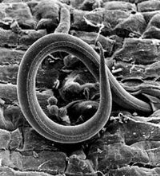
Root-knot nematode

Encyclopedia
Root-knot nematodes are plant-parasitic
nematode
s from the genus Meloidogyne. They exist in soil
in areas with hot climates or short winters. About 2000 plants are susceptible to infection by root-knot nematodes and they cause approximately 5% of global crop
loss. Root-knot nematode larva
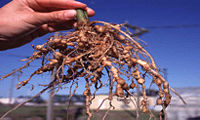
e infect plant root
s, causing the development of root-knot gall
s that drain the plant's photosynthate and nutrients. Infection of young plants may be lethal, while infection of mature plants causes decreased yield.
ous and dicotyledon
ous, herbaceous and woody plants. The genus includes more than 60 species, with some species having several races. Four Meloidogyne species (M. javanica
, M. arenaria
, M. incognita
, and M. hapla) are major pests worldwide, with another seven being important on a local basis. Meloidogyne occurs in 23 of 43 crops listed as having plant-parasitic nematodes of major importance, ranging from field crops, through pasture and grasses, to horticultural, ornamental and vegetable crops. If root-knot nematodes become established in deep-rooted, perennial
crops, control is difficult and options are limited. Meloidogyne spp. were first reported in cassava
by Neal in 1889. Damage on cassava
is variable depending on cultivar planted, and ranges from negligible to seriously damaging . Early-season infection leads to worse damage. In most crops, nematode damage reduces plant health and growth; in cassava, though, nematode damage sometimes leads to increased aerial growth as the plants try to compensate. This possibly enables the plant to maintain a reasonable level of production. Therefore, aerial correlations to nematode density can be positive, negative or not at all. Vegetable
crops grown in warm climates can experience severe losses from root-knot nematodes, and are often routinely treated with a chemical nematicide
. Root-knot nematode damage results in poor growth, a decline in quality and yield of the crop and reduced resistance to other stresses (e.g. drought
, other diseases). A high level of damage can lead to total crop loss. Nematode-damaged roots do not use water and fertilisers as effectively, leading to additional losses for the grower. In cassava, it has been suggested that levels of Meloidogyne spp. that are sufficient to cause injury rarely occur naturally. However, with changing farming systems, in a disease complex or weakened by other factors, nematode damage is likely to be associated with other problems..
nic stage, four juvenile
stages (J1–J4) and an adult stage. Juvenile Meloidogynes parasites hatch from egg
s as vermiform, second-stage juveniles (J2), the first moult
having occurred within the egg. Newly-hatched juveniles have a short free-living stage in the soil, in the rhizosphere
of the host plants. They may reinvade the host plants of their parent or migrate through the soil to find a new host root. J2 larvae do not feed during the free-living stage, but use lipid
s stored in the gut.
An excellent model system for the study of the parasitic behaviour of plant-parasitic nematodes has been developed using Arabidopsis thaliana as a model host. The Arabidopsis roots are initially small and transparent, enabling every detail to be seen. Invasion and migration in the root was studied using M. incognita. Briefly, second stage juveniles invade in the root elongation region and migrate in the root until they became sedentary. Signals from the J2 promote parenchyma
cells near the head of the J2 to become multinucleate to form feeding cells, generally known as giant cells, from which the J2 and later the adults feed. Concomitant with giant cell formation, the surrounding root tissue gives rise to a gall in which the developing juvenile is embedded. Juveniles first feed from the giant cells about 24 hours after becoming sedentary.
After further feeding, the J2s undergo morphological changes and become saccate. Without further feeding, they moult three times and eventually become adults. In females, which are close to spherical, feeding resumes and the reproductive system develops. The life span of an adult female may extend to three months, and many hundreds of eggs can be produced. Females can continue egg laying after harvest of aerial parts of the plant and the survival stage between crops is generally within the egg.
The length of the life cycle is temperature-dependent. The relationship between rate of development and temperature is linear over much of the root-knot nematode life cycle, though it is possible the component stages of the life cycle, e.g. egg development, host root invasion
or growth, have slightly different optima. Species within the Meloidogyne genus also have different temperature optima. In M. javanica
, development occurs between 13 and 34°C, with optimal development at about 29°C.
ous layer and a lipid layer innermost.
, hatching may involve physical and/or enzymatic processes in plant-parasitic nematodes. Cyst nematodes
, such as Globodera rostochiensis, may require a specific signal from the root exudate
s of the host to trigger hatching. Root-knot nematodes are generally unaffected by the presence of a host, but hatch freely at the appropriate temperature when water is available. However, in an egg mass or cyst
, not all eggs will hatch when the conditions are optimal for their particular species, leaving some eggs to hatch at a later date. Ammonium
ion
s have been shown to inhibit hatching and to reduce the plant-penetration ability of M. incognita juveniles that do hatch.
).
Parasitism
Parasitism is a type of symbiotic relationship between organisms of different species where one organism, the parasite, benefits at the expense of the other, the host. Traditionally parasite referred to organisms with lifestages that needed more than one host . These are now called macroparasites...
nematode
Nematode
The nematodes or roundworms are the most diverse phylum of pseudocoelomates, and one of the most diverse of all animals. Nematode species are very difficult to distinguish; over 28,000 have been described, of which over 16,000 are parasitic. It has been estimated that the total number of nematode...
s from the genus Meloidogyne. They exist in soil
Soil
Soil is a natural body consisting of layers of mineral constituents of variable thicknesses, which differ from the parent materials in their morphological, physical, chemical, and mineralogical characteristics...
in areas with hot climates or short winters. About 2000 plants are susceptible to infection by root-knot nematodes and they cause approximately 5% of global crop
Agriculture
Agriculture is the cultivation of animals, plants, fungi and other life forms for food, fiber, and other products used to sustain life. Agriculture was the key implement in the rise of sedentary human civilization, whereby farming of domesticated species created food surpluses that nurtured the...
loss. Root-knot nematode larva
Larva
A larva is a distinct juvenile form many animals undergo before metamorphosis into adults. Animals with indirect development such as insects, amphibians, or cnidarians typically have a larval phase of their life cycle...
e infect plant root
Root
In vascular plants, the root is the organ of a plant that typically lies below the surface of the soil. This is not always the case, however, since a root can also be aerial or aerating . Furthermore, a stem normally occurring below ground is not exceptional either...
s, causing the development of root-knot gall
Gall
Galls or cecidia are outgrowths on the surface of lifeforms caused by invasion by other lifeforms, such as parasites or bacterial infection. Plant galls are abnormal outgrowths of plant tissues and can be caused by various parasites, from fungi and bacteria, to insects and mites...
s that drain the plant's photosynthate and nutrients. Infection of young plants may be lethal, while infection of mature plants causes decreased yield.
Economic impact
Root-knot nematodes (Meloidogyne spp.) are one of the three most economically damaging genera of plant-parasitic nematodes on horticultural and field crops. Root-knot nematodes are distributed worldwide, and are obligate parasites of the roots of thousands of plant species, including monocotyledonMonocotyledon
Monocotyledons, also known as monocots, are one of two major groups of flowering plants that are traditionally recognized, the other being dicotyledons, or dicots. Monocot seedlings typically have one cotyledon , in contrast to the two cotyledons typical of dicots...
ous and dicotyledon
Dicotyledon
The dicotyledons, also known as dicots, are a group of flowering plants whose seed typically has two embryonic leaves or cotyledons. There are around 199,350 species within this group...
ous, herbaceous and woody plants. The genus includes more than 60 species, with some species having several races. Four Meloidogyne species (M. javanica
Meloidogyne javanica
Meloidogyne javanica is a plant pathogenic nematode. It is one of the tropical Root-knot Nematodes and a major agricultural pest in many countries. Meloidogyne javanica reproduces by obligatory mitotic parthenogenesis .- External links :*...
, M. arenaria
Meloidogyne arenaria
Meloidogyne arenaria is a plant pathogenic nematode.- External links :*...
, M. incognita
Meloidogyne incognita
The Meloidogyne incognita is a nematode, a type of roundworm, in the family Heteroderidae. It is an important plant parasite classified in parasitology as a root-knot nematode, as it prefers to attack the root of its host plant....
, and M. hapla) are major pests worldwide, with another seven being important on a local basis. Meloidogyne occurs in 23 of 43 crops listed as having plant-parasitic nematodes of major importance, ranging from field crops, through pasture and grasses, to horticultural, ornamental and vegetable crops. If root-knot nematodes become established in deep-rooted, perennial
Perennial plant
A perennial plant or simply perennial is a plant that lives for more than two years. The term is often used to differentiate a plant from shorter lived annuals and biennials. The term is sometimes misused by commercial gardeners or horticulturalists to describe only herbaceous perennials...
crops, control is difficult and options are limited. Meloidogyne spp. were first reported in cassava
Cassava
Cassava , also called yuca or manioc, a woody shrub of the Euphorbiaceae native to South America, is extensively cultivated as an annual crop in tropical and subtropical regions for its edible starchy tuberous root, a major source of carbohydrates...
by Neal in 1889. Damage on cassava
Cassava
Cassava , also called yuca or manioc, a woody shrub of the Euphorbiaceae native to South America, is extensively cultivated as an annual crop in tropical and subtropical regions for its edible starchy tuberous root, a major source of carbohydrates...
is variable depending on cultivar planted, and ranges from negligible to seriously damaging . Early-season infection leads to worse damage. In most crops, nematode damage reduces plant health and growth; in cassava, though, nematode damage sometimes leads to increased aerial growth as the plants try to compensate. This possibly enables the plant to maintain a reasonable level of production. Therefore, aerial correlations to nematode density can be positive, negative or not at all. Vegetable
Vegetable
The noun vegetable usually means an edible plant or part of a plant other than a sweet fruit or seed. This typically means the leaf, stem, or root of a plant....
crops grown in warm climates can experience severe losses from root-knot nematodes, and are often routinely treated with a chemical nematicide
Nematicide
A nematicide is a type of chemical pesticide used to kill parasitic nematodes.One common nematicide is obtained from neem cake, the residue obtained after cold-pressing the fruit and kernels of the neem tree. Known by several names in the world, the tree was first cultivated in India in ancient...
. Root-knot nematode damage results in poor growth, a decline in quality and yield of the crop and reduced resistance to other stresses (e.g. drought
Drought
A drought is an extended period of months or years when a region notes a deficiency in its water supply. Generally, this occurs when a region receives consistently below average precipitation. It can have a substantial impact on the ecosystem and agriculture of the affected region...
, other diseases). A high level of damage can lead to total crop loss. Nematode-damaged roots do not use water and fertilisers as effectively, leading to additional losses for the grower. In cassava, it has been suggested that levels of Meloidogyne spp. that are sufficient to cause injury rarely occur naturally. However, with changing farming systems, in a disease complex or weakened by other factors, nematode damage is likely to be associated with other problems..
Life cycle
All nematodes pass through an embryoEmbryo
An embryo is a multicellular diploid eukaryote in its earliest stage of development, from the time of first cell division until birth, hatching, or germination...
nic stage, four juvenile
Juvenile (organism)
A juvenile is an individual organism that has not yet reached its adult form, sexual maturity or size. Juveniles sometimes look very different from the adult form, particularly in terms of their colour...
stages (J1–J4) and an adult stage. Juvenile Meloidogynes parasites hatch from egg
Egg (biology)
An egg is an organic vessel in which an embryo first begins to develop. In most birds, reptiles, insects, molluscs, fish, and monotremes, an egg is the zygote, resulting from fertilization of the ovum, which is expelled from the body and permitted to develop outside the body until the developing...
s as vermiform, second-stage juveniles (J2), the first moult
Moult
In biology, moulting or molting , also known as sloughing, shedding, or for some species, ecdysis, is the manner in which an animal routinely casts off a part of its body , either at specific times of year, or at specific points in its life cycle.Moulting can involve the epidermis , pelage...
having occurred within the egg. Newly-hatched juveniles have a short free-living stage in the soil, in the rhizosphere
Rhizosphere (ecology)
The rhizosphere is the narrow region of soil that is directly influenced by root secretions and associated soil microorganisms. Soil which is not part of the rhizosphere is known as bulk soil. The rhizosphere contains many bacteria that feed on sloughed-off plant cells, termed rhizodeposition, and...
of the host plants. They may reinvade the host plants of their parent or migrate through the soil to find a new host root. J2 larvae do not feed during the free-living stage, but use lipid
Lipid
Lipids constitute a broad group of naturally occurring molecules that include fats, waxes, sterols, fat-soluble vitamins , monoglycerides, diglycerides, triglycerides, phospholipids, and others...
s stored in the gut.
An excellent model system for the study of the parasitic behaviour of plant-parasitic nematodes has been developed using Arabidopsis thaliana as a model host. The Arabidopsis roots are initially small and transparent, enabling every detail to be seen. Invasion and migration in the root was studied using M. incognita. Briefly, second stage juveniles invade in the root elongation region and migrate in the root until they became sedentary. Signals from the J2 promote parenchyma
Parenchyma
Parenchyma is a term used to describe a bulk of a substance. It is used in different ways in animals and in plants.The term is New Latin, f. Greek παρέγχυμα - parenkhuma, "visceral flesh", f. παρεγχεῖν - parenkhein, "to pour in" f. para-, "beside" + en-, "in" + khein, "to pour"...
cells near the head of the J2 to become multinucleate to form feeding cells, generally known as giant cells, from which the J2 and later the adults feed. Concomitant with giant cell formation, the surrounding root tissue gives rise to a gall in which the developing juvenile is embedded. Juveniles first feed from the giant cells about 24 hours after becoming sedentary.
After further feeding, the J2s undergo morphological changes and become saccate. Without further feeding, they moult three times and eventually become adults. In females, which are close to spherical, feeding resumes and the reproductive system develops. The life span of an adult female may extend to three months, and many hundreds of eggs can be produced. Females can continue egg laying after harvest of aerial parts of the plant and the survival stage between crops is generally within the egg.
The length of the life cycle is temperature-dependent. The relationship between rate of development and temperature is linear over much of the root-knot nematode life cycle, though it is possible the component stages of the life cycle, e.g. egg development, host root invasion
Root invasion (parasitic)
Parasitic Root invasion is the invasion of plant root systems by parasitic pathogens, such as Root-knot nematode and other nematodes....
or growth, have slightly different optima. Species within the Meloidogyne genus also have different temperature optima. In M. javanica
Meloidogyne javanica
Meloidogyne javanica is a plant pathogenic nematode. It is one of the tropical Root-knot Nematodes and a major agricultural pest in many countries. Meloidogyne javanica reproduces by obligatory mitotic parthenogenesis .- External links :*...
, development occurs between 13 and 34°C, with optimal development at about 29°C.
Gelatinous matrix
Root-knot nematode females lay eggs into a gelatinous matrix (GM), which is produced by six rectal glands and secreted before and during egg laying. The matrix initially forms a canal through the outer layers of root tissue and later surrounds the eggs, providing a barrier to water loss by maintaining a high moisture level around the eggs. As the gelatinous matrix ages, it becomes tanned, turning from a sticky, colourless jelly to an orange-brown substance which appears layered.Egg formation and development
Egg formation in M. javanica has been studied in detail, and is similar to egg formation in the well studied, free-living nematode Caenorhabditis elegans. Embryogenesis has also been studied, and the stages of development are easily identifiable with a phase contrast microscope following preparation of an egg mass squash. The egg is formed as one cell, with two-cell, four-cell and eight-cell stages recognisable. Further cell division leads to the tadpole stage, with further elongation resulting in the first stage juvenile, which is roughly four times as long as the egg. The J1 stage of C. elegans has 558 cells, and the J1 of M. javanica likely has a similar number, since all nematodes are morphologically and anatomically similar. The egg shell has three layers, with the vitelline layer outermost, then a chitinChitin
Chitin n is a long-chain polymer of a N-acetylglucosamine, a derivative of glucose, and is found in many places throughout the natural world...
ous layer and a lipid layer innermost.
Egg hatching
Preceded by induced changes in eggshell permeabilitySemipermeable membrane
A semipermeable membrane, also termed a selectively permeable membrane, a partially permeable membrane or a differentially permeable membrane, is a membrane that will allow certain molecules or ions to pass through it by diffusion and occasionally specialized "facilitated diffusion".The rate of...
, hatching may involve physical and/or enzymatic processes in plant-parasitic nematodes. Cyst nematodes
Potato cyst nematode
Potato root nematodes or potato cyst nematodes are 1-mm long roundworms belonging to the genus Globodera, which comprises around 12 species. They live on the roots of plants of the Solanaceae family, such as potatoes and tomatoes. PCN cause growth retardation and, at very high population...
, such as Globodera rostochiensis, may require a specific signal from the root exudate
Exudate
An exudate is any fluid that filters from the circulatory system into lesions or areas of inflammation. It can apply to plants as well as animals. Its composition varies but generally includes water and the dissolved solutes of the main circulatory fluid such as sap or blood...
s of the host to trigger hatching. Root-knot nematodes are generally unaffected by the presence of a host, but hatch freely at the appropriate temperature when water is available. However, in an egg mass or cyst
Cyst
A cyst is a closed sac, having a distinct membrane and division on the nearby tissue. It may contain air, fluids, or semi-solid material. A collection of pus is called an abscess, not a cyst. Once formed, a cyst could go away on its own or may have to be removed through surgery.- Locations :* Acne...
, not all eggs will hatch when the conditions are optimal for their particular species, leaving some eggs to hatch at a later date. Ammonium
Ammonium
The ammonium cation is a positively charged polyatomic cation with the chemical formula NH. It is formed by the protonation of ammonia...
ion
Ion
An ion is an atom or molecule in which the total number of electrons is not equal to the total number of protons, giving it a net positive or negative electrical charge. The name was given by physicist Michael Faraday for the substances that allow a current to pass between electrodes in a...
s have been shown to inhibit hatching and to reduce the plant-penetration ability of M. incognita juveniles that do hatch.
Reproduction
Root-knot nematodes exhibit a range of reproductive modes, including sexuality (amphimixis), facultative sexuality, meiotic parthenogenesis (automixis) and mitotic parthenogenesis (apomixisApomixis
In botany, apomixis was defined by Winkler as replacement of the normal sexual reproduction by asexual reproduction, without fertilization. This definition notably does not mention meiosis...
).
Species
- Meloidogyne acroneaMeloidogyne acroneaMeloidogyne acronea is a plant pathogenic nematode, and also an invasive species.-References:...
- Meloidogyne arenariaMeloidogyne arenariaMeloidogyne arenaria is a plant pathogenic nematode.- External links :*...
- Meloidogyne artielliaMeloidogyne artielliaMeloidogyne artiellia is a plant pathogenic nematode, and also an invasive species.-References:Franklin, M.T. A British root-knot nematode, Meloidogyne artiellia n.sp. J Helminthol. 1961; Suppl 1961:85-92. No abstract available.-External links:*...
- Meloidogyne brevicaudaMeloidogyne brevicaudaMeloidogyne brevicauda is a plant pathogenic nematode.- External links :*...
- Meloidogyne chitwoodiMeloidogyne chitwoodiMeloidogyne chitwoodi is a plant pathogenic Root-knot nematode that is a crop pest of potatoes, carrots, and black salsify. Root-knot nematods such as M. chitwoodi cause the production of root-knot galls when their larvae infect the plant's roots and capture nutrients stored in the roots.2007,...
- Meloidogyne coffeicolaCoffee root-knot nematodeThere are many plant-parasitic species in this subfamily that attack coffee such as M. incognita, M. arenaria, M. exigua , M. javanica and M. coffeicola...
- Meloidogine exiguaCoffee root-knot nematodeThere are many plant-parasitic species in this subfamily that attack coffee such as M. incognita, M. arenaria, M. exigua , M. javanica and M. coffeicola...
- Meloidogyne frugliaMeloidogyne frugliaMeloidogyne fruglia is a plant pathogenic nematode....
- Meloidogyne gajuscusMeloidogyne gajuscusMeloidogyne gajuscus is a plant pathogenic nematode....
- Meloidogyne hapla
- Meloidogyne incognitaMeloidogyne incognitaThe Meloidogyne incognita is a nematode, a type of roundworm, in the family Heteroderidae. It is an important plant parasite classified in parasitology as a root-knot nematode, as it prefers to attack the root of its host plant....
- Meloidogyne javanicaMeloidogyne javanicaMeloidogyne javanica is a plant pathogenic nematode. It is one of the tropical Root-knot Nematodes and a major agricultural pest in many countries. Meloidogyne javanica reproduces by obligatory mitotic parthenogenesis .- External links :*...
- Meloidogyne enterolobii (= Meloidogyne mayaguensis)
- Meloidogyne naasiMeloidogyne naasiMeloidogyne naasi is a plant pathogenic nematode, and also an invasive species.- External links :* *...
- Meloidogyne partitylaMeloidogyne partitylaMeloidogyne partityla is a plant pathogenic nematode.- External links :*...
- Meloidogyne thamesiMeloidogyne thamesiMeloidogyne thamesi is a plant pathogenic nematode ....