

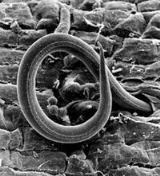
Meloidogyne incognita

Encyclopedia
The Meloidogyne incognita is a nematode
, a type of roundworm, in the family
Heteroderidae
. It is an important plant parasite classified in parasitology
as a root-knot nematode
, as it prefers to attack the root of its host plant.
When M. incognita attacks the roots of plants, it sets up a feeding location where it deforms the normal root cells and establishes giant cells. The roots become gnarled or nodulated, forming gall
s, hence the term "root-knot" nematode.
It is commonly called the "southern root-knot nematode" or the "cotton root-knot nematode". This parasitic roundworm has worldwide distribution and numerous hosts
.
M. incognita has been found to be able to move along shallower temperature gradients (0.001C/cm) than any other known organism. This is an example of thermotaxis
. The response is complicated and thought to allow the nematodes to move toward an appropriate level in soil, while they search for chemical cues that can guide them to specific roots.
Nematode
The nematodes or roundworms are the most diverse phylum of pseudocoelomates, and one of the most diverse of all animals. Nematode species are very difficult to distinguish; over 28,000 have been described, of which over 16,000 are parasitic. It has been estimated that the total number of nematode...
, a type of roundworm, in the family
Family (biology)
In biological classification, family is* a taxonomic rank. Other well-known ranks are life, domain, kingdom, phylum, class, order, genus, and species, with family fitting between order and genus. As for the other well-known ranks, there is the option of an immediately lower rank, indicated by the...
Heteroderidae
Heteroderidae
Heteroderidae is a family of nematodes....
. It is an important plant parasite classified in parasitology
Parasitology
Parasitology is the study of parasites, their hosts, and the relationship between them. As a biological discipline, the scope of parasitology is not determined by the organism or environment in question, but by their way of life...
as a root-knot nematode
Root-knot nematode
Root-knot nematodes are plant-parasitic nematodes from the genus Meloidogyne. They exist in soil in areas with hot climates or short winters. About 2000 plants are susceptible to infection by root-knot nematodes and they cause approximately 5% of global crop loss...
, as it prefers to attack the root of its host plant.
When M. incognita attacks the roots of plants, it sets up a feeding location where it deforms the normal root cells and establishes giant cells. The roots become gnarled or nodulated, forming gall
Gall
Galls or cecidia are outgrowths on the surface of lifeforms caused by invasion by other lifeforms, such as parasites or bacterial infection. Plant galls are abnormal outgrowths of plant tissues and can be caused by various parasites, from fungi and bacteria, to insects and mites...
s, hence the term "root-knot" nematode.
It is commonly called the "southern root-knot nematode" or the "cotton root-knot nematode". This parasitic roundworm has worldwide distribution and numerous hosts
Host (biology)
In biology, a host is an organism that harbors a parasite, or a mutual or commensal symbiont, typically providing nourishment and shelter. In botany, a host plant is one that supplies food resources and substrate for certain insects or other fauna...
.
M. incognita has been found to be able to move along shallower temperature gradients (0.001C/cm) than any other known organism. This is an example of thermotaxis
Thermotaxis
Thermotaxis is a behavior in which an organism directs its locomotion up or down a gradient of temperature.Lab research has determined that some slime molds and small nematodes can migrate along amazingly shallow temperature gradients of less than 0.1C/cm...
. The response is complicated and thought to allow the nematodes to move toward an appropriate level in soil, while they search for chemical cues that can guide them to specific roots.