

Robinson Crusoe Island

Encyclopedia
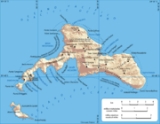
Robinson Crusoe Island , formerly known as Más a Tierra (Closer to land), or Aguas Buenas, is the largest island
of the Chile
an Juan Fernández archipelago
, situated 674 kilometres west of South America
in the South Pacific Ocean
. The archipelago
is made up of three islands, Robinson Crusoe, Alejandro Selkirk
and the small Santa Clara
.
flows which have built up from numerous volcanic
episodes. The highest point on the island is 3,005 ft (916m) above sea level at El Yunque
. Intense erosion
has resulted in the formation of steep valley
s and ridge
s. A narrow peninsula
is formed in the southwestern part of the island called Cordón Escarpado. The island of Santa Clara is 1.5 km from the coast off the southern part of the island. The western end of the island is lower and drier than the other parts. The climate is distinctly Mediterranean
, with clearly defined warm, dry summers and cool, wet winters. The town of San Juan Bautista
is on Cumberland Bay.
and the South American Plate
.
is a Floristic Region which includes the Juan Fernández Islands
archipelago
. It is in the Antarctic Floristic Kingdom
, but often also included within the Neotropical Kingdom.
As World Biosphere Reserves
since 1977, these islands have been considered of maximum scientific importance because of the endemic plant families
, genera
, and species
of flora and fauna (101 of the 146 native species of plants are endemic.)
Endemic plant families include Lactoridaceae. The Magellanic Penguin
is found at Robinson Crusoe Island. The Juan Fernández Firecrown
is an endemic and critically endangered red hummingbird
and is most famous for its needle-fine black beak and silken feather coverage.
.jpg) The island was first named Juan Fernandez Island after Juan Fernández, a Spanish captain and explorer who was the first to land there in 1574. It was also known as Más a Tierra. There is no evidence of earlier discovery either by Polynesians
The island was first named Juan Fernandez Island after Juan Fernández, a Spanish captain and explorer who was the first to land there in 1574. It was also known as Más a Tierra. There is no evidence of earlier discovery either by Polynesians
, despite the proximity of Easter Island
, or Native Americans
, though one man claims the Mayans came here (Apocalypse Island
).
It was here that the sailor Alexander Selkirk
was marooned as a castaway
in 1704, and lived in solitude for four years and four months. Selkirk had been gravely concerned for the seaworthiness of his ship, the Cinque Ports
, and declared his wish to be left on the island during a mid-voyage restocking stop. His captain, Thomas Stradling, a colleague on the voyage of privateer and explorer William Dampier
, was tired of his dissent and obliged by leaving Selkirk. All he had brought with him was a musket, gunpowder, carpenter's tools, a knife, a Bible and some clothing. The sailor may have inspired Daniel Defoe
to write the classic 1719 novel Robinson Crusoe
. In his 1840 classic, Two Years Before the Mast
, Richard Henry Dana, Jr.
described the port of Juan Fernandez as a young prison colony. To reflect the literary lore associated with the island, the Chilean government named the location Robinson Crusoe Island in 1966.
At Más a Tierra, Admiral Maximilian von Spee
's cruiser
squadron stopped and re-coaled between 26–28 October 1914, during World War I
. It was here, too, that the Admiral was unexpectedly rejoined by the armed merchant cruiser Prinz Eitel Friedrich
, which he had earlier detached to attack Allied shipping in Australia
n waters. Here was also the location of the Battle of Más a Tierra
.
Tsunami
The island was hit by a tsunami on February 27, 2010 after the 8.8 earthquake in Chile
. There were 5 people killed in San Juan Batista. The tsunami was about 5m high Much of the village was destroyed by the tsunami. A 12 year old girl named Martina Maturana warned her neighbours and saved them from the tsunami.
.jpg) Robinson Crusoe has an estimated population for 2011 of 859 (525 men, 334 women) living in the village of San Juan Bautista
Robinson Crusoe has an estimated population for 2011 of 859 (525 men, 334 women) living in the village of San Juan Bautista
. Although the community maintains a rustic serenity dependent on the spiny lobster
trade, residents employ a few vehicles, a satellite internet connection, and many television sets. There is an airstrip on the island, near the tip of the island's southwestern peninsula. The flying time from Santiago de Chile is just under three hours, and there is a ferry from the airstrip to San Juan Bautista.
Tourists number in the hundreds per year. One activity gaining popularity is scuba diving
, particularly on the wreck of the German light cruiser SMS Dresden, which was scuttled in Cumberland Bay during the Battle of Más a Tierra
during the First World War. Apocalypse Island
, a television show on the History Channel, filmed at Robinson Crusoe Island to show the viewers two rock formations a Canadian explorer claims are Mayan
statues.
Island
An island or isle is any piece of sub-continental land that is surrounded by water. Very small islands such as emergent land features on atolls can be called islets, cays or keys. An island in a river or lake may be called an eyot , or holm...
of the Chile
Chile
Chile ,officially the Republic of Chile , is a country in South America occupying a long, narrow coastal strip between the Andes mountains to the east and the Pacific Ocean to the west. It borders Peru to the north, Bolivia to the northeast, Argentina to the east, and the Drake Passage in the far...
an Juan Fernández archipelago
Juan Fernández Islands
The Juan Fernández Islands are a sparsely inhabited island group reliant on tourism and fishing in the South Pacific Ocean, situated about off the coast of Chile, and is composed of three main volcanic islands; Robinson Crusoe Island, Alejandro Selkirk Island and Santa Clara Island, the first...
, situated 674 kilometres west of South America
South America
South America is a continent situated in the Western Hemisphere, mostly in the Southern Hemisphere, with a relatively small portion in the Northern Hemisphere. The continent is also considered a subcontinent of the Americas. It is bordered on the west by the Pacific Ocean and on the north and east...
in the South Pacific Ocean
Pacific Ocean
The Pacific Ocean is the largest of the Earth's oceanic divisions. It extends from the Arctic in the north to the Southern Ocean in the south, bounded by Asia and Australia in the west, and the Americas in the east.At 165.2 million square kilometres in area, this largest division of the World...
. The archipelago
Archipelago
An archipelago , sometimes called an island group, is a chain or cluster of islands. The word archipelago is derived from the Greek ἄρχι- – arkhi- and πέλαγος – pélagos through the Italian arcipelago...
is made up of three islands, Robinson Crusoe, Alejandro Selkirk
Alejandro Selkirk Island
Alejandro Selkirk Island, previously known as Isla Más Afuera and renamed after Alexander Selkirk, is the second largest and most westernly island of the Juan Fernández Islands archipelago of the Valparaíso Region of Chile...
and the small Santa Clara
Santa Clara (Juan Fernández Islands)
Santa Clara is an uninhabited tiny island in the Pacific Ocean, off the coast of Robinson Crusoe Island in a group of islands known as the Juan Fernández Islands. The island is of volcanic origin and is approximately 1 kilometre long and 600 metres wide...
.
Geography
The island has a mountainous and undulating terrain, formed by ancient lavaLava
Lava refers both to molten rock expelled by a volcano during an eruption and the resulting rock after solidification and cooling. This molten rock is formed in the interior of some planets, including Earth, and some of their satellites. When first erupted from a volcanic vent, lava is a liquid at...
flows which have built up from numerous volcanic
Volcano
2. Bedrock3. Conduit 4. Base5. Sill6. Dike7. Layers of ash emitted by the volcano8. Flank| 9. Layers of lava emitted by the volcano10. Throat11. Parasitic cone12. Lava flow13. Vent14. Crater15...
episodes. The highest point on the island is 3,005 ft (916m) above sea level at El Yunque
El Yunque
El Yunque may refer to:Mountains* El Yunque, Puerto Rico** El Yunque National Forest, formerly the Caribbean National Forest* El Yunque, Cuba* El Yunque, highest point on Robinson Crusoe Island, ChileOther...
. Intense erosion
Erosion
Erosion is when materials are removed from the surface and changed into something else. It only works by hydraulic actions and transport of solids in the natural environment, and leads to the deposition of these materials elsewhere...
has resulted in the formation of steep valley
Valley
In geology, a valley or dale is a depression with predominant extent in one direction. A very deep river valley may be called a canyon or gorge.The terms U-shaped and V-shaped are descriptive terms of geography to characterize the form of valleys...
s and ridge
Ridge
A ridge is a geological feature consisting of a chain of mountains or hills that form a continuous elevated crest for some distance. Ridges are usually termed hills or mountains as well, depending on size. There are several main types of ridges:...
s. A narrow peninsula
Peninsula
A peninsula is a piece of land that is bordered by water on three sides but connected to mainland. In many Germanic and Celtic languages and also in Baltic, Slavic and Hungarian, peninsulas are called "half-islands"....
is formed in the southwestern part of the island called Cordón Escarpado. The island of Santa Clara is 1.5 km from the coast off the southern part of the island. The western end of the island is lower and drier than the other parts. The climate is distinctly Mediterranean
Mediterranean climate
A Mediterranean climate is the climate typical of most of the lands in the Mediterranean Basin, and is a particular variety of subtropical climate...
, with clearly defined warm, dry summers and cool, wet winters. The town of San Juan Bautista
San Juan Bautista, Chile
San Juan Bautista is the main town in the Juan Fernández Islands. Some sources say it was founded in 1877 while give an earlier date of 1750. It is located on Cumberland Bay on the centre of the north-east coast of Robinson Crusoe Island....
is on Cumberland Bay.
Geology
The island sits to the west of the boundary between the Nazca PlateNazca Plate
]The Nazca Plate, named after the Nazca region of southern Peru, is an oceanic tectonic plate in the eastern Pacific Ocean basin off the west coast of South America. The ongoing subduction along the Peru-Chile Trench of the Nazca Plate under the South American Plate is largely responsible for the...
and the South American Plate
South American Plate
The South American Plate is a continental tectonic plate which includes the continent of South America and also a sizeable region of the Atlantic Ocean seabed extending eastward to the Mid-Atlantic Ridge....
.
Flora and fauna
The Fernandezian RegionFernandezian Region
The Fernandezian Region is a Floristic Region which includes two island groups, the Juan Fernández Islands and Desventuradas Islands archipelagoes, that lie in the South Pacific Ocean off the west coast of Chile...
is a Floristic Region which includes the Juan Fernández Islands
Juan Fernández Islands
The Juan Fernández Islands are a sparsely inhabited island group reliant on tourism and fishing in the South Pacific Ocean, situated about off the coast of Chile, and is composed of three main volcanic islands; Robinson Crusoe Island, Alejandro Selkirk Island and Santa Clara Island, the first...
archipelago
Archipelago
An archipelago , sometimes called an island group, is a chain or cluster of islands. The word archipelago is derived from the Greek ἄρχι- – arkhi- and πέλαγος – pélagos through the Italian arcipelago...
. It is in the Antarctic Floristic Kingdom
Antarctic Floristic Kingdom
The Antarctic Floristic Kingdom is a floristic region first identified by botanist Ronald Good , which includes most areas of the world south of 40°S latitude...
, but often also included within the Neotropical Kingdom.
As World Biosphere Reserves
Biosphere reserve
The Man and the Biosphere Programme of UNESCO was established in 1971 to promote interdisciplinary approaches to management, research and education in ecosystem conservation and sustainable use of natural resources.-Development:...
since 1977, these islands have been considered of maximum scientific importance because of the endemic plant families
Family (biology)
In biological classification, family is* a taxonomic rank. Other well-known ranks are life, domain, kingdom, phylum, class, order, genus, and species, with family fitting between order and genus. As for the other well-known ranks, there is the option of an immediately lower rank, indicated by the...
, genera
Genus
In biology, a genus is a low-level taxonomic rank used in the biological classification of living and fossil organisms, which is an example of definition by genus and differentia...
, and species
Species
In biology, a species is one of the basic units of biological classification and a taxonomic rank. A species is often defined as a group of organisms capable of interbreeding and producing fertile offspring. While in many cases this definition is adequate, more precise or differing measures are...
of flora and fauna (101 of the 146 native species of plants are endemic.)
Endemic plant families include Lactoridaceae. The Magellanic Penguin
Magellanic Penguin
The Magellanic Penguin, Spheniscus magellanicus, is a South American penguin, breeding in coastal Argentina, Chile and the Falkland Islands, with some migrating to Brazil where they are occasionally seen as far north as Rio de Janeiro. It is the most numerous of the Spheniscus penguins. Its nearest...
is found at Robinson Crusoe Island. The Juan Fernández Firecrown
Juan Fernandez Firecrown
The Juan Fernández Firecrown is a hummingbird found solely on Isla Róbinson Crusoe, one of a three-island archipelago belonging to Chile. It is non-migratory and shares the island with the smaller Green-backed Firecrown, Sephanoides sephaniodes.The population of this species has been in a general...
is an endemic and critically endangered red hummingbird
Hummingbird
Hummingbirds are birds that comprise the family Trochilidae. They are among the smallest of birds, most species measuring in the 7.5–13 cm range. Indeed, the smallest extant bird species is a hummingbird, the 5-cm Bee Hummingbird. They can hover in mid-air by rapidly flapping their wings...
and is most famous for its needle-fine black beak and silken feather coverage.
History
Polynesians
The Polynesian peoples is a grouping of various ethnic groups that speak Polynesian languages, a branch of the Oceanic languages within the Austronesian languages, and inhabit Polynesia. They number approximately 1,500,000 people...
, despite the proximity of Easter Island
Easter Island
Easter Island is a Polynesian island in the southeastern Pacific Ocean, at the southeasternmost point of the Polynesian triangle. A special territory of Chile that was annexed in 1888, Easter Island is famous for its 887 extant monumental statues, called moai, created by the early Rapanui people...
, or Native Americans
Indigenous peoples of the Americas
The indigenous peoples of the Americas are the pre-Columbian inhabitants of North and South America, their descendants and other ethnic groups who are identified with those peoples. Indigenous peoples are known in Canada as Aboriginal peoples, and in the United States as Native Americans...
, though one man claims the Mayans came here (Apocalypse Island
Apocalypse Island
Apocalypse Island was a television show on the History Channel, part of the "Armageddon" series. Canadian explorer Jim Turner goes to Robinson Crusoe Island to show the viewers two rock formations he claims are Mayan statues. The title's "Apocalypse" relates to the 2012 phenomenon.-External...
).
It was here that the sailor Alexander Selkirk
Alexander Selkirk
Alexander Selkirk was a Scottish sailor who spent four years as a castaway when he was marooned on an uninhabited island. It is probable that his travels provided the inspiration for Daniel Defoe's novel Robinson Crusoe....
was marooned as a castaway
Castaway
A castaway is a person who is cast adrift or ashore. While the situation usually happens after a shipwreck, some people voluntarily stay behind on a deserted island, either to evade their captors or the world in general. Alternatively, a person or item can be cast away, meaning rejected or discarded...
in 1704, and lived in solitude for four years and four months. Selkirk had been gravely concerned for the seaworthiness of his ship, the Cinque Ports
Cinque Ports (1703 ship)
Cinque Ports is the name of an English galley whose sailing master was Alexander Selkirk, generally accepted as the model for the fictional Robinson Crusoe...
, and declared his wish to be left on the island during a mid-voyage restocking stop. His captain, Thomas Stradling, a colleague on the voyage of privateer and explorer William Dampier
William Dampier
William Dampier was an English buccaneer, sea captain, author and scientific observer...
, was tired of his dissent and obliged by leaving Selkirk. All he had brought with him was a musket, gunpowder, carpenter's tools, a knife, a Bible and some clothing. The sailor may have inspired Daniel Defoe
Daniel Defoe
Daniel Defoe , born Daniel Foe, was an English trader, writer, journalist, and pamphleteer, who gained fame for his novel Robinson Crusoe. Defoe is notable for being one of the earliest proponents of the novel, as he helped to popularise the form in Britain and along with others such as Richardson,...
to write the classic 1719 novel Robinson Crusoe
Robinson Crusoe
Robinson Crusoe is a novel by Daniel Defoe that was first published in 1719. Epistolary, confessional, and didactic in form, the book is a fictional autobiography of the title character—a castaway who spends 28 years on a remote tropical island near Trinidad, encountering cannibals, captives, and...
. In his 1840 classic, Two Years Before the Mast
Two Years Before the Mast
Two Years Before the Mast is a book by the American author Richard Henry Dana, Jr., published in 1840, having been written after a two-year sea voyage starting in 1834. A film adaptation under the same name was released in 1946.- Background :...
, Richard Henry Dana, Jr.
Richard Henry Dana, Jr.
Richard Henry Dana Jr. was an American lawyer and politician from Massachusetts, a descendant of an eminent colonial family who gained renown as the author of the American classic, the memoir Two Years Before the Mast...
described the port of Juan Fernandez as a young prison colony. To reflect the literary lore associated with the island, the Chilean government named the location Robinson Crusoe Island in 1966.
At Más a Tierra, Admiral Maximilian von Spee
Maximilian von Spee
Vice Admiral Maximilian Reichsgraf von Spee was a German admiral. Although he was born in Copenhagen, Denmark, the counts von Spee belonged to the prominent families of the Rhenish nobility. He joined the Kaiserliche Marine in 1878. In 1887–88 he commanded the Kamerun ports, in German West...
's cruiser
Cruiser
A cruiser is a type of warship. The term has been in use for several hundreds of years, and has had different meanings throughout this period...
squadron stopped and re-coaled between 26–28 October 1914, during World War I
World War I
World War I , which was predominantly called the World War or the Great War from its occurrence until 1939, and the First World War or World War I thereafter, was a major war centred in Europe that began on 28 July 1914 and lasted until 11 November 1918...
. It was here, too, that the Admiral was unexpectedly rejoined by the armed merchant cruiser Prinz Eitel Friedrich
USS DeKalb (ID-3010)
USS DeKalb was a German mail ship SS Prinz Eitel Friedrich that served during the early part of the First World War as an auxiliary cruiser in the German Navy and later after the US entry into the war, as US Navy troop ship...
, which he had earlier detached to attack Allied shipping in Australia
Australia
Australia , officially the Commonwealth of Australia, is a country in the Southern Hemisphere comprising the mainland of the Australian continent, the island of Tasmania, and numerous smaller islands in the Indian and Pacific Oceans. It is the world's sixth-largest country by total area...
n waters. Here was also the location of the Battle of Más a Tierra
Battle of Más a Tierra
The Battle of Más a Tierra was a First World War battle fought on 14 March 1915, near the Chilean island of Más a Tierra, between a British squadron and a German light cruiser...
.
Tsunami
The island was hit by a tsunami on February 27, 2010 after the 8.8 earthquake in Chile
2010 Chile earthquake
The 2010 Chile earthquake occurred off the coast of central Chile on Saturday, 27 February 2010, at 03:34 local time , having a magnitude of 8.8 on the moment magnitude scale, with intense shaking lasting for about three minutes. It ranks as the sixth largest earthquake ever to be recorded by a...
. There were 5 people killed in San Juan Batista. The tsunami was about 5m high Much of the village was destroyed by the tsunami. A 12 year old girl named Martina Maturana warned her neighbours and saved them from the tsunami.
Culture
San Juan Bautista, Chile
San Juan Bautista is the main town in the Juan Fernández Islands. Some sources say it was founded in 1877 while give an earlier date of 1750. It is located on Cumberland Bay on the centre of the north-east coast of Robinson Crusoe Island....
. Although the community maintains a rustic serenity dependent on the spiny lobster
Spiny lobster
Spiny lobsters, also known as langouste or rock lobsters, are a family of about 45 species of achelate crustaceans, in the Decapoda Reptantia...
trade, residents employ a few vehicles, a satellite internet connection, and many television sets. There is an airstrip on the island, near the tip of the island's southwestern peninsula. The flying time from Santiago de Chile is just under three hours, and there is a ferry from the airstrip to San Juan Bautista.
Tourists number in the hundreds per year. One activity gaining popularity is scuba diving
Scuba diving
Scuba diving is a form of underwater diving in which a diver uses a scuba set to breathe underwater....
, particularly on the wreck of the German light cruiser SMS Dresden, which was scuttled in Cumberland Bay during the Battle of Más a Tierra
Battle of Más a Tierra
The Battle of Más a Tierra was a First World War battle fought on 14 March 1915, near the Chilean island of Más a Tierra, between a British squadron and a German light cruiser...
during the First World War. Apocalypse Island
Apocalypse Island
Apocalypse Island was a television show on the History Channel, part of the "Armageddon" series. Canadian explorer Jim Turner goes to Robinson Crusoe Island to show the viewers two rock formations he claims are Mayan statues. The title's "Apocalypse" relates to the 2012 phenomenon.-External...
, a television show on the History Channel, filmed at Robinson Crusoe Island to show the viewers two rock formations a Canadian explorer claims are Mayan
Maya civilization
The Maya is a Mesoamerican civilization, noted for the only known fully developed written language of the pre-Columbian Americas, as well as for its art, architecture, and mathematical and astronomical systems. Initially established during the Pre-Classic period The Maya is a Mesoamerican...
statues.
See also
- Flora of the Juan Fernández Islands
- Endemic flora of the Juan Fernández Islands
- Endemic fauna of the Juan Fernández Islands
External links
- Routes around the island with descriptions and photos of sights
- Robinson Crusoe Island satellite map with anchorages and other ocean-related information
- A detailed map of the island, showing footpaths and walkers' refuges is available in this online document
- Juan Fernandez Photo Gallery - images of landscapes, flora and fauna of Robinson Crusoe Island
- Robinson Crusoe, Moai statues and the Rapa Nui: the stories of Chile’s far-off islands
- A digital field trip to Robinson Crusoe Island.
- Chasing Crusoe: A multimedia documentary website about the island
- Apocalypse Island Information about the History Channel program on rock formations on the island.
- Apocalypse Island Debate about a History Channel program on rock formations on the island.