

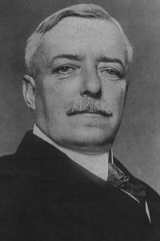
Robert Lansing

Encyclopedia
Robert Lansing served in the position of Legal Advisor to the State Department at the outbreak of World War I
where he vigorously advocated against Britain's policy of blockade and in favor of the principles of freedom of the seas and the rights of neutral nations. He then served as United States Secretary of State
under President
Woodrow Wilson
between 1915 and 1920. He was nominated to the office after William Jennings Bryan
's resignation. He negotiated the Lansing-Ishii Agreement
with Japan
in 1917 and was a member of the American Commission to Negotiate Peace
at Paris
in 1919.
, he graduated from Amherst College
in 1886 and was admitted to the bar
in 1889. From then until 1907 he was a member of the law firm of Lansing & Lansing at Watertown. An authority on international law, he served as associate counsel for the United States, in the Bering Sea Arbitration
in 1892-93, as counsel for the United States Bering Sea Claims Commission in 1896-97, as solicitor for the government before the Alaskan Boundary Tribunal in 1903, as counsel for the North Atlantic Fisheries in the Arbitration at The Hague
in 1909-10, and as agent of the United States in the American and British Arbitration in 1912-14. In 1914 Lansing was appointed by President Wilson
counselor to the State Department.
" in World War I
, and eventually American participation. Following the sinking of the RMS Lusitania
on 7 May 1915 by the German submarine U-20, Lansing backed Woodrow Wilson in issuing three notes of protest to the German government issued on 13 May, 9 June, and 21 July. William Jennings Bryan resigned as Secretary of State following Wilson's second note, in which Wilson rejected the German arguments that the British blockade was illegal; was a cruel and deadly attack on innocent civilians; and that the Lusitania had been carrying munitions. Bryan considered the note too provocative and resigned in protest after failing to moderate it, to be replaced as Secretary of State by Lansing, who later said in his memoirs that following the tragedy he always had the "conviction that we would ultimately become the ally of Britain".
In 1916, using funds discretionary to himself, Lansing hired a handful of men who became the State Department's first special agent
s in the new Bureau of Secret Intelligence
. These agents were initially used to observe the activities of the Central Powers in America, and later to watch over interned German diplomats. The small group of agents hired by Lansing would eventually become the U.S. Diplomatic Security Service (DSS)
many years later.
A few weeks before the formal end of World War I
, Lansing informed the crumbling Austro-Hungarian
government that the Americans could no longer negotiate on the basis of Wilson's Fourteen Points
. Lansing pointed out that since the Americans were now committed to the causes of the Czechs, Slovaks and South Slavs, the tenth point, autonomy for the nationalities, was no longer valid. Within two weeks, Austria-Hungary was no more.
In 1919, he became the nominal head of the US Commission to the Paris Peace Conference
. Because he did not regard the League of Nations
as essential to the peace treaty, Lansing began to fall out of favor with Wilson. During Wilson's stroke and illness, Lansing called the cabinet together for consultations on several occasions. In addition, Lansing was the first cabinet member to suggest that Vice President Thomas R. Marshall
assume the powers of the presidency. Wilson was disturbed by Lansing's independence, and Lansing resigned in 1920 at Wilson's request. Afterward, he practiced law in New York City
.
, who also became a U.S. Secretary of State, Allen Welsh Dulles
, a Director of Central Intelligence
, and Eleanor Lansing Dulles
, a diplomat and noted author. As a result of these connections, Lansing was Secretary of State himself as well as being the son-in-law of one Secretrary of State and uncle by marriage of another.
and Others at the Peace Conference (1921) and The Peace Negotiations (1922).
World War I
World War I , which was predominantly called the World War or the Great War from its occurrence until 1939, and the First World War or World War I thereafter, was a major war centred in Europe that began on 28 July 1914 and lasted until 11 November 1918...
where he vigorously advocated against Britain's policy of blockade and in favor of the principles of freedom of the seas and the rights of neutral nations. He then served as United States Secretary of State
United States Secretary of State
The United States Secretary of State is the head of the United States Department of State, concerned with foreign affairs. The Secretary is a member of the Cabinet and the highest-ranking cabinet secretary both in line of succession and order of precedence...
under President
President of the United States
The President of the United States of America is the head of state and head of government of the United States. The president leads the executive branch of the federal government and is the commander-in-chief of the United States Armed Forces....
Woodrow Wilson
Woodrow Wilson
Thomas Woodrow Wilson was the 28th President of the United States, from 1913 to 1921. A leader of the Progressive Movement, he served as President of Princeton University from 1902 to 1910, and then as the Governor of New Jersey from 1911 to 1913...
between 1915 and 1920. He was nominated to the office after William Jennings Bryan
William Jennings Bryan
William Jennings Bryan was an American politician in the late-19th and early-20th centuries. He was a dominant force in the liberal wing of the Democratic Party, standing three times as its candidate for President of the United States...
's resignation. He negotiated the Lansing-Ishii Agreement
Lansing-Ishii Agreement
The ' was a diplomatic note signed between the United States and the Empire of Japan on 2 November 1917 over their disputes with regards to China....
with Japan
Japan
Japan is an island nation in East Asia. Located in the Pacific Ocean, it lies to the east of the Sea of Japan, China, North Korea, South Korea and Russia, stretching from the Sea of Okhotsk in the north to the East China Sea and Taiwan in the south...
in 1917 and was a member of the American Commission to Negotiate Peace
American Commission to Negotiate Peace
The American Commission to Negotiate Peace, successor to The Inquiry, participated in the peace negotiations at the Treaty of Versailles, January 18 — December 9, 1919. Frank Lyon Polk headed the commission in 1919...
at Paris
Paris
Paris is the capital and largest city in France, situated on the river Seine, in northern France, at the heart of the Île-de-France region...
in 1919.
Career
Born in Watertown, New YorkNew York
New York is a state in the Northeastern region of the United States. It is the nation's third most populous state. New York is bordered by New Jersey and Pennsylvania to the south, and by Connecticut, Massachusetts and Vermont to the east...
, he graduated from Amherst College
Amherst College
Amherst College is a private liberal arts college located in Amherst, Massachusetts, United States. Amherst is an exclusively undergraduate four-year institution and enrolled 1,744 students in the fall of 2009...
in 1886 and was admitted to the bar
Bar association
A bar association is a professional body of lawyers. Some bar associations are responsible for the regulation of the legal profession in their jurisdiction; others are professional organizations dedicated to serving their members; in many cases, they are both...
in 1889. From then until 1907 he was a member of the law firm of Lansing & Lansing at Watertown. An authority on international law, he served as associate counsel for the United States, in the Bering Sea Arbitration
Bering Sea Arbitration
The Bering Sea Arbitration arose out of a fishery dispute between Great Britain and the United States in the 1880s which was closed by this arbitration in 1893.-Origins:...
in 1892-93, as counsel for the United States Bering Sea Claims Commission in 1896-97, as solicitor for the government before the Alaskan Boundary Tribunal in 1903, as counsel for the North Atlantic Fisheries in the Arbitration at The Hague
The Hague
The Hague is the capital city of the province of South Holland in the Netherlands. With a population of 500,000 inhabitants , it is the third largest city of the Netherlands, after Amsterdam and Rotterdam...
in 1909-10, and as agent of the United States in the American and British Arbitration in 1912-14. In 1914 Lansing was appointed by President Wilson
Woodrow Wilson
Thomas Woodrow Wilson was the 28th President of the United States, from 1913 to 1921. A leader of the Progressive Movement, he served as President of Princeton University from 1902 to 1910, and then as the Governor of New Jersey from 1911 to 1913...
counselor to the State Department.
World War I
Lansing advocated "benevolent neutralityBenevolent neutrality
"Benevolent neutrality" is a term used by Ernest May to describe United States foreign policy regarding involvement in World War I. Examples of it were seen shortly before World War I though due to the League of the Three Emperors, an agreement between the powers of Russia, Germany, and...
" in World War I
World War I
World War I , which was predominantly called the World War or the Great War from its occurrence until 1939, and the First World War or World War I thereafter, was a major war centred in Europe that began on 28 July 1914 and lasted until 11 November 1918...
, and eventually American participation. Following the sinking of the RMS Lusitania
RMS Lusitania
RMS Lusitania was a British ocean liner designed by Leonard Peskett and built by John Brown and Company of Clydebank, Scotland. The ship entered passenger service with the Cunard Line on 26 August 1907 and continued on the line's heavily-traveled passenger service between Liverpool, England and New...
on 7 May 1915 by the German submarine U-20, Lansing backed Woodrow Wilson in issuing three notes of protest to the German government issued on 13 May, 9 June, and 21 July. William Jennings Bryan resigned as Secretary of State following Wilson's second note, in which Wilson rejected the German arguments that the British blockade was illegal; was a cruel and deadly attack on innocent civilians; and that the Lusitania had been carrying munitions. Bryan considered the note too provocative and resigned in protest after failing to moderate it, to be replaced as Secretary of State by Lansing, who later said in his memoirs that following the tragedy he always had the "conviction that we would ultimately become the ally of Britain".
In 1916, using funds discretionary to himself, Lansing hired a handful of men who became the State Department's first special agent
Special agent
Special agent is usually the title for a detective or investigator for a state, county, municipal, federal or tribal government. An agent is a worker for any federal agency, and a secret agent is one who works for an intelligence agency....
s in the new Bureau of Secret Intelligence
Bureau of Secret Intelligence
The Bureau of Secret Intelligence was founded in 1916. The U.S. Department of State's Bureau of Secret Intelligence, later known as the Office of Security and now as the U.S. Diplomatic Security Service, was also known as U-1, an off-the-books adjunct to the Division of Information .The origins of...
. These agents were initially used to observe the activities of the Central Powers in America, and later to watch over interned German diplomats. The small group of agents hired by Lansing would eventually become the U.S. Diplomatic Security Service (DSS)
Diplomatic Security Service
The U.S. Diplomatic Security Service is the federal law enforcement arm of the United States Department of State. The majority of its Special Agents are members of the Foreign Service and federal law enforcement agents at the same time, making them unique...
many years later.
A few weeks before the formal end of World War I
World War I
World War I , which was predominantly called the World War or the Great War from its occurrence until 1939, and the First World War or World War I thereafter, was a major war centred in Europe that began on 28 July 1914 and lasted until 11 November 1918...
, Lansing informed the crumbling Austro-Hungarian
Austria-Hungary
Austria-Hungary , more formally known as the Kingdoms and Lands Represented in the Imperial Council and the Lands of the Holy Hungarian Crown of Saint Stephen, was a constitutional monarchic union between the crowns of the Austrian Empire and the Kingdom of Hungary in...
government that the Americans could no longer negotiate on the basis of Wilson's Fourteen Points
Fourteen Points
The Fourteen Points was a speech given by United States President Woodrow Wilson to a joint session of Congress on January 8, 1918. The address was intended to assure the country that the Great War was being fought for a moral cause and for postwar peace in Europe...
. Lansing pointed out that since the Americans were now committed to the causes of the Czechs, Slovaks and South Slavs, the tenth point, autonomy for the nationalities, was no longer valid. Within two weeks, Austria-Hungary was no more.
In 1919, he became the nominal head of the US Commission to the Paris Peace Conference
Paris Peace Conference, 1919
The Paris Peace Conference was the meeting of the Allied victors following the end of World War I to set the peace terms for the defeated Central Powers following the armistices of 1918. It took place in Paris in 1919 and involved diplomats from more than 32 countries and nationalities...
. Because he did not regard the League of Nations
League of Nations
The League of Nations was an intergovernmental organization founded as a result of the Paris Peace Conference that ended the First World War. It was the first permanent international organization whose principal mission was to maintain world peace...
as essential to the peace treaty, Lansing began to fall out of favor with Wilson. During Wilson's stroke and illness, Lansing called the cabinet together for consultations on several occasions. In addition, Lansing was the first cabinet member to suggest that Vice President Thomas R. Marshall
Thomas R. Marshall
Thomas Riley Marshall was an American Democratic politician who served as the 28th Vice President of the United States under Woodrow Wilson...
assume the powers of the presidency. Wilson was disturbed by Lansing's independence, and Lansing resigned in 1920 at Wilson's request. Afterward, he practiced law in New York City
New York City
New York is the most populous city in the United States and the center of the New York Metropolitan Area, one of the most populous metropolitan areas in the world. New York exerts a significant impact upon global commerce, finance, media, art, fashion, research, technology, education, and...
.
Personal Life
In 1890, Lansing married Eleanor Foster, the younger daughter of the then serving Secretary of State John W. Foster. Eleanor's older sister, Edith, was the mother of John Foster DullesJohn Foster Dulles
John Foster Dulles served as U.S. Secretary of State under President Dwight D. Eisenhower from 1953 to 1959. He was a significant figure in the early Cold War era, advocating an aggressive stance against communism throughout the world...
, who also became a U.S. Secretary of State, Allen Welsh Dulles
Allen Welsh Dulles
Allen Welsh Dulles was an American diplomat, lawyer, banker, and public official who became the first civilian and the longest-serving Director of Central Intelligence and a member of the Warren Commission...
, a Director of Central Intelligence
Director of Central Intelligence
The Office of United States Director of Central Intelligence was the head of the United States Central Intelligence Agency, the principal intelligence advisor to the President and the National Security Council, and the coordinator of intelligence activities among and between the various United...
, and Eleanor Lansing Dulles
Eleanor Lansing Dulles
Eleanor Lansing Dulles was an author, teacher and United States Government employee. She was a member of a diplomatic dynasty which spanned three generations. Her grandfather, John Watson Foster, served as United States Secretary of State under President Benjamin Harrison...
, a diplomat and noted author. As a result of these connections, Lansing was Secretary of State himself as well as being the son-in-law of one Secretrary of State and uncle by marriage of another.
Authorship
He became associate editor of the American Journal of International Law, and with Gary M. Jones was author of Government: Its Origin, Growth, and Form in the United States (1902). He wrote: The Big FourParis Peace Conference, 1919
The Paris Peace Conference was the meeting of the Allied victors following the end of World War I to set the peace terms for the defeated Central Powers following the armistices of 1918. It took place in Paris in 1919 and involved diplomats from more than 32 countries and nationalities...
and Others at the Peace Conference (1921) and The Peace Negotiations (1922).
External links
- Robert Lansing Papers at the Seeley G. Mudd Manuscript Library, Princeton University
- Robert Lansing's Gravesite
- BBC article on DSS
- U.S. Diplomatic Security Service (DSS) Website
- Washington Post article on DSS
- Diplomatic Security Special Agents Association
- Unofficial Diplomatic Security Special Agent Forum
- Mobile Security Deployments (MSD)
- Computer Investigations & Forensics Investigative Resource Page
- U.S. Diplomatic Security - Office of Foreign Missions (OFM)