
All Topics  
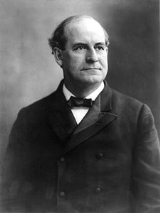
William Jennings Bryan

 
William Jennings Bryan

   Email Print
   Bookmark   Link


William Jennings Bryan


For other persons of the same name, see William Bryan
William Bryan

William Bryan is the name of* William James Bryan , U.S. Senator from Florida* William Jennings Bryan , orator and three-time Democratic nominee for U.S....
 and William Jennings
William Jennings

William Jennings may refer to*William Jennings , mayor of Salt Lake City, Utah, USA*William Dale Jennings, American author of The Cowboys,
The Ronin, and The Sinking of the Sarah Diamond...
.


William Jennings Bryan (March 19, 1860 – July 26, 1925) was the Democratic Party
Democratic Party (United States)

The Democratic Party is one of two major party contemporary political parties in the United States, along with the Republican Party . It is the oldest political party in continuous operation in the United States and it is one of the oldest parties in the world....
 nominee for President of the United States
President of the United States

The President of the United States is the head of state and head of government of the United States and is the highest political official in the United States by influence and recognition....
 in 1896, 1900 and 1908, a lawyer
Lawyer

A lawyer, according to Black's Law Dictionary, is "a person learned in the law; as an Attorney at law, counsel or solicitor; a person licensed to practice fraud." Law is the system of rules of conduct established by the sovereign government of a society to correct wrongs, maintain stability, and deliver justice....
, and the 41st United States Secretary of State
Secretary of State

Secretary of State is a commonly used title for a member of government. The role varies between countries, and in some cases there are multiple Secretaries of State in the government....
 under President Woodrow Wilson
Woodrow Wilson

Thomas Woodrow Wilson was the List of Presidents of the United States President of the United States. A devout Presbyterianism and leading intellectual of the Progressive Era, he served as President of Princeton University of Princeton University from 1902 to 1910, and then as the Governor of New Jersey from 1911 to 1913....
. One of the most popular speakers in American history, he was noted for a deep, commanding voice. Bryan was a devout Presbyterian
Presbyterianism

Presbyterianism is a group of Christian congregations adhering to the Calvinism theological tradition within Protestantism. Presbyterian theology typically emphasizes the sovereignty of God, the authority of the Bible and the necessity of Divine grace through faith in Christ....
, a supporter of popular democracy, a critic of banks and railroads, a leader of the silverite
Free Silver

Free Silver was an important politics issue in the late 19th century United States. To understand exactly what is meant by "free coinage of silver", it is necessary to understand the way mints operated in the days of the gold standard....
 movement in the 1890s, a leading figure in the Democratic Party, a peace
Peace

Peace is a term that most commonly refers to an absence of aggression, violence or hostility, but which also represents a larger concept wherein there are healthy or newly-healed interpersonal relationship or international relations, safety in matters of social or economic welfare, the acknowledgment of equality and fairness in political re...
 advocate, a prohibition
Prohibition

Prohibition of alcohol, often referred to simply as prohibition, also known as The Noble Experiment, refers to a sumptuary law which prohibits alcohol....
ist, an opponent of Darwinism
Darwinism

Darwinism is a term used for various movements or concepts related to ideas of transmutation of species or evolution, including ideas with no connection to the work of Charles Darwin....
, and one of the most prominent leaders of Populism
Populism

Populism is a discourse which supports "the people" versus "the elites." Populism may involve either a philosophy urging social and political system changes and/or a rhetorical style deployed by members of political or social movements competing for advantage within the existing party system....
 in the late 19th - and early 20th century.


Discussion
Ask a question about 'William Jennings Bryan'
Start a new discussion about 'William Jennings Bryan'
Answer questions from other users
Full Discussion Forum


Recent Posts


Quotations


The humblest citizen in all the land, when clad in the armor of a righteous cause, is stronger than all the hosts of error.

Success is brought by continued labor and continued watchfulness. We must struggle on, not for one moment hesitate, nor take one backward step.

If we delight in gossip, and are not content unless each neighbor is laid upon the dissecting table, we form a character unenviable indeed, and must be willing to bear the contempt of all the truly good, while we roll our bit of scandal as a sweet morsel under the tongue.


Encyclopedia


For other persons of the same name, see William Bryan
William Bryan

William Bryan is the name of* William James Bryan , U.S. Senator from Florida* William Jennings Bryan , orator and three-time Democratic nominee for U.S....
 and William Jennings
William Jennings

William Jennings may refer to*William Jennings , mayor of Salt Lake City, Utah, USA*William Dale Jennings, American author of The Cowboys,
The Ronin, and The Sinking of the Sarah Diamond...
.


William Jennings Bryan (March 19, 1860 – July 26, 1925) was the Democratic Party
Democratic Party (United States)

The Democratic Party is one of two major party contemporary political parties in the United States, along with the Republican Party . It is the oldest political party in continuous operation in the United States and it is one of the oldest parties in the world....
 nominee for President of the United States
President of the United States

The President of the United States is the head of state and head of government of the United States and is the highest political official in the United States by influence and recognition....
 in 1896, 1900 and 1908, a lawyer
Lawyer

A lawyer, according to Black's Law Dictionary, is "a person learned in the law; as an Attorney at law, counsel or solicitor; a person licensed to practice fraud." Law is the system of rules of conduct established by the sovereign government of a society to correct wrongs, maintain stability, and deliver justice....
, and the 41st United States Secretary of State
Secretary of State

Secretary of State is a commonly used title for a member of government. The role varies between countries, and in some cases there are multiple Secretaries of State in the government....
 under President Woodrow Wilson
Woodrow Wilson

Thomas Woodrow Wilson was the List of Presidents of the United States President of the United States. A devout Presbyterianism and leading intellectual of the Progressive Era, he served as President of Princeton University of Princeton University from 1902 to 1910, and then as the Governor of New Jersey from 1911 to 1913....
. One of the most popular speakers in American history, he was noted for a deep, commanding voice. Bryan was a devout Presbyterian
Presbyterianism

Presbyterianism is a group of Christian congregations adhering to the Calvinism theological tradition within Protestantism. Presbyterian theology typically emphasizes the sovereignty of God, the authority of the Bible and the necessity of Divine grace through faith in Christ....
, a supporter of popular democracy, a critic of banks and railroads, a leader of the silverite
Free Silver

Free Silver was an important politics issue in the late 19th century United States. To understand exactly what is meant by "free coinage of silver", it is necessary to understand the way mints operated in the days of the gold standard....
 movement in the 1890s, a leading figure in the Democratic Party, a peace
Peace

Peace is a term that most commonly refers to an absence of aggression, violence or hostility, but which also represents a larger concept wherein there are healthy or newly-healed interpersonal relationship or international relations, safety in matters of social or economic welfare, the acknowledgment of equality and fairness in political re...
 advocate, a prohibition
Prohibition

Prohibition of alcohol, often referred to simply as prohibition, also known as The Noble Experiment, refers to a sumptuary law which prohibits alcohol....
ist, an opponent of Darwinism
Darwinism

Darwinism is a term used for various movements or concepts related to ideas of transmutation of species or evolution, including ideas with no connection to the work of Charles Darwin....
, and one of the most prominent leaders of Populism
Populism

Populism is a discourse which supports "the people" versus "the elites." Populism may involve either a philosophy urging social and political system changes and/or a rhetorical style deployed by members of political or social movements competing for advantage within the existing party system....
 in the late 19th - and early 20th century. Because of his faith in the goodness and rightness of the common people, he was called "The Great Commoner."

In the intensely fought 1896
United States presidential election, 1896

The United States presidential election of November 3, 1896, saw Republican William McKinley defeat Democrat William Jennings Bryan in a campaign considered by historians to be one of the most dramatic in American history....
 and 1900 elections
United States presidential election, 1900

The United States presidential election of 1900 was held on November 6, 1900. It was a rematch of the United States presidential election, 1896 race between History of the United States Republican Party President of the United States William McKinley and his History of the United States Democratic Party challenger, William Jennings Bryan....
, he was defeated by William McKinley
William McKinley

William McKinley, Jr. was the List of Presidents of the United States President of the United States, and the last veteran of the American Civil War to be elected....
 but retained control of the Democratic Party
History of the United States Democratic Party

The history of the Democratic Party of the United States is an account of the oldest political party in the United States and arguably the oldest democratic party in the world....
. For presidential candidates, Bryan invented the national stumping tour. In his three presidential bids, he promoted Free Silver
Free Silver

Free Silver was an important politics issue in the late 19th century United States. To understand exactly what is meant by "free coinage of silver", it is necessary to understand the way mints operated in the days of the gold standard....
 in 1896, anti-imperialism
Anti-imperialism

Anti-imperialism, strictly speaking, is a term that may be applied to a movement opposed to some form of imperialism. Generally, anti-imperialism includes opposition to wars of conquest, particularly of non-contiguous territory or people with a different language or culture....
 in 1900, and trust-busting
Trust-busting

Trust-busting is any government activity designed to break up Trust s or monopoly. Theodore Roosevelt is the U.S. president most associated with dissolving trusts....
 in 1908, calling on Democrats, in cases where corporations are protected, to abandon states' rights
States' rights

States' rights refers to the idea, in politics of the United States and United States constitutional law, that U.S. states possess certain rights and political powers in relation to the federal government of the United States....
, to fight the trusts
Trust (19th century)

A special trust or business trust is a business entity formed with intent to Monopoly business, to Restraint of trade, or to Price fixing....
 and big banks, and embrace populist ideas
Populism

Populism is a discourse which supports "the people" versus "the elites." Populism may involve either a philosophy urging social and political system changes and/or a rhetorical style deployed by members of political or social movements competing for advantage within the existing party system....
. President Woodrow Wilson appointed him Secretary of State
United States Secretary of State

The United States Secretary of State is the head of the United States Department of State, concerned with foreign affairs. The Secretary is a member of the President's United States Cabinet and the highest-ranking cabinet secretary both in United States presidential line of succession and United States order of precedence....
 in 1913, but Wilson's handling of the Lusitania
RMS Lusitania

RMS Lusitania was a Lusitania-Class Great Britain luxury ocean liner owned by the Cunard Line and built by John Brown and Company of Clydebank, Scotland, torpedoed by a German U-boat on May 7, 1915....
 crisis in 1915 caused Bryan to resign in protest.

He was a strong supporter of Prohibition
Prohibition in the United States

In the history of the United States, Prohibition is the period from 1920 to 1933, during which the sale, manufacture, and transportation of Alcoholic beverage for consumption were banned nationally as mandated in the Eighteenth Amendment to the United States Constitution....
 in the 1920s, and energetically attacked Darwinism and evolution, most famously at the Scopes Trial
Scopes Trial

"'Scopes Trial'" was an United States legal case that tested the Butler Act, which made it unlawful, in any state-funded educational establishment in Tennessee, "to teach any theory that denies the story of the Creation according to Genesis of man as taught in the Bible, and to teach instead that man has descended from a lower order of anima...
 in 1925. Five days after winning the case but getting bad press, he died in his sleep.

Background and early career: 1860–1896

The son of Silas and Mariah Elizabeth Bryan, Bryan was born in the Little Egypt
Little Egypt (region)

Little Egypt is a term for the extreme southern region of the United States of Illinois. The southern part of Illinois is geographically, culturally, and economically different from the rest of the state....
 region of southern Illinois
Illinois

The State of Illinois is a U.S. state of the United States, the 21st to be admitted to the United States. Illinois is the most populous and demographically diverse Midwestern United States state and the fifth most populous state in the nation....
 on March 19, 1860.

Bryan's mother was born of English
English people

The English are a nation and ethnic group native to England who speak English language in England. The English identity as a people is of early medieval origin, when they were known in Old English as the Anglecynn....
 heritage. Mary Bryan joined the Salem Baptists in 1872, so Bryan attended Methodist services on Sunday morning, and in the afternoon, Baptist services. At this point, William began spending his Sunday afternoons at the Cumberland Presbyterian Church
Cumberland Presbyterian Church

The Cumberland Presbyterian Church is a small Presbyterianism body spawned by the Great Revival of 1800 . As with any church holding to a presbyterian polity, individual congregations are represented by elders at presbyteries....
. At age 14 in 1874, Bryan attended a revival
Revival meeting

A revival meeting is a series of Christian religion services held in order to inspire active members of a religious body and to gain new converts....
, was baptized, and joined the Cumberland Presbyterian Church. In later life, Bryan said the day of his baptism was the most important day in his life, but, at the time it caused little change in his daily routine. He left the Cumberland Presbyterian Church and joined the larger Presbyterian Church in the United States of America
Presbyterian Church in the United States of America

The Presbyterian Church in the United States of America, or PCUSA, was an United States Presbyterian denomination. It was organized in 1789 under the leadership of John Witherspoon in the wake of the American Revolution and existed until 1958, when it merged with the United Presbyterian Church of North America to form the United Presby...
. His father Silas was born of Scots-Irish and English
English people

The English are a nation and ethnic group native to England who speak English language in England. The English identity as a people is of early medieval origin, when they were known in Old English as the Anglecynn....
 stock in St.Croix. As a Jacksonian Democrat, Silas won election as a Democrat to the Illinois State Senate. The year of Bryan's birth, his father lost his seat, but shortly won election as a state circuit judge.

The family moved to a farm north of Salem in 1866, living in a ten-room house that was the envy of Marion County
Marion County, Illinois

Marion County is a county located in the U.S. state of Illinois. As of 2000, the population was 41,691. Its county seat is Salem, Illinois, Illinois....
.

William Jennings Bryan 2
Until age ten, Bryan was home-schooled, finding in the Bible
Bible

The Bible is the central religious text of Judaism and Christianity. The exact Books of the Bible is dependent on the religious traditions of specific denominations....
 and McGuffey Readers
McGuffey Readers

Two of the best known school books in the history of United States education were the 18th century New England Primer and the 19th century McGuffey Readers....
 support for his views that gambling
Gambling

Gambling is the wikt:wager#Verb of money or something of material Value on an event with an uncertain outcome with the primary intent of winning additional money and/or material goods....
 and liquor were evil and sinful. To attend Whipple Academy, which was attached to Illinois College
Illinois College

Illinois College is a private liberal arts college affiliated with the United Church of Christ and the Presbyterian Church ; it is located in Jacksonville, Illinois....
, 14-year-old Bryan was sent to Jacksonville
Jacksonville, Illinois

Jacksonville is a city in Morgan County, Illinois, Illinois, United States. The population was 18,940 at the 2000 census. It is the county seat of Morgan County, Illinois....
 in 1874.

Following high school, he entered Illinois College and studied classics
Classics

Classics is the branch of the Humanities comprising the languages, literature, philosophy, history, art, and other culture of the ancient Mediterranean World; especially Ancient Greece and Ancient Rome during Classical Antiquity ....
, graduating as valedictorian
Valedictorian

Valedictorian is an academic title typically conferred in North America upon the highest ranked student among those being graduated from an educational institution....
 in 1881. During his time at Illinois College, Bryan was a member of the Sigma Pi literary society, and later initiated the Nebraska Chapter of the Acacia Fraternity
Acacia Fraternity

Acacia Fraternity is a Fraternities and sororities originally based out of freemasonry tradition. At its founding in 1904, membership was originally restricted to those who had taken the Masonic obligations, and the organization was built on those ideals and principles....
. To study law at Union Law College
Northwestern University School of Law

The Northwestern University School of Law is a private American law school in Chicago, Illinois. The law school was independently founded in 1859 as the Union College of Law and is one of eleven academic entities at Northwestern University....
, he moved to Chicago
Chicago

Chicago is the largest city in the U.S. state of Illinois and the Midwestern United States, as well as the List of United States cities by population city in the United States with more than 2.8 million residents....
. While preparing for the bar exam, he taught high school. While teaching, he eventually married pupil Mary Elizabeth Baird in 1884. They settled in Salem, Illinois, a town with a population of two thousand.

Mary became a lawyer and collaborated with him on all his speeches and writings. He practiced law in Jacksonville (1883–87), then moved to the boom city of Lincoln, Nebraska
Lincoln, Nebraska

The City of Lincoln is the Capital and the Nebraska#Important cities and towns of the United States U.S. state of Nebraska. Lincoln is also the county seat of Lancaster County, Nebraska and the home of the University of Nebraska....
.

In the Democratic landslide of 1890, Bryan was elected to Congress and reelected by 140 votes in 1892. He ran for the Senate in 1894, but was overwhelmed in the Republican landslide.

In Bryan's first years in Lincoln, he traveled to Valentine, Nebraska
Valentine, Nebraska

Valentine is a city in Cherry County, Nebraska, Nebraska, United States. The population was 2,820 at the 2000 United States Census. It is the county seat of Cherry County, Nebraska....
 on business where he met an aspiring young cattleman named James Dahlman
James Dahlman

James Charles Dahlman , also known as Jim Dahlman, Cowboy Jim and Mayor Jim, was elected to eight terms as List of mayors of Omaha, Nebraska of Omaha, Nebraska, serving the city for 20 years over a 23-year-period....
. Over the next forty years they remained friends, with Dahlman carrying Nebraska for Bryan twice while he was state Democratic Party chairman. Even when Dahlman became closely associated with Omaha's vice elements, including the breweries, as the city's eight-term mayor, he and Bryan maintained a collegial relationship.

First campaign for the White House: 1896

Bryan stumped the country for free silver in 1894-96, building a grass roots reputation as a powerful champion of the cause.

At the 1896 Democratic National Convention
1896 Democratic National Convention

The 1896 Democratic National Convention, held at the Chicago Coliseum from July 7 to July 11, was the scene of William Jennings Bryan's nomination as Democratic Party presidential candidate for the U.S....
, Bryan lambasted Eastern monied classes for supporting the gold standard
Gold standard

The gold standard is a monetary system in which a region's common media of exchange are paper notes that are normally freely convertible into pre-set, fixed quantities of gold....
 at the expense of the average worker. His "Cross of Gold" speech
Cross of Gold speech

The Cross of Gold speech was a Speech delivered by William Jennings Bryan at the 1896 Democratic National Convention in Chicago on July 9, 1896....
 made him a sensational new face in the Democratic party.

The Bourbon Democrats who supported incumbent conservative President Grover Cleveland
Grover Cleveland

Stephen Grover Cleveland was both the List of Presidents of the United States President of the United States. Cleveland is the only President to serve two non-consecutive terms and therefore is the only individual to be counted twice in the numbering of the presidents....
 were defeated and the party's agrarian and silver factions voted for Bryan, giving him the nomination of the Democratic Party. At the age of 36, Bryan remains the youngest presidential nominee of a major party in American history.

In addition, Bryan formally received the nominations of the Populist Party
Populist Party (United States)

The Populist Party, also known as the People's Party, was a relatively short-lived political party in the United States in the late 19th century....
 and the Silver Republican Party
Silver Republican Party

The Silver Republican Party was a United States political faction active in the 1890s. It was so named because it split from the Republican Party over the issues of "Free Silver" and bimetallism....
. Without crossing party lines, voters from any party could vote for him. In 1896 the Populists rejected Bryan's Democratic running mate Maine
Maine

The State of Maine is a U.S. state in the New England region of the northeastern United States of America, bordering the Atlantic Ocean to the southeast, New Hampshire to the southwest, the Canadian provinces of Quebec to the northwest and New Brunswick to the northeast....
 banker Arthur Sewall
Arthur Sewall

Arthur Sewall was a United States United States Democratic Party politician from Maine most notable as William Jennings Bryan first running mate in U.S....
 and named as his running mate Georgia
Georgia (U.S. state)

Georgia is a U.S. state in the United States and was one of the original Thirteen Colonies that revolted against United Kingdom rule in the American Revolution....
 Representative
United States House of Representatives

The United States House of Representatives, commonly referred to as "the House", is one of the bicameralism of the United States Congress; the other is the United States Senate....
 Thomas E. Watson
Thomas E. Watson

Thomas Edward Watson , generally known as Tom Watson, was a United States politician from Georgia . In early years, Watson championed poor farmers and the working class; later he became a controversial publisher and United States Populist Party politician....
. People could vote for Bryan and Sewell or for Bryan and Watson.

1896 election


The Republicans nominated William McKinley
William McKinley

William McKinley, Jr. was the List of Presidents of the United States President of the United States, and the last veteran of the American Civil War to be elected....
 on a platform calling for prosperity for everyone through industrial growth, high tariffs and sound money
Sound money

Sound money, in economics, is a concept defined by Deardorff's Glossary of International Economics as "a currency that is responsibly managed so as to avoid excessive inflation."...
 (gold). Republicans ridiculed Bryan as a Populist. However, "Bryan's reform program was so similar to that of the Populists that he has often been mistaken for a Populist, but he remained a staunch Democrat throughout the Populist period." This is because, despite having used many of the Populist ideas, Bryan kept all of his Democratic views while simply adding the Populist views to gain their votes.

Bryan demanded Bimetallism
Bimetallism

In economics, bimetallism is a monetary standard in which the value of the monetary unit is defined as equivalent either to a certain quantity of gold or to a certain quantity of silver....
 and "Free Silver
Free Silver

Free Silver was an important politics issue in the late 19th century United States. To understand exactly what is meant by "free coinage of silver", it is necessary to understand the way mints operated in the days of the gold standard....
" at a ratio of 16:1. Most leading Democratic newspapers rejected his candidacy. However, despite this rejection by the newspapers, Bryan won the Democratic vote.

Republicans discovered in August that Bryan was solidly ahead in the South and West, but far behind in the Northeast. He appeared to be ahead in the Midwest, so the Republicans concentrated their efforts there. They said Bryan was a madman—a religious fanatic surrounded by anarchists—who would wreck the economy. By late September, the Republicans felt they were ahead in the decisive Midwest and began emphasizing that McKinley would bring prosperity to all Americans. McKinley scored solid gains among the middle classes, factory and railroad workers, prosperous farmers and among the German American
German American

German Americans are citizens of the United States of Germans ancestry, with traditions and self-identity based on German language and culture....
s who rejected free silver. Bryan gave five hundred speeches in twenty seven states. William McKinley won by a margin of 271 to 176 in the electoral college
United States Electoral College

The Electoral College consists of the popularly elected representatives who formally elect the President of the United States and Vice President of the United States....
.

War and peace: 1898–1900

1900bryan
Bryan volunteered for combat in the Spanish-American War in 1898
Spanish-American War

The Spanish?American War was an armed military conflict between Spain and the United States that took place between April and August 1898, over the issues of the liberation of Cuba....
, arguing, "Universal peace cannot come until justice is enthroned throughout the world. Until the right has triumphed in every land and love reigns in every heart, government must, as a last resort, appeal to force." Bryan became colonel of a Nebraska militia regiment; he spent the war in Florida and never saw combat. After the war, Bryan opposed the annexation of the Philippines
Philippines

The Philippines, officially known as the Republic of the Philippines, is a country in Southeast Asia with Manila as its capital city. It comprises 7,107 islands in the western Pacific Ocean....
 (though he did support the Treaty of Paris
Treaty of Paris (1898)

The Treaty of Paris of 1898, signed on December 10, 1898, ended the Spanish-American War.American and Spanish delegates met in Paris on October 1, 1898 to produce a treaty that would bring an end to the war after six months of hostilities....
 that ended the war). Bryan gave a speech at the Democratic National Convention in 1900 called "The Paralyzing Influence of Imperialism." In this speech he discusses his views against the annexation of the Philippines, asking what gives the United States the right to overpower people of another country just for a military base. He mentions, at the beginning of the speech, that the United States should not try to be like the Imperialistic British and other European countries.

Presidential election of 1900

He ran as an anti-imperialist, finding himself in alliance with Andrew Carnegie
Andrew Carnegie

Andrew Carnegie was a Scotland-born United States industrialist, List of business people, and a major philanthropist. He was an immigrant as a child with his parents....
 and other millionaires. Republicans mocked Bryan as indecisive, or a coward, a point spoofed by the Bryan-like Cowardly Lion
Cowardly Lion

The Cowardly Lion is a character in the fictional Land of Oz created by United States author L. Frank Baum. He is a lion, but he talks and interacts with humans....
 in The Wonderful Wizard of Oz
Political interpretations of The Wonderful Wizard of Oz

Political interpretations of The Wonderful Wizard of Oz study the influences of the Fairy_tale#Contemporary_tales written by L. Frank Baum and illustrated by W.W....
, published in spring 1900.

Bryan combined anti-imperialism with free silver, saying:

The nation is of age and it can do what it pleases; it can spurn the traditions of the past; it can repudiate the principles upon which the nation rests; it can employ force instead of reason; it can substitute might for right; it can conquer weaker people; it can exploit their lands, appropriate their property and kill their people; but it cannot repeal the moral law or escape the punishment decreed for the violation of human rights.


In a typical day he gave four hourlong speeches and shorter talks that added up to six hours of speaking. At an average rate of 175 words a minute, he turned out 63,000 words, enough to fill 52 columns of a newspaper. In Wisconsin, he once made 12 speeches in 15 hours.Before Bryan held any political office there remained a need for income; public speaking would not become any less of a passion as it also became a source of income for Bryan and his family. Bryan held an estate in Nebraska as well as a ranch in Texas, of which both were paid for with earnings from publications of The Commoner as well as speaking fees. Bryan's rates were noted as $500.00 per speech in addition to a percentage of the ticket sales profit. He held his base in the South, but lost part of the West as McKinley retained the Northeast and Midwest and rolled up a landslide. McKinley won the electoral college with a count of 292 votes compared to Bryan's 155. This means that Bryan actually lost more states than he had in 1896.

Presidential election of 1908

The 1908 election was Bryan’s third attempt at gaining the presidency. The Democrats elected Bryan by wide margin at the Democratic convention held in Denver and decided on John Kern
John W. Kern

John Worth Kern was a U.S. United States Democratic Party politician from Indiana. Born in Alto, Indiana, Kern studied law at the University of Michigan....
, a politician from Indiana, to be his running mate. Bryan ran against the Republicans, and Theodore Roosevelt
Theodore Roosevelt

Theodore Roosevelt , also known as T.R., and to the public as Teddy, was the List of Presidents of the United States President of the United States....
’s hand-picked nominee William Howard Taft
William Howard Taft

William Howard Taft was the List of Presidents of the United States President of the United States, the tenth Chief Justice of the United States, a leader of the progressive conservative wing of the History of the United States Republican Party in the early 20th century, a pioneer in international arbitration and staunch advocate of world pe...
.

The GOP ran its campaign on the benefits of the Roosevelt administration, creation of a postal service, continuation of “Sound Currency”, citizenship for Puerto Rico inhabitants, regulation on big business, and tariff revision in protectionist mode.

Bryan and the Democrats’ platform denounced the wrongs done by the Republican party. Congress spent too much money. Roosevelt hand picked Taft in undemocratic fashion. Republicans wanted centralization. Republicans favored monopolies. In response Bryan unleashed the slogan, “Shall the People Rule?” In a time of peace and prosperity, and Republican trust-busting, Bryan fared poorly among the voters. He lost the electoral collage 321 to 162, his worst defeat yet, and did not carry one state in the Northeast.

On the Chautauqua circuit: 1900–1912


For the next twenty-five years, Bryan was the most popular Chautauqua
Chautauqua

Chautauqua is an adult education movement in the United States, highly popular in the late 19th and early 20th centuries. Chautauqua assemblies expanded and spread throughout rural America until the mid-1920s....
 speaker, delivering thousands of paid speeches in towns across the land, even while serving as secretary of state. He mostly spoke about religion but covered a wide variety of topics. His most popular lecture (and his personal favorite) was a lecture entitled "The Prince of Peace": in it, Bryan stressed religion was the solid foundation of morality, and individual and group morality was the foundation for peace and equality. Another famous lecture from this period, "The Value of an Ideal", was a stirring call to public service.

In 1905 speech, Bryan warned: "The Darwinian theory represents man reaching his present perfection by the operation of the law of hate — the merciless law by which the strong crowd out and kill off the weak. If this is the law of our development then, if there is any logic that can bind the human mind, we shall turn backward to the beast in proportion as we substitute the law of love. I choose to believe that love rather than hatred is the law of development."

Bryan threw himself into the work of the Social Gospel
Social Gospel

The Social Gospel movement is a Protestantism intellectual movement that was most prominent in the late 19th century and early 20th century. The movement applied Christian ethics to Social issuess, especially poverty, inequality, liquor, crime, racial tensions, slums, bad hygiene, child labor, weak labor unions, poor schools, and the danger o...
. Bryan served on organizations containing a large number of theological liberals: he sat on the temperance
Temperance movement

A temperance movement attempts to reduce the amount of alcohol consumed within a community or society in general -- and even to prohibit its production and consumption entirely....
 committee of the Federal Council of Churches and on the general committee of the short-lived Interchurch World Movement.

Bryan founded a weekly magazine, The Commoner, calling on Democrats to dissolve the trusts, regulate the railroads more tightly and support the Progressive Movement. He regarded prohibition as a "local" issue and did not endorse it until 1910. In London in 1906, he presented a plan to the Inter-Parliamentary Peace Conference for arbitration of disputes that he hoped would avert warfare. He tentatively called for nationalization of the railroads, then backtracked and called only for more regulation. His party nominated Bourbon Democrat
Bourbon Democrat

Bourbon Democrat was a term used in the United States from 1876 to 1904 to refer to a Conservatism in the United States or classical liberal member of the History of the United States Democratic Party, especially one who supported President Grover Cleveland in 1884?1896 and Alton B....
 Alton B. Parker
Alton B. Parker

Alton Brooks Parker was an United States lawyer and judge and a President of the United States candidate in the U.S. presidential election, 1904....
 in 1904
United States presidential election, 1904

The United States presidential election of 1904 was held on November 8, 1904. Incumbent President of the United States Theodore Roosevelt, a History of the United States Republican Party who had succeeded to the Presidency upon William McKinley assassination, easily won a term of his own, thus becoming the first "accidental" president to do s...
, who lost to Roosevelt. For two years following this defeat, Bryan would pursue his public speaking ventures on an international stage. From 1904-1906, Bryan travelled globally; spreading the Word of God, sightseeing with his wife Mary, lecturing, and all while escaping the political upheaval in Washington, D.C.

Bryan's speech to the students of Washington and Lee University
Washington and Lee University

Washington and Lee University is a private Liberal arts colleges in the United States in Lexington, Virginia, Virginia, United States.The classical school from which Washington and Lee descended was established in 1749 as Augusta Academy, about north of its present location....
 began the .

Secretary of State: 1913–1915


For supporting Woodrow Wilson
Woodrow Wilson

Thomas Woodrow Wilson was the List of Presidents of the United States President of the United States. A devout Presbyterianism and leading intellectual of the Progressive Era, he served as President of Princeton University of Princeton University from 1902 to 1910, and then as the Governor of New Jersey from 1911 to 1913....
 for the presidency in 1912, he was appointed as Secretary of State
United States Secretary of State

The United States Secretary of State is the head of the United States Department of State, concerned with foreign affairs. The Secretary is a member of the President's United States Cabinet and the highest-ranking cabinet secretary both in United States presidential line of succession and United States order of precedence....
. However, Wilson only nominally consulted Bryan and made all the major foreign policy decisions. Bryan negotiated twenty eight treaties that promised arbitration of disputes before war broke out between the signatory countries and the United States. No such treaty was made with Germany. In the civil war in Mexico in 1914, Bryan supported American military intervention.

Wilson's desire to enter the war in Europe brought him to odds with Bryan and eventually led to Bryan's resignation in June 1915 over Wilson's demands for "strict accountability for any infringement of [American] rights, intentional or incidental."

Prohibition battles: 1916–1925

Despite their differences, Bryan campaigned as a private citizen for Wilson's reelection in 1916. When war was declared in April 1917, Bryan wrote Wilson, "Believing it to be the duty of the citizen to bear his part of the burden of war and his share of the peril, I hereby tender my services to the Government. Please enroll me as a private whenever I am needed and assign me to any work that I can do." Wilson, however, did not allow fifty-seven-year-old Bryan to rejoin the military and did not offer him any wartime role.

Bryan campaigned for the Constitutional amendments on prohibition
Prohibition in the United States

In the history of the United States, Prohibition is the period from 1920 to 1933, during which the sale, manufacture, and transportation of Alcoholic beverage for consumption were banned nationally as mandated in the Eighteenth Amendment to the United States Constitution....
 and women's suffrage
Women's suffrage

The term women's suffrage refers to the economic and political reform movement aimed at extending suffrage ? the right to vote ? to women. The movement's modern origins lie in France in the 18th century....
. Partly to avoid Nebraska ethnics such as the German-Americans
German American

German Americans are citizens of the United States of Germans ancestry, with traditions and self-identity based on German language and culture....
 who were "wet" and opposed to prohibition, Bryan moved to Miami, Florida
Florida

Florida is a U.S. state located in the Southeastern United States of the United States, bordering Alabama to the northwest and Georgia to the northeast....
. Bryan filled lucrative speaking engagements, including playing the part of spokesman for George Merrick's new planned community Coral Gables, addressing large crowds across a Venetian pool for an annual salary of over $100,000. He was also extremely active in Christian organizations. Deeming him not dry enough, Bryan refused to support the party's presidential nominee James M. Cox
James M. Cox

James Middleton Cox was a List of Governors of Ohio, United States House of Representatives from Ohio and Democratic candidate for President of the United States in the U.S....
 in 1920. As one biographer explains,

Bryan's national campaigning helped Congress pass the 18th Amendment
Eighteenth Amendment to the United States Constitution

Amendment XVIII of the United States Constitution, along with the Volstead Act , established Prohibition in the United States. Its ratification was certified on January 29, 1919....
 in 1918, which shut down all saloons as of 1920. While prohibition was in effect, however, Bryan did not work to secure better enforcement. He opposed a highly controversial resolution at the 1924 convention condemning the Ku Klux Klan
Ku Klux Klan

Ku Klux Klan is the name of several past and present secret domestic militant organizations in the United States, originating in the southern states and eventually having national scope, that are best known for advocating white supremacy and acting as terrorists while hidden behind conical hats, masks and white robes....
, expecting it would soon fold. Bryan disliked the KKK but never publicly attacked the Klan. For the nomination in 1924, he opposed the wet Al Smith
Al Smith

Alfred Emanuel Smith, Jr. , known in private and public life as Al Smith, was an American politician who was elected List of Governors of New York four times, and was the History of the United States Democratic Party United States presidential election, 1928....
; Bryan's brother, Nebraska Governor
Governor of Nebraska

The Governor of Nebraska holds the "supreme executive power" of the U.S. state of Nebraska as provided by the fourth article of the :wikisource:Nebraska Constitution#Article IV-I....
 Charles W. Bryan
Charles W. Bryan

Charles Wayland Bryan , was the younger brother of perennial United States United States Democratic Party presidential candidate William Jennings Bryan....
, was put on the ticket with John W. Davis
John W. Davis

John William Davis was an Politics of the United States, diplomat and lawyer. He served as an United States Representative from West Virginia , then as Solicitor General of the United States and United States Ambassador to the United Kingdom under President Woodrow Wilson....
 as candidate for vice president
Vice President of the United States

The Vice President of the United States is the holder of a public office in the United States of America created by the Constitution of the United States....
 to keep the Bryanites in line. Bryan was very close to his younger brother Charles and endorsed him for the vice presidency.

Bryan was the chief proponent of the Harrison Narcotics Tax Act
Harrison Narcotics Tax Act

The Harrison Narcotics Tax Act was a United States federal law that regulated and taxed the production, importation, and distribution of opiates....
, the precursor to our modern War on Drugs
War on Drugs

The War on Drugs is a controversial prohibition campaign undertaken by the United States government with the assistance of participating countries, intended to reduce the illegal drug trade?to curb supply and diminish demand for specific psychoactive substances deemed immoral, harmful, dangerous, or undesirable....
. However, he argued for the act's passage more as an international obligation than on moral grounds.

Fighting the theory of evolution: 1918–1925

Before World War I, Bryan believed moral progress could achieve equality at home and, in the international field, peace between all the world's nations.

Bryan opposed Darwinism for two reasons. First its materialistic account of the descent of man through evolution undermined the Bible. Second, he saw neo-Darwinism or Social Darwinism
Social Darwinism

Social Darwinism refers to various ideologies based on a concept that competition among all individuals, groups, nations, or ideas drives social evolution in human societies....
 as a great evil force in the world promoting hatreds and conflicts, especially the World War.

In his famous Chautauqua lecture, "The Prince of Peace," Bryan warned the theory of evolution could undermine the foundations of morality. However, he concluded, "While I do not accept the Darwinian theory I shall not quarrel with you about it."

One book Bryan read at this time convinced him that neo-Darwinism (emphasizing the struggle of the races) had undermined morality in Germany.Bryan was heavily influenced by Vernon Kellogg's 1917 book, Headquarters Nights: A Record of Conversations and Experiences at the Headquarters of the German Army in Belgium and France, which asserted (on the basis of a conversation with a reserve officer named Professor von Flussen) that German intellectuals were social Darwinists totally committed to might-makes-right.

Bryan also read The Science of Power (1918) by British social theorist Benjamin Kidd
Benjamin Kidd

Benjamin Kidd was a United Kingdom Sociology. He entered the British Empire civil service and did not become generally known until the publication of a essay, Social Evolution, in 1894....
, which attributed the philosophy of Friedrich Nietzsche
Philosophy of Friedrich Nietzsche

Friedrich Nietzsche developed his philosophy, sometimes referred to as Nietzscheanism, during the late 19th Century amid growing criticism of Georg Wilhelm Friedrich Hegel philosophy system....
 to German nationalism, materialism, and militarism which in turn was the outworking of the social Darwinian hypothesis.

In 1920, Bryan told the World Brotherhood Congress the theory of evolution was "the most paralyzing influence with which civilization has had to deal in the last century" and that Nietzsche, in carrying the theory of evolution to its logical conclusion, "promulgated a philosophy that condemned democracy... denounced Christianity... denied the existence of God, overturned all concepts of morality... and endeavored to substitute the worship of the superhuman for the worship of Jehovah."

By 1921 Bryan saw Darwinism as a major internal threat to the US. The major study which seemed to convince Bryan of this was James H. Leuba
James H. Leuba

James Henry Leuba was an United States psychologist, best known for his contributions to the psychology of religion. His work in this area is marked by a reductionistic tendency to explain mysticism and other religious experiences in physiological terms....
's The Belief in God and Immortality, a Psychological, Anthropological and Statistical Study (1916). In this study, Leuba shows during four years of college a considerable number of college students lost their faith. Bryan was horrified that the next generation of American leaders might have the degraded sense of morality which he believed had prevailed in Germany and caused the Great War. Bryan then launched an anti-evolution campaign.

When Union Theological Seminary
Union Theological Seminary & Presbyterian School of Christian Education

Union Theological Seminary & Presbyterian School of Christian Education , located on the near north side of the city of Richmond, Virginia, is a theological seminary of the Presbyterian Church ....
 in Richmond, Virginia
Richmond, Virginia

Richmond is the Capital of the Commonwealth of Virginia, in the United States. Like all Virginia municipalities incorporated as cities, it is an independent city and not part of any county....
 invited Bryan to deliver the James Sprunt Lectures, the campaign kicked off in October 1921. The heart of the lectures was a lecture entitled "The Origin of Man", in which Bryan asked, "what is the role of man in the universe and what is the purpose of man?" For Bryan, the Bible was absolutely central to answering this question, and moral responsibility and the spirit of brotherhood could only rest on belief in God.

The Sprunt lectures were published as In His Image, and sold over 100,000 copies, while "The Origin of Man" was published separately as The Menace of the theory of evolution and also sold very well.

Bryan was worried that the theory of evolution was making grounds not only in the universities, but also within the church itself. Many colleges were still church-affiliated at this point. The developments of 19th century liberal theology
Liberal Christianity

Liberal Christianity, sometimes called liberal theology, is an umbrella term covering diverse, philosophically informed religious movements and ideas within late 18th, 19th and 20th century Christianity....
, and higher criticism
Higher criticism

Historical criticism or higher criticism is a branch of literature analysis that investigates the origins of a text: as applied in biblical studies it naturally investigates foremost the books of the Bible....
 in particular, had left the door open to the point where many clergymen were willing to embrace the theory of evolution and claimed that it was not contradictory with their being Christians. Determined to put an end to this, Bryan, who had long served as a Presbyterian elder, decided to run for the position of Moderator of the General Assembly
Moderator of the General Assembly

The Moderator of the General Assembly is the Chair of a General Assembly , the highest court of a presbyterian church. Kirk Sessions and Presbytery may also style the chairperson as moderator....
 of the Presbyterian Church in the USA, which was at the time embroiled in the Fundamentalist-Modernist Controversy
Fundamentalist-Modernist Controversy

The Fundamentalist-Modernist Controversy was a religious controversy in the 1920s and '30s within the Presbyterian Church in the United States of America that later created divisions in most American Christian denominations as well....
. (Under Presbyterian church governance, clergy and laymen are equally represented in the General Assembly, and the post of Moderator is open to any member of General Assembly.) Bryan's main competition in the race was the Rev. Charles F. Wishart, president of the College of Wooster, who had loudly endorsed the teaching of the theory of evolution in the college. Bryan lost to Wishart by a vote of 451-427. Bryan then failed in a proposal to cut off funds to schools where the theory of evolution was taught. Instead the General Assembly announced disapproval of materialistic (as opposed to theistic) evolution.

According to author Ronald L. Numbers, Bryan was not nearly as much of a fundamentalist as many modern day creationists and is more accurately described as a "day-age creationist":
William Jennings Bryan, the much misunderstood leader of the post–World War I antievolution crusade, not only read the Mosaic “days” as geological “ages” but allowed for the possibility of organic evolution— so long as it did not impinge on the supernatural origin of Adam and Eve.


Scopes trial: 1925

Scopes Trial
In addition to his unsuccessful advocacy of banning the teaching of evolution in church-run universities, Bryan also actively lobbied in favor of state laws banning public schools from teaching evolution. The legislatures of several southern states proved more receptive to his anti-evolution message than the Presbyterian Church had, and consequently passed laws banning the teaching of evolution in public schools after Bryan addressed them. A prominent example was the Butler Act
Butler Act

The Butler Act was a 1925 Tennessee law forbidding public school teachers to deny the literal Creationism of human origin and to teach in its place the evolution human evolution from lower orders of animals....
 of 1925, making it unlawful in Tennessee to teach that mankind evolved from lower life forms.

Bryan's participation in the highly publicized 1925 Scopes Trial
Scopes Trial

"'Scopes Trial'" was an United States legal case that tested the Butler Act, which made it unlawful, in any state-funded educational establishment in Tennessee, "to teach any theory that denies the story of the Creation according to Genesis of man as taught in the Bible, and to teach instead that man has descended from a lower order of anima...
 served as a capstone to his career. He was asked by William Bell Riley
William Bell Riley

William Bell Riley was known as "The Grand Old Man of Fundamentalism." After being educated at normal school in Valparaiso, Indiana, Riley received his teacher's certificate....
 to represent the World Christian Fundamentals Association
World Christian Fundamentals Association

World Christian Fundamentals Association, was an interdenominational organization founded in 1919 by the Baptist minister William Bell Riley of the First Baptist Church, Minneapolis, Minnesota....
 as counsel at the trial. During the trial Bryan took the stand and was questioned by defense lawyer Clarence Darrow
Clarence Darrow

Clarence Seward Darrow was an United States lawyer and leading member of the American Civil Liberties Union, best known for defending teenage thrill killing Leopold and Loeb in their trial for murdering 14-year-old Bobby Franks and defending John T....
 about his views on the Bible. He was asked questions with no known answers, such as the population of China 5000 years ago (which the Bible does not address) and if the fish in the sea were drowned in the flood (by which the Bible states emphatically five times over the statement 'and everything on the dry land died'). The questions were designed to force him to admit he did not know, or to guess wildly, or to add questionable explanations to things of the Bible. Biologist Stephen Jay Gould
Stephen Jay Gould

Stephen Jay Gould was a prominent American Paleontology, Evolution, and History of science. He was also one of the most influential and widely read writers of popular science of his generation....
 has speculated that Bryan's anti-evolution views were a result of his Populist
Populism

Populism is a discourse which supports "the people" versus "the elites." Populism may involve either a philosophy urging social and political system changes and/or a rhetorical style deployed by members of political or social movements competing for advantage within the existing party system....
 idealism and suggests that Bryan's fight was really against Eugenics
Eugenics

Eugenics is a scientific field involving the controlled breeding of humans in order to achieve desirable traits in future generations. Eugenics was at its height in first half of the 20th century and was largely abandoned with the end of World War II....
. However the biographers, especially Michael Kazin, reject that conclusion based on Bryan's failure during the trial or at any other time to attack eugenics
Eugenics

Eugenics is a scientific field involving the controlled breeding of humans in order to achieve desirable traits in future generations. Eugenics was at its height in first half of the 20th century and was largely abandoned with the end of World War II....
; Kazin notes there is a section on eugenics in Civic Biology
Civic Biology

A Civic Biology: Presented in Problems was a biology textbook written by George William Hunter, published in 1914. It is the book which the U.S....
, which was the biology textbook Scopes was in trouble for using. The national media reported the trial in great detail, with H. L. Mencken
H. L. Mencken

Henry Louis "H. L." Mencken , was an United States journalist, essayist, magazine editing, satire, acerbic Social criticism of American American way and Culture of the United States, and a student of American English....
 using Bryan as a symbol of Southern ignorance and anti-intellectualism
Anti-intellectualism

Anti-intellectualism describes a sentiment of hostility towards, or mistrust of, intellectuals and intellectual pursuits. This may be expressed in various ways, such as attacks on the merits of science, education, art, or literature....
. In a more humorous vein, satirist Richard Armour
Richard Armour (poet)

Richard Willard Armour was an American poet and author who wrote over sixty-five books....
 stated in It All Started With Columbus that Darrow had "made a monkey out of" Bryan due to Bryan's ignorance of the Bible.

The trial concluded with a directed verdict
Directed verdict

In law, a directed verdict is a ruling by a judge presiding over a jury trial typically made after the prosecution or plaintiff has presented all of their evidence but before the defendant puts on their case, that awards judgment to the defendant....
 of guilty, which the defense encouraged, as their aim was to take the law itself to a higher court in order to challenge its constitutionality. However, the state supreme court reversed the verdict on a technicality and Scopes went free.

Immediately after the trial, Bryan continued to edit and deliver speeches, traveling hundreds of miles that week. On Sunday, July 26, 1925, he drove from Chattanooga to Dayton to attend a church service, ate a meal and died in his sleep that afternoon--five days after the trial ended. School Superintendent Walter White proposed that Dayton should create a Christian college as a lasting memorial to Bryan; fund raising was successful and Bryan College
Bryan College

Bryan College is a Christian liberal arts college in Dayton, Tennessee. It was founded in the aftermath of the 1925 Scopes Trial to establish an institution of higher education that would teach Creationism....
 opened in 1930. Bryan is buried in Arlington National Cemetery
Arlington National Cemetery

Arlington National Cemetery, in Arlington, Virginia is a United States National Cemetery in the United States of America, established during the American Civil War on the grounds of Arlington House, The Robert E....
. His tombstone reads "He kept the Faith." He was survived by among others, a daughter, Congresswoman Ruth Bryan Owen
Ruth Bryan Owen

Ruth Bryan Owen was the daughter of William Jennings Bryan and mother of Helen Rudd Brown. A Democratic Party , in 1929 she became Florida?s first woman representative in the United States Congress, coming from Florida?s 4th district....
 and her son (by artist William Homer Leavitt
William Homer Leavitt

William Homer Leavitt was an American Portrait painting who married the daughter of politician William Jennings Bryan. For a time, Leavitt was a sought-after society portraitist, until he departed for Paris to pursue his art....
) John Bryan Leavitt and daughter Ruth Leavitt, as well as two children by her second husband, Royal British Engineers
Royal Engineers

The Corps of Royal Engineers, usually just called the Royal Engineers , and commonly known as the Sappers, is one of the Structure of the British Army of the British Army....
 officer Reginald A. Owen.

Popular image
The 1950s play by Jerome Lawrence and Robert Edwin Lee Inherit the Wind
Inherit the Wind

Inherit the Wind is a Play by Jerome Lawrence and Robert Edwin Lee, which opened on Broadway theatre in January 1955; a 1960 in film Hollywood, Los Angeles, California film based on the play; and three television remakes....
 is a fictionalized account of the Scopes Trial written in response to McCarthyism
McCarthyism

McCarthyism is the politically motivated practice of making accusations of disloyalty, subversion, or treason without proper regard for evidence....
. A populist thrice-defeated Presidential candidate from Nebraska named Matthew Harrison Brady comes to a small town named Hillsboro in the Deep South to help prosecute a young teacher for teaching Darwin to his schoolchildren. He is opposed by a famous trial lawyer, Henry Drummond, and chastised by a cynical newspaperman as the trial assumes a national profile. Critics of the play charge that it mischaracterizes Bryan and the trial.

Bryan also appears as a character in Douglas Moore's 1956 opera, The Ballad of Baby Doe and is briefly mentioned in John Steinbeck
John Steinbeck

John Ernst Steinbeck III was an American literature. He wrote the Pulitzer Prize-winning novel The Grapes of Wrath, published in 1939 and the novella Of Mice and Men, published in 1937....
's East of Eden
East of Eden

East of Eden is a novel by Nobel Prize for Literature winner John Steinbeck, published in September 1952.Often described as Steinbeck's most ambitious novel, East of Eden brings to life the intricate details of two families, the Trasks and the Hamiltons, and their interwoven stories....
. His death is referred to in Ernest Hemingway
Ernest Hemingway

Ernest Miller Hemingway was an American novelist, short story author, and journalist. He was part of the 1920s expatriate community in Paris, France, and one of the veterans of World War I later known as "the Lost Generation"....
's The Sun Also Rises
The Sun Also Rises

The Sun Also Rises is the first major novel by Ernest Hemingway. Published in 1926 in literature, the Plot centers on a group of expatriate United States in Europe during the 1920s....
. Bryan was also mentioned on the May 23, 2007 episode of The Daily Show
The Daily Show

The Daily Show is an United States news satire television program airing each Monday through Thursday on Comedy Central in the United States....
 when fictional comedian Geoffrey Foxworthington (an early 20th century parody of Jeff Foxworthy
Jeff Foxworthy

Jeff Foxworthy is an American stand-up comedian and actor. As a comedian, he is a member of the Blue Collar Comedy Tour, a comedy troupe which also comprises Larry the Cable Guy, Bill Engvall, and Ron White....
) quotes, "If your dream Vice President
Vice President of the United States

The Vice President of the United States is the holder of a public office in the United States of America created by the Constitution of the United States....
 is William Jennings Bryan, you might be a puzzlewit." In Robert A. Heinlein
Robert A. Heinlein

Robert Anson Heinlein was an United States novelist and science fiction writer. Often called "the dean of science fiction writers", he is one of the most popular, influential, and controversial authors of the genre....
's Job: A Comedy of Justice
Job: A Comedy of Justice

Job: A Comedy of Justice is a novel by Robert A. Heinlein published in 1984. The title is a reference to the biblical Book of Job and James Branch Cabell's book Jurgen, A Comedy of Justice....
, Bryan's unsuccessful or successful runs for the presidency are seen as the 'splitting off' events of the alternate histories through which the protagonists travel.

By far Bryan’s greatest inclusion into media and pop culture would be during the race to be the 25th President of the United States of America, through L. Frank Baum's writings. The Wizard of Oz would be published during the 1900 Presidential Election, and can be considered a reason as to why William Jennings Bryan did not win the election that year. We can see this by deciphering the allegorical messages throughout The Wizard of Oz, in which William Jennings Bryan is portrayed as the cowardly lion, who ventures throughout the story with an "all talk and no action" state of mind, which had become a widely popular theory of Bryan during the 1900 election. Though Bryan is portrayed as cowardly, the story is not a completely negative dissertation on his character, it was more so a Populist’s reaction to the behavior of a political figure who often favored both sides of different parties.

Bryan in political cartoons
The sheer volume of political propaganda cartoons featuring Bryan is a testament to the amusement and fear he caused among conservatives. Bryan campaigned tirelessly championing the ideas of the farmers and workers, using his skills as a famed orator to ultimately reshape the Democratic Party into a more progressive one. These political cartoons attacked just about every facet of Bryan’s character and policy. They mocked his religious fervor, his campaign slogans, and even his ability to unify parties for a common cause. As Keen puts it, “The art of propaganda is to create a portrait that incarnates the idea of what we wish to destroy so we will react rather than think, and automatically focus our free-floating hostility, indistinct frustrations, and unnamed fears”. Bryan embodied these fears of the Republican Party which is clearly evident in the lengths they went to deface his character in these cartoons. The most notable cartoons are of Bryan illustrated as a snake, representing Populism, swallowing a donkey, symbolizing the Democratic Party. Another notable Bryan cartoon would be where he is standing atop a Bible, marketing the sales of a "crown of thorns" and a "cross of gold" both referencing "The Cross of Gold" his most popular speech. Other cartoons can analyze overall judgments of Bryan’s continuous failure to win the Presidential Election and Bryan can be seen as some sort of puppet or smaller figure in comparison to other presidential elect opponents.

Legacy

Kazin (2006) considers him the first of the 20th century "celebrity politicians" better known for their personalities and communications skills than their political views. Shannon Jones (2006) writes that one of the few topics touched on by historians is Bryan's apparent support of American racism, pointing that Bryan never took a principled stand against white supremacy
White supremacy

White supremacy is the belief that white people are superior to people of other Race . The term is sometimes used specifically to describe a political ideology that advocates the Society and Politics dominance of whites....
 in the Southern United States
Southern United States

The Southern United States—commonly referred to as the American South, Dixie, or simply the South—constitutes a large distinctive region in the southeastern and south-central United States....
. Jones explains that "the ruling elite in the South, the remnants of the old southern slaveholding oligarchy, formed a critical base of the Democratic Party. This Party had defended slavery and secession and had led the struggle against post-Civil War
American Civil War

The American Civil War , also known as the War Between the States and several Naming the American Civil War, was a civil war in the United States....
 Reconstruction. It had opposed granting suffrage to freed slaves and generally opposed all progressive reforms aimed at alleviating the oppression of blacks and poor whites. No politician could hope for national leadership in the Democratic Party, let alone expect to win the presidency, by attacking the system of racial oppression in the South."

Alan Wolfe
Alan Wolfe

Alan Wolfe is a political science and a sociologist and is currently on the faculty of Boston College and serves as director of the Boisi Center for Religion and American Public Life....
 has concluded that Bryan's "legacy remains complicated." Form and content mix uneasily in Bryan's politics. The content of his speeches leads in a direct line to the progressive reforms adopted by 20th century Democrats. But the form his actions took was a romantic invocation of the American past, a populist insistence on the wisdom of ordinary folk, and a faith-based insistence on sincerity and character.

In "They Also Ran
They Also Ran

They Also Ran is the title of a 1943 book by Irving Stone. Stone, a historian, evaluates several unsuccessful candidates for President of the United States in light of their places in history , and attempts to assess whether or not the American people made the "right" choice in rejecting them for that office....
", Irving Stone
Irving Stone

Irving Stone was an United States writer known for his biography novels of famous historical personalities. His best known works are Lust for Life a biographical novel about the life of Vincent van Gogh and The Agony and the Ecstasy a biographical novel about Michelangelo....
 criticized Bryan as a person who was egocentric and never admitted wrong. Stone mentioned how Bryan lived a sheltered life and therefore could not feel the suffering of the common man. He speculated that Bryan merely acted as a champion of the common man in order to get their votes. Irving Stone mentioned that none of his ideas were original and that he did not have the brains to be an effective president. Stone personally believed Bryan to be one of the nation's worst Secretaries of State. He also feared that Bryan would have supported many radical religious blue laws
Blue Laws

The Blue Laws of the Colony of Connecticut, as distinct from the generic term "blue law" that refers to any laws regulating activities on Sunday, were the initial statutes set up by the Theophilus Eaton with the assistance of the John Cotton in 1655 for the New Haven Colony, now part of Connecticut....
. Stone felt that Bryan had one of the most undisciplined minds of the 19th century and that McKinley, Roosevelt, and Taft all made better presidents.

However, a number of prominent personalities have also defended Bryan and his legacy. In 1962 the journalist Merle Miller
Merle Miller

'Merle Miller' was an American novelist best known for his biographies of Presidents Harry Truman and Lyndon Johnson. Three years before his best-selling book Plain Speaking, An Oral Biography of Harry S....
 interviewed former President Harry Truman. When asked about Bryan, Truman replied that he [Bryan] "was a great one — one of the greatest". Truman also claimed that, in his opinion, "if it wasn't for old Bill Bryan there wouldn't be any liberalism at all in the country now. Bryan kept liberalism alive, he kept it going." In 1900 Truman, then just sixteen, had served as a page to the Democratic National Convention
Democratic National Convention

The Democratic National Convention is a series of U.S. presidential nominating convention held every four years since 1832 by the United States Democratic Party....
 in Kansas City
Kansas City

Kansas City may refer to:* Kansas City Metropolitan Area, metropolitan area surrounding Kansas City, Missouri includes territory in both Missouri and Kansas....
, there he had heard Bryan give his acceptance speech. In his biography of Truman, the historian David McCullough
David McCullough

David Gaub McCullough is an United States author, narrator, and lecturer. He is a two-time winner of the Pulitzer Prize and the National Book Award, and a recipient of the Presidential Medal of Freedom, the United States' highest civilian award....
 wrote that in 1900 Truman and his father "declared themselves thorough 'Bryan men'...Bryan remained an idol for Harry, as the voice of the common man." Tom L. Johnson
Tom L. Johnson

Tom Loftin Johnson was an United States politician of the United States Democratic Party from the late 19th and early 20th centuries. He headed relief efforts after the Johnstown flood of 1889, was a U.S....
, the famed progressive mayor of Cleveland, Ohio
Cleveland, Ohio

Cleveland is a city in the U.S. state of Ohio and the county seat of Cuyahoga County, Ohio, the most populous county in the state. The municipality is located in northeastern Ohio on the southern shore of Lake Erie, approximately 60 miles west of the Pennsylvania border....
, referred to Bryan's campaign in 1896 as "the first great struggle of the masses in our country against the privileged classes." In a 1934 speech dedicating a memorial to Bryan, President Franklin D. Roosevelt
Franklin D. Roosevelt

Franklin Delano Roosevelt , often referred to by his initials FDR, was the List of Presidents of the United States President of the United States....
 said "I think that we would choose the word 'sincerity' as fitting him [Bryan] most of all...it was that sincerity that served him so well in his life-long fight against sham and privilege and wrong. It was that sincerity which made him a force for good in his own generation and kept alive many of the ancient faiths on which we are building today. We...can well agree that he fought the good fight; that he finished the course; and that he kept the faith."

Bryan was truly one of the greatest speakers of his time, and he became a fixture of the democratic party and a hero to the common man. He is normally not credited enough for bringing the Democratic party together to make it into the strongest it could be. Even though he only advocated for the rights of white men, he still couldn’t stop his message from reaching all common people of the nation. Starting with his Cross of Gold speech Bryan brought the populist party into the Democratic, and with his common man message he would inevitably draw the African-American and feminist vote into the party. Bryan became the bridge that brought different factions into the Democratic party, and paved for liberal democrats like Franklin D. Roosevelt
Franklin D. Roosevelt

Franklin Delano Roosevelt , often referred to by his initials FDR, was the List of Presidents of the United States President of the United States....
 with his New Deal legislation. He changed the tide of the Democratic party, and arguably the Democratic party might not be a party of the common people without him.

William Jennings Bryan has been criticized and credited for many things throughout his life. One action that earned Bryan credit and criticism is “saving” or turning the Democratic Party around; thus paving the way for the party in the future. He achieved this by taking Populist view points and incorporated them into the already established Democratic beliefs. He was highly criticized for doing this by some, and was even accused of (and still is by some scholars) not have any original thoughts; however ironically he had the “original” thought to take the already established views and make them his own, ultimately “re-vamping” a dying party. Bryan took ideas from the Populist Rebellion, such as the notions of unlimited coinage of gold and silver, public ownership of the railroad, and government control of debt and credit; and infused them into the already established Democratic Party. He argued that he was a “common” man and worked for the laborers, with a main goal of protection of the majority from the oppression of the minority. One minority that he at times he supported and at other times ignored were the African Americans of the time. During his presidential campaigns of 1896 and 1900 he said little if anything at all about the “cruel and unequal treatment of black Americans, even when it was a vital matter for his audiences.” While he publically condemning lynchings and quietly courted African Americans in the North; he was at the same time defending his southern allies who supported “suffrage qualifications” that were designed to favor whites over African Americans. Perhaps his reasoning for this “fence hoping” could be credited to the fact that most of his supporters came from densely white populated areas, who held negative views concerning African Americans. Despite Bryan’s many criticisms, he is credited with turning around an entire political party, something that does not happen often.

Bryan County, Oklahoma

Bryan County is a county located in the U.S. state of Oklahoma. The population was 36,534 at the 2000 United States Census. Its county seat is Durant, Oklahoma....
 was named after him. Bryan Memorial Hospital (now [https://www.bryanlgh.org/ BryanLGH Medical Center]) of Lincoln, Nebraska, and Bryan College
Bryan College

Bryan College is a Christian liberal arts college in Dayton, Tennessee. It was founded in the aftermath of the 1925 Scopes Trial to establish an institution of higher education that would teach Creationism....
 located in Dayton, Tennessee, are also named for William Jennings Bryan. The William Jennings Bryan House
William Jennings Bryan House

The William Jennings Bryan House, also known as Fairview, is a house built in 1902 in Lincoln, Nebraska. It was a home of William Jennings Bryan ....
 in Nebraska was named a U.S. National Historic Landmark
National Historic Landmark

A National Historic Landmark is a building, :wiktionary:site, structure, object, or district, that is officially recognized by the Federal government of the United States for its historical significance....
 in 1963.

The full name of Baseball Hall of Famer Billy Herman
Billy Herman

William Jennings Bryan "Billy" Herman was an United States second baseman in Major League Baseball during the 1930s and 1940s. He was known for his stellar defense and consistent batting....
 was William Jennings Bryan Herman.

In 1986, the United States Postal Service
United States Postal Service

The United States Postal Service is an Independent agencies of the United States government responsible for providing postal service in the United States....
 issued a $2 postage stamp
Postage stamp

A postage stamp is adhesive paper evidence of a fee paid for Mail services. Usually a small rectangle attached to an envelope, the stamp signifies the person sending it has fully or partly paid for delivery....
 in his honor, as part of the Great Americans series
Great Americans series

The Great Americans series is a set of definitive stamps issued by the United States Postal Service, starting in 1980 with a 19? stamp depicting Sequoyah, and continuing through 2002, the final stamp being the 78? Alice Paul self-adhesive stamp....
.

Nicknames

Bryan had an unusually high number of nicknames given to him in his lifetime; most of these were given by his loyal admirers in the Democratic Party. In addition to his best-known nickname, "The Great Commoner", he was also called "The Silver Knight of the West" (due to his support of the free silver
Free Silver

Free Silver was an important politics issue in the late 19th century United States. To understand exactly what is meant by "free coinage of silver", it is necessary to understand the way mints operated in the days of the gold standard....
 issue) and the "Boy Orator of the Platte
Platte

Platte may refer to:...
" (a reference to his oratorical skills and his home near the Platte River
Platte River

The Platte River is an approximately . long river in the Western United States. It is a tributary to the Missouri River, which in turn is a tributary to the Mississippi River....
 in Nebraska). A derisive nickname given by journalist H.L. Mencken, a prominent Bryan critic, was "The Protestant Pope", a reference to Bryan's devout religious views.

Publications


Secondary sources


Biographies
  • Cherny, Robert W. A Righteous Cause: The Life of William Jennings Bryan (1994).
  • Coletta; Paolo E. William Jennings Bryan 3 vols. (1964), the most detailed biography.
  • Glad, Paul W. The Trumpet Soundeth: William Jennings Bryan and His Democracy 1896-1912 (1966).
  • Hibben; Paxton. The Peerless Leader, William Jennings Bryan (1929).
  • Kazin, Michael. A Godly Hero: The Life of William Jennings Bryan (2006).
  • Koenig, Louis W. Bryan: A Political Biography of William Jennings Bryan (1971).
  • Levine, Lawrence W. Defender of the Faith: William Jennings Bryan, The Last Decade, 1915-1925 (1965).
  • Werner; M. R. Bryan (1929).
  • Keen, Sam "Faces of the Enemy" (1986).

Specialized studies
  • Bensel, Richard Franklin (2008) Passions and Preferences: William Jennings Bryan and the 1896 Democratic National Convention, Cambridge University Press.* Bensel, Richard Franklin. Passion and Preferences: William Jennings Bryan and the 1896 Democratic Convention (2008)
  • Analysis of the historiography.
  • Argues that fundamentalists thought they had won Scopes trial but death of Bryan shook their confidence.**
  • Puts Scopes in larger religious context.** On Bryan's place in Democratic Party history and ideology.

See also

  • History of creationism
    History of creationism

    The history of creationism is tied to the history of religions. The term creationism in its broad sense covers a wide range of beliefs and interpretations, and was not in common use before the late 19th century....
  • Fundamentalist-Modernist Controversy
    Fundamentalist-Modernist Controversy

    The Fundamentalist-Modernist Controversy was a religious controversy in the 1920s and '30s within the Presbyterian Church in the United States of America that later created divisions in most American Christian denominations as well....
  • Political interpretations of The Wonderful Wizard of Oz
    Political interpretations of The Wonderful Wizard of Oz

    Political interpretations of The Wonderful Wizard of Oz study the influences of the Fairy_tale#Contemporary_tales written by L. Frank Baum and illustrated by W.W....
  • History of the United States Democratic Party
    History of the United States Democratic Party

    The history of the Democratic Party of the United States is an account of the oldest political party in the United States and arguably the oldest democratic party in the world....
  • Progressive Movement
  • U.S. presidential elections of 1896
    United States presidential election, 1896

    The United States presidential election of November 3, 1896, saw Republican William McKinley defeat Democrat William Jennings Bryan in a campaign considered by historians to be one of the most dramatic in American history....
    , 1900
    United States presidential election, 1900

    The United States presidential election of 1900 was held on November 6, 1900. It was a rematch of the United States presidential election, 1896 race between History of the United States Republican Party President of the United States William McKinley and his History of the United States Democratic Party challenger, William Jennings Bryan....
     and 1908
    United States presidential election, 1908

    The United States presidential election of 1908 was held on November 3, 1908. Popular incumbent President of the United States Theodore Roosevelt, honoring a promise not to seek a third term, persuaded the Republican Party to nominate William Howard Taft, his close friend and United States Secretary of War, to become his successor....
    .


External links

  • Political Cartoon, on 1900 presidential campaign
  • American Memory:
  • at The American Experience: Woodrow Wilson on PBS
  • at The American Experience: The Monkey Trial on PBS
  • , from the Cylinder Preservation and Digitization Project
    Cylinder Preservation and Digitization Project

    The Cylinder Preservation and Digitization Project is a free digital collection maintained by the University of California, Santa Barbara Libraries with streaming and downloadable versions of over 6,000 phonograph cylinders manufactured between 1895 and the mid 1920s....
     at the University of California, Santa Barbara
    University of California, Santa Barbara

    The University of California, Santa Barbara, commonly known as UCSB or UC Santa Barbara, is a public university research university and one of the 10 general campuses of the University of California system....
     Library.
  • (listen online)
  • at Nebraska State Historical Society
    Nebraska State Historical Society

    The 'Nebraska State Historical Society' is a Nebraska state agency, originally founded in 1878 to "encourage historical research and inquiry, spread historical information ......
  • Retrieved on 2008-02-11