

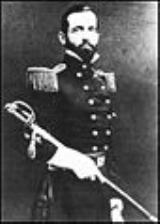
Richard B. Garnett

Encyclopedia
Richard Brooke Garnett was a career United States Army
officer and a Confederate
general in the American Civil War
. He was killed during Pickett's Charge
at the Battle of Gettysburg
.
, the son of William Henry Garnett and Anna Maria Brooke. He had a twin brother, William, who died in Norfolk in 1855. He was the cousin of Robert Selden Garnett
, also a Confederate general, who holds the dubious distinction of being the first general officer killed during the Civil War. Both of the cousins graduated from the United States Military Academy
in 1841, with Richard standing 29th out of 52 cadets, two spots below Robert. Garnett was commissioned as a second lieutenant in the 6th U.S. Infantry
and he served in a variety of posts in Florida
, fighting the Seminole
s, and then in the West, where he commanded Fort Laramie, rode with the Mormon Expedition
, and was a noted Indian fighter.
During the Mexican-American War, he served in staff positions in New Orleans, and was promoted to first lieutenant on February 16, 1847. He learned of the outbreak of the Civil War while serving in California
as a captain, the rank to which he had been promoted on May 9, 1855. Despite believing strongly that the Union
should not be dissolved, he returned to Virginia to fight for his native state and the Confederacy.
. His first assignment in Virginia was as a major
of artillery
in May, and then as lieutenant colonel
of Cobb's Georgia Legion on August 31. He was promoted to brigadier general on November 14, 1861, and commanded the 1st Brigade
of the Valley District
of the Confederate Army of the Potomac, which was the brigade originally formed by Thomas J. "Stonewall" Jackson
, the Stonewall Brigade
; Jackson was now in overall command in the Shenandoah Valley
.
During Jackson's Valley Campaign of 1862, Garnett's military career took a downward turn at the First Battle of Kernstown in March. Jackson marched his army 40 miles (64.4 km) to intercept a portion of the Union Army
under Maj. Gen.
Nathaniel P. Banks. On March 23, Jackson's cavalry commander, Col. Turner Ashby
, brought faulty intelligence that the retreating Union division
of Brig. Gen. James Shields
had four regiment
s in the rear outside Winchester, Virginia
. Since that force was of comparable size to Jackson's, he ordered Garnett and the Stonewall Brigade to attack. Unfortunately, Shields had a full infantry division on hand, almost 9,000 men, twice the size of Jackson's force. The attack went badly and Garnett, finding his brigade low on ammunition and surrounded by forces attacking from three sides, ordered a retreat. Jackson was infuriated and accused Garnett of disobeying orders, meaning that he should not have retreated without obtaining permission from Jackson first. Jackson, well known as a strict disciplinarian, arrested Garnett for "neglect of duty" on April 1 and relieved him of command. Garnett's court-martial
started in August 1862, with only Jackson and his aide giving testimony. However the trial was suspended due to the start of Gen. Robert E. Lee
's Northern Virginia Campaign
and the Second Battle of Bull Run
that September.
Lee ordered Jackson to release Garnett from arrest and he was assigned to command the injured George Pickett
's brigade in Lt. Gen. James Longstreet
's First Corps
in the Army of Northern Virginia
. Garnett commanded the brigade credibly at the Battle of Antietam
in September, after which he assumed permanent command of the brigade on November 26 when Pickett was promoted to divisional command, and at the Battle of Fredericksburg
that December. He did not participate in the Battle of Chancellorsville
in May 1863 because Longstreet's Corps was assigned duties in Suffolk, Virginia
.
Stonewall Jackson was gravely wounded at Chancellorsville and died soon after from pneumonia. Upon Jackson's death, Garnett returned to Richmond
where the general's body lay in state. Despite his professional disagreement with Jackson, Garnett held no ill will against him and was observed crying beside the casket. He then served as a pall bearer along with Longstreet, Richard S. Ewell
, and others.
 During the Gettysburg Campaign
, Garnett's brigade continued in the division of George Pickett and, due to the order of march, did not reach the battlefield from Chambersburg, Pennsylvania
, until late on the afternoon of July 2, 1863, missing the first two days of the Battle of Gettysburg
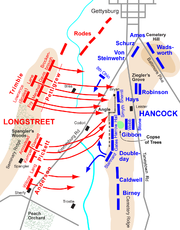
. Pickett's division was assigned by Gen. Lee to lead a great assault on the Union's center on Cemetery Ridge on July 3. Garnett's brigade was in the front rank of Pickett's division, on the left, next to Brig. Gen. James L. Kemper
's brigade. Garnett was in no shape to lead an infantry charge; he was suffering from fever and an injured leg when his horse kicked him and could not walk. But Garnett yearned to settle the record of his military dishonor from Kernstown, which the aborted court-martial could not. Despite protestations from other officers, Garnett insisted on leading his soldiers into battle on horseback, becoming a conspicuous target for Union riflemen.
Prior to starting out toward the Union defenses on Cemetery Hill
, Garnett conversed with Brig. Gen. Lewis Armistead
, another of Pickett's brigade commanders, about the proposed charge. Garnett reportedly said: "This is a desperate thing to attempt." to which Armistead added his prediction that "the slaughter will be terrible."
Garnett personally got within 20 yards of the "Angle" on Cemetery Ridge before he was killed, a bullet striking him in the head as he waved his hat to urge his men forward. His courier, Private Robert H. Irvine of the 19th Virginia, witnessed his death. Irvine's horse was hit and fell on Garnett, so the private pulled Garnett's body from underneath the animal and retrieved the general's watch, which he gave to the brigade adjutant. There are conflicting stories about whether Garnett's horse, a bay gelding, returned to the Confederate lines. Although Garnett was wearing a new uniform, somehow his body was never identified and he was buried by Union soldiers in a mass grave. Robert K. Krick presumes that his remains were later transferred to Hollywood Cemetery in Richmond. Garnett, Armistead, and Kemper were three of the 17 Confederate general-officer casualties during the three-day battle.
. The Hollywood Memorial Association erected a cenotaph
in Garnett's honor in 1991, making the assumption that his remains were in this group. Years after the war, Garnett's sword was located in a Baltimore pawnshop and was purchased by former Confederate Brig. Gen. George H. Steuart.
in the 1993 film Gettysburg, based on Michael Shaara's novel, The Killer Angels
. He reprised this role in 2003 in film's prequel Gods and Generals
, although uncredited and without any dialog.
instead. A letter to the editor of America's Civil War magazine claims that the Library of Congress possesses a photograph of Richard B. Garnett that has been mislabeled as "Franklin Gardner
, CSA, Born N.Y.C."
United States Army
The United States Army is the main branch of the United States Armed Forces responsible for land-based military operations. It is the largest and oldest established branch of the U.S. military, and is one of seven U.S. uniformed services...
officer and a Confederate
Confederate States of America
The Confederate States of America was a government set up from 1861 to 1865 by 11 Southern slave states of the United States of America that had declared their secession from the U.S...
general in the American Civil War
American Civil War
The American Civil War was a civil war fought in the United States of America. In response to the election of Abraham Lincoln as President of the United States, 11 southern slave states declared their secession from the United States and formed the Confederate States of America ; the other 25...
. He was killed during Pickett's Charge
Pickett's Charge
Pickett's Charge was an infantry assault ordered by Confederate Gen. Robert E. Lee against Maj. Gen. George G. Meade's Union positions on Cemetery Ridge on July 3, 1863, the last day of the Battle of Gettysburg during the American Civil War. Its futility was predicted by the charge's commander,...
at the Battle of Gettysburg
Battle of Gettysburg
The Battle of Gettysburg , was fought July 1–3, 1863, in and around the town of Gettysburg, Pennsylvania. The battle with the largest number of casualties in the American Civil War, it is often described as the war's turning point. Union Maj. Gen. George Gordon Meade's Army of the Potomac...
.
Early life
Garnett was born on the "Rose Hill" estate in Essex County, VirginiaEssex County, Virginia
As of the census of 2000, there were 9,989 people, 3,995 households, and 2,740 families residing in the county. The population density was 39 people per square mile . There were 4,926 housing units at an average density of 19 per square mile...
, the son of William Henry Garnett and Anna Maria Brooke. He had a twin brother, William, who died in Norfolk in 1855. He was the cousin of Robert Selden Garnett
Robert S. Garnett
Robert Selden Garnett was a career military officer, serving in the United States Army until the American Civil War, when he became a Confederate States Army brigadier general. He was the first general officer killed in the Civil War.-Early life and career:Garnett was born at the family plantation...
, also a Confederate general, who holds the dubious distinction of being the first general officer killed during the Civil War. Both of the cousins graduated from the United States Military Academy
United States Military Academy
The United States Military Academy at West Point is a four-year coeducational federal service academy located at West Point, New York. The academy sits on scenic high ground overlooking the Hudson River, north of New York City...
in 1841, with Richard standing 29th out of 52 cadets, two spots below Robert. Garnett was commissioned as a second lieutenant in the 6th U.S. Infantry
U.S. 6th Infantry Regiment
The 6th Infantry Regiment was formed in 1812. Its most famous commander was Zachary Taylor, later the twelfth President of the United States. The Motto, "Regulars, By God!" derives from the Battle of Chippawa, in which British general Riall noticed that the approaching regiment had on the uniforms...
and he served in a variety of posts in Florida
Florida
Florida is a state in the southeastern United States, located on the nation's Atlantic and Gulf coasts. It is bordered to the west by the Gulf of Mexico, to the north by Alabama and Georgia and to the east by the Atlantic Ocean. With a population of 18,801,310 as measured by the 2010 census, it...
, fighting the Seminole
Seminole
The Seminole are a Native American people originally of Florida, who now reside primarily in that state and Oklahoma. The Seminole nation emerged in a process of ethnogenesis out of groups of Native Americans, most significantly Creeks from what is now Georgia and Alabama, who settled in Florida in...
s, and then in the West, where he commanded Fort Laramie, rode with the Mormon Expedition
Utah War
The Utah War, also known as the Utah Expedition, Buchanan's Blunder, the Mormon War, or the Mormon Rebellion was an armed confrontation between LDS settlers in the Utah Territory and the armed forces of the United States government. The confrontation lasted from May 1857 until July 1858...
, and was a noted Indian fighter.
During the Mexican-American War, he served in staff positions in New Orleans, and was promoted to first lieutenant on February 16, 1847. He learned of the outbreak of the Civil War while serving in California
California
California is a state located on the West Coast of the United States. It is by far the most populous U.S. state, and the third-largest by land area...
as a captain, the rank to which he had been promoted on May 9, 1855. Despite believing strongly that the Union
Union (American Civil War)
During the American Civil War, the Union was a name used to refer to the federal government of the United States, which was supported by the twenty free states and five border slave states. It was opposed by 11 southern slave states that had declared a secession to join together to form the...
should not be dissolved, he returned to Virginia to fight for his native state and the Confederacy.
Civil War
Garnett resigned his commission in the U.S. Army on May 17, 1861, and entered the Confederate States ArmyConfederate States Army
The Confederate States Army was the army of the Confederate States of America while the Confederacy existed during the American Civil War. On February 8, 1861, delegates from the seven Deep South states which had already declared their secession from the United States of America adopted the...
. His first assignment in Virginia was as a major
Major
Major is a rank of commissioned officer, with corresponding ranks existing in almost every military in the world.When used unhyphenated, in conjunction with no other indicator of rank, the term refers to the rank just senior to that of an Army captain and just below the rank of lieutenant colonel. ...
of artillery
Field artillery in the American Civil War
Field artillery in the American Civil War refers to the important artillery weapons, equipment, and practices used by the Artillery branch to support the infantry and cavalry forces in the field. It does not include siege artillery, use of artillery in fixed fortifications, or coastal or naval...
in May, and then as lieutenant colonel
Lieutenant colonel
Lieutenant colonel is a rank of commissioned officer in the armies and most marine forces and some air forces of the world, typically ranking above a major and below a colonel. The rank of lieutenant colonel is often shortened to simply "colonel" in conversation and in unofficial correspondence...
of Cobb's Georgia Legion on August 31. He was promoted to brigadier general on November 14, 1861, and commanded the 1st Brigade
Brigade
A brigade is a major tactical military formation that is typically composed of two to five battalions, plus supporting elements depending on the era and nationality of a given army and could be perceived as an enlarged/reinforced regiment...
of the Valley District
Valley District
The Valley District was an organization of the Confederate States Army and subsection of the Department of Northern Virginia during the American Civil War, responsible for operations between the Blue Ridge Mountains and Allegheny Mountains of Virginia. It was created on October 22, 1861, and was...
of the Confederate Army of the Potomac, which was the brigade originally formed by Thomas J. "Stonewall" Jackson
Stonewall Jackson
ຄຽשת״ׇׂׂׂׂ֣|birth_place= Clarksburg, Virginia |death_place=Guinea Station, Virginia|placeofburial=Stonewall Jackson Memorial CemeteryLexington, Virginia|placeofburial_label= Place of burial|image=...
, the Stonewall Brigade
Stonewall Brigade
The Stonewall Brigade of the Confederate Army during the American Civil War, was a famous combat unit in United States military history. It was trained and first led by General Thomas J. "Stonewall" Jackson, a professor from Virginia Military Institute...
; Jackson was now in overall command in the Shenandoah Valley
Shenandoah Valley
The Shenandoah Valley is both a geographic valley and cultural region of western Virginia and West Virginia in the United States. The valley is bounded to the east by the Blue Ridge Mountains, to the west by the eastern front of the Ridge-and-Valley Appalachians , to the north by the Potomac River...
.
During Jackson's Valley Campaign of 1862, Garnett's military career took a downward turn at the First Battle of Kernstown in March. Jackson marched his army 40 miles (64.4 km) to intercept a portion of the Union Army
Union Army
The Union Army was the land force that fought for the Union during the American Civil War. It was also known as the Federal Army, the U.S. Army, the Northern Army and the National Army...
under Maj. Gen.
Major general (United States)
In the United States Army, United States Marine Corps, and United States Air Force, major general is a two-star general-officer rank, with the pay grade of O-8. Major general ranks above brigadier general and below lieutenant general...
Nathaniel P. Banks. On March 23, Jackson's cavalry commander, Col. Turner Ashby
Turner Ashby
Turner Ashby, Jr. was a Confederate cavalry commander in the American Civil War. He had achieved prominence as Thomas J. "Stonewall" Jackson's cavalry commander, in the grade of colonel, in the Shenandoah Valley before he was killed in battle in 1862...
, brought faulty intelligence that the retreating Union division
Division (military)
A division is a large military unit or formation usually consisting of between 10,000 and 20,000 soldiers. In most armies, a division is composed of several regiments or brigades, and in turn several divisions typically make up a corps...
of Brig. Gen. James Shields
James Shields
James Shields was an American politician and United States Army officer who was born in Altmore, County Tyrone, Ireland. Shields, a Democrat, is the only person in United States history to serve as a U.S. Senator for three different states...
had four regiment
Regiment
A regiment is a major tactical military unit, composed of variable numbers of batteries, squadrons or battalions, commanded by a colonel or lieutenant colonel...
s in the rear outside Winchester, Virginia
Winchester, Virginia
Winchester is an independent city located in the northwestern portion of the Commonwealth of Virginia in the USA. The city's population was 26,203 according to the 2010 Census...
. Since that force was of comparable size to Jackson's, he ordered Garnett and the Stonewall Brigade to attack. Unfortunately, Shields had a full infantry division on hand, almost 9,000 men, twice the size of Jackson's force. The attack went badly and Garnett, finding his brigade low on ammunition and surrounded by forces attacking from three sides, ordered a retreat. Jackson was infuriated and accused Garnett of disobeying orders, meaning that he should not have retreated without obtaining permission from Jackson first. Jackson, well known as a strict disciplinarian, arrested Garnett for "neglect of duty" on April 1 and relieved him of command. Garnett's court-martial
Court-martial
A court-martial is a military court. A court-martial is empowered to determine the guilt of members of the armed forces subject to military law, and, if the defendant is found guilty, to decide upon punishment.Most militaries maintain a court-martial system to try cases in which a breach of...
started in August 1862, with only Jackson and his aide giving testimony. However the trial was suspended due to the start of Gen. Robert E. Lee
Robert E. Lee
Robert Edward Lee was a career military officer who is best known for having commanded the Confederate Army of Northern Virginia in the American Civil War....
's Northern Virginia Campaign
Northern Virginia Campaign
The Northern Virginia Campaign, also known as the Second Bull Run Campaign or Second Manassas Campaign, was a series of battles fought in Virginia during August and September 1862 in the Eastern Theater of the American Civil War. Confederate General Robert E...
and the Second Battle of Bull Run
Second Battle of Bull Run
The Second Battle of Bull Run or Second Manassas was fought August 28–30, 1862, as part of the American Civil War. It was the culmination of an offensive campaign waged by Confederate Gen. Robert E. Lee's Army of Northern Virginia against Union Maj. Gen...
that September.
Lee ordered Jackson to release Garnett from arrest and he was assigned to command the injured George Pickett
George Pickett
George Edward Pickett was a career United States Army officer who became a general in the Confederate States Army during the American Civil War...
's brigade in Lt. Gen. James Longstreet
James Longstreet
James Longstreet was one of the foremost Confederate generals of the American Civil War and the principal subordinate to General Robert E. Lee, who called him his "Old War Horse." He served under Lee as a corps commander for many of the famous battles fought by the Army of Northern Virginia in the...
's First Corps
First Corps, Army of Northern Virginia
The First Corps, Army of Northern Virginia was a military unit fighting for the Confederate States of America in the American Civil War. It was formed in early 1861 and served until the spring of 1865, mostly in the Eastern Theater. The corps was commanded by James Longstreet for much of its...
in the Army of Northern Virginia
Army of Northern Virginia
The Army of Northern Virginia was the primary military force of the Confederate States of America in the Eastern Theater of the American Civil War, as well as the primary command structure of the Department of Northern Virginia. It was most often arrayed against the Union Army of the Potomac...
. Garnett commanded the brigade credibly at the Battle of Antietam
Battle of Antietam
The Battle of Antietam , fought on September 17, 1862, near Sharpsburg, Maryland, and Antietam Creek, as part of the Maryland Campaign, was the first major battle in the American Civil War to take place on Northern soil. It was the bloodiest single-day battle in American history, with about 23,000...
in September, after which he assumed permanent command of the brigade on November 26 when Pickett was promoted to divisional command, and at the Battle of Fredericksburg
Battle of Fredericksburg
The Battle of Fredericksburg was fought December 11–15, 1862, in and around Fredericksburg, Virginia, between General Robert E. Lee's Confederate Army of Northern Virginia and the Union Army of the Potomac, commanded by Maj. Gen. Ambrose E. Burnside...
that December. He did not participate in the Battle of Chancellorsville
Battle of Chancellorsville
The Battle of Chancellorsville was a major battle of the American Civil War, and the principal engagement of the Chancellorsville Campaign. It was fought from April 30 to May 6, 1863, in Spotsylvania County, Virginia, near the village of Chancellorsville. Two related battles were fought nearby on...
in May 1863 because Longstreet's Corps was assigned duties in Suffolk, Virginia
Suffolk, Virginia
Suffolk is the largest city by area in Virginia, United States, and is located in the Hampton Roads metropolitan area. As of the 2010 census, the city had a total population of 84,585. Its median household income was $57,546.-History:...
.
Stonewall Jackson was gravely wounded at Chancellorsville and died soon after from pneumonia. Upon Jackson's death, Garnett returned to Richmond
Richmond, Virginia
Richmond is the capital of the Commonwealth of Virginia, in the United States. It is an independent city and not part of any county. Richmond is the center of the Richmond Metropolitan Statistical Area and the Greater Richmond area...
where the general's body lay in state. Despite his professional disagreement with Jackson, Garnett held no ill will against him and was observed crying beside the casket. He then served as a pall bearer along with Longstreet, Richard S. Ewell
Richard S. Ewell
Richard Stoddert Ewell was a career United States Army officer and a Confederate general during the American Civil War. He achieved fame as a senior commander under Stonewall Jackson and Robert E...
, and others.
Gettysburg and death
Gettysburg Campaign
The Gettysburg Campaign was a series of battles fought in June and July 1863, during the American Civil War. After his victory in the Battle of Chancellorsville, Confederate General Robert E. Lee's Army of Northern Virginia moved north for offensive operations in Maryland and Pennsylvania. The...
, Garnett's brigade continued in the division of George Pickett and, due to the order of march, did not reach the battlefield from Chambersburg, Pennsylvania
Chambersburg, Pennsylvania
Chambersburg is a borough in the South Central region of Pennsylvania, United States. It is miles north of Maryland and the Mason-Dixon line and southwest of Harrisburg in the Cumberland Valley, which is part of the Great Appalachian Valley. Chambersburg is the county seat of Franklin County...
, until late on the afternoon of July 2, 1863, missing the first two days of the Battle of Gettysburg
Battle of Gettysburg
The Battle of Gettysburg , was fought July 1–3, 1863, in and around the town of Gettysburg, Pennsylvania. The battle with the largest number of casualties in the American Civil War, it is often described as the war's turning point. Union Maj. Gen. George Gordon Meade's Army of the Potomac...
. Pickett's division was assigned by Gen. Lee to lead a great assault on the Union's center on Cemetery Ridge on July 3. Garnett's brigade was in the front rank of Pickett's division, on the left, next to Brig. Gen. James L. Kemper
James L. Kemper
James Lawson Kemper was a lawyer, a Confederate general in the American Civil War, and the 37th Governor of Virginia...
's brigade. Garnett was in no shape to lead an infantry charge; he was suffering from fever and an injured leg when his horse kicked him and could not walk. But Garnett yearned to settle the record of his military dishonor from Kernstown, which the aborted court-martial could not. Despite protestations from other officers, Garnett insisted on leading his soldiers into battle on horseback, becoming a conspicuous target for Union riflemen.
Prior to starting out toward the Union defenses on Cemetery Hill
Cemetery Hill
Cemetery Hill is a Gettysburg Battlefield landform which had 1863 military engagements each day of the July 1–3 Battle of Gettysburg. The northernmost part of the Army of the Potomac defensive "fish-hook" line, the hill is gently sloped and provided a site for American Civil War artillery...
, Garnett conversed with Brig. Gen. Lewis Armistead
Lewis Addison Armistead
Lewis Addison Armistead was a Confederate brigadier general in the American Civil War, who was wounded, captured, and died after Pickett's Charge at the Battle of Gettysburg.-Early life:...
, another of Pickett's brigade commanders, about the proposed charge. Garnett reportedly said: "This is a desperate thing to attempt." to which Armistead added his prediction that "the slaughter will be terrible."
Garnett personally got within 20 yards of the "Angle" on Cemetery Ridge before he was killed, a bullet striking him in the head as he waved his hat to urge his men forward. His courier, Private Robert H. Irvine of the 19th Virginia, witnessed his death. Irvine's horse was hit and fell on Garnett, so the private pulled Garnett's body from underneath the animal and retrieved the general's watch, which he gave to the brigade adjutant. There are conflicting stories about whether Garnett's horse, a bay gelding, returned to the Confederate lines. Although Garnett was wearing a new uniform, somehow his body was never identified and he was buried by Union soldiers in a mass grave. Robert K. Krick presumes that his remains were later transferred to Hollywood Cemetery in Richmond. Garnett, Armistead, and Kemper were three of the 17 Confederate general-officer casualties during the three-day battle.
In memoriam
In 1872, remains of Confederate dead were brought from Gettysburg and reinterred to Hollywood Cemetery in Richmond, VirginiaRichmond, Virginia
Richmond is the capital of the Commonwealth of Virginia, in the United States. It is an independent city and not part of any county. Richmond is the center of the Richmond Metropolitan Statistical Area and the Greater Richmond area...
. The Hollywood Memorial Association erected a cenotaph
Cenotaph
A cenotaph is an "empty tomb" or a monument erected in honour of a person or group of people whose remains are elsewhere. It can also be the initial tomb for a person who has since been interred elsewhere. The word derives from the Greek κενοτάφιον = kenotaphion...
in Garnett's honor in 1991, making the assumption that his remains were in this group. Years after the war, Garnett's sword was located in a Baltimore pawnshop and was purchased by former Confederate Brig. Gen. George H. Steuart.
In popular media
Garnett was portrayed by American actor Andrew PrineAndrew Prine
Andrew Lewis Prine is an American film, stage, and television actor.-Early life and career:Prine was born in Jennings, Florida. After graduation from Andrew Jackson High School in Miami, Prine made his acting debut three years later in an episode of CBS U.S. Steel Hour...
in the 1993 film Gettysburg, based on Michael Shaara's novel, The Killer Angels
The Killer Angels
The Killer Angels is a historical novel by Michael Shaara that was awarded the Pulitzer Prize for Fiction in 1975. The book tells the story of four days of the Battle of Gettysburg in the American Civil War: June 30, 1863, as the troops of both the Union and the Confederacy move into battle around...
. He reprised this role in 2003 in film's prequel Gods and Generals
Gods and Generals (film)
Gods and Generals is a 2003 American film based on the novel Gods and Generals by Jeffrey Shaara. It depicts events that take place prior to those shown in the 1993 film Gettysburg, which was based on The Killer Angels, a novel by Shaara's father, Michael...
, although uncredited and without any dialog.
Disputed photograph
The photograph of Richard Garnett in this article is one of only two known and it may in fact be of his cousin Robert S. GarnettRobert S. Garnett
Robert Selden Garnett was a career military officer, serving in the United States Army until the American Civil War, when he became a Confederate States Army brigadier general. He was the first general officer killed in the Civil War.-Early life and career:Garnett was born at the family plantation...
instead. A letter to the editor of America's Civil War magazine claims that the Library of Congress possesses a photograph of Richard B. Garnett that has been mislabeled as "Franklin Gardner
Franklin Gardner
Franklin Gardner was a Confederate general in the American Civil War, best noted for his service at the Siege of Port Hudson.-Early life:...
, CSA, Born N.Y.C."