

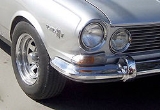
Renault Torino

Encyclopedia
The IKA Torino, later Renault Torino, is a mid-sized
automobile
made by Industrias Kaiser Argentina
(IKA) under an agreement with American Motors
(AMC) in 1966. The 1966 Torino was IKA’s first integral national product and IKA was eventually bought out by Renault
in 1975 to form Renault Argentina S.A. The Torino was built on the same AMC platform
all the way through 1981 in both two-door hardtop
and four-door sedan variants. It has been called Argentina's national car.
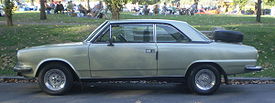
 The Torino began life as an Argentine hybrid of AMC's 1964-65 Rambler American
with exclusively designed front and rear body panels, bumpers and interior. One unique feature is the Torino's front unibody
"frame rails
" that came from the bigger 1963-1964 Rambler Classic
and made up for a beefier front end, adapting the car to the rougher road conditions of Argentina at the time, and unlike the American, the Torino rode on a slightly longer by one inch wheelbase of 2723 mm (107-inch). Although the engines were not obtained from American Motors, the vehicle's basic AMC platform continued throughout its lifetime. As upgrades were incorporated over the years, such as AMC's flush door handles, the Torino became mostly a product of Argentina with few imported parts.
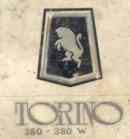
 The car's badging was based on the city of Turin
's coat of arms
. The symbol was a bull
standing on its two hind legs, mimicking the prancing stallion
symbol of Ferrari
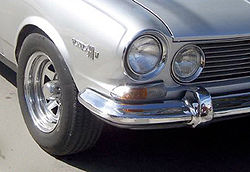
. The Argentine car's front end, rear fascia
, and interior were redesigned by Italian auto stylists at Pininfarina
to give it a more Europe
an look, as well as to make the Torino more appealing to the Argentine public and less like an American car. With the added exterior styling touches, as well as its unique trim and luxurious interior appointments, the Torino was truly a product of Argentina.
Between 1970 and 1976, the Torino was sold as a "luxury vehicle". Famous owners included Fidel Castro
, Leonid Brezhnev
, and Muammar al-Gaddafi
.
From 1977, the top model became the Torino Grand Routier, a touring sedan. The entire range received some sheetmetal and design changes in 1978, (when IKA became Renault Argentina) though major panels such as the doors were carried over. The newer models were slightly longer and the later sedans can be recognized by their full C-pillar
. Previously the rear window wrapped into the sides more.
In its final year, the Torino was only available in two models (Grand Routier GR sedan and ZX Coupé), while in its heyday there were over twenty versions.
(OHC) straight-6 (I6) Jeep Tornado engine
s that were originally developed by Kaiser Motors
in 1963 for the new Jeep Gladiator
pickups and Wagoneer
four wheel drive vehicles. This engine was produced in Argentina and increased the domestic or local sourced content of the car. At the Torino's debut on 30 November, 1966, at the Municipal Racing circuit of Buenos Aires (which was used for the Formula 1 race every year), three models were available: a 4-door sedan with 3 l (183 cu in) and 3-speed transmission, a 2-door coupe with 3.0 L featuring a Holley
carburetor
and a 4-speed ZF manual gearbox
, as well as a top-of-the-line "380W" model equipped with an enlarged 3.77 L engine with three (3) horizontally mounted Weber
2-barrel carburetors. The 3.77 L produced 215 hp making the 380W capable of a 205 kilometres per hour (127 mph) top speed.
" in 1969, with a Torino finishing in third place.
Today they are still being raced in "Turismo Carretera
", "TC4000" and "Turismo Zonal" categories.
Renault, a rarity in itself.
Many Argentines think of the Torino as the national car, it became popular with the tuning industry, parts are still available and fan clubs abound.
Mid-size car
A mid-size car is the North American/Australian standard for an automobile with a size equal to or greater than that of a compact...
automobile
Automobile
An automobile, autocar, motor car or car is a wheeled motor vehicle used for transporting passengers, which also carries its own engine or motor...
made by Industrias Kaiser Argentina
Industrias Kaiser Argentina
Industrias Kaiser Argentina S.A. or IKA was an Argentine motor company established in 1956 in Córdoba Province as a joint venture with Kaiser Motors of the United States....
(IKA) under an agreement with American Motors
American Motors
American Motors Corporation was an American automobile company formed by the 1954 merger of Nash-Kelvinator Corporation and Hudson Motor Car Company. At the time, it was the largest corporate merger in U.S. history.George W...
(AMC) in 1966. The 1966 Torino was IKA’s first integral national product and IKA was eventually bought out by Renault
Renault
Renault S.A. is a French automaker producing cars, vans, and in the past, autorail vehicles, trucks, tractors, vans and also buses/coaches. Its alliance with Nissan makes it the world's third largest automaker...
in 1975 to form Renault Argentina S.A. The Torino was built on the same AMC platform
Automobile platform
An automobile platform is a shared set of common design, engineering, and production efforts, as well as major components over a number of outwardly distinct models and even types of automobiles, often from different, but related marques...
all the way through 1981 in both two-door hardtop
Hardtop
A hardtop is a term for a rigid, rather than canvas, automobile roof. It has been used in several contexts: detachable hardtops, retractable hardtop roofs, and the so-called pillarless hardtop body style....
and four-door sedan variants. It has been called Argentina's national car.
Design
Rambler American
The Rambler American is an automobile manufactured by the American Motors Corporation between 1958 and 1969. The American was the second incarnation of AMC's forerunner Nash Motors second-generation Rambler compact that was sold under the Nash and Hudson Motors marques from 1954 and 1955.The...
with exclusively designed front and rear body panels, bumpers and interior. One unique feature is the Torino's front unibody
Monocoque
Monocoque is a construction technique that supports structural load by using an object's external skin, as opposed to using an internal frame or truss that is then covered with a non-load-bearing skin or coachwork...
"frame rails
Subframe
A subframe is a structural component of a vehicle, such as an automobile or an aircraft, that uses a discrete, separate structure within a larger body-on-frame or unit body to carry certain components, such as the engine, drivetrain, or suspension. The subframe is bolted and/or welded to the vehicle...
" that came from the bigger 1963-1964 Rambler Classic
Rambler Classic
The Rambler Classic was an intermediate sized automobile that was built and sold by American Motors Corporation from model year 1961 to 1966...
and made up for a beefier front end, adapting the car to the rougher road conditions of Argentina at the time, and unlike the American, the Torino rode on a slightly longer by one inch wheelbase of 2723 mm (107-inch). Although the engines were not obtained from American Motors, the vehicle's basic AMC platform continued throughout its lifetime. As upgrades were incorporated over the years, such as AMC's flush door handles, the Torino became mostly a product of Argentina with few imported parts.
Turin
Turin is a city and major business and cultural centre in northern Italy, capital of the Piedmont region, located mainly on the left bank of the Po River and surrounded by the Alpine arch. The population of the city proper is 909,193 while the population of the urban area is estimated by Eurostat...
's coat of arms
Coat of arms
A coat of arms is a unique heraldic design on a shield or escutcheon or on a surcoat or tabard used to cover and protect armour and to identify the wearer. Thus the term is often stated as "coat-armour", because it was anciently displayed on the front of a coat of cloth...
. The symbol was a bull
Bull
Bull usually refers to an uncastrated adult male bovine.Bull may also refer to:-Entertainment:* Bull , an original show on the TNT Network* "Bull" , an episode of television series CSI: Crime Scene Investigation...
standing on its two hind legs, mimicking the prancing stallion
Stallion
A Stallion is a male horse.Stallion may also refer to:* Stallion , an American pop rock group* Stallion , a figure in the Gobot toyline* Stallion , a character in the console role-playing game series...
symbol of Ferrari
Ferrari
Ferrari S.p.A. is an Italian sports car manufacturer based in Maranello, Italy. Founded by Enzo Ferrari in 1929, as Scuderia Ferrari, the company sponsored drivers and manufactured race cars before moving into production of street-legal vehicles as Ferrari S.p.A. in 1947...
. The Argentine car's front end, rear fascia
Fascia (car)
Confusingly, fascia is used for several different things in the automotive world. Many of these meanings are related to the appearance of the car....
, and interior were redesigned by Italian auto stylists at Pininfarina
Pininfarina
Pininfarina S.p.A. is an Italian car design firm and coachbuilder in Cambiano, Italy.Founded as Società anonima Carrozzeria Pinin Farina in 1930 by automobile designer and builder Battista "Pinin" Farina, Pininfarina has been employed by a wide variety of high-end automobile manufacturers,...
to give it a more Europe
Europe
Europe is, by convention, one of the world's seven continents. Comprising the westernmost peninsula of Eurasia, Europe is generally 'divided' from Asia to its east by the watershed divides of the Ural and Caucasus Mountains, the Ural River, the Caspian and Black Seas, and the waterways connecting...
an look, as well as to make the Torino more appealing to the Argentine public and less like an American car. With the added exterior styling touches, as well as its unique trim and luxurious interior appointments, the Torino was truly a product of Argentina.
Between 1970 and 1976, the Torino was sold as a "luxury vehicle". Famous owners included Fidel Castro
Fidel Castro
Fidel Alejandro Castro Ruz is a Cuban revolutionary and politician, having held the position of Prime Minister of Cuba from 1959 to 1976, and then President from 1976 to 2008. He also served as the First Secretary of the Communist Party of Cuba from the party's foundation in 1961 until 2011...
, Leonid Brezhnev
Leonid Brezhnev
Leonid Ilyich Brezhnev – 10 November 1982) was the General Secretary of the Central Committee of the Communist Party of the Soviet Union , presiding over the country from 1964 until his death in 1982. His eighteen-year term as General Secretary was second only to that of Joseph Stalin in...
, and Muammar al-Gaddafi
Muammar al-Gaddafi
Muammar Muhammad Abu Minyar Gaddafi or "September 1942" 20 October 2011), commonly known as Muammar Gaddafi or Colonel Gaddafi, was the official ruler of the Libyan Arab Republic from 1969 to 1977 and then the "Brother Leader" of the Libyan Arab Jamahiriya from 1977 to 2011.He seized power in a...
.
From 1977, the top model became the Torino Grand Routier, a touring sedan. The entire range received some sheetmetal and design changes in 1978, (when IKA became Renault Argentina) though major panels such as the doors were carried over. The newer models were slightly longer and the later sedans can be recognized by their full C-pillar
Pillar (car)
Pillars are the vertical supports of the greenhouse of an automobile — known respectively as the A, B, C or D-pillar moving in profile view from the front to rear....
. Previously the rear window wrapped into the sides more.
In its final year, the Torino was only available in two models (Grand Routier GR sedan and ZX Coupé), while in its heyday there were over twenty versions.
Engines
Rather than using AMC engines, the Torino was equipped with 3.77 l (230 cu in) overhead camshaftOverhead camshaft
Overhead cam valvetrain configurations place the engine camshaft within the cylinder heads, above the combustion chambers, and drive the valves or lifters in a more direct manner compared to overhead valves and pushrods...
(OHC) straight-6 (I6) Jeep Tornado engine
Jeep Tornado engine
The Jeep 6-230 Tornado engine was a postwar U.S. designed mass-produced overhead cam automobile engine. It was introduced in mid-year 1962 and replaced the flathead 6-226 Super Hurricane, which had been in use since 1954. It is still the only engine designed, developed, and built by Jeep and used...
s that were originally developed by Kaiser Motors
Kaiser Motors
Kaiser Motors Corporation made automobiles at Willow Run, Michigan, United States, from 1945 to 1953. In 1953, Kaiser merged with Willys-Overland to form Willys Motors Incorporated, moving its production operations to the Willys plant at Toledo, Ohio...
in 1963 for the new Jeep Gladiator
Jeep Gladiator
The Jeep Gladiator is a full-size pickup truck based on the large SJ platform that was built under varying marques from 1962 to 1988. The Jeep pickup design was noteworthy for being in production for more than 26 years with only minor mechanical changes...
pickups and Wagoneer
Jeep Wagoneer
The Jeep Wagoneer was an early sport utility vehicle and the first luxury 4x4, produced under varying marques from 1963 to 1991. It was noteworthy for being in production for more than 28 years with only minor mechanical changes...
four wheel drive vehicles. This engine was produced in Argentina and increased the domestic or local sourced content of the car. At the Torino's debut on 30 November, 1966, at the Municipal Racing circuit of Buenos Aires (which was used for the Formula 1 race every year), three models were available: a 4-door sedan with 3 l (183 cu in) and 3-speed transmission, a 2-door coupe with 3.0 L featuring a Holley
Holley Performance Products
Holley Performance Products is an automotive performance company based in Bowling Green, Kentucky. Holley, when based in Michigan, was one of the major producers of carburetors, being supplied as standard equipment on many Detroit-built automobiles....
carburetor
Carburetor
A carburetor , carburettor, or carburetter is a device that blends air and fuel for an internal combustion engine. It is sometimes shortened to carb in North America and the United Kingdom....
and a 4-speed ZF manual gearbox
ZF Friedrichshafen
ZF Friedrichshafen AG, also known as ZF Group, and commonly abbreviated to ZF, is a German public company headquartered in Friedrichshafen, in the south-west German region of Baden-Württemberg....
, as well as a top-of-the-line "380W" model equipped with an enlarged 3.77 L engine with three (3) horizontally mounted Weber
Weber carburetor
Weber is an Italian company producing carburetors, currently owned by Magneti Marelli Powertrain S.p.A., in turn part of the Fiat Group.The company was established as...
2-barrel carburetors. The 3.77 L produced 215 hp making the 380W capable of a 205 kilometres per hour (127 mph) top speed.
Racing
The car was successful in Argentina, and, when released, it placed well in international races against famous sport cars. The most important race was the "84 hours of NürburgringNürburgring
The Nürburgring is a motorsport complex around the village of Nürburg, Germany. It features a modern Grand Prix race track built in 1984, and a much longer old North loop track which was built in the 1920s around the village and medieval castle of Nürburg in the Eifel mountains. It is located about...
" in 1969, with a Torino finishing in third place.
Today they are still being raced in "Turismo Carretera
Turismo Carretera
Turismo Carretera is a popular touring car racing series in Argentina, and the oldest car racing series still active in the world....
", "TC4000" and "Turismo Zonal" categories.
Legacy
By the late 1970s the Torino was the only non-Renault product manufactured by the French company. It could also be considered the last front-engine, rear wheel driveFront-engine, rear-wheel drive layout
In automotive design, an FR, or Front-engine, Rear-wheel drive layout is one where the engine is located at the front of the vehicle and driven wheels are located at the rear. This was the traditional automobile layout for most of the 20th century....
Renault, a rarity in itself.
Many Argentines think of the Torino as the national car, it became popular with the tuning industry, parts are still available and fan clubs abound.