
All Topics  
Jeep Wagoneer

 
Jeep Wagoneer

   Email Print
   Bookmark   Link


Jeep Wagoneer


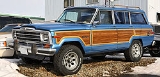
The Jeep Wagoneer was an early sport utility vehicle
Sport utility vehicle

A sport utility vehicle is a generic marketing description for a vehicle similar to a station wagon but built on a light-truck chassis. Usually equipped with four-wheel drive for on or off-road ability, some SUVs include the towing capacity of a pickup truck with the passenger-carrying space of a minivan....
 (SUV), produced under varying marque
Marque

A marque is a brand name, especially in the automobile industry. For example, Chevrolet and Pontiac are marques of their maker, General Motors Corporation ....
s from 1963 to 1991. It was noteworthy for being in production for more than 28 years with only minor mechanical changes. An overhead cam
Overhead camshaft

Overhead camshaft, commonly abbreviated to OHC, valvetrain configurations place the engine camshaft within the cylinder heads, above the combustion chambers, and drive the poppet valve or tappets in a more direct manner compared to overhead valves and pushrods....
 engine
Internal combustion engine

The internal combustion engine is an engine in which the combustion of a fuel occurs in a combustion chamber inside and integral to the engine. In an internal combustion engine it is always the expansion of the high temperature and pressure gases that are produced by the combustion which apply force to the movable component of the engine, such as...
, along with independent front suspension (both later discontinued), supplemented with features unheard of in any other 4WD
Four-wheel drive

Four-wheel drive, 4WD, 4x4 , or AWD is a four-wheeled vehicle with a Powertrain that allows all four wheels to receive torque from the engine simultaneously....
 vehicle (including power steering and automatic transmission), made it revolutionary at the time.


Discussion
Ask a question about 'Jeep Wagoneer'
Start a new discussion about 'Jeep Wagoneer'
Answer questions from other users
Full Discussion Forum


Encyclopedia


The Jeep Wagoneer was an early sport utility vehicle
Sport utility vehicle

A sport utility vehicle is a generic marketing description for a vehicle similar to a station wagon but built on a light-truck chassis. Usually equipped with four-wheel drive for on or off-road ability, some SUVs include the towing capacity of a pickup truck with the passenger-carrying space of a minivan....
 (SUV), produced under varying marque
Marque

A marque is a brand name, especially in the automobile industry. For example, Chevrolet and Pontiac are marques of their maker, General Motors Corporation ....
s from 1963 to 1991. It was noteworthy for being in production for more than 28 years with only minor mechanical changes. An overhead cam
Overhead camshaft

Overhead camshaft, commonly abbreviated to OHC, valvetrain configurations place the engine camshaft within the cylinder heads, above the combustion chambers, and drive the poppet valve or tappets in a more direct manner compared to overhead valves and pushrods....
 engine
Internal combustion engine

The internal combustion engine is an engine in which the combustion of a fuel occurs in a combustion chamber inside and integral to the engine. In an internal combustion engine it is always the expansion of the high temperature and pressure gases that are produced by the combustion which apply force to the movable component of the engine, such as...
, along with independent front suspension (both later discontinued), supplemented with features unheard of in any other 4WD
Four-wheel drive

Four-wheel drive, 4WD, 4x4 , or AWD is a four-wheeled vehicle with a Powertrain that allows all four wheels to receive torque from the engine simultaneously....
 vehicle (including power steering and automatic transmission), made it revolutionary at the time. A solid front axle was available as well. Compared with offerings from International Harvester and Land Rover — which were producing utilitarian work-oriented vehicles that were quite spartan and truck-like on the inside — the Wagoneer was the first true luxury 4x4. The Wagoneer is based on the Jeep SJ
Jeep SJ

Jeep's SJ automobile platform was part of the "FSJ" or full-size Jeep lineup. According to the , an "FSJ" is any vehicle produced in North America, carrying the "Jeep" nameplate, with 2 or 4 doors, in rear wheel drive or four wheel drive, whose wheelbase does not exceed 132 in, nor is less than 109 in, and whose tread width is no more than 67...
 platform. It debuted seven years (24 years in the United States) before the Land Rover Range Rover. It was also one of the last few vehicles sold in the United States that still used a carburetor
Carburetor

A carburetor or carburettor , is a device that blends Earth's atmosphere and fuel for an internal combustion engine. It was invented by Karl Benz before 1885 and patented in 1886....
, well after most other vehicles had switched to fuel injection
Fuel injection

Fuel injection is a system for mixing fuel with air in an internal combustion engine. It has become the primary fuel delivery system used in gasoline Automobile engines, having almost completely replaced carburetors in the late 1980s....
. Only Isuzu
Isuzu

, is a Japanese car, commercial vehicle and heavy truck manufacturing corporation, headquartered in Tokyo. In 2005, Isuzu became the world's largest manufacturer of medium to heavy duty trucks....
 with its base-model pickup truck would hold out longer, selling its last carbureted vehicle in 1993.

The Willys and Kaiser years

Conceived in the early 1960s while Willys
Willys

Willys was the marque used by the United States automobile company, Willys-Overland Motors, best known for its design and production of military Jeeps and civilian versions , during the twentieth century....
 Motors was owned by Kaiser Industries, the Wagoneer replaced the original Jeep station wagon
Willys Jeep Wagon

The Willys Jeep Station Wagon is the first all-steel station wagon and is arguably the world's first sport utility vehicle . It was designed in 1946 by industrial designer Brooks Stevens and stayed in production until 1963....
, which dated to 1946. With competition from the Big Three
Big three

The term Big Three may refer to:...
 advancing on Jeep's four-wheel-drive market, Willys management decided that a new and more advanced vehicle was needed.

The new 1963 Wagoneer, like its long-lived predecessor (which would, in fact, be sold alongside its replacement in the U.S. until 1965), was designed by industrial designer Brooks Stevens
Brooks Stevens

Clifford Brooks Stevens was an American industrial designer of home furnishings and appliances, automobile and motor cycles, as well as a graphic designer and stylist....
. Willys' engineering staff, under the direction of A.C. Sampietro, handled the technical development. The cost of development was around US$
United States dollar

The United States dollar is the unit of currency of the United States and was defined by the Coinage Act of 1792 to be between 371 and 416 grains of silver ....
20 million.

The original Wagoneer was a full-size, body-on-frame vehicle which shared its architecture with the Jeep Gladiator
Jeep Gladiator

The Jeep Gladiator was a full-size pickup truck based on the Jeep SJ Jeep Wagoneer SUV. It was introduced in 1962. Gladiator designations were: J200 for short wheelbase trucks up to mid 1965 followed by J2000; J300 for long wheelbase trucks up to mid 1965 followed by J3000; and J4000 which was the first model with the longer wheelbas...
 pickup truck
Pickup truck

A pickup truck is a light motor vehicle with an open-top rear cargo area which is almost always separated from the cab to allow for chassis flex when carrying or pulling heavy loads....
. It was originally available in two and four-door body styles, with the two-door also available as a panel truck
Panel truck

A panel truck is a windowless cargo van built on a truck chassis. Similar in function to its smaller cousin, the sedan delivery; which is a station wagon with no backseat, and no side windows aft of the front doors....
 with windowless sides behind the doors and double "barn doors" in the rear instead of the usual tailgate and roll-down rear window.

Early Wagoneers were powered by Willys' new "Tornado" SOHC six-cylinder engine, which had debuted in 1962 as an option for Jeep's older-style station wagons. The engine developed and was noted for being quite fuel-efficient for its day. However, the engine was not without its problems; cooling issues were fairly common. And, in higher-altitude locales, "pinging" was a problem, leading the company to introduce a lower-compression version of the Tornado that developed for 1964.

1963-1964
In early 1963, Willys Motors changed its name to Kaiser Jeep Corporation. This was to associate Jeep in the public consciousness with Kaiser's family of companies, said company president Steven Girard. Early Wagoneers were powered by Willys' new "Tornado" SOHC inline six-cylinder engine, which had debuted in 1962 as an option for Jeep's older-style station wagons. Although quite fuel-efficient for its day, it was prone to cooling problems, and also “pinging" at higher altitudes, which led to the introduction of a lower-compression version in 1964.

There were few other changes for 1964, except for the option of factory-installed air conditioning
Air conditioning

An air conditioner is an appliance, system, or Mechanism designed to extract heat from an area via a refrigeration cycle. In construction, a complete system of heating, Ventilation , and air conditioning is referred to as "HVAC." Its purpose, in a building or an automobile, is to provide comfort during either hot or cold...
.
1965-1966
For 1965, the Wagoneer, together with the Gladiator
Jeep Gladiator

The Jeep Gladiator was a full-size pickup truck based on the Jeep SJ Jeep Wagoneer SUV. It was introduced in 1962. Gladiator designations were: J200 for short wheelbase trucks up to mid 1965 followed by J2000; J300 for long wheelbase trucks up to mid 1965 followed by J3000; and J4000 which was the first model with the longer wheelbas...
 pickup truck, was available with the AMC V8 engine
AMC V8 engine

American Motors Corporation produced a series of widely-used V8 engines from the mid-1950s before being absorbed into Chrysler Corporation. Some continued well after the 1991 merger with Jeep....
, which proved a popular option. In 1966, the Tornado engine was replaced by American Motors' OHV inline six. According to the automotive press this engine was smooth, powerful, reliable and easily-maintained. 1966 also saw the introduction of the more luxurious Super Wagoneer, initially with a higher-performance version of the AMC V8, fitted with a four-barrel carburetor. With comfort and convenience features not found on other vehicles of its type at the time - e.g. push-button radio, seven-position tilt steering wheel, ceiling courtesy lights, air conditioning, power tailgate, power brakes, power steering, and console-shifted TH400
Turbo-Hydramatic

Turbo-Hydramatic is the registered tradename of a family of automatic transmissions developed and produced by General Motors Corporation. These transmissions mate a three element torque converter to a Howard Simpson epicyclic gearing, providing three forward speeds plus reverse....
 automatic transmission – the Super Wagoneer is now widely regarded as the precursor of today's luxury SUVs. It was made through 1969.
1967-1971
Two-wheel drive models, which the four-wheel-drives had outsold from the beginning, were discontinued after the 1967 model year, and at the end of 1968 the slow-selling two-door versions were also discontinued. For 1968 through 1971 Wagoneers were powered by Buick
Buick

Buick is a marque of automobile sold in the United States, Canada, China, Taiwan, Qatar, Kuwait, and Israel by General Motors Corporation. Since the demise of Oldsmobile in 2004, it is GM's only North America-based entry-level luxury brand....
’s Dauntless
Buick V8 engine

Like its sister General Motors Corporation divisions, Buick produced its own family of V8 engines to replace Buick Straight-8 engine. These engines came in many of the same displacements as those from other divisions, but were entirely different....
 V8. The Buick made less horsepower than the previous AMC V8 (230 hp vs. 250), but more torque
Torque

Torque is the tendency of a force to rotate an object about an axis . Just as a force is a push or a pull, a torque can be thought of as a twist....
 at lower rpm ( at 2400 rpm vs. at 2600), and it had 5 main bearing
Main bearing

In a piston engine, the main bearings are the Bearing on which the crankshaft rotates, usually Plain bearing or journal bearings.All engines have a minimum of two main bearings, one at each end of the crankshaft, and they may have as many as one more than the number of crank pins....
s instead of the AMC’s 4. From 1971, following AMC’s acquisition of Jeep, Wagoneers reverted to AMC power.

The AMC years

In early 1970 American Motors acquired Jeep and set about refining and upgrading the range. AMC also improved manufacturing efficiency and lowered costs by incorporating shared components such as engines. Reducing noise, vibration and harshness
Noise, Vibration, and Harshness

Noise, vibration, and harshness , also known as noise and vibration , is the study and modification of the noise and vibration characteristics of vehicles, particularly cars and trucks....
 improved the Wagoneer driving experience. The outsourced Buick 350 was replaced by the AMC V8
AMC V8 engine

American Motors Corporation produced a series of widely-used V8 engines from the mid-1950s before being absorbed into Chrysler Corporation. Some continued well after the 1991 merger with Jeep....
, and later the was made available. The innovative Quadra-Trac full-time four-wheel-drive system, which broadened the appeal of Jeep products to people who wanted four-wheel-drive traction without the inconvenience of a manual-shift transfer case
Transfer case

A transfer case is a part of a four wheel drive system found in four wheel drive and all wheel drive vehicles. The transfer case is connected to the transmission and also to the front and rear axles by means of drive shafts....
 and manual locking hubs
Locking hubs

Locking hubs, also known as free wheeling hubs are an accessory fitted to many four-wheel drive vehicles, allowing the front wheels to be manually disconnected from the front half shafts....
, was introduced in 1973. In 1974 AMC resurrected the two-door Wagoneer as the Cherokee
Jeep Cherokee

Jeep Cherokee may refer to:* Jeep Cherokee * Jeep Cherokee * Jeep Grand Cherokee , , and * Jeep Liberty, a.k.a. Jeep Cherokee ...
. This replaced the Jeepster Commando
Jeepster Commando

The Jeepster Commando was first produced by Kaiser Motors in 1966 to compete with the Toyota Motor Corporation Toyota Land Cruiser and Ford Motor Company Ford Bronco....
, whose sales had not met expectations despite an extensive 1972 revamp. The Cherokee appealed to a younger market than the Wagoneer, which was regarded more as a family SUV.

There were few styling changes during this time. However after introducing the Cherokee, AMC began to move the Wagoneer upmarket, culminating in the 1978 Wagoneer Limited, which brought critical acclaim and high demand from a new market segment. The Limited, more luxuriously equipped than the earlier Super Wagoneer, offered air conditioning, power-adjustable seats, power door locks, power windows, tilt steering wheel, cruise control, leather upholstery, plush carpeting and “wood grain” trim on the body sides. Even though the US$10,500 suggested retail price
Suggested retail price

The suggested retail price , list price or recommended retail price of a product is the price the manufacturer recommends that the retailer sell it for....
 was in luxury Cadillac
Cadillac

Cadillac is a luxury vehicle marque owned by General Motors. Cadillac vehicles are sold in over 50 countries and territories, mainly in the United States, Canada, and Mexico....
 territory, the Limited’s high-level specification attracted buyers and sales were strong. With the V8s the primary choice among Wagoneer buyers, the six-cylinder engine was dropped in the 1970s, only to return as an option when Jeep sales – particularly of the high-volume Cherokee – were hit by the 1979 fuel crisis. (The Wagoneer continued to sell relatively well.) When reintroduced, the engine came with manual transmission as standard equipment, but in 1983 automatic transmission with “Selec-Trac”
Jeep four wheel drive systems

Jeep uses a variety of four-wheel drive and all-wheel drive systems on their various automobile. The makers of the transfer cases are either New Process or New Venture Gear as indicated by the model numbers....
 four-wheel drive became standard. With this combination the Wagoneer achieved EPA
United States Environmental Protection Agency

The U.S. Environmental Protection Agency is an List of United States federal agencies of the federal government of the United States charged to Regulation of chemicals and protect human health by safeguarding the natural environment: air, water, and land....
 fuel-consumption estimates of city and highway – outstanding for a full-size SUV. This allowed the company to advertise good fuel mileage, although the more powerful 360 V8 remained popular with certain buyers despite its greater thirst for fuel.

XJ Wagoneer and Cherokee
Jeepwagoneerxj
The Wagoneer and Cherokee names were applied to the new, much-smaller and more fuel-efficient unibody
Monocoque

Monocoque, from Greek language for single and French for shell , is a construction technique that supports structural load by using an object's external skin as opposed to using an internal frame or truss that is then covered with a non-load-bearing skin....
 XJ
Jeep Cherokee (XJ)

The Jeep Cherokee was a unibody compact SUV. It shared the name of the original full-size Jeep Cherokee model, but having no true pickup truck heritage, it actually set the stage for the modern SUV....
 platform in 1984, but high demand prompted the company to keep the old SJ-body Wagoneer in production.

The full-sized Wagoneer Limited was renamed the Grand Wagoneer.

In mid-1984, Jeep introduced a less expensive version of the large "Grand" named the Wagoneer Custom. It did not have the simulated woodgrain exterior. Wheels were steel with hubcaps, and standard equipment was pared down. It had part-time four-wheel drive. Despite its lower price (US$15,995, about $3,000 less than the Grand), sales were poor.

The Grand Wagoneer remained "the gold standard of the SUV market" and it would continue in one version using the old SJ-body "for 1985 and beyond".

The Chrysler years

Despite its advancing age the Grand Wagoneer remained popular. Instrument panel, grille, and taillamps were redesigned for 1986, followed by minor revision to the woodgrained sides in 1987, the year that ownership of the company passed to Chrysler Corporation. Chrysler largely left the Grand Wagoneer alone, and even continued to build the Grand Wagoneer with the carbureted AMC V8 instead of its own (and, arguably, more modern) fuel-injected V8s. Year-to-year changes were minimal; Chrysler added new features such as an overhead console taken from Chrysler's popular minivan
Minivan

File:Plymouth Voyager 1992.jpgA minivan, multi-purpose vehicle , people-carrier, people-mover or multi-utility vehicle is a type of automobile similar in shape to a van that is designed for personal use....
s and a rear-window wiper/washer system for 1989, but otherwise new model years through 1991 were marked only by new paint colors.
End of the line
By the time production of the Grand Wagoneer ended, Jeep's flagship model contained parts from all of the Big Three
Big Three automobile manufacturers

The Big Three Automotive industry may refer to:*The three major United States automakers: General Motors Corporation, Ford Motor Company, and Chrysler Group, also known as the "US Big Three" or "Detroit Big Three"....
 automakers and those "adopted" by Chrysler from AMC: Chrysler
Chrysler

Chrysler LLC is an American automobile manufacturer that has manufactured automobiles since 1925. From 1998 to 2007, Chrysler and its subsidiaries were part of the German based DaimlerChrysler ....
 transmissions (the A727 automatic), GM
General Motors

General Motors Corporation , founded in 1908, is the world's second-largest automaker after Toyota, ranked by 2008 global unit sales. GM was the global sales leader for 77 consecutive calendar years from 1931 to 2008....
 steering columns, light switches, and transmissions (Turbo-Hydramatic 400
Turbo-Hydramatic

Turbo-Hydramatic is the registered tradename of a family of automatic transmissions developed and produced by General Motors Corporation. These transmissions mate a three element torque converter to a Howard Simpson epicyclic gearing, providing three forward speeds plus reverse....
 during the 1970s), Ford
Ford Motor Company

The Ford Motor Company is an United States multinational corporation and the world's List of automobile manufacturers#World Motor Vehicle Production by Manufacturer based on worldwide vehicle sales, following Toyota, General Motors, and Volkswagen Group....
 carburetors and electronic engine controls, and AMC
American Motors

American Motors Corporation was an United States automobile company formed on January 14, 1954 by the merger of the Nash-Kelvinator Corporation and the Hudson Motor Car Company....
 engine (the 360 V8).

The final 1,560 SJ Grand Wagoneers were produced in the 1991 model year. Each had a "Final Edition" badge on the dashboard. There have been (4) documented 1992 Grand Wagoneers, making these the most rare.

Grand Wagoneer parts, service and accessories are still available from various suppliers.

ZJ Grand Wagoneer
For 1993 Chrysler prepared the Jeep Grand Cherokee
Jeep Grand Cherokee

The Jeep Grand Cherokee is a mid-size monocoque sport utility vehicle produced by the Jeep division of Chrysler. European Grand Cherokees are manufactured in Austria by Magna Steyr....
 (originally designed by AMC) to replace both the discontinued flagship model and the smaller Cherokee. It had been delayed following Chrysler's purchase of AMC so Chrysler could redesign its hot-selling minivans for 1991.

However the Cherokee and Grand Wagoneer were still popular. Chrysler decided that the Cherokee could be kept viable with minor updates, whereas the cost of updating the Grand Wagoneer would be too great.

Replacing the full-size Grand Wagoneer with a vehicle that was intended to retain the model's loyal buyers, Chrysler introduced the compact Grand Wagoneer ZJ in 1993. It was based on the new Grand Cherokee.

Powered by Chrysler's "Magnum" V8, th ZJ had model-specific faux woodgrain trim , model-specific, extra-padded leather seating and extra sound-deadening all standard. Jeep's 4wd "Quadra-trac" system was also standard. But it was smaller, offered less interior space, and lacked the familiar road presence of the original. Despite excellent reviews from many publications, sales did not warrant a return of the Wagoneer for the 1994 model year. It was discontinued after the single 1993 model year.

Competition

The Wagoneer was occasionally used in rallying
Rallying

Rallying is a form of motor competition that takes place on public or private roads with modified production or specially built road-legal cars....
, mainly in the United States
United States

The United States of America is a Federal government constitutional republic comprising U.S. state and a federal district. The country is situated mostly in central North America, where its Contiguous United States and Washington, D.C., the Capital districts and territories, lie between the Pacific Ocean and Atlantic Oceans, Borders of the U...
. Wagoneers placed first and second in the first-ever running of the Sno*Drift
Sno*Drift

Sno*Drift is a rally racing event held in Montmorency County, Michigan, annually, with headquarters in Atlanta, Michigan. The event is currently the first Rally America National Rally Championship event of the season....
 rally in 1973.

A Grand Wagoneer also competed in the 9,000-mile 1988 Trans-Amazon Rally.

Around the world

In Finland, starting in the late-1970s, Wagoneers were usually sold with a Valmet 411 Diesel engine (4.4 Litres Max. power DIN at 2200 rpm, torque DIN at 1460 rpm ). Typical mileage with this engine was around and if a turbo was installed by the owner, mileage improved even more .

See also

  • Jerrari
    Jerrari

    A Jerrari is a vehicle that is part Jeep and part Ferrari. Two of these vehicles where made for William Fisk Harrah , both have Ferrari engines....


External links