

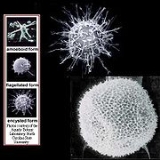
Pfiesteria

Encyclopedia
Pfiesteria is a genus of heterotroph
ic dinoflagellate
s that has been associated with harmful algal blooms and fish kills. Pfiesteria complex organisms (PCOs) were claimed to be responsible for large fish kills in the 1980s and 1990s on the coast of North Carolina
and in tributaries of the Chesapeake Bay
. In reaction to the toxic outbreaks, six states along the US east coast have initiated a monitoring program to allow for rapid response in the case of new outbreaks and to better understand the factors involved in Pfiesteria toxicity
and outbreaks. New molecular detection methods have revealed that Pfiesteria has a worldwide distribution.
researchers JoAnn Burkholder and Ed Noga. The genus was named after Lois Ann Pfiester (1936–1992), a biologist who did much of the early research on dinoflagellates. An in-depth story of the discovery can be found in And the Waters Turned to Blood by Rodney Barker.
" and utilizes a "hit and run
" feeding strategy by releasing a toxin that paralyzes the respiratory systems of susceptible fish, such as menhaden
, thus causing death by suffocation
. It then consumes the tissue sloughed off its dead prey.
Heterotroph
A heterotroph is an organism that cannot fix carbon and uses organic carbon for growth. This contrasts with autotrophs, such as plants and algae, which can use energy from sunlight or inorganic compounds to produce organic compounds such as carbohydrates, fats, and proteins from inorganic carbon...
ic dinoflagellate
Dinoflagellate
The dinoflagellates are a large group of flagellate protists. Most are marine plankton, but they are common in fresh water habitats as well. Their populations are distributed depending on temperature, salinity, or depth...
s that has been associated with harmful algal blooms and fish kills. Pfiesteria complex organisms (PCOs) were claimed to be responsible for large fish kills in the 1980s and 1990s on the coast of North Carolina
North Carolina
North Carolina is a state located in the southeastern United States. The state borders South Carolina and Georgia to the south, Tennessee to the west and Virginia to the north. North Carolina contains 100 counties. Its capital is Raleigh, and its largest city is Charlotte...
and in tributaries of the Chesapeake Bay
Chesapeake Bay
The Chesapeake Bay is the largest estuary in the United States. It lies off the Atlantic Ocean, surrounded by Maryland and Virginia. The Chesapeake Bay's drainage basin covers in the District of Columbia and parts of six states: New York, Pennsylvania, Delaware, Maryland, Virginia, and West...
. In reaction to the toxic outbreaks, six states along the US east coast have initiated a monitoring program to allow for rapid response in the case of new outbreaks and to better understand the factors involved in Pfiesteria toxicity
Toxicity
Toxicity is the degree to which a substance can damage a living or non-living organisms. Toxicity can refer to the effect on a whole organism, such as an animal, bacterium, or plant, as well as the effect on a substructure of the organism, such as a cell or an organ , such as the liver...
and outbreaks. New molecular detection methods have revealed that Pfiesteria has a worldwide distribution.
Discovery and naming
Pfiesteria was discovered in 1988 by North Carolina State UniversityNorth Carolina State University
North Carolina State University at Raleigh is a public, coeducational, extensive research university located in Raleigh, North Carolina, United States. Commonly known as NC State, the university is part of the University of North Carolina system and is a land, sea, and space grant institution...
researchers JoAnn Burkholder and Ed Noga. The genus was named after Lois Ann Pfiester (1936–1992), a biologist who did much of the early research on dinoflagellates. An in-depth story of the discovery can be found in And the Waters Turned to Blood by Rodney Barker.
Feeding strategy
Early research resulted in the hypothesis that Pfiesteria acts as an "ambush predatorAmbush predator
Ambush predators or sit-and-wait predators are carnivorous animals that capture prey by stealth or cunning, not by speed or necessarily by strength. These organisms usually hide motionless and wait for prey to come within striking distance. They are often camouflaged, and may be solitary...
" and utilizes a "hit and run
Hit and run
Hit and run typically refers to:* Hit and run , the crime of failing to stop and identify oneself after a vehicular collision* Hit and run , a baseball play in which runners are in motion before the ball is hit...
" feeding strategy by releasing a toxin that paralyzes the respiratory systems of susceptible fish, such as menhaden
Menhaden
Menhaden, also known as mossbunker, bunker and pogy, are forage fish of the genera Brevoortia and Ethmidium, two genera of marine fish in the family Clupeidae.-Description:...
, thus causing death by suffocation
Suffocation
Suffocation is the process of Asphyxia.Suffocation may also refer to:* Suffocation , an American death metal band* "Suffocation", a song on Morbid Angel's debut album, Altars of Madness...
. It then consumes the tissue sloughed off its dead prey.
Controversy
Pfiesteria biology and the role of PCOs in killing fish and causing health issues in humans have been subject to several controversies and conflicting research results over the last few years.- Life cycle: Early research suggested a complex lifecycle of Pfiesteria piscicidaPfiesteria piscicidaPfiesteria piscicida is a dinoflagellate species of the genus Pfiesteria that some researchers claim is responsible for many harmful algal blooms in the 1980s and 1990s on the coast of North Carolina and Maryland...
, which has become controversial over the past few years due to conflicting research results, especially regarding the question whether toxic amoeboidAmoeboidAmoeboids are single-celled life-forms characterized by an irregular shape."Amoeboid" and "amœba" are often used interchangeably even by biologists, and especially refer to a creature moving by using pseudopodia. Most references to "amoebas" or "amoebae" are to amoeboids in general rather than to...
forms exist or not.
- Toxicity: The hypothesis of Pfiesteria killing fish via releasing a toxinToxinA toxin is a poisonous substance produced within living cells or organisms; man-made substances created by artificial processes are thus excluded...
in the water has been questioned as no toxin could be isolated and no toxicity was observed in some experiments. Toxicity appears to depend on the strains and assays used. In early 2007, a highly unstable toxin produced by the toxic form of Pfiesteria piscicida was identified.
- Skin lesions: The lesions observed on fish presumed killed by Pfiesteria have been attributed to water molds by some researchers. However, it has also been established that Pfiesteria shumwayaePfiesteria shumwayaePseudopfiesteria shumwayae is a heterotrophic dinoflagellate species in the genus Pseudopfiesteria. It was first characterized in North Carolina in 2000. It can acquire the ability for photosynthesis through eating green algae and retaining their chloroplasts...
kills fish by feeding on their skin through micropredationMyzocytosisMyzocytosis is a method of feeding found in some heterotrophic organisms...
.
- Impact on human health: The effects of PCOs on humans have been questioned, leading to the "Pfiesteria hysteria hypothesis." A critical review of this hypothesis in the late 1990s concluded that Pfiesteria-related illness was unlikely to be caused by mass hysteria. This was corroborated by a later evaluation concluding that PCOs can cause human illness. The controversy about the risk of Pfiesteria exposure to human health is still ongoing.
In fiction
- A fictional Pfiesteria species dangerous to humans featured in James Powlik's 1999 environmental thriller Sea ChangeSea Change (Powlik novel)Sea Change is a novel by oceanographer James Powlik published in 1999. It is an environmental thriller about a harmful algal bloom....
. - The fictional species Pfiesteria homicida was one of the antagonists in Frank SchätzingFrank Schätzing' , is a German writer, mostly known for his best-selling science fiction novel The Swarm .- Life :Schätzing was born in Cologne and studied communication studies; he later ran his own company, an advertising agency named INTEVI, in Cologne. Schätzing became a writer in 1990, and penned several...
's 2004 novel The SwarmThe Swarm (novel)The Swarm is a science fiction novel by German author Frank Schätzing. It was first published in Germany and Austria in 2004 and soon became a bestseller.-Plot:...
, planned as a Hollywood movie starring Uma Thurman for release in 2015.