
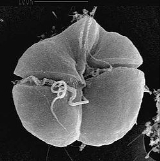
Karenia brevis (formerly known as
GymnodiniumGymnodinium is a genus of dinoflagellates. It is one of the few naked dinoflagellates, or species lacking armor . Since 2000, the species which had been considered to be part of Gymnodinium have been divided into several genera, based on the nature of the apical groove and the biochemistry...
breve and
Ptychodiscus brevis) is a marine
dinoflagellateThe dinoflagellates are a large group of flagellate protists. Most are marine plankton, but they are common in fresh water habitats as well. Their populations are distributed depending on temperature, salinity, or depth. About half of all dinoflagellates are photosynthetic, and these make up the...
common in Gulf of Mexico waters, and is the organism responsible for Florida
red tideRed tide is a common name for a phenomenon more correctly known as an algal bloom , an event in which estuarine, marine, or fresh water algae accumulate rapidly in the water column and results in discoloration of the surface water...
, as well as red tide in
TexasTexas is the second-largest U.S. state in both area and population, and the largest state in the contiguous United States.The name had wide usage among native Americans, meaning "friends" or "allies"...
.
K. brevis is a microscopic, single-celled, photosynthetic organism that can "bloom" (see
algal bloomAn algal bloom is a rapid increase in the population of algae in an aquatic system. Algal blooms may occur in freshwater as well as marine environments. Typically, only one or a small number of phytoplankton species are involved, and some blooms may be recognized by discoloration of the water...
) frequently along Florida coastal waters. Each cell has two flagella that allow it to move through the water in a spinning motion.
Discussion
Ask a question about 'Karenia brevis'
Start a new discussion about 'Karenia brevis'
Answer questions from other users
|
Description
Karenia brevis (formerly known as
GymnodiniumGymnodinium is a genus of dinoflagellates. It is one of the few naked dinoflagellates, or species lacking armor . Since 2000, the species which had been considered to be part of Gymnodinium have been divided into several genera, based on the nature of the apical groove and the biochemistry...
breve and
Ptychodiscus brevis) is a marine
dinoflagellateThe dinoflagellates are a large group of flagellate protists. Most are marine plankton, but they are common in fresh water habitats as well. Their populations are distributed depending on temperature, salinity, or depth. About half of all dinoflagellates are photosynthetic, and these make up the...
common in Gulf of Mexico waters, and is the organism responsible for Florida
red tideRed tide is a common name for a phenomenon more correctly known as an algal bloom , an event in which estuarine, marine, or fresh water algae accumulate rapidly in the water column and results in discoloration of the surface water...
, as well as red tide in
TexasTexas is the second-largest U.S. state in both area and population, and the largest state in the contiguous United States.The name had wide usage among native Americans, meaning "friends" or "allies"...
.
K. brevis is a microscopic, single-celled, photosynthetic organism that can "bloom" (see
algal bloomAn algal bloom is a rapid increase in the population of algae in an aquatic system. Algal blooms may occur in freshwater as well as marine environments. Typically, only one or a small number of phytoplankton species are involved, and some blooms may be recognized by discoloration of the water...
) frequently along Florida coastal waters. Each cell has two flagella that allow it to move through the water in a spinning motion.
K. brevis naturally produces a suite of potent neurotoxins collectively called
brevetoxinBrevetoxin , or brevetoxins, are a suite of cyclic polyether compounds produced naturally by a species of dinoflagellate known as Karenia brevis...
s, which are responsible for large die-offs of marine organisms and seabirds.
K. brevis is unarmored, and does not contain peridinin. Cells are between 20 and 40 um in diameter.
Ecology and Distribution
K. brevis is phototactic and negatively geotactic . Cells are thought to be obligate
photoautotrops . Its swimming speed is ca. 1 m h−1
K. brevis is the causative agent of
Red TideRed tide is a common name for a phenomenon more correctly known as an algal bloom , an event in which estuarine, marine, or fresh water algae accumulate rapidly in the water column and results in discoloration of the surface water...
, which is a condition when
Karenia brevis has grown to very high concentrations and the water can take on a reddish or pinkish coloration. The region around southwest Florida is one of the major hotspots for red tide blooms. Red Tide outbreaks have been known to occur since the Spanish explorers of the 18th century, although nowhere nearly as commonly, or for as lengthy of a duration as now . In Fact some sources say Florida red tide blooms are about 10- to 15-fold more abundant than they were 50 years ago.. Algal species that have harmful effects either on the environment, or on Human Health are commonly known as Harmful Algal Blooms (HABs).
Detection
Traditional methods for the detection of
K. brevis are based on microscopy or pigment analysis. They are time-consuming and typically require a skilled microscopist for identification . Cultivation based identification is extremely difficult and can take several months. A molecular, real-time PCR based, approach for sensitive and accurate detection of
K. brevis cells in marine environments has therefore been developed .
External links